#oneaday Day 762: So, Should You Play Final Fantasy XIII-2?

20120220-012257.jpg

I've been playing Final Fantasy XIII-2 for most of today and am almost at the end. I have reached the final boss, in fact, though haven't beaten it as yet.

You are doubtless wondering whether or not it is worth playing this game, as you may have heard mixed reviews from around the Internet. I therefore present a list of bullet points which you may wish to take into consideration when deciding whether or not you actually want to pick up a copy and try it for yourself. I am going to present each point as neutrally as possible, as some people may react strongly one way or the other to each factor, and those reactions may not coincide with my own feelings!

I'm assuming at least passing familiarity with Final Fantasy XIII here.

  • The main story can be completed in approximately 25-30 hours, making it significantly shorter than a lot of other RPGs in this generation.
  • Following completion of the main story, there is a veritable shitload of stuff to do. Progress in the game is measured through your collection of 160 fragments. At my current point (final boss) I have 62. There is plenty more I can go back and do after the credits have rolled.
  • The main story is somewhat confusing, and all the more so thanks to its non-linear structure. The antagonist's motivations are not made entirely clear until the very end of the game.
  • You play the same two characters all the way through the game. Neither of them have particularly "personal" stories to follow, though there is an underdeveloped narrative thread regarding Noel's memories.
  • There is a squeaky-voiced companion character present throughout the entire game. It is a Moogle, true in every way to past incarnations in the series, right down to ending almost every sentence with "kupo".
  • Final Fantasy XIII's characters all put in at least one guest appearance throughout the course of the game, but only one plays a major role in the story.
  • When you meet Hope, he is older than he was in Final Fantasy XIII and seems to have got over his "issues".
  • The time travel mechanic is more of a location menu. There aren't any particularly clever time manipulation puzzles throughout the course of the game, though there are a few sections where you revisit the same areas in different eras.
  • There are puzzles in certain areas. These take the form of "anomalies" in which you have to complete one of three different types of puzzle — finding a route over a board of tiles which disappear when you step on them while collecting crystals; joining like-coloured crystals with lines to form pictures; and a complex clock-themed puzzle that requires either forward planning or a lot of patience.
  • The game does not hold your hand as much as Final Fantasy XIII-2. This is most apparent around about 15 hours in when you are given a quest to go and find five items throughout time out of a possible seven, and given only vague clues and a picture to help you locate them. Said items are almost invisible in the field, but the Moogle reacts to them when you are close.
  • There is a quest system, where certain characters will exchange a Fragment for completing a small task, which usually takes the form of either a fetch or kill quest. There is no means of visually distinguishing questgivers from just people you can normally talk to, though once you have accepted their quest they get a marker above their head and on the map.
  • Collecting set numbers of fragments rewards you with extra special abilities.
  • Gameplay has a much stronger focus on exploration and observation than Final Fantasy XIII's straight-line corridors.
  • The automap is good and tells you how much of an area you have successfully explored. There is a quest late in the game to 100% as many maps as possible. Areas which you visit in different time periods share map completion percentage.
  • The weapon upgrade system from Final Fantasy XIII is no longer present. Instead, certain new weapons which you purchase require certain components acquired from monsters.
  • The Crystarium level-up system is a little different to Final Fantasy XIII. Both Serah and Noel do "laps" of a single crystal formation rather than having a longer "map" per role. On a lap, they can distribute their levels across any of their available roles. On completion of a lap, they can either unlock another role, enhance the bonus of one of their existing roles or extend their Active Time Battle bar, allowing them to complete more actions in succession.
  • After 25 or so hours, I have maxed out 3 of the 6 possible roles for both Noel and Serah. Progress slows with each lap around the Crystarium, requiring more Crystogenesis Points (acquired by defeating monsters and recovering Fragments) for each level gained.
  • There's a monster collection and training aspect. You can equip up to three monsters at once, each one specialising in a single role. These can then be incorporated into the Paradigm system to create custom party lineups.
  • Monsters are levelled up by feeding them special items rather than spending CP. When a monster completes a lap of its own Crystarium, it starts requiring rarer and/or more expensive items to level up further.
  • Monsters can be renamed by choosing from a large list of preset names, and adorned with decorative items found throughout the game.
  • Content has been withheld for DLC. This is most apparent in the "casino" area, where asking an attendant to explain the card games pops up a window that simply says "reserved for future DLC."
  • The music is very good and features a mix of both brand new tracks and recognisable ones from Final Fantasy XIII.

So there you go. A series of facts about Final Fantasy XIII-2 which may assist you in the decision of whether or not you want to give it a go. For what it's worth, I've been enjoying it more than I thought I would at the bewildering outset, but it's not the strongest Final Fantasy there's ever been, not by a long shot. It is significantly better than Final Fantasy XIII in most respects, however, so those who disliked that may wish to give this one another chance.

I've got a few days to finish this off, and then a copy of The Last Story is on its way to me. Given that that game is made by many members of the old Final Fantasy team (notably Hironobu Sakaguchi and Nobuo Uematsu), I am very interested to see what it offers.
#oneaday Day 761: I Think They Were Lying When They Said "Final"

20120219-015407.jpg

In an about-face from recent activities, I've been playing a relatively mainstream game today in the form of Final Fantasy XIII-2. Despite being a big release, however, one could put forward the argument that the Final Fantasy series is actually becoming somewhat niche again thanks to mixed opinions on the more recent titles.

Said mixed opinions are largely due to the fact that here is a series that is absolutely not afraid to reinvent itself every so often — with varying results.

Up until Final Fantasy IX, you pretty much knew what you were getting — a traditional-style JRPG with random battles. Sure, each one had its own unique ability system, some of which worked better than others (FFV's Job system was a highlight for many, while FFVIII's ridiculously abstract Junction system was both needlessly overcomplicated and far too easy to game) but for the most part, you could rely on the fact that you'd have a lengthy quest involving dungeons, towns, a world map, an airship and eleventy bajillion random battles along the way which, from FFIV onwards, used the series' iconic Active Time Battle system, offering gameplay somewhere between real-time and turn-based.

It was said prior to FFIX's launch, however, that that particular game would be the last "traditional" Final Fantasy title. And in many ways, that game did feel like a farewell to the series, featuring numerous references to all the previous entries in the franchise, a great story, some lovable characters and an utterly bewildering finale. It was also to be the last Final Fantasy to grace the PS1.

Final Fantasy X, the first entry in the series to arrive on the PlayStation 2, shook things up. While it was still fundamentally an RPG with random battles, a lot of elements which people had taken for granted had changed completely. Gone was the traditional experience and levels progression system, replaced with the Sphere Grid, a flexible system that allowed for a degree of character customization — or a lot of character customization if you elected to play in the "Advanced" mode. Also gone was the traditional world map, with the whole game structured as one continuous journey through the world rather than jaunts through key locations punctuated with running across a peculiarly-scaled map screen. Also gone was the Active Time Battle system, replaced by a more cerebral turn-based system in which players could manipulate turn order with the use of certain abilities. It was a neat system, but Active Time Battle returned with Final Fantasy X-2 — itself a departure for the series by being the first ever direct sequel to a previous Final Fantasy game.

Final Fantasy X-2 was great. Some people hated it for the fact that its tone and attitude was so different to that of its predecessor which, despite all its changes, told a pretty good tale, despite having one of the most irritating main characters the franchise has ever seen. Some people hated it for the fact it was as camp as a row of pink tents. Some people didn't even give it a chance after seeing the seriously cheesy intro sequence. But beneath the girlish nonsense lay a deep JRPG with an excellent character development system that combined elements of FFX's Sphere Grid and FFV's Job system.

Then came Final Fantasy XI, which was an MMO. This caused even series mainstays to shy away, and also proved that Square Enix had a lot to learn about making MMOs. It was difficult, progress was painfully slow and its tech was rather janky — due in part to the fact it was a cross-platform release on PC and PS2 (and later Xbox 360). But somehow despite this it was still recognisable as a Final Fantasy on some level — particularly once you started getting into the story missions and boss fights. You'd be forgiven if you skipped this one, however, as it required a time investment that many players aren't able or willing to give. That said, it's still going relatively strong today, meaning there must be something there that people like.

Final Fantasy XII reinvented the series once again, taking a few lessons from Final Fantasy XI and applying them to a single-player game. Ditching the concept of random battles altogether, Final Fantasy XII took place in an open world divided into zones, much like an MMO, and saw combat taking place on the field. There was a far greater focus on exploration and freedom than in any previous Final Fantasy game (except, arguably, the very first one, which pretty much plonked you down in the world and told you to get on with it with nary a hint of coherent plot) and, for the first time in the mainline single player series, the game focused far more on game mechanics than plot. This wasn't a bad thing — it was great fun to play, and the new systems worked brilliantly — but the plot was rather lacking, ending up as a rather poor imitation of Star Wars without the space combat. It just wasn't a very interesting story, which caused it to suffer. This, coupled with the fact that the game was so fundamentally different to what people thought Final Fantasy was — despite the fact it had been continually reinventing itself since X — caused many people to treat it with a degree of caution. The soundtrack was a bit rubbish, too — a big deal in a series that was known for its stirring, memorable music.

And then came Final Fantasy XIII, the first "next-gen" Final Fantasy. Conscious of the fact that some JRPG fans had shied away from the Westernness of XII, XIII took on a much more traditional JRPG structure. It was linear for the most part, it featured battles which took place on a separate screen, it had a levelling system somewhat reminiscent of FFX's Sphere Grid and it had a strong cast of characters participating in a plot best described as "bewildering". It was certainly a spectacle to watch, and remains one of the best-looking games of all time to this day. Unfortunately, its extreme linearity coupled with the fact that it was still throwing tutorial messages at you by the time you were a good 20 hours into it caused many people to, again, respond negatively to it.

Now enter Final Fantasy XIII-2, a game where Square Enix seem to think they've learned from the mistakes of the past. And in some senses they have done — gone is the straight line corridor design of XIII and in are much more open-plan areas which require exploration to discover all their secrets, for example. But in some senses, they've taken a few steps backward, too — the plot, for one, which is complete nonsense, even for a Final Fantasy game. There's a lot of time travel, though it's not until a good while into the game that you start to see this used in an interesting manner with parallel timelines and whatnot. Chrono Trigger it ain't. For the most part, it's used as a bit of a lazy excuse for whatever disastrous event is afflicting the next location you go to — it's always "a paradox", and dealing with it usually involved beating the snot out of some giant monster. 16 hours in and this format is starting to change up a bit, though, so I'm hoping for a bit more variety later in the game. (Yes, obligatory disclaimer here: I haven't finished it yet.)

There's a few technical issues which mar the experience, too. While XIII was criticised somewhat for its relative lack of character interaction, it did at least have properly-directed and blocked scenes for all the important conversations. XIII-2 occasionally takes the lazy way out, with characters standing woodenly in place and flapping their mouths at each other. This wouldn't be so bad were it not for the fact that the character you aren't controlling at the time you initiate the conversation freezes in place when the conversation starts, meaning that if they're in a position where they block the camera, the entire cutscene might be watched through their back. And sure, Serah has a nice bum, but it's nice to see the faces of people you're talking to.

All that said, these considerations don't stop XIII-2 from being an enjoyable game. They stop it from being a truly great, essential purchase game, but they certainly don't stop it from being fun. The battle system is straightforward and satisfying (if a little easy for the most part) and there is certainly plenty to do — and usually plenty of options for things to do at any one time rather than forcing the player down a linear path, too. There's a lot to like and a bit to dislike. If you hated XIII, it's worth a look to see the changes that have been made. If you hate Final Fantasy or JRPGS in general, it's probably not going to change your mind. If you're one of the relatively few people who enjoyed XIII, you'll enjoy the new (if batshit crazy) plot with numerous guest appearances from recognizable characters. And if you passed up playing XIII because of its mixed reviews, you can still get an enjoyable experience out of this thanks to its "Beginner's Primer" feature as well as numerous explicit explanations of past events throughout the course of the game.

Were I to believe in review scores (which I don't, really) I would give it a solid 7. Good, not great. Worth playing, but not essential. Flawed, but enjoyable.

#oneaday Day 760: I Love You, Kana

20120218-012654.jpg

I'm on a bit of a "narrative-based games that challenge the conventions of what is 'normal' and/or 'acceptable' for video games to tackle" kick at the moment, if you can even have a "kick" in such a thing. So it was that I found myself playing Kana Little Sister recently.

"What is Kana Little Sister?" I hear you ask. It's another one of them visual novel type things from Japan, meaning lots of reading, occasional decisions to make, anime-style pictures and, in many (though not all) cases, some naughty pictures. If you want to check it out for yourself, you can acquire a legal copy that works on modern machines right here. Link is pretty much NSFW, just so you know.

It will probably not surprise you to note that there are likely to be spoilers ahead. Consider yourself warned. Spoileriffic stuff is below the break. All discussion here is based on a single playthrough which achieved Ending No. 6, aka "Live Now", aka "Intellectual Ending No. 3", so any and all spoilers will relate to that route only.

Continue reading "#oneaday Day 760: I Love You, Kana"

#oneaday Day 757: SEX!

20120214-231602.jpg

Let's talk about sex. Sex in video games, to be exact.

I read this article over on Eurogamer today. It makes its point in a rather crude manner, noting that video games "can't do sex", going on to cite numerous examples including popular media's backlash against Mass Effect's sex scene and BioWare's subsequent retreat into their characters' underwear; sex-focused games such as 3D Sex Villa 2; Second Life's notorious sex industry (which likely accounts for a considerable proportion of that virtual world's economy) and numerous others.

But I sort of think that the argument in that article is a bit flawed. There seems to be something of a confusion in the distinction between "sexual content" and "porn". I don't think anyone is advocating the inclusion of outright pornography in our games, though this is often the assumption that mainstream media makes when news emerges of sexual content in a high-profile game. But the Eurogamer piece jumps from discussing Mass Effect's soft-focus sideboob to games that are just plain porn. There's no middle ground, it seems.

Or is there? Well, yes, but you have to look outside of the mainstream and outside of the pornographic games industry to find it.

Probably the most common example you'll find of this "middle ground" is in the dating sim/visual novel/eroge genre. I've played a few of these over the years for curiosity's sake and while some are just interactive porn stories (Paradise Heights springs to mind — there are no choices to make and a lot of fucking) others like True Love, Kana Little Sister, Three Sisters' Story and, yes, Katawa Shoujo use their sexuality as something more than just a titillating scene for players to jack off over or something deliberately provocative to attract the ire (and thus inadvertent publicity) of the mainstream media. (This latter interpretation is a cynical view, I know, but I've seen too much video game marketing over the last couple of years to believe it doesn't happen.)

Rather, these games use sexual scenes in context. Katawa Shoujo is perhaps the best example, with sex scenes proving to be a way for us to get to know more about the characters. We learn that Emi is adventurous and willing to try anything once; that Lilly, despite her prim and proper appearance, enjoys her sexuality; that Shizune is dominant in all aspects of her personality; that Misha is confused; that Hanako believes no-one will see her as anything more than a "princess" to be saved; that Rin craves intimacy, to find some way to connect to another person. All of these scenes feature explicit erotic imagery and text, but none descend into being porn — sex for the sake of sex. During the sex scenes with Rin, for example, there's a lot of philosophising about what might be going on inside Rin's confused, creative head. Lilly uses one of her sex scenes to show Hisao what it's like to be blind. Emi's "Anal." scene is endearingly awkward as only teenage sex can be. And Hanako's encounter with Hisao is faintly horrifying after the fact.

"I can't fap to this!" was the war cry thrown up by members of 4chan upon playing Katawa Shoujo, but that's not a bad thing — do you jack off every time there's a sex scene in a movie? No, because that's ridiculous. Sex doesn't equal porn.

The same is true to a lesser extent in True Love, another dating sim based in a high school, though in this instance it's a regular education institute rather than a special school. In True Love, gameplay revolves around managing the protagonist's schedule so he builds up a series of different statistics ranging from creativity to sportsmanship. Different statistics will attract different members of the game's cast, and this then sends you down their various narrative routes where, again, along the way you get to know them a whole lot better and, again, you get to shag them at least once in a scene that, while erotic, is more focused on characterisation than providing something for the player to get their rocks off to.

Three Sisters' Story actively punishes players for being promiscuous, though not until it's far too late to do anything about it. Throughout the course of the game's story, the player gets the opportunity to have sex with the three sisters in question, but also has the opportunity to turn them down, too. If the player elects to have sex with all of them over the course of the game, the story doesn't end well for our protagonist, even after he saves them from abduction. A degree of self-control on the player's part is required in order to get the best ending. Do they want the sexy scene now, or do they want the story to end well?

Moving out of the visual novel genre, Silent Hill is another series which has always used sexual imagery to striking effect. Rather than being outright explicit about it, however, it tends to make use of more abstract imagery, leaving the player to interpret things for themselves. At no point in the game do we see exactly what made Angela so wrong in the head, but we can interpret that it was sexual abuse from her father. At no point in the game does James speak about his resentment over his wife's illness depriving him of sexual gratification, but we can determine that from the appearance and behaviour of Maria, the various times Pyramid Head shows up and the grotesque mannequins who form the bulk of the game's enemies.

You can't fap to Silent Hill, in short.

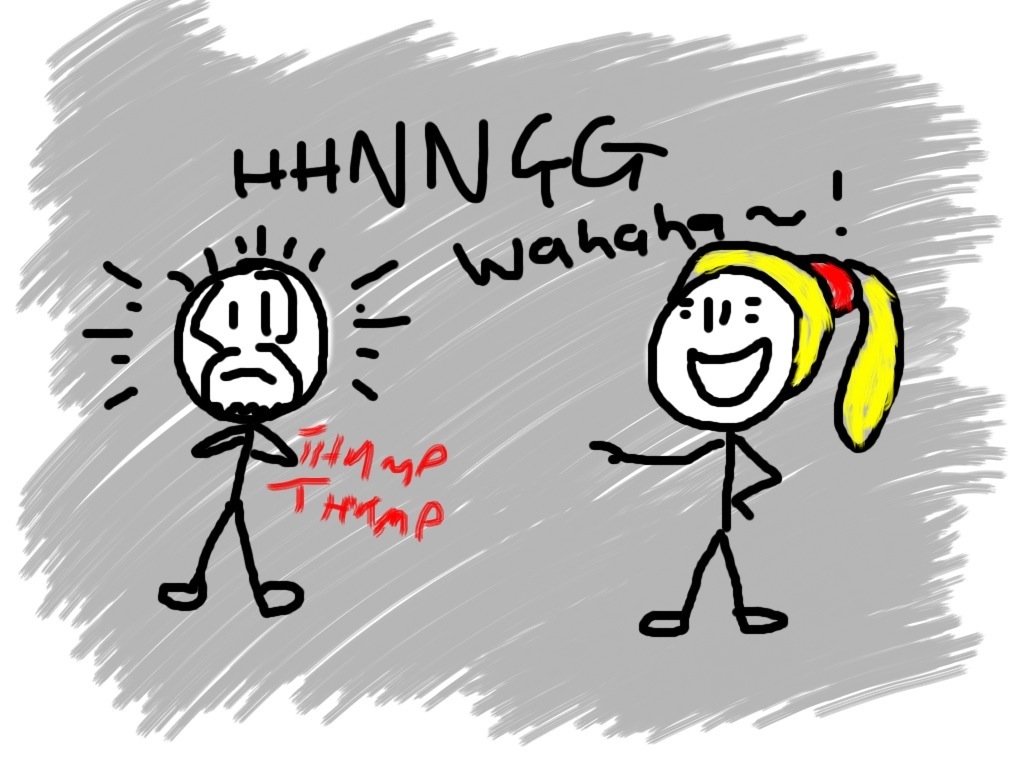
Look at Catherine, too. The game's just come out in the UK so a whole new wave of reviews has been hitting. I was rather surprised to see at least a couple calling it out for not being daring enough with its visuals — i.e. not showing any tits, muff, cock and/or balls. Despite the game's focus on adultery, sexuality and adult relationships, there are no explicit sex scenes in the game, and nothing more than sideboob in the nudity department. But the thing is, there doesn't need to be. Catherine didn't need explicitly pornographic scenes to get across its point. Sex is a key theme in that game, but that doesn't mean we need to stop for a fuck break every so often. Sometimes implying something can be just as powerful as showing it and — God forbid — making it interactive: Heavy Rain's painfully awkward interactive sex scene says "HHNNNGGG" at this juncture.

So can games "do sex"? Why yes, yes they can. Unfortunately, those games which do do sex and do it well tend to be confined to the specialist interest, cult classic or underpromoted independent title department. So why don't we see large publishers taking more risks, producing more adult games with sexual themes and/or content?

Part of it is a marketing issue. Getting too explicit with the sexytime in a game will net a release an "Adults Only" rating from the ESRB, and that's a big no-no for a lot of game retailers, thus hurting physical sales for the publisher. Given the growth of digital downloads, however, at least part of this problem goes away — there's no shame in purchasing an Adults Only title online, and publishers can simply sell it themselves, which is generally a better deal for everyone involved anyway.

Part of it, too, is fear of backlash from the mainstream media and, subsequently, politicians who don't understand the first thing about the industry, assuming it to be toys for children. California had a narrow escape just last year, and it's doubtful that publishers want to take the risk of making the people in charge think that censorship of a creative industry still finding its feet is a good idea.

Do we "need" sex in games? If we want to explore the full gamut of human emotions in the interactive stories that we tell, then yes, we do. We need to get over the assumptions that everyone playing games is too young to be able to handle sexual content. We need to get over childish tittering at every sight of sideboob. We need to have realistic characters who have realistic relationships.

What this doesn't mean, however, is that we need sex in all games. And those games that we do have sex in should justify its inclusion somehow, otherwise we're right back to accusations of peddling porn again. Katawa Shoujo and its ilk are doing it right. Mainstream publishers could learn a lot from the risks that independent studios and those who tackle the development of a game as a creative rather than a technical or marketing project.

Who knows what the future holds? I certainly don't. But it's clear that the industry as a whole still has a lot of growing up to do as yet.

#oneaday Day 755: WHY CAN'T I HOLD ALL THESE FEELS

20120213-001733.jpg

I properly broke down and cried at a video game tonight. That's never, ever happened before. I've had games that have brought a tear to my eye, games that have profoundly affected me emotionally and made me think about them long after I've finished playing them, but I can usually hold back the tears and prevent myself from looking too foolish and/or compromising my hairy, manly exterior.

This was not the case with Freebird Games' To The Moon, an independently-developed, narrative-heavy game created with popular game making software RPG Maker XP, whose final scenes utterly destroyed me. (In a good way.)

To call To The Moon an RPG is to do it a complete injustice, as it's not one, despite appearances, not to mention the software with which it was created. It most closely resembles a point and click adventure with Chrono Trigger-style top-down 16-bitesque visuals, but that, too does the game an injustice. In fact, discussing game mechanics with regard to To The Moon is almost irrelevant — it is a story first and foremost, albeit an interactive one in which you, the player, participate.

I shall try and minimise spoilers in this post, but in order to understand some of the things that are interesting about this game, you at least need to know the basic concept. So here it is.

It's the future. Exactly when is never specified, nor does it matter. What does matter is the existence of a technology which allows for the rewriting of memories. This is used by our heroes of the hour, Drs. Watts and Rosalene, in order to grant the last wishes of the dying — at least, so far as they remember in their final moments. Their patient in To The Moon is an old man named Johnny, who is slowly losing his grip on life. He wants to go to the moon. It sounds like an impossible, inexplicable wish, and much of the story revolves around understanding this desire and attempting to make it come true — at least so far as his memories are concerned. That's all I'll say on the plot.

Unlike the "sit back and read" nature of Katawa Shoujo, To The Moon sees you directly controlling the game's two protagonists. The nature of the game's story, however, sees additional layers being added on top of the traditional "player-protagonist" relationship. Drs. Watts and Rosalene work their way through Johnny's memories largely as invisible, relatively passive observers. Meanwhile, the player is sitting another layer back from these two, observing their reactions to everything that is going on, and reaching their own understanding of the events that are unfolding. It's a really interesting narrative technique, and the doctors' glib comments throughout are a perpetual source of dry amusement in an otherwise fairly serious narrative.

It's not a difficult game to play — there are a few puzzles, but they're relatively incidental — nor is it a long one. But that doesn't matter — the important thing is the story and how it is presented. And somehow, through some sort of magical combination of 2D pixel art and a gorgeous, melancholy soundtrack, To The Moon manages to provide an incredibly intense emotional experience.

If you're anything like me, you may not feel it at the beginning, but by golly you will feel it at the end. If you have taken the time to invest yourself in the setting, characters and narrative, you will likely find it a profoundly powerful experience. You may not find yourself full-on weeping at it as I did, but it would take a hard-hearted soul to be completely unaffected.

It's for experiences like this that I, personally, play games.

#oneaday Day 753: I Love You, Katawa Shoujo

20120211-015059.jpg

This is the sixth (and definitely final… for now) of several posts regarding the notorious amateur-developed visual novel Katawa Shoujo. If you are intending to play this game and would like to avoid spoilers, this post is somewhat less spoilery than the recent character-specific ones, but might still spoil a few bits and pieces. All spoilery discussion is below the break.

If you’re still reading this, it’s highly likely you already know what Katawa Shoujo is but just in case you aren’t and/or you haven’t read the previous posts where I included this exact same paragraph, it’s a visual novel developed by 4 Leaf Studios, made up of members of the much- (and usually justifiably-) maligned 4chan community along with other itinerant creative types from around the Internet. It was developed following extended discussion over a sketch by Japanese doujinshi artist Raita, and is the very definition of a “labour of love”, having come from discussions on 4chan all the way to a full-fledged, professional-quality game between the years of 2007 and 2012. It’s been described by some as “eroge” or an erotic game, but I feel this does it an injustice; there are sexual scenes in the game, yes, but the point of the game is not to get to these scenes — rather, they are part of the plot, and not necessarily a “victory” for the player. They are also not terribly frequent compared to the rest of the game, which focuses on interpersonal interactions and psychological issues.

If you want to check out Katawa Shoujo for yourself, take a peek at the official website. My previous post regarding Emi’s path can be found here, and if you’re too lazy to scroll down, yesterday’s post on Rin can be found here, the previous day's post on Shizune can be found here, the previous previous day’s post on Hanako can be found here, and the day before that’s post on Lilly can be found here. I've now finished the game 100%, so perhaps I'll shut up about it now.

Continue reading "#oneaday Day 753: I Love You, Katawa Shoujo"

#oneaday Day 752: I Love You, Rin

20120210-015401.jpg

This is the fifth (and possibly final… maybe) of several posts regarding the notorious amateur-developed visual novel Katawa Shoujo. If you are intending to play this game and proceed down the “Rin” path and would like to avoid spoilers, I recommend you skip this post. I’ve even put the spoilery discussion below the break. Aren’t I nice?

If you’re still reading this, it’s highly likely you already know what Katawa Shoujo is but just in case you aren’t and/or you haven’t read the previous posts where I included this exact same paragraph, it’s a visual novel developed by 4 Leaf Studios, made up of members of the much- (and usually justifiably-) maligned 4chan community along with other itinerant creative types from around the Internet. It was developed following extended discussion over a sketch by Japanese doujinshi artist Raita, and is the very definition of a “labour of love”, having come from discussions on 4chan all the way to a full-fledged, professional-quality game between the years of 2007 and 2012. It’s been described by some as “eroge” or an erotic game, but I feel this does it an injustice; there are sexual scenes in the game, yes, but the point of the game is not to get to these scenes — rather, they are part of the plot, and not necessarily a “victory” for the player. They are also not terribly frequent compared to the rest of the game, which focuses on interpersonal interactions and psychological issues.

If you want to check out Katawa Shoujo for yourself, take a peek at the official website. My previous post regarding Emi’s path can be found here, and if you’re too lazy to scroll down, yesterday’s post on Shizune can be found here, the previous day's post on Hanako can be found here, and the day before that's post on Lilly can be found here. I'm at 96% completion as of tonight, with only a few scenes and endings left to clear up. In for a penny, in for a pound…

Continue reading "#oneaday Day 752: I Love You, Rin"

#oneaday Day 751: I Love You, Shizune

20120208-154652.jpg

This is the fourth of several posts regarding the notorious amateur-developed visual novel Katawa Shoujo. If you are intending to play this game and proceed down the “Shizune” path and would like to avoid spoilers, I recommend you skip this post. I’ve even put the spoilery discussion below the break. Aren’t I nice?

If you’re still reading this, it’s highly likely you already know what Katawa Shoujo is but just in case you aren’t and/or you haven’t read the previous posts where I included this exact same paragraph, it’s a visual novel developed by 4 Leaf Studios, made up of members of the much- (and usually justifiably-) maligned 4chan community along with other itinerant creative types from around the Internet. It was developed following extended discussion over a sketch by Japanese doujinshi artist Raita, and is the very definition of a “labour of love”, having come from discussions on 4chan all the way to a full-fledged, professional-quality game between the years of 2007 and 2012. It’s been described by some as “eroge” or an erotic game, but I feel this does it an injustice; there are sexual scenes in the game, yes, but the point of the game is not to get to these scenes — rather, they are part of the plot, and not necessarily a “victory” for the player. They are also not terribly frequent compared to the rest of the game, which focuses on interpersonal interactions and psychological issues.

If you want to check out Katawa Shoujo for yourself, take a peek at the official website. My previous post regarding Emi’s path can be found here, and if you’re too lazy to scroll down, yesterday’s post on Hanako can be found here, and the previous day's post on Lilly can be found here. Following this, there's only Rin left to go.

Continue reading "#oneaday Day 751: I Love You, Shizune"

#oneaday Day 750: I Love You, Hanako

20120207-172300.jpg

This is the third of several posts regarding the notorious amateur-developed visual novel Katawa Shoujo. If you are intending to play this game and proceed down the “Hanako” path and would like to avoid spoilers, I recommend you skip this post. I’ve even put the spoilery discussion below the break. Aren’t I nice?

If you’re still reading this, it’s highly likely you already know what Katawa Shoujo is but just in case you aren’t and/or you haven't read the previous posts where I included this exact same paragraph, it’s a visual novel developed by 4 Leaf Studios, made up of members of the much- (and usually justifiably-) maligned 4chan community along with other itinerant creative types from around the Internet. It was developed following extended discussion over a sketch by Japanese doujinshi artist Raita, and is the very definition of a “labour of love”, having come from discussions on 4chan all the way to a full-fledged, professional-quality game between the years of 2007 and 2012. It’s been described by some as “eroge” or an erotic game, but I feel this does it an injustice; there are sexual scenes in the game, yes, but the point of the game is not to get to these scenes — rather, they are part of the plot, and not necessarily a “victory” for the player. They are also not terribly frequent compared to the rest of the game, which focuses on interpersonal interactions and psychological issues.

If you want to check out Katawa Shoujo for yourself, take a peek at the official website. My previous post regarding Emi’s path can be found here, and if you're too lazy to scroll down, yesterday's post on Lilly can be found here.

Continue reading "#oneaday Day 750: I Love You, Hanako"

#oneaday Day 749: I Love You, Lilly

20120206-150446.jpg

This is the second of several posts regarding the notorious amateur-developed visual novel Katawa Shoujo. If you are intending to play this game and proceed down the “Lilly” path and would like to avoid spoilers, I recommend you skip this post. I’ve even put the spoilery discussion below the break. Aren’t I nice?

If you’re still reading this, it’s highly likely you already know what Katawa Shoujo is but just in case you aren’t, it’s a visual novel developed by 4 Leaf Studios, made up of members of the much- (and usually justifiably-) maligned 4chan community along with other itinerant creative types from around the Internet. It was developed following extended discussion over a sketch by Japanese doujinshi artist Raita, and is the very definition of a “labour of love”, having come from discussions on 4chan all the way to a full-fledged, professional-quality game between the years of 2007 and 2012. It’s been described by some as “eroge” or an erotic game, but I feel this does it an injustice; there are sexual scenes in the game, yes, but the point of the game is not to get to these scenes — rather, they are part of the plot, and not necessarily a “victory” for the player. They are also not terribly frequent compared to the rest of the game, which focuses on interpersonal interactions and psychological issues.

If you want to check out Katawa Shoujo for yourself, take a peek at the official website. My previous post regarding Emi's path can be found here.

Continue reading "#oneaday Day 749: I Love You, Lilly"