2276: Video Computer System

0276_001

As I wrote in a few posts recently, I've been checking out the new Atari Vault compilation on Steam. Rather than talking about a specific game today, I wanted to talk a little bit about the value of the compilation as a whole, and why I'm enjoying exploring it.

Atari Vault is a compilation of somewhere in the region of 100 Atari games from the '80s. The bulk of the compilation consists of VCS 2600 games, but there are some arcade games in there too, including the likes of Crystal Castles, Missile Command, Major Havoc and Liberator.

I've owned a number of previous similar compilations in the past, and have typically gravitated towards the arcade games, since they seem more "palatable" from a modern perspective than the extremely primitive-looking 2600 games. I recall growing up with the Atari 8-bit home computers, and in comparison to those, 2600 games looked primitive even back at that time when it was relatively current, and as such, I've always found them a little offputting. I've made a specific effort to explore them a bit more this time around, though, and I've been pleased to discover some really interesting games.

Take Haunted House, for example. This is a fairly straightforward top-down "find all the things" game with an intriguing twist: you're in the dark. With your character represented as nothing more than a pair of eyes, you navigate around by either bumping into walls or lighting matches to illuminate the area immediately around you. A single game of Haunted House requires that you find all the pieces of a… thing… an urn? And you have to do so while using as few matches as possible and losing as few lives as possible, for this being a haunted house, it has a number of unpleasant beasties lurking around just waiting to nibble on you.

Or take Save Mary, a prototype game that never saw commercial release, but which presented an interesting twist on vaguely Tetris-ish block puzzles. The eponymous Mary is trapped at the bottom of a pit which is slowly filling with water. You control a crane and have to drop blocks into the well for Mary to climb up. You need to get her high enough to be able to grab her with the crane and save her. Once you've done this, you have to do it again, only with significantly more awkward-shaped blocks. The peculiar variation on the typical block puzzle formula is the fact that Mary has a mind of her own (albeit a predictable one) and you have to be careful not to squish her with the blocks you drop as she wanders back and forth trying to get to high ground.

Or how about Atari Video Cube, a really simple but surprisingly compelling puzzle game loosely based on Rubik's Cube? Controlling a weird little man (who has a name and a backstory and everything, though I can't remember it offhand), it's your job to pick up coloured squares from each of the 3×3 faces of the cube and lay them down so that each side is a solid colour. To make this more difficult, to pick up a coloured tile, you have to swap it with the one you're holding, and to make it even more difficult, you can't walk through tiles that are the same colour as the tile you're holding, even if they're on a different face of the cube.

The 2600 back catalogue appears to be filled with these sorts of interesting little games that we'd probably find laughable if released as full-scale, full-price commercial releases today, but as part of this compilation, they provide a surprising amount of entertainment value — and, in some cases, represent types of games that are very much deserving of a modern remake.

My only issue with them from a modern viewpoint is the fact that 2600 games tend to end rather abruptly, regardless of whether you "win" or "lose", and this can sometimes make victories over a particularly difficult level feel a bit less than satisfying. Still, this was from an age where gaming was quite a social pursuit — many of the 2600 games are very much designed to be played together with a partner — and so, I feel, a key part of the fun back then must have been making your own fun with the games to a certain extent; similar to how a tabletop game doesn't automatically set off fireworks as soon as you win, neither does a 2600 game. The celebrations and victory rewards are entirely up to you; I recommend betting each other a slice of pizza or a big lump of cake on a game of Combat and see how much you like each other by the end of the evening!

2275: A Need for Progression

0275_001

Playing some Dungeon Travelers 2 this evening, I found myself pondering exactly why I have, so far, spent 130 hours on this game — the longest I've ever spent on a single-player RPG, I believe — while a short time back, I decided that I really needed to take a break from Final Fantasy XIV, which was previously something of a life and free time-devourer.

On reflection, it comes down to a need for progression; more specifically, a need for a near-constant feeling of progression.

Herein lies the main reason I've set Final Fantasy XIV aside for the time being, and it's by no means an issue exclusive to that game, either — it's a genre-wide thing with all MMOs. And that issue is that once you reach "endgame" level — i.e. you hit the level cap, and progression becomes about acquiring better gear and taking on tougher challenges rather than earning experience points and levelling up — progression stops being constant and instead comes in fits and starts, in extreme cases, with instances of actually improving coming weeks apart from one another.

To put this in some sort of context for those who are unfamiliar with MMO endgames: you have several means of acquiring new gear at the level cap in Final Fantasy XIV. You can loot it from dungeons, which is based on random drops. You can acquire it from the raid dungeon Alexander, but this requires strategically acquiring items from its various floors, because you are limited in what you can acquire each week and different bits of gear require different numbers of items. You can acquire it using Tomestones of Esoterics, which have no limit on how many you can acquire per week. You can acquire it using Tomestones of Lore, of which you're limited to collecting 450 per week. You can take on the lengthy Anima Weapon quest. Or you can acquire it by running the top-tier challenging stuff such as the latest Extreme primal fights or Alexander on Savage difficulty.

Part of the issue here, I guess, is that everyone generally wants to go for the biggest upgrade possible at any given time, and it's these bigger upgrades that you're somehow limited in, meaning progress is artificially constrained. In order to earn a piece of body armour using Tomestones of Lore, for example, which is among the best equipment in the game right now, you need at least two weeks to earn the 825 or so Tomestones required, since you're capped at 450. In that intervening period, all you're doing is grinding for no discernible gain: the actual gain comes only when you've finished the process and you get your shiny new armour. (And then moan about it not having the stats you want, probably.)

Now, this sort of design is a key part of how MMOs generally keep people engaged over a long period — if everyone could get the best possible gear immediately, they'd complain about having "not enough content" more than they do already (which is a lot), and that is obviously undesirable for the development team, who are put under pressure to put out more content more quickly, which inevitably leads to quality suffering. Instead, these moments of progression are significant, but time-consuming: they have a noticeable impact on your character's abilities, but only after a long period of doing the same things over and over again until you've earned enough whatevers to get your doohickey.

That sort of treadmill progression had started to become a little less enjoyable to me than it had been, particularly as the current endgame of Final Fantasy XIV now has a number of different grindathons required to get the best possible gear. And so I put it down for now and instead focused on Dungeon Travelers 2's postgame (actually bigger than the main game) which is also a grindfest, but which is considerably more appealing to me right now for that feeling of constant rather than sporadic progression.

Progression in Dungeon Travelers 2 comes in several forms. The most obvious is in the earning of experience points and levelling up: finishing the main story will get you to about level 50, but the postgame will take you to the cap of 99 by its conclusion. This means that rather than hitting a level cap early and progression slowing by very nature of one of its sources being cut off, there's the constant satisfaction of earning experience points right up until the end of the game. And if you're still hungry for more, a "Level Reset" system allows you to discard those hard-earned levels in favour of some bonuses to the character's base stats if they had reached a high enough level, meaning you can level them up all over again and they'll be marginally better.

That's not the only means of progression, though. Gear is another important aspect of progression in Dungeon Travelers 2, much like other dungeon crawlers. The gear system is very interesting, in fact, since it's based around just a few base items, and then built upon with an enchantment system. What happens is you have a piece of base gear (say, a piece of leather armour) which has a bonus value attached to it (say, +5). The bonus indicates how much better than its base incarnation it is, and the value can keep going up and up and up. In order to make it go up, you have to enchant your gear using the Sealbooks you acquire by defeating sets of 9 of each monster in the game. Each of these Sealbooks has a level, and when you use it to enchant a piece of gear, two things happen: the bonus goes up by the tens value of the Sealbook's level (up to a maximum of 5 for books of level 50 and above) and one or more of the Sealbook's special effects (ranging from bonuses to stats to special effects such as regenerating health and TP each turn) is attached to the piece of gear.

Here's an example. I have a set of Leather Armour+40. I run across the wandering blacksmith in a dungeon, who allows you to enchant your gear. I use a level 50 Sealbook to enchant the armour, which increases its bonus to +45 and attaches a DEF Up and Elemental Resistance Up effect to it, making it considerably more defensive than before. Then I use another level 50 Sealbook of the same type to boost it to +50 and keep the same enchantments. Then I use a different Sealbook of a level higher than 50 (to increase the bonus, the Sealbook must be of a higher level than the bonus' current value) to boost it to +55 and add a Max HP Up effect to my existing DEF Up and Elemental Resistance Up effect, since equipment over +50 can have three, not two, effects attached to it. By this point, I've run out of money for the moment, so I take my leave of the bear blacksmith (yes, really) and proceed on my way, secure in the knowledge that I could upgrade that armour twice more before it becomes "capped" and I'd have to start looking for a stronger base item to progress further gear-wise.

These two systems intertwine so that you're always making one form of progress or the other. Levelling is quite slow in Dungeon Travelers 2 compared to more conventional JRPGs, but it has a noticeable impact, particularly on your characters' maximum HP. In the meantime, you can partly plug the gap for an underleveled character by giving them gear with huge bonuses — there's no level restrictions on equipping items — but you'll need to level them to ensure their survival and their usefulness in most cases.

But that's not all, either. The third means of progression in Dungeon Travelers 2 is simply getting further through the dungeons. Every expedition, you'll manage to get a bit further, perhaps even unlocking a shortcut allowing you to get to the new stuff more quickly next time you head in. Perhaps you'll beat a boss. Perhaps you'll find a nice piece of treasure. Perhaps you'll run into an area that has different enemies to the start of the dungeon. Point is, there's always something to discover, and while you're still wandering around grid-based mazes, swearing at one-way doors and teleporters and fighting battle after battle, at no point are you doing exactly the same thing over and over. You're not running the same dungeon time after time; you're discovering new parts of these sprawling mazes. You're not fighting the same bosses; you're taking on progressively more difficult challenges. And yes, you are grinding, but you're not doing so on a treadmill: you're always moving forwards.

This, I've come to the conclusion, is important to me, and it's why I'm not feeling the MMO thing right now. It's also why I've repeatedly bounced off the Souls series, despite trying to like them several times: those games are so heavily based on learning through repetition that I quickly get frustrated with the lack of forward momentum and tend to put them down after being smacked off a cliff by an armoured douchebag with a hammer for the umpteenth time, only to get smacked off a different cliff by a different armoured douchebag with a hammer on the way to reclaim my hard-earned souls and effectively undo the potential for progression I had before the unfortunate incident.

Nah. Give me a constant feeling of moving forward; that's what I really crave from my RPGs these days. And Dungeon Travelers 2 is very much scratching that particular itch right now.

2274: Holding Back the Night(s) of Azure

0274_001

The more I play Nights of Azure, Gust's latest game, the more I like it.

It's a slow burn, though, I must admit; although the setup and premise is intriguing, mechanically it feels a little obtuse to begin with — or perhaps I'm just overthinking it and trying to play it like a conventional grind-heavy RPG, which it emphatically isn't.

There are a whole bunch of unconventional aspects to the game, most notably its progression system. The level cap is just 11, for one thing, and unusually, the protagonist's level progression isn't a case of grinding for experience; rather, you collect "Blood" from fallen enemies, and then make use of this in increasingly large quantities to gain a level. Levelling up increases your base stats, unlocks new skills to purchase using the four different types of skill points, and sometimes gives you access to new weapons or abilities.

However, there's a more noteworthy aspect to levelling up, which is that it gives you access to a story scene between the protagonist Arnice and the "Maiden of Jorth", a mysterious young woman who looks awfully like Arnice's ladyfriend Lilysse and hangs out in a dream world. During these scenes, you generally have the option to either find out a bit more about the background lore of the world or a bit more about the relationship between Arnice and Lilysse.

It's interesting to see level progression and narrative progression intertwined so closely, as this isn't something that happens very often. In fact, outside of level-locked quests in MMOs, the last time I remember it happening in a single-player RPG is The Granstream Saga on PlayStation 1, though this came at it from the other angle in that you levelled up at predefined moments in the story rather than levelling up triggering story scenes.

There's a more conventional levelling system in there too in the form of the "Servans" system that forms the main basis for the battle mechanics. During the game's action sequences, Arnice can take one or more "decks" of Servans with her, and summon them in exchange for her SP. She can have up to four Servans out at once, and each of them have a combination of passive, automatically activated and manually activated "Burst" abilities. They all act independently of Arnice; while you can give them some rudimentary orders such as "Follow me" and "Attack my target", they mostly do their own thing according to their personality — some loyally attack your target without question; others hang back and attack if they feel like it; others still don't like fighting at all and would rather dig up items for you.

There was the potential for the lack of direct control of the Servans to be enormously frustrating, but it seems to work pretty well. Arnice isn't an especially strong combatant by herself, but wading into the melee yourself generally sends a clear message to your Servans as to which enemies you want to focus on. And the more you use them, the more they level up; after an action scene, they gain experience points in a more "normal RPG" style, levelling up and unlocking abilities of their own.

Each of the Servans seems to have a very different use; I have what feels like a good party right now, but I'm sure it won't be ideal for every situation. Of particular note in this system is the fact that each Servan has a coloured affinity, and the combination of affinities in your deck (or, rather, which affinity has a clear majority) determines what weird and wonderful demonic form Arnice can transform into after charging up through battle. These demon forms are enormously powerful in various ways — some hit hard, some are very fast, some can take a beating. They're particularly useful when it comes to the bosses in the game, which are interesting, challenging battles that demand successful juggling of Arnice's attacks, your Servans' attacks, positioning and well-timed transformations.

I don't feel I quite have my head around all the mechanics in Nights of Azure just yet, but I'm enjoying it a lot. The story and characters are compelling, and the game doesn't waste a lot of time with endless dialogue sequences; it's pretty pacy, moving from one episode to the next in short order, and the action sequences are cut into short, 5-15 minute chunks, making it an easy game to dip into.

There's a whole bunch of interesting stuff going on in this game, in other words, and I feel it's probably a strong contender to spend a month on over at MoeGamer in the near future. So I think I'd probably better start taking notes!

2273: One an Hour

0273_001

(11:23) Today I am going to write one sentence each hour.

(12:35) It's going well so far; I've remembered to follow up the first sentence with this one.

(13:26) Could do with a poo; not currently in an ideal situation to do so.

(14:22) Still need a poo, but I will survive, dammit; I will survive!

(15:07) Semicolons sure are useful for exercises like this; they effectively allow me to cheat the system and write more than one sentence at once.

(16:15). Lacerated my thumb on a security box; now both of my thumbs have been mangled by retail work.

(17:31) I'm having a poo; at last, sweet relief, and after this I'm going to go and play some old Atari games before dinner thanks to the excellent compilation Atari Vault.

(18:58) Ooh, nearly forgot to write something this hour; got in there with two minutes to spare.

(19:53) Gave the Prison Break heist in Grand Theft Auto Online another go; we still can't nail that last part, though this time our failure was more due to the game glitching than actual incompetence for once.

(23:05) GOD FUCKING DAMMIT.

See, I could have been dishonest there and just made up sentences for the hours I forgot about, but my integrity means too much to pull the wool over your eyes in such a manner, dear reader.

Oh well, it was fun while it lasted; certainly made working on a Sunday a smidgen more palatable. I have tomorrow off, which is nice; I do like a nice midweek day off, although I only have one before it's back to work for three days. I shouldn't complain, I guess; it's money, and the place where I work so far appears to be inoffensive enough for the time being.

Tomorrow will be spent sleeping, completing some freelance work assignments and playing lots of video games, in that order. The remainder of this evening will be spent playing video games, too.

2272: Mistakes Happen

0272_001

One thing I've learned about myself over the last few years is that I learn most effectively by making mistakes. Once I make a mistake once, I tend not to make it again.

This is quite an effective means of learning, which is why the expression "learn from your mistakes" is a thing, presumably, but in my case I think it comes from the very real fear of being wrong, of doing something wrong, of being judged incompetent at something — even something I know deep down that I'm perfectly competent at.

Impostor syndrome is a very real thing, and I know quite a few people who suffer from it — including myself. It's the constant and occasionally paralysing fear that you won't be able to do something, or that you've found your way into a situation that you don't "belong" in, and that you'll be "found out" by someone at some point, then punished in some way for being somewhere you don't "belong".

I've felt impostor syndrome a whole lot over the years. I felt it in teaching, even though I regularly got positive feedback on my lessons — feeling like I didn't "belong" wasn't helped by the fact that I'm simply not an assertive enough person to control a room full of 30 teenagers, of course. I felt it in games journalism, where I always felt like I was enormously lucky to have the positions I did have — again, even when I received positive feedback on the efficiency, accuracy and engaging…ness of my work. And I've felt it in the retail positions I've held, being hesitant to perform certain duties for fear of doing them "wrong" and fucking things up for other people.

I think that latter point is the most important part for my brain: it's not necessarily a fear of failure that gives me difficulty, but more a fear that I'll do something wrong that affects someone else in a negative way, and that they will, consequently, be upset, annoyed or angry at me as a result. In my experience, it's actually pretty rare for someone to get upset, annoyed or angry at me as the result of a mistake I've made — probably because most of the mistakes I've made over the years have actually been pretty minor and, for normal people, nothing to worry about whatsoever.

That's the thing, though; part of this whole sense of anxiety is feeling like any mistake is the worst thing ever, and that it will be a permanent stain on your record for all eternity. You'll always be "the guy who messed up that one time". You only have one chance to prove yourself, and if you blow it, your days are numbered.

I know that these things aren't true, of course, and becoming very much aware of the fact that I do clearly learn from making mistakes is making me feel a bit more positive about the whole thing. Most of the mistakes I make in my day-to-day life are as a result of not knowing something rather than any actual incompetence, and so it doesn't serve any particularly useful purpose to dwell on them or feel bad: if they're the result of not knowing something, then a good means of not making that mistake again (and, by extension, feeling bad about making a mistake) is to find out the thing I don't know and remember it. And because there's such a strong incentive at stake, I tend to really remember those things I learn in this way.

It may not be a particularly ideal way of doing things — in an ideal world, no-one would make any mistakes whatsoever and everything would be the very picture of perfection and efficiency — but it works for me. And besides, an ideal world sounds kinda boring, doesn't it? Because there can be a funny side to mistakes, too, and the other thing I'm starting to realise and accept is that it's all right to laugh at mistakes both you and others make — in fact, it's important to, because laughter can help defuse negative feelings and show that really, in the grand scheme of things, the mistake itself doesn't matter all that much to anyone involved.

Tomorrow I will probably make some more mistakes. Tomorrow I will probably learn some new things. By the end of tomorrow, perhaps I will be a slightly better person.

2271: Pledging for Positivity

0271_001

A short, somewhat belated entry today, as last night was… not good, to say the least.

I've been thinking. Partly following a discussion with my friend Chris after my post from the other day, and partly after watching this video from TotalBiscuit:

Negativity isn't getting anyone anywhere. Negativity is not effecting social change for those who believe in such things, and negativity is not going to change the mind of people who have their minds stubbornly made up about the things they believe.

As such, here and now, I'm going to make a pledge for positivity — and not for the first time — and try my very best to stick to it, for my own sanity if anything else.

I don't like getting angry and upset about things; it puts me in a bad mood and often ruins my day. It might make me feel good that I'm expressing my frustration at a situation, but ultimately all a good rage achieves is letting other people who already share my views know that they're not alone, while failing to change the mind of those who are stubbornly entrenched in their own ideology. And while the former aspect of that can be valuable, the latter is completely unhelpful.

So I'm going to stick to the positive things — at least, I'm going to try to. I'm going to celebrate the things I love, and do my best to explain why I love the things I love.

I've actually already made a bit of a start on this over on my other site MoeGamer, with two articles so far on Senran Kagura Estival Versus: one introducing the game, and a second exploring its historical context and game mechanics. Over the course of the rest of the month, I'm going to write about its narrative, characterisation and aesthetics, too, so watch out for those.

I need good things in my life right now. And that means consciously trying to avoid that which makes me miserable.

2270: HunieCam Studio: A Few Tips

0270_001

Have you been playing HunieCam Studio? If not, you should; it's great.

If you have, you've probably discovered that it's quite challenging, at least for your first few playthroughs. Here, then, are a few tips that I've figured out in my first three playthroughs, the last of which resulted in a lovely gold dick trophy.

The first few days on the job

While your overall goal in HunieCam Studio is to have as many fans as possible by the end of the 21st day, don't sweat fans at all to begin with, since you only have one girl and you need money.

It doesn't really matter which of the three starter girls you pick, since they all have identical stats and none of them are addicted to drink or cigarettes. Choose whoever you like the most, though take note of the fetishes they cater to, as these will be more important later in the game.

Immediately send your starter girl to do a few cam shows one after the other. This will give you enough money to spend on a few upgrades. You'll want to prioritise both the staffing upgrade that increases the number of girls you can hire, and the inventory upgrade that allows girls to carry accessories.

Once you've upgraded your staffing, send your girl to the model agency to find some hot new talent. Pick someone who won't break the bank with her hourly rate, because you don't have a lot of income yet. Once you've got your second girl up and running, you can start branching out a bit.

Getting into the rhythm

Now you can start building your fanbase a bit. Remember that when a girl does a photoshoot, she gains fans of some or all of the fetishes she caters to, so it's actually quite helpful to hire girls with overlapping fetishes. You can force overlaps with the accessories that unlock new fetishes, too; if every girl has a butt plug, for example, they'll all earn fans of Anal when they do a photoshoot, which will give you a fanbase that will apply to all of them when they do a cam show — which means more money.

Consider upgrading one of your girls' abilities with the strip club and the shopping mall, but keep a steady flow of income coming in; remember that you have to pay your girls by midnight every day, and if you get into debt and don't get back out again by midnight of the next day, the game is over! Don't over-upgrade, either, since your money will still be fairly limited until you have more girls with better skills.

Thrusting forwards

From your third girl onwards, don't be afraid to hire a drinker or a smoker, though perhaps steer clear of those who are heavily addicted. Drinkers and/or smokers build up stress more slowly so long as they have a supply of their particular vice(s), so they can perform more actions before you need to send them to the Day Spa to recover.

Once you do hire a drinker and/or a smoker, be sure to either use one of your unupgraded starter girls — or, if you've upgraded them both, a new hire with skills at the base level to save costs — to become your errand girl, doing nothing but running to the shops to get drink and cigarettes. You can make her considerably more efficient by acquiring a Shopping Basket from the Adult Shop, which doubles the yield of both shops, and you can make her even more efficient by dosing her up with coke each day, which makes her complete her activities at double speed. If you find yourself with a considerable surplus of drink and cigarettes, use the opportunity to send her to the Adult Shop whenever you can, as accessories are always useful. Grab condoms and antibiotics when you see them, as these are handy during financial emergencies.

Oh, God, yes

One of the most useful accessories is the Subscribe pillow. This allows a girl to earn fans when she does a cam show — it's not quite as quick as when she does a photoshoot, but it gives you a trickle of fan income, which will gradually increase your financial income and final score, too. Equip all your main camgirls with the best skills with one as soon as possible, and fill their remaining inventory slots with fetish accessories, as these increase the amount of fans they earn as well as allow them to cater to specific fetishes.

As you progress, don't forget about upgrades, particularly those that allow you to collect more money and fans with each click on the cam and photo studios. Time you're spending collecting resources is time you're not spending micromanaging your army of sex workers, so being able to collect it more efficiently is a godsend. Also be sure to invest in at least a couple of levels of the Automation upgrade, since this allows you to passively collect resources even when you're doing other things.

Uhhhhuhhhhggghhhhnnnngh

Money troubles? No worries. Whore out your girls at the Sleazy Motel and you'll earn all the money they'd earn from a camshow in a fraction of the time. There is, however, the risk of them catching an STD from this, and STDs range from mildly inconvenient and curable to completely incapacitating and incurable. If a girl gets AIDS, immediately hire another one to take her place, since AIDS victims are unable to do anything.

To prevent STDs, give the girl you're sending to the Motel — your highest earner, obviously — a condom, and you won't have to worry. If the worst does happen, however, dose her up with antibiotics and she'll be better in three days. Alternatively, you can give her a shot of steroids to negate the effects of the STD temporarily, though this is not an ideal solution.

Aaaaaahhh

Once you've got a good lineup of well-skilled girls and you're making good money, make sure you start investing in advertising, since this simply allows you to exchange money for fans. If your cashflow is a little limited, prioritise the ads that cater to fetishes you have on staff, since this will make those girls more profitable. If money is no object, buy all the ads you can, and upgrade your advertising to be able to purchase more — and better — ads each day. Note that this upgrade isn't retroactive, though; it takes effect from the following day, so it's useless if you forget about it until day 21.

Also, it is very much worth your while to upgrade your web hosting and photo equipment, as these significantly increase the cash you get from camshows and the fans you get from photoshoots respectively. They're expensive upgrades, but they pay for themselves before long.

Finishing off

In your last few days, ditch any "useful" accessories you've been using such as the Piggy Bank, Nicotine Patch or Wine Box, and make sure each girl has three fetish-catering items, increasing her fan yield. Rotate your girls between camming and photoshooting to keep both money and fans coming in, and be sure to buy ads each day. Keep your errand girl active, too; if you don't need drink and cigarettes, keep her shopping at the Adult Shop for condoms and antibiotics.

Most importantly for the whole game, make sure no girl is wasting time: everyone should always be doing something, even if that something is just resting at the Day Spa. If a girl finishes an activity and you're in the middle of collecting a resource, stop and assign her to something new before you resume collection, otherwise she's dead weight for those few moments, and if you want a huge fan count and that big, spunking platinum dick trophy, every second counts.

2269: Video Games (Might Have) Saved My Life

0269_001

I thought about writing about this yesterday, but didn't; I was feeling rather emotional about it and thus figured it probably wasn't the best idea to spew out an ill-considered rant on such a sensitive subject. It's still a delicate subject, of course, but I feel a bit more mentally prepared to tackle it and attempt to do it justice today.

This will doubtless be difficult to write, so bear with me while I inevitably ramble around the point. It will probably also be quite difficult to read, particularly if you know me quite well… but, again, bear with me — hopefully you'll come away with a better understanding of some of the things I feel.

All right, preamble over: let's begin.

Yesterday, when I first thought about writing this piece, I was angry. I got suddenly very angry about something I've been angry about before, and have been doing my best to not be as bothered by: the ongoing "culture war" that has all but destroyed rational, reasonable discussion of popular media — particularly gaming — through public social channels such as Twitter, as well as all but destroying any credibility, inclusiveness and, in many cases, entertainment value the mainstream video games press had.

It wasn't really a specific event that made me feel angry; it was more a buildup of tension that just needed to be released. Recent controversies over the new Baldur's Gate expansion, the press and "social justice" types outright lying about why people didn't like it, needless outrage over Tracer's butt in Blizzard's Overwatch, the ever-present undercurrent of the morally superior looking down on people who are into video games and branding them misogynistic, homophobic, transphobic, cis white heterosexual male scum… all of it was getting on top of me, even though a lot of it didn't even directly concern me and the games I'm into. But the controversies still resonated with me, since I've also seen very similar nonsense aimed at the games I am into.

When I get angry about something, after the fact I often like to take a moment to reflect on exactly why I got so angry — why is that thing in particular so important to me that it had such a powerful emotional effect on me? Video games are dumb timewasters, aren't they? Why should I care so much what some people I'd never want to hang out with at parties (not that I want to hang out with anyone at parties save for people who want to join me in another room and play computer games all night) think of the things I enjoy? Why do I feel compelled to continually defend my hobby and this medium from people who desire nothing more than to tear it down and remake it in the way they think it should be — because make no mistake, the loudest critics like this aren't after true "diversity" or "inclusion" since they, in many cases, simply cannot accept the existence of material they deem "problematic", nor can they understand that some people enjoy said "problematic" material and don't want to be called sex pests/paedophiles/misogynists/assholes simply for the things they happen to be into. Why?

Well, "video games are important to me" is the simple answer. And I could leave it at that. But I'm not going to: I'm going to explain exactly why video games are important to me.

Growing up, I was a bit of an outcast. I was shy, I lacked confidence, I didn't know how to talk to people. I remember on my first day at secondary school I turned to Matthew, one of my few friends from primary school and, with genuine fear in my eyes, whispered to him that I "couldn't remember how to make friends", which was putting me at something of a conversational impasse with Murray, the boy I had been sat next to in our tutor room. (Murray turned out to be a massive bullying twat, whom I finally punched in the face just as the headmaster was walking around the corner one memorable lunchtime; I escaped truly serious punishment on the grounds that he most certainly had had it coming for a very long time indeed.)

Growing up, I wasn't into sports. I was into stuff that other people weren't into. I played the piano. I played computer games. I wrote stories. (All of these are things I still do.) These were things that I learned I enjoyed at a very young age, so I have clung onto them with all my might for my whole life — and I've always known when someone would turn out to be a true friend, because they'd be into at least one of those things, and preferably more than one of them. Indeed, when I did eventually successfully remember how to make friends at secondary school, the group of friends I surrounded myself with were all a little like me to varying degrees — I was by far the most awkward and nerdy of them, but we all had our shared interest in video games which we felt like other people didn't really get the appeal of.

When the time came for me to go to university, I was terrified at the prospect of having to deal with new people and even live with them. Fortunately, I found myself living with a flat full of thoroughly decent people who tended to be remarkably understanding of my quirks. There were still occasions when what I now recognise as social anxiety would get the better of me, and I'd want nothing more than to lock myself away and escape into the wonderful worlds and stories gaming let me explore and be a part of.

I continued my love of video games throughout my adult life. They always served as something comforting to me: after a challenging day at university, games were there to help me relax. After a difficult day working in teaching, games were there to help me vent my stress. After a day of chaotic retail, games were there to help me chill out and forget about the previous eight hours. And after a day where everything felt like it had gone wrong, games were there to save me.

Those who have been reading this blog for a while will know that I've been through a few difficult periods over the last six years in particular. The most notable of these was in 2010, when my first wife and I parted ways and I was left unemployed, with no money and facing the prospect of having to move back home — something which I found mortifyingly embarrassing for a man of my age who had qualifications (and a failed/abandoned career based on those qualifications).

As time passed, I sank deeper and deeper into a very dark depression indeed. There were days when I was completely unable to function normally. I had a long period where I didn't — couldn't — get up until about 5 in the afternoon, which would always make me feel terrible when I'd stagger, unkempt, to the shop across the road from my flat and the guy with the smelly armpits behind the counter would ask "how my day had been".

Everything felt like it had gone wrong; I felt like I had completely failed at life. I felt like I had made all the wrong choices, and that there was no way out of the situation in which I found myself. And so my thoughts turned, as do those of many people in a similar situation, I'm sure, to whether or not this world really needed me in it any more.

Once that initial floodgate bursts and you start wondering such things, all manner of unwelcome thoughts start coming to the fore. Would it hurt? What's it like to die? If I did die, who would find me? Would anyone find me? Should I tell someone I'm feeling this way? Should I tell someone I'm going to kill myself? If I do, do I actually want them to stop me?

More often than not, these strings of thoughts would cause my brain to get into a bit of a feedback loop and I'd end up eventually just passing out from exhaustion, often after having had a spectacularly undignified cry and/or rage about the whole thing. But so long as the situation remained, the thoughts wouldn't go away entirely. I'd picture different ways of how I might do it, and what would happen once the deed had been done and someone found me — or what would happen if no-one found me.

To cut a long story short, I pushed through all that — more on how in a moment — and, for a while, things started to look up, and I started to think that I might have finally gotten myself into a situation where I could be happy and content, looking forward to the future rather than dreading it.

That didn't happen. The unceremonious loss of my job at USgamer for vague (and, frankly, probably spurious) reasons, followed by the horrendous way in which subsequent employer energy company SSE (or, more specifically, my immediate managers) treated me while I worked for them — yes, I am naming and shaming here, because it fucked me right up, and I am still bitter about it to such a degree that I often have flashbacks to my particularly horrible last day — caused me to once more sink into an awful pit of depression, and it wasn't any easier this time around, either.

Those thoughts of not being sure if I wanted to be part of this world any more started to come back. Familiar images of me holding a gun to my head came around; questions over what would happen if I followed through on these thoughts started to rise up once more.

And yet, even though I wouldn't describe myself as being out of the worst of it even now, I never once harmed myself, let alone made an attempt on my own life. Even in my darkest moments, I was always pulled back from the edge of that particular precipice.

Why? Two reasons, the first of which is the one I imagine most people in a similar situation quote: awareness of the few people in the world who do care about you, and what it would do to them if you were to do something as drastic as killing yourself.

The second is video games.

I'm not joking. A big part of why I am still on this planet is because of video games. And it's hard to explain exactly why, because there are a myriad of reasons I feel this way, but it is absolutely true, as ridiculous as it might sound.

Games have always been important to me. But over the last few years in particular — since about 2010 or so — I feel like I've really found the niche of games that interest and excite me, along with a group of publishers and developers who consistently and regularly put out things that keep me enthralled for hours on end. These games engage my emotions and draw me in with their stories and characterisation; these games make me feel like I can be someone that I'm not; these games put me in a situation where, while there might be problems and strife, there's always a way to deal with it, however challenging.

As I became more and more conscious of how I felt about these games, I started "stockpiling" — picking up games that I had no real intention of playing immediately, but which I wanted to add to my collection while they were still reasonably readily available. I also started re-acquiring games that I had previously owned that had made me feel the same way. And, one by one, I'd work my way through them, constantly finding new and enjoyable experiences to discover — even where, in many cases, said experiences weren't received particularly well by critics.

And here's how games saved me: the knowledge that in every DVD case on my bookshelf there is a new experience to be had; a new world to explore; new characters to fall in love with — that's the one thing that, every time, pulls me back from the brink of doing something drastic, however dark the situation in which I find myself might be, and however persistent those horrible thoughts in my head might be. I have literally had the thought "I can't die until I've played all the Neptunia games". I have literally had the thought "I'm not going anywhere until I've played all the Ateliers". And so on and so on; so much do I value these experiences — and the ability to talk and enthuse about them with those people I know who do respect my interests, even if they don't share them — that I can't bring myself to even hurt myself, let alone make an attempt on my own life.

You may think this is a dumb reason to keep living. You may think that this is unhealthy. You may think that there are more deep-seated problems here (and you'd be right). But trust me when I say: when even a tiny part of your brain starts considering whether or not you're really needed in this plane of existence any more, the part of you that is still concerned with self-preservation will cling on to any thing — however dumb it might be — that will help you survive.

For me, that thing is video games, and to my reckoning they've saved me from three particularly bad periods in my life: the nervous breakdown that convinced me once and for all that no, classroom teaching was not the career for me; my first wife and I parting ways; and my recent employment woes.

Hopefully it is now clear to you, dear reader, how important video games are to me. And, bearing in mind how important they are to me, can you perhaps understand how frustrating and upsetting it is to me when a needless, pointless cultural war comes stomping all over them — with the games that resonate with me the most inevitably being the ones that come under the heaviest fire from some of the most obnoxious people on the Internet?

Video games — as they are today, regardless of how "problematic" or whatever other bullshit adjectives you want to apply to them — saved my life. So you damn well better believe I will fight back with all my might against anyone who wants to change them and the culture surrounding them for the worse.

Video games saved my life. Thank you, video games — and everyone who makes them.


(Here's the source for the awesome image the header pic is based on, if you were curious.)

2268: Baffling Descriptors

0268_001

I was explaining HunieCam Studio to a friend earlier, and it became apparent that the things I was saying about it were actually rather amusing.

It occurs to me that describing what you do in games in their most literal sense is actually quite entertaining, and a sobering reminder that our beloved hobby is filled with baffling and wonderful things.

With that in mind, here are a few paragraphs describing games I've played recently.

HunieCam Studio

In my second playthrough of this, I specialised my girls a bit more than I did in my first attempt. Because I had a few particularly troublesome drinkers and smokers, I hired Tiffany (cheap, doesn't do either) to do nothing but run errands, which worked well, particularly if you give her a shopping basket to double the yield from the shops. Then I maxed out some girls and gave them the Subscribe pillows so they earned fans even while camming. My workforce was riddled with STDs, though, which made things a bit more challenging. Nikki caught AIDS on day 2.

Nights of Azure

I went down into the subways in search of the cat who had swallowed Lilysse's ring back in the Old Count's Garden. There was a black butterfly infestation at the Amusement Park Station, so a demon stood between me and my feline friend. I summoned my Servans and told Ace to make the demon bleed while I slashed away at it from behind. I was ultimately successful in my efforts, and the cat coughed up the ring, which Lilysse was relieved to see again.

Dungeon Travelers 2

My exploration through Eternal Hell looked like it was coming to a close, but suddenly I felt a strong presence from the other side of a door. Steeling my party for a tough fight, I stepped through and battled the enemy waiting for us. Predictably, after combat she lay there in a distinctly provocative pose making flirtatious remarks to Fried, who finally lost his patience, having put up with this sort of behaviour throughout his entire adventure, and told her to stop acting this way because it was making his party members think less of him. She obliged sulkily.

Grand Theft Auto Online

It looked like our prison break had been successful. The escapee was ready to flee the country in the plane we had provided for him, and all that was left was to parachute to safety while he flew off into the sunset. We leaped out of the plane and set our sites on the beach far below us. We were all ready to celebrate our victory over this, our toughest challenge to date, when suddenly: a distant explosion, then silence. Our comrade had crashed his helicopter, causing all our hard work to be for naught.

Dead or Alive Xtreme 3

I went rock climbing with Kasumi, then had a butt battle with Honoka at the pool. In the evening, we had a volleyball match against Nyotengu and Helena. Then I went to the casino, won a bit of money at blackjack and then lost it again at poker. Then Kasumi went to bed. The next morning I took some photographs of her and Honoka having a Pool Hopping race, then I bought Kasumi a new swimsuit which she felt indifferently towards. I gift-wrapped an ice-cream cone and gave it to Honoka and she seemed to like it a great deal. Then we had a tug of war on floating platforms on the pool, then it was time for bed again.

2267: HunieCam Studio: Private Time Management

0267_001

Remember "time management" games? Diner Dash and the like? They were a large part of what constituted "casual games" before free-to-play mobile shit entered the marketplace and ruined everyone's fun with microtransactions, throttling and "fun pain".

HuniePot, developer of HuniePop and now HunieCam Studio, clearly remembers the good old days of casual games before free-to-play. Not only have they made an excellent puzzle game in the form of HuniePop — a game that successfully puts an interesting twist on match-3 and doesn't just clone Bejeweled — but now they've made an enjoyable and surprisingly addictive time management game in the form of HunieCam Studio.

HunieCam Studio describes itself as a management/tycoon game, but set aside any thoughts of the complex '90s/'00s-era tycoon games here: this is a game that is extremely simple to pick up — thanks in part to an amusingly well-written (and skippable) tutorial starring Kyu, the perverted fairy from HuniePop — but challenging to master. And it's a game that's designed to be replayed and experimented with, too; both to beat your own high score and to tackle some of the challenging achievements on offer.

But what is HunieCam Studio? Well, let me rewind a bit and give some context. HunieCam Studio's predecessor HuniePop was a Kickstarter success story, promising a Western-style dating sim with anime-style graphics but a distinctly foul-mouthed Western comedy approach. It changed a little from its original brief, but maintained its core formula of using its puzzle mechanics to represent how well your dates with the game's various lovely ladies were going, and incorporated some resource management as you upgraded your character's abilities and bought the girls gifts.

huniecam3

HunieCam Studio takes much of HuniePop's cast along with some newcomers and puts them in a new context: the seedy underbelly of the Internet, specifically the "camgirl" industry. For those far too innocent to know what a camgirl is, you can probably work it out; just in case you really have led a sheltered life, though, a camgirl is an online sex worker, putting on shows from her bedroom (or studio) for the gratification of horny people who want to watch some live porn. Camgirls make their money through a combination of tips from the audience (delivered electronically) and particularly amorous punters who pay for some private one-on-one time with the girl.

In many ways, camgirl work is the "acceptable" face of the sex work industry, if such a thing exists, since many camgirls work independently for themselves, and the natural barrier that the Internet puts between them and their audience means that it's a lot easier for them to stay safe from dangers such as STDs and punters who get a little… overenthusiastic.

Ideal video game fodder, wouldn't you say? No? Well then, you'd be wrong.

huniecam2

HunieCam Studio's gameplay takes place on a static town map. Beginning with just one girl in your camgirl empire — HunieCam Studio's take on camgirls has you working for Kyu, who in turn wants nothing more than to roll in big piles of money obtained through the sleaziest means possible — you assign your charges to various tasks, each of which takes a varying amount of time, but which can be sped up by clicking or holding the mouse button down on it. This has led many people to arguably erroneously describe HunieCam Studio as a "clicker" game, but it differentiates itself from popular clickers such as Clicker Heroes by having a clearer structure and goals in place rather than just playing endlessly for the sake of it.

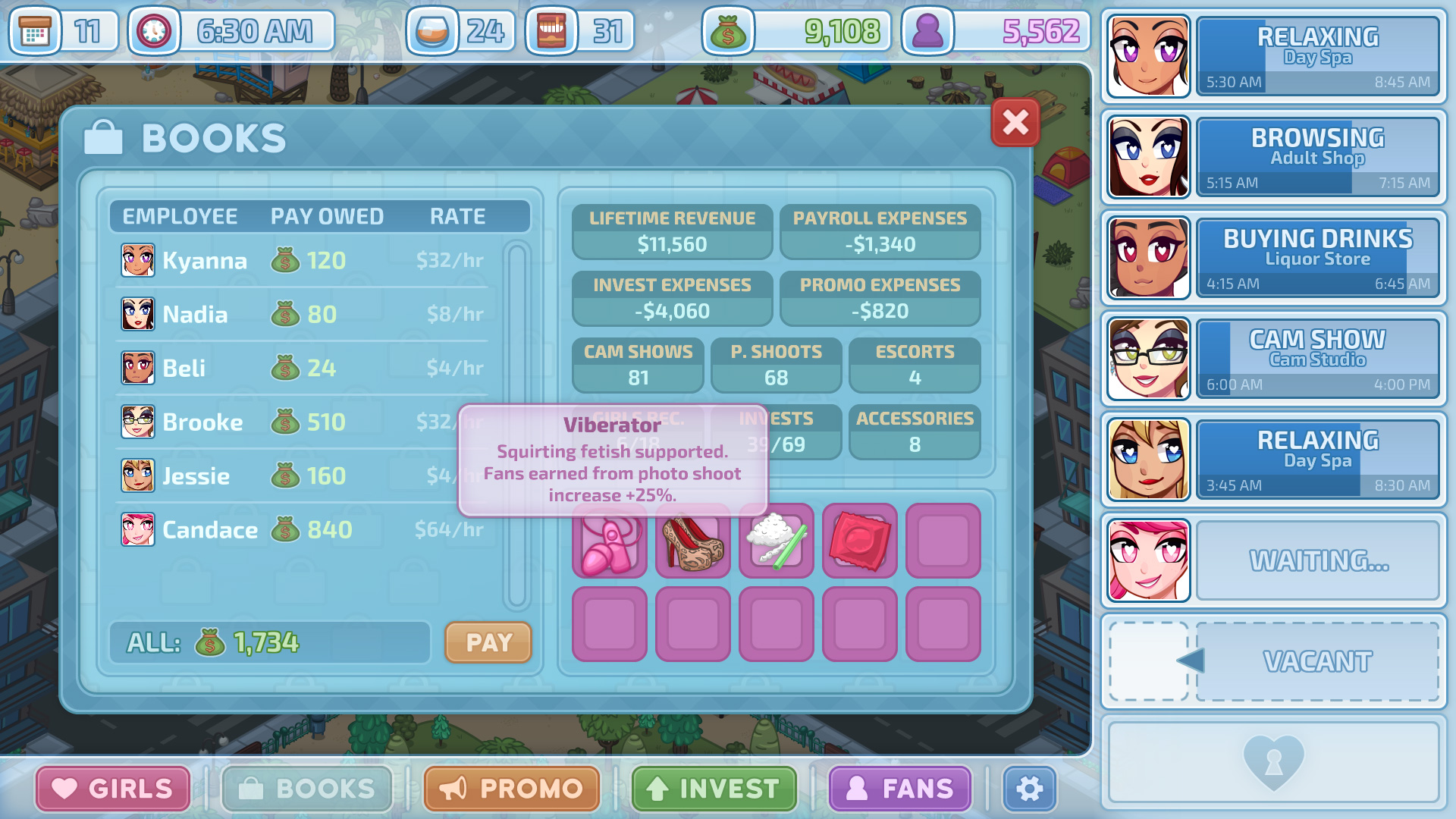
The tasks the girls can take on include putting on cam shows (which earns money), doing photo shoots (which earns fans, which equal more money when doing cam shows), training their talent (which improves the money they make per fan during cam shows) and style (which improves the number of fans they acquire per photo shoot), shopping for booze and cigarettes (both of which cause those with varying degrees of addiction to either or both to remain somewhat more stress-free than their clean counterparts), fucking punters in a sleazy motel (which makes money more quickly than cam shows, but which carries a risk of the girl catching one of several STDs, each of which has its own negative effects that restrict her actions), shopping for accessories (which carry passive bonuses) or resting at the day spa (which alleviates stress built up through all of the above activities).

Meanwhile, as Kyu's assistant, it's your job to manage the girls' time effectively and upgrade the overall operation using the money they earn. As you progress, you can unlock more slots to hire more girls and consequently perform more simultaneous actions, and you can also improve the pace at which clicking on things speeds things along as well as automating the collection of the resources actions produce. This becomes particularly important later when the girls start earning large amounts of money and fans with each action; clicking over a thousand times to collect all your ill-gotten gains isn't going to work.

huniecam1

You also have to manage the overall budget. The girls have an hourly rate of pay that increases as their talent and style levels increase, and at midnight each day you have to pay them. If this puts you in debt and you're not back out of debt by midnight on the next day, you lose. There are no other consequences to getting into debt, however, so sometimes it can be tactically advantageous to quickly blow all your money to get your operation in a good position, then spend part of the next day recouping the deficit you're left with after paying the girls.

The overall aim of HunieCam Studio is to have as many fans as possible by the end of a 21-day period. Once this time period is up, your final fan total is totted up and you're awarded a trophy according to how well you did. This, in turn, provides you with coins that can be spent on unlocking new hairstyles and costumes for the girls, with a mildly lewd picture on offer as a reward for each girl if you unlock all her variations. (Interestingly, during the game itself there's no explicitly lewd content whatsoever; everything is implied or mentioned in text. This is not a game to fap to.)

HunieCam Studio appears simple, but there are some interesting things going on under the (clitoral) hood, particularly with how the "fans" system works. Each girl starts catering to two specific fetishes, usually relating to their physical appearance — "MILF", "Teen", "Latina" and suchlike. Fans you acquire have specific tastes, meaning that girls who have a greater share of your total fanbase will make more money doing cam shows, and more money means faster upgrades. Ideally, you'll have multiple girls with overlapping fetishes, and this can be partially manipulated by purchasing accessories from the shop — buying butt plugs and giving them to a girl allows her to cater to fans who enjoy bum fun, for example, but this won't do you much good until you attract some fans of bum fun in the first place through photoshoots or paying for advertising to a particular audience.

As the game progresses and you get more girls in your little harem, things get surprisingly hectic if you want to keep things running as efficiently as possible, and STDs can throw a real spanner in the works, particularly if they're one of the serious, incurable ones — AIDS, for example, prevents a girl from doing anything at all because she's so depressed about the situation, making her completely useless to your operation. There is, sadly, little time to feel sorry for her, though; not if you want to make money and attract fans, anyway. Such is the way of a capitalist society.

huniecam4

I enjoy HunieCam Studio a lot more than I was expecting to. Its controversial new art direction — taking a distinctly more "Western cartoon" approach than the anime-inspired art of HuniePop — actually looks pretty good in the context of the game, and it's enjoyable to play. A full 21-day game only takes about an hour and a half tops, too, so it's easily replayable, and for those with little free time, you can save and come back at another time. You can also continue playing the game in "endless" mode after the 21 days are up, but you can't achieve the better trophies in this way — you'll need to start again for that.

A lot of people describe the people making consciously "arty" indie games as the punk movement of the games industry, but I have to say, I feel a bit differently; while I have nothing against the art-games movement and indeed encourage it in many cases, it's a very cliquey little part of the industry that has very specific ideas about what is and isn't "acceptable" or "good", particularly with regard to controversial and/or progressive themes.

HuniePot, meanwhile, don't give a shit what people think of them and deliberately set out with their games to be as provocative and offensive to those with delicate sensibilities as possible — while taking care to ensure that what they produce is also actually technically proficient and enjoyable to play. That sounds pretty punk to me — and they've set out to achieve what they wanted to twice now. I hope we see more from them in the future.