#oneaday Day 773: Off the Beaten Path

20120301-225122.jpg

The astute among you who follow my gaming posts (which, yes, I'm aware constitute an overwhelming majority of these entries — I am a passionate gaming enthusiast and an occasionally-professional games writer, after all) will be well aware of the fact that over the last few years, I've been drifting further and further away from the "mainstream" in terms of the titles I've been playing. This initially wasn't a particularly conscious decision, but rather a reaction to the fact that I just wasn't enjoying myself with the supposedly "big" titles of the day. I haven't made it through any Halo games except the original and Reach, for example, and my few forays into Call of Duty have left me feeling by turns underwhelmed and insulted. Similarly, I've given up all hope of ever making it through the Assassin's Creed series since it seems as soon as I think about playing through the older titles, Ubisoft goes and announces another one. You know, like they did today. Bastards.

I can't quite pin down exactly when this shift in attitudes happened, but I do know that I've come across some truly remarkable games in the process. One of the most memorable of these is Recettear: An Item Shop's Tale, which I picked up as part of one of Steam's characteristically generous Indie packs during one of the service's many sales, and promptly played all the way through for 40 hours. This was something of a difference from my expectation, which was that the game would be a shallow, social game-style experience with little depth and no long-term appeal. How pleasantly surprised I was when it turned out to be quite the opposite — deep, fun, well-written (kudos to Carpe Fulgur's wonderful translation efforts — we're talking PS1-era Working Designs-quality work here) and immensely satisfying to play. And not an Achievement in sight, either.

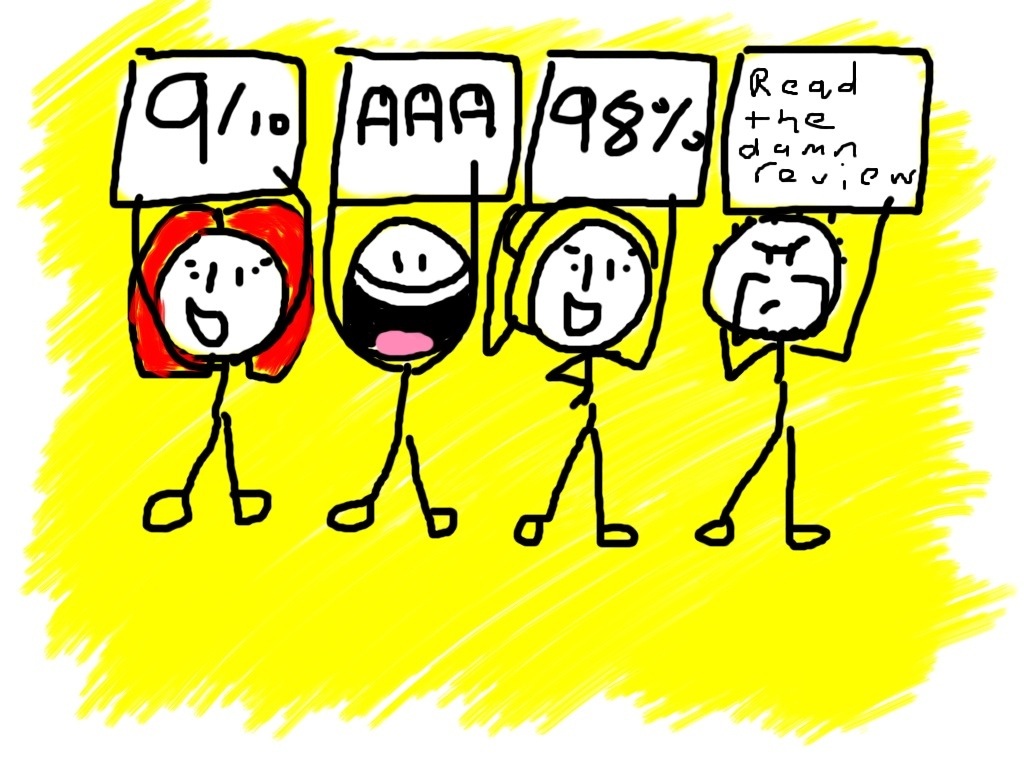
The attitude that I've decided to take as a result of discovering brilliant titles like Recettear and numerous others like it a little way off the "beaten path" is to simply say "fuck it" to the mainstream, and explore the things that I'm interested in, rather than the titles which the media makes it seem you're "supposed" to be interested in. It's been a very long time since I consulted a review prior to purchasing a new game, instead relying on a combination of word-of-mouth, intuition and simple, immediate, visceral reactions to screenshots, descriptions and other media.

This philosophy has also been born from the original ideals of the Squadron of Shame way back in the 1up days. Our original remit as a group was as follows, and I quote directly from the original 1up club page, which still stands today:

Games of Shame. You know you have them. They sit in your closet, collecting dust: Little jewels that you always tell yourself you are going to play, but never get around to. Well, that's about to change, soldier. You've been drafted to join the Squadron of Shame. Here we, the elite members of the 1UP Radio boards, paratroop into the bargain bins and rescue the unappreciated games that deserve to be saved. From there we battle through the trenches as a squad. At the end of the day, we take a moment to break down what made the whole experience worth fighting for by sharing war stories, reflections, and cigars. But the fight isn't just on the front of retro games: Any game deemed "fit for duty" by command can be put on the pile. At the end of the day, the reason we fight isn't just to discover new experiences, it's to answer that simple and fundamental question: "Why do we play?" Now suit up. The pile awaits.

I've pretty much stuck by those ideals as the years have gone by, always preferring to check out things that are outside of the mainstream, far from the things that everyone is talking about. I can't help but feel you can have too much of a good thing in terms of game coverage, and this is a problem which is only compounded by the explosive growth social media has enjoyed over the last few years. By the time a big-name game comes out, there are very few surprises left due to the constant PR trickle of new screens, exclusive reveals, teaser trailers, live-action videos, behind-the-scenes developer diary videos, blog posts, interviews, features, podcasts, multiplayer betas and all manner of other things besides. And when the game does come out, everyone is talking about it on Twitter and Facebook, putting you at serious risk of spoilers — or at the very least, of a feeling of "saturation".

So rather than bitch and moan about the state of the mainstream, the iron-fist rule of unscrupulous PR agencies and publishers destroying interesting, outlet-unique coverage and games that I have little interest in playing, I'm simply going to ignore stuff that doesn't interest me and focus on things which sound intriguing. (I'm aware that this post may well constitute bitching and moaning about the state of the &c &c but… but… FUCK YOU, that's what. WAIT I DIDN'T MEAN IT, COME BACK, I STILL LOVE Y—)

And, subsequently, I'll cover them myself, right here. I may be late to the party on some titles, but in many cases, things don't stop being relevant just because of their age, particularly with the number of HD remasters, portable remakes and backward-compatible devices we've seen recently. Providing these games with a little exposure here — "little" being the operative word, since I'm well aware of the relatively miniscule amount of traffic this blog generates, and am perfectly happy with that fact — will make me feel better, because then I then know that there's someone out there (me) appreciating and giving some much-needed attention to titles which maybe don't have a massive marketing budget or an omnipotent PR organisation managing and coordinating all their coverage. And, as small as my audience here is, if I write something, then there will be people reading about these titles, too. And if just a few of those people think "hmm, that does sound interesting" then I can feel like I've done a good job somewhere along the line.

So if I blog about something which sounds interesting and you decide to check it out for yourself, be sure to let me know. I'd love to hear your reactions to titles such as Katawa Shoujo, To The Moon, Recettear, Xenoblade Chronicles, The Last Story and numerous others. Over the course of the next few days/weeks/months, I'm intending to catch up on a variety of PSP titles, starting with Corpse Party and following with the portable Persona remakes. So watch out for those entries soon, and be sure to let me know your thoughts on those games if you've also sampled their charms.

And if you're excited for Mass Effect 3, Assassin's Creed III or, God forbid, the rumoured Call of Duty: Black Ops 2, then don't let me stop you being excited — I'd actually love to hear about those games, from you, too. Just be aware I probably won't be joining you in playing them!
#oneaday Day 772: The Last Story: A Scoreless Review

20120301-001735.jpg

Japanese role-playing games, despite having been a mainstay of the console space for many, many years, have fallen somewhat out of favour with the mainstream recently. Even Square Enix's flagship Final Fantasy series doesn't carry the same cultural cachet it once did, with the latest two instalments in particular proving very divisive.

The most common complaint thrown around when criticising the humble JRPG is that it hasn't moved with the times, that it hasn't evolved, that it has become predictable. And while this is true to a certain extent — we're still typically helping whiny-voiced spiky-haired twerps use their total lack of personal magnetism to bring together a disparate group of individuals to save the world from a white-haired androgynous gentleman who wants to use the power of something that came from space and/or inside the planet to BECOME A GOD — it's not quite the full picture. But you have to look a little off the beaten track to find examples of the genre evolving in positive directions.

Three such examples can be found on the Nintendo Wii of all places, in the form of three distinct titles that have become known as the "Operation Rainfall" games, after the movement which has been gently but repeatedly prodding Nintendo to localise them and bring them to the West.

Xenoblade Chronicles came first, with a European release last year and a North American arrival coming in the next month. Offering a vast open world, a bajillion quests, charming British voice acting and quasi real-time combat, Xenoblade certainly wasn't the JRPG we know and love — and it was all the better for it.

Pandora's Tower, an intimate story about a relationship between a monster-slaying man and a girl who is turning into a monster, is the third on the list, with a European release set for this April, and no plans for a North American appearance as yet.

Meanwhile, The Last Story saw its European release in late February, with a North American release courtesy of Xseed Games following later in 2012.

The Last Story is notable for a number of reasons, chief among which is the fact that it's a new collaboration between Hironobu "Final Fantasy" Sakaguchi and Nobuo "The Music of Final Fantasy" Uematsu. That alone should be enough to pique the interest of any genre enthusiasts, but it may also be grounds for caution. After all, these two have been making JRPGs for years, so surely they must be stuck in their ways by now?

Thankfully, such caution is not warranted, for The Last Story is an inventive take on the JRPG genre that dispenses with almost every convention in the unwritten rulebook, replacing them with a streamlined, efficient, rewarding and fun experience that should be a part of every JRPG fan's collection.

The Last Story tells the tale of Zael and his friends, a band of mercenaries with diverse British accents brought to Lazulis Island at the behest of the local Count in order to slay some monsters. Over the course of the 25 or so hours it will take you to beat the main plot, you'll have seen political intrigue, fairytale romances, magic, mystery, comedy, creepiness, conflict, betrayal, tragedy and everything in between. The game's twisting, turning plot moves at a brisk pace and never once gets bogged down in excessive angst or overly philosophical nonsense. There's a section roughly halfway through where a couple of sections feel a little out of place in the context of the overarching narrative, but these remain enjoyable mini-adventures in their own right and are over relatively quickly.

The game's brisk pace is in part due to the way it is designed. Unfolding over a series of linear chapters, The Last Story's narrative is constantly moving forward. Dungeons tend to be straightforward and linear to navigate through, but it's not exploration you play this game for — it's combat.

And what a combat system. Blending elements of character action, stealth, third person shooter and real-time strategy games, it's a real treat. Controlling Zael directly, the player is able to move freely around the battlefield and unleash attacks on enemies simply by tilting the analogue sticks in their direction. As the game progresses, Zael unlocks a series of other abilities allowing him to quickly move around the battlefield, "diffuse" magic circles to provide special effects, and give specific orders to his allies. Meanwhile, said allies hold their own intelligently and realistically, following the player's lead and orders sensibly. Charge in head-on and the rest of the gang will support Zael. Fall back to a healing circle and others will join until everyone's back to full strength.

It's far from straight hack and slash, though. Some combats are over in seconds as Zael hides around a corner and lures enemies out one by one with a crossbow bolt to the leg followed by a devastating "Slash" attack. Others are more protracted, strategic experiences where the terrain comes into play. Mages or archers on high platforms bothering you? Chuck a bomb in their direction, or order your own mages to collapse the crumbling masonry they're precariously perched atop. Despite having to give these orders in real time while the battle continues to rage around you, The Last Story's combat never feels overwhelming, but frequently feels exhilarating. Only an occasionally-wobbly camera and a frame rate that struggles a little bit in large-scale battles mar the experience slightly.

Despite the Wii's much-maligned technical limitations, The Last Story is a glorious-looking game. All thoughts of this being "just a Wii game" or "only 480p" quickly blow out of the window when you see the fabulous visuals, blending a slight sepia tint with some excellent lighting and high-contrast HDR effects, providing a beautifully rich, sumptuous aesthetic. Character models are detailed and well-animated, with clothing and armour changing their appearance as you upgrade it over the course of the game. And the environments are packed with detail, making navigating the game's small but beautifully-crafted world a real pleasure.

It's where the game differs so drastically from the conventions of JRPGs that it becomes the most interesting, though, as lovely as the visuals are and as satisfying as the combat is. The narrative, for example, largely centres around a single city rather than the usual globetrotting adventure, and deals with a variety of very "human" themes — class discrimination, racism, ambition, greed and the lust for power — without descending into "bad guy turns into giant monster" territory. There's plenty of magic and mayhem in there to ensure we don't forget we're taking part in a fantasy story, but for the most part it knows when to rein it in and focus on the characters. A tip of the hat is also given to Western RPGs' fondness of giving the player "choice" in how to respond to situations, but in practice this is a little underused throughout, with the game typically gently nudging you down the "correct" path if you happen to pick the "wrong" option.

The treasure-hunting aspect of JRPGs has undergone a big change, too. There's a small selection of armour available, and all characters can wear whatever they like. All pieces start with equal statistics, too, with differences only becoming apparent once you start upgrading them with materials which can be looted from monsters and chests. You'll be wearing the same armour at the end of the game as you started with — albeit considerably upgraded with a variety of special effects and a gradually-increasing amount of visual badassness. Weapons, meanwhile, can be upgraded to a certain extent simply by spending money on them — but to unlock their latent special abilities and make them considerably more powerful, you'll often need to find specific crafting items.

And — here's The Last Story's killer blow for those tired of 100 hour epics only being that long because of the excessive amount of fighting — there's no grinding. That's right. No random encounters. No running around in circles to attract monsters. No hanging around an area just to beef up enough to beat the boss. Instead, certain dungeons have "summoning circles" available for you to use, allowing you to trigger a small fight and gain some experience if you want to. Doing so will make subsequent boss battles a little easier by powering up your characters somewhat, but it's never obligatory. Characters gain experience at such a rapid rate and combat is such a pleasure, however, that you'll usually want to take advantage of these opportunities when they arise.

I haven't even touched on the wide range of sidequests in Lazulis City, nor indeed the fact that Lazulis City is one of the most convincingly realised fantasy towns of any RPG ever. Nor have I mentioned the curious inclusion of multiplayer, in which players can take their own customised Zaels online to either cooperate with other players against tough monsters or compete against one another in competitive matches. And then there's the guy who rewards you with vegetables and cooking equipment to be used as weapons if you bump into enough people in the streets. The fact there's a sidequest whose sole reward is an army of adoring groupies who scream every time you go to see them. The "Prank Banana" ammunition for Zael's crossbow which causes people to slip over in comedic fashion. Despite being a relatively short game by genre standards, there's a ton of stuff here to enjoy, and it never outstays its welcome. Notably, too, the non-plot-related stuff is all totally optional, as rewards for completing mostly take the form of items which can be acquired elsewhere, a better sense of the game world and its inhabitants and, of course, a smug sense of self-satisfaction.

The Last Story is without a doubt one of the best JRPGs of recent years, and certainly one of the most inventive takes on genre conventions. Even if you've long given up on JRPGs due to frustration at their narrative, aesthetic and mechanical cliches, you'll find something to like here. It saddens me a little that as a limited-run niche Wii title it will likely never find a huge audience worldwide, but those who do give its charms a chance will find themselves amply rewarded with a truly memorable experience.