#oneaday Day 535: Updated My Journal

As I sit here on my friend Tim's spare bed (which just a few short moments ago had the entirety of Helm's Deep atop it) typing this entry using a piece of software that runs on a computer several thousand miles away from the tiny computer that I'm actually pressing the keys on which has no physical connection to this thing we call "the Internet", I'm reminded, as I often am, of how much things have changed.
I'm not that old — I'm thirty and, if not proud then certainly "grudgingly accepting" — but I still find the amount of progress since I was a kid to be fairly astonishing when you think about it. Take what I'm doing right now — writing a blog post — and rewind it some fifteen-plus years. I vividly recall as a youngling, early-ish in my secondary school career, writing a secret diary, inspired by Adrian Mole. Said diary was in a really nice part leather-bound volume that said "journal" on the spine and had nice paper. My first entry was about my family's visit to the National Stone Centre, in retrospect possibly the dullest way I could have possibly started a secret diary.

Over time, though, my writing evolved. I wasn't writing for anyone in particular, but more just to get thoughts out of my head when there wasn't anyone handy to share and discuss them with — or if they were thoughts that I didn't particularly want to share and discuss with people. In some senses it was like a form of therapy, where I could discuss anything I wanted with someone who wouldn't judge what I was saying, and would simply respond with an unspoken "tell me more" for as long as it had empty pages. My journal became less about "Today I went to the National Stone Centre and we saw lots of stones" and more about "I've been thinking about [girls/school/bullies/life] and this is what I feel about it".

I took to scripting fantasy conversations for a while, particularly when it came to talking to girls, because at least in the pages of my diary I stood a chance with Nikki, the girl with the finest boobs and legs in the whole school orchestra. In reality — well, I never quite found out whether or not I stood a chance with her, but given the general standard of guys she went out with, I'm not sure my greasy-and-crap-haired zit-faced teenage self would have stood up particularly well, however much better at playing the clarinet I was than her other boyfriends.

On one memorable occasion, I recall doing a lengthy post-mortem of an encounter with a girl I liked when my friends pretty much forced me to tell her that I liked her. She turned me down, of course, but the fact I'd actually gone through with it was immensely satisfying — so much so that I recall drawing diagrams of how the event had actually gone — where I was, where my friends were (doubtless watching and laughing at me making a tit of myself) and where she was.

In retrospect, it was perhaps a bit creepy, which is probably why one day I took a look at everything I had written, became hideously embarrassed by the whole thing and discreetly threw the by then half-full book out into the trash, never to be seen again. I often wonder what happened to it, and occasionally wondered if a bin man might have come across it and had a good giggle at my teenage lameness.

The world's different now, though, and the closest people come to a "secret" these days is posting passive-aggressive tweets and Facebook statuses. I still write — every day, as you've doubtless noticed. Sometimes the things I write are still therapeutic and a way of getting thoughts out of my head that are difficult to vocalise, and sometimes it's just stupid shit that I feel like rambling on about.

The difference now is that after 535 days, I'm not ashamed of a bit of it. Sure, some of it probably only has any meaning to me and me alone, but everything I've written here has some sort of meaning and memory attached to it. Which is why you won't find me ever throwing this blog out in the trash like my teenage secret diary. We are the sum of our memories and experiences, for better or worse, and sometimes it's good to look back and see how you got to where you are now — and where you might be headed in the future.

The future's not yet written, as everyone knows. But day by day it'll reveal itself, leading us ever onward to the end of one chapter and the start of the next.

#oneaday Day 129: Professionalism Is

Skills are a funny thing. Unlike in the world of roleplaying games, it's extremely difficult to quantify skills. Sure, you can go and get yourself a qualification, but it's not a simple case of repeatedly doing the same thing over and over again until a chime sounds and the words "LEVEL UP!" appear over your head. (Unfortunately. Because that would have made assessing learning in the classroom a whole lot easier.)

No, the vast majority of skills that you (well, I) have are not quantifiable in any sense. I can write — well — but that's difficult to prove except with, well, writing. I can't point to a character sheet and say "Look! 85 skill points in writing!" when applying for a job. I can just say things along the lines of "I'm excellent at writing" and "I have a strong attention to detail and think people who use the wrong 'your' should be abused with sledgehammers" or the like. I can also correct typos without too many people noticing.

It's even worse with IT skills. I can use computers, and I have a knack for being able to find creative solutions to problems if something's behaving strangely. When putting my new PC together the other day, I found myself frustrated with the woeful instructions that came with it and just worked things out for myself. Sure, it took me a little while to figure out that you can actually unscrew and take out 3.5" drive bays in order to fit a hard drive in them — I thought it was a bit stupid to expect Eugene Victor Tooms levels of contortion just to screw in a storage device — but I got there in the end. (Also, bonus points if you know the reference.) However, the ability to "find things out" isn't quantifiable in any way, and short of someone plonking me down in front of a broken computer and saying "fix it!" there's no way I can prove that I'm "good with computers".

I guess this is where all those lessons you had in Persuasive Writing back in school come in handy. It's up to you to convince people that you are The Right Person for the Job by using suitably flowery language and/or carefully referencing things you know about the person in question. And it doesn't always work, as my year's worth of "we have decided to pursue another candidate" emails and letters will attest.

But oh well. Some good has come of my skills and abilities — I'm writing for sites I like on a freelance basis, and that in itself is giving me a sizeable portfolio of experience that I can point at should I find myself in the running for a full-time position somewhere. While it may not be a character sheet with 85 skill points in the Writing skill, it's the next best thing.

#oneaday Day 68: What Now?

It's coming up on a year since my departure from the obnoxiously-named "world of work", when I left my employment at a primary school, went to PAX East and had what was to this day the happiest week of my life, then came home only for my life to completely fall to pieces two short months later.
Now, here I am, and some things have changed, and some things aren't any further along than they were even back then. I have some awesome new people of various descriptions in my life, for one thing, and while most of them are some distance away, none of them are so far away as to make it completely impractical to go and see them. This is a Good Thing.

I also have a sweet writing gig that I'm absolutely loving. I enjoy doing the news posts every day and I've had great fun at the events I've had the opportunity to attend so far. This is also a Good Thing.

But I get the impression that some Decisions are going to have to be Made at some point. How much do I want to be a writer in the games industry? Quite a lot, as it happens. Despite having been technically "unemployed" for the last year, I've been doing a lot of writing and I haven't reached that "jaded" stage that some writers have got to—the stage where they've forgotten to have fun with what was once their hobby. I don't see myself getting to that point any time soon because I'm a fan of games, the games industry and everything it involves, and hopefully that comes across in my writing. I believe that I'm a good writer and a valuable addition to any of the teams I've been part of over the years, and friends and colleagues would (hopefully) back me up on that front. I certainly have a heap of LinkedIn recommendations that would attest to this.

So what's the problem? Well, as much as I love it, it's not a full-time gig… at the moment, anyway. Making it into a full-time gig would likely, at this time anyway, involve having to whore myself around to a number of outlets on a freelance basis, without any particular guarantee of a particular amount of money coming in each month. I wouldn't have a problem with this were it not for the fact that the events of the last year have left me in a terrible state financially. The thing I find myself constantly coming back to is whether I should leave behind "the dream" and get a full-time job instead. Practically speaking, it's the thing that would probably make most financial sense, and anyway, there's nothing to say I can't continue contributing to sites on a freelance basis while I hold down another job.

So I have been applying for jobs. And applying. And applying. And tweaking my CV and cover letter and trying new templates and writing in different styles. And nothing. This is immensely frustrating as I know that I am Good At Stuff. But on paper I am qualified for just two things: writing and teaching. Teaching I have no desire to go back to as it's nearly killed me on two separate occasions, but I have a lingering fear that it's the only career path I can all but guarantee I'll be able to find myself a position in. I've held three teaching jobs in the past, all of which were in schools that could politely be described as "challenging" and as such my perception of the profession may have been coloured in a slightly negative light. But I'm not sure I want to risk my sanity and happiness (well, potential happiness, anyway) diving back in "just to see" if I was just imagining it was as awful as I thought it was.

In summary, I'm not sure what I "should" do. A job's a job, after all, and anything that gets some money coming in is surely better than doing nothing and having no money coming in whatsoever. My quandary is this, then: after this long out of full-time work, should I continue looking for that elusive something that's going to make me happy? Or after this long, should I just take whatever the hell I can get?

And are you hiring?

#oneaday Day 66: Is Traditional Writing Dead?

It seems every other week, particularly in tech-related industries, there is some sort of discussion over whether this or that is "dead". Inevitably, the answer is usually some vague waffle about how most people may have stopped using their Nokia N-GAGE but there are a few people out there utterly determined to beat Tomb Raider on a portrait-wise screen on a device which can survive being run over by a bus (I speak from experience) and thus the thing in question isn't dead, just on perpetual life support. Until it gets run over by one bus too many, of course.
A discussion I participated in earlier today on Twitter regarding grammatical usage of hashtags got me thinking, though. Is the concept of "traditional writing" dead?

When considering this, though, it's first important to determine what you mean by "traditional writing". And it's not an easy thing to define. Is this blog "traditional writing"? It mostly follows grammatical conventions (except when I'm being deliberately obtuse or conversational) and uses paragraphs. But no; I'd argue that it isn't writing in the traditional sense. Blogs are designed as a platform upon which people can share their thoughts on a subject and invite responses from other people. That last bit—the invitation for other people to respond, whether or not it's taken up by commenters—is the important part of blogging for many people. The best blogs are "conversations"—or at the very least, pieces which start discussions amongst other people.

You could argue, of course, that persuasive writing, philosophy and the like has had this sort of thing covered for many years, and you'd be right—people still debate Nietzsche down the pub, right? (I don't go to the pub that often.) But the key thing is that with blogs and their commenters, everyone has a voice of (relatively) equal power. Ironically, though, the popular blogs diminish the power of their own commenters by having so many that people are unlikely to read them all. But at least some of them get read, unlike a weighty tome on all matters philosophical, in which those pub conversations rarely go any further than the pub.

Then there's Twitter, the reason I got thinking about this in the first place. Here's the kind of tweet that got me wondering:

We'll leave @tanaymodi1's absent apostrophe and misspelling of "myself" aside for a moment, and look at those hashtags. Being someone brought up on "traditional" writing and grammar rules, those hashtags in the middle of a sentence are somewhat jarring to me and interrupt the flow of what's being said somewhat. Now, in theory, the use of those hashtags allows anyone reading that tweet to click on either #AngryBirds or #Mac and read what other people are saying on those topics. A sensible idea for hot topics under discussion. But I've seen people do it with more vague concepts, such as "I'm writing a #novel" or "Is Sasha Grey a model of fashionable female #sexuality?" that could be taken in all manner of different contexts. Are they still useful?

Apparently so; a number of people came forward in response to my query and said that they find it useful to have the facility to find out what other people are saying on the subject. The only fly in the ointment, however, is that not everyone uses them. If I'm writing a tweet about my Mac, for example, I'll use the word "Mac" and have never, ever hashtagged it, if only for the fact it saves one of Twitter's precious 140 characters. The only time I use hashtags are if I'm participating in a discussion about something (like, say, a TV show that's on at the time) and appending the hashtag on the end of the tweet, for these blog posts or for #lamehashtaghumourthatifindquitefunnysometimes.

This is obviously a different use of writing to how it's used here on my blog, how I use it when writing for GamePro, how I use it when writing an email and how I'd use it if I were writing a book. But it doesn't mean that any of these forms of writing are "dead" or "dying". Increasingly what's happening over time is that things that were once on a relatively linear path, such as the evolution of language, are splitting off into separate branches with their own contexts and purposes. Some people stick resolutely to one path and thus find it rather jarring when something from one of the other paths invades their consciousness. Other people can happily jump back and forth between the different strands, adapting their language to the situation as they see fit.

So no. I don't believe that traditional writing is dead, nor is it a niche interest that only a few dedicated souls are continuing with. It's simply one branch of an increasingly-complicated tree. As we find ourselves with more and more different means of communication available to us, language adapts, changes, broadens. And it will continue to do so for some time.

Where does it stop? Will (English-speaking) people on Twitter end up speaking their own language that looks a bit like English but isn't? Perhaps not. But it's something to ponder.

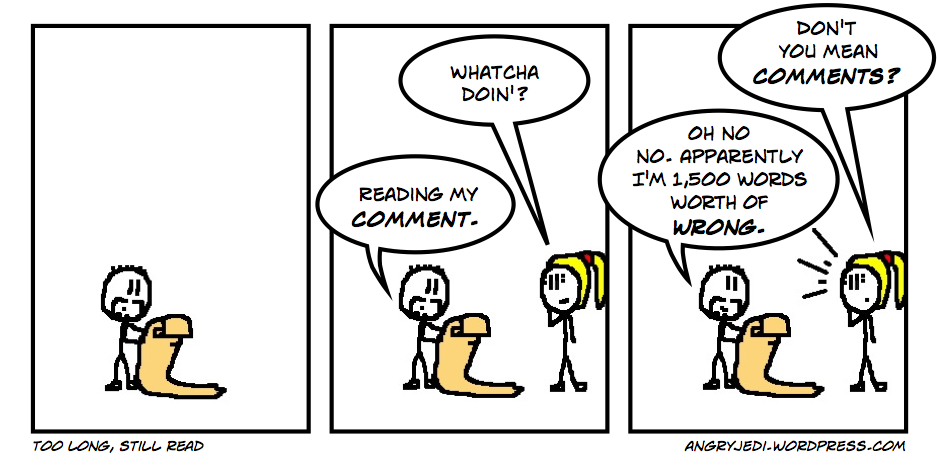
#oneaday Day 62: Too Long, Still Read

I'm almost entirely certain I have ranted on this topic at least once in the past. But, well, it bears repeating, given what I do both here and professionally.
More than one paragraph isn't bad.

More than 140 characters isn't bad. (Unless you're using Twitter, when all the deck.ly and TwitLonger nonsense kind of defeats the object.)

I read an answer to a question on GameFAQs earlier. The original poster had asked something which required quite a detailed answer. One respondee gave a detailed, good answer that was two paragraphs long, probably about 150-200 words or so. He apologised for writing "alot of text" (sic)—and I'll let the "alot" slide for the minute because there are bigger issues at work here, dammit. (Incidentally, if you've never seen this, well, you should.)

No. Stop apologising when you write things. Stop complaining at people in forums if they write detailed thoughts. Stop providing lazy people with "TL;DR" summaries and make them read. No wonder people haven't got the patience for books any more if they can't bear to read more than 10 words of someone else's opinion at a time and inevitably respond with something utterly inane like "lol". (And I bet they're not even really laughing out loud either, the bastards.)

Language is an incredibly powerful thing. Look at all the things it's built over the years. Those things didn't come about by people worrying about writing an "OMFG WALL OF TEXT" and people ignoring them. Those people had something to say and damn well said it, in detail, and argued their case. Their passion for what they were talking about came through in the power of the words that they chose, their enthusiasm for the topic came across with the depth into which they explored their topics verbally and on paper.

Now granted, there are times when brevity is better than verbosity. Anything from any government agency or law office, for example. I received a letter from the tax office a while back which went on for 3 pages when the single word "no" would have sufficed. These people have nothing to say and ironically spend pages and pages proving how little they have to say. Why? Who knows. To sound "official", perhaps.

But people with opinions? People debating things? People being—who'd have thought it—helpful? There's no sin in using a few more words if it might make someone think, discuss or smile.

So stop apologising when you write something, be it a blog post, forum post, Yahoo! Answers answer (well, someone has to write them) or blog comment. If you have something to say, it is absolutely your right to be able to say it without worrying about whether its length is going to put people off (*deftly sidesteps "that's what she said" gag*). And those who are too lazy to read a couple of paragraphs of comment? Well, they're probably not the sort of person you'd want to engage in a debate anyway. So F them in the B.

TL;DR: Stop being a dick.

#oneaday, Day 20: Idea Factory

They—I'm not sure who, just, you know, "them"—say that you should never write about writer's block. Which is why I'm not writing about writers block; I'm writing about how I avoid it. An important thing to consider if you're going to be writing something every day, I'm sure you'll agree.
Firstly, I never think "I have nothing to write about". If you believe you have nothing to write about, you're not thinking hard enough. There is always something to write about, even if it's the mundanity of your day, how much rubbish there is on your desk or how much your pants smell.

Banished that phrase from your memory? Good. Now you can start narrowing down all those possible things that you can write about into the one thing that you actually are going to write about.

First of all, think about your day, personally. Did anything interesting happen? Did anything amusing happen? Would other people find those things interesting or amusing? Is it something that you'd particularly like to remember when looking back over random entries months down the line? If not, then probably best to steer clear of writing about your day.

Next, think about the news. Did anything interesting happen? Did anything amusing happen? You get the idea. Did anything happen that you consider is worth commenting on? If so, why not try writing about it? There have been plenty of posts around the One A Day Project recently that are topical in nature, and they've sparked plenty of discussion in comment threads and even some complete counter-blogs at times.

If there's nothing in the news that tickles your fancy, think about the most recent thing that has irritated you. People seem to enjoy a good rant about annoying things, particularly if they can relate to them. Perhaps you can frame it in the wider context of something else, or even start an occasional series of Things That Really Piss You Off About Socks.

If you're the mild-tempered sort and don't get annoyed about socks or the declining badger population of our riverbanks, perhaps something has inspired you recently. Maybe it's something a friend did or said that's led you on to doing something else. Maybe you've made the decision to make some changes in your own life, and you'd like to state them publicly "for the record", as it were. Even if your blog doesn't enjoy that many readers, putting virtual pen to metaphorical paper and stating in attractive, clear Times New Roman that yes, you are going to stop scratching your testicles in public because it is Freaking People The Fuck Out is more powerful than just making a resolution to yourself.

If there's nothing in reality that tickles your fancy, delve into the realms of fantasy and do some creative writing. There's no one way to be "good" at creative writing, as everyone has their own style. Just write what comes naturally. Perhaps it's a simple, descriptive piece. Perhaps it's a short scene. Perhaps it's a complete self-contained story, or maybe a poem. Whatever it is, you summoned it up from your brain. That's cool. That guy over there hasn't done that today.

And if you struggle for inspiration in the creative sphere, try out "Freewriting". Get a clock or stopwatch, set it for ten minutes, start it and just type. Type type type without stopping, without checking your work and without editing. Let the words flow freely out and see what happens. You may have a surreal, imaginative scene pop out. You may have the things you're thinking about laid bare. Some home truths may be revealed. Whatever pops out as a result of freewriting, it's often interesting to glance over afterwards and figure out where on Earth that came from.

Our world is made of language. There's always something to write about. You just have to find it.

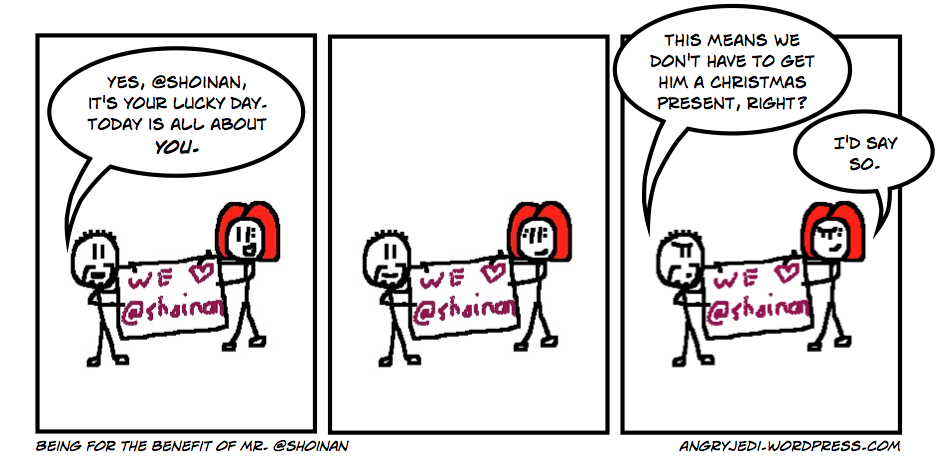
#oneaday, Day 336: Being For The Benefit Of Mr. @shoinan (And Any Other Prospective #oneaday-ers)

The few of us who are still flying the #oneaday flag are closing in on the grand finale. 365 posts of non-stop bollocks, some of which might have been entertaining, some of which may have been utter nonsense. If you haven't checked out the fellow survivors' blogs yet, I encourage you to pay Jen, Mat, Mike, Krystian, Ian and other Ian a visit and support the awesome work (and endurance) they've shown over the last year. Give 'em a big hand, or whatever the Internet equivalent of applause is.

Now: to the point. I have tagged @shoinan in this post because he was specifically asking about it on Twitter at some indeterminate point in time that I'm confused about due to intercontinental time zone drift and watching Scott Pilgrim until 1:30 in the morning, then getting up at 7am to record a podcast. But this post is directed at anyone who wants to be Awesome Like Us.

#oneaday is something I intend to keep going with once my year is up. The others may feel differently. For some it feels more like work, for others it's a good habit that they've got into. Some are persisting out of sheer bloody-mindedness, some are passionate about the whole thing and want to succeed in it as a creative endeavour. In fact, most of us have fallen into some or all of the above categories at different times. And those who dropped the project partway through the year all did so for completely valid reasons, too.

It's a challenge, make no mistake, but it's one you largely set the rules for yourself. The only rule that everyone needs to abide by is this:

Post something—anything—at least once a day for a whole year.

Exactly what "something" means to you can be anything at all. It can be a photo-based post (I've done a few of those in the past). You can set yourself a minimum of at least a paragraph. Personally, I try to write at least 500 words a day, and in the last *mumble* days I've also been doing my comic daily, too. (All right, I couldn't be bothered to check. But I know it's over a hundred days now.)

But there's no hard and fast rules about how much you need to write, how good it needs to be or even what it needs to be about. The whole point of the exercise is to get you (yes, YOU) writing. Writing anything. Posting anything. Getting into the habit of being creative regularly. Creativity is something you need to exercise, just like your muscles. Spend your time not being creative and you'll stagnate, but it doesn't take long to get back on track. And there's no better way to exercise the creative bits of your mind than coming up with something—anything—every single day.

The other side effect that you might find is that it's a good outlet. I've had a shit year, by all accounts, and I know that one thing that has really helped me deal with said shit is writing about it, getting my thoughts out of my head (where they'd fester and eventually explode) onto the page. Saying things and knowing people are reading them—even if the things I've written aren't specifically aimed at anyone (or are, in some cases)—helps. It's a form of therapy.

I'm not saying you need to have something going on in your head to enjoy success at #oneaday blogging. But it certainly gives you something to write about, and I believe it's a healthy thing to do, too.

So for those of you interested in participating next year, I'm fully intending on continuing to take part and helping to co-ordinate everyone's efforts, too. Keep an eye on these pages for further details, and in the meantime feel free to get started whenever you like. If you do, be sure to let me know that you're on the case and I'll be sure to throw up some links.

Not in a vomity way. That would be weird. You know what I meant.

Anyway. Now it is time for pancakes. I hope those of you reading this who have a creative itch that is proving difficult to scratch will certainly consider joining me on another year of #oneaday blogging next year. Good luck to those of you who are in for the ride.

#oneaday, Day 319: Report This Post, It Contains Opinion

There is an increasingly popular—and increasingly worrying—tendency for games journalism and writing about games (which some people are keen to point out are two different things) to be judged as "broken" or "lame".

On paper, you can perhaps understand why this is. Gaming is one of the most popular subjects for wannabe writers to pebble-dash the Internet with, and there are so many people out there who want to do it "professionally" that a good 90% (I made that up) of gaming-focused sites out there can't even pay their writers, however awesome they are. As such, there is a lot of crap out there, but it's generally quite easy to spot, and there's certainly no need for sites like this.

Fellow #oneaday-er and all-round lovely grumpy chap Ian Dransfield of Play Magazine wrote an impassioned rant on this subject. I highly recommend you go and read it. Now. Go on.

I agree with the Dransfield. No kind of journalism should be homogenised, automaton-written garbage. It should have scope for individual opinion and comment, and certain outlets should have the opportunity to develop distinctive "voices" on the matter. It's worked for our newspapers for years, after all—for all the shit everyone gives the Daily Mail about their bizarre and often misguided opinions, at least they stick to their guns. Similarly, were the Daily Express ever to write about anything other than Princess Diana, the nation would be in uproar.

One of the things that bugs me most about today's games journalism is the plague that is N4G. For the uninitiated, N4G is a community-driven news-aggregation service. Community members may post articles to a "pending" queue, and they then have to get ten "approvals" in order to show up in the main news feed.

Fair enough, you might say. It separates the wheat from the chaff, surely. And surely the people who have approval rights must all be published professionals, right?

Wrong. Anyone can submit any page to N4G with no requirement that the article be your own. Get three articles approved by the community (a simple case of rounding up ten Twitter/Facebook friends to help you) and voila—approval rights. This then means that your opinion has as much weight as someone who's been doing the job for fifteen years.

This may still not sound unreasonable. So let me show you the drop-down menu of options available for "reporting" an article if you believe it to be "inappropriate":

Yes, you have read that correctly; one of the options for reporting an article as unworthy of appearing in the N4G news feed is that it is "lame".

N4G is seen as a primary means of promoting games-related articles, and sure enough, it does seem to generate a lot of hits for sites, so I can't fault those people who do take advantage of it to get more readers to their sites—fair play to you. I can say with some honesty, though, that I have never used it as a place to go to find out the latest news. The whole thing is too chaotic, too run by people who write comments after reading only the headline and not the article and—ugh—it makes me mad, I tellsya. I can't take it seriously in the slightest.

My main issue with it is one of the things Dransfield points out in his article: who are these people to say what is and is not "relevant"? What gives them the right to brand something as "lame" simply because it doesn't have "HALO IS A REALLY COOL GUY" in the headline? What gives them the right to ignore a supposed "duplicate article" on a subject which offers some opinion or additional facts over and above what has already been written first, in haste?

Absolutely nothing. Traditional news outlets and even longer-established specialist press (such as publications for music and films) aren't held to account in the same way. But games journalism, being a younger industry, seems to be held to entirely different standards, and judged unnecessarily harshly. There is a lot of negativity surrounding the games press, and not enough positivity. Trolling and flame wars are particularly prevalent on articles about games, and platform-specific articles seem to bring out the very worst in the community.

Here's food for thought then: in a world where we're so concerned about free speech a goodly proportion of the Twitter population in the UK (and beyond) is supporting the legal fees of someone they've never met, why are we so harsh on this particular breed of writers? Why shouldn't they be able to write what they feel, rather than what will "get hits"?

If you would like to share this post with the community, then please feel free to make use of the buttons below.

#oneaday, Day 265: Skill Points

Take a minute, now, to take stock of yourself. Specifically, take stock of the skills you have. And don't say that you don't have any. Everybody has skills of some description, whether it's the ability to make the perfect Angel Delight without the use of a measuring jug, the ability to excite women simply by looking at them, an understanding of the various wires, pipes and bendy things that make up a car engine or being able to do something awesome like play the piano.

It's quite a strange experience to suddenly be conscious of your own skills. But there are times when it happens. It often doesn't happen when you're young or lacking in self-confidence. But at some point in your life, something flips a switch in your head and says, "Hey. You're awesome. It's okay to think that." Not in an arrogant way, simply in the sense that you can picture a task in front of you—be it making said Angel Delight, exciting said women or… you get the idea—and feel confident that yes, you probably are going to be able to pull that off.

You know you're at that stage when you casually mention something you're doing to friends and they're all "Oh wow! That's so awesome!" and you're all like "Yeah, whatever." and then they're all "No, SRSLY, that's AWESOME!" and you're like "Really?" and they're all "Yeah!" and you get all proud of yourself and then a bit guilty that you're feeling pride because it's one of the Seven Deadly Sins after all and you don't want to end up in a field shouting "WHAT'S IN THE FUCKIN' BOX?!" and finding spoilers in the spoiler. (Yes, I know the Statute of Limitations was up on Se7en years ago.)

But it's actually a pretty cool feeling. Particularly when you realise that rather than being someone quite a way down the "pecking order" of "talent", whatever your skill might be, you're actually pretty high up, and that people know that, realise that and respect you for it.

My skills that I'm most proud of? (Hi, Satan.) Music and writing. I'm sure there are ways I could improve both. I know for a fact I'm not as good a musician as many of my peers and friends, for example. But I'm satisfied with the skills I've got, I'm an awesome accompanist and my sight-reading skills are the stuff of legend. Amongst musicians. Who tell legends about sight-reading.

And my writing: if you're reading this, take a look at the number at the top. 265 days. That's how much I love my writing. 265 days of wanking on about bollocks, at least 500 words at a time. Some of it is bullshit. Some of it is profound. Some of it is non-descript. But I like all of it. I see some trusted friends, peers and colleagues being so very hard on themselves and their writing sometimes. And it actually makes me glad for once; while there are many things I would like to change and/or improve about myself, my writing is the one thing that I generally find myself feeling happy and satisfied with and, dare I say it, proud of.

So take a moment the next time you have a free second. Put down that celebrity gossip rag, that chocolate eclair or that tube of personal lubricant. Think about yourself. Think about what you're good at. And take a moment to give yourself a pat on the back. Well done. You do a great job on that thing you're really good at.

#oneaday, Day 256: Writer's Block

I'm actually surprised I've managed to go for 256 days without running out of things to write. Whenever I consider pitching an article idea to somebody, you know, "proper", it concerns me greatly that my brain will just zone out and forget how to be creative. But if this blog has proven one thing, it's that it's possible to come up with something that is at least readable every day.

Different people take very different approaches to writing. I remember back in school and at university, being encouraged to write detailed plans for any piece of writing. Including while under exam conditions. Being someone who never had trouble sitting down with a pen and piece of paper (or indeed in front of a computer) and letting the words flow naturally, it always struck me as something of a waste of time. For me, anyway. When I write, I tend to let my brain run several steps ahead of what my hands are writing. Thus, I find myself developing organic, natural arguments in the same way I would if I was talking to someone face-to-face. Perhaps more well-considered, since face-to-face conversations don't have the opportunity to go back and delete something stupid that you just said. Like the sentence I just deleted that you'll now never get to read. Hah. It might have been about you. How does that make you feel?

No, I can honestly say that I have never sat down and actually written down a plan of what I'm about to write. Thinking about it, though, I do go through the process. I make a plan in my head. I just don't commit it to paper, Word document or draft post. I've certainly never used Outline Mode in a word processor, which made it rather hard to explain the benefits of said mode when attempting to sell copies of iWork '09 to customers.

Once I've written the whole thing, depending on the "importance" of what I'm writing (i.e. whether it's a strictly personal thing, something I want to impress people with or something that I'm doing professionally) I'll go back and read over what I've written again. Sometimes I'll come to the conclusion that I was talking complete nonsense and delete huge chunks of work that will never be seen again. Such as that other paragraph all about your sister that I just deleted. (It wasn't really relevant to the matter at hand.) Other times I'll rearrange paragraphs and make them flow more naturally. And sometimes, just sometimes, I'll start all over again in the electronic equivalent of screwing up the piece of paper and flinging it in the bin. (Cmd-W, Cmd-N… yes, I'm a Mac user, deal with it.)

Eventually, I'll end up with something like this that, as I say, is at least readable if not necessarily the most interesting thing in the world. And then I do the same again tomorrow. And again the day after. And the following day. And… You get the idea.

I've done this process so often now that I use it on everything, from blog posts like this to feature-length articles on websites to comments on Facebook (seriously). It's pretty rare you'll catch me responding to something with nothing but a simple "lol" (actually, never on that one) or a smiley.

And that, everyone, is how you keep the creative juices flowing. Like anything, practice makes perfect, and the more consistently you do it, the more naturally it'll happen.