#oneaday Day 679: Hold on to the night, there will be no shame

I was randomly reminded of the existence of Robot Unicorn Attack this evening, and I am pleased to report that despite Flash being long-dead, you can actually still play the original (complete with Erasure soundtrack) over at CrazyGames. We are officially living in an age where Flash, as a platform, is old enough to have Web-based emulators. Not only that, this blog is old enough to have posts referring to the original incarnation of Robot Unicorn Attack, along with its excellent Facebook-based incarnation. Now there's something I don't say very often.

For the unfamiliar, Robot Unicorn Attack is a simple, "endless runner" game with just two buttons: one to jump (which can be used again in mid-air for a double-jump), and one for a rainbow attack dash move that can break through crystal stars. Your one and only goal in Robot Unicorn Attack is to survive as long as possible and score as many points as you can across three "wishes" (lives). As the game says when you start it, "you will fail". And indeed you will. But then you will try again, and again, and again.

It's a potent example at arcade-style game design at its absolute best: provide an experience that is extremely easy to understand, even for those who don't play a lot of games, and then balance it just well enough to make it inordinately compelling rather than frustrating, but still challenging. It is unironically one of the most well-crafted games of the 2010s, and I'm glad that people have found a means of preserving it — and in a fashion that is true to its original incarnation, no less. As a Flash game, originally published by Adult Swim, Robot Unicorn Attack's home is very much on the Web, and while I certainly wouldn't be averse to having an offline version I could play at any time I want, you can't get much more convenient than just going to a website and playing using nothing more than the Z and X keys on your keyboard.

Web games are in such a strange place right now. There's always been a certain amount of cloning and overly derivative stuff, but this seems to be particularly rife these days. There are about a billion variations on the "run down the path and go through gates with numbers on them" game. I don't know what the original and first one of those was; I just know there are now so many of them it is, at times, difficult to find anything else.

It doesn't help that a lot of today's Web games are adaptations of mobile games, with all the obnoxious predatory monetisation and infestation with adverts that entails. But, like I say, I'm pleased to see that some of the all-time classics are preserved through emulation — and best of all, no-one can bitch at you about not playing on "original hardware" if you play Robot Unicorn Attack on CrazyGames, or anywhere else it might be hosted, because it always was intended to just be played right there in your browser.

Now that I've rediscovered it, I think it might be time for a high score run or twenty before bed. Sing it with me, now… always, I want to be with you, and make believe with you, and live in harmony, harmony, oh love…


Want to read my thoughts on various video games, visual novels and other popular culture things? Stop by MoeGamer.net, my site for all things fun where I am generally a lot more cheerful. And if you fancy watching some vids on classic games, drop by my YouTube channel.

If you want this nonsense in your inbox every day, please feel free to subscribe via email. Your email address won't be used for anything else.

#oneaday Day 637: Slow Roads

I'm very fond of weird little software toys that don't really have a point, but which have obviously had some love, care and attention devoted to them. One of my favourites in this regard is a Web-based driving "sim" of sorts known as Slow Roads. You can fiddle around with it here.

Slow Roads isn't really a "game". There's no objective, no win state, no fail state, no punishments for doing things "wrong" and indeed no "right" way to do things, save for the implied suggestion that you stay on the road. As you can see from the screenshot above, this is not mandatory.

Slow Roads plops you into a procedurally generated world based on either the rolling English countryside — the sort of undulating terrain you'd see if you were driving around the Peak District, say — and invites you to just drive. There's no other cars on the roads so you can drive as safely or unsafely as you like; this is a pure playground in which you can take your electric car, bus or futuristic motorcycle and just go. It's a pleasantly liberating, relaxing experience that I find myself turning to in quiet moments when I just want to do something, but I don't want to have to think about it too hard.

I forget who first pointed me in the direction of Slow Roads and even when it was. I've definitely had it on my bookmarks bar for several years at this point, and over the course of those years it has continued to evolve gradually. The first version I tried only had the car and the countryside terrain in the daytime. Over time, more features have been added, including the ability to adjust the countryside scene between four different seasons and four times of day and set the weather conditions, choose how winding (or not) you want the road to be, how wide you want it to be and a variety of characteristics about how the controls handle.

The game has somewhat sim-like tendencies in how it handles. You have to slow down for corners, and the three different vehicles have a very different feel to how they handle; the bus, for example, appropriately feels like a large, lumbering vehicle that it's probably not a good idea to throw into a corner at 80mph, while at the other end of the spectrum, the bike provides a frighteningly fast thrill ride, and could probably get you around the most twisty roads at high speed once you learn how to handle it.

That's it. That's all Slow Roads is. There's no point to it. And yet I love it. It's not trying to be anything that it's not. It's not being designed for "player retention" or "monetisation". It just is. It's a lovely little thing, and if you've never spent any time fiddling around with it, I highly recommend it.

The one long-term goal for Slow Roads appears to be for it to have a standalone Steam release, which looks set for April of this year (2026 if you're reading in The Future, assuming we're not all dead by then), with a demo towards the end of this month. It will be great to see this project finally come to some sort of "fruition", such as it is, and I have whiled away more than enough hours in the Web-based version to quite happily toss the developer a few quid when the full version finally arrives.

Now, maybe just a few miles before bed…


Want to read my thoughts on various video games, visual novels and other popular culture things? Stop by MoeGamer.net, my site for all things fun where I am generally a lot more cheerful. And if you fancy watching some vids on classic games, drop by my YouTube channel.

If you want this nonsense in your inbox every day, please feel free to subscribe via email. Your email address won't be used for anything else.

#oneaday, Day 46: 5 Facebook Games that Aren't Shit

It's fair to say that, as a general rule, Facebook games are pretty, well, shit. For the most part, they're cynical, money-grabbing exercises designed only for bored soccer moms and office drones to while away the hours performing virtual meaningless tasks instead of real-life meaningless tasks. What's worse is the fact that the real-life meaningless tasks are still there once you've clicked on every single field in FarmVille 300 times.

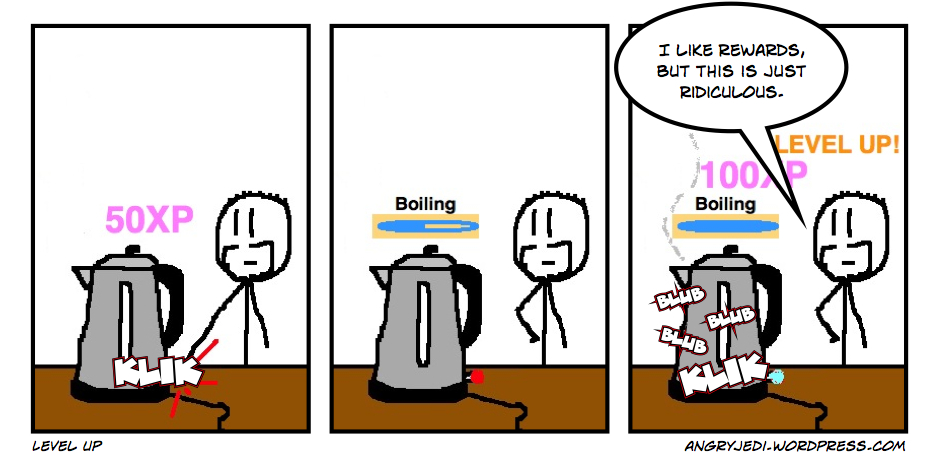
Fortunately, it doesn't have to be this way. There are a few developers out there who are starting to produce games which have some actual substance to them, even if almost every single one of them insists on including an utterly meaningless, pointless experience point/levelling system. Memo to Facebook game developers: you don't "need" that to be competitive. Make a game that's addictive and fun and people will come back of their own volition. You don't need some arbitrary, meaningless, substanceless "reward" to keep people dangling on your Fish-Hook of +5 Monetization. So stop it.

Anyway. Here's 5 Facebook games that aren't shit.

Bejeweled Blitz

The grand-daddy of Facebook Games that Aren't Shit is surely PopCap's minute-long masterpiece. Featuring the match-three gameplay of Bejeweled condensed into a frantic, hectic minute of scoring points that is, to be honest, more luck-based than anything else, Blitz is great fun and enormously competitive thanks to the weekly-resetting friend leaderboards. Even better, the mobile versions also work with the Facebook scoreboards, allowing you to challenge friends on the go. Go play!

Zuma Blitz

See above, only you're playing Zuma instead. You're still matching groups of three or more colours together, only this time you're trying not to let them drop down a big hole. Frantic and arguably more skill-based than Bejeweled, this is another good choice for daytime timewasting. Go play!

Asteroids Online

This game combines the structure of obnoxious gameplay-free experiences like Mafia Wars and actually adds some gameplay to it. Offering a wide variety of missions and some surprisingly impressive (for a web game, anyway) polygonal graphics, this is a good, challenging choice for anyone who grew up with the old Atari classics. Go play!

Where in the World is Carmen Sandiego?

A fun, educational detective game particularly suitable for younger players. You can use it as a means of testing your geographical knowledge and deductive reasoning, or you can cheat (a bit) and using Google/Wikipedia to help you work things out. Either way, it's a lot of fun, even if it does have a completely pointless levelling system that I really, genuinely can't see any reason for whatsoever. Go play!

Robot Unicorn Attack

One of the quintessential two-button platformers out there, Robot Unicorn Attack is always a pleasure to play, largely because of its soundtrack. Now it's approximately seven thousand times as competitive thanks to Bejeweled-style friend leaderboards. Pity the iPhone version doesn't sync with these, however. Go play!

Dishonorable Mention: Scrabble

Fuck Facebook Scrabble. Why? Facebook should be the perfect platform for asynchronous wordplay. Well, two reasons: firstly, dumb copyright issues meaning that there are separate Facebook apps for the US/Canada and the rest of the world, meaning that if you have any friends in North America and you yourself are not in North America, you can't play them. And secondly, the non-American version features some of the most obnoxious, annoying, obtrusive pre-game advertising I've ever had the misfortune to see. Stick to Words with Friends on your smartphone. It's now available for Android, you know.

Honorable Mention: Word Scramble

Basically Boggle, this is a genuinely fun and competitive word game that would be much better if it actually told you when it was your turn. There's also a decent iPhone version of the game which sadly doesn't appear to sync with the Facebook version. Go play!

#oneaday, Day 84: Eternally Questing

Giant Bomb recently launched a quest system on their site. It rewards participants with experience points, badges and a sense of "yay" for exploring the site, looking at different pages and taking part in various activities. Some of the quests are as simple as setting up your profile. Others are more complex "puzzly" ones that require one to solve some cryptic clues about games and game culture. It's a lot of fun, and it actually convinced me to sign up to the site and make greater use of it.

This echoes the thoughts of social game designers at GDC a while back, including Brian Reynolds from Zynga. The idea of getting Achievements for things you do in "reality". It sounded stupid, but given the amount of fun I, and numerous others, have had with Giant Bomb's metagame, it may not be so dumb after all.

It's not the first time it's been tried, either. A very long time ago I posted about a site called PMOG, or the Passively Multiplayer Online Game. This game, actually a Firefox addon that sits atop your normal browser interface and re-christened The Nethernet a while back, allows players to earn experience points, achievements and items for exploring the web. More than that, though, other players can leave stuff on web pages for others to discover. These could be malicious (bombs, which make your browser shake about a bit and cause you to lose some points) or helpful (crates with money in them). They could also be mysterious portals, which lead to random places on the web, the destinations of which are only known to the portal's creator. It was an interesting concept let down only by the fact that it only worked in Firefox. Since Chrome came to Mac, I haven't touched Firefox since, the Mac version not being the greatest piece of coding there ever was.

Then there's Shuffletime, now sadly defunct – although the developers claim to be working on the "Next Big Thing". Shuffletime was a great idea – it was a collectible card game where the cards were websites. And you only got to collect the card if you correctly answered a question about the site it was showing you against a strict time limit. It was a fantastically addictive game, and a fine way to get people looking around the web at things they wouldn't normally. I'm sorry to see it go, but I'm sure something interesting will come out of it.

Like them or loathe them, Achievements and Trophies are here to say. And it's entirely possible that their influence will spread out of the world of core gaming and into the collective awareness of the web at large. Let's face it, it's always nice to get some encouragement isn't it?

Now, how many Gamerscore is hitting 100 One A Day posts worth?