1547: Reading Steiner

A lengthy Steins;Gate session this evening coupled with a chat about Saya no Uta (aka Song of Saya, a game I haven't played but am looking forward to trying) with my friend Mark has reminded me both how and why I love the visual novel medium.

I use the word "medium" when referring to visual novels rather than "genre" because in many cases, it's not entirely accurate to call them "games", despite the fact that they tend to be festooned in the trappings of video games. Most tend to include some sort of metagame element, be it a simple checklist of endings, a CG gallery with a completion percentage or, in the case of more complex games like Steins;Gate, even achievements. Most of them are presented in a distinctly game-like fashion, with console-style main menus that make pleasing noises when you click on them, colourful but clear text boxes with a little spinny thing in the corner that tells you when you've reached the end of the current paragraph, and all manner of other things.

And yet they're not games. Not really. They're interactive stories — some having no more than one or two meaningful choices over the course of the entire narrative, and some even eschewing the element of choice whatsoever — that make use of multimedia presentation to distinguish themselves from, you know, reading a book. The combination of static background images, static or lightly animated characters, music, voice acting, sound effects and text all combine to create a very distinctive effect — and one that can be a powerful poke to the imagination.

Books, of course, are the poster childs for stoking the fires of the imagination, but visual novels also do this, albeit in a different way. Whereas in a book it's left largely up to you how you picture the scene unfolding in front of you, in visual novels you tend to get a bit more in the way of audio-visual cues. You can hear the characters' voices (at least you can in recent releases; earlier VNs were text-only), you can see the characters, you can hear the music giving you an idea of the overall mood and, if the scene is a particularly important one, there'll be an "event" image depicting a dramatic moment from whatever is happening.

Far from being an inferior means of stirring the imagination, this approach works in a different way. While books provide the stimulus for mental pictures through descriptive text, visual novels simply use their multimedia element to do so, which allows them to cut back a little on the descriptive text and instead explore the protagonist's innermost thoughts, or engage in some snappy dialogue between characters.

Visual novels present a particularly good means of expressing a first-person narrative. While in first-person perspective books you tend to feel like you're just along for the ride, in visual novels it feels like you're taking a much more active role — even if your influence on the overall story is minimal. You're sitting inside the main character's mind looking out through their eyes and listening to their innermost thoughts — and even if the main character is some sort of awful jerk (as they often are in visual novels) this provides a very good means of exploring that character, why they are an awful jerk and how they may or may not go about changing themselves. Character growth! How about that.

This isn't to say visual novels have to be confined to first-person narratives, however. No; in fact, it can be very effective for a visual novel to "cut away" to another character, or even a complete shift in perspective to third-person. Nitroplus' visual novel Deus Machina Demonbane is a particularly good example of this being used effectively; during its first-person sections, it's something of a film noir tale about a down-on-his-luck detective and how he becomes embroiled in a series of increasingly ridiculous events. During its third-person sections, however, the true scale of what Kujou is involved in becomes apparent thanks to being able to get an overall picture of what is going on — coupled with the authentically overblown and distinctly Lovecraftian narration that accompanies these scenes.

Steins;Gate, also from Nitroplus, is a little more traditional than Demonbane in that it remains firmly stuck inside the protagonist's mind, but my gosh what an interesting head to be stuck inside, for Rintaro Okabe is a strange individual indeed — seemingly convinced he's a mad scientist named Hououin Kyouma (which his voice actor bellows with admirable aplomb every time it comes up in the script) who is being pursued by "The Organisation", it's not entirely clear for a lot of the game whether Okabe genuinely has a screw loose or if he's just playing up for the people around him. The sheer ridiculousness of his statements would seem to suggest the latter, but then he does something so outrageous that you have to wonder about his mental state. And when Steins;Gate's overarching narrative threads start to get moving, things become even more murky.

The upshot of this is that Okabe becomes something of an unreliable narrator. And this is something that visual novels are particularly good at exploring. Saya no Uta is another particularly good example from what little I know of it, but there are countless others, too; when you're observing a narrative from a first-person perspective, after all, you're only getting one person's perspective on it — and how can you be sure that person is telling the truth?

That's the question, huh? Anyway. That's that for now. Check out Steins;Gate if you've got a yawning chasm in your life that can only be filled by utterly fascinating sci-fi; full review coming soon on USgamer.

1478: Virtue's Numerous Penultimate Rewards

Feb 4 -- PathsI'm still plugging away at the sequel to 999, Virtue's Last Reward. This is an interesting game in many ways, but one of the most fascinating things I've found about it so far is how it's far more willing to withhold an ending from you than 999 was. In 999, there was only one ending that had a "prerequisite" — i.e. you had to finish one path before you could finish the "true" path — but in Virtue's Last Reward, there are numerous plot branches that end prematurely with a "To Be Continued" message that may only be unlocked using knowledge obtained in one of the other narrative paths. Consequently, a big part of the game's challenge looks set to revolve around determining precisely which order you should do things in.

To speak too much about this aspect of the game and why it's structured in this way would be to get somewhat spoileriffic, and I know that at least one person who might be reading this is currently playing through the game at the same time as me, a number of hours behind where I am. As such, I'll refrain from discussing this aspect of it too publicly for the moment and satisfy myself simply by saying that I find this approach really interesting.

It's one of the things I like best about the visual novel medium, as it happens. It's also one of the main means through which the visual novel medium distinguishes itself from conventional novels and other linear forms of storytelling. The branching nature of visual novels means the medium inherently lends itself to a form of storytelling whereby you only get the complete picture of what is going on by seeing things from multiple perspectives. And I'm not necessarily talking about switching narration perspectives to different characters — in most cases I'm simply talking about the protagonist making different choices, proceeding down a different path and consequently demonstrating a different side to themselves.

In some cases, these different paths are manifested as the protagonist changing in different ways. In Katawa Shoujo, for example, each narrative path sees the protagonist learning something from his chosen partner, and growing into a markedly different person as a result. He's still Hisao at heart, but each of the girls bring a different aspect of him to the forefront — Rin brings out his artistic side, for example, while Emi encourages him to never give up and to always keep on with whatever he's put his mind to.

In other cases, these different paths simply allow us to see how the protagonist responds to different life situations. In Kira Kira, for example, each of the main narrative paths corresponds to each of the very different female members of the cast, each of whom have their own story to tell. By seeing all of these stories through to their conclusion, you get a complete picture of who they are — and perhaps the reasons they do the things they do.

One of the best examples I can think of in recent memory is School Days HQ, too. I'm still yet to see 100% of the scenes in this, but I've seen enough of the endings to know that knowledge gained in some narrative paths can completely change the way you look at others. What may superficially seem to be a romantic scene can be tinged with sadness or tragedy when approached from a different angle with different knowledge already in your mind. And if you're unfortunate enough to catch that game's most notorious bad ending on your first run through… well, I pity you trying to see the rest of the game in the same way afterwards.

Rather than separating narrative paths into their own discrete threads that neatly tie themselves up, then leaving the player to do all the mental fingerwork to weave them all together into a complete picture, it seems that Virtue's Last Reward is deliberately structured in such a way as to encourage you to explore all the different options — including the "bad" endings. In the path I played tonight, making a "bad" choice ultimately proved to be something I actually needed to do in order to progress the story further down another route. That's something I've never seen before, and it's proving to be a real highlight of the experience for me.

But as I say, in discussing this we're getting dangerously close to spoiler territory, and I'm keen to avoid that. So I'll leave that there… and now I'm off to go and see if I can't actually make it to one of the endings before I go to sleep this evening.

1277: Failing to Resist the Urge to Call This Post 'Rim Job'

I'M SORRY. (I'm not sorry.)

I went to see Pacific Rim this evening with my similarly-named friends Tim and Tom. This, along with Akira the other night, means that I've officially been to the cinema more times in the past week than I have in the last year.

As for Pacific Rim, it was enjoyable, if cheesy. Good, dumb fun on the surface, but a movie clearly designed with an appreciation — possibly even reverence — for Japanese giant robot anime. Throughout the whole thing, I couldn't help thinking that the movie might have been better just as a straight-up anime. In fact, partway through the movie, I found myself making mental comparisons with the visual novel Deus Machina Demonbane, with which Pacific Rim actually shares a significant number of similarities.

Lest you're unfamiliar with Deus Machina Demonbane but have seen Pacific Rim, the former is a visual novel about giant robots battling monsters loosely inspired by the work of HP Lovecraft; the latter is a movie about giant robots battling monsters with too many mouths. Already quite similar, albeit the Lovecraftian twist on Demonbane is a pleasant break from the norm.

Then we have the whole "you need two people to pilot a giant robot" thing, which is present in both Demonbane and Pacific Rim; in the former, the pilot is paired up with a "tome" (in the case of the protagonist, an absolutely adorable personification of the Necronimicon), while in the latter, two people have to "drift" together and share their consciousness, or memories, or something.

Then there's the fact that the main "hero" robot gets the crap kicked out of it repeatedly, yet somehow always gets repaired to immaculate condition every time, which is present in both works.

And the fact that the giant robots fighting do just as much damage — if not more so — to the places they're trying to protect than the monsters they're fighting, which is, again, present in both works.

Demonbane does have a bit of a twist in that the antagonists are given personalities and stories of their own, rather than just being "GRRR ARRGH MONSTERS". There's an overall "bad guy" in Demonbane, who is responsible for the Lovecraftian beasts invading our dimension, and there are some truly loathsome "lieutenants" who give the protagonist and the other characters in the story a lot of grief, to say the least.

Also, there is more fucking in Demonbane, while there is none in Pacific Rim, what with it being a 12A and all while Demonbane is an adults-only title. For the most part, the sexual scenes in Demonbane are more horrific than titillating, though; it's one of those "I can't fap to this!" games, unless you have some seriously weird tastes. Likewise, you cannot fap to Pacific Rimbut for different reasons.

Anyway, I guess what I'm saying is that if you enjoyed Pacific Rim and you're open to the idea of playing sexually explicit visual novels, then you should give Deus Machina Demonbane a look. It's one of the more memorable, well-written visual novels I've played in my time, and it's satisfyingly hefty in length, too, particularly if you go for all the endings.

I am hot and sweaty. I am going to drink something cold and go to bed. Good night.

1104: Tsuntsun, Deredere

Page_1It's funny to think that it was only this time last year that I played Katawa Shoujo, rekindled my love for all things Japanese and got properly "into" the visual novel medium. Over the course of last year, I played a bunch of VNs and took some tentative steps into the world of anime, too, and I haven't really looked back since. I've found a medium (well, several forms of closely-related media, really) that "speaks" to me, and that's always a pleasant feeling, particularly when there is a whole shitload of stuff in that medium for you to explore and discover.

Because it was only last year that I got into all this shit, though, it was only last year that I found out what the word "tsundere" means. I had occasionally heard it mentioned by people I knew were into anime and Japanese games, but I'd never thought to look it up before — perhaps because I assumed it was an obscure, specialist piece of jargon relating to something that I wasn't, at the time, particularly immersed in.

There's a good chance that there are a few of you reading this who have absolutely no fucking idea what I'm talking about right now, so allow me to educate you. Then you can walk away from one of these posts feeling like you've learned something for once. Wouldn't that be nice? Of course it would. Let's go, then.

"Tsundere" is a word primarily (though not exclusively) used in relation to characters in Japanese media (manga, anime, games and everything in between) who run "hot and cold". Tsunderes are usually female, though not always. The word is a portmanteau that combines parts of two different words to describe the two main moods of the character — tsuntsun describes the part of the personality that is aloof and/or irritable or even outright hostile; deredere describes the soft, squishy and adorable lovestruck centre that the abrasive exterior is protecting.

The tsundere is a stock character in a variety of Japanese works, and can pretty much be guaranteed to put in an appearance in any "harem" stories — i.e. those that include a male protagonist and a disparate gaggle of female heroines who flock to him for various reasons that are not always to do with love or sexuality. (Popular anime Sword Art Online has been described by some as a harem work, for example; even though the main focus of the story is on the romantic relationship between protagonist Kirito and female lead Asuna rather than Kirito attempting to knob his way around cyberspace, a number of episodes introduce a female character who is drawn to the protagonist for some reason before disappearing without a trace by the next episode.) They are a character type that is obviously exaggerated for either comic or dramatic effect — sometimes both — and thus it's unlikely that you'd find a real-life tsundere. At least, not one that takes quite the same form as you'd see one in an anime or game.

The tsundere can be recognised through a number of different means. Most commonly, it's through the use of the iconic combo of stuttering slightly when around the object of their affections, and the curiously-specific denial of something that belies their deredere side through what initially appears to be tsuntsun behaviour. ("What? I-it's not like I've been thinking about you or anything…!") Other tell-tale signs include excessive use of the word "baka" (idiot, stupid) for the slightest misdemeanour and blushing beet red when confronted with an obviously romantic or sexual situation that they haven't steeled themselves for.

Most tsunderes have tsuntsun as their default behaviour pattern and lapse into deredere when they let their guard down, but characters who represent an inversion of this format exist, too, spending most of their time adorably lovestruck and occasionally lapsing into abrasiveness and hostility if provoked. The latter type can easily be confused with the yandere, which also has deredere as their default behaviour type, but hides proper full-on psychotic mania underneath if the object of their affections either doesn't want them or is taken away from them. (A tell-tale sign that an anime yandere is about to go bonkers, incidentally, is that their eyes go completely blank, lacking the usual "sparkles" seen in the corner of anime eyes. If a character goes like that, you should probably get worried, and you can pretty much guarantee that someone is going to die very soon.)

Yanderes aside, the tsundere's behaviour is usually tolerated and accepted by their friends, and rarely commented on directly — it's just the sort of person they are. The object of their affections usually has to take the brunt of the tsuntsun side, but close friends who want to help the tsundere get closer to the person they obviously like often have to deal with this, too. More often than not, the long-suffering best friend either just shakes it off or is completely oblivious to it, having presumably learned to tune it out a long time ago.

There's something oddly attractive about a tsundere character, which probably explains why it's such a commonly-appearing trope. I couldn't possibly speak for everyone on why this is, but from my own personal perspective, I find the commonly-used "hard-hearted bitch showing a softer side" approach to be an effective one that helps me to sympathise with the characters in the relationship. Reasons that "tsuntsun by default" tsunderes act the way they do vary by story, but one thing is constant — letting that deredere side out is a sign that they're letting down the barriers around themselves and showing another character that they both trust them and care about them. It can be a very touching moment if handled effectively.

Here are a few of my favourite tsunderes. Oh come on, you knew this was coming.

noireNoire (Hyperdimension Neptunia)

Noire, the character who represents Sony and the PlayStation in the Hyperdimension Neptunia series of games, is very obviously a tsundere thanks to her regular use of curiously-specific denials when talking to Neptune in particular. She seems aloof, arrogant and abrasive most of the time, but gradually reveals herself to be someone who just really likes to try and do their best at all times. She obviously likes Neptune, despite what often appears to be open hostility, and has found that her efforts to make the land of Lastation as good as it can be have left her lonely.

President4Irina (My Girlfriend is the President)

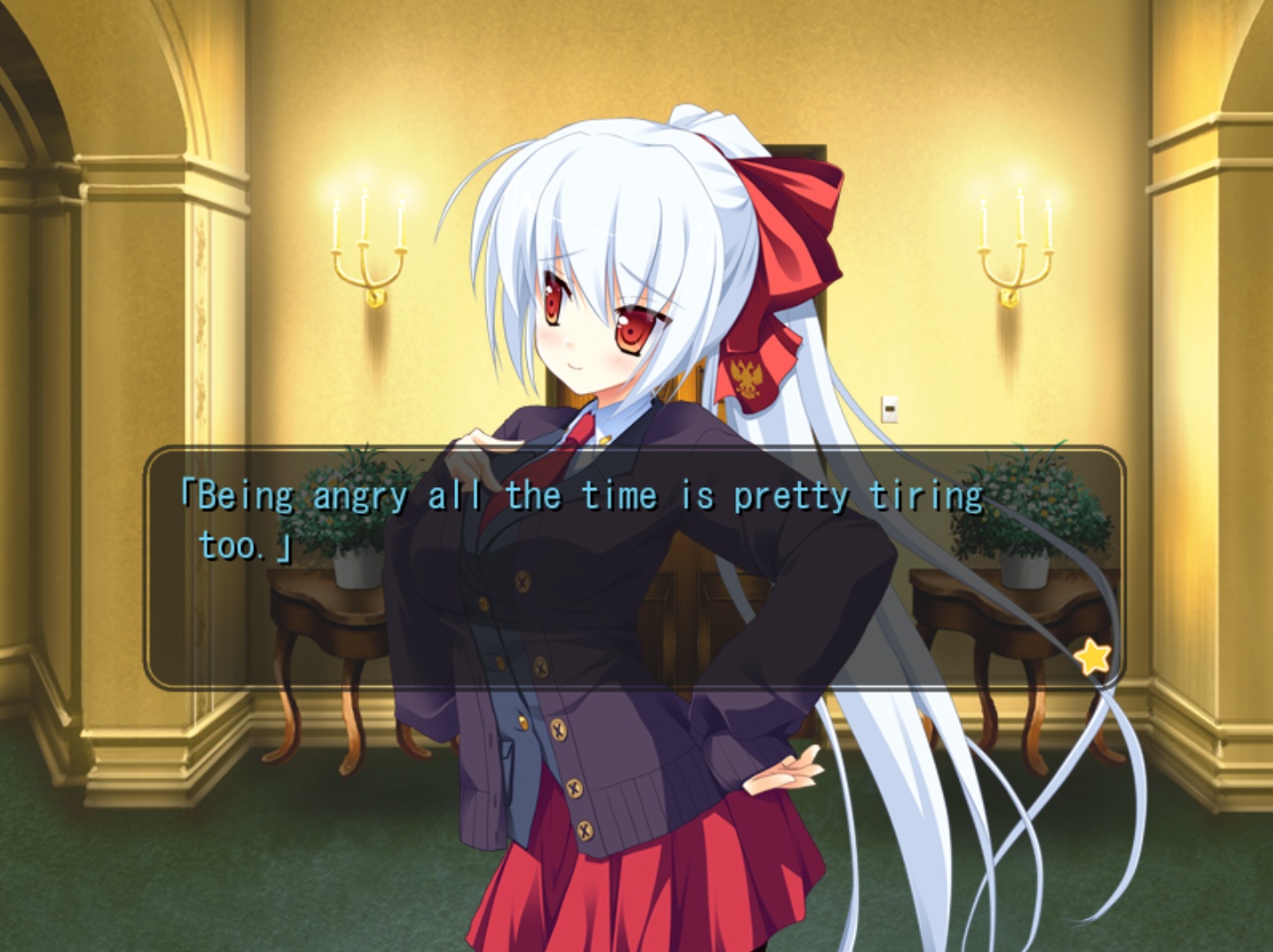
Irina Vladimirovna Putina, the Rusian [sic] president in the visual novel My Girlfriend is the President, is a textbook tsundere. Spending most of her time early in the game alternating between yelling at the protagonist Junichiro and twatting him around the head with her slapping fan every time he does something pervy (which is quite often), she eventually shows a softer side and ends up being a positive influence on Jun. Jun also has a positive effect on her; while she manages to mellow him out somewhat, his easygoing nature helps her be less uptight.

Yuru Yuri no Uta Series 07 - Sugiura AyanoAyano (Yuru Yuri)

Poor old Ayano is the butt of a bunch of jokes in the slice-of-life anime Yuru Yuri. The feisty redhead is obviously carrying a rather large torch for resident chaotic character Kyoko and is completely unable to express her feelings adequately, instead regularly flying into a blind rage at Kyoko's slightest misdemeanours. Kyoko, being Kyoko, doesn't mind at all, and is oblivious to Ayano's feelings. The only one who is truly aware of Ayano's crush is student council member Chitose, who regularly fantasises about the pair of them, usually resulting in a violent nosebleed.

#oneaday Day 967: I Love You, Irina

I have already said a few positive things about batshit crazy visual novel My Girlfriend is the President on here and done a writeup over at Games Are Evil, but I feel it's worthy of another post as I'm still playing it. My initial writeups were based on a single playthrough, you see, and like any good visual novel worth its salt, there are several possible "routes" through the narrative. (Interestingly, once on a route, there only appears to be one ending and minimal decision-making along the way — something which I thought would bother me a lot more than it does, which is not at all.)

(Author's note: it is nearly 2am and I am tired, so I apologise in advance for incoherent rambling.)

Mild to moderate spoilers follow.

Currently I am about halfway through Irina's route. Irina Putina is the Rusian (sic) president who shows up early in the game's (fixed) first act and then sticks around for varying amounts of time in the remaining three, depending on which route you chose. She's a textbook tsundere in almost every respect, seeming abrasive, grumpy and quick to anger on the surface but regularly demonstrating that she has a soft centre beneath all the slapping. And to be fair to her, protagonist Jun deserves every single slap he gets from her.

Playing Irina's route directly after Yukino (the titular "girlfriend" — actually better translated as "childhood friend") is interesting. On Yukino's route, a huge deal was made out of her history with Jun, particularly a key event in their past which made them the close friends (and, later, lovers) that they are in the game's story. On Irina's route, the pair are still very close to one another, but Jun's attitude towards Yukino is markedly different, at least so far as I have progressed. The pair still play with one another — Yukino's "puppy" impression is particularly adorable ("Wan! Wan!") — but over time as Jun becomes increasingly aware of Irina, he becomes self-conscious about his relationship with Yukino and about how he is stringing her along and making her jealous.

Jun, just in case you haven't read my other entries on the subject, is a bit of a dick at the start of the game. Specifically, he's a wannabe sex pest, constantly making inappropriate comments and lusting after his female friends, most of whom know exactly how to put him in his place. It's worth bearing in mind that he is a teenage boy, however, and consequently is wracked with perpetual horniness and no outlet into which to channel this energy. Moreover, his "harassment," as he calls it, doesn't escalate beyond ill-chosen words and an occasional bit of peeping at things he shouldn't. His actions are regularly completely inappropriate, of course, but he could also be much, much worse.

It's this thoroughly objectionable nature that Jun has at the start of the story that allows him to take such a bold personal journey over the course of the narrative, even as utter insanity is unfolding around him and his friends. By beginning as a heavily flawed character, a pervert, he has the potential to grow and change into something better, and the girls of the story provide the catalyst for him to change. In the case of Yukino, he learns to respect and respond to the feelings of others; in the case of Irina, he learns restraint and gentleness. (I can't speak for Ell or Ran as I haven't played their paths at all yet.)

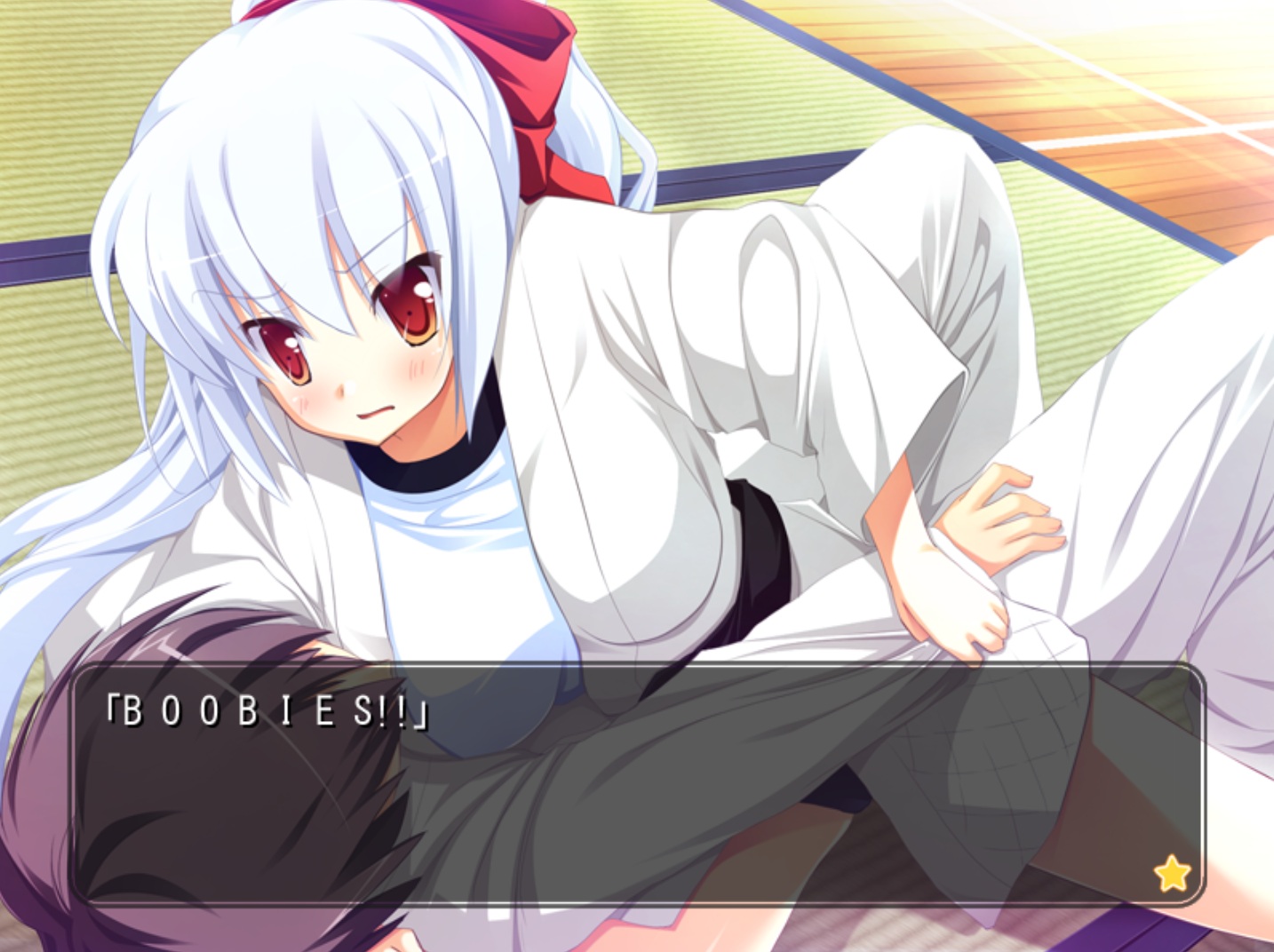
It's actually quite touching to see. We first witness Jun going through some changes on Irina's path when she comes with him to a judo class and shows him her passion for the sport. When he ends up pinned beneath her and starts teasing her about her breasts, she gets absolutely furious at him and storms out. Normally, Old Jun would have just shrugged this off, but he actually feels bad that he has hurt her feelings by mocking something she loves so much. He goes out of his way to try and make things right — even more remarkable given that he knows she's going to leave in a couple of weeks and thus he could just as easily stay out of her way. His feelings grow, and he realises that he wants to make her happy, to give her the opportunity to be a "normal" girl for those two short weeks rather than the "girl president" position she's been lumbered with.

It's an interesting twist on what happens with Yukino's path. When Jun and Yukino become lovers, Jun stands by her, swears to support her and goes out of his way to help her complete her mountains of work — without her knowledge in some cases. As he grows to love Irina, however, he seemingly wants to provide her with an "escape" from reality for a short period, to let her be "herself" rather than the "Rusian Fairy" facade she normally has to keep up.

I really love that a game with such an utterly nonsensical overarching plot as My Girlfriend is the President still has such wonderfully-defined characters and a genuine sense of emotional engagement in its narrative. The game is absolutely masterful at building up sexual tension in particular, meaning the player is right there with Jun throughout, feeling the electricity of every stolen glance, flushed cheek and hesitant word of affection.

That sense of involvement, of being inside the heads of the characters? That's why I love VNs. There are few other places in gaming where you can have such profound experiences.

#oneaday Day 922: Interactive Tales

As you may have realised if you read my lengthy series of pieces about Katawa Shoujo (and one about Kana Little Sister, which I really must get around to replaying), I am a big fan of the "visual novel" genre, a style of video game that tends to be big on story and light on interaction.

I came to this genre through the Ace Attorney series, which remains one of my favourite video game franchises of all time. (Hurry up and release those iOS remakes, Capcom!) Phoenix Wright and its sequels combined the strong sense of narrative, puzzle-solving and dialogue choices from adventure games with a style of presenting the story that really allowed you to get in close with the characters, giving you a real sense of what made them "tick". Audio-visual presentation was very simple, with detailed anime-style characters overlaid over static backdrops, and a large degree of imagination on the part of the player being required.

Ace Attorney is a relatively good entry into the visual novel genre because it's fairly family-friendly (despite being based around solving a variety of murder cases) and doesn't delve into the less salubrious side of things that some of the more "niche" titles explore. There's no fucking in it, basically, despite Franziska von Karma's clear tendencies towards S&M.

I've talked extensively about Katawa Shoujo in the past, so I won't delve into that too much here, but I did want to mention a new acquisition which showed its face on my doorstep today. School Days HQ from JAST, which is apparently a remake of an earlier title of the same name, and an adaptation of an animé I know nothing about aside from something to do with "nice boat". Or possibly some other combination of those things. I'm not sure.

School Days is an unusual visual novel in that it's fully animated. Yes, rather than watching static images and reading mountains of text, the game is essentially an interactive, episodic animé series, where the player watches what unfolds and occasionally makes choices that direct the path of the story — choices that, unusually for the genre, can include remaining silent through inactivity. Structurally, it's identical to something like Katawa Shoujo — decision points branch the narrative down various "paths" leading to either "good" or "bad" endings, and the game client is set up in such a way as to easily allow players to "rewind" and try other choices — the virtual equivalent of putting your fingers in the possible pages you could turn to in a Choose Your Own Adventure book.

I've only played the first of the game's episodes so far, but the setup is intriguing — and, as with most visual novels, pleasingly mundane. Makoto likes Kotonoha. Kotonoha likes Makoto. Both of them are too shy to do anything about it, so in steps Sekai, Makoto's classmate, who manages to get the two of them together but steals a kiss from Makoto as "payment" for her services. Already there have been a couple of hints about Sekai being dangerously unhinged, so I will be very curious to see how the inevitable love triangle unfolds.

But anyway. I'm not here to talk plot. I'm here to talk about this style of game, and wonder what happened over the course of the last twenty years to make it "okay" to develop a narrative-focused game in which the player's interaction is largely limited to occasional choices.

You see, I vividly remember back in the late '90s when the CD-ROM revolution started. The vastly-superior storage capacity of CDs allowed developers to put a whole bunch more content in their games than was previously possible. One of the most common uses of this space was full-motion video — real actors performing scenes in games. And thus, the "interactive movie" was born. The exact implementation of the "interactive movie" genre varied from traditional adventure games which happened to include full-motion video (Sierra's Phantasmagoria and Gabriel Knight: The Beast Within spring to mind here) to titles which already had designs on movies taking the next step (say hello, Wing Commander III and IV) and, at the far end of the spectrum, games that were quite literally movies that sometimes stopped for — you guessed it — the player to make a choice. (Submarine-themed game Silent Steel is the first game of this type that I remember.)

At the time, the latter option was ridiculed for offering only the most rudimentary of gameplay while flaunting the new technology unnecessarily — and often making it painfully apparent that most game developers didn't have the same budgets as movie studios. (How times change, huh?) But now, this style of gameplay has become a firmly-established genre, particularly in the Japanese market, with a little spill-over into the West thanks to publishers like JAST and hard-working enthusiasts like Four Leaf Studios, the crowdsourced team behind Katawa Shoujo.

I'm not complaining, really — I must confess that even in the late '90s I found interactive movies to be something of a guilty pleasure, despite their poor reviews — but I find it interesting that a style of play which many commentators at the time believed would be nothing more than a passing fad is now a firmly-entrenched part of the landscape of gaming. A niche part, sure, but one that certainly doesn't appear to be going away any time soon. School Days is an interactive movie, and unashamedly so — it has rewind and fast-forward buttons at the top of the screen, for heaven's sake — and there certainly seems to be plenty of people clamouring to play it.

Naturally, the apparently popularity of School Days is nothing to do with the fact that it, unlike Ace Attorneydoes have fucking in it. (I also discovered post-install that it supports a USB-connected wanking machine (yes, really, and no, you probably shouldn't click that link at work), which is a mildly terrifying prospect in and of itself. No I don't have one.) Actually, it might be, though perhaps not for the reasons you're doubtless thinking of right now. The visual novel genre represents a sector of gaming that is absolutely unashamed to deal with issues that would be unpalatable to mainstream publishers (and possibly consumers, too). It tackles adult issues — sexuality in its many forms, violence and people acting like people rather than game characters — and does so without patronising the player or being "preachy", unless of course the story calls for it to do so for whatever reason. While there will undoubtedly be those who come to School Days purely to get their rocks off — and the game caters to those people by allowing the sex scenes to be viewed again once they have been "unlocked" in the story (that and the wanking machine compatibility, of course) — I have a sneaking suspicion that a lot of people are attracted to titles like School Days and indeed the visual novel genre in general because, for the most part anyway, it treats them like adults.

Which, coincidentally, is something that a lot of interactive movies failed to do. The lack of budget that many of these titles suffered caused them to feel cheap and nasty, and any violent, sexual or otherwise graphic scenes tended to come across as rather laughable rather than an integral part of the story. Phantasmagoria, for example, featured a "rape" scene that was badly handled and clearly put in purely for shock value. Mention of this notorious scene made up a significant proportion of the game's viral marketing, though when it actually came down to it, it was terribly executed, poorly acted and had the complete opposite effect to what such a scene should have. Instead of being horrifying, traumatic and, most importantly, mature, it was just laughable, embarrassing, dumb. Compare and contrast, meanwhile, with a number of very uncomfortable scenes in, say, Katawa Shoujo (and I'm guessing the later stages of School Days, given the fact that it carries a warning for "violence" as well as "sexual content" on its box), all of which were thought-provoking, respectful of the player's intelligence and had a strong, real impact.

As I drift further and further away from the "blockbusters" of the games industry to get my entertainment, it pleases me that certain barriers seem to be gradually collapsing. While once the prospect of playing an "eroge" visual novel would be shameful, now people will happily and freely admit to it — thanks, at least in part, to a much better cultural understanding of the difference between "porn" and "containing erotic content". (That said, people are a lot more open about their porn consumption these days, too.) While I wouldn't recommend titles like School Days or Katawa Shoujo to someone not mature (or open-minded) enough to be able to handle their content, I'm very happy that they exist, providing true entertainment for adults without any of the associated skeeziness of porn.

(I can't get away from that wanking machine option in the menus, though. That's just odd. Does the game prompt you when to get your knob out? And how do you… oh, no. Never mind. Probably best not to think about it too much.)

#oneaday Day 100: What a Novelty

[Side note: Day 100! Yay. This marks my 448th day of blogging every day. I've been half-tempted to start numbering the posts from when I originally started again, but then that will just get confusing. Perhaps I'll put the total number at the end of each post or something. I don't have an eventual goal number in mind—I fully intend to keep doing this until I can't do it any more, for whatever reason. But given that I continued writing through the disastrous events of last year, it'll take something pretty severe to stop me being here every day. Now, on to your regularly scheduled blog post.]
I can't program. Actually, that's a lie; I wrote a very good Treasure Hunt game in ATARI BASIC once. It used Graphics Mode 2, a custom character set, featured a randomly-generated playfield and custom sound effects. Okay, it perhaps wasn't "very good" but it was at least a completed project. Since then, though, my programming knowledge has tailed off somewhat. It's when everyone stopped using line numbers that it got confusing. I know ditching line numbers was actually a good thing in that you could more easily insert code where it needed to go rather than having to resort to increasingly-convoluted GOSUB/RETURN subroutines, but as soon as all these punctuation rules started to come in? Hmmm.

Perhaps it's just that I haven't spent enough time trying to learn one language. I spent a bit of time doing JavaScript and managed to get some fancy DHTML working, but have since forgotten it. I did some Java once, though it didn't do much. I worked my way through the first two chapters of a C# (pronounced "C-sharp", for anyone who had been wondering about it for as long as I had before I eventually found out) book and thought I was doing pretty well until I got to the first "independent project" type chapter and completely failed to produce the program required.

This is why I enjoy tools that allow you to express your creativity without having to know how to write a complete program. Sure, if you need to do something exciting, you can (and probably will) delve into scripting, but for the most part, the built-in tools are enough to get something up and running.

Over the years, I've used many different tools like this. By far my most beloved (and now outdated) is Klik & Play from Clickteam, which later became Games Factory and Multimedia Fusion. These required absolutely no programming knowledge whatsoever and simply a logical mind to figure out a series of "When this happens, make this happen" statements. Winner. And surprisingly flexible.

I'm also a big fan of the RPG Maker series, especially the later ones that do include a scripting language that allows people far cleverer than me to completely replace the game's battle system with something cool.

Most recently, I've come across Novelty, which is a tool for making Japanese-style visual novels. This is a completely free application—though still in beta—and is one of the most polished pieces of free software I've ever seen. It's incredibly flexible and allows for everything from barely-interactive "click to continue" visual novels that don't require any player decisions, to more in-depth Phoenix Wright-style affairs with buttons, hotspots, branching story paths and all sorts. There's not only a scripting language, but also an impressive markup language for creating graphical assets. There's no need to delve into these if you don't want to, of course, but for "power users" they'll be a boon I'm sure.

My only trouble with tools like these is that I have trouble getting started on something. I get some grand plan in my mind and either end up getting daunted by all the preparatory work which will need to be done (gathering/creating assets, planning and whatnot) or find myself starting, getting too ambitious and bumping into an insurmountable roadblock.

Still, it's nice to know these tools are out there for creative types. I have idle plans to experiment with making some sort of visual novel, but whether or not that will ever happen is anyone's guess.

void blog(string bollocks)
{
     Object@ myBlog = GetObject("Blog");
     if (myBlog !is null)
     {
            myBlog.SetText(bollocks);
     }
}

See? No problem at all.

blog("Cock! Piss! Partridge!")

Day 448

#oneaday Day 96: Don't Take It Personally, Babe

The thing I like about games that are a bit off the beaten track is the fact that they're not afraid to break with every gaming convention under the sun in order to try something a bit different. Objectively, sometimes they're not great "games" in the traditional sense, but they are definitely worthwhile experiences that explore interesting new ways of telling stories.

One "author" who produces such games is Christine Love, who is fond of creating ren'ai titles. For the uninitiated, ren'ai games have strong plot elements of romantic love. They're not necessarily dating sims or hentai games—though some are—but all of them have a narrative which explores love and emotions. Final Fantasy VIII, for example, is regarded as a ren'ai game. Stretching the definition somewhat, you could even argue Silent Hill 2 has elements of the genre.

The appropriately-named Love's titles, however, are much more up-front about their intentions. Digital: A Love Story and the oddly-named Don't Take It Personally, Babe, It Just Ain't Your Story are two games which go about telling a ren'ai tale in similar, though markedly different fashions. Both of them revolve heavily around the use of technology and its role in interpersonal relations.

I'll resist spoiling either of them, but I think they're well worth exploring for anyone interested in the "visual novel" genre—anyone who liked games such as the Ace Attorney series, 999 or Hotel Dusk, for example.

Digital: A Love Story sits you at the desk of an Amiga (or rather, a non-copyright infringing equivalent) five minutes into the future of 1988. Purely by interacting with your computer and dialling up a number of virtual BBS systems, a genuinely compelling tale is told without any graphics whatsoever. You don't "break character" for a single instant in the game, and it's this gameplay "hook" that keeps you playing to see what's going on. I'll say nothing else, as that would spoil it. But it's excellent—if only for nostalgia value. It happens to tell a good story, too.

Don't Take It Personally… is a little different. Taking a more Japanese style to its art, it looks like a dating game, though it isn't one. Casting players in the role of John Rook, a 38-year old double divorcee who came to high school teaching in 2027 as part of a mid-life crisis, it tells a tale which explores interpersonal and social issues that you don't generally see in games. It's a relatively simplistic visual novel in terms of gameplay, with only a few choices to make, but like Digital, it's the story that matters. And it's told in a very interesting way through three different "layers". There's the face-to-face action, where the player, as John, sees and hears what's going on in front of him. John also has access to his students' Facebook-like social network, though, and is able to read any of his students' communications—even the private ones—giving an ethically-questionable insight into what they're thinking and what is really going on behind the dramas that unfold. And thirdly, this game features possibly the only time you'll ever see 4chan (sorry, "12channel") being used as a Greek chorus.

Both games have a "message" and while Don't Take It Personally in particular is a little heavy-handed with it towards the end, it's cool to see games trying to say something a little more than the usual melodrama.

So check 'em out. They take, like, two hours at most each. And they're free. You love free stuff, right?