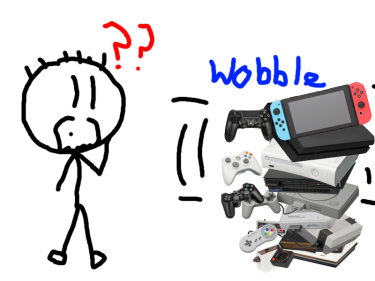
There are a few terms that are bandied around the gaming enthusiast sphere that I've really come to loathe: "gameplay loop" and "quality of life". The reason for this is that any time discussion involving these terms comes up, I find myself pulled right out of any sense of immersion I might have had in something, and start thinking of something purely in terms of its mechanical and structural features.
This isn't necessarily a bad thing in and of itself, of course, because the artistry of video game design isn't just about making pretty graphics, composing stirring music and writing a compelling story. Indeed, there are many games that completely lack a narrative element, making their mechanical and structural elements the important bit you should be looking at if attempting to analyse a title as a creative work in any level of detail.
But there are also times where it just sort of sucks to be aware of the man behind the curtain; of all the things that are going on that make something look interesting and compelling. By being aware of all the digital ropes and pulleys behind the scenes, it becomes harder to suspend your disbelief and treat something as a coherent, creative, artistic work.
I became particularly conscious of this in Final Fantasy XIV over the last couple of years. This is by no means the only example where I've felt this, but it's one where I have felt it particularly keenly, so I'm going to use it as a specific example.
When I started playing Final Fantasy XIV, I absolutely adored it, and it will always be special to me, not least because it's the medium through which I proposed to my wife. But over time, it's started to feel less like an immersive world in which to exist and live another life, and more like a series of buttons to push in order to make the next thing happen.
Part of this is down to predictability. Final Fantasy XIV's main scenario has a predictability problem — not in the narrative itself, but in the way that narrative is delivered. Essentially, it goes like this:
- Arrive at new major location, unlock new fast-travel point
- Do couple of story quests to introduce location
- Map suddenly explodes with sidequest icons, all confined to the location you're in
- Do sidequests (because if you're anything like me, unfinished sidequest icons are complete anathema)
- Do next few story quests
- Map suddenly explodes in sidequest icons again (it always does it twice)
- Do sidequests (see above)
- Do next few story quests
- Do dungeon/trial
- Move on to next major location
- Repeat
I hate that I'm aware of this, and I can't "unsee" it. Because over the course of the last few expansions, I found myself reaching a new location and not thinking "cool, a new place to explore and get to know!" but instead just thinking "those sidequests are going to pop up any minute now, and I'm going to have to do them before I move the story on, even though I've already outlevelled the story by a considerable factor". The whole thing started to feel a bit like it was just doing things by rote precisely because it was so predictable; you never stumbled across someone in the wild who had a cool "secret" quest for you to do, for example.
Part of the reason for this ties in with those terms I used above: "gameplay loop" and "quality of life". The relevance of "gameplay loop" should already be self-evident: it's the predictable sequence of events you go through when you play the game. "Quality of life", though, bears a bit more discussion — and not just because when I hear that term I always think "making your beloved pet/family member comfortable before their imminent death" rather than "making the menus a bit nicer to navigate".
Modern gamers are obsessed with "quality of life improvements" in games. In short, ways to make playing the game more efficient and, supposedly, comfortable. "Quality of life" is why Final Fantasy XIV only ever gives you sidequests in populated areas in big, predictable chunks like this; it's so those who want to power through the story and get to the endgame — where "the real game" starts for many MMO players — can do that, while everyone else can, in theory, take their time over enjoying the story.
Except, as I've outlined above, it doesn't really work like that, because this structural element is so flagrantly transparent that it actively detracts from my feeling of immersion in the game world and whether or not I care about the various communities of non-player characters that I encounter over the course of the story. And it's really hampered my overall enjoyment of the game in recent years.
Some of this is, perhaps, a me problem. But I also think it's symptomatic of a broader problem with gaming in general. Both players and designers are seemingly obsessed with creating an experience that is as "frictionless" as possible, where everything you might want to do in a game is always within arm's reach, and while you might have to put in a bit of time to see everything, you probably won't have to work too hard for it.
In Final Fantasy XIV, this is visible not only through the game design itself, but in the way the western player base seemingly likes to play the game: all third-party externally hosted spreadsheets and timers designed to get each session being as "efficient" as possible rather than just enjoying the ride. I don't like it, and it's not as if I can just ignore it, either, because there are elements of the game — notably The Hunt and FATEs, which both involve things spawning semi-randomly around maps, and which are inevitably dominated by those with a spreadsheet on a second screen to tell them where to go next — that I simply can't engage with due to the way other people play; all because of their obsession with "efficiency" and "quality of life".
As I noted the other day, I'm replaying Xenoblade Chronicles right now. And while this is, to an extent, prone to the exact same problem I describe with Final Fantasy XIV above, it also isn't afraid to throw unexpected elements in your path such as questgivers hiding in an obscure corner of the map or who only appear under certain conditions, nor is it afraid to present you with an objective that you can't just quickly grind out in five minutes. I've had a quest in my log since near the beginning of the game challenging me to demonstrate friendship between two female party members, for example; you don't even get a second female party member to be potential friends with the first one until a good 25+ hours into the game.
Rather than that being annoying, I appreciate that. It's something I keep at the back of my mind while I'm playing and, while it does inform the way I play to a certain extent, I'm not just thinking "I need to do this for a mechanical benefit or to progress the story". It ultimately doesn't matter if I complete that quest or not, though the rewards are nice. But I want to, because Xenoblade Chronicles gets you in a mindset where it's enjoyable to help the virtual people, particularly if it requires some effort on your part. This is, of course, taken to an extreme by the "rebuild Colony 6" sidequest that pretty much lasts the duration of the game, whereby you'll need to find collectible items, enemy drops and recruitable NPCs to rebuild a ruined colony that suffered an attack from the game's main antagonists, the Mechon.
Again, though, because that objective is there as a long-term thing to engage with rather than a throwaway sidequest to power through just so I can see the next main scenario event, I actually give a shit about it. It's not trying to be part of a "gameplay loop" and it certainly doesn't care about your "quality of life" if the drop rate on some of these materials is anything to go by… but y'know what? I like it. I appreciate it. It doesn't feel like the game is pandering to my laziness.
Being aware of a game's structure can hurt the narrative in other ways, too. For example, it's extremely rare that playable characters in an RPG are put into any real peril, meaning that if you see a cutscene where they're suffering, they're probably going to be all right in the end. One could argue that this is a problem shared with serialised television, in which the contracted regular cast members will always be all right regardless of whatever scrapes they get into in each episode (unless their contract's up at the end of the season… RIP Jadzia Dax), but it somehow feels more pronounced in gaming.
There are, of course, rare exceptions to the rule — anyone who played Final Fantasy VII back in 1997 will be well aware of probably the textbook exception — but they don't come up often, particularly in games that go for a somewhat lighter tone. In short, game designers don't want to take away a playable character that people might have invested time and effort into customising and levelling up, because they'll see that as "poor quality of life". It's why you don't often see the "party member becomes the final boss" trope, either; people would be upset, and not because of the way the story went.
In talking about this, I'm reminded of the fuss there was over the ending of Fallout 3, which originally ended with your character selflessly doing… something or other (I forget what) in a heavily irradiated room, meaning the last thing you did in the game was die. I absolutely loved this when I first encountered it, because I thought it was an incredibly symbolic and ballsy thing for the developers to do — even if, when you stopped to think about it, it didn't make a ton of sense, because you were with a radiation-proof mutant at the time who could have quite happily done what you did with absolutely no risk to himself whatsoever.
But to me, that plot hole didn't matter. The ending was dramatic and symbolic. "This is my last act in this horrible world," that ending made you say. "I hope it makes life better for someone." But no. Because people wanted to keep playing after the ending, it got patched out, making the actual end of the story much more of a wet fart in comparison. I lost a lot of respect for Bethesda that day, and it was frustrating to see mechanical and structural elements win out over narrative, making the latter significantly weaker and less impactful than it was before.
Your mileage may vary with all this, and I'm sure it's possible to train your brain out of seeing all the metaphorical Oompa Loompas going about their business. But for me, I kind of long for the days when I was innocent and full of wonder; back then, I never found myself thinking "how did they do that within the constraints of the game engine and overall structure?", because I was too busy thinking "wow, that's cool". And, as I get older, I can't help but feel like that sense of starry-eyed wonderment was much more fun.
Want to read my thoughts on various video games, visual novels and other popular culture things? Stop by MoeGamer.net, my site for all things fun where I am generally a lot more cheerful. And if you fancy watching some vids on classic games, drop by my YouTube channel.
If you want this nonsense in your inbox every day, please feel free to subscribe via email. Your email address won't be used for anything else.