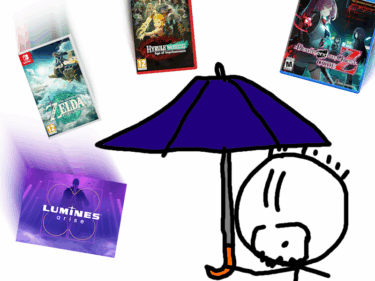
A report came out today that suggested the third-party titles which launched alongside the Nintendo Switch 2 have been somewhat underperforming, and physical retailers in particular have noted, to no-one's surprise, that no-one wants to buy those dumbass Game Key Cards. If someone wants to buy a physical game, they want the actual game.
Now, there are likely multiple explanations for this situation, just one of which is the Game Key Card thing. The other is the fact that many of the third-party titles for the Switch 2 launch are games that are already at least several years old — things like Cyberpunk 2077, Bravely Default and Yakuza Zero being the main examples. Granted, each of those things have new features for their Switch 2 incarnations, but they're still games that are 5+ years old, and which have been widely available on other platforms since their launch. There's only really Bravely Default that isn't super-easy to get hold of any more, and even that's no more than £20 or so for a second-hand 3DS copy.
The optimist in me would like to think that both Nintendo and the third-party publishers who have been trying to push Game Key Cards will see the under-performance of these launch titles as a wake-up call, realise they fucked up and make an effort to reverse course. In an ideal world, I would love to see all the launch titles reissued on full, proper cartridges, no downloads required.
I also know that we do not live in an ideal world. In fact, some might say we live in one of the worst timelines imaginable, and as such I do not think it particularly unreasonable to think that one of two things will actually happen: 1) Nintendo and the third parties plug their ears, go "la la la" and hope that people will just suck up Game Key Cards given no other option, or 2) Nintendo and the third parties go "welp, that didn't work" and pull out of physical releases altogether.
Of the two, I think 1) is the most likely outcome, because Nintendo themselves appear mostly committed to doing actual proper cartridges for their own games. Mario Kart World comes on one, for example, and the upcoming Donkey Kong Bananza does, too, as do the "Nintendo Switch 2 Version" rereleases of stuff like Breath of the Wild, Tears of the Kingdom and suchlike. We've also seen no indication that titles like Metroid Prime 4 will be coming on Game Key Cards.
The issue, I'm told, is that there are actually only two options for publishers to release games physically on Switch: 64GB "full" cartridges, and 1GB Game Key Cards. And the trouble with the 64GB ones is that they're expensive, so even if a game could easily fit on one of them — like Bravely Default — a lot of publishers are baulking at both the extra cost to them, and the consequent business need to pass that cost onto consumers via higher prices. We're already seeing some resistance to things like Mario Kart World costing £75 — quite right, too — and so it's understandable that publishers would hesitate to go down a path that would require them to charge a high price in order to make their money back. To the Game Key Cards' credit, any games released in this way are a bit cheaper — but you're still talking at least £30-35 for most.
No-one has really said exactly why the 64GB cards for Switch 2 are so expensive, but it's presumably to do with them being based on the high-speed access that SD Card Express offers. A 256GB SD Card Express is a lot more expensive than a regular old SD Card of the same capacity, and if the Switch 2 carts are based on the same tech — which one would assume they are, otherwise why would the system require SD Card Express for digital downloads? — then that means that faster flash memory is pricier in general.
There's also the capacity question: 64GB is probably not enough for some modern games, since file sizes for triple-A titles have been ballooning over the 100GB mark for quite some time now. That said, if Cyberpunk 2077 can fit on a 64GB card, I feel like most other things probably can, too. And if not, well, game developers should rediscover the incredible art of compression. The games industry in general used to be really good at that — look at the amazing stuff you could fit on a single floppy disk in the 16-bit era! — but it feels like it just hasn't been a priority for developers in more recent years. After all, if the capacity is there, might as well use it, right…? Maybe it's time to get out of that mindset.
There's not really an easy solution then, though I suspect people would be at least a bit more open to paying a little more for their games if they knew they were absolutely, definitely getting the full game, complete on cartridge. Of course, these days there are things like patches, content updates and DLC to consider also, with many physical releases from the previous generation already being of questionable archival value as a result, one might say this is something of a losing battle.
Not all hope is completely lost, however; several of the limited-print companies such as Strictly Limited Games and Lost In Cult have committed to releasing their stuff on full Switch 2 cartridges, and I have little doubt that others will follow. Given that a significant portion of my Switch 1 library consists of titles from publishers like this, that makes me feel a little better. It is, however, disappointing to see companies like NIS America announcing things like new entries in the Trails series as being on Game Key Cards. Given that there's a strong crossover between those who enjoy niche-interest stuff like Japanese role-playing games and those who buy a lot of physical games — as my own shelves will attest — this feels like an intensely foolish thing to do.
It's early days, so I'm not ready to write physical gaming's obituary just yet. But I hope the data we've seen today actually causes some people to sit up, take notice and ponder if they might not be just a little better off doing things slightly differently.
Want to read my thoughts on various video games, visual novels and other popular culture things? Stop by MoeGamer.net, my site for all things fun where I am generally a lot more cheerful. And if you fancy watching some vids on classic games, drop by my YouTube channel.
If you want this nonsense in your inbox every day, please feel free to subscribe via email. Your email address won't be used for anything else.
Played a bit more Cyberpunk 2077 on Switch 2 today, and I'm really enjoying it so far. I'm starting to get to grips with how to play a bit more stealthily, and it's considerably more gratifying to play this way than going in all guns blazing. The fact you can go in all guns blazing is also gratifying, but after one of the "fixers" telling me I had done sloppy work because in the process of attempting to steal a bit of data, I had murdered everyone in the building, I figured I should learn how to do things a bit more appropriately. I've put all those points into Intelligence and Technical Ability, after all, so I might as well use them!
What's fun about playing stealthily is that it makes each mission feel a bit more varied. Rather than showing up, aggroing the first guard you see and then effectively playing a cover shooter for a bit, you generally have to explore the environment a bit more thoroughly to find suitable means of entry and exit. Canny use of Quickhacks can also allow you to "tag" important objectives, mechanisms and guard positions, so you can keep track of them even when they're not in direct line of sight. And if you take control of security cameras — something you can do with your starter Cyberdeck — you can use their perspective to hack things that aren't within protagonist V's direct line of sight.
I'm anticipating that long-term, you'll probably be able to get into a position where you can complete an entire mission without setting foot inside the building once. I'm not at that point yet, largely because I think I'm lacking some useful Quickhacks for achieving that, but I have reached a point where I can convincingly perform reconnaissance on the target area before attempting to breach it. What then follows is a bit of wandering around outside, usually to find a means of getting on top of the building, and then planning a means of attack that either allows me to avoid everyone, or perhaps perform some silent takedowns.
The silent non-lethal takedowns are immensely satisfying to perform. By sneaking up behind an unaware enemy, you can grab them and drag them into another room before either killing them or knocking them out; the latter option is usually encouraged. Once you have a body, you can then pick it up and move it somewhere, including stuffing it into dumpsters (fatal), the boot of a car (not fatal) or just an out-of-the-way location.
This sort of thing is what I was talking about when I said I hoped Cyberpunk 2077 was going to feel like an old-school PC game. I'm talking sort of Deus Ex and Thief: The Dark Project era. I can't remember the last time I picked up an unconscious body and stashed it somewhere out of sight in a video game. Perhaps that says something about the games I typically play, but it feels like something we don't do a whole lot of in games any more. And that's a shame, because well-implemented stealth sections are a lot of fun.
And there's the rub, I think: I reckon a lot of people, having experienced many bad stealth sections in games, have forgotten what well-implemented stealth is like, and at worst have conditioned themselves to think that stealth is automatically bad. But one thing Cyberpunk 2077 shows is that if you do stealth sections correctly — and by that I mean providing the player with plenty of tools to monitor the situation and strategically plan things out — they can be as fun as all-out gunplay.
Cyberpunk 2077 doesn't do anything especially out of the ordinary. You have a little minimap in the corner of the screen that acts a bit like the radar in Metal Gear games. Enemies can be unaware, cautious or alerted, and it takes a moment for them to "switch" between those states; if you can get out of sight before they fully reach the new state, you can escape their notice. Cameras and security devices can be hacked, manipulated and even turned against enemies. And various things you do — ranging from stumbling over discarded noisy debris to attempting to hack their mainframe — have the potential of giving you away.
Since I'm not very far in the game's main story, I haven't seen a lot of additional options to customise V's cyberware to hack in various different ways, but already I'm starting to see how all this works. My "Netrunner" skill stat is getting a nice workout, and it's satisfying to see that rise with use.
And thus far I've mostly been doing random-ish odd jobs rather than progressing the main story. None of these have felt throwaway, either; they all have narrative context, and feel just as important to the overall setting as the main missions. That's good; it's helping the setting to feel nicely immersive, and making the game a whole lot more enjoyable.
So yeah! I'm glad I picked it up. It looks and runs great on Switch 2 — and with no frame of reference for the PC or PlayStation versions I don't feel like I'm "missing out" on any graphical flourishes — and it's a lot of fun to play. So it may be five years old, but to me it's new, fresh, and exciting — and I'm looking forward to playing more.
Want to read my thoughts on various video games, visual novels and other popular culture things? Stop by MoeGamer.net, my site for all things fun where I am generally a lot more cheerful. And if you fancy watching some vids on classic games, drop by my YouTube channel.
If you want this nonsense in your inbox every day, please feel free to subscribe via email. Your email address won't be used for anything else.
This is a cross-post from my gaming site MoeGamer. I figured if I spent several hours writing this, that absolutely counts as Me Having Written Something for today. So please enjoy, even if you don't normally frequent MoeGamer. I will likely be doing this more going forward.
Last week, I got around to something I've been meaning to do for ages: play through Toby Fox's modern classic Undertale, and attempt to understand why it is so well-regarded and popular.
I'd held off for quite some time for a few reasons: first and foremost was simply a matter of making time for it, since as anyone who knows me will be well aware, I have a lot of video games on my shelves. But I was also quite keen to play the game divorced from the context of its somewhat… passionate fanbase.
I have nothing against the Undertale fanbase, I hasten to add — I've never really come into contact with it directly — but for a game like this, I was keen to approach it with as much of a beginner's mind as possible. I wanted to try and understand what, exactly, it was about Undertale that resonated with people so much when it first released. And I think I got there in the end.
Spoilers follow.
Undertale, for the unfamiliar, casts you in the role of a kind-of-sort-of self-insert character. I say kind-of-sort-of because the protagonist is deliberately gender-ambiguous and you can't customise their appearance. You can customise the way they behave, though, and that's something we'll come back to in a moment.
As Undertale begins, you have fallen down a big hole into the land of monsters. Supposedly, many years ago, humankind and monsters lived together on the surface of the world, but a great war eventually led monsters to becoming trapped underground while humans dominated the surface. This is all the context you're really given at the start of the game; in short order, you meet up with a kind-but-a-bit-too-much monster named Toriel, who wants to take you in and look after you.
Toriel is a rather overbearing, motherly type to a borderline sinister degree, and thus it is natural to want to break free of her clutches and explore the greater world in which you find yourself. You can achieve this in a couple of ways, and herein you get to know probably the most important thing about Undertale, and the tagline it's used in various places in more recent years: this is an RPG where no-one has to die.
It's true! In every combat encounter you run into throughout Undertale, you have the option of fighting the monsters you come face to face with, or attempting to placate or otherwise peacefully resolve the conflict somehow. The exact way you go about this varies from monster to monster, but it is indeed possible to pass through the entire game without anyone dying by your hand.
Interestingly, resolving conflicts peacefully does not reward you with "EXP" that allows you to increase your "LV", meaning that if you choose to do a peaceful playthrough, your character will never get any "stronger". Undertale takes great pains to never actually use the full terms "experience points" and "level" for very good reason: in its world, that is not what "EXP" and "LV" mean. Instead, "EXP" stands for "Execution Points", hence you only acquiring them when you kill someone, and "LV" is short for "LOVE", which in turn is short for Level Of ViolencE.
In combat, regardless of whether or not you choose violence, you will have to fend off enemy attacks in short action sequences loosely inspired by shoot 'em up bullet patterns. By controlling the protagonist's SOUL (all caps, but not an abbreviation or acronym to my knowledge), represented as a heart, you can avoid taking damage from enemy attacks. Each enemy type has its own unique attacks, and the further into the game you go, the more varied these become.
One key variation comes with some enemies' ability to change the colour of the protagonist's SOUL. This causes it to behave in various different ways; for example, when it's blue, it's affected by gravity, meaning it has to "jump" over incoming attacks; when it's purple, it can only move between and across set "wires" on the screen. Enemy attacks also have colours, too; blue attacks are harmless if you stay still, orange attacks are harmless if you're moving when they pass through you, and green "attacks" are actually beneficial, providing a small amount of healing and also often triggering special effects. The green attacks most frequently come up when attempting to peacefully resolve conflicts.
But why might you want to spare the monsters of Undertale, when RPG convention has it that you are "supposed" to kill everything in your path? Well, that's because Undertale makes a specific effort to, for want of a better word considering we're talking about "monsters", humanise everyone and everything you come into contact with. Even fodder enemies have personalities and quirks, and it takes the most steely of resolves to look past all that and murder them. But, crucially, the option is there.
Not only that, but Undertale also keeps track of all manner of other things in the background. If you inadvertently killed someone in a first playthrough and then reset the game without having saved, it will know. On subsequent playthroughs, characters you "haven't met yet" will have recollections of you. And if you went all-out and did a "Genocide" run as your first playthrough, there are some fairly significant differences to how everything concludes.
Undertale is a game that is designed to make you think. Not in the sense that it's especially complicated or difficult to understand, but it really does make you think about the consequences of your actions — and how "game logic" might work were it applied to a "real" situation.
A good example comes if you complete what is known as a "True Pacifist" route. This is only possible after "beating" the game once, and fleshes out the story, resolving in an eventual "true ending" where the monsters finally escape the underground and are able to once again live free on the surface. If you open the game up again after you've reached this ending, the game tells you in no uncertain terms that yes, you absolutely can play again by making use of what it calls a "True Reset", but in doing so you are depriving an entire society — and yourself — of a happy ending. And why are you doing that? Just to see what happens? Is that something you can really justify doing?
A valid response to this is, of course, to say "no, I can't", and to close the game down, never to open it again. You got your happy ending. No need for any "what ifs". No need to satisfy your curiosity as to what might happen if you did the most morally reprehensible thing possible at every opportunity. No need to ruin the lives of a significant number of people.
At the same time, the game absolutely does provide plenty of meaningful changes if you do decide you want to see what might happen if you kill everyone. And then, if you decide to do that "True Pacifist" ending again just to "set everything right", there will be consequences to that, too.
This is the stuff that makes Undertale so clever and noteworthy. The moment-to-moment storytelling and dialogue is charming and memorable — I'd go so far as to say that this is a game with one of the clearest senses of authorial voice I've ever played — but the really interesting stuff comes about once you've been through the whole thing once and you start to contemplate and understand how differently some scenes can unfold depending on your previous actions. Various characters can be seen in rather different lights, and encounters can be resolved in other ways depending on everything from the things you've said to other characters to the objects in your inventory.
Of course, under the hood it's all an illusion based on hidden flags and counters, but in the moment, it absolutely works. Undertale is enormously emotionally engaging from start to finish, and I defy anyone to play through to the conclusion of the True Pacifist route and not at least hesitate before contemplating doing a Genocide run.
As previously noted, a lot of this is down to author Toby Fox's excellent writing, but Fox doesn't just use well-crafted dialogue to infuse his characters with personality; he uses visual elements such as fonts and the case in which characters' text-only dialogue is presented to help you build up a mental picture of each character. Probably the best example of both of these comes in the case of Papyrus and Sans, two skeletal characters you encounter early in the game after freeing yourself from Toriel's oppressive motherliness.
Papyrus is loud, brash and outspoken — if he had voice acting, he'd absolutely sound like Skeletor — but is this way in order to cover up intense insecurity and loneliness. We can tell this from the combination of his facial expressions, the things he says… and the fact that, as his name suggests, all his dialogue is presented in all-caps Papyrus font, a font that certain types of people tend to use if they want people to like them. Not only that, he's so desperate for validation and friendship that even if you've been on a Genocide run up until this point in the game, your encounter with Papyrus represents a key opportunity to turn back and change your ways.
By contrast, Sans is much more chilled out. Again, we can tell this from the way he looks at us and the things he says, but also the fact his dialogue is all in lower case Comic Sans, a font that everyone knows to be awful, but it serves a function. It's little stylistic things like this that are almost entirely unique to video games; one could get away with the typeface thing in written creative works, but here, it's the way this is combined with other visual and auditory elements that makes it work quite so well.
Expand this to a whole 7-10 hour game, with a variety of other characters who are all equally well-crafted and play very different roles on your overall journey, and you have something that really gets deep into the emotional centres of your brain, and which will stay with you long after the credits roll. This is a game where the characters feel real enough for you to be personally invested in them, and where all but the most hard-hearted will find it very difficult to make the decision to put them to death.
At least, that's how I felt about it, anyway. The nice thing about Undertale is that you can also go in completely the other direction with it, and look at it as an experiment in how video game narratives can manipulate one's emotions so that we believe in things which very much are, by their very nature, unthinking, unfeeling fabrications of someone's imagination. There's no logical reason why you should feel "bad" for "killing" a character in a video game, because you're not actually killing them. After all, think about how many anonymous grunts you've shot in the head in other games; how many slobbering monsters you've hacked and slashed your way through in your average RPG; how many societies you've doomed when you've set a game aside, never to return to it.
Among other things, Undertale makes us think about the context of our actions in video games, and how that might translate to something a bit more real. At its heart, it's not trying in the slightest to be "realistic", hence its deliberately slipshod visual presentation; it behooves us, then, to ask exactly why we end up caring so much more about these characters presented in low-resolution, often monochromatic pixel art than we might do about, say, an anonymous enemy soldier in a Call of Duty, or an enemy knight in a strategy RPG.
The answer, probably, is love. We don't care about grunts in a first-person shooter because we're never given any reason to. We have no opportunity to get to know them; they have a single mechanical function, and that is to stop us achieving our objectives. And, in turn, as Sans points out to us in the late game, "the more you kill, the easier it becomes to distance yourself; the more you distance yourself, the less you will hurt… the more easily you can bring yourself to hurt others."
In Undertale, meanwhile, every potential "enemy" is depicted as someone or something that could also, under different circumstances, be a friend. Even characters like Papyrus, who might initially appear to be set up in such a way to be a "villain", with his fixation on capturing you and seeming inability to actually follow through on this, end up expressing their support and validation for you. And a lot of this happens early on, making those first kills — the ones from before you find it "easy to distance yourself" — hard to perform.
Yes, part of Undertale's effectiveness comes from the fact that it makes you feel good. Because you are playing "you" — despite not being able to customise the player avatar — the game and its characters are effectively able to address you directly. And many of the things both the game and the individual characters have to say are positive, uplifting and supportive. Would you punch someone in the face if they told you that they believed in you, and that they could see you were trying your best?
Some of you might, and Undertale accepts that as a valid response. Some of you, like me, might be a lot more open to what is essentially emotional manipulation (positive), and thus find yourself staring at that post-game screen, unable to click "True Reset" and undo everything you'd done up until this point.
So yeah. I get it. Undertale is excellent. And I'm glad I finally understand why.
Want to read my thoughts on various video games, visual novels and other popular culture things? Stop by MoeGamer.net, my site for all things fun where I am generally a lot more cheerful. And if you fancy watching some vids on classic games, drop by my YouTube channel.
If you want this nonsense in your inbox every day, please feel free to subscribe via email. Your email address won't be used for anything else.
I decided to nab Cyberpunk 2077 from the Nintendo Switch 2's launch lineup. I haven't particularly followed the game since its original semi-disastrous launch several years back, but I figured the Switch 2 port would be a good way to jump in with zero expectations. I also wanted to support one of the few third-party developers releasing their game on an actual game card instead of a Game Key Card. Vote with your wallet, send a message and all that.
I'm pretty impressed so far. While the game doesn't run at 4K 60fps, I wasn't expecting it to; it does, however, run at what appears to be a perfectly stable 30fps in 1080p, and it also taught me that my TV apparently does have a 120Hz mode, because despite not actually running at 120fps, it switches to that mode when playing Cyberpunk.
I haven't played a lot of the game so far, but what I was hoping for was something with a similar sort of vibe to classic PC games like Deus Ex. While I don't think Cyberpunk 2077 goes quite as hard on the "immersive sim" side of things as some games like that, I've been enjoying what I've played so far. Playing a CD Projekt game from first-person is a fun novelty, and Night City seems like an interesting location to explore so far. They've also nailed that thing where they drop you into a setting and everyone is using what will initially be unfamiliar slang, but you soon pick up the lingo and feel like you're part of the world.
I haven't really decided what kind of character "my" V is going to be as yet. With games like this, I do often tend to gravitate towards stealthy and hacking-type abilities, but I appreciate there's a stat in this just called "cool", which involves doing cool things like taking down enemies using pistols and being street smart.
Thus far the combat seems to be all right. It's of the "point a gun at someone and numbers pop out of them" variety, but supposedly with the right combination of skills, weapons and good aim, you can do things like knock enemies down with a single headshot and suchlike. The close-up melee combat appears to be a bit cack, however, but no first-person game has ever really nailed this, and at least it's not quite Elder Scrolls levels of wafting blindly at an enemy right in front of you; there is at least a nominal sense of impact when your blows connect.
I think I'm out of what is essentially the tutorial missions now, so I'm going to spend a bit more time with it tonight and see how I get on. I still have several other games on the go so starting a brand new one is probably a terrible idea, but you know how it is. Shiny new toy, you want to try it out as much as you can. And, outside of Mario Kart World, this was probably the most interesting thing from the launch lineup.
So anyway. Cyberpunk 2077 thus far appears to be A Good. Further bulletins as events warrant.
Want to read my thoughts on various video games, visual novels and other popular culture things? Stop by MoeGamer.net, my site for all things fun where I am generally a lot more cheerful. And if you fancy watching some vids on classic games, drop by my YouTube channel.
If you want this nonsense in your inbox every day, please feel free to subscribe via email. Your email address won't be used for anything else.
I've never played Undertale. More impressively, I have somehow not been spoiled on Undertale as yet, but I'm feeling increasingly like I should probably play it. I do own a copy, after all, and now its follow-up Deltarune is out on Switch 2, I feel like the risk of inadvertently stumbling across spoilers in the wild is about to take a sudden spike back up.
I don't really have a good reason for not having played Undertale. It's not that I don't want to play it, it's just never been a particularly high priority for me. Part of that is down to the "reverse hype" thing, where so many people are playing it and making memes about it that I just want it to go away in order to appreciate it on its own merits. In fact, I think that's probably most of the reason I haven't played it as yet. Which is arguably a bit silly, because as I have seen with a number of other games in the past — Clair Obscur: Expedition 33 and Mario Kart World being the most recent ones — it's sometimes fun to feel like you're part of the "current" conversation.
I'm still in the process of weaning myself off the habit of only playing one game at a time. While it definitely pays to devote yourself to something lengthy like Xenoblade Chronicles X (which I'm closing in on 90 hours of) it also certainly doesn't hurt to play some other things in the meantime, too.
The way I've found most helpful of thinking about it is in terms of TV shows: back in the prime of serialised TV shows in the late '90s, you'd watch maybe five or six ongoing shows all at the same time and still be able to keep them all straight in your head, even with a gap of a week in between each episode. While that's not how most people enjoy TV shows today, it absolutely is still possible to watch and enjoy multiple TV shows simultaneously (well, not simultaneously, but you know what I mean) without feeling like you've "abandoned" one in favour of another. And the same should be — is — true for games, too.
Very few games have such an intense structure that they demand your undivided attention for hundreds of hours; in the case of Xenoblade Chronicles X, for example, the main story is split into discrete chapters, and in between each chapter there are a bunch of "side" missions (which are actually also very important to fleshing out the overall setting and narrative) that can be tackled a bit at a time. With that structure, it's easy to find a natural stopping point — on the micro level, after completing a single mission; on a more macro level, after completing a story chapter, or clearing up all the accessible missions between story chapters — and then go do something else for a bit.
So y'know what? This weekend I might just start Undertale. I believe it's not particularly long, either, so it might be a nice palate-cleanser, and then I can play Deltarune and be part of the conversation over that. Maybe.
In fact, I will make that a commitment. Tomorrow I will start Undertale. I have no real commitments for the weekend, so I'll sit down with it, give it some time and see what I think. As I say, I know pretty much nothing about it at all, so I am very interested to finally give it some time.
For now, though, bed. Or maybe a Mario Kart race or two before that…
Want to read my thoughts on various video games, visual novels and other popular culture things? Stop by MoeGamer.net, my site for all things fun where I am generally a lot more cheerful. And if you fancy watching some vids on classic games, drop by my YouTube channel.
If you want this nonsense in your inbox every day, please feel free to subscribe via email. Your email address won't be used for anything else.
Come on, Nintendo, "Switch 2sday" was right there and you blew it. Sega had this shit sorted back in the '90s… although given the trajectory they took shortly afterwards, probably best not to take too many cues from them on the hardware front.
Anyway. Yes! It is the Nintendo Switch 2 launch day and I have been fortunate enough to get one on launch day. I ordered from Argos when pre-orders first went up, and I was half-expecting my order to be cancelled. But no! It arrived mid-afternoon today, so I went through the whole "transfer" process from my original Switch, and I've been happily enjoying Mario Kart World and Ridge Racer this evening.
I'm going to write something more substantial about both of those games over on MoeGamer at some point in the very near future, so I thought today I'd talk a little about my initial experiences with the Switch 2 in general.
Overall, my impressions have been very positive. Outside of the thing refusing to connect to my Wi-Fi on one side of my study (a problem that is by no means exclusive to the Switch 2), everything has gone pretty much as smoothly as you would ever want.
If you're upgrading from an original Switch, there's a straightforward transfer process you can run. This involves putting the two consoles physically close to one another, presumably so they can establish a direct wireless connection between one another, and then triggering the transfer process from both ends, perhaps with a login or two along the way depending on how you have your accounts set up. It even asked for the microSD card from the original Switch to transfer over captured screenshots and videos.
When it was finished (about 15-20 minutes later), all of my saves, settings and account details had been transferred over to the Switch 2, and the Switch 2 made a start on redownloading all the digital software I had on my original Switch. This was fine for my purposes, though those who have larger digital libraries may have run into issues, since the largest microSD Express card you can get for Switch 2 (and it will only take microSD Express, except for the aforementioned screenshot library transfer process) is 256GB. OG Switch, meanwhile, would happily take 512GB or more.
The auto-download thing was fine, but for some reason it did stop partway through and didn't resume. I assume this is because I started doing something that talked to online — that's what generally happened with downloads on the original Switch — but I would have expected it to start downloading again afterwards. This didn't happen. Not a huge issue, since I can easily manually redownload anything I want to put back on the system, because the icons for those pieces of software are there, but it would have been nice for that to be fully automated.
One of the biggest upgrades is to the eShop. No longer a slow, annoying mess to navigate, the Switch 2's eShop seems perfectly functional, and it already has some hentai shovelware games ready to go. So the curation issue isn't exactly solved, but the painful user experience side of things is, at least, fixed now.
I briefly fired up the new Gamecube app you get with a Nintendo Switch Online subscription, and boy, those games sure do look lovely all HD-ified. I'm looking forward to having a play with Soul Calibur II and F-Zero GX in particular; I'm in no hurry to replay Wind Waker, meanwhile, since I played the Wii U version a few years back and while I enjoyed it, I also don't have much desire to play it again just yet.
Handheld, the screen looks lovely. While not OLED, it's bright, large and smooth. Games look great on it. I haven't tried any original Switch titles on it as yet, but Switch 2 stuff looked pin-sharp and super-slick. It's also a bit bigger than the original Switch, meaning it'll probably be more comfortable to play more complex games in handheld mode than the original Switch was. I will likely still keep it connected to the TV for the vast majority of the time, but I feel more inclined to play handheld with that lovely screen than I do the original Switch. No shade on those who primarily played OG Switch handheld; I just preferred the TV experience by quite a considerable margin.
Thus far, then, I'm happy with my purchase. I still have plenty of concerns about things like Game Key Cards, software prices and suchlike, but we'll see how things pan out long-term. I do find myself wondering if Nintendo will be able to capture the same lightning in a bottle that the original Switch was — historically speaking, they've tended to follow an astronomical success (Game Boy, SNES, Wii) with anything from middling-to-solid commercial performance (N64, Gamecube) to catastrophic failure (Virtual Boy, Wii U), so it will be interesting to see where Switch 2 falls on that spectrum… or if it will continue a run of good luck for the company.
Anyway, it doesn't really matter. I have one, I like it and I'm looking forward to playing with it some more. So I'm going to do just that before I head to bed. Mario Kart World calls me!
Want to read my thoughts on various video games, visual novels and other popular culture things? Stop by MoeGamer.net, my site for all things fun where I am generally a lot more cheerful. And if you fancy watching some vids on classic games, drop by my YouTube channel.
If you want this nonsense in your inbox every day, please feel free to subscribe via email. Your email address won't be used for anything else.
Switch 2 is officially out tomorrow. Some folks have been getting theirs today. Mine looks on track to arrive tomorrow, so I should be able to get some time in with Mario Kart World and Arcade Archives 2: Ridge Racer tomorrow evening. Doubtless I will have things to say about both of those.
Today I just wanted to offer a tip of the cap to the original Switch. It's not a "farewell", because the Switch 2 will (hopefully) allow me to continue to enjoy all the original Switch's games, and if not, well, I still have that original Switch.
I love the Switch. I actually don't use its main tentpole function of being a handheld all that much, but I do take advantage of its easily portable nature quite frequently. It's much easier to bundle a Switch case and dock into a suitcase than it is a PlayStation 5, after all, so when I travel, the Switch typically comes with me.
I've also amassed an enormous collection of Switch games — 405, to be exact, if my collection database is to be believed, plus a number of digital-only games. That's more than any other single system in my collection — PS2 comes close with 282, but Switch has definitely been the front-runner for a long time. I would often buy multiplatform games on Switch by preference, even if they weren't the "best" version in terms of graphics and performance; even though I didn't play the games handheld all that much, that aforementioned portability factor remains a great thing.
Plus there's the fact that the Switch plays host to a ton of games that I wanted to play! In particular, it took up the mantle from the PlayStation Vita in terms of anime-inspired RPGs and visual novels, and some clever publishers even found a means of getting full-on sexually explicit games onto a console for the first time. A Nintendo console, at that.
I'm not just talking about lewd games, though. Tons of great Japanese games came — are still coming — to the original Switch, and there are loads on my shelves that I haven't gotten to just yet. The thriving limited-print scene, which I know is divisive, has been particularly strong on Switch for those who want packaged versions of indie games — and best of all for collectors, most of those releases are truly complete on cart in terms of DLC and patches.
Sure, Switch has had its annoyances, most notably Joy-Con drift. I also had a drifting stick on my Pro Controller for a bit, but taking it apart and putting it back together again fixed that and it's been absolutely fine since. The eShop has long been a bit cack, though, both in terms of speed and the amount of AI-generated slop it's been subject to. Early reports would seem to indicate that Switch 2's eShop has taken care of the former issue, and the latter is something more endemic to the entire digital distribution scene, not a Nintendo-exclusive thing by any means.
I think Switch 2 is going to be a lot of fun. I also think it's going to see a few teething troubles, with the most notable being the Game Key Card situation. There are a lot of games that people want to play that are being released on these stupid things, and that concerns me. I do not want the Switch 2 to be a platform that forces me to go all-digital because I like collecting games. My quiet hope is that the early Game Key Card releases are such a flop that the publishers cheaping out by using them rather than proper cartridges will abandon them, Nintendo will quietly retire the practice before long and these games will get reissues on a proper cartridge. But I guess we'll have to wait and see on that. It feels like it might be unlikely, but stranger things have happened.
Anyway, I am looking forward to playing Mario Kart World and Ridge Racer tomorrow, and I, of course, still have to finish off Xenoblade Chronicles X — pity that one doesn't appear to have a "Switch 2 version" upgrade, as it could really benefit from the additional oomph! — so the future, for now, looks bright and enjoyable. And, tomorrow, there will be much racing!
Want to read my thoughts on various video games, visual novels and other popular culture things? Stop by MoeGamer.net, my site for all things fun where I am generally a lot more cheerful. And if you fancy watching some vids on classic games, drop by my YouTube channel.
If you want this nonsense in your inbox every day, please feel free to subscribe via email. Your email address won't be used for anything else.
I've spent the evening playing Kathy Rain 2: Soothsayer. I played Kathy Rain: Director's Cut a few years back and apparently didn't write about it, but suffice to say I enjoyed it. As such, I was excited to see the sequel show up a few days back — one of several interesting-looking adventure games that have released recently.
I've played about 4 hours of it this evening and I'm not sure how far through I am — most estimates seem to place it around 7 hours in total — so I'm not going to give any conclusive thoughts just yet. I'll save those for MoeGamer and/or YouTube another time. I can give some first impressions, though, and those first impressions are very good indeed.
Like its predecessor, Kathy Rain 2: Soothsayer is a point-and-click adventure presented in deliberately low resolution pixel art, albeit making use of modern widescreen resolutions and colour depth to provide a level of detail that wouldn't quite have been possible back in the classic VGA age. It is, I believe, an Adventure Game Studio affair, which accounts for its interface being rather similar to The Excavation of Hob's Barrow, another excellent modern adventure I played a little while back. That's no bad thing, though; Adventure Game Studio is a well-respected engine, used by a lot of modern adventure developers with good reason.
As with most modern adventure games, interactions in Kathy Rain 2: Soothsayer are kept nicely simple. Click on things to either look at them or do something with them, click on inventory items to examine them, drag inventory items onto items in the scene or other inventory items to use them on things. Conversations unfold using a Gabriel Knight-style keyword system, where Kathy accumulates (and erases) keywords over the course of her investigation and can ask interactive characters about them, along with also being able to ask them about things in the scene or her inventory. It's a simple but effective conversation system that works well, and there are occasional traditional dialogue options that appear when Kathy has multiple things to ask about a situation.
Kathy's case this time around is that of a serial killer known as the Soothsayer. This individual has committed five murders over the course of the last few months, with the most recent being a local celebrity writer. As a rather down-on-her-luck private investigator, Kathy sees the $200,000 reward money and decides she'd like a bit of that action, so she proceeds to go about her investigation in her own mildly anarchic style. I say "mildly" because while she flouts a few rules and laws over the course of her investigation, she does draw the line at doing anything likely to get her thrown in prison — or, indeed, lose the confidence of her contact in the police force, who, as you might expect, is a helpful resource to draw upon, particularly as he very much wants to get into Kathy's pants.
Thus far in the 4 hours of play, I haven't felt like I've got "stuck" at all, which is good — and the game has kept up a decent pace as a result. The puzzles, while not super-easy, won't take long to solve for experienced adventure game veterans, but they are nonetheless satisfying. There's no moon logic on display here; everything makes logical sense, and those who really struggle can check out Kathy's notebook to get some hints on the objectives she needs to accomplish. The presence of the notebook and a list of objectives in the first place is a helpful addition not normally present in this type of game; it helps keep you focused without spoiling the sense of player agency or working things out for yourself.
I remember the original Kathy Rain getting a bit weird towards the end — and I didn't have a problem with that, I hasten to add — and I have a suspicion something similar is probably going to happen in this one, too. The "weird bit" of the first Kathy Rain led to some eye-opening revelations about the character, so I will be very surprised if something similar doesn't occur this time around, too. But we'll have to see, I guess.
Thus far, then, I've been thoroughly absorbed by this new investigation. The game looks great, has a wonderfully atmospheric soundtrack and decent voice acting, and it plays very well, too. Plus at what looks like it will be 7-10 hours in total, it's a decent length for this type of game, too — particularly when you consider most of the "golden age" adventures from Sierra and LucasArts could be beaten within an hour or two (or even less, in some cases) if you knew what you were doing.
I'm looking forward to seeing how things end up. At this rate, it's looking like I might beat it tomorrow. I will definitely pen some more substantial thoughts for MoeGamer and/or my YouTube channel when I've finished the whole thing. For now, though, it's an easy recommend for adventure game enthusiasts.
Want to read my thoughts on various video games, visual novels and other popular culture things? Stop by MoeGamer.net, my site for all things fun where I am generally a lot more cheerful. And if you fancy watching some vids on classic games, drop by my YouTube channel.
If you want this nonsense in your inbox every day, please feel free to subscribe via email. Your email address won't be used for anything else.

I think I pinned down what I want to do for some videos. As I've noted a couple of times recently, I've been feeling a bit short on inspiration and motivation of late, and I've been wondering how I might shake things up a bit for myself.
The answer is to do something a bit different to usual! So I'm going to do just that. Specifically, I've set myself the goal of doing two main things this weekend: one, a pre-scripted video on the subject of PS3 racer MotorStorm, which I've only just played for the first time and really like, and secondly, an "Exploring Together" Let's Play-type video on one of the Game Boy games that has just been added to Nintendo Switch Online: a Kemco title called The Sword of Hope.
I'm really interested in the latter. I've never heard of it before — although I must confess that's not hard with me and Game Boy games, since I only had a limited library when I was younger — but I saw someone describe it earlier as a cross between a conventional RPG and the Icom Simulations adventure games. You know, Deja Vu, Uninvited and Shadowgate.
I really like those games! And I really like the NES and Game Boy ports of them, even if they lack a fair old chunk of the text found in the computer originals. So the idea of playing something that appears to be inspired by them, but which adds some additional mechanics over the top rather than just killing you every five seconds, sounds very appealing to me indeed.
I'm going in as blind as possible because I want to include my immediate reactions to the game in the video. And I think, long-term, I'd like to cover some more Game Boy stuff — not just the stuff on Nintendo Switch Online, but in general, too. The Game Boy, Game Boy Color and Game Boy Advance each have vast libraries, and there are some thoroughly interesting titles among them. Presumably because development for these platforms was so cheap — and because they didn't have nearly as much critical scrutiny on them as the TV-connected consoles — developers were, seemingly, quite keen to be very creative with their work on the system. So there's some wonderfully experimental Game Boy (Color/Advance) games out there, and I think there's plenty of scope to explore those through both Nintendo Switch Online and the MiSTer Multisystem 2.
So that's my plan for this weekend. Some of it, anyway. It's a long weekend here in the UK, so I can take my time and enjoy it, then it's back to the ol' grindstone from Tuesday. We've been enduring a particularly busy and stressful period at work for quite some time now, so it's nice to have an extra day off to decompress a bit. It'll all be worth it in the end, though.
Before that, though, bed. Sleep! Sleep is good.
Want to read my thoughts on various video games, visual novels and other popular culture things? Stop by MoeGamer.net, my site for all things fun where I am generally a lot more cheerful. And if you fancy watching some vids on classic games, drop by my YouTube channel.
If you want this nonsense in your inbox every day, please feel free to subscribe via email. Your email address won't be used for anything else.
There are a lot of "boutique" limited-print companies around at the moment, and people inevitably have mixed feelings about them. A lot of people feel particularly negatively about some of them — often without being able to say why, probably because they only hate [company] because some YouTuber told them to — but I enjoy what they do. They provide physical copies of games that, in many (though not all) circumstances otherwise wouldn't have had one. And, even better, most of the time those physical copies are archive-ready, in that in the vast majority of cases, the physical print runs don't get done until all the DLC and updates for the game in question are done and dusted. I like that.
There are some companies who take things a bit further, though, and one that I've found particularly worthy of note just recently is called Lost in Cult. They're kicking off a new programme called EDITIONS, where they're publishing games that, previously, were digital-only.
We'll get onto EDITIONS in a moment, but what is also worthy of note about Lost in Cult is that they're also doing standard retail editions of their games, and these don't appear to be limited in quantity beyond the usual business considerations — i.e. how many they think they'll sell, and how long their licensing agreement is with the games' developers and original publishers. What they're effectively doing with these standard editions is doing a non-limited (in principle) physical print run of games that, on release, were assumed to be digital-only. That's great!
But EDITIONS is what I really want to talk about. EDITIONS are their special, collectors' editions of games. Costing £60 a pop, they come in a custom slipcase that contains the game, a decent-size poster, some miscellaneous goodies to do with the game, and an art/commentary book that explores the history, creative process and impact of the game.
Here's an example covering The Excavation of Hob's Barrow, a point and click adventure I played recently and really rather enjoyed, as my article about it on MoeGamer will attest:
Looks pretty lovely, doesn't it? Simple, but effective, and sure to look very nice as part of a collection.
The other games that are available to preorder from the company now include Immortality, a fascinating-sounding FMV game that I remember one of my writers on Rice Digital having a lot of time for a year or two back. The EDITIONS package for that one looks like this:
And then there's the wonderfully hilarious Thank Goodness You're Here!, which the EDITIONS package for doesn't appear to have been revealed just yet.
As someone who is always banging on about collecting physical games, I felt duty and honour-bound to support these releases. I've played The Excavation of Hob's Barrow before, and I've seen Andie play Thank Goodness You're Here!, but I've never played Immortality, and I'm definitely open to returning to the other two.
Lost in Cult's long-term plan is to have a "book club"-like approach, where they do one of these releases a month after this initial batch of three are out the door. I am well up for that, let me tell you. It, of course, remains to be seen what games will get this wonderful treatment, but judging by the initial picks, I feel like the Lost in Cult folks have good taste.
So I guess that's £60 a month accounted for, then…!
Want to read my thoughts on various video games, visual novels and other popular culture things? Stop by MoeGamer.net, my site for all things fun where I am generally a lot more cheerful. And if you fancy watching some vids on classic games, drop by my YouTube channel.
If you want this nonsense in your inbox every day, please feel free to subscribe via email. Your email address won't be used for anything else.