There was yet another round of Tedious Discourse™ today over what the word "retro" really means, if anything, when it comes to video games. As always, there were lots of varying definitions, no agreement, and a bunch of people getting in a bit of a flap about it when their definitions of "retro" didn't line up with other people's definition of "retro".
Several people, as part of this process, pointed out that the term "retro" is not really all that helpful any more, and I'm inclined to agree. And yes, I'm aware I say this as part of a company that specifically markets itself as "retro gaming"-focused — and someone who has a "Retro Video Games" category on his blog — but what I'm about to talk about applies to all that, also.
My feelings are pretty simple: drop the "retro". They're just games. Zork? Game. Adventure for 2600? Game. The Last of Us? Game. The Witcher 3? Game. Gone Home? Game. (There, that should have covered everything that might piss at least one person off.)
The reason I say this is that as soon as you introduce the word "retro" into the mix, you also introduce a perceived barrier to entry. "Retro gaming" is perceived as a markedly different hobby to "gaming", whereas this doesn't really happen with any other medium. You might have people who are into different genres of books, movies, music, TV shows and suchlike, but you don't get people going "yeah, I'm a retro reader". Even people who make the majority of their reading time involve pre-20th century literature just "enjoy reading" — because most of them don't confine themselves to that one, single niche all of the time. Why? Because that's daft. Just because you like Jane Eyre doesn't mean you can't enjoy The Da Vinci Code or whatever. And you're not any less of a "reader" if you do.
The net effect of this when it comes to gaming is that you get people who will only ever play the latest and greatest games, and if it came out more than three weeks ago it might as well not exist, and you get people who will happily play a triple-A cinematic blockbuster one evening, an 8-bit home computer game another and a PlayStation RPG the next. You also get people who fall somewhere between those two extremes, which is a perfectly reasonable and healthy way to approach things. No-one is saying you have to enjoy everything from throughout the entirety of gaming history, but to draw a completely imaginary "hard cutoff" line between what is "modern" and what is "retro" based on, let's face it, nothing other than vibes is kind of ridiculous.
Case in point: currently, I am playing through Soul Blazer. This is a game originally released for Super NES in 1992 (1994 if you're PAL like me). There is absolutely nothing about this game that someone who has only ever played games released in the last three weeks would not be able to grasp. There's a common misconception that "retro games are complicated, you need to read the manual", but Soul Blazer is literally "move in four directions, hit things with your sword", and everything else is introduced either organically through gameplay, or explicitly told to you. You could release Soul Blazer today, completely unchanged — gorgeous pixel art has never gone out of fashion, thankfully — and it would be regarded as a good game, because it is a good game. It's not a good retro game, it's just a good game.
I think some of this likely originally stems from the crossover between the Mega Drive and SNES era to the age of PlayStation, Saturn and N64. Rumours abounded at the time that developers were specifically being discouraged from making 2D pixel art games on PlayStation, because polygonal 3D — even the relatively janky polygonal 3D of the PlayStation — was regarded as the One True Future. But I'm not sure quite how true that ever was, because one of the absolute most beloved games of that particular period — Castlevania: Symphony of the Night — was resolutely 2D, with only very occasional polygons used for special effects or parallax backgrounds. And there are countless other beautiful, wonderful and well-loved 2D games from that era — particularly on Saturn. Marginally less so on N64, but that was operating in a bit of a world of its own anyway. (Also, play Mischief Makers.)
That doesn't really explain how this sort of thinking appears to have persisted for this long, though. Yes, over the last 20 years or so there very much has been a rise in the sort of gamer who only ever buys that year's Call of Duty, FIFA/Madden or equivalent and leaves it at that, who doesn't really consider the history of the medium. But there seems to be the perception that there are plenty of people who have been gaming since the '80s — even earlier in some cases — who, for whatever reason, will not play anything released before a certain date — or, at the very least, will corral those experiences into a distinct "retro gaming" category, distinct from the implied "proper" modern gaming sector where they spend the majority of their time. I don't doubt people like that exist, but I wonder how widespread they really are.
Some of this is down to access; we're all familiar with that Video Game History Foundation report, or at least I hope we are at this point. But "not commercially available" is by no means the same as "inaccessible" these days. You don't even need original hardware; emulation of pretty much everything up to the Xbox 360 and PlayStation 3 era is in a good place, and after that (some would argue during that period) the newer games consoles were basically just PCs anyway, so outside of a dwindling number of genuine exclusives, you can play all that stuff pretty easily, too. At this point, everyone, everywhere, so long as you have some combination of an Internet connection, a computer and a monitor or TV, can enjoy pretty much any game released within the last 50 years without very much in the way of effort.
And modern rereleases of stuff that first came out many years ago are happening, too, if you don't want to delve into the proverbial high seas! There's Hamster's Arcade and Console Archives series on the current consoles. There are numerous bespoke releases of classic console, computer and arcade games on various platforms. Evercade, the platform I work on, has a huge number of cartridges at this point, covering more that 700 games between them, all of them officially licensed rereleases!
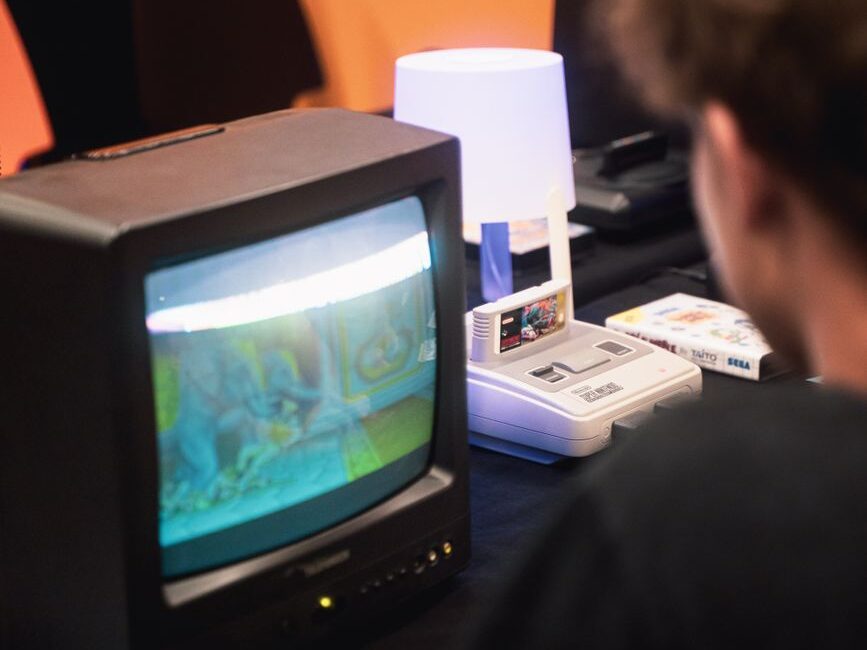
Any perceived barrier to entry that "retro gaming" might have had in the past — be that the technical knowhow required to get old finicky hardware up and running; the possession of vintage CRT TV hardware; an understanding of what "RGB" is; the ability to recap an Xbox or replace the battery in a Dreamcast — has not been there for a good long while, unless you want to enjoy a specific type of experience. (Snobbery over whether you're "doing retro gaming right" is a whole other discussion, mind, and it's hopefully already clear where my opinions fall on that side of things.)
If you enjoy games, you (hopefully) just enjoy games. There is absolutely no rule written down anywhere that places down a hard boundary of what you are allowed to enjoy, based on whatever combination of "year of release" and "age of player" people are using to calculate their completely arbitrary definition of "retro". Sure, some older stuff might take a little adjusting to if you're unfamiliar with it — much as reading Jane Eyre takes a bit of adjustment after reading The Da Vinci Code — but it's still the same basic form of entertainment at heart: push buttons, fun (or at least interesting) stuff happens.
Go on. Spoil yourself. Play something from a system you've never explored before. Revisit a game you haven't played since childhood. Fire up a copy of that one game you always saw in magazines and lusted over, but which you never got for Christmas or birthdays. And, with an appropriately receptive and open mind, I pretty much guarantee that you'll have an experience just as interesting, compelling and worthwhile as if you played something that released last week.
Want to read my thoughts on various video games, visual novels and other popular culture things? Stop by MoeGamer.net, my site for all things fun where I am generally a lot more cheerful. And if you fancy watching some vids on classic games, drop by my YouTube channel.
If you want this nonsense in your inbox every day, please feel free to subscribe via email. Your email address won't be used for anything else.