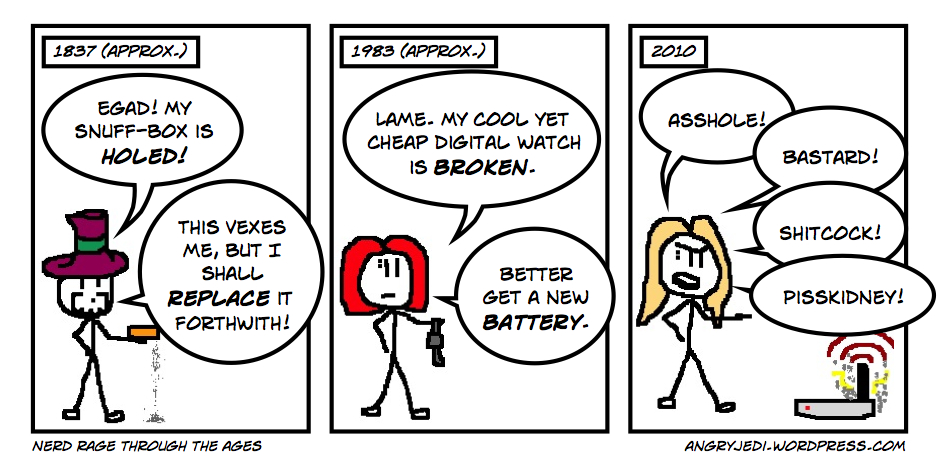
As a new acquaintance from Twitter would say, nerd rage is one of the most formidable forces known to Man. It is a dreadful and terrible force, both specific and unfocused at the same time, often showing itself via the personification of inanimate objects who really don't know any better and are just attempting to do their job and failing. Raging at said inanimate objects or poorly-constructed pieces of software rarely does any good, but it is commonly assumed that it makes one "feel better".
As the years have passed, though, everyone's bullshit-tolerance threshold has lowered significantly to the stage we're at now, where if something doesn't work immediately and instantly and then remain working 100% of the time, people blow their top and spew their vitriol to whoever will listen, which is usually the Internet. Assuming the Internet connection isn't the thing which is causing the nerd rage, in which case alternative outlets have to be explored.
This is why issues such as the Xbox 360's infamous "red ring of death" smart so much. Not only is it a shoddy flaw in the system which should never happen in the first place, but people's tolerance for such shoddiness is far lower now than it would have been, say, twenty or thirty years ago. Hell, in the days of the NES, everyone was quite happy to accept the fact that if a game didn't boot up first time, it clearly and obviously meant that you had to blow in it to "get the dust out" despite no actual evidence that it was actually dust causing the game not to work correctly. And no evidence that those tiny flecks of gob that probably got into the cartridge circuitry while you were blowing in it actually helped matters, either.
It's also why we get such whingers in places such as Apple's App Store. "OMG 1 STAR COZ IT DIDNT WORK ONCE THIS IS A DIGSRACE REFUND PLZ". "Is it working now?" "Yes, but…" (etc.)
It's fair enough to want things to "just work". Apple in particular like to pride themselves on the fact that their products "just work" (which they do approximately 95% of the time, which means the remaining 5% incites nerd rage of a degree you've never seen before, particularly amongst recent converts and/or Android users). But it's worth remembering a time not so long ago when we enjoyed tape load errors, boot errors, numerical error codes you had to look up in a book, garbled graphics, tape decks that chewed up tapes and then spat them out, CD players that seemed to deliberately wait for you to insert your favourite disc then sprout internal blades to scratch the crap out of it and dial-up network connections where it was possible to get a "busy" signal for hours at a time. And there was no Internet to spew your vitriol over back then.
Nowadays we have complicated devices and software that no-one except superhumans understand really, and established solutions such as blowing on it, shaking it, hitting it, shouting at it, turning it off and back on again and setting fire to it don't work. So the only thing left to do is get frustrated. And possibly call up one of those superhumans. Because everybody knows at least one. (Note: If you don't know a superhuman nerd or don't want to bother them, you can save yourself a lot of time by referring to this chart.)
In other news, the router here is rubbish and crap and I hate it and it disconnects Xbox LIVE every five minutes when I'm playing Fable II and it doesn't like WordPress and SRSLY who uses AOL nowadays anyway and… (repeat to fade)
 So, Google Wave is going bye-bye, huh? Can't say I'm particularly surprised. As cool an idea as it was, there just wasn't the buy-in from people that it deserved. Largely because a goodly proportion of the Internet population didn't seem to understand what it was actually for.