#oneaday Day 647: The third 9th Dawn

Just recently, I have returned to a game I really enjoyed when I first tried, but never got around to finishing. That game is 9th Dawn III: Shadow of Erthil from Valorware, which is a delightfully rough-round-the-edges but made-with-heart game that feels like a classic PC game from days of yore, but has enough modern aspects to it to make it feel right at home on console (Switch, specifically, where I am playing.)

I came back to this because Limited Run put up 9th Dawn Remake for preorder recently, and I was reminded that I had been enjoying 9th Dawn III up until the point I put it down in favour of something else. So I decided to go back. And, if you're wondering, no, you don't need to play 9th Dawn (Remake) and/or 9th Dawn II before III.

The simple elevator pitch for 9th Dawn III is that it's a large, open-world RPG presented from a top-down 2D perspective. It has real-time combat primarily driven through twin stick shooter-like mechanics, and when playing on gamepad it has a Final Fantasy XIV-esque hotbar system, whereby holding a trigger and pressing one of the face buttons or directional pad controls allows you to trigger various abilities.

It's more Diablo than Baldur's Gate for the most part — though the thing I'd probably compare it to more than anything is something like World of Warcraft. You can wander around the world as you see fit, step into dungeons as you discover them, and level up a wealth of different skills, including a number of crafting options. There are no character classes, so you can build your character according to the way you like to play — and this also means that you can change up how you're playing quite easily, too. Some items of equipment have certain skill requirements, but it's a simple matter to train up to a level where you can use them — and immensely satisfying when doing so allows you to use a weapon that increases your damage output by a good 10x or more.

One thing I particularly like about the game is the way it implements dungeons. Each dungeon is quite a substantial, self-contained challenge in its own right, and while they initially look quite "open", there's often a good route to take through them, and in taking that route you will gradually unlock a number of shortcuts back to earlier areas. The game tracks your percentage completion of each dungeon, measured by how many of the "ability coins" you have found and whether or not you have beaten the main "boss" enemy in each dungeon, allowing you a clear sense of when you've done everything "important" — but there's often a nice amount of random loot to be found outside of these core "objectives".

It's a game that has a lot of interesting, interlocking systems, but which is very easy to pick up and play, and quite enjoyable to just spend an evening with, hacking and slashing your way through all and sundry. Also, you can recruit monsters and summon up to 10 of them to fight alongside you, which is immensely satisfying.

I'm a long way off beating the game — it's a big 'un! — but I'm having a lot of fun with it right now, so I'm going to stick with it for the immediate future. I'm interested to see quite how powerful you can get by the conclusion to proceedings. I'm hoping for some Diablo III-style huge numbers — given that I'm level 20-something and already putting out four-figure damage, that's entirely within the realm of possibility. Fun times await!


Want to read my thoughts on various video games, visual novels and other popular culture things? Stop by MoeGamer.net, my site for all things fun where I am generally a lot more cheerful. And if you fancy watching some vids on classic games, drop by my YouTube channel.

If you want this nonsense in your inbox every day, please feel free to subscribe via email. Your email address won't be used for anything else.

#oneaday Day 636: Esoteric Ebb and Flow

Well, my original plan was to play at least one of the bonus episodes of Resident Evil Revelations this evening, but then I was distracted by some screenshots of a game that apparently came out recently, and which I hadn't previously heard of: Esoteric Ebb by Christoffer Bodegård, published by the "indie publisher to watch" of the moment, Raw Fury.

Here's one of the screenshots that convinced me to buy and play this game:

If you're looking at that and thinking something along the lines of "cor blimey guvnor, that sure does look like Disco Elysium and no mistake", you'd be absolutely right. The game isn't trying to hide its inspiration. But the other thing you may well notice from this screenshot is that this is Disco Elysium, But Fantasy.

In Esoteric Ebb, you play the role of The Cleric, an ostensible agent of the government who has been sent in to investigate an explosion in a local teahouse. As befits a CRPG hero, whether or not you actually get stuck right in to this "main quest" is entirely up to you, because the small but well-crafted world of Esoteric Ebb certainly has lots of distractions. You do have a time limit, though; the setting is having its first ever democratic election in five days' time, and the current sitting government would really rather all this unpleasantness was quietly dealt with before that happens.

If you've never played Disco Elysium (or, indeed, games like it, since they appear to be Becoming a Thing right now) the simple pitch is this: they're a cross between classic "Infinity Engine" RPGs like Baldur's Gate, Planescape Torment and the like, with almost all of the combat removed, and a strong emphasis on the game responding to you a bit more like a human dungeon master during a tabletop gaming session would. That means all of your stats get a workout, with most sequences in the game involving either passive skill checks (which you will just automatically pass or fail based on your current stats) or active skill checks (where you roll a die and your stats can potentially boost or penalise the score).

Crucially, failure is not necessarily a bad thing, because it can lead to amusing situations or alternative solutions — much as real tabletop sessions are often at their best when things get a little improvisatory.

Skill checks are only half the story, though. The other defining feature of a game following the Disco Elysium mould is that your stats "talk" to you, reflecting your character's often conflicted inner monologues about the situations in which they find themselves. Exactly how helpful you will find these "Chimes", as Esoteric Ebb calls them, depends on those aforementioned passive skill checks; failure often means you misinterpret a situation, fail to notice something or do something clumsy, depending on the context, while success can mean anything positive: performing a complicated physical task correctly, finding just the right words to say in an awkward situation, feeling empathy for the person you're talking to.

Esoteric Ebb adds a few additional features atop this, too. One of the most notable is that you can examine any of the interactable characters, and a skill check of variable difficulty (with the exact stat being tested depending on the character you're examining) will determine how much information you can tell about them just from looking at them. Failing to pass the check at all means you just about notice their basic appearance; passing higher difficulty level checks will let you know their level, class, stats and even pieces of information they would rather remain hidden — you might recognise someone who is trying to conceal their identity, for example. These pieces of information can often be used in conversation.

Other interesting features are the interconnected web of quests in place of the usual quest journal; this indicates how various happenings around the city relate to one another, and upon successfully finishing one of the major quests, you then get to reflect on the situation and allow your stats to "debate" one another, with the eventual result being a nice chunk of experience and a new feat based on the eventual conclusion you came to. In this way, there's a real sense you're building your character just by playing the game; you do "level up" in a conventional RPG style, and you can increase one of your stats when you do so, but it's not just about gaining experience — and, indeed, given that it's a game where it's impossible to grind, you're best off just exploring the world and seeing what happens.

This can, of course, sometimes have fatal consequences in unusual ways. Thus far I have died from attempting to retrieve a shiny object that was stuck in a set of gears, which caused me to get crushed and then fall to my death just to make sure, and from being eaten by a "Roper" enemy hiding in the rocks. I also narrowly escaped death in the very first scene of the game, where I felt an uncontrollable urge to try and eat a path through a room-filling pile of apples, but thankfully my sense of self-preservation kicked in early enough to allow me to survive.

It's a really fun game, so long as you're on board with a slow pace. There are combat encounters in the game, but rather than being a matter of lining up and attacking or quasi-strategic combat, these instead unfold much like all the other encounters in the game: through skill checks, dialogue and choosing actions to take that are always more interesting than just pressing "attack".

I played for a good few hours this evening, and I'm looking forward to exploring it further. The full thing is apparently about 10-15 hours or so, so it's not a game that outstays its welcome. This, to me, is a selling point. It also means it's potentially replayable, and in a choice-heavy game like this, that's always a good thing.

So yeah. A confident thumbs-up from me on this one from my few hours with it this evening, then. Grab it on Steam (don't think there's any news of console or alternative PC storefront releases as yet) — it's 10% off until the 14th.


Want to read my thoughts on various video games, visual novels and other popular culture things? Stop by MoeGamer.net, my site for all things fun where I am generally a lot more cheerful. And if you fancy watching some vids on classic games, drop by my YouTube channel.

If you want this nonsense in your inbox every day, please feel free to subscribe via email. Your email address won't be used for anything else.

#oneaday Day 589: HeroQuest First Light, First Session

I've done it! I've finally played a game of HeroQuest with actual real human people. And we had a really good time! We got through the first two quests in the First Light campaign — I've bought both First Light and the big-box core set, but I wanted to give First Light a go because it's a completely different campaign to the big-box core set, and the big-box core set campaign is largely based on the 1989 original, which I was already familiar with.

Both sets stand by themselves, and both are a good means of getting into HeroQuest as a hobby; the main difference is that First Light is a lot cheaper and comes in a smaller box, because it lacks the big collection of plastic miniatures included in the big-box core set. And, having played the game with those big-box core set miniatures today, I'm glad I picked it up; making the whole game a lot more "3D" really adds to the atmosphere and makes it look great on the table. (For the budget-conscious, the cardboard standees for monsters in First Light have some great artwork on them — and you do still get miniatures for the heroes and a recurring dragon boss — but all the furniture items are flat cardboard tiles that just show a plan view of the furniture. They serve their purpose, but it's hard to deny that the 3D furniture is just better.)

Playing Zargon (known as Morcar in the European '80s version) is an interesting experience. One thing you have to remember while playing is that although you are technically an "adversary" for the Hero players, you are not necessarily trying to defeat them. You are, instead, attempting to facilitate a fun session of storytelling, using the game mechanics as a framework, and that sometimes means quietly fudging things a bit, rebalancing the difficulty on the fly and responding to things that happen in a way that isn't necessarily laid down for you in the Quest Book in black-and-white.

Some people turn their nose up at HeroQuest because of its simplistic mechanics, and I can totally understand that; there are games with similar theming that go much harder on strategy and tactics, with each encounter feeling a lot more like a tabletop wargaming skirmish than a dungeon crawl. For some, that's what they want; for me, though, I've always been very fond of HeroQuest's straightforward mechanics, because not only do they keep the game pacy and help emphasise the collective, emergent narrative of the players' quest, they also make it very easy for newcomers to pick up. There's very little trawling through an epic rulebook once you have the basic rules sorted, which means there's very little downtime, and a lot more time for moving, fighting and searching things — because those are the three main things you do in HeroQuest.

The two quests we played today were enjoyably different from one another. The first was a relatively open-plan dungeon in which the Heroes, by chance, picked the "correct" way to go at the beginning and ended up at the concluding encounter relatively quickly, but in the process they also missed out on potentially collecting a bit more treasure. The second quest had an interesting series of magic portals that could send the Heroes to different parts of the dungeon, some of which connected with one another and some of which did not.

The second quest was noticeably harder than the first. The Heroes did have a bit of a run of bad luck with dice rolls — particularly once they opened up a secret room and found a pair of Mummies, which are surprisingly tough enemies to beat — but that made their eventual victory over the quest's "boss" feel hard-earned and definitely worthwhile. And relatively little Zargon fudging was required to keep everyone alive!

The cool thing is that I think the Hero players learned something from how these two quests went down — notably, that it is helpful to stay together, but in a tactically advantageous formation so, for example, the Wizard doesn't get twatted in the face, so the Barbarian doesn't block doorways and so everyone is able to get a chance to line up and punch something. The Wizard got equipped with a staff after the first quest, which allows him to attack diagonally, so that helped inform some tactics, and the Heroes have also determined that getting themselves some better equipment probably wouldn't be a terrible idea, either.

Lots of scope for growth, and the players enjoyed themselves enough to want to play it again! So with any luck, in a couple of weeks' time, it'll be hitting the table again and the campaign can continue.

I'm really very happy about this. I've been wanting to run a proper game of HeroQuest since I was, like, ten, and now I am. And I'm having fun! Sometimes you just need patience. And to buy the game multiple times in the intervening years.


Want to read my thoughts on various video games, visual novels and other popular culture things? Stop by MoeGamer.net, my site for all things fun where I am generally a lot more cheerful. And if you fancy watching some vids on classic games, drop by my YouTube channel.

If you want this nonsense in your inbox every day, please feel free to subscribe via email. Your email address won't be used for anything else.

#oneaday Day 487: Deeanddee

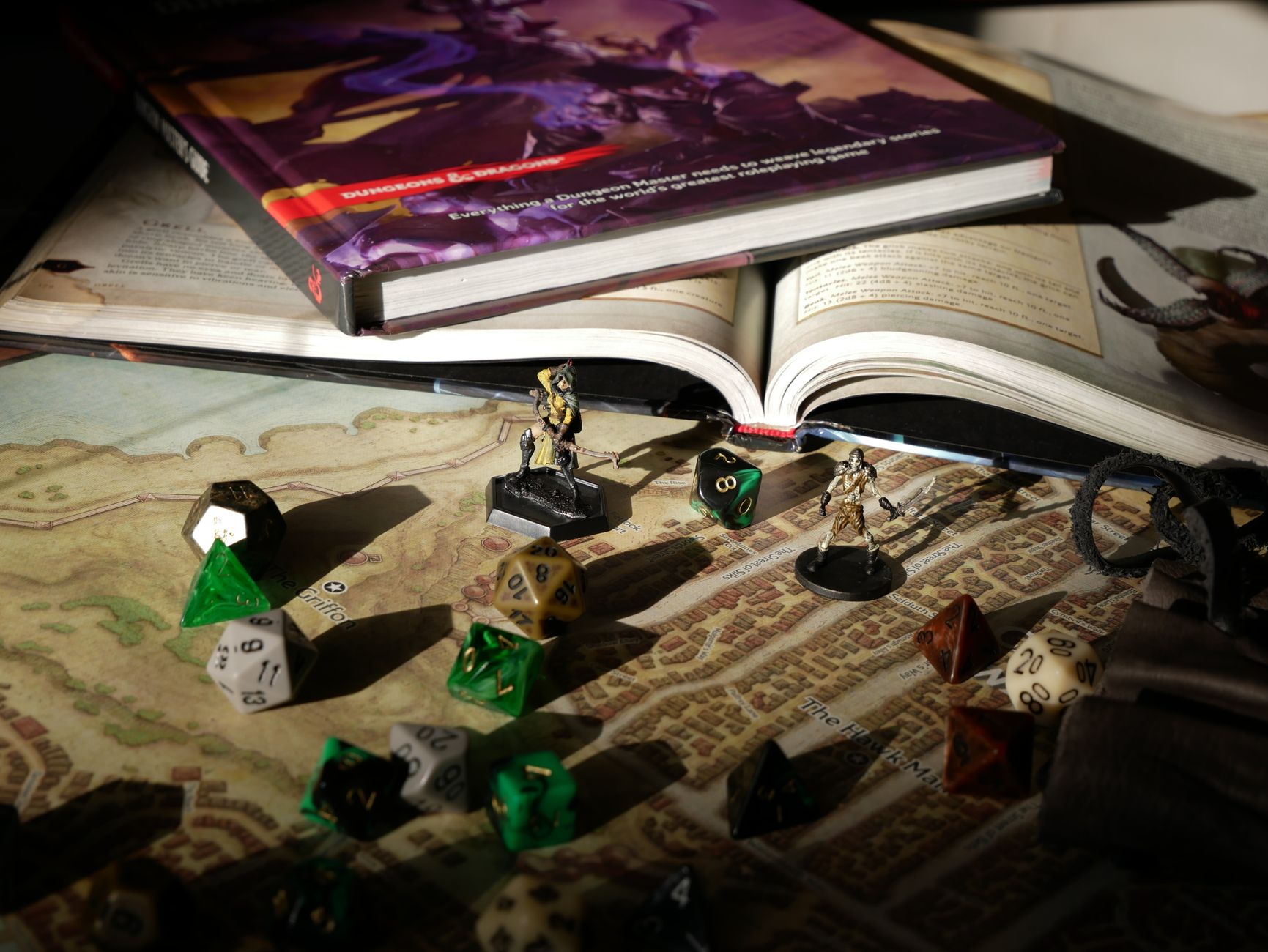
One of my biggest regrets — all right, probably not biggest, but one I find myself thinking about occasionally — is not getting more into Dungeons & Dragons when I was younger.

Oh, don't get me wrong, I was interested — at various points I have owned Player's Handbooks, Monster Manuals and Dungeon Master's Guides for at least three generations of the game — but outside of a few isolated opportunities, I never really had much of a chance to play it. And I understand that these days, at least partly due to Fifth Edition and/or Wizards of the Coast's possible mismanagement of the franchise, interest in the system is, on the whole, waning.

That's not to say there are no people playing tabletop role-playing games out there, of course. And I'm sure someone, even now, is preparing to type an epic comment telling me how much better their roleplaying system of choice is. I'm sure it is. But I will always have a particular soft spot for Dungeons & Dragons.

Why? The video games, of course. I must confess, I haven't played many of them, and even less of them to completion — I think Baldur's Gate, Neverwinter Nights and its first expansion Shadows of Undrentide are the only ones I've actually beaten — but I like the ruleset(s), I understand the ruleset(s) and I often find myself wondering what it would have been like to get involved in a lengthy campaign.

I played a little bit at university as part of the Games Society. I had a thief character named Singol Nithryan, and he was constantly robbing my friend Tim, whose arrogant arse of a fighter was constantly asking for it with his behaviour. I don't remember a ton about the adventures we went on, but I do recall it being a lot of fun sitting there in the Student Union coffee bar while the Society took it over for a few hours, losing ourselves in our imaginations and the rolls of a bagful of dice.

"It's never too late," of course, and there are probably online groups and solutions also. But as an autistic adult with fairly severe social anxiety, self-esteem and body image issues, the prospect of finding a suitable group is a fairly daunting one. I don't even know where to begin, to be perfectly honest.

I'll tell you what I miss, and that is Neverwinter Connections, a website designed for aspiring roleplayers to get together with fellow enthusiasts of Neverwinter Nights and make use of that game's astoundingly good (and never since recreated) multiplayer mode, in which one player could take on the role of the Dungeon Master, controlling NPCs and monsters rather than leaving it all up to the game's AI. I have exceedingly fond memories of playing the sorcerer Jay Wrekin (and his pixie familiar Sianie, whom I was delighted to discover it was possible to "possess" and speak as during multiplayer) with several thoroughly lovely people that I miss quite a bit.

Ah well. One day I might get the chance to roll a THAC0 again. Yes, I know they don't do THAC0 any more (I don't think?), but Second Edition will always be special.


Want to read my thoughts on various video games, visual novels and other popular culture things? Stop by MoeGamer.net, my site for all things fun where I am generally a lot more cheerful. And if you fancy watching some vids on classic games, drop by my YouTube channel.

If you want this nonsense in your inbox every day, please feel free to subscribe via email. Your email address won't be used for anything else.