#oneaday Day 531: Riding the air

Kirby Air Riders is out today, and I've spent the evening playing it. Specifically, I've spent the evening playing the "Road Trip" mode that I didn't know anything about prior to starting the game. This is a single-player mode that is presumably intended to get you up to speed on everything you might be doing at any point in the other modes, but it also unlocks a bunch of stuff in a similar fashion to Smash Bros.' single-player modes from over the years.

The whole package is very Smash Bros., in fact, including the way you navigate the menus, the way you adjust your settings for a play session and the overall structure of the game. It's a very customisable game, from the look of things, so I'm looking forward to investigating the other aspects of it soon.

Road Trip, meanwhile, that I can talk about. In this mode, you pick a character and initial "machine" to ride on, and progress through a series of stages, each of which is split into a series of "encounters" on the road. Under most circumstances, you have a choice of three encounters to choose from at any point, with different rewards on offer for each. Successfully beating an encounter generally rewards you with some Road Trip-specific currency and a stat increase or two. Outside of the competitive events, you may also run into shops (where you can, of course, spend the aforementioned Road Trip-specific currency) and weird things that determine which of several branching paths you will take at the conclusion of the current stage.

The events you'll compete in on the Road Trip are generally pretty short in duration — races tend to be one or two laps at most, and the events which aren't races are all time-limited. It's enough to give you a look at the different things you can do in the game's other modes, but in a way that you never get particularly bogged down in anything. You rarely do the same type of event twice in a row, and the difficulty curve progresses nicely from "very easy" in the early stages to "genuinely quite challenging, but not annoyingly so" as you get closer to the conclusion.

As you progress through the Road Trip, you'll gain the opportunity to earn "memory shards", which tell the unfolding story. This is surprisingly dark, considering this is a Kirby game, involving a mechanical creature that has sat for aeons without being able to move because it requires someone's "strong will" to allow it to do anything, a terrifying orbital satellite that, among other things, constructs an army of robotic ants to rip this aforementioned creature to bits and rebuild it into a world-crushing weapon, and the implication that everyone's vehicles in the game are like Pokémon, if Pokémon were forms of sentient transporation rather than creatures that liked to fight. So maybe not all that much like Pokémon at all, other than the fact that they clearly have "personalities" of sorts, and partner up with the people of Kirby's world, Popstar, in a quasi-symbiotic relationship.

In the events, Kirby Air Riders is chaotic. For those concerned that it might be a bit too much like Mario Kart: it's nothing like Mario Kart. My wife saw me playing it briefly and said it looked like "Wipeout, but Kirby" and honestly she's not far from the truth there. There's a touch of F-Zero, a bit of Burnout, even a bit of Twisted Metal in there, depending on the type of event you're playing. I can see it easily being overwhelming for some players, but there is clearly method in the madness.

Probably the most clever thing it does is use an incredibly simple control scheme, much like Kirby platformers tend to. There are only two buttons to worry about: characters accelerate automatically, and the only time you need to press a button is when you want to slow down (which also charges up your boost) or use your character's "Special", which can only be used when a particular meter has charged.

The "Boost Charge" mechanic has a nicely tactile feel. You're effectively "pulling back" your character, winding them up and then letting them twang forward, though the exact implementation of this depends quite significantly on the machine you've chosen to ride. Some are built for drifting around corners; others stop dead when charging a boost and can thus immediately change direction when going around 90-degree bends; others still can't drift or boost at all, but make up for this with other strengths.

These differences between the machines, along with individual machines' special capabilities (such as the "Vampire Star" machine's ability to "bite" opponents, damaging and slowing them down and stealing their power-ups) and the stat growth throughout Road Trip mode mean that there's a surprising amount of depth considering how simple the game is to control. Different machines are eminently suitable to different types of event, so it pays to try and build up a collection — indeed, I believe to get the "true" ending for the game, you need to collect all of them prior to reaching the final encounter, though this is made more straightforward through a New Game+ option that lets you carry over the stuff you've already acquired.

There are some other interesting little things, too. A significant portion of the Road Trip mode involves the "Top Rider" mode, which is racing from a top-down perspective on simplified tracks. This is a lot of fun, though obviously less spectacular and chaotic than the 3D races — and it's nice that this is a whole mode you can play given equal weight to the "main" game mode. There are even different control options, depending on if you prefer "turn left and right" or "push the analogue stick in the direction you want to go" for these top-down sequences.

All in all, it seems like a really solid game given that distinctive Sora Ltd. polish. I'll be interested to see whether it has the juice to go for the long term on the multiplayer circuit; I can see this being a really solid multiplayer game, but, of course, it needs a community for that to work over the long term. I don't yet know if the broader community will take to it in the same way as something like Mario Kart — but then, Splatoon came out of nowhere on Wii U and managed to be a big enough hit (on the Wii U!) to spawn two sequels, so there's precedent for a Nintendo game not called Mario Kart or Smash Bros. to have a thriving online community.

More than anything, it's nice to see the Switch 2 finally picking up the pace with some solid releases — and on proper game cartridges, too. Now, if they'd just quit doing that dumbass Game Key Card thing completely I'd be very happy indeed…


Want to read my thoughts on various video games, visual novels and other popular culture things? Stop by MoeGamer.net, my site for all things fun where I am generally a lot more cheerful. And if you fancy watching some vids on classic games, drop by my YouTube channel.

If you want this nonsense in your inbox every day, please feel free to subscribe via email. Your email address won't be used for anything else.
#oneaday Day 316: Mario Kart World looks like fun!

You will doubtless be aware of the impending release of the Nintendo Switch 2, and its launch title Mario Kart World. You may also be aware of the fact that people are complaining about the price (not unjustifiably). And you may even have sat down and watched the Mario Kart World-centric presentation the other day.

Some people seem to be a bit down on Mario Kart World. I had to banish a video from my YouTube recommendations earlier for it claiming to offer "the unfortunate truth" about the new game, when said "truth" was just that the video maker, who hadn't played the game, didn't think it going open world was a good idea.

I'm not going to get into whether he's right or wrong (he's definitely wrong, though), but instead I want to talk about my own personal response to what I've seen of Mario Kart World so far, with the caveats that I haven't played it, I haven't been to any of the "Nintendo Switch 2 Experience" events, and that have preordered the Switch 2 bundle that comes with a digital copy of Mario Kart World, so I am perhaps predisposed to like the thing I've spent money on.

Basically, I'm well up for what Mario Kart World has to offer. I like common-or-garden Mario Kart to a decent degree, and it usually comes off the shelf any time friends are over. But despite the improving tech, visuals and course design with each new installment, the overall structure of the game hasn't really changed all that much since the SNES original. Mario Kart has always had a bit of a problem with its single-player modes being a bit bare-bones, and this is something that has never really been fixed over the course of 8 mainline installments. It was particularly apparent in the Nintendo 64 era, where Rare's Diddy Kong Racing offered an impressively substantial single-player "Adventure" mode that really made Mario Kart 64's paltry grand prix offerings look a tad weedy.

Granted, today the enduring appeal of modern Mario Kart games is in playing online, where you get the performance and visuals of single-player but the thrill of competing against real opponents. But that's not something that everyone enjoys — particularly since, as a popular game, it's filled with people who have no-lifed their way into mastering the most important "skills" (and/or exploits) in order to win every time. Playing Mario Kart online as a casual player is a great way of testing whether or not you really believe that "it's not the winning that counts, it's the taking part". Because after myriad sessions of seeing the frontrunners scream off over the horizon, never to be seen again, and not really knowing why or how they did that, it gets a bit old.

Mario Kart World, now, though, that's different. Online is still going to be an important part of the experience, and with the Nintendo Switch 2's GameChat feature, it looks like a potential return to the early days of Xbox Live, when it's easy to get folks together to shoot the shit while you're playing games — and not necessarily the same games. The key difference, this being Nintendo, is that GameChat is restricted to your friends, so no jumping into public lobbies and immediately being screamed at or called a racial epithet, unless that's what your friends are like. In which case you should find new friends.

But perhaps more importantly, judging by what we've seen so far, is that Mario Kart World offers a substantial single-player experience, and it's all down to that open world. Driving games are one type of game where it makes perfect sense to have an open-world map, and theming the game around rough-and-ready vehicles such as go-karts and motorcycles makes it feel less weird to go off-road exploring. One of my favourite games in this regard is Codemasters and Asobo Studio's Fuel, which has an absolutely vast open world filled with events to participate in and things to find. Plus it's just plain fun to drive around and see how a variety of different vehicles handle the various terrains.

Fuel is a semi-realistic game, though; Mario Kart World, meanwhile, is not beholden to the laws of reality, being a game set in a cartoonish fantasy world. That means we can have a map with incredible geographic diversity, weird and wonderful things to discover and a real sense that you might find anything around the corner. For all I love Fuel, its overriding colours are dull green, grey and brown, and any changes in the map you encounter as you pass from region to region are gradual rather than drastic. Not so in Mario Kart World, and I think that's going to be a lot of fun.

One of the things I really like the sound of is how the races link together, with circuit races leading to point-to-point races that take you to the next course in the sequence. I absolutely love point-to-point races — a side-effect of growing up with games like OutRun and Lotus Turbo Challenge — and Mario Kart World sounds like it's going to implement them not only as interstitial races in the main Grand Prix events, but also as non-stop "knockout" rally competitions that unfold as one long race taking you between multiple areas, with the bottom [x] participants being knocked out at every checkpoint.

But then the open world is filled with collectibles to find — the exact function of which we don't know just yet — and "P-switch challenges", which task you with completing various missions that test your driving skills. It's this exploration aspect that I think I find most exciting, particularly as you can not only play it solo, but you can bring friends along, too. Burnout Paradise was excellent fun in its multiplayer free-roam mode — sadly, I only ever really got to play it with friends once — and I can see this being very enjoyable; a great way to virtually hang out with friends over GameChat while having a meaningful, but relaxing and not-too-demanding, gaming experience.

Whether or not all this is really "worth" £75 for its physical RRP remains to be seen, and "game worth" is a completely subjective thing anyway. But I know that after seeing the announcement and the subsequent Direct, I'm very much on board with Mario Kart World, and I'm looking forward to getting stuck into it when June finally rolls around.


Want to read my thoughts on various video games, visual novels and other popular culture things? Stop by MoeGamer.net, my site for all things fun where I am generally a lot more cheerful. And if you fancy watching some vids on classic games, drop by my YouTube channel.

If you want this nonsense in your inbox every day, please feel free to subscribe via email. Your email address won't be used for anything else.
#oneaday Day 266: Beetle Drive

After writing a bit about flash cartridges the other day (and, err, ordering one for my Mega Drive when I saw it was payday) I thought it was probably time I sat and played some of the stuff I had on my Everdrive 64 X7 hooked up to my Nintendo 64. So I did. And I'm reminded that while the Nintendo 64 was a rather odd system in many ways, it also had some great games.

I will probably write some more on these over on MoeGamer at some point, but in the absence of anything particularly interesting happening today, I thought at least a couple of them would make worthwhile blog fodder.

The first one I decided to give a bit of a go was Beetle Adventure Racing, a game which I remember reviewing well back in the day, which I know is often featured in "best of Nintendo 64" retrospectives, which I know my brother likes and which, somehow, I have never gotten around to trying. So I decided I would fix that issue and try it.

Beetle Adventure Racing is really good, you guys. I'm kicking myself for not trying this sooner — and kicking myself for not taking a punt on it back in the days when the N64 was current, either, because I would have absolutely loved this.

For the unfamiliar, Beetle Adventure Racing is an arcade racer from Electronic Arts (boo, hiss, I know, but we still liked them back in the N64 days) and Pilotwings 64 co-developer Paradigm Entertainment. It was created at least in part as a sort of "advergame" for the new-model Volkswagen Beetle, which launched in the late '90s, right when the N64 was in its heyday. It's not obnoxious about it, mind; it's just a game in which all the cars happen to be '90s New Beetles, and apparently Volkswagen weren't all that precious about what EA and Paradigm did to them, because Beetle Adventure Racing sees you doing some ridiculous things with them.

At its heart, Beetle Adventure Racing is a relatively straightforward arcade racer. You can play single events as either full-field races, duels against a single opponent or time trials. There's a championship mode with several difficulty levels, each of which unlocks some new tracks. You can play two-player races. And there's a four-player battle mode that, back in the days when I had three-dimensional friends and we, as a people, went around to each other's houses on a fairly regular basis, I feel we would have had a lot of fun with. One day. Maybe.

The "Adventure" part of the title comes from the design of the courses. While they're relatively straightforward (albeit surprisingly long by genre standards) circuit races at first glance, it won't take you long to notice that there seem to be a lot of scenery elements that just beg the question "I wonder if I can go over there". And the answer, usually, is yes. Track splits in two? Pick a direction. Road goes one way, railway lines head the other way into a boarded-off tunnel? Crash through that sucker and see what's in there! Curious-looking pathway running parallel to the main course, then branching off in a different direction? Check it out next lap.

Now, the nice thing about the course design in Beetle Adventure Racing is that taking these detours doesn't put you at a disadvantage, despite, in some cases, appearing to lead you in a completely different direction to the "official" course. Nope, a lot of them are, in fact, shortcuts that let you skip parts of the track — or at the very least take a different route to get to the same destination.

In the championship mode, they have a secondary purpose, too: they tend to conceal boxes with numbers on them. Crashing into these boxes gives you points. If you get 50 points in a single race, you get a continue that lets you try again if you mess up. If you get 100 points, you get a "bonus" that the game is rather coy about — I believe it's extra stages for the battle mode. There are also, I've just discovered, three hidden "flower boxes" in each stage that unlock "cheats". I haven't even seen one of these yet.

Anyway, the long and short of it is in Beetle Adventure Racing it pays to really explore the different tracks, understand the different routes it's possible to take and practice nabbing the bonus boxes at every opportunity. Because while it's relatively easy to win the novice-level races without putting yourself out too much, combining the point-scoring (and the flower box-hunting) with still winning the race makes things much more interesting than your average arcade racer.

And the tracks! While obviously a little limited by the late '90s tech and the system the game is on, they're proper "thrill ride" courses. One takes you through a not-particularly-subtle Jurassic Park homage, complete with T-Rex bursting through the bushes at the side of the course. One takes you through a volcano. An icy course sees you careening through crystal caves and negotiating huge frozen obstacles. And, as previously mentioned, they're all long, meaning you get plenty of time to enjoy them, and there are plenty of opportunities to spot the different shortcuts, detours and otherwise optional areas.

It's not quite the same as today's "open world" racers, where it's possible to go very off-piste, often to the detriment of your race performance. In Beetle Adventure Racing, the alternative routes are very much designed as integral parts of the courses, rather than simply a thing to go "huh, cool" at, then return to following the guide line for maximum efficiency.

It's a joyful, silly game that I've had a lot of fun with so far — and will likely continue to do so for quite a while yet. In fact, I think I will go and do just that right now.


Want to read my thoughts on various video games, visual novels and other popular culture things? Stop by MoeGamer.net, my site for all things fun where I am generally a lot more cheerful. And if you fancy watching some vids on classic games, drop by my YouTube channel.

If you want this nonsense in your inbox every day, please feel free to subscribe via email. Your email address won't be used for anything else.
#oneaday Day 118: I left this too late again

Oh dear. Half past midnight and I haven't written anything. Time to quickly think of something off the top of my head!

Err… quick! Video games! I bought Victory Heat Rally today. This is a game I've had my eye on for a while (though not as long as some other people have, from the sound of things) after I played its excellent demo a few Steam Next Fests ago. I'm going to do a full writeup and video on this at some point in the very near future, but suffice to say for now that it's very good.

It's a game that takes aim at Sega's "Super Scaler" racers in style, with Power Drift being a particular inspiration. It doesn't slavishly try to ape the retro style, mind — though there is a nice "pixelise" filter option for the visuals — and rather makes use of some nice pixel art for the characters, cars and some roadside objects, and low-poly environments. It moves along at a fair old clip even on my mini PC that doesn't have a graphics card, and it's a lot of fun to play.

Besides Power Drift, it also draws inspiration from Ridge Racer (drift-heavy handling, '90s rave soundtrack), Sega Rally (rally stages with exaggerated handling), Mario Kart (multiple tracks set in a limited number of environments) and probably some others that I can't think of right now because I'm tired. It takes all these elements and blends them together to make an immensely compelling game that I've played for about 5 hours this evening.

The first series of championship challenges is a bit easy, but the second ramps things up nicely to a good challenge level. There are also some truly infuriating bonus stages known as "Joker" levels where you have to race through checkpoints against the clock while performing some sort of precise driving task. The one I'm presently stuck on requires you to take full advantage of the "drift boost" mechanic the game has borrowed from Mario Kart and boost through various checkpoints. This is a lot harder than it sounds, particularly with the awkward placement of some of these checkpoints, and it has cause many expletives to belch forth from my mouth this evening.

While these levels are infuriatingly difficult, the rest of the game seems pitched at a pretty sensible difficulty level. The opening championship eases you into things nicely, then things ramp up from there. I suspect the third series of championships will be genuinely quite difficult, if the escalation in the second series is anything to go by.

But anyway. Half past midnight, like I said, so I should probably close everything down and go to sleep. There can (and probably will) be more racing tomorrow.


Want to read my thoughts on various video games, visual novels and other popular culture things? Stop by MoeGamer.net, my site for all things fun where I am generally a lot more cheerful. And if you fancy watching some vids on classic games, drop by my YouTube channel.

If you want this nonsense in your inbox every day, please feel free to subscribe via email. Your email address won't be used for anything else.
#oneaday Day 117: Car Racing

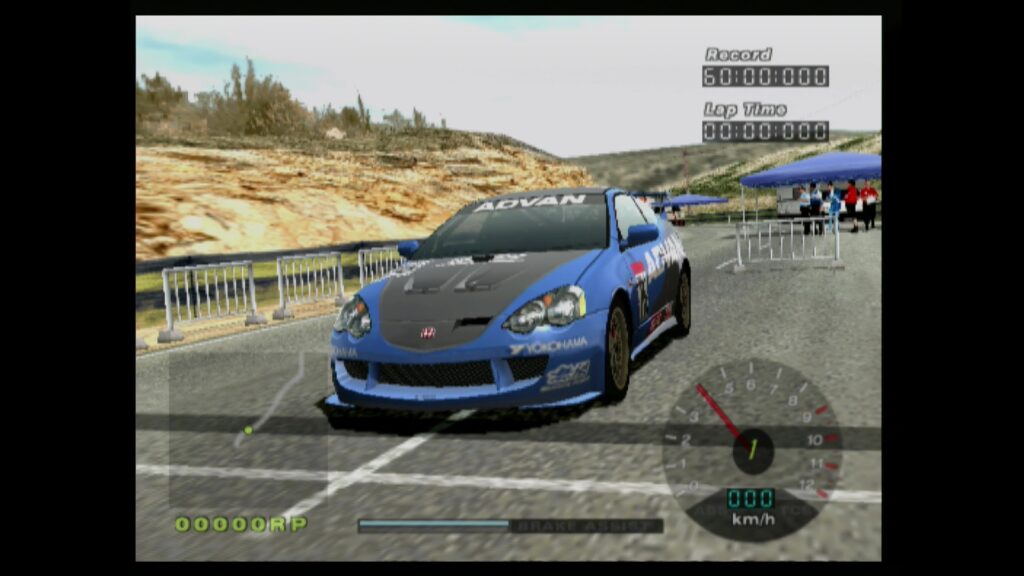
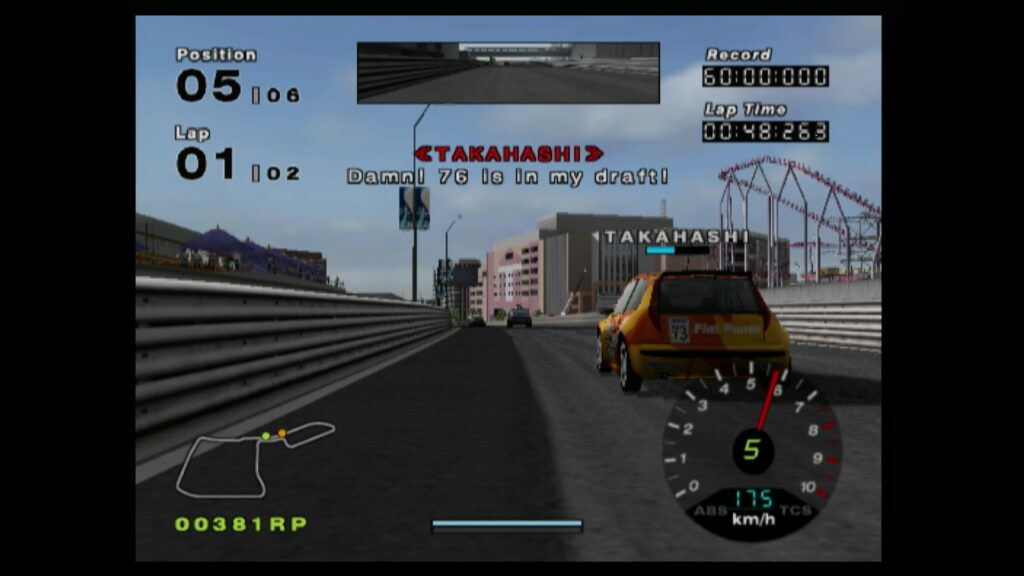
This evening, I felt like playing some random PlayStation 2 shenanigans, so I fired up R: Racing for the first time. (My wife misheard the name as "Car Racing" and was somewhat incredulous; I almost didn't want to correct her.)

For the unfamiliar, R: Racing is a game from Namco where they sort of wanted to make a new Ridge Racer, but also wanted to get in on this "racing sim" action that had been growing in popularity since the original Gran Turismo at the tail end of the previous generation. To that end, they made what is essentially a new Ridge Racer game, but featuring real cars and circuits along with the requisite tuning options that no-one understands.

One of the things that excited me most about R: Racing back when it was originally announced was that it had an actual story mode. This was very unusual for racing games at the time, and when it first released I still hadn't come to the conclusion that no, not all games need stories, a subject that I was sure I'd blogged about at some point in the past, but couldn't find any evidence thereof.

Anyway, long story short, for one reason or another I never picked up R: Racing back in the day, despite it being something that appealed quite a bit… but it is one of the many titles I added to my PS2 collection when I stumbled across it in CEX for somewhere in the region of 50p and subsequently never got around to actually trying. Until now!

Honestly, of all the things it reminds me of, it's actually most akin to the Ace Combat series. Perhaps not surprising, since they're both Namco titles — and there's a strong argument to suggest the Ridge Racer series unfolds in Ace Combat's Strangereal setting — but it works pretty well. The narrative sequences are kept short and snappy — arguably to a fault — but it provides a certain incentive to progress through the game's 14-chapter "Racing Life" mode, which appears to be primarily intended as an introduction before what I assume is "the real game" starts. Put it this way: I'm 6 chapters into that 14-chapter story after a little over an hour of play, and my save file says it's 12% complete. That suggests you beat the story and there's a whole lot more stuff to fiddle around with.

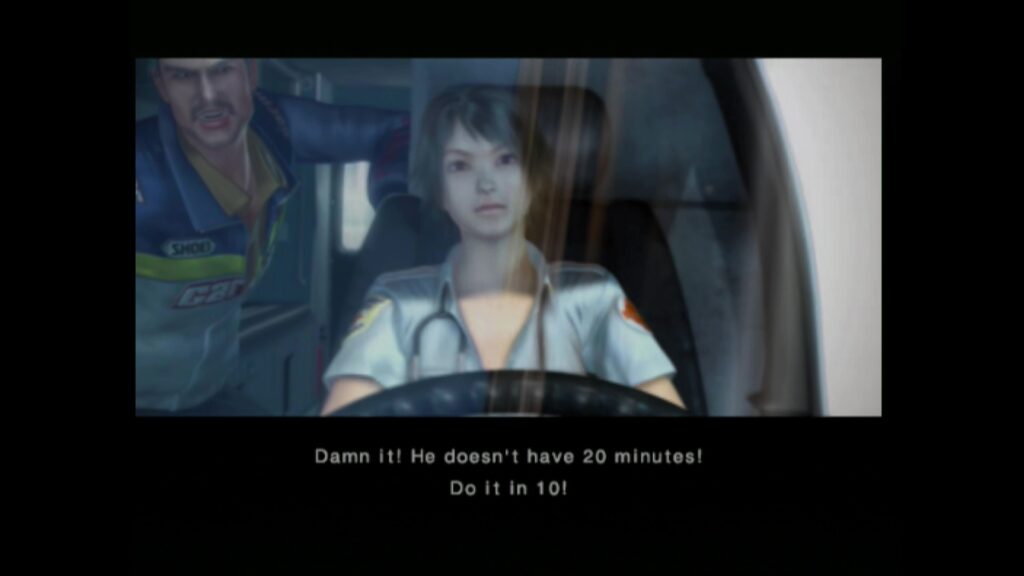
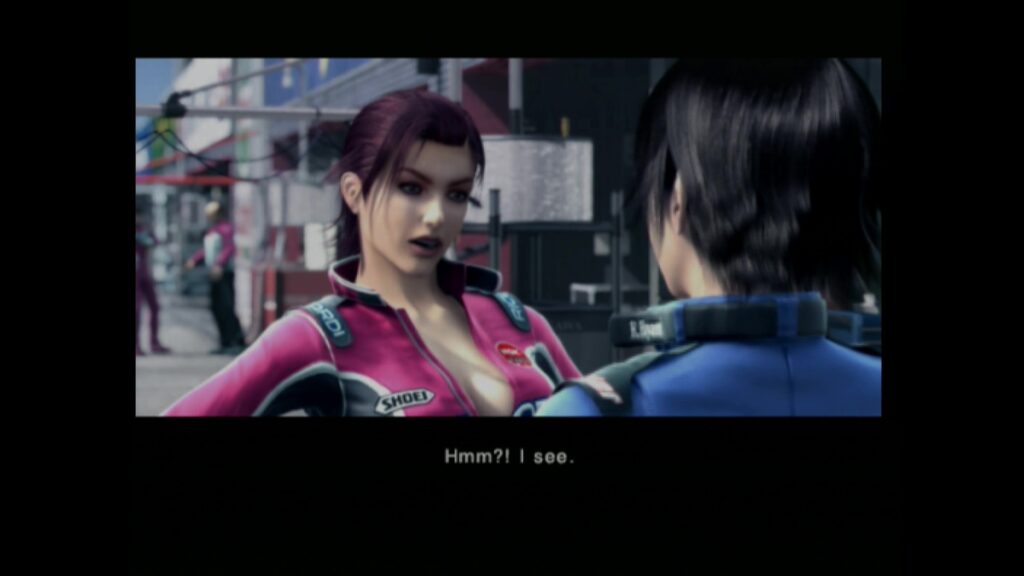
The narrative involves Rena, a female protagonist — quick, alert the Woke Content Detector idiots! — who works as an ambulance driver. One day, she displays some fancy moves on the job, and her coworker, who apparently never sleeps, signs her up to be part of a mysterious organisation known as "G.V.I." who are somehow involved with motorsports, but in what appears to be a not entirely trustworthy sort of way. Rather than being a racing team themselves, it appears that they work with racing teams and… honestly, I don't really understand at the point I'm at in the narrative because it hasn't really explained anything other than the fact it somehow caused Rena's amply-bosomed rival Gina to be pissy with her pretty much immediately upon first meeting her.

What then follows is a series of races and championships, beginning with a straightforward speedway race that is easy to win, and progressing through track, street and rally racing across several courses, many of which appear to have several variations in the same way that the Ridge Racer series' tracks typically unfold as different routes through the same environments.

R: Racing's unique selling point appears to be its "pressure" mechanic, whereby if you get up another driver's arse for long enough, a bar above their car starts filling up, and when it fills, they'll get so stressed out at your proximity to their rectum that they'll do something stupid, allowing you to pass easily. There's no obligation to fill the bar, and indeed doing so for every opponent is probably quite inefficient, but it's fun nonetheless — and it's a mechanic I've not really seen in a racer before. Presumably it's attempting to reflect the sort of stress the player feels when they have an opponent bearing down on them in their rear-view mirror; in execution, it's a tad "artificial", but, well, it's a mechanic that is there to be taken advantage of, so you might as well do so!

The soundtrack hails from post-Ridge Racer V Namco so unfortunately we've left the funky acid jazz beats of the late PS1 era far behind and are into cacophonous EDM territory. R: Racing's soundtrack isn't quite as obnoxiously awful as Ridge Racer V's, but it's almost aggressively bland, which is a bit of a shame. The Ridge Racer series has some serious highs when it gets music right, so it's always unfortunate when an entry doesn't really live up to those standards.

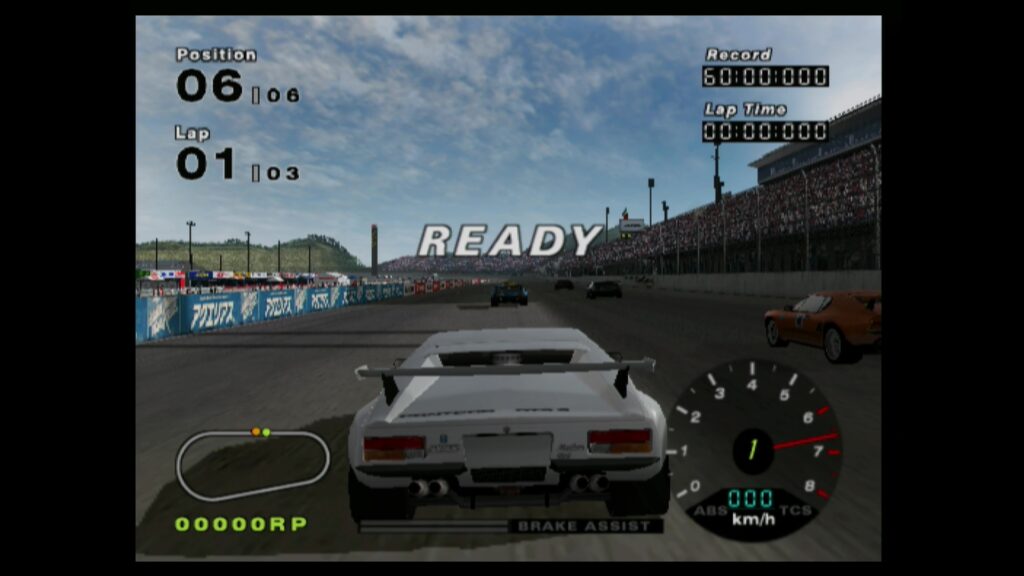
Still, it's an enjoyable enough game. Although definitely more sim-esque than the mainline Ridge Racer titles, it's also a lot more forgiving than the Gran Turismos and Forza Motorsports (do they still make those?) of the world. There's a braking assist function for those allergic to actually using the brakes themselves, which makes the game feel really arcadey (and a tad easy), but you can still throw the cars into power slides if you're aggressive enough with them. It's just not necessarily the best thing to do at every opportunity in R: Racing, unlike mainline Ridge Racer.

I enjoyed what I played this evening! I'm looking forward to exploring it a bit further. It occupies a nice sweet spot between sim and arcade that I rather like, and the story mode is intriguing, even if, as I suspect, it turns out to be a bit rushed and doesn't really go anywhere. Even if that does end up being the case, I suspect the "Event Challenge" mode, or whatever it's called, will have a fair bit of meat on the bones to fiddle around with. We'll see, I guess, and I'll write something more substantial once I've spent some more time with it.

For now, though, an evening well spent, I say.


Want to read my thoughts on various video games, visual novels and other popular culture things? Stop by MoeGamer.net, my site for all things fun where I am generally a lot more cheerful. And if you fancy watching some vids on classic games, drop by my YouTube channel.

If you want this nonsense in your inbox every day, please feel free to subscribe via email. Your email address won't be used for anything else.
2434: Crewsin'

0434_001

I've been spending some time with Ubisoft's The Crew for the last few days. I actually picked it up shortly after release but didn't play it all that much. With the recent announcement that the base game would be free throughout September (you can still claim a copy here at the time of writing) I thought I'd give it another go.

What is The Crew? Allow me to elaborate in video form, because I can.

I'm left wondering why I didn't play The Crew more when it first released, because it occurs to me that it's what I wanted from a driving game for quite some time: the elusive ideal of the "caRPG", or an RPG with cars if you prefer less clumsy portmanteaus.

The Crew ticks all the boxes that I wanted. For one, it has a plot that is reasonably interesting and features some characters that, while a bit cliched, occasionally have some entertaining things to say — the protagonist offhandedly complaining to his FBI handler that he really wanted a shower because he'd been in his damn car for days was a nice bit of self-reference to the fact that The Crew doesn't have any on-foot missions. The plot itself may be Fast and Furious-level nonsense, but it works in context.

Secondly, it has a levelling system that is actually meaningful. Unlike games such as Forza Motorsport, which largely seem to have a levelling system just to show how long you've been playing, The Crew's levelling system actually works like one in a more conventional RPG — some gear is level-locked, your cars get more powerful as you level up and there's an MMO-style "endgame" once you reach the cap, further improving your abilities by getting better and better loot.

Which brings us on to the third point. The Crew is also a loot-whoring game, which is something I never thought I'd say about a racing game, but it's true. Any activity you complete rewards you with loot, with better results giving you better gear. You get immediate feedback on whether the gear is better or worse than your current setup by means of an "item level"-like system for each of your cars, and events have recommended vehicle levels so you never tackle anything that is going to be way too difficult for you.

In case you're still not quite convinced about The Crew secretly being an RPG, well, there are different classes of cars, too. Fullstock cars are exactly as they came out of the garage. Street cars are modified street-legal cars for road races. Dirt cars are suitable for offroading and stunts. Raid cars are powerhouses that can take a beating and dish one out too. Perf cars are extremely fast. And there's plenty more where that came from — even more with the Wild Run expansion, which adds several "extreme" specs to the list, too.

And then there's the multiplayer, which to be honest I haven't tried all that much yet. There's a sort of passive multiplayer a la Test Drive Unlimited as you zip around the open world, occasionally passing other players by. You can queue up for PvP-specific missions. You can recruit people to help you out with story missions, which then have to be played fully cooperatively — race missions, for example, mean that your teammates just have to make sure that you win by fair means or foul, whereas missions where you have to wreck a fleeing vehicle are likely to be much easier with company.

And on top of all that, The Crew makes driving around its vast open world interesting by 1) having some lovely scenery and 2) scattering Project Gotham-style skill challenges around the roads, tasking you with everything from slaloming around markers to simply getting as far away from your start point as possible. Each of these reward you with loot and experience, making them the equivalent of "trash" enemies in a more conventional RPG.

I'm enjoying the game a lot. Handling is enjoyably slidey and arcadey, just how I like it, and there's a ton of stuff to do, yet enough structure to ensure that you never get overwhelmed with too many options at any one time. And it feels like the best use of Ubisoft's open-world formula to date, with plenty of hidden things to find that reward you with experience, loot and even hidden cars to uncover.

The Crew is free for the rest of the month on PC. Be sure to claim your copy here.

2258: TrackMania Turbo: Impressions from the Full Version

0258_001

I knew after just a couple of minutes of playing TrackMania Turbo's demo that I needed the full game in my life, so it wasn't long before I was in my local game emporium picking up a physical copy. (Discs rule. Yes they do.) And I've been spending some time with the full version. Here are some things you might like to know about it.

It's an arcade racer with gloriously old-school handling

That means tapping the brakes to suddenly find yourself going sideways, powersliding around corners, releasing the accelerator to slow down only when you absolutely have to, and all that good stuff. It's not realistic in the slightest, but TrackMania has always been about having fun that just happens to be in cars; it's never been trying to be realistic, and it's always been all the better for it.

There are four distinct environments, each with a very different feel

Earlier TrackMania titles incorporated multiple environments, each of which had its own unique vehicle with its own unique handling. TrackMania 2 bucked this trend by releasing each environment as a separate game — Canyon, Valley and Stadium. It was a controversial move that some saw as new publisher Ubisoft trying to make a bit more money off the game and perhaps it was — but each of these environments was very well fleshed out with plenty of variety. Plus each individual game was a fraction of the price of a brand-new triple-A game.

TrackMania Turbo incorporates revamped versions of the Canyon, Valley and Stadium environments from TrackMania 2 and adds its own Lagoon environment to the mix. Lagoon is somewhat similar to the Island environment from TrackMania United, but with a few additions — most notably magnetic rollercoaster tracks that your car sticks to, allowing for corkscrewing, loop-the-looping and all manner of other acrobatics with zero risk of your car flying off into the sunset or plummeting from a great height into shark-infested waters.

Pleasingly, each environment feels very different. The Canyon cars are extremely drifty — we're talking Ridge Racer territory here. The Valley cars, meanwhile, are a little more twitchy, plus the wider variety of road (and off-road) surfaces means that you have to adapt to several different ways of throwing your car around. The Lagoon cars are the most sensitive and grippy of all, able to get around very tight corners without having to drift (or even slow down, in some cases), and the Stadium cars are much like their counterparts from the previous games: heavy but grippy, with the ability to throw them into a drift with judicious application of the brakes.

There's a 200-level campaign

Yep, 200 races for you to complete. You can't just challenge them in any order, though; you have to start with the "White"-level Canyon tracks, then attain enough medals to unlock the "White" Valley tracks, then the "White" Lagoon tracks and finally the "White" Stadium tracks — only then will you be able to move up to the next tier. The top two tiers of difficulty require silver and gold medals respectively, while the first three only require bronze medals.

This structure is a bit more restrictive than past TrackMania games in that you can't jump back and forth between each environment's mini-campaign if you get fed up with a particular track, but ultimately it gives the game a good sense of progression.

There's a bunch of ways to play multiplayer

TrackMania has always been an incredibly overlooked local multiplayer party game, and hopefully its jump to consoles will help fix that. Turbo incorporates a number of different ways to play together.

Split-Screen is self-explanatory: everyone races together, first over the line wins, and the overall winner is determined by a best of three. This is noteworthy for being one of the only four-player split-screen games I've seen on the last two generations of consoles.

Arcade mode is a flexible mode where you can pick a track and then attempt to set a time using three "credits". The top ten times are recorded on a high score table, so you can challenge your friends to beat your best times that you've previously set — or have a mini-tournament there and then.

Hotseat mode is most similar to the previous games' multiplayer option. Up to 16 players can play in turn, each of whom is given a full tank of gas. Each player then attempts to set a time on the course; if the current leader is beaten, they then have to try and beat their challenger. The process repeats until everyone has run out of gas, and whoever is top of the leaderboard at that point is the winner.

All these local multiplayer modes can be played using any of the 200 campaign tracks (all of which are unlocked from the outset — no need to play single-player to open them up for multiplayer), any tracks you've built using the game's track editor, or a randomly generated track that the game builds for you. This latter option is fun, but a little time-consuming: you can watch the game building the track piece-by-piece, then it has to spend a few moments calculating shadows for the objects it's added. (Pro-Tip: choose "Fast" rather than "Nice" for lighting quality unless you want to wait a good 3 or 4 minutes before you can play the track.)

It's built for console

TrackMania has always felt like a PC game. And I don't necessarily mean that as a positive thing. Past installments have been highly customisable and expandable, but this came at a price: a clunky, inconsistent interface and an online component that required you know about (and are able to set up) dedicated servers and suchlike. The game was considerably expanded by a worldwide community of modders, in other words.

TrackMania Turbo doesn't support mods, nor does it do dedicated servers — at least not in the same way as the earlier PC games. This, naturally, has made the PC crowd get furious as they are wont to do, but really for the average player it's a change for the better. Multiplayer is now a case of just creating a room or joining an existing one. The interface is consistent and controller-friendly. You don't need to worry about having the right mods installed just to make other people's cars show up, or spend time tweaking settings to optimise performance. It is an overused phrase, but TrackMania Turbo just works, and thank God for that.

It's the best arcade racer for years

While many of the more "arcadey" racing games have gone in the open-world direction over the last few years, making for sprawling, unfocused experiences where you dribble from one type of activity to another, TrackMania remains so true to its arcade inspirations that on its title screen it prompts you to "insert coin or press X", followed by the sound of a coin clunking into an arcade machine when the main menu appears.

It's presented well, with a clear, uncluttered interface, wonderful handling and a pick-up-and-play nature that is accessible (but challenging) to all ages, and with the combination of the track editor, the ability to download other players' tracks and the random track generator, has potentially limitless replayability.

So if you like arcade racing — or the technical, puzzle-like stunt racing of titles like Ubisoft stablemate Trials — then you absolutely, definitely should pick up a copy of TrackMania Turbo as soon as possible.

2256: TrackMania Turbo Demo Impressions

0256_001

Those who know me well will know that I've been a huge fan of the TrackMania series since the original release of TrackMania United, and have spent many hours on the various updates to United and the eventual follow-ups TrackMania 2 Canyon, Valley and Stadium. So it was with some excitement that I realised that the next official sequel, TrackMania Turbo, was releasing this week, though I was torn on whether to pick it up for console (PS4, in my case) or PC, which has traditionally been the home of TrackMania.

After playing the PS4 demo for a bit this evening, I think I'm going to grab the PS4 version. I'm very impressed with how at home it feels on console — much of the clunkiness of the PC versions, particularly in the menus, has been tidied up considerably, making it much more controller-friendly, and the addition of a variety of local multiplayer modes makes it eminently suitable for console play. It, so far, seems to be a highly polished product, which addresses what has always been my main criticism of the series as a whole: the fact that in terms of gameplay, it is wonderful, but in terms of interface and user-friendliness, it has traditionally been a ridiculous mess, only made worse by the gazillions of mods server operators apply to their custom dedicated servers, making the game screen more complicated than your average MMO come raid time.

PC players on Steam seem to be a bit salty that TrackMania Turbo has stripped out a number of features they've come to take for granted: specifically, the ability for players to run their own dedicated servers and install gajillions of mods that make players' screens look more complicated than your average MMO come raid time. And while this is a bit of a shame from the perspective of the game's flexibility — something that TrackMania has always prided itself on — I don't think it's going to hurt the complete package, and in fact it may well be good for the series as a whole. TrackMania Turbo will serve as the friendly face of TrackMania, in other words, while the truly hardcore still have United and TrackMania 2 to play and mod to their heart's content. Both of those games are still a hell of a lot of fun to play, after all — and surprisingly good looking, to boot, especially considering their age.

But what of TrackMania Turbo then? How does it shape up compared to its illustrious, if clunky, predecessors? Judging from the five tracks available in the demo, extremely favourably. In fact, if the whole game handles in the way those early tracks do, I'm confident that it will become a new favourite arcade racer.

The thing I like the most is the unabashedly arcadey handling. We're talking Ridge Racer-tier drifting here: release the accelerator, steer around a corner and slam the gas back on and you're going sideways. Hit the brakes and you'll find yourself in an even tighter drift, allowing you to get around even the most ridiculous of corners without losing anywhere near as much speed as if you'd have to drive "properly" like in boring driving sims.

The game screen, sans custom mod clutter, is clean, clear and offers ample feedback on your performance as you play, including split times, worldwide and regional rankings, and fun little extras like arcade-style counters showing how far you've jumped or drifted for — a nice addition that gives the game a very "Sega" feel.

I was debating whether or not I wanted to grab the game today. Playing those five tracks in the demo has made me quite happy to pick it up, though; I can see it being a whole lot of fun, and I hope it's a big success, helping to show console players the joy of this wonderfully silly but skillful and creative series.

2177: Black Screen of Death

0177_001

I've noticed something annoying about technology, particularly entertainment technology: the moment you want to revisit something you haven't played/watched/listened to for a while, the technology that makes doing so possible is almost certainly going to fail somehow.

This has happened to me on numerous occasions ever since I was a youngling. From games that refused to boot on our old Atari 8-bit to… well, today, games that refuse to boot on my Windows PC, it's an inordinately frustrating experience.

It's more frustrating than something just normally not working, because the fact that you haven't indulged in the thing in question for a while means that you build up a certain degree of anticipation in your mind for the first time revisiting it in weeks, months, perhaps even years. As such, it's extremely disappointing when you find yourself unable to satisfy your hunger for the thing you were craving.

Today, I had an extremely strong desire to play Bizarre Creations' swansong Blur, one of my favourite racing games of all time. I own both the Xbox 360 and PC versions of this game — the PC version being something that I'm actually seemingly rather lucky to own, since it has been pulled from the Steam store at some point in the last few years — but I was keen to play the PC version, since it runs at a superior framerate and resolution to the 360 version. Plus I'd been having idle thoughts about doing a "racing games supertest" series of videos, and Blur was one of the games I particularly wanted to highlight.

Blur has run fine on my machine before and I don't think I've made any significant changes to it since the last time I ran it. I've perhaps replaced the graphics card in that period — which may be the issue, though I don't see why — but that's about it. But no; I was to be denied. I fired up Blur via Steam, saw the familiar noisy Activision logo followed by the now somewhat forlorn-seeming Bizarre Creations logo… and then the menu music started.

And then nothing happened. No spinny thing in the corner saying the game was loading. No main menu. No prompt to login. Just the menu music, and a Steam popup with the CD key that I was unable to dismiss.

I tried again on the offchance it was a random crash; no luck. I took to Google in an attempt to find the cause of the problem, or indeed if anyone else had had it — note to game developers: if you name your game a single word, please don't name it after a common graphical setting, because it really makes situations like this a lot more difficult than they need to be — but I was ultimately disappointed, since this was, inevitably, one of those situations where lots of people in the last five years have had this problem, but none of them have come up with an adequate solution.

I tried the few solutions that were offered, and swore silently at Yahoo! Answers commenters making inane, generic comments about Windows updates and checking video drivers, but none seemed to work. As I type this, I'm restarting my PC — a rare treat for that machine, which tends to stay on most of the time — in a last-ditch attempt to see whether or not that works. If it doesn't, I guess I'll have to be satisfied with the 360 version; no great loss, since that's the version I originally "discovered" the game with, but it would be nice to run it at 60fps and 1080p.

Oh well. It's getting late now, anyway, so probably no Blur for me this evening. Fingers crossed I can get it working eventually though…

EDIT: Restarted computer. Game now works. Maybe those Yahoo! Answers idiots weren't such idiots after all.

2175: Nail'd It

0175_001

My good friend Mr Alex Connolly was kind enough to donate me a copy of Nail'd on Steam over the Christmas period. This is a game he's mentioned to me before, but I'd never gotten around to trying it. Now I'm regretting not checking it out sooner!

Nail'd is an offroad racing game from Techland and Deep Silver, the developer-publisher combo perhaps best known in recent years for the Dead Island series and its not-really-but-sort-of follow-up Dying Light. It's an unshamed arcade racer experience, with no pretensions towards having a plot or any reason for existing beyond simply being fun — nor, it must be said, is it making any attempt whatsoever to be the slightest bit realistic.

Nail'd is ridiculous. There's no other word for it, really. From the moment you squeeze the accelerator and you immediately ramp up to approximately three thousand miles per hour in less than a tenth of a second, it's clear that this is not a game intended to be taken seriously. This feeling is further cemented when you take your first jump and spend a good ten seconds airborne before landing with no ill effects, and set in diamond when you crash for the first time and your quad-bike explodes into fragments, while your driver goes spinning off into the distance with exaggerated ragdoll physics.

Taking part in a race in Nail'd is a rollercoaster ride. There's dips and undulations, huge jumps, banked corners, environmental hazards, narrow gaps to traverse and stunts to perform. Pleasingly, there are multiple routes through each track, too, bringing the races a feel somewhat akin to EA's classic SSX series back in its heyday, particularly as many of Nail'd's races are downhill point-to-point affairs rather than circuit races.

I hadn't previously been particularly interested in motocross or ATV racing games before, and I don't know how many of them are like Nail'd. But I do feel I've been missing out on some crazy offroad fun with this game, at least; it's an absolute pleasure to play, it's a challenge while keeping its mechanics extremely simple, and it's one of the most thrilling, exciting racers I've come across, ever. It's just a pity that the multiplayer servers are no longer active, so it's not currently possible to share the ridiculousness of a Nail'd race with other people, except by doing some jiggery-pokery with the LAN mode and external software.

My arcade racing renaissance continues, then; Nail'd has been a delight to discover, and it's inspiring me to check out some other racers I haven't spent all that much time with — or haven't tried at all — with a mind to doing a full roundup at some point in the future, either here on the blog or in video format, or perhaps even both!

Now I think I'll go hurl myself off a few cliffs before bedtime…