2380: Gal*Gun: Deeper Than You Think

0380_001

Lightgun and rail shooters generally aren't regarded as particularly deep and meaningful experiences for the most part, and this is fine; after all, sometimes all you want to do is hold a plastic gun in your hand (or aim a crosshair) and blow seven shades of shit out of everything walking your way.

Sometimes, though, these games go the extra mile and provide a surprising amount of depth beneath the facade of mindless blasting. Nintendo's Star Fox series has been a good example of this in the rail shooter genre since Star Fox 64, with its complex scoring and medals system, and Gal*Gun: Double Peace does something similar for the (lightgun-less) lightgun shooter genre. Which may surprise you.

Gal*Gun's wrapper mechanics are that of a dating sim — a proper, full-on, stats-based one like True Love rather than the games that get called "dating sims" but are actually just visual novels with romantic themes. The protagonist has statistics determining his intelligence, athleticism, fashion style and lewdness, and these can be adjusted over the course of a playthrough either by taking girls into the "Doki Doki Field" and poking them until they emit some extremely suggestive moans, or by purchasing items between stages. The difference between the two approaches is that while purchasing items allows you to choose the stats you raise (or lower, if you need to) so long as you have the ability to pay for it, taking girls into the Doki Doki Field generally affects more than one stat at a time to a more significant degree, and each and every one of the girls in the game has a different impact on your stats. In other words, if you're trying to form a particular "build" — something that becomes particularly important in the more "freeform" mode that unlocks after you've beaten the main story-based routes — you'd better learn which girls are most useful for your purposes.

The stats are relevant in a couple of instances. Firstly, in the story-based routes, your stats need to be at a particular level in order to choose certain dialogue options. For example, if your lewdness level is too low, you are unable to make lecherous comments towards the heroines, which is probably for the best. Secondly, in the freeform mode, in order to pursue a particular girl, you'll need your stats to be in specific regions in order to be the type of guy they want you to be. I haven't got far enough to try out this mode yet, but it presents an interesting twist on the formula; in the story-based routes, you can pretty much get away with just raising all your stats as high as possible in order to have the maximum available options in dialogue.

As for the story-based routes' structure, they have a Good End and a True End, with the latter being dependent on a combination of your overall score for the playthrough being high enough and your affection rating with the heroine being high enough by the time you reach the final chapter. The latter is mostly a case of saying the right things in dialogue sequences, but it's also affected by the "event" levels where you're doing something other than just blasting incoming girls.

The scoring system, meanwhile, has a certain degree of depth to it, too. Most of your points come from fending off the girls who relentlessly charge towards the protagonist, but just blindly blasting away won't get you the best scores. No, in order to score highly, you need to achieve "Ecstasy Shots", which allow you to one-hit eliminate a girl by hitting her in a weak point. These are helpfully indicated when you move your crosshair over the girl by a piece of Japanese onomatopoeia appearing, though you can also learn where each girl's weak point is over time, too. There are four main weak areas: red popups indicate you should hit them in the head, orange means the neck, yellow means the torso and pink means the legs.

Each time you get an Ecstasy Shot, your combo counter increases by one. Your combo is broken if you take damage or eliminate a girl "normally" without performing an Ecstasy Shot. There's also an additional Quick Bonus for eliminating girls in rapid succession.

The Ecstasy Shot system makes the shooting a lot slower and methodical than the typical franticness of regular lightgun shooters, and there are a couple of other techniques you can use to tip the scales in your advantage, too. Firstly, shooting a girl anywhere but her weak spot without eliminating her stuns her for a moment, preventing her from doing her attack animation briefly. Secondly, holding down the fire button allows you to do a "Charged Shot", which covers a wider area and can likewise stun enemies briefly. Thirdly, taking one or more girls into the Doki Doki Field and poking them until not-an-orgasm-honest causes a smart bomb effect to go off, taking out all girls in the vicinity as if you'd Ecstasy Shotted them. These techniques are particularly helpful — even essential — during the sequences where enemies come at you from all sides and you have to manually turn to face several different directions to fend them off as they approach.

As well as the points earned through eliminating enemies in each level — not all of whom charge at you, so some need to be quickly taken out as they wander past during transitions between "shooting gallery" areas — there are also three bonuses at the end of each level for clear time (the quicker the better), amount of damage taken and accuracy, ranked between one and five stars, with five stars providing significantly more points than anything below. Clear Time is a particularly variable one, as many of the levels offer branching routes, with some being significantly quicker than others, but perhaps counterbalancing this with fewer enemies to chain Ecstasy Shots off.

As well as clearing the various story routes and attaining high scores, there are loads of hidden collectibles to uncover throughout the game. Some of these are hinted at by the "requests" you receive on your phone between levels, and largely involve finding either hidden objects or characters and shooting or staring at them, depending on what the request was. Others are simply hidden objects and provide anything from point bonuses to new costumes — the game's Dressing Room mode allows you to customise each and every character in the entire game to your own personal preferences (including undies), though disappointingly, the PS4's Share facility is blocked while you are using this, meaning you can't take pictures of your own personal take on the cast.

Alongside the hidden objects are student and teacher handbooks hidden in plain sight around the levels; shooting these unlocks parts of each character's profile, and you can complete said profile by taking each character's bust, waist and hips measurements by using the "zoom" function (also used to locate hidden objects by seeing through otherwise opaque scenery such as locker doors) and staring at them in the appropriate region before you blast them into euphoria.

On top of all that, there's at least one hidden ending that you can achieve by fulfilling a particular set of conditions (they're fairly obvious, but I wasn't expecting them to actually lead to a full-on ending) and a Score Attack mode that allows you to play either a whole story route or an individual stage and record your best score and highest combo.

So yes. There's a lot to this game. It's no Time Crisis, in other words, which, while it was great, pretty much played all its cards within twenty minutes if you were the slightest bit skilled with a lightgun. Gal*Gun, meanwhile, looks set to keep me busy for a very long time indeed.

2378: People Ruin Everything: FFXIV Edition

0378_001

I quit Final Fantasy XIV today.

I am sad about this. Really, genuinely sad. The game has been an important part of my life for quite some time now, and will always be special to me — hell, it's where I proposed to my wife.

But I think I'm gone for good this time. I've just had enough.

Not of the game, mind you; the game itself remains one of my favourites, with an enjoyably rhythmic combat system, plenty of distinction between classes and some truly memorable encounters — not to mention an incredible soundtrack and a great story.

No, I've had enough of the people who infest it.

The community's slide into unpleasantness has been a gradual but noticeable process. Whereas I described FFXIV's player base in my USgamer review (circa 2.0-era A Realm Reborn) as one of the most helpful, supportive and friendly communities in gaming, these days I regrettably can't say the same — though I find myself pondering whether or not it's because at the time I wrote that review, I'd only been playing endgame content for a short period.

Let me talk a bit about the incident that drove me over the edge today, then I'll talk a bit in more general terms about what I feel has gone wrong.

A short while back — like, earlier this week — FFXIV introduced a new type of content called Deep Dungeon. This was a completely new way to play the game, and involved descending into a 50-floor dungeon with up to three companions and clearing it out, one randomly generated floor at a time. The rewards on offer include tokens called "potsherds", which can be exchanged for various valuable items, and if you fully upgrade the weapon and armour you use in the Deep Dungeon — these are separate from those which you use in the main game — you get a high-level weapon for a level 60 character that is not quite the very best in the game, but certainly very respectable and suitable for all levels of content.

Upgrading the weapon and armour requires that you find silver treasure chests in the Deep Dungeon. Opening one of these will do one of three things: upgrade your weapon, upgrade your armour or explode, dealing damage to you and anyone unfortunate enough to be standing nearby. The deeper you go into the dungeon, the more likely it seems you are to come across trapped chests, and your weapon's upgrade level is also capped by your character's level within the deep dungeon — also measured independently of progress in the main game. To put it another way: your weapon and armour can go up to level +30, and in order to upgrade them to this level your character must reach level 60 in the Deep Dungeon, though thankfully levelling up is considerably quicker than in the main game.

After completing all 50 floors once, it's likely that your weapon and armour will be around the +10 to +15 mark, depending on how lucky you've been. This means you then have to challenge the dungeon again from floor 1 but with your upgraded gear, hoping you'll get luckier on the deeper floors this time. As incentive to run it again, however, every 10 floors gives you a generous shot of gil as well as Allagan Tomestones of Poetics, Esoterics and Lore, all of which are used to purchase the best level 50 or 60 gear available, so it's not as if running the upper floors again is a useless waste of time. Alternatively, if you enter the Deep Dungeon on a class you don't yet have to level 60 in the main game, completing 10 floors awards you with a large chunk of XP for your character's level in the main game, so it's also a good means of levelling alternative classes.

You may have surmised from that description that this structure puts a lot of pressure on Floors 41-50 to get players up to the magical +30/+30 needed to take away a shiny new weapon into the main game. And indeed, this is where the problems arise, with players doing everything from skipping fights with monsters that they don't feel the party "needs" to fight (despite some players not having reached level 60 at this point, and some enemies dropping treasure chests) to outright Vote Abandon-ing the whole dungeon if they don't feel they got "enough" silver chests in the first couple of floors.

I ran into one of these people today: a white mage, which is to say, a healer, and so an important, useful part of any group. Deep Dungeon, unlike everything else in the game, doesn't matchmake you into a party made up of one tank, one healer and two DPS, so it's entirely possible you'll find yourself running in a group with no healer at times, and as such having a healer in your group is something to be celebrated.

Unless it was this guy. Right from the very start of Floor 41, he ran off in completely the opposite direction to the rest of the party, leaving the remaining three of us to fight off monsters and get afflicted with various status effects that could have easily been cleansed if he had been there. But no; he had places to be, apparently, and finding those silver chests was more important than actually helping the other three people in there.

"Will you PLEASE stop running off?" piped up one of my companions halfway through Floor 42, obviously getting as impatient as I was with this git's shenanigans.

"I'm skipping mobs," replied our friend.

I then pointed out that not everyone in our party was level 60 yet — one was 56, one was 58 — and thus it would be in everyone's interest to kill as many monsters as possible, particularly as it's also necessary to kill a certain number to open the exit to the next floor anyway. He then complained about us being "slow" and "inefficient", and took great umbrage at several of us accusing him of "speedrunning".

Speedrunning is a bit of an issue in Final Fantasy XIV as a whole, particularly in dungeons, most of which are tuned more to the "casual" end of the difficulty spectrum, but nonetheless remain a good source of income for those valuable Tomestones. With a well-geared, confident party that knows what it is doing, most dungeons can be cleared in about 10 minutes or so, but this relies on everyone being both well-geared and confident in the speedrunning process, which usually involves the tank pulling as many enemies as possible at the same time, the healer working overtime to keep their HP topped up and the DPS doing area-effect attacks as much as possible.

It's quick, sure. It's also boring, because more often than not fighting like this means that you use maybe two or three of your complete suite of abilities, and fighting the monsters just becomes a case of standing in place hitting the same buttons over and over for ten minutes. Not interesting, and certainly not doing justice to the impressive encounters the Final Fantasy XIV team have created throughout the game. But no, at some point between 2.0 and 3.35, where we are now, someone somewhere decided that the de facto way to run dungeons was as quickly — sorry, "efficiently" — as possible, and woe betide anyone who slows it down for any reason, even if, say, the tank or healer say they don't feel confident or geared enough to do it.

Now, the thing with Deep Dungeon is that speedrunning is largely pointless, because monsters respawn, everyone needs to level up, you need to kill a certain number of monsters to open the exit to the next floor and, as with any good role-playing game, if you split the party you're probably asking for a bad time. With the levels being randomly generated, too, there's no set route through each floor, either, so you can't even work out a route that lets you avoid certain encounters as in certain fixed dungeons in the game, so it's really more trouble than it's worth.

That didn't stop this obnoxious White Mage from arguing his case increasingly aggressively though, eventually descending to insults about his perception of the rest of the party's skill levels. Hilariously, he even had a go at me on the grounds that I "wouldn't last five minutes in Expert Roulette" (the current two highest difficulty level 60 dungeons, neither of which are very tough) — I chose not to engage with him by explaining that actually, I had been playing the game since its open beta and as such knew it pretty fucking well by this point. Instead, I just voted to dismiss him from the party; my companions silently agreed, and thankfully he was booted shortly afterwards, to be replaced by a much friendlier person who unfortunately wasn't a healer.

This White Mage's attitude is representative of a considerable proportion of Final Fantasy XIV's player base as it stands today: the game, for these people, is about the relentless pursuit of "efficiency" so that they can acquire all the best gear, get all the achievements — achieve whatever they want to achieve, in other words — as quickly as possible then, in all likelihood, go on the official forums and Reddit to complain that three months is too long between content patches and that there's "nothing to do", despite smaller patches with additional features (such as Deep Dungeon, which was a significant addition) being added on a monthly basis.

I also saw this among a number of active Final Fantasy XIV players I used to follow on Twitter. There was a marked shift in their attitude over time; one person in particular that I started following as a result of attending an in-game "funeral" for a player who had sadly passed away in real life began as a very pleasant person to talk about the game with. But gradually over time he started caring more and more about parser figures — a parser being an external program you can run to see how much damage per second (DPS) everyone in the party is doing, a common means of harassing other players for "not pulling their weight" and technically against the game's Terms of Service, though I don't know of anyone who has been punished for it. He'd complain about parties he'd come across in Duty Finder; he'd post images of the parser figures; he'd shame people for not playing "well enough" or being "lazy". That relentless pursuit of "efficiency"; your DPS must be this high to ride.

I just can't stand it any more. It's ruined the game for me. Dungeons that I used to love running, like A Realm Reborn's final storyline dungeons Castrum Meridianum and The Praetorium, lose all their drama by people skipping all cutscenes — and yelling at people who don't — and speedrunning their way through as quickly as possible, even if someone in the group hasn't seen this part of the story before. (Not coincidentally, those two dungeons were also the last to have lengthy cutscenes in the middle of the dungeon run.) If I decide I want a leisurely run through a dungeon rather than a stressful but boring speedrun, I get yelled at. If someone in the party makes a mistake and there's a single death, everyone gets yelled at. And apparently not going fast enough in Deep Dungeon is now a cardinal sin, too.

Fuck all that. Fuck everyone who has ruined one of my favourite games of the last few years. And fuck this shitty behaviour being considered "normal" in all games, not just Final Fantasy XIV — indeed, I'm under no illusions, and am well aware that this sort of thing is a problem in all MMOs.

I just thought Final Fantasy XIV's community was better than that. It certainly was once — at least, I think it was. But no longer. The buildup of this crappy behaviour and how not-fun this makes the game for me has led me to both cancel my subscription and uninstall the game completely for the first time ever since open beta. And I doubt I'm the only one who feels this way.

2376: Gal*Gun: Gloriously Stupid

0376_001

Gal*Gun: Double Peace came out today, and my preorder from a while back arrived right on time. The limited edition comes in an absolutely enormous box thanks to the nice quality wallscroll in there.

But let's talk about the game!

Gal*Gun, as I shall refer to it from hereon, is a peculiar affair that is part dating sim and part lightgun-style shooter. The story concerns our protagonist inadvertently being hit with a fully charged angel's bullet that is 32 times the normal strength of a Cupid's arrow, which means that for the next 24 hours, he will be completely and utterly irresistible to women. There's a catch, however: if he fails to find his true love during this period of unprecedented popularity, he will remain alone for the rest of his life. Thus begins a rather peculiar adventure.

Gal*Gun is split into a number of different components when playing through its Story mode. Firstly, there are straightforward visual novel-style sections with occasional choices, some of which are locked off if your stats are too low or too high. Secondly, there's an "intermission" between the action stages where you can visit the school shop to purchase items that either buff up your character's base stats and personality traits or provide protection against various types of attacks. Thirdly, there are the rail shooter segments, which also incorporate "Doki Doki Mode". And finally, there are minigames corresponding with various events.

The visual novel sections see you pursuing one of several different love interests, with the aim being to get their affection rating as high as possible by the end of the game. You're given auditory cues when you make a choice as to whether or not you picked the correct choice to increase their affection rating, allowing you to make better choices on a subsequent playthrough. The presentation uses a combination of polygonal animated characters for most of the dialogue, and hand-drawn event pictures for noteworthy things happening. The 2D art is quite a lot more detailed than the 3D models, but the 3D models are animated nicely and presented in an attractive cel-shaded style.

During the intermission sequences, as well as purchasing various items from the shop, you can also read a virtual message board, on which the various characters in the game post about problems they've been having or things they've lost. These exchanges contain cryptic clues for hidden items you need to look out for in the coming action stage, as well as whether these hidden things are something you need to actually shoot or just stare at until they register. Sometimes you get a choice of stages to proceed onward to, and certain requests only apply to certain locations, so if you're interested in pursuing a particular girl, you need to pay careful attention to her messages.

The action stages unfold in fairly standard lightgun fashion, with a few twists. Firstly, you're not actually killing anyone; you're fending them off with a "Pheromone Shot" until they collapse from "euphoria". Different girls have different weak spots that allow you to one-shot eliminate them, and doing so is called an "Ecstasy Shot". You can also zoom in while playing the action sequences, and this has several uses: firstly, it allows for more accurate (albeit slower) aiming; secondly, it allows you to see hidden things; thirdly, it allows you to see through things, including tree leaves, items of furniture and, of course, clothing. Ogling a girl for long enough also allows you to determine what her measurements are, which are subsequently recorded in the in-game database.

As you progress, the challenge escalates somewhat. Initially, the girls run towards you and "attack" you with love letters, hugs and kisses, but later in the game as the plot gets underway, you start coming across sadistic girls who have been afflicted by a demon's curse; these rather aggressive young ladies like to slap, punch and step on you, and the only way to snap them out of it is to find the hidden "mini-demon" floating around them, then shoot it before eliminating them in the usual manner.

Success in the action phases increases a meter in the upper corner of the screen; when this is at 1 or higher, you can enter Doki Doki Mode and bring as many girls as the meter indicates. In Doki Doki Mode, the girl(s) are presented posing provocatively, and you're tasked with finding where they like to be poked and rubbed to increase an affection meter at the side of the screen. The main use of this mode is to affect your stats, since each and every girl affects one or more stats in different ways. There's a secondary benefit, though: successfully completing a Doki Doki sequence unleashes a "bomb" when you return to the action phase, making it a good way to clear a particularly stubborn crowd.

Finally, the event sequences occur when the protagonist and a girl find themselves in a somewhat awkward situation; for example, early in one of the routes, the hero's love interest finds herself stuck in a window as she tried to escape being locked in the PE equipment closet. In order to free her, you have to find and shoot various hidden targets over her body, and in some cases do motions on the touchpad, to increase her "Satisfaction" level. Once this phase is completed, you then have a particular action to complete as many times as possible in a short time limit, then you repeat the process twice.

At the end of each section of the game, your score is tallied up and you are graded on your total progress. You're also awarded Angel Feathers to purchase items from the store in the intermission menu.

There are several story routes, an absolute shit-ton of collectibles and a customisation system for all the characters in the game. There's also a score attack mode that can be played independently of the main story mode.

Gal*Gun is gloriously, deliciously stupid. It knows exactly what it is, and isn't trying to be intelligent or clever about it whatsoever. It's colourful, high-energy, joyful fun with a filthy sense of humour, and yet it somehow manages to come across as charming rather than sleazy. The story is surprisingly enjoyable and the characters are fun; I'm looking forward to seeing what hidden depths this game offers! Failing that, just a bit of looking at pantsu will do me nicely.

2331: Revenge of the Horde

0331_001

Patch day for Final Fantasy XIV today, and it seems like a good one so far. I haven't yet delved into absolutely everything on offer — partly because I went out for the evening — but what I've seen so far is pretty great.

Of particular note is The Final Steps of Faith, the big new Trial for this patch. This sees players taking on the mighty Nidhogg in a battle to the death as he brings the full force of his rage down on Ishgard and those he believes to have betrayed him.

The Final Steps of Faith is a cool fight, because — at the moment, anyway — it's genuinely challenging, even in its story mode incarnation. It's not excessively difficult by any means — the challenge factor comes from the fact that you actually have to pay attention to mechanics and can't just cheese your way through it. I'm all for this; while there's a certain amount of pleasure in being able to overpower old content with top-end gear, it's always a bit of a disappointment when fights that were once challenging, exciting and dramatic become a matter of simply soaking up all the damage being thrown at you and repeatedly smacking the enemy in the teeth.

I'm sure this situation won't last with The Final Steps of Faith, but for now it's nice to have an important storyline fight carry the appropriate amount of drama for the context.

This got me thinking back to the reasonably hefty amount of time I spent playing World of Warcraft, and how that game never quite got me feeling excited about combat. Things got a little better when I went a bit crazy modding the game's UI and added a "Jukebox" mod that allowed you to play music in combat, but it still never felt quite the same as an exciting encounter in a single-player RPG.

Final Fantasy XIV, meanwhile, absolutely nails the drama aspect. While the movement-heavy nature of combat means that it's not able to include the sort of cinematic camera work that people have associated with Final Fantasy since VII hit PS1s all those years ago, the combination of amazing music, gorgeously spectacular visual effects and a genuine feeling that you're struggling against a foe of unimaginable power help make the game's most important fights shine as some of the most memorable things I've ever done in a game — and certainly in an online game.

I've now finished the main story (and the enjoyable, optional "post-story" quest, which had a really heartwarming ending) so I find myself pondering what's next for Heavensward. While this patch brings the Dragonsong War plot arc to a close, there are still some unresolved threads that are clearly going to be tugged at further in the next couple of patches, and I'm very much looking forward to seeing how the stakes will be raised towards some sort of dramatic showdown that will inevitably lead into the next full expansion pack.

And in the meantime, I hear those bloody Moogles need some help with their crafting…

2320: Never Pick One Main

0320_001

This advice is true for many different class-based games, be they massively multiplayer online RPGs like Final Fantasy XIV or competitive games like Dota 2 or, indeed, Overwatch. (Yes, it's another Overwatch post, for which I make no apologies.)

Overwatch is an interesting case study, though, in that unlike the other examples I gave above, you can change your character and indeed your complete role in the team at any time — either immediately after dying or if you're back in your base. This leads to a whole new interesting metagame where your team isn't bound by the principles of the "holy trinity" of tank, healer and damage-dealer (or, in Overwatch's case, the holy quartet of tank, support, offense and defense) and can instead evolve and change as a match progresses according to the team's needs.

Because this is such A Thing in Overwatch, you absolutely shouldn't pick a single character and "main" them like in other character-based games like competitive one-on-one fighters. At the bare minimum, you should be familiar with a hero in each of the four roles, and ideally you should at least know what every hero is capable of, even if you're not particularly skilled in playing as them.

You can read guides about this, but the best way I've found to learn which hero is good against which opponent is simply to experiment and see what happens. That way, you'll naturally figure out which heroes you enjoy playing and who they're effective against.

I have a number of heroes that I've started gravitating naturally towards so far. I intend to expand my repertoire over time, but for the moment here are my favourites.

In the offense role, I'm a fan of Tracer. Her rapid fire guns immediately hit their target when you fire them, so there's no need to lead targets in the same way as you need to with those who shoot more obvious projectiles — you still need at least a reasonable degree of precision, though. Her absolute best features are her special abilities, though. Her Blink ability lets her teleport a short distance up to three times in succession, letting her quickly dart across doorways and passages that are covered by dangerous sentry types such as Bastion or Widowmaker. And her Recall ability is great for confusing an enemy, as well as providing a means of self-healing by not only rewinding her location, but also the value her health was at a few seconds ago.

For defense, I like Mei. Her Ice Wall ability is great for blocking off specific routes and funneling the opposing team down a route you can cover more easily. Her weapon also has a great deal of flexibility; the short-range "ice thrower" acts a bit like a flamethrower only, you know, colder, and also has the added benefit of freezing enemies, initially slowing them and eventually freezing them completely for a brief moment. Her alt-fire, meanwhile, fires an immensely accurate icicle bolt that proves devastating to snipers such as Widowmaker, dealing a huge chunk of damage in a single hit at medium to long range. Combine this with her ability to freeze herself, making her temporary invulnerable while self-healing, and her Ultimate, which causes a freeze and damage effect over a decent-sized area, and you have a great defensive hero who is more than capable of going toe-to-toe with dangerous, occasionally insurmountable-seeming threats like Reinhardt.

In the tank role, I enjoy D.Va. D.Va is interesting to me in that she's not necessarily designed to soak up a huge amount of damage in the same way as some of the other tank characters, but is instead a rather mobile unit that can put out a good amount of close-range damage while having much better survivability behind enemy lines than the Offense heroes. Her absolute best thing, though, is her Ultimate, which self-destructs her mech suit, taking anyone in a significant radius with it, including herself if she doesn't get out of the way. What's fun about this ability is that you can combine it with her mech suit's jump jets ability, effectively "throwing" the self-destructing mech at the enemy team from a distance while she skips off happily into the distance. Also she's adorable.

Finally, in the support role, I've had most success with Lucio. A speedy character with a passive "aura" effect rather than a more active healer like Mercy, Lucio is an excellent support character who is very capable of putting out a decent amount of damage in his own right. His decent mobility thanks to his high speed and Wallride ability allows him to move unpredictably and avoid damage, while the relatively short cooldowns on his abilities let him provide either speed boosts or decent healing to nearby companions on a pretty consistent basis. Not only that, but the fact his buffs and healing work as an aura mean that he can concentrate on wrecking some fools while he's benefiting the team, meaning he can help out in several ways at once.

I'm sure I'll discover new favourites in the near future, but for now these are the ones I've had the most success — and fun — with.

2319: Pass into the Iris

0319_001.png

Overwatch is still excellent.

I'm tempted to leave it at that, but I should perhaps qualify my statement.

It's difficult to pin down a single, truly appealing element of it because there are so many, and that's perhaps it's biggest strength: there's something in there that will appeal to most people who are at least vaguely receptive to the idea of competitive first-person shooters.

For me, the absolute best thing about it is its accessibility. There's a wide variety of different heroes, some of which are more difficult to use, but all of which are rewarding. Plus some absolutely wonderful balancing has clearly gone into the game's development, since each hero has a clear "counter" that is eminently suitable for dealing with them when they start giving you grief.

It's a game with accessibility for casual players, in other words, but one which has sufficient depth to keep competitive players interested in the long term. It will be interesting to see how the community as a whole takes to the ranked competitive games when they launch soon, and whether the game as a whole takes off as an e-sport.

It's rather enjoyable to be in at the very beginning of what is clearly going to be a thriving game with the longevity of Valve's classic Team Fortress 2, a game to which Overwatch is often compared, and not unreasonably so. However, where I found Team Fortress 2 to be completely intimidating (due to the fact that by the time I had a computer and Internet connection that could handle running it, everyone else who had been playing for years was infinitely better than me, and it felt impossible to get any better), with Overwatch I'm finding it easy to contribute to a team effort, pick the right heroes for the right situation and help get the job done.

What seems nice about the community as a whole — at least on PC, I can't speak for the console versions — is that the player base isn't afraid to have a bit of fun. Earlier tonight, for example, I had a game where the opposing team started out by posting three Winstons (a giant Tesla cannon-wielding gorilla with a rather refined voice and attitude) outside our base, and gradually, as the match progressed, everyone else participating switched to Winston too, until by the end of things we had an absolutely chaotic melee made up of twelve mutant gorillas all going all HULK SMASH on one another at once. The results of that game really didn't matter in the end, because everyone involved had such a great time, and of course it was followed up with a couple of other matches in which everyone picked the same character again. Six Reinhardts bearing down on you is certainly a sight to behold, though this situation helped me realise Pharah's value in that she can leap high into the air and rain rocket death down on Reinhardt from above while staying well out of range of his big-ass hammer.

Overwatch is a game that hasn't forgotten a core reason we play games is, well, to play. It's a consistently joyful, smile-inducing experience that the vast majority of the community seem to play well and with a good attitude; you get the occasional ragequitter yelling "uninstall the game now" when their team loses, but they are relatively few and far between in my experience so far, and when this happens most people just shrug and move on. Overwatch's excellent matchmaking coupled with the significant player base means that their team slot will be filled in a matter of seconds anyway, so it's no great loss to the other players if that person wants to ragequit.

Assuming Blizzard keeps supporting Overwatch as much as it claims it will — we're promised free new heroes and maps on a fairly regular basis; the only "premium" paid content is the ability to purchase the Loot Boxes containing skins and other customisation items that you acquire for free every time your account levels up anyway — I can see myself playing it for a long time. And it's a nice feeling to find a multiplayer experience like that: it's one I can easily share with friends, since there's none of the MMO issue of you "outlevelling" each other, getting to different stages and being unable to play together due to the disparity in your characters' power levels, and its 5-10 minute matches make it eminently friendly to the more busy people I know who perhaps only have half an hour here and there to play some games together.

So yes. Overwatch. If you've been on the fence about grabbing it but you like the sound of it, stop hesitating and grab it. Then we can go and shoot some fools together.

Cheers luv.

2316: Overwatch is Out, and It's Awesome

0316_001

Well, it's here: the only multiplayer-only first-person shooter I think I've ever actually been genuinely excited to play and be on board with from day one: Blizzard's Overwatch.

The servers went live at a little after midnight my time, and aside from one incident where I lost connection from a game, everything seems to be running extremely smoothly. I am happy about this.

Here is a list of reasons why I like Overwatch when I typically haven't got into other competitive first-person shooters:

  • It has characters. Call of Duty is boring to me because soldiers are boring. Overwatch has a wide variety of characters that includes cute girls. So that's a win.
  • There's no complicated metagame. No challenges to unlock weapons, no perks to worry about, no loadouts, no higher-level people dominating you through use of higher-level unlocks: everyone is on an equal playing field.
  • The "you must be this skillful to play" barrier is lower than a lot of other shooters. The thing that puts me off a lot of competitive shooters is the fact that it's extremely difficult to learn how to play them effectively when some 10-year old can snipe you from halfway across the map before you've even got anywhere near the objective. Overwatch's characters cater to a wide variety of skill and confidence levels, and most don't require pinpoint accuracy to have a good time with.
  • The objectives are simple to understand but challenging to complete. The game modes may be straight out of Team Fortress, but they work. The Overtime mechanic makes for some genuinely exciting last-second turnarounds, too.
  • The weapons are satisfying. Each character only has one or two weapons at most, and they're all great fun to use. They make good noises and feel powerful.
  • The game gives excellent feedback. Through the use of sound and HUD elements, Overwatch keeps you nicely informed on what's going on. If you're getting shot in the back, a nearby character will tell you. If you're successfully hitting an enemy from a distance but can't see it very well, a sound effect lets you know that your shots are on target. And most characters' HUDs are designed so that you don't have to take your eyes off the action to know important information.
  • The abilities give characters unique identities. Not only that, but you need to know the best ways to avoid and/or counter these abilities. That keeps things interesting.
  • The support characters are more than just healbots. Most of them are more than capable of putting out respectable damage, too, and some even have other interesting abilities to support the team.
  • D.Va. Say no more.

Now I'd better go to bed before I get tempted to stay up all night blasting fools… doubtless there will be a lot more of this over the next little while, though!

If you're playing Overwatch on PC, feel free to add AngryJedi#2260 as a friend. If you do so, let me know if it's on the North American or European servers, because Blizzard inexplicably region-locks its friends lists rather than having one global one.

2305: Fighting Talk

0305_001

I spent a bit of time playing some Dead or Alive 5 Last Round online with a friend from Final Fantasy XIV earlier. (Hi, Neon!) I've never really played a fighting game online before — it's a genre that has something of a reputation as being brutally unforgiving to newcomers, and with good reason, since the fighting game genre is one that attracts significant numbers of people good enough to actually get paid to play these games.

Thankfully, my friend Neon appears to be of a roughly equal level of skill to me, since we had a series of matches and we both came out roughly equal in terms of victories and losses.

So far in Dead or Alive 5 I'd been focusing on the Training mode, attempting to learn some combos and moves for characters I liked the look of, because I'd love to get past the "button mashing" phase that everyone goes through when they first pick up a fighting game. As such, I was a bit hesitant to even jump into the story mode, because I didn't feel like I knew any characters well enough. But I thought I'd give fighting another person a go — and I'm glad I did.

Fighting Neon gave me a potent reminder of exactly why I've always liked the Dead or Alive series in preference to perhaps more established, popular fare like Capcom's Street Fighter series. It's kind of hard to describe the exact feeling, but I think it's best described as the game feels instinctive, almost primal. You can spend hours learning the specific button combinations to pull off specific moves at the right time — and doubtless the really good players do that — but at a fairly rudimentary level, which is where I'd generously put myself, the fighting system works in such a way that you can look at what's going on on the screen, push directions and attack buttons and have something that "feels" right unfold in front of you. Opponent blocking high blows? Get in there with some low kicks. Taunting you? Charge in and tackle them with a running throw. Knocking you off balance with a flurry of blows? Block, block, block dammit, oh for fuck's sake. (I never have quite mastered blocking in fighting games; given how important and helpful — and tied to the series' iconic countering system — it is in Dead or Alive, I should probably do something about that.)

I haven't yet picked a "main" to play with. I will almost certainly end up going with Kasumi, at least initially, because Kasumi is hot and I vaguely know some of her effective moves. Today I also particularly enjoyed playing as Hitomi (who appears to have wonderful reach with her kicks) and Momiji (though I haven't done any training with her yet, so I was taking wild stabs at her moves). I also discovered that, as I previously thought, I want to steer clear of slower, heavy-hitting characters, because I very obviously don't know how to handle them effectively and tend to get my ass handed to me if I try and fight with them in the same way as the Kasumis and company of the world.

My few games today were an eye-opening experience, then. I'm definitely up for playing some more; if you, too, suck at fighting games and would like a punching bag to play with, feel free to hit me up on PSN under the ID Angry_Jedi.

2304: Blizzard's New Phenomenon

0304_001

I know I wrote about Overwatch the other day, but having been, well, present on the Internet for the past few days I think it's fairly safe to declare that Blizzard has an honest-to-goodness phenomenon on its hands.

Overwatch's open beta (read: free demo — the best marketing tool they could have possibly used) ended at the start of this week, but people haven't stopped talking about it since. They also haven't stopped producing fan art, incorporating Overwatch characters into memes and cartoon strips, discussing strategies, taking the piss out of people who play nothing but Bastion and admiring Tracer's admittedly fine posterior.

It's kind of remarkable, really, because it seems to have come out of nowhere and evolved organically without a trace of interference from the marketing or PR machines. A few weeks ago, I knew very little about Overwatch and had little interest in it; after a couple of days with the beta on both PS4 and PC, I'm well and truly sold and am happily enjoying the wealth of fan-made content that's been produced seemingly in just the last few days.

Blizzard has always been a somewhat unconventional developer-publisher, producing wildly popular games that eschew popular conventions — mechanically, aesthetically and even functionally. Their insistence on using their own proprietary client Battle.Net to distribute, update and even sell their latest games initially drew criticism — particularly in the case of Diablo III — but as the world has become more and more comfortable with the idea of being always online and multiplayer-centric titles, these complaints have started to fade into the background until now, Blizzard's ecosystem allows it to have extremely successful titles without having to rely on the more established distribution channels such as Steam.

Overwatch's stealth marketing is another example of this. While there have been TV spots, video ads and site takeovers for the game, it has never felt like an aggressive marketing push in the same way that a Call of Duty or a Battlefield sees. Instead, Blizzard chose to rely on the most powerful marketing tool in the world these days: word of mouth. Putting their absolute confidence in their game and releasing it to the public for free for a few days achieved more than any multi-million dollar marketing campaign ever would; it allowed people to try the game for themselves and either confirm that yes, they did want to play it, or, in many cases, sate their curiosity as to what it was all about. In more than one case, the satiation of that curiosity has led to additional sales.

So why is Overwatch such a phenomenon? Well, a lot of it has to do with its striking visual design — it's immediately recognisable — but I think the biggest contributing factor is its wildly varied selection of playable characters. There's something for everyone in Overwatch's cast, whether you're into moody, dark types; big, stompy robots; hot girls; cute girls; frightening muscle-bound girls who probably have a Tumblr page; Westerns; sci-fi… there's a bit of everything. And somehow despite this massive variety in its cast, Overwatch feels coherent and none of its characters feel like token inclusions.

This, naturally, leads to people picking favourites — never underestimate the power of the waifus! — which, in turn, leads to people producing fan-created content based on their favourite characters. And, from there, other fans can enjoy this content and express how much they like their favourite character through sharing these fan-made productions or engaging with the artists. Over time, a whole meta-community outside of the game builds up, even bringing in people who don't actually play the game but just like watching it, or appreciate the art direction, or like the look of the characters.

In short, Blizzard would have to do something absolutely spectacular right now to fuck up Overwatch. I'm really looking forward to giving the full version a go at the end of the month, and if you're up for a multiplayer rumble in its wonderfully colourful world, be sure to hit me up.

2301: Overwatch

0301

I decided to give the game everyone seems to be talking about — Blizzard's new first-person shooter Overwatch — a bit of a go this weekend. They were running an open beta, after all, so there was no risk whatsoever involved in downloading it and giving it a shot.

And what do you know — it's actually pretty good. I'm not sure if I'm sold enough on it to want to pick up a copy when it comes out later in the month, but I certainly enjoyed the time I spent with it over the last couple of days.

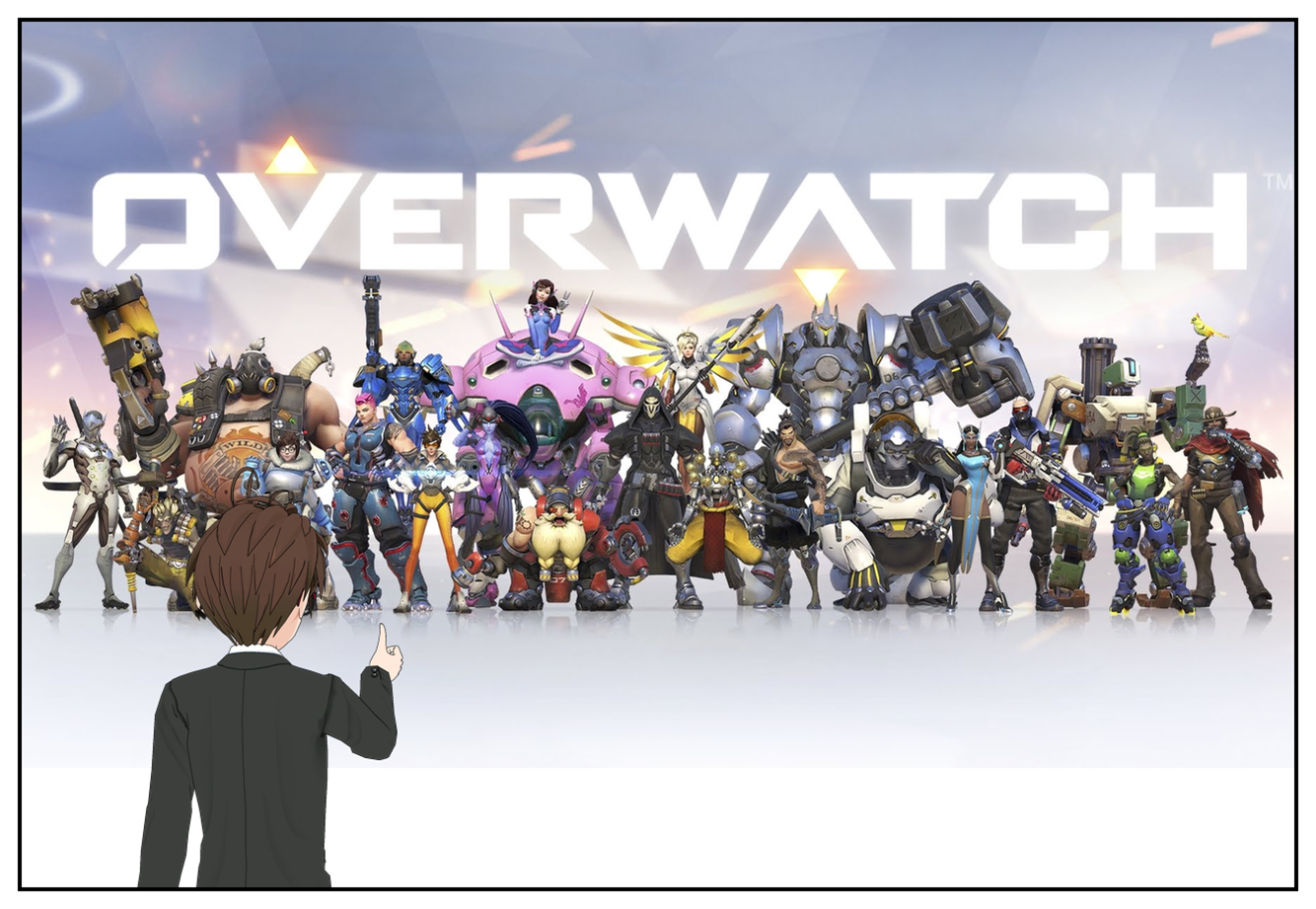
For those who have perhaps heard of Overwatch but not found out any more information about it, it is, in many ways, similar to Valve's classic Team Fortress 2 in that two teams made up of various different characters with different capabilities face off against one another in order to complete an objective of some description. In the game as it stands at the moment, the objectives on offer include a "king of the hill" type affair, where over the best of three rounds, each team has to control a particular area on the map for a certain amount of time; an "attack and defend" situation, where one team has to defend a point against assault from the other team; an "assault" variant, where the attacking team has to escort a slow-moving "payload" vehicle from one end of the map to the other while the other team stops them; and a mode that mixes the "attack and defend" and "assault" objectives together.

Like Team Fortress 2, the different characters have different roles on the team. Offensive characters are nimble but fragile, with their weapons and abilities concentrating on inflicting damage efficiently. Defensive characters have the ability to do things like lay down turrets or, in the case of one particular character, turn themselves into a turret. Tank characters have a huge pool of health points so are designed to act as a distraction for the other team. And support characters generally have some sort of useful ability to help the team out — usually some form of healing, buffing or both.

Where Team Fortress 2 only had one character of each archetype, though, Overwatch has several, each of whom has a unique weapon and loadout of special abilities. Weapons have clips of ammo and have to be reloaded when empty, but you have infinite clips, so there's no hunting around for ammo or any punishment for spray-and-pray gunplay. You can restore your health by returning to your home base, similar to how Blizzard's MOBA Heroes of the Storm works. And if you find a hero isn't working out for you, you can switch either when you die or when you're in your base.

Overwatch strikes an excellent balance between simplicity and tactical depth. The characters are all easy to learn in terms of mechanics, but applying their weapons and skills to situations throughout a match is the real challenge. That and not blowing yourself up in some instances; my favourite character so far, D.Va, has the ability to self-destruct her mech suit, killing anyone nearby, which is an absolutely devastating skill, but also very likely to take you with it if you don't immediately run away.

There's also a fun metagame that doesn't fall into the Call of Duty trap of excessive challenges and skill levels: you simply have an experience level, which gives you a "loot box" every time you level up, and the items in the loot box are randomly selected skins, animations, spray paint logos and voice clips for the various characters in the game. None of these have any effect on the characters' abilities — they're just there as cool collectibles as an incentive for players to keep playing. The choice to make Overwatch a full-price game rather than a free-to-play affair also seems quite sensible, too; while some may balk at paying full whack for a multiplayer-only game, there's a substantial amount of content in here, both heroes and maps, and Blizzard claim that they're going to support the game post-launch with new, free add-on content rather than paid DLC. A round of applause for them, then; doubly so since their parent company is Activision, who loves milking the annual Call of Duty installments dry.

The other nice side-effect of it being a full-price game is that everyone has access to everything from day one. Everyone can pick a favourite character and get to grips with them without having to wait for them to come around in a free-to-play rotation; everyone is, in other words, on a level playing field to begin with, with no advantage given to someone who has paid up for characters, boosters or whatever.

As I say, I'm not yet sure if I'm convinced enough by the beta to hand over 50 quid for the full game when it releases later in the month, but I will say it's the most fun I've had in a first-person shooter for a very long time indeed, and I generally don't go in for competitive first-person shooters. The beta seems to have had some positive attention, too, so hopefully it will enjoy a solid community for some time — long enough for it to be worthwhile for Blizzard to keep adding new content.

If you want to give it a go for yourself, I believe you have until Monday morning to try it out. Better hurry!