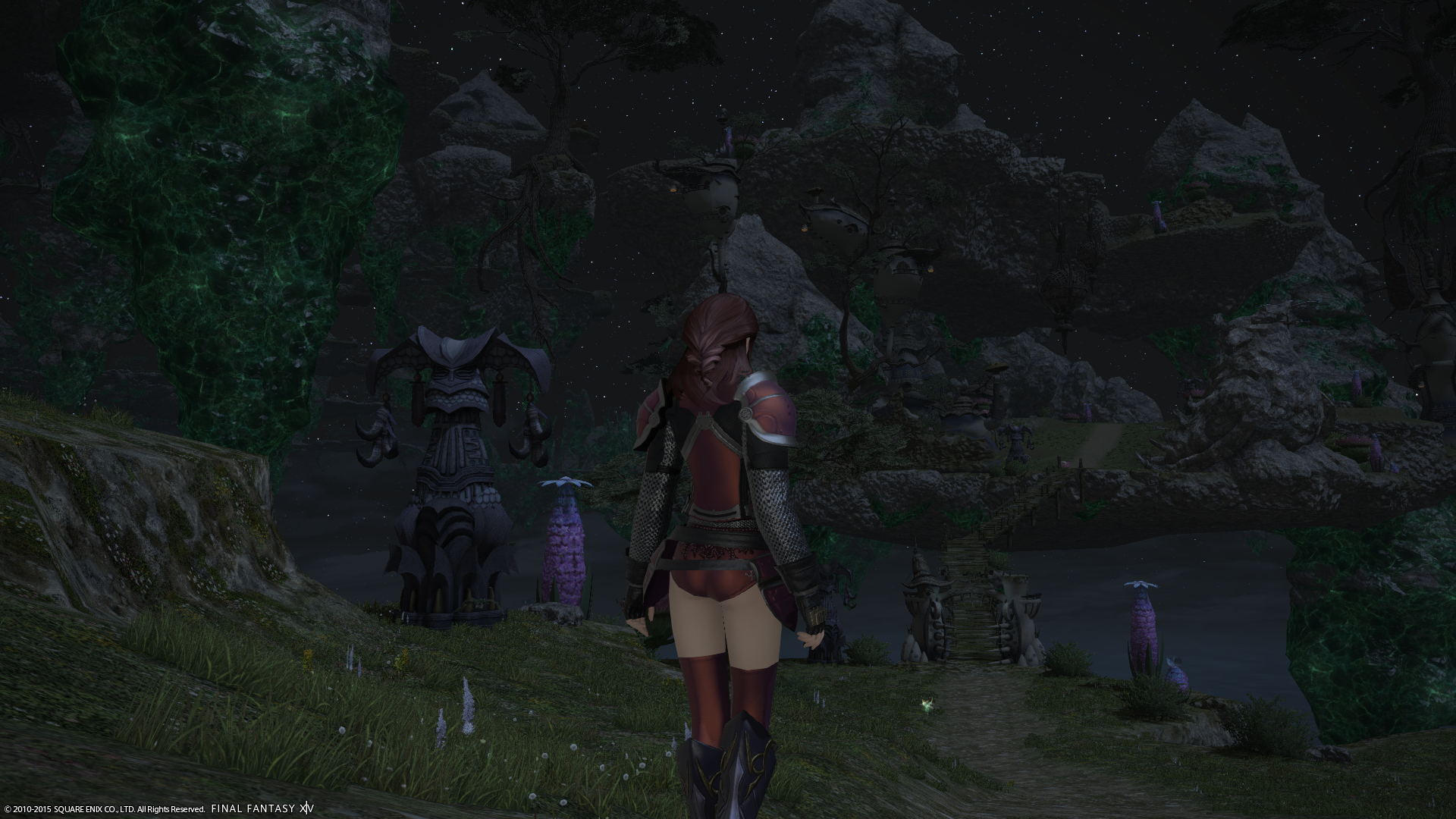
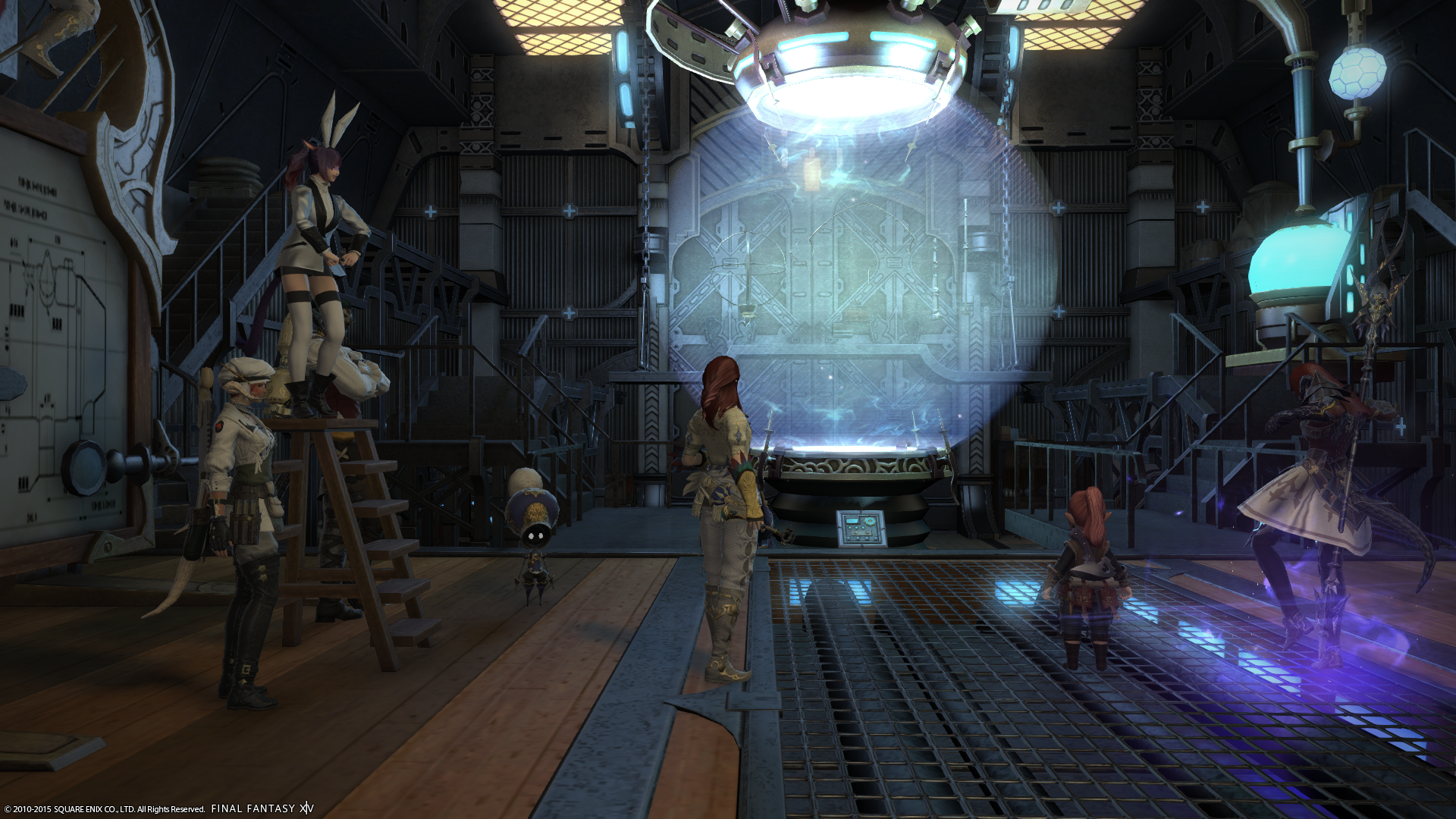
1978: Some More Heavensward Thoughts

Spent some more time playing Heavensward today and am having an absolute blast with it.

It's been an odd adjustment to move from the rather freeform, "pursue your own goals" gameplay of a level cap character back into the routine of doing quests, exploring and all manner of other things. But I'm enjoying it a lot, particularly as so far Heavensward is proving itself to have a wide variety of things to do and ways to earn those all-important experience points.

ffxiv_20062015_141237

The main story quests have been very good so far. They always were mostly quite interesting (though in the post-50 ones there was quite a lot of lugging boxes around and other menial tasks in between the more dramatic moments — not exactly the Warrior of Light's finest hour) but Heavensward has raised the bar somewhat.

One way in which it's done this is through the use of instanced quest battles — scripted encounters that take you out of the main multiplayer world and put you in your own private little area to complete objectives. In A Realm Reborn, these were usually fairly small scale but fun; in Heavensward they're much more ambitious affairs with their own unique mechanics. One particular highlight relatively early on sees you running through one of the earlier dungeons by yourself in the attempt to rescue a prisoner — while you do so, their captors start filling the place with poison gas, so you have to deal with that as well as finding a way to release them.

The main story itself is interesting and feels more focused than A Realm Reborn, too. Taking a somewhat darker overall tone, the plot thus far has seen the Warrior of Light (you!), one of your erstwhile companions and two other characters who each played roles in A Realm Reborn exploring the lands beyond Ishgard in an attempt to stop a war between the Dravanian dragons and Ishgard that will doubtless end with much death and destruction on both sides.

ffxiv_20062015_144146

A Realm Reborn set up dragons mostly as fearsome, dehumanised foes to be treated with respect but defeated nonetheless. They played a relatively minor role in the overarching storyline until the latter hours and the Binding Coil of Bahamut storyline, but they were there nonetheless — and as you progressed, particularly through the Bahamut narrative, it became very apparent that they weren't quite the simple foes you might have expected them to be based on their appearances in other fantasy media.

Heavensward runs with this theme, with both the main story and sidequests going some distance to help us understand the dragons a little better. One questline in particular sees you helping out an Ishgardian who is essentially a "racist" of sorts against dragons — he refuses to believe they are anything more than monsters, but as you complete his quests, both you and he come to see that the dragons apparently have feelings and society just like the humanoids of the world.

The sidequests are kind of interesting in that they further your understanding of the game world much like in A Realm Reborn, but unlike the base game, the darker tone seeps in quite often, with many quests ending in less than perfect circumstances. In some regards it feels like some cues have been taken from Nier — also published by Square Enix — by demonstrating that sometimes, even with your best intentions and god-felling skills and abilities, you simply can't bring about a happy ending for everyone. It's sobering, but very much in keeping with the overall tone.

ffxiv_20062015_154720

Then you have boss fights in which you and seven friends take on a giant insect god with a penchant for swinging four gigantic swords around at once, and you remember that this is still very much a Final Fantasy game at heart — and oh, do I love it for it.

1977: To The Heavens

Well, it's finally here: Final Fantasy XIV opened the doors to its first full expansion Heavensward today — for those who preordered it, anyway — and I've spent literally all day playing it.

It's good.

The story follows on directly from the end of the 2.55 story arc, which I won't spoil here for those who haven't seen it in all its ridiculous and tragic glory. Suffice to say, however, that it provides good reason for the Warrior of Light (that's you!) and occasional companion Alphinaud to head in the direction of Ishgard, a region which had previously been closed off to outsiders, but which became a little more open-minded after seeing how you (and seven friends) fended off an absolutely massive dragon towards the end of A Realm Reborn.

The city of Ishgard itself is beautifully rendered, being somewhat similar in design to a cross between Final Fantasy XI's cities of San d'Oria and Jeuno. It has its own very distinctive character that is separate to the three previous city-states we had the opportunity to visit in A Realm Reborn — the verdant, nature-filled environs of Gridania; the tall towers and tall ships of Limsa Lominsa; and the juxtaposition between extreme affluence and extreme poverty of Ul'Dah — with an austere, almost unwelcoming facade and some beautiful architecture. The kind of place where you'd be slightly afraid to touch anything, lest you befouled or defaced it in some way or another.

Outside the city, things get interesting. Early on, the main scenario quest sends you off in two separate directions: in one direction lies the Coerthas Western Highlands — a snowy, mountainous region similar to the existing Central Highlands region, but with more in the way of sheer cliff faces and inconvenient but impressive-looking lumps of rock all over the place — while in the other lies the Sea of Clouds, a floating archipelago of islands in the sky where skies are often clear and blue by simple virtue of the fact that the islands are above the clouds, but whose altitude drops the temperature to less-than-inviting levels. There's a huge contrast between these initial two areas; Coerthas is drab, monochromatic and somewhat grounded in reality for the most part (huge dead dragon corpse aside), while the Sea of Clouds is dramatically colourful, the stuff of pure fantasy. I haven't proceeded further afield just yet, but the main story is shortly to have me heading for Dravania, home of the dragons, so I'm interested to see how that compares.

One really striking thing about Heavensward is its sense of scale. A Realm Reborn was no stranger to sprawling environments that were impressive to behold, but Heavensward takes it to a new level. Ishgard is gigantic and imposing in the same way an old cathedral is; meanwhile, the field maps are huge in terms of both surface area and variation in altitude — the latter aspect of which is, in part, designed to accommodate the new flying mounts you can ride around after completing the surprisingly enjoyable task of hunting down a number of hidden "aether currents" scattered around the region.

Another striking thing about Heavensward is nothing to do with its architecture, however: a good 80-90% of the original voice cast appears to have been replaced, meaning some characters sound quite different to how they sounded in A Realm Reborn, with several even having picked up regional accents (primarily Yorkshire so far) in the intervening period. It's initially somewhat jarring, but overall the quality of the voice acting is much better than A Realm Reborn. This isn't particularly difficult, however, because although A Realm Reborn had an excellent localisation (albeit one that diverged quite a bit from the original Japanese script and took on something of a life of its own) its voice acting was passable at best and woefully awful at worst. At least in English it was, anyway; the Japanese voice acting makes use of well-known voice talent like Rie Tanaka (Hyperdimension Neptunia) and Eri Kitamura (Senran Kagura) and as such has always been pretty good, but it's clear that the English dub was perhaps, to put it politely, done a little bit on the cheap side.

It's not entirely surprising, mind you; A Realm Reborn was a huge risk for Square Enix given Final Fantasy XIV version 1.0's critical and commercial failure. As such, the decision to perhaps skimp a bit on the voice acting budget — many scenes in A Realm Reborn and indeed Heavensward also are unvoiced — was understandable. However, since A Realm Reborn achieved the seemingly impossible and rescued an all-but-dead MMO from oblivion, turning it into one of the company's greatest success stories in the process, it's gratifying to see that a bit more effort has been put into aspects of the presentation such as voice acting — even if the change in some characters' voices is a little surprising the first time you hear it.

I'm yet to try out a huge amount of the new gameplay features — I'm concentrating on levelling my main class Paladin to 60 before levelling anything further — but the new skills for existing classes look interesting, and the altogether new classes seem to be really cool, though it looks as if "lolDRK" is going to become the new "lolDRG". (Context for those unfamiliar: for the longest time, Dragoons (DRG) were notorious for dying a lot, due in part to their low magic resistance but also due to awkward animation locks on certain skills making it difficult to move out of the way of attacks; hence, "lolDRG" as the response to a Dragoon's inevitable death; Dark Knights (DRK), however, appear to be ready to take up the mantle for themselves, from what I've heard so far.)

Oh, and the music is amazing. And the story is interesting. And I've fallen in love with this stupid game all over again. There goes the next few years of my life…

1975: Bahamut Down

In the early hours of this morning, Wuckle and I achieved something I hoped we'd achieve before Friday: we defeated Bahamut Prime in The Burning Heart, bringing our expeditions into the Final Coil of Bahamut to a close — for now, at least; we have some members of our static raid group who are still yet to clear these fights, so we'll be helping them through at some point soon.

As the "true final boss" of the game, I was hoping that the Bahamut Prime fight would be pretty spectacular, and sure enough I wasn't disappointed. Here's a video (from my character's perspective as a Black Mage) of our clear:

The fight is not only a suitably challenging battle to bring the main endgame raid of "vanilla" Final Fantasy XIV to a close, it's also a fitting conclusion for a Final Fantasy game. Japanese role-playing games are often known for getting a little… peculiar in their final confrontations, with final bosses often being fought in space, in clouds of darkness, in strange swirling miasmas or inside the cores of planets. In the case of Final Fantasy XIV, your battle against Bahamut Prime takes place within Bahamut's own heart — Bahamut Prime, it seems, is not literally Bahamut himself (since he is both absolutely massive and in the process of being regenerated by the various Coils) but rather a manifestation of his will and rage.

This doesn't stop him being a formidable opponent, mind you. The fight combines mechanics from a number of earlier battles to create a confrontation where you have to use everything you've learned about handling mechanics to be successful. There's heavy amounts of damage. There's people taking responsibility for ensuring the group isn't wiped out by carelessness or inattention. There's puddles of nasty shit on the floor that you have to drop carefully. And, of course, there are Divebombs, Final Fantasy XIV's most notorious enemy ability, first introduced in the Turn 5 fight against Twintania, later seen in a somewhat different format in the Turn 9 fight against Nael deus Darnus and finally seen from not one but two independent sources in the Bahamut Prime battle.

Divebombs are notorious because in the case of Turn 5 in particular, they were the "roadblock" that stopped a lot of groups from progressing further, simply because they're tricky to handle properly and can have devastating consequences for the whole group if handled incorrectly. Their inclusion in each of the three "final" battles in the three separate parts of Coil shows the battle designers' awareness that they are a challenge — albeit a surmountable one — and a desire to test players' abilities to the maximum, often without the helpful visual telegraphs that many of the other enemy attacks in the game have.

But anyway. You didn't come for a deconstruction of the mechanics of Final Fantasy XIV's raids. (Probably.) You came to hear me enthuse about beating a spectacular final boss fight — and, if you've watched the video, you'll see that it most certainly is.

As I've written about a few times previously on these pages, I'm a big fan of well-done final confrontations, and a big part of an effective one in my book is good use of music. Turn 5 and Turn 9 (the previous "final bosses" of the game prior to the introduction of Final Coil) both had great music that was unique to the fight (or "almost unique" in the case of Turn 5 — it's also used for the final boss of the main 2.0 storyline as well as a later confrontation); Turn 13, meanwhile, makes stunningly effective use of the game's main theme song "Answers".

"Answers" is one of the first things you hear in A Realm Reborn, since it accompanies the dramatic introduction sequence that depicts the end of the 1.0 world through the Calamity — an event that those who played the original incarnation of Final Fantasy XIV actually lived through.

The Calamity saw the descent of the artificial moon Dalamud as a result of the machinations of Nael van Darnus, an overly ambitious Imperial legatus and the main antagonist of the 1.0 storyline. As the moon approached Eorzea, however, an unexpected thing happened: it burst open to reveal a very angry Bahamut, who proceeded to lay waste to the realm in his somewhat understandable rage — after all, you'd be pissed off if you'd been locked inside a moon since ancient times, wouldn't you?

All looks lost for Eorzea, but the intervention of Archon Louisoix, a major character in the 1.0 storyline and quests, sees something mysterious happen that no-one quite understands or remembers. Everyone wakes up five years later in a realm that is somewhat different to what it once was, but still very much intact. This is how A Realm Reborn kicks off, but the main storyline then goes off in its own direction and the truth of what really happened in the Calamity doesn't start to be revealed when (if) you venture into the Binding Coil of Bahamut.

Through your explorations of the three Coils, you discover not only the truth behind the Calamity, but also what happened to a number of important characters who had apparently disappeared or died — most notably, Louisoix himself and Nael. Needless to say, everything comes back to Bahamut in the end — but during your investigations you also discover exactly what it was that led to Bahamut's imprisonment inside the artificial moon, and why he's so full of rage and resentment towards humanity.

Since "Answers" is a song so closely tied to this storyline, it's fitting that it should be the accompaniment for its final conclusion. And it's used beautifully throughout the fight, too, beginning with the mournful baritone lyrics speaking of suffering and pain, moving through the gentler, sweeter female lyrics that speak of "the land's light of justice" and walking free before eventually culminating in the gloriously thick-sounding choral finale. The music isn't just played straight through, though; the simple, sparse baritone singing is used in the fight's first phase, the female lyrics come in in the second phase as you start having to deal with Bahamut's minions as well as the dragon god himself, and the explosion of passion that is the finale comes as Bahamut Prime begins casting his ultimate attack Teraflare: a devastating blast of flaming energy that, assuming you survive, signals the beginning of the end.

Final Fantasy XIV uses music spectacularly well throughout to help with its storytelling. Each of the story's main confrontations are accompanied by their own unique theme tunes, many of which have relevant lyrics. The presentation of the game's absolutely, positively, definitely final battle (until Heavensward, obviously) is no exception to this, and I'm very excited to hear what Soken and his team come up with to accompany our new adventures.

It's now 1am, though, and since I've had like three hours sleep, I think it's probably time I caught up a bit.

1970: Phoenix Down

We cleared The Final Coil of Bahamut, Turn 3 (aka Turn 12) in Final Fantasy XIV this evening. That means there's only one more boss left to go until I've officially cleared everything in the game at least once. Said boss is a biggie, however; I'd expect nothing less, both for the "true final boss" of the game and for the "true final boss" of a Final Fantasy game.

Turn 12 is an enjoyable fight, though. It took a bit of practice to get it right, but we eventually got there without too much difficulty and frustration. It's interesting in that it's quite unforgiving of any mistakes you might make, but also relatively straightforward and easy once everyone knows what they're doing. There's a lot less in the way of randomness than some of the other encounters (particularly in Coil) so there's a lot less in the way of unexpected things for the party to deal with — any unfortunate happenings can usually be traced directly back to someone doing something wrong somewhere.

Interestingly, a guildmate pointed out that the fight is very unforgiving because unforgiveness is an important narrative theme of the confrontation itself. I won't spoil the story context of it for those who are yet to clear and hoping to remain unspoiled — it's a significant narrative moment in the grand scheme of Final Fantasy XIV's overarching storyline, particularly the spectacular cutscene that follows your victory — but I found it really cool that the mechanics of the game mirrored the narrative themes so nicely. It's a subtle thing, but as someone who is very much interested in the different ways interactive entertainment can tell stories, I liked it very much.

I've been a little burnt out on the game recently, as prior to the imminent expansion Heavensward it's been going through its longest drought of new content since it launched, and it's been hard to motivate myself to keep running the same things over and over again, particularly as in some cases the things I "need" to run for various quests are things that have been in the game since launch, and as such I can probably do them in my sleep. (The Aurum Vale is a bit of an exception; I kind of like that there's a dungeon that can still kick the arse of an unprepared or complacent party, even if it can be frustrating to plough through sometimes.)

There's also the fact that with Heavensward comes a level cap increase, too, and as such a lot of the shiny, top-end gear that everyone's been stocking up on will probably be irrelevant in a matter of weeks following the expansion's release — though not much has been revealed about new gear as yet, so it will be interesting to see how they deal with the discrepancy between character level (currently capped at 50, rising to 60 with Heavensward) and gear level (currently capped at 130, with a couple of individual items being level 135) without revamping the whole system. (Or perhaps they will revamp the whole system, I don't know. Either way, I'm looking forward to it.)

Running T12 tonight, though, reminded me the main reason I play this game; it's not to always be running new and exciting things, it's not to bring down fearsome foes — though that's cool — and it's not to experience the story (which is also great) — but instead it's to have a good time with people who have become really good friends over the course of the last couple of years. The feeling of camaraderie you build when playing a game like this over a long period is unlike anything else in all of gaming, and it's a delight to be able to team up for nights like tonight, where everyone bands together against a common challenge and helps each other out.

So yeah. I may be a little burnt out on grinding for tomestones and the current gear treadmill, but there's still plenty of life in Eorzea's champion Amarysse yet; and I have no doubt whatsoever that Yoshi-P and his team will deliver a spectacular experience with Heavensward that will make me fall in love with the game all over again. Only 6 days until Early Access starts… man, I better finish Omega Quintet before then…

1964: 95 Hours With the Idols

My game clock in Omega Quintet now reads somewhere in the region of 95 hours. I'm now about three-quarters of the way through my New Game Plus run and attempting to get the True Ending, and then there's a bunch of post-game stuff, too, so that timer's going to tick well over 100 by the time I've finished, I'm sure. This officially makes Omega Quintet certainly the Compile Heart game I've spent the longest on, and probably getting on for the overall RPG (Final Fantasy XIV excepted, of course) that I've spent the longest on. The previous record holders were Hyperdimension Neptunia Victory from Compile Heart, and I think I took slightly longer than the 100 hours I took for Victory over Xenoblade Chronicles on Wii — and didn't see anywhere near everything.

Anyway. I don't want to dwell on how long this game is — I could have been done long ago, since I've technically already "cleared" it once and I'm doing all of the optional side quests — but rather on something that I noticed as I was playing today: after nearly 100 hours, I'm still spotting new things about the mechanics and working out ways to leverage them to my advantage.

Compile Heart games are often quite mechanically interesting. The original Hyperdimension Neptunia, for example, featured a combat system in which I spent hours assembling combo attacks that would neatly chain into one another, swap out characters mid-combo and do all sorts of other cool things. The later Neptunia games took a different approach to battle, with freedom of movement, area-of-effect attacks and different types of strike. Hyperdevotion Noire is a solid strategy RPG with easy to understand but tricky to master mechanics involving elemental affinities, range, height and areas of effect. Moe Chronicle — my copy of which arrived today, hooray! — sees you equipping stereotypically moe traits onto a range of monster girls to give them various special abilities. And there are a few I'm still yet to play, too.

One thing that the Neptunia series in particular lacks a bit, though, is customisation. The characters aren't completely fixed in their abilities — you have some flexibility in the combo attacks you can equip each character with, and it's possible to customise the special attack combo-finishers they use, too — but so far as their main special abilities go, they're fixed.

Enter Omega Quintet, then, which offers more customisation than I think I've ever seen in a Compile Heart game, with the possible exception of the original Neptunia. And it's far, far slicker than that game — much as I love it, it was very, very flawed in many places.

The early part of the game sees you assembling the titular Quintet, and various mechanics are locked out until you've assembled them all and you've read all the tutorials (which are thankfully skippable, so you don't need to read them again on a second playthrough). When the team is assembled and all the mechanics are in place, the default setup gives each of the five girls a different weapon and a basic few skills that they've already learned.

Skills fall into three broad categories: Elemental Skills (or E Skills) are magic-like abilities that either attack with elemental affinities or provide beneficial effects such as healing or buffing. Mic Skills — the weapons are known as "Mics", because they're idols, after all — are attacks that are tied to an individual weapon type, so the character must have the appropriate weapon equipped in order to use them. And Special Skills are character-specific attacks that require "Voltage" built up through performing well in combat to be able to pull off.

Of these abilities, only Special Skills are fixed on a per-character basis; everything else is fully customisable. The girls each clearly have a favoured weapon — the one they start with — but there's nothing stopping you from levelling their proficiency in other weapons, too. In fact, it's beneficial to do so, since levelling up a weapon proficiency provides you with additional "Disc Analysis" points besides those you already get from increasing the character's overall level.

Disc Analysis is Omega Quintet's main progression and customisation system. Each character has a large diamond-shaped grid with lots of nodes on it. Each node represents a new skill, an upgrade to an existing skill or a buff to the character such as additional E Skill slots or increased stat growth when levelling up. Spending the Disc Analysis points acquired through levelling and increasing in proficiency unlocks new abilities and opens up new nodes, since some nodes have prerequisites before you can use them or require you to "approach" them from a particular direction on the grid.

In my first playthrough, I wasn't terribly careful with how I organised my characters' development. I kept long-term goals in mind — "I want that ability that's all the way over there" — and attempted to take the most direct routes across the grid to where I wanted to go, picking up any necessary prerequisites along the way. This mostly worked, but it left each character feeling fairly "generic", since a lot of them had ended up learning the same or similar skills, and none of them were particularly playing to their strengths.

This second playthrough, I've been more focused, since I'm playing on the Advanced difficulty. (It hasn't been too difficult yet, but that may be something to do with the fact I carried over my weapons and items from my first playthrough, making me a powerhouse in the early game) I've been specialising my characters and paying more attention to the "Chain Skill" system, which allows multiple characters to trigger more powerful special attacks if they perform the right skills in the right order using the "Harmonics" (simultaneous turn) system.

Kyouka, for example, has high Vitality — Vitality in this game is your speed stat, for some reason, rather than its more common usage as "ability to take punishment" — which means she usually acts first in a fight. This puts her in an ideal position to be a "buffer", so I've given her all of the stat-boosting spells and, using her four actions per turn, she can increase any four of the party's Song Power (physical attack), Stamina (physical defense), Knowledge (magical attack), Divinity (magical defense/healing power), Technique (accuracy) or Vitality (speed). Alternatively, she can use her spear skills to attack; she has a couple of useful area-of-effect attacks as well as one which draws enemies closer, helping to negate the damage penalty for attacking something at the "wrong" range for your weapon or ability.

Aria, meanwhile, has high Divinity, putting her in a good position to be a healer. So I've given her the healing spells. Her high Divinity also means that she can shrug off magical attacks quite easily — sometimes they even miss her altogether, and she has good resistance to status effects. When she's not healing, her combat fan skills have some large area-of-effect attacks as well as two skills that steal items from enemies, making her very useful indeed for farming items.

Nene has the highest Knowledge in the party, making her the "mage". Most of the other characters have fairly woeful Knowledge stats, making their E Skill attacks next to useless for anything other than the status effects or stat penalties most of them come with. Nene, however, probably does more damage with her E Skills than with her gun, so I've given her the most powerful, most costly area-of-effect offensive E Skill spells, making her a powerhouse for blowing things up. She's also very useful for item farming, since her Special Skill comes with a "Rare Steal" effect attached, allowing you to acquire items that you can't get otherwise. In the case of the powerful bosses in the Training Center optional dungeon, these rare items are extremely profitable, though you can seemingly only fight each of these bosses twice before they're gone for good, so no endless farming!

Otoha and Kanadeko are more "average" characters, with their main strengths stat-wise being Song Power, Stamina and, in Kanadeko's case, Vitality. This makes them solid physical attackers, and in Kanadeko's case, her high Vitality means that she usually acts immediately after Kyouka, allowing for some quick hits before the enemy gets started on pummelling the party. The two of them are distinguished by their Mic Skills, however; Otoha has two large area-of-effect attacks and a huge area-of-effect Special Skill, while Kanadeko has some smaller area-of-effect attacks and a single-target Special Skill, but does considerably more overall damage and also has the ability to delay enemy turns with many of her skills.

Things get even more interesting when you throw the Chain Skills into the mix. Because Chain Skills necessitate each "step" being performed by a different character, this makes each individual character's arsenal of E Skills important to consider to give access to the widest possible variety of Chain Skills at any given moment. But then you need to consider that character acting by themselves, too, since you can't always guarantee you'll be able to get the turn order to line up just the way you want it in order to pull one off.

Then you have the Neptunia-esque guard break system, whereby each enemy has a "magnetic field" surrounding them that weakens to varying degrees with each hit they take, and which replenishes fully when the enemy's turn next rolls around. When the field is broken, not only does the enemy take more damage, but certain abilities — particularly Chain Skills and Special Skills — activate a special mode called Pursuit, which extends the usual animation for the skill and does additional hits, usually for quite a bit more damage. As such, it's in your interest to try and batter the magnetic field down as efficiently as you can with low-cost skills, then unleash the powerful Chain Skills and Special Skills when the field is already broken, since Pursuit will only activate if the field is broken at the start of the move in question.

Sound complicated? It kind of is; the game does explain each of these individual elements to you on your first playthrough, but it doesn't really tell you how to apply them to your advantage. That part is entirely up to you to figure out, and after nearly 100 hours I think I've pretty much cracked it. We'll have to see if these tactics will take me safely to the end of the game and beyond, or whether I'll have to have a strategic rethink at some point!

Anyway, I've been playing the damn thing all day so I'm going to bed now.
1961: Sound Shapes

I remember first seeing Sound Shapes at a Gamescom I was covering for GamePro back when GamePro was still a thing. I found it immediately intriguing — partly because it was a game on the then-new-and-shiny Vita, but also because it looked to have some interesting ideas. Now, some several years later, thanks to a significant PlayStation Plus discounted price, I've finally played it. And I've been quite surprised by what I found.

Sound Shapes, if you're unfamiliar, is ostensibly a platform game, but with a few peculiar twists, the first of which being that you don't play as a "character" as such, instead this weird sort of ball thing that can switch between "sticky" and "non-sticky" states at will. When in its default sticky state, it can stick to certain walls and even ceilings; when in its non-sticky state, it moves faster and can jump further. These are the only controls you use in Sound Shapes; where the game gets interesting is in the sheer variety of ways it uses these very simple mechanics.

The "sound" part of the title comes from the fact that the game is heavily music-based. Elements of each screen you visit — no scrolling here; only old-school 8-bit style flick screens — move in time with the music, and the collectible objects in each level are "notes" that affect the soundtrack once you've picked them up. Indeed, when you make use of the level editor, you're not only putting together some fiendish platforming puzzles, you're also composing a piece of music.

And there's a surprising amount of variety, too. Shipping with a number of different "albums" and providing plenty more to explore online, Sound Shapes sees you exploring a number of different environments according to special guest musicians and artists. The first "world"'s art is done by Capy, for example, while the second is a collaboration between Jim Guthrie on music and Superbrothers on art. The two contrast hugely; Capy's world is very organic and smooth, looking like it's been drawn in flat-shaded vector graphics. Guthrie and Superbrothers' world, meanwhile, looks very much like their well-known game Sworcery, but appears to be some sort of introspective reflection on the futility of modern everyday office life.

What I like about Sound Shapes is that it's arty without being pretentious about it. You can treat it as a straightforward platformer if you like, or you can treat the stages as works of interactive art, where the overall multimedia experience has been crafted to put a particular image in your mind, or make you feel a particular way. Some are more successful than others, but all are satisfying and fun to play.

I've been really surprised at quite how good Sound Shapes is. It's a shame I didn't pick it up sooner, really, but I'm having fun with it now, at least; I can recommend it if you're in the mood for some straightforward, pick-up-and-play platforming with a very distinctive, striking audio-visual aesthetic.

1956: Diving into Hell

I grabbed a copy of a game I've been curious about for a little while today: Helldivers, from Arrowhead.

Helldivers is a PS3, PS4 and Vita game (cross-buy, cross-save and cross-play, thank you very much!) in which you take on the role of one of the titular dropship troopers, blow shit up and then get extracted. Except it's rather more likely that you will die in the process.

Arrowhead, you may recall, also developed Magicka, which is a gloriously chaotic "cooperative" multiplayer shooter in which friendly fire is well and truly turned on. In Magicka, a significant part of the fun comes from seeing what happens when your spells interact with other players' spells — there are often unexpected consequences. Helldivers is less explicitly ridiculous than Magicka is, but there's a lot of the same magic — no pun intended — in there.

Yes, friendly fire is turned on in Helldivers. Yes, things that you do supposedly to benefit the group can end up killing them. Yes, it's a rather good time despite the somewhat generic premise of "space marines go places and kill stuff" — the mission objectives and maps are varied and interesting enough to keep things enjoyable. Or so it looks, anyway; I've only played for about half an hour so far, but I enjoyed it a lot.

The interesting stuff in Helldivers, it seems, will come in the form of "Strategems". These are a rough equivalent to the spells in Magicka in that using them requires you to input a particular string of button commands, but the difference is that they don't take effect immediately. Powerful attacks like air strikes take time to reach your location, for example, meaning you'll need to hold off enemies while you wait for support. And then when support arrives, you'd better make sure you're not standing where you dropped the beacon, otherwise the thing you requested will indeed drop on your head and kill you.

There's something understatedly ridiculous about the multiplayer that makes it a joy. Earlier, I played a game with two random people in which one of our objectives was to disarm some unexploded armaments. No further information was given than that, aside from a location on the map that didn't seem to have anything there. Then several of us realised that we had a "metal detector" strategem available, allowing us to call in a supply drop containing a metal detector. When we'd acquired this, we could then sweep the area for the (apparently buried) bombs. Unfortunately, while we were doing so, our beacons attracted the attentions of the Bug hordes, so my two comrades had to fend them off while I was methodically searching the area for unexploded bombs. The juxtaposition was hilarious.

There's also a really interesting metagame going on, too. The concept puts the Helldivers at work in wars on three fronts, with control of sectors and systems being determined by players succeeding in missions they challenge. When the player community as a whole has pushed the front to the alien homeworld, the ability to assault it becomes available, and consequently an opportunity to win that particular war. Then every so often things reset and start again, from what I understand; I'm interested to see how the current war (the 4th, apparently) unfolds over time — it's a really cool idea and a great use of online.

So yeah. Helldivers. It's a good time. And if you're a PlayStation Plus subscriber, it's cheap right now, too.

1936: Modern Old-School

One of the games I've been playing a bunch on my shiny new PlayStation 4 is Resogun, a game that I was previously moderately excited about, and which, prior to Omega Quintet (and, arguably, Final Fantasy Type-0, which I'm interested to try at some point in the near future) was a game I often cited as the only (then-current) reason that I'd be interested in a PlayStation 4.

But it wasn't enough by itself to make me want to buy one. For a new platform to be truly compelling for me, there needs to be some long-form games that I'm interested in, whereas Resogun is an arcade game, intended to be enjoyed in relatively short bursts. This isn't a criticism of it, mind, but I'd have had a tough time justifying a PlayStation 4 purchase to myself purely on the strength of what is, essentially, next-gen Defender.

But oh, what a game Resogun actually is! I'm still skeptical of whether I'd have found it worth buying a PS4 for by itself — although in retrospect, I bought an Xbox 360 primarily because of Geometry Wars, which is even more simplistic than Resogun — but I'm absolutely in love with it, because it represents a true fusion between classic old-school arcade-style gameplay and modern presentation.

At its core, as previously noted, Resogun is similar to the classic arcade game Defender. You fly a little ship that can move and fire left and right at will. Like Defender, the game unfolds on a scrolling, wrapping stage, though here it's represented as a cylinder that you fly around the outer surface of. Like Defender, your job is to save little green humans from being abducted by invading alien flying saucers. Unlike Defender, there's significantly more to it than that.

For starters, the humans are held in captivity before you can rescue them. In order to do so, you need to destroy "Keepers" — special enemies that show up every so often with a green glow surrounding them. You'll get an audible announcement when some Keepers show up, but not a visual indicator showing where they are if they're around the other side of the level, so you'll need to find and destroy them quickly to save the human in question, because if you miss any of them — or, in some cases, destroy them in the wrong order — the human will immediately die. Succeed, however, and the human will pop out of his little prison box and start running around on the ground, at which point he becomes vulnerable to being abducted, falling into holes, drowning and being splattered by unpleasant things. He also becomes available to be picked up by your ship and transported to one of the rescue pods at the top of the level.

To complete a level, you need to proceed through three "phases". Each phase requires you to destroy a certain amount of enemies represented by a bar filling up at the bottom of the screen. When you complete a phase, you get a brief "time out" where you can still move and fire, but you're invincible and the enemies move in slow-motion. This allows you a moment to compose yourself and get yourself into an advantageous position before proceeding. The end of the third phase, however, jumps directly into a boss battle, with bosses taking the form of various peculiar geometric shapes that warp and twist before your very eyes as you shoot chunks off them and chip away at their energy bar. When the boss is dead, the whole level explodes and you move on to the next one. Repeat for five levels, beat game.

Except that's not all that there is to Resogun — at least not with the excellent DLC packages that have been released since it originally came out. Between these two packages (available as a bundle or individually) there are several new modes, including Survival, which places you on a single level and tasks you with surviving through a series of increasingly difficult days, acquiring power-ups by picking up humans; Protector, which requires you to deliver humans to cities to rebuild them and subsequently defend them from giant alien flying saucers; Commando, which casts you as a human attempting to protect his house from falling meteors in scenes somewhat reminiscent of Missile Command for a new generation; and Challenge, which gives you a series of unconventional ways to play the game and tasks you with completing some generally pretty fiendish objectives.

Resogun is unabashedly a score-attack game, and consequently it naturally comes with online support, allowing you to compare your scores both to your friends and the rest of the world's players. You can also filter these scores by time, allowing you to challenge friends each week or month to see who is truly the best (this week/month), and scores are tracked completely independently for each mode and difficulty setting.

Combine this with a robust ship editor, allowing you to create your own custom ships using the 3D "voxel" pixels from which the entire game is built (and which it is very fond of exploding things into at a moment's notice) and the ability to share said creations online and you have a remarkably "complete"-feeling package that, now I've spent some time with it, I'm pretty confident in recommending as an essential purchase for anyone with a PlayStation 4. (Assuming you like shooting things and watching numbers go up. And who doesn't like shooting things and watching numbers go up?)

So yeah. Buy Resogun. You won't regret it.

1932: Life with No Guide

It's not that often I play games shortly after they've been released, but starting Omega Quintet on literally the day it came out in Europe (physically, anyway; the digital version is out tomorrow, apparently) has reminded me of one interesting thing that you can only do in the moments after a game has been released: play the damn thing without a guide.

GameFAQs is such an ingrained part of gaming culture now that it's very difficult to resist its allure, particularly when playing a complicated, sprawling game like an RPG. It's natural to want to track down every single little secret and see every possible hidden scene, and GameFAQs provides a valuable service to people who feel this way but don't necessarily want to have to put in the hard work to figure things out for themselves. (This isn't a criticism, by the way; sometimes game secrets are so incredibly obtuse it's difficult to fathom how anyone ever discovered them without assistance directly from the developers, and in these cases your average player has little choice but to rely on a guide.)

But playing Omega Quintet before seemingly any guides have hit the Internet is proving to be a pleasurable experience. It's intriguing and fascinating to discover the intricacies of the game system for myself rather than relying on someone else's interpretation. It's satisfying to discover things that work well, and also the things that don't work so well. And, the more I discover about the game — I'm sure I haven't even seen all its mechanics yet, even as I approach the 30-hour mark — the more I'm actually quite grateful for one of the game's most common criticisms: the fact that it doesn't explain a lot of things immediately. Because without the game explicitly setting some things out for you, you have to make use of what information it does give you in order to extrapolate the rest for yourself. And that's enjoyable.

Take today's discovery, for example: a means of acquiring over 200% more rewards at the end of a battle than normal. The game gives you a few brief tutorials in its early hours that mention "bonuses" at the end of battle, and hint that things like your combo hit count and something about "linking" will increase this bonus, but it doesn't sit you down and say "Now you try!" like so many other modern games do. As such, it's possible to forget all about this bonus system and enjoy the combat on a fairly superficial level. But start to delve into it and suddenly it becomes a much more interesting, complex experience, and consequently far more rewarding as a result.

I went from using the same skills in every battle to attempting to make as long a chain of "linked" skills as possible, because the longer this chain, the more significant the bonus you get after battle. This involves looking at the skill information when you select one and taking note of the "link" type marked; in the case of weapon skills, it's inevitably another weapon type. Kyouka's spear skills, for example, link to Otoha's hammer skills; Kanadeko's gauntlet skills link to Aria's fan skills. Where it gets interesting is in the few instances where a character like Nene has some skills that can potentially link in several different directions — one skill might link to Kanadeko's gauntlets, for example, while another might link to Kyouka's spear. In this way, it becomes an interesting challenge to try and optimise the sequence of skills you use in order to link as many as possible without breaking the chain. I haven't quite figured out if it's possible to link everyone's skills that I have so far together into one long sequence yet, but I'm coming perilously close to getting a piece of paper and drawing flow charts to try and work it out.

I'm actually reminded somewhat of the original Hyperdimension Neptunia; perhaps unsurprising, since that was also an Idea Factory/Compile Heart game. The original Neptunia didn't have a particularly popular or well-regarded combat system, but I actually rather enjoyed it for much the same reasons I'm enjoying Omega QuintetNeptunia, too, had a distinctly puzzle-esque strategic element to how you set up your skills, with much of the challenge and interest coming from setting up your characters with combos that flowed well, maximised the amount of damage you put out and made efficient use of your available action points in a turn. Omega Quintet's combat is considerably more elegant than Neptunia's — IF and Compa have learned a lot since then! — but, to return to the original point of this post, I'm pleased to discover this depth for myself rather than reading about it in a guide.

I'd say I fully intend to try and play the next few games I tackle without looking at a guide at all, but we all know that isn't true. For now, though, I'm greatly enjoying "flying blind" in Omega Quintet, and I feel I have plenty left to discover.

1930: Fun with Harmonics

Spent some more time with Omega Quintet today, and I am, as I may have mentioned a couple of times already, absolutely thrilled with how enjoyable it is — and that it's much more than a reskinned Neptunia. Don't get me wrong, you know how much I love me some Neptunia, but I'm glad that Compile Heart and Idea Factory weren't resting on their laurels with this one; it would have been very easy indeed for them to simply lift Neptunia's admittedly very fun combat system and plonk it in Omega Quintet, but instead Omega Quintet has something all of its own.

Perhaps "all of its own" isn't quite the right description, mind, since Omega Quintet's combat is executed as something of a curious blend between the battle systems from the Atelier series, the Ar Tonelico series, The Legend of Heroes: Trails in the SkyFinal Fantasy X and Final Fantasy XIII. That's quite a mixture, but it works really well, particularly when you pull off something as enjoyably silly as this:

The above sequence was recorded at just level 20, by the way; I shudder to think what numbers the girls will be putting out by the end of the game.

Interestingly, the game doesn't bombard you with the complete combat system right from the get-go; it gradually increases in complexity over the course of the first few chapters at a fairly sedate pace, allowing you to get comfortable and familiar with each new concept before a new one is introduced. Ultimately, by the time the complete battle system has unlocked, you should be well familiar with all the possibilities it has to offer. At about 15 hours or so in, I haven't seen everything the system has to offer, yet; for some, this may draw unfavourable comparisons to Final Fantasy XIII, which was lambasted for having a "20 hour tutorial", but it's worth noting that Omega Quintet does sidestep this issue a little by being somewhat less linear than Final Fantasy XIII was; at any given moment, there's a bunch of sidequests to do, hidden treasures to find, new areas to open up, items to craft, special items to unlock and all manner of other things to do. (And besides, there was nothing the fuck wrong with the way Final Fantasy XIII did things, anyway. So there.)

Here's roughly how the system works. Like the Neptunia games, you can get the advantage at the start of combat by attacking an enemy before they come into contact with you; conversely, letting an enemy touch you from behind will give them the advantage. How battle begins sets the opening initiative order, and from there the game follows a clear to understand turn order system, reflected by a graphical representation down the side of the screen.

Each party member has a number of actions per turn, increasing as they increase their overall proficiency with each of the game's five weapon types — axe, gun, spear, fans and gauntlets. These actions can be used to attack, use a skill or use an item, and when all the actions have been chosen, the party member performs each of them in sequence before the turn order moves on to the next combatant. Of key consideration when choosing skills is the "wait time" — more powerful skills will push the party member's next turn further down the turn order, potentially giving enemies the opportunity to attack several times before she can go again. Conversely, certain skills increase the enemies' wait time when they successfully land, so you can manipulate the turn order yourself to a certain degree.

Attacks, skills and even items have an effective range, represented by coloured lines on the ground. Do something to someone in the green area and it will be most effective; then comes blue, yellow and finally red, which means you either can't do the action at all, or it will be at severely reduced effectiveness. Certain attacks and skills also have a radius, either circular or a range of "tiles" horizontally, vertically or both, meaning you can hit multiple enemies at the same time. At the start of a party member's turn, you can move them forward or backward in the formation, allowing you to manipulate the positioning to your advantage. There are also "knockback" skills, which are self-explanatory, and "reverse" skills, which… uh, I'm not entirely sure what they do.

Here's one thing I have to nitpick slightly; there are certain aspects the game doesn't explain very well or, indeed, at all in some cases. The stat names, for example, don't take the usual Attack/Defense/Magic Attack/Magic Defense/Accuracy/Agility format from other Compile Heart games; instead we have Song Power/Stamina/Knowledge/Divinity/Technique/Vitality. You can work out what they are from a bit of experimentation, but it takes a bit of adjustment. Likewise, some of the status effects and added effects (such as the aforementioned "Reverse") aren't made very clear at all, though again, you can probably work these things out for yourself.

Personally, I'm actually all for games encouraging you to figure out some of their mechanics for yourself. You don't need to understand these things to get a kick out of Omega Quintet, but if you're the sort of person who likes to min-max your characters and have them fighting at maximum effectiveness, be aware that you'll need to get your hands a little dirty — particularly as the characters in Omega Quintet are significantly more customisable than, say, the Neptunia girls, who don't allow you to take any control over their development at all, though they do allow you to set up your own custom combos according to how you like to fight. In other words, Omega Quintet's apparently deliberate obtuseness at times will be a turn-off to some people, but personally, I actually like not being spoon-fed absolutely everything.

Anyway. It's good. Real good. And I can't wait to play more. So I'm probably going to do just that right now; I've got a combo record to beat, after all.