1558: PeeVeePee

I'm not a huge fan of competitive play, be it online or on the tabletop; I generally prefer cooperative games. This explains why I'm generally drawn to theme-heavy games on the tabletop — they often tend to be cooperative in nature — and why I've been enjoying Final Fantasy XIV so much to date — most of it is cooperative.

Tonight, though, a couple of members of my Free Company in Final Fantasy XIV said that they'd been trying out the game's PvP (Player vs. Player) area, known as The Wolves' Den. And they'd been enjoying themselves a great deal. So, curious to take a look at this part of the game that I had, to date, never touched despite having ploughed an unspeakable number of hours into the game as a whole, I decided to join up with my comrades Avexxis and Emma and jump into The Wolves' Den.

Before I go on, let me explain a little: I've played a number of MMOs in the past, and given the PvP experiences a go in most of them. And I've never really had a satisfying experience with them. In World of Warcraft my main experience with PvP was being ganked when I'd forgotten to turn my PvP flag off for whatever reason. In The Secret World the areas were too big and it couldn't seem to make its mind up if it wanted to be a fast-paced shooter or an RPG. Star Wars: The Old Republic had the same problem; sprawling areas and a feeling of extreme unbalance. The closest I've come to having a good time with PvP in an MMO was in Guild Wars, and coincidentally that's probably the closest equivalent to Final Fantasy XIV's PvP.

PvP in Final Fantasy XIV isn't about huge, sprawling battles that inevitably continue into a stalemate because no-one knows how to work as a team and accomplish objectives together. Rather, it's about short, snappy, four-on-four battles in a small, enclosed arena that nonetheless has a number of convenient walls and pillars around the place to block line of sight. And it's a completely different experience to playing the normal "PvE" (Player vs. Environment) cooperative game.

The biggest difference is that you can't rely on your usual MMO setup of the tank maintaining the attention of all your enemies while everyone else knocks them down one by one. In PvP, your opponents are controlled by actual, real people so a tank's aggro-management skills are utterly useless. More often than not, you'll see the enemy team making a beeline for the opposing healer, who will find themselves having the most to do in the fight — usually in the form of running away and trying to get out of sight for long enough to catch their breath.

I was playing as the healer using my White Mage class, and it was a lot of fun. PvE White Mageing involves a lot of standing still and casting Cure on the tank, with occasional breaks to heal the party when a wider-range attack hits them, or to cure status effects when they crop up. In PvP, however, I was constantly using the Sprint ability to put some distance between me and the enemies chasing me — usually the opposing tank — and doing drive-by Regen casts on anyone I happened to be in range of. There simply wasn't time for the lengthy casting of Cure and its ilk, except when I had the opportunity to make use of the Black Mage skill Swiftcast and quickly drop in a Cure II on someone whose HP had reached critical level. It was extremely satisfying to bring someone back from the brink of death — even more so than in PvE.

The second battle we fought this evening was my favourite. I saw the enemy team heading straight for my comrades rather than me for once, so I hid behind a pillar, hoping they wouldn't see me for a little while. But then out of the corner of my eye, movement: a tiny Lalafell black mage, creeping towards me. Before I could react, I heard the telltale sound of the Sleep spell, and I was completely immobilised for 30 seconds. Fortunately, the Black Mage chose not to get a quick hit off on me — that would have woken me up — and instead fled to return his attention to the rest of my party, but later returned to fling a Thunder (damage over time) spell at me just as the Sleep effect was set to wear off.

I started running around the arena, hoping I wouldn't bump into someone who could stun me or do significant damage. I passed the opposing healer, who was fleeing in the opposite direction around the arena. I did a complete lap, and by the time I reached the rest of my party there were three members of the opposing group lying dead on the floor. I stopped running and watched them finish off the last. While I hadn't done any damage directly, I had evidently proven distracting enough to help win the fight, if only by dropping a few Regens and helping keep everyone alive.

Overall, a thoroughly pleasant surprise, then, and I can see myself indulging in it a little more often, particularly if I can get together with some guildmates and form a team.
1537: Lord of... Whatever

I decided to give Diablo III another chance now that the new expansion and its version 2.0 is here, bringing new loot rules and a bunch of other tweaks to the mix. And you know what, it's a big improvement.

I actually enjoyed the original incarnation of Diablo III more than most, and I maintain that its move to an MMO-like always-online structure was actually a pretty good idea from the perspective of easily allowing drop-in, drop-out multiplayer. I did find that it didn't hold my interest after I'd beaten it once, though, much like Diablo II; the fact that in order to unlock the other difficulty levels you had to play all the way through the campaign again and again and again just wasn't appealing — particularly if you wanted to try another character and thus had to start all over again.

One of the biggest additions in the new expansion is called "Adventure Mode" and is probably the aspect I'm most interested in. Unfortunately, access to Adventure Mode is locked behind completing the story-based campaign (including the new Act introduced in the expansion) and thus I find myself having to play through the whole bloody game again because the character I previously finished it with was on the American servers and the people I'm most likely to be playing with this time are on the European servers. I understand why Blizzard separated people by region, but it doesn't stop that particular aspect of the game's always-online nature from sucking a big load of balls.

Anyway, as I understand it, once you unlock Adventure Mode you can just play Adventure Mode whenever you want, and that's a much more appealing prospect. Unlocking the entire map from the get-go rather than forcing you to play through that interminably tedious desert sequence (why do action RPGs always have interminably tedious desert sequences?) again and again and again, Adventure Mode sees you tracking down "Bounties" in various areas of the game world and receiving rewards for them, and occasionally jumping into a "Nephalem Rift" where things go utterly bonkers and you have to kill bajillions of enemies.

It's Diablo in its purest sense, in other words; stripped of the narrative aspects that people skip through and focusing entirely on the game's most enjoyable aspect: the grind, and the drive to earn ever-better items of equipment for your characters. Making the experience non-linear rather than forcing you to play through the campaign repeatedly is a masterstroke, and is likely to give the game a lot more longevity. It also makes it much more friendly to short play sessions, since you don't feel tied to checkpoints in the plot to have made "meaningful" progress. It's just a shame you can't just jump straight back into it — though with the effort Blizzard puts into the story of the campaign, I understand why they want people to see it at least once.

I do find myself wondering why they bother, though. Much like I question the wisdom of including a single-player campaign in Call of Duty year after year when people are much more inclined to spend their time in the multiplayer mode, I can't help thinking Diablo would be a better game without the plot. And I generally like the nonsensical plots of role-playing games — but Diablo's mechanics jar so forcefully with its narrative aspect that it's hard to ignore. The mechanics are ridiculously fun, bringing in strong influences from arcade-style games such as time-limited challenges, secret levels and difficult-to-defeat opponents that yield massive rewards — and yet the plot takes itself deadly seriously. It doesn't quite mesh when you're supposed to feel bad for a major character in series lore dying (spoilers!) one minute, and the next you are literally punching the skeleton out of monsters.

Still, I can't complain too much. I am actually enjoying the new run through the campaign — helped partly by the fact that you can start on a higher difficulty level now rather than being forced to coast through the super-easy "Normal" mode — and am making good progress with my current Monk character. I still prefer Final Fantasy XIV as an online RPG, but I'm looking forward to having the opportunity to play online a bit more with my friends very soon.

If you played Diablo III back when it came out and have since left it behind, I'd encourage you to give it another look; the updates from Patch 2.0 alone are well worth exploring, and the additional content in the expansion looks like being a lot of fun indeed.

1531: Zodiac Brave

Final Fantasy XIV's second major patch is brilliant stuff, bringing with it an absolute shit-ton of things to do for those who have reached the level cap.

I used to be a little disappointed to hear that MMO expansions and major patches tended to favour endgame players over those working their way up through the levels, but now that I am an endgame player, I completely understand the logic. There's already a bunch of stuff there designed to get people from level 1 to level 50; but the people who have reached level 50 need a constant, continual stream of New Things to Do otherwise they'll simply jump ship and go off to play something else. In a subscription-based game such as Final Fantasy XIV, this is exactly what Square Enix does not want to happen.

Patch 2.1 added a decent amount of new content for endgame players to work through, primarily in the form of new dungeons and Trials (complex boss battles) to play through. Patch 2.2, the most recent one, initially appears to be somewhat similar, but there's a bunch of more subtle tweaks here and there that are designed to keep people invested in the game in the long term rather than simply racing through the new content as quickly as possible, then taking to the forums to whinge that there's not enough to do.

Chief among this time-consuming stuff is the Zodiac Weapons quest. One of the first things you'll want to do upon reaching the level cap in Final Fantasy XIV is complete the "A Relic Reborn" quest, which outfits you with a good weapon for your class that can subsequently be upgraded. The quest is a lengthy affair that demands you work through some of the toughest battles in the game and then participate in enough endgame content to earn the special currency required to purchase some items. Once it's done, it's done, though, and for each class there was previously only really one weapon better than the Relic available, and that was extremely difficult to obtain due to it being secreted in what was formerly the hardest dungeon in the whole game.

Now, though, your Relic can be upgraded further through the new Zodiac Weapons quest. After maxing out your relic, you're then tasked with going on the hunt for twelve "Atmas" — mysterious items that are required to buff up your Relic weapon into something new and shiny. In order to obtain the Atmas, you have to participate in the "FATE" events around Eorzea — little mini-quests that pop up around the world map that anyone in the area can jump in and help out with. For each FATE that you attain a gold medal in, there's about a 5% chance that the Atma for that area will drop, and you need to obtain twelve Atmas in total, so I'm sure you can see how this will take a while.

A grind it may be, but it's had the side-effect of making FATEs relevant again, which is a good thing, since they're a lot of fun and had fallen somewhat into disuse after the rewards from dungeon-crawling became significantly better. Now, though, there's always bands of wandering adventurers crawling around the various areas and stomping through the FATEs, and due to the game's level-sync mechanic, no-one will ever come along and simply overpower them, making it no fun.

Once you've obtained the twelve Atmas, there's then a selection of books to work through, each of which have their own challenges to complete and each of which buff up the Zodiac weapon's stats by a particular amount when you complete them. And then you can do this for each class.

In other words, it's going to take a while to accomplish. Despite the fact it's a fairly unsubtle move to keep endgame players invested in the game in the long-term, having a long-term goal like this is actually rather enjoyable because it brings a wonderful sense of achievement when you do finally accomplish it. I have no doubt that I'll put in the hours required to get a Zodiac weapon for my Black Mage class, and I will probably do it for the other classes I get to 50, too. I'm in this game for the long run, and I'm really enjoying the flow of new challenges that appear every few months.

#oneaday Day 892: In Memory of Floppy Drives

20120629-015705.jpg

I was struggling to think of something to write about until an offhand comment on Twitter got me thinking about, of all things, floppy disk drives.

I miss floppy disk drives.

No, wait. Bear with me. Not in practical terms — I'm sure no-one misses the days when games had a whole disk just for their intro sequence, or the era when Microsoft Office came in a box roughly the size of a Borg Cube — but in terms of… of… you know what? It's hard to describe exactly, so let me just wax nostalgic about a few things.

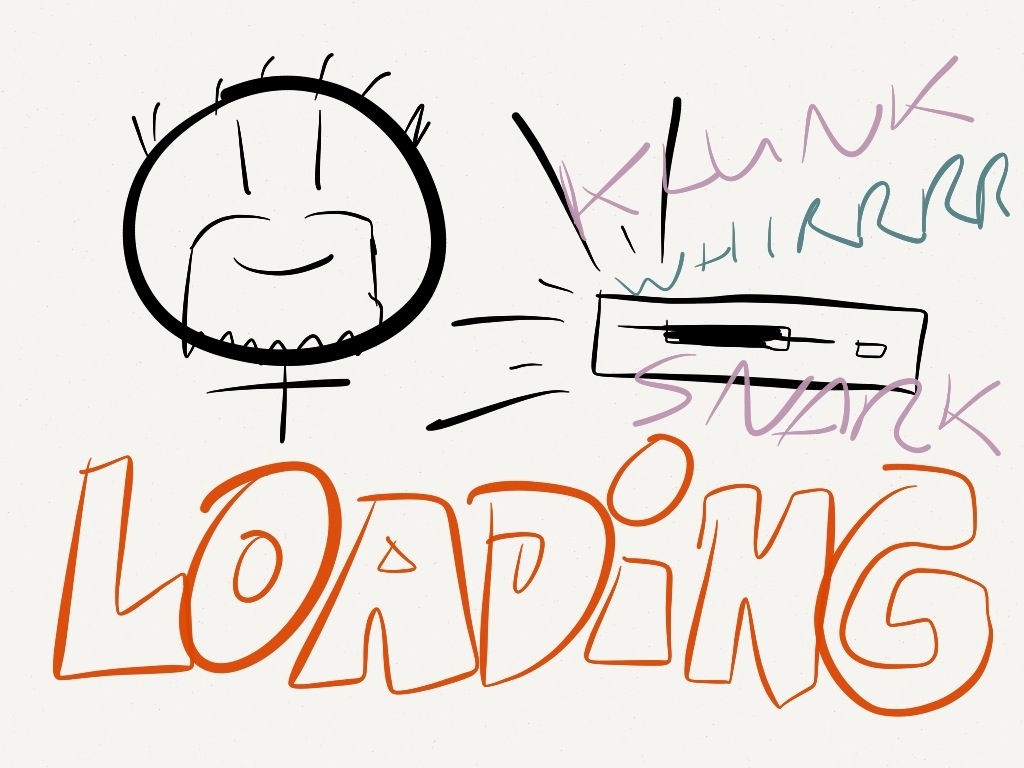
I used to find something oddly comforting in the sound of floppy drives whirring away doing their thing. Every floppy drive sounded different, too — the ridiculously huge 810 drive for the Atari 8-bit computers snarked and farted; the later 1050 was a little quieter (though had squeaky mechanical parts sometimes); the external floppy drives for the Atari ST made a pleasant frog-like croaking noise; the internal Atari ST drive was subtler, giving the occasional chug; and the drives in our first PCs were pretty quiet, putt-putt-putting away, usually installing something.

Their uses varied over the years, too. Up until DOS and Windows-based PCs started to take off as a serious gaming platform and required you to install everything, pretty much all software ran directly from floppies, making it necessary to have lots of those big plastic disk boxes (inevitably full of pirated software) — organised alphabetically if you wanted to remain sane. In practical terms, this meant things often took quite a long time to load, which brings us to something that is all but forgotten these days except in the most inefficiently-programmed and/or massive video games: the loading screen.

Loading screens used to be the place where the graphic artist for the game could really let rip and show off what they could do with the limited colour palette and resolution of the hardware they were working on. My most fondly-remembered loading screens were the work of Herman Serrano, a dude who could really make the Atari ST sing. (Visually. Whatever the visual equivalent of singing is. Oh, be quiet.) He did good loading screens for companies such as Argonaut and Psygnosis, and always signed his name prominently on them, which is something you don't see these days, either. Often they were just pixel-by-pixel recreations of the box art, but sometimes there were variations, and it was fun to look carefully at them, pick out the details and spot the occasional Easter eggs. You didn't have much choice, really, since there was nothing else you could do while it was loading.

While games still ran from floppies, loading breaks — now considered to be a thing of great evil that should be avoided at all cost — were considered something of a perk, as they generally indicated that you had done something good. This was true whether you were playing an Infocom text adventure on the Atari 8-bit or a LucasArts adventure on the Amiga. If the disk started chugging immediately after you did something, you were usually on to a winner. (Unless you were playing a Sierra game, of course, in which case it was entirely possible it was simply loading one of its many elaborate death scenes for your long-suffering character.) Some emulators of old systems even allow for the simulation of these loading breaks for the fully-authentic experience — though without the sound of a disk drive chugging away it loses something.

So yes. I miss floppy drives. I don't begrudge the 21st century's massive storage capacities and lightning-fast access, of course, but I do miss that comforting feel of sliding a disk into a slot with a satisfying "clunk", turning the computer on (yes! Remember having to turn the computer off every time you wanted to run something else?) and then sitting listening to the distinctive mechanical whirrs, groans and farts of the disk drive as it loaded whatever it was you wanted to play or use.

Rest in peace, floppy drives. You're missed!

#oneaday Day 837: No Wind Here

20120505-011701.jpg

My fine friend Alex picked me up a copy of the unusual A Valley Without Wind for my birthday — thank you, good sir! — and I had a brief foray into its strange world this evening. Obviously I haven't spent that much time playing yet, but it's certainly been enough for me to determine it's a game I look forward to exploring further.

AVWW is a procedurally-generated Metroidish platformer with spellcasting, building, collecting and resource management. The concept sees the player taking the role of one of several random (and disposable) characters and exploring a vast 2D world in an effort to take down "The Overlord".

In order to accomplish this, the player must explore the overworld, find their way into abandoned buildings that are remnants of the "old world" to recover supplies, delve into caves to find gems and other resources, and ultimately build up a settlement and their own power.

As you progress through the game, you acquire new "spell gems" which allow you to cast various magics. You can also upgrade your abilities with various materials and take on missions to provide a sense of "structure", but otherwise the game is very open and free, and the developers claim that it's both impossible and impractical to explore every nook and cranny of the randomly-generated world.

The game takes place on a series of 2D maps, with different "rooms" (actually scrolling regions) connected to one another by doorways and cave entrances. Exploring these rooms and the way they're connected to each other is a key part of the experience. A helpful minimap system helps you figure out where to aim for, where resources are located and where strong boss enemies can be found.

Interesting things come about when the player dies. The game features permadeath of sorts, but the game isn't over when a character bites it. Instead, the world lives on but the player starts a new character. There's even the chance to come across the ghost of your old character.

Then there's a multiplayer option, which I haven't investigated as yet, but the prospect is intriguing in a Minecraft sort of way — a procedurally generated world with multiple players running around finding resources and killing enemies? Sounds awesome.

There's an element of the "roguelike" genre about the game, and as regular readers will know, I'm a big fan of that sort of thing. The fact the game has a convincing sense of structure while still being put together almost completely at random is an impressive achievement, and I look forward to seeing if the game manages to maintain a sense of pace and direction throughout. It's obviously designed to be replayed, too, as there are a wide array of difficulty settings for both the combat and the platforming sections separately.

Further thoughts to follow when I've spent a bit more time with the game! (And you can expect more on Nier shortly, too — though this may well be in the form of a Squadron of Shame SquadCast.)

#oneaday Day 717: Just One More Turn

I've been playing Civilization V. It's now 3AM. The two facts may be somewhat related.

I've only been playing the Civ series since its fourth instalment, and while I've found it entertaining and fun, like many heavily strategic board games, I find it difficult to actually succeed at it. It's a challenging series of games, for sure, and there are lots of things for you to focus on all at once — thankfully with the infinite time offered by turn-based games.

Civilization Revolution on consoles provided a different experience which I liked a whole lot. What we had in that game was a simplified (but not dumbed-down) Civ experience which could be played in relatively short sessions, and which was set up to encourage players to be at each others' throats almost constantly.

And now we have Civ V. I know we've had Civ V for a while now, but I've only just started playing it thanks to a generous Christmas gift. (Thanks, Paul!) Civ V, for me, is resonating nicely, offering a pleasing middle ground somewhere between the simplicity of CivRev and the depth of Civ IV. It's certainly a different beast from Civ IV, and those who have grown accustomed to the functions of the various buildings in IV will have to relearn everything for V. Thankfully, the game does a pretty good job of explaining what each building does, and offering enough suggestions to help you out without feeling like you're being shunted down a specific path or letting the game "play itself".

There seems to be a nice balance between number of players and game time, too. In Civ IV, I often found that playing a game with any more than two or three players total often meant it would stretch on into the "days long" territory, making it all the more disheartening when something went disastrously wrong in 850BC and you then spent the rest of the game playing catch-up, with no hope of winning. The game of Civ V I played tonight, however, went on for about three and a half hours. That's not short by any means, but it's certainly doable. A tabletop game of Arkham Horror takes three hours. And, of course, with Civ you can always save and come back to it later.

Except you can't. Because there's something in that game that means you can't just leave it alone. Something deep within the coding that taps into the pleasure centres of your brain and wants you to keep playing — yes, for "just one more turn". It's difficult to pin down what it is — certainly it doesn't resort to Skinner Box tricks like social games, but there's definitely something in there giving it a particularly addictive quality. Perhaps it's the fact that you have to come up with a long-term strategy and aim for a specific type of victory. (Cultural in the case of the game I just played, meaning my empire focused almost entirely on developing culture, and I spent the entire game hoping my neighbour to the North wouldn't feel the need to attack me. Fortunately, he was more interested in subjugating the city-state of Singapore to pay too much attention to me.) Perhaps it's the little countdowns showing how many turns until you complete that piece of research or build that cool building. Perhaps it's the little mini-rewards — famous quotes when you research a tech, short movies when you build a Wonder. Or perhaps it's just the satisfaction of seeing your empire grow and grow and grow and thinking "I made that."

Whatever it is, I say simply DAMN YOU, SID MEIER.

#oneaday Day 158: Wii3

More E3 gubbins today, with the big news being Nintendo's announcement of its new console, the Wii U, which features a controller with a big-ass touchscreen in the middle of it. It looks pretty damn impressive, to be fair, but it remains to be seen whether or not it'll become just another gimmick for people to deride.

That said, I liked the Wii. It was a good console for social gaming. And I'm not talking about bollocksy "Share This With Your Friends!" Facebook titles — I'm talking about getting together with actual real-life three-dimensional people in the same room and playing fun games. Maybe the Wii's games weren't the most hardcore — but have you ever played a "hardcore" game with friends who aren't particularly up on their gaming? It becomes an exercise in frustration, with experienced players either deliberately having to nerf themselves or the less-experienced ones giving up out of sheer frustration. The Wii knew exactly what its market was, and it tapped it perfectly with the minigame collections and the motion control. Hardcore gaming it was not, but the 360 and PS3 covered that more than adequately, so Nintendo had no need to compete.

Now, though, it's a different story. Microsoft is wooing the former Wii market with all its Kinect shenanigans and running the risk of alienating the core user base, were it not for platform mainstays such as Call of Duty, Gears of War and the like. Microsoft's E3 press conference left a lot of gamers frustrated that there wasn't more for "them" on offer, but Microsoft have seen the success Nintendo had with the Wii and want a piece of that pie — and given the Wii's dated technology, are perfectly entitled to that.

Nintendo, in response, fight back with a new console that purports to offer the best of both worlds — a casual-friendly console that supports all existing Wii hardware and software that is also a hardcore-friendly console that will see hopefully great versions of big-name games like Batman: Arkham City with the additional benefit of both the world's biggest VMU (Dreamcast-five!) and the ability to carry on playing whenever your significant other and/or housemate bursts into the room desperate to watch Britain's Got Desperate People Who Really Want To Be On Television Despite Being Shit and Absolute Cunts. It looks awesome, though a lot will depend on the price of the system — and its crazy controller.

Meanwhile, in PC land, we continue to have the most backward-compatible system in the universe with the cheapest games in the universe (excepting that little games exchange on Zargon Prime, they actually do have the cheapest games in the universe) and consoles start to look just a little bit gimmicky. Possibly.

Oh dear. PC snobbery is starting to infest my brain!

#oneaday Day 128: That's Not Very PC

I just bought a new PC. Well, technically, I bought a case with a motherboard, processor, RAM and PSU pre-installed along with a graphics card, the wrong wireless adapter, a hard drive, a DVD drive and a few other little bits and pieces. Technically speaking, it cost a lot of money that I don't really have, but while I can at least "sort of" afford it (that's the closest I'm going to get for a while) I figured I'd take the plunge as a birthday treat to myself.

I have it hooked up to my HDTV and it looks glorious at 1080p. Naturally, the first thing I did was download a bunch of stuff from my Steam account that used to run like ass on my Mac and see how well it works on the new machine. Here are my findings so far:

  • Mass Effect – Silky smooth, character models are blurrier than I remember from the Xbox version, but the gorgeous framerate makes up for that.
  • The Witcher – Super-sexy hi-res, though the frame rate chugs a bit if there's a fancy magical effect taking up a lot of the screen. It otherwise looks great, though.
  • Crysis – Bought for £2.50 in the EA sale the other day even though I have been fairly anti-Crysis in the past — granted, I haven't played it and was ready to dismiss it as a shooter. But by God that game looks fantastic. Am actually intrigued to play it, too — it seems to be rather different from your typical corridor shooter.
  • Left 4 Dead 2 – Silky-smooth. Hi-res. Actually playable rather than borderline unplayable.
  • Borderlands – My God why did I ever play this on a console? (Although the PC interface is a bit crap in the menus.)
  • Magicka – actually runs and looks like fun. Bit juddery at times though I think that is more down to its questionable programming than performance issues.
  • TrackMania United – Looks great on a 40" HDTV and is just as fun as ever. Looking forward to TrackMania 2 now.
  • Amnesia: The Dark Descent – Had a copy of this for ages, just started. Looks utterly terrifying. Looking forward to it.

So. Looking forward to playing some games the way they are meant to be played. And of course, if any of you want to add me on Steam, you can feel free — Steam community username is, as always, "angryjedi". Say hey and feel free to send me a message or send me an invite to a game.

Now I'm off to go and shit my pants at Amnesia. See you in the morning. Maybe.