2357: Life is Strange

0357_001

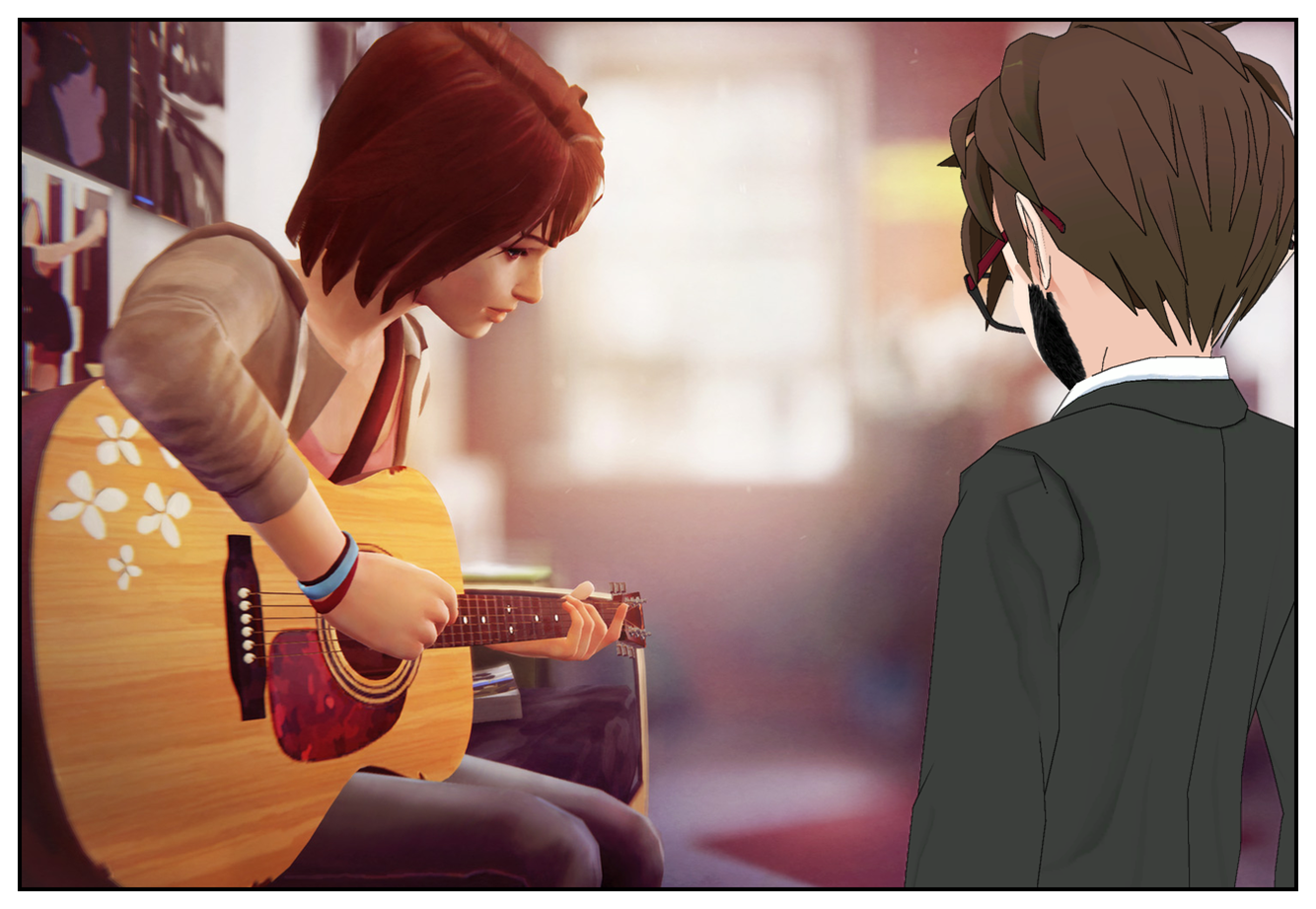
I've played the first two episodes of Dontnod's adventure game Life is Strange, and I'm enjoying it so far. It remains to be seen whether the whole thing is the life-changing masterpiece some people I know have made it out to be, but it's certainly solid and interesting so far.

It didn't start brilliantly, though this was partly my own fault for deciding to read through all of protagonist Max's diary before actually doing anything. Max's blathering on about how amazing it was to be in a "diverse" school and other such witterings made me recoil at the prospect of an obnoxiously self-righteous heroine, but thankfully the game nipped that in the bud pretty quickly, and Max actually comes across as a likeable individual — a little shy and withdrawn as well as more than a bit nerdy, so eminently relatable to me. Whew. Bullet dodged.

I'm less enamoured with her friend Chloe, who is built up in Max's diary to be some sort of amazing super-friend, and comes across as a spoiled, unnecessarily rebellious jerk when we finally meet her. It's been years since Max and Chloe have seen each other, and Chloe has been through some changes that are perhaps best exemplified by the fact her hair is now blue. Her rebelliousness is at least a little understandable, though; she's dealt with the death of her father and her mother marrying someone else, who so far has been depicted as a bit of a twat — and an abusive, angry twat at that. Unfortunately, Chloe's way of dealing with things just makes her, too, come across as a twat, and I find myself questioning why Max fawns over her at every opportunity, since they are so very different. Still, I guess we'll find out more about Chloe as the series progresses, so I will reserve final judgement on her until we see where this all ends up.

Outside of the Chloe-Max interactions, which are clearly intended to be a centrepiece of the narrative, Life is Strange is solid and enjoyable, being effectively an interactive high school drama, with all the usual frictions and cliquiness that signifies. There are the bitchy cool girls, who Max takes great pleasure in successfully humiliating in the first episode. There's the hot teacher that all the girls fawn over. There's the weird janitor. There's the overly religious, abstinence-preaching girl who stands up for what she believes in even as she gets relentlessly abused by those around her. And like in most good high school drama movies, Max is a relatively inoffensive, pleasant sort of individual who manages to get along with most people if she tries.

Where things get interesting is in Life is Strange's main twist: Max's discovery that she has time-shifting powers. In other words, she is able to rewind time and make use of this fact to her advantage: perhaps she can learn some information, then rewind back before a conversation and use that information when talking to someone. Perhaps she can see the consequences of an action, then rewind and reconsider. Perhaps she can use her powers to save people's lives. The mechanic itself is simple and well executed, and it's used creatively in a variety of places, both to allow you to reconsider your actions, and to resolve various situations.

Being an adventure game of the Telltale-esque mould, Life is Strange is riddled with decision points, some of which are more important than others. Particularly significant decisions tend to be binary in nature, and Max always has something to ponder after making one of these choices. Interestingly, the game's script always manages to make it seem as if the other choice was the "right" one, so there's no real sense that there's a path down which the writers feel like you "should" continue; often, there are no real good choices in particularly difficult situations, so it's a case of deciding how to handle it in the moment.

Life is Strange's setting is presented really nicely. Deliberately eschewing photorealism in favour of a somewhat watercolour-esque aesthetic, there's a lovely vignetting effect on the screen that blurs the edges, and scenery and set dressing is heavily stylised rather than realistic. The characters have a touch of "plastic doll" about them, but this is in keeping with the rest of the aesthetic; a kind of slightly otherworldly appearance, like things just aren't quite right, but where it's hard to put your finger on what is actually wrong.

The writing is good, too. Conversations are believable, riddled with modern slang and authentic modern cultural references. Like Deadly Premonition, the last game I can remember that did this, Life is Strange isn't afraid to namecheck real things — celebrities, movies, books, authors, artists — and does so without feeling like they've been included just to show off how cultured the writers are. Instead, it all feels very natural, and adds to the authentic feeling of the setting as a result.

I'm intrigued to see where the overarching narrative goes. There's clearly something very odd going on with Max, whose power appears to take a physical toll on her, and she also keeps seeing visions of her town being destroyed by an enormous tornado, which presumably will show up (or not?) in the final episode. But alongside this, there are numerous other well-crafted subplots that intertwine with one another nicely, so it will be interesting to see how all these fit together by the end. Aside from a few hitches in the script here and there where you'll figure really obvious things out long before Max does — a common problem in adventure games — the whole thing seems like a very well-crafted narrative experience, and I'm intrigued to see where it ends up, though I kind of hope it doesn't involve Chloe quite as much as I feel like it's probably going to.

2356: Packing a LaunchBox

0356_001

I'm a big fan of emulating old systems. There's no substitute for playing on original hardware and having original packaging, of course, but emulation is a relatively straightforward and cost-effective means of enjoying older games without having to brave eBay, thrift stores or exorbitant "collector's" prices.

The legality of emulation is something that has been discussed to death online, so I will sidestep that particular issue for the moment and instead bring your attention to a wonderful tool I've started using recently.

One of the biggest pains with emulation of older systems, particularly if you have a lot of ROM files, is managing and organising all these files, and indeed even knowing what you have available to play. This is a particular issue with old computers, whose disk images tend to contain multiple titles much like the pirated disks "computer clubs" would exchange freely in the '80s and '90s, but given the sheer number of games that have been released for various console platforms over the years, it can be an issue finding what you're looking for even on systems that use media that only contains a single title.

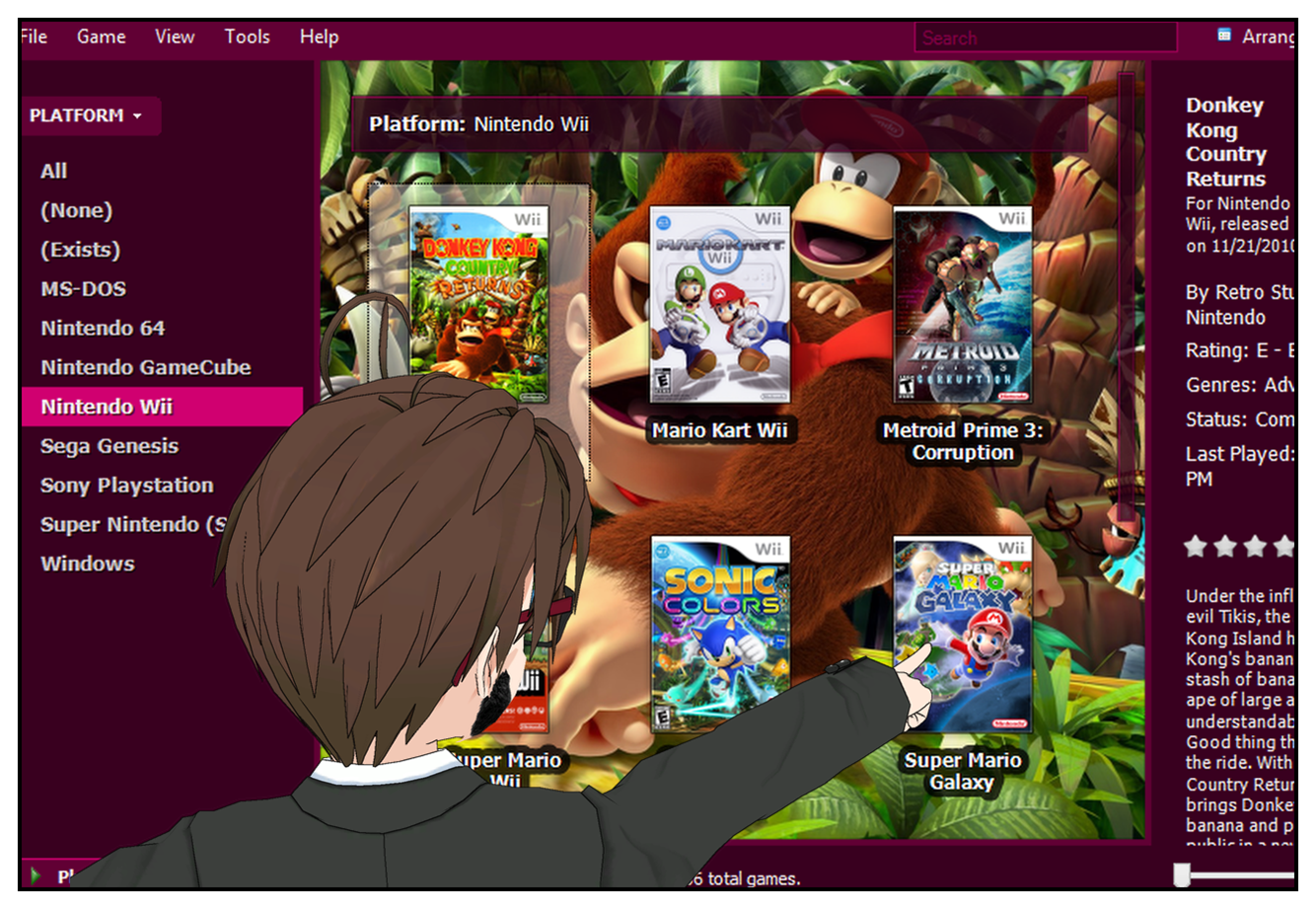
Enter LaunchBox, then, a thoroughly pleasant and well put together front-end for all your emulation… well, no, all your PC-based gaming needs, with a particular emphasis on the emulation of old platforms and operating systems.

Launchbox is, at its heart, a database designed to be filled with records of games with related media files — including ROMs and disk images — attached. It organises software by platform and allows the automatic launching of a particular emulator when selecting a game.

Perhaps its best feature, though, is its online connectivity, which allows it to connect to various online services, including its own online database, Wikipedia and Emumovies, and download all manner of supporting media for each game, where available. This supporting media ranges from simple box art and PDFs of the original manuals to music, movies and fanart of the games. By importing all your ROM files into LaunchBox, you can quickly and easily build up a full gaming database and automatically populate it with relevant information about pretty much any game you'd care to name; any game that doesn't get automatically populated with information can either be corrected yourself or manually searched in case it was stored online under different details.

This makes LaunchBox an excellent resource both for organising your collection and learning about titles you might not be familiar with — particularly those from other territories. The brief blurb LaunchBox provides for supported titles gives a good synopsis of what the game is all about and what to expect from it, and from there it's a simple matter to double-click the game in your collection and be playing it in a suitable emulator almost immediately. LaunchBox even recommends and provides download links to emulators for the most popular platforms and can automatically set them up for you; it also comes bundled with the wonderful DOSBox, which enables you to play old DOS-based games on modern Windows computers.

While I'd still prefer to have a wall full of original packaging and games playable on their original systems, that's not an especially cost-effective thing for me to do right now. So LaunchBox is very much scratching my "collector's" itch until I'm in a position to put together an actual physical collection. And in the meantime, it's turned my PC into pretty much the ultimate games console ever.

2349: Arcade Golf...?

0349_001

To my surprise, the game I'm enjoying most out of the Neo Geo collection I got recently is Neo Turf Masters, a golf game. Now, I'm not averse to a good golf game at the best of times, but I'm really surprised and impressed with how well Neo Turf Masters adapts the standard golf game format to a (relatively) fast-paced, challenging arcade format. It really works!

Neo Turf Masters is pretty simple and straightforward as far as golf games go. You don't have to worry about things like elevation when driving your way up the fairway, just smack the ball in the right direction and make sure it doesn't land in places it shouldn't. When it's on the green, line up with the hole and hit the button when your power meter is around the same point as the handy mark showing where you should hit it. Repeat.

It's refreshingly simple, even as the more cartoony golf games (such as Sony's Everybody's Golf series) adopt more complex mechanics, and it works really well for a quick game of golf. Despite the simplicity of the basic mechanics, the game instead provides most of its challenge through some surprisingly fiendish course designs and an extremely unforgiving structure designed to keep you pumping coins into the arcade original version. (Of course, on the port you can simply continue as many times as you like, but this isn't really in the spirit of playing arcade games.)

No, Neo Turf Masters' biggest challenge comes from its unusual "lives" system. You begin the game with 3 lives or "holes" and spend one of these lives any time you get a Par. (For the non golfing-literate, this means putting the ball in the hole in the exact number of shots the hole's Par says.) If you get a Bogey (one more shot than the Par) you spend an extra hole on top of this. But if you get a Birdie (one fewer shot than the Par) you not only don't lose the hole, you get an extra one to add to your stock. I haven't seen what happens if you do worse than a Bogey or better than a Birdie because my skills at Neo Turf Masters are thoroughly average.

I really like this system, though. It has the arcadey addictive quality of wanting to "1cc" (1 Credit Clear) it without using the Continue function, but considering I can only make it to about hole 4 or so before getting a Game Over, I feel it may be a while before I can manage a full round yet. Still, this is a game designed very much in the old-school mould, where you couldn't just plough through it from start to finish — you had to get good at it. And that's fine! If you could just hammer straight through it would be back on the shelf in less than a couple of hours; with only four courses on offer, there's not a lot of "content" (as modern gamers like to say) here, but it will sure as hell take you a while to master the game and its courses enough to be able to clear each of them.

Easy to pick up, difficult to master, then; something of a mantra for retro games, arcade games in particular, and I can see that the Neo Geo library, regardless of genre, very much seems to be designed around this particular philosophy. And I like it!

2348: I Beat Ys Seven

0348_001

I beat Ys Seven tonight. That leaves just one more Ys game to play through before I've beaten every one of the currently available games in the series, making me eminently ready for Ys VIII, whenever that makes its way West, because it almost certainly (hopefully) will.

Ys Seven is an interesting change after the three games built on the Ys VI engine — Ys VI, Oath in Felghana and Ys Origin. I kind of miss some of the defining aspects of those three games — most notably the platforming elements, which are completely absent from Seven — but Seven very much does its own thing and takes ownership of it, creating an experience that is satisfying in its own right, even if it's a slightly jarring change of pace initially.

The first thing to note about Ys Seven is that it's at least twice the length of previous Ys games. This still puts it at well under the average length of a typical JRPG these days — it took me 24 hours to beat on Normal — but makes it feel significantly longer than the previous titles. This isn't a bad thing, though; along with the greater length comes greater scope: Ys Seven's narrative feels more ambitious and, for want of a better word, epic than its predecessors; while past Ys games felt very much like you were taking care of business in a small, localised area, Ys Seven does a good job of making you feel like the fate of a whole country is at stake. There's a sprawling overworld to explore, and several villages, each with their own unique aesthetic.

This rather more sprawling scale comes at a slight cost: while past Ys games' small geographical area meant that pretty much every character in the game had a name and a story to tell, Ys Seven's NPCs, for the most part, feel quite a bit more generic. This is partly due to the fact that none of them have names, instead being called things like "Obliging Maid" and suchlike — with the curious exception of questgivers, who all have very Western names like "Kevin Lassiter" — but I suppose it does help keep the focus on the main cast, which, in keeping with the rest of the experience, is significantly bigger than previous Ys games.

Even your party is bigger. Adol is no longer alone, bringing up to two companions in tow this time, and there's a reason for this: enemies now have various resistances, meaning you need a balanced party that can cover all types of damage, otherwise you simply won't be able to kill some enemies. For most of the game, there's little reason to switch out from the default party of Adol, longtime companion (but first time playable) Dogi and whoever fills the third slot at that point in the party, but upon reaching the final boss the reason for the total squad size being seven members becomes clear. Be sure to keep everyone's equipment up to date — thankfully, inactive characters gain experience at the same rate as the front line, so there's no need to go out of your way to grind too much.

One aspect of the game that feels very different comes when you're fighting a boss. Whereas in past Ys games boss fights were almost puzzles and dexterity challenges, where you'd have to dodge incoming attacks and take advantage of openings, Ys Seven's bosses are often damage sponges that, at least on Normal difficulty, feel like they can be beaten more through brute force than anything. On the harder difficulty levels I can see them being stiffer challenges, because you're more limited in the healing items you can carry, but certainly on Normal, I could get through most bosses without too much difficulty by just making sure I had enough potions on hand. It wasn't until the final boss, which has significantly more complex mechanics than any of the other fights in the game, that I found myself having to be a bit more careful with what I was doing.

This isn't necessarily a bad thing; Ys Seven's boss fights are enjoyably hard work and feel like you're struggling against a powerful opponent. Like a lot of other things in the game, though, coming straight off Oath in FelghanaOrigin and Ark of Napishtim, it's a bit of an adjustment for sure.

Above all, though, Ys Seven keeps the heart of Ys firmly intact. It's wonderfully sincere about everything, but isn't afraid to show a sense of humour now and again. That said, it's overall considerably darker than any of the previous installments, particularly around the middle of the story, giving it a distinctive feel. It's not overly grimdark or anything — it's still a bright, colourful, earnest quest featuring a silent protagonist who quite literally lives for adventure — but it was a little surprising to see things like a shirtless Adol getting tortured in a jail cell after a particularly dramatic revelation partway through.

I enjoyed it a lot, in other words. Now I just have Memories of Celceta to go and I'm up to date. And then I will have to physically restrain myself from going back to the beginning and doing a Nightmare run, I feel…

2346: Please Buy VA-11 HALL-A

0346_001

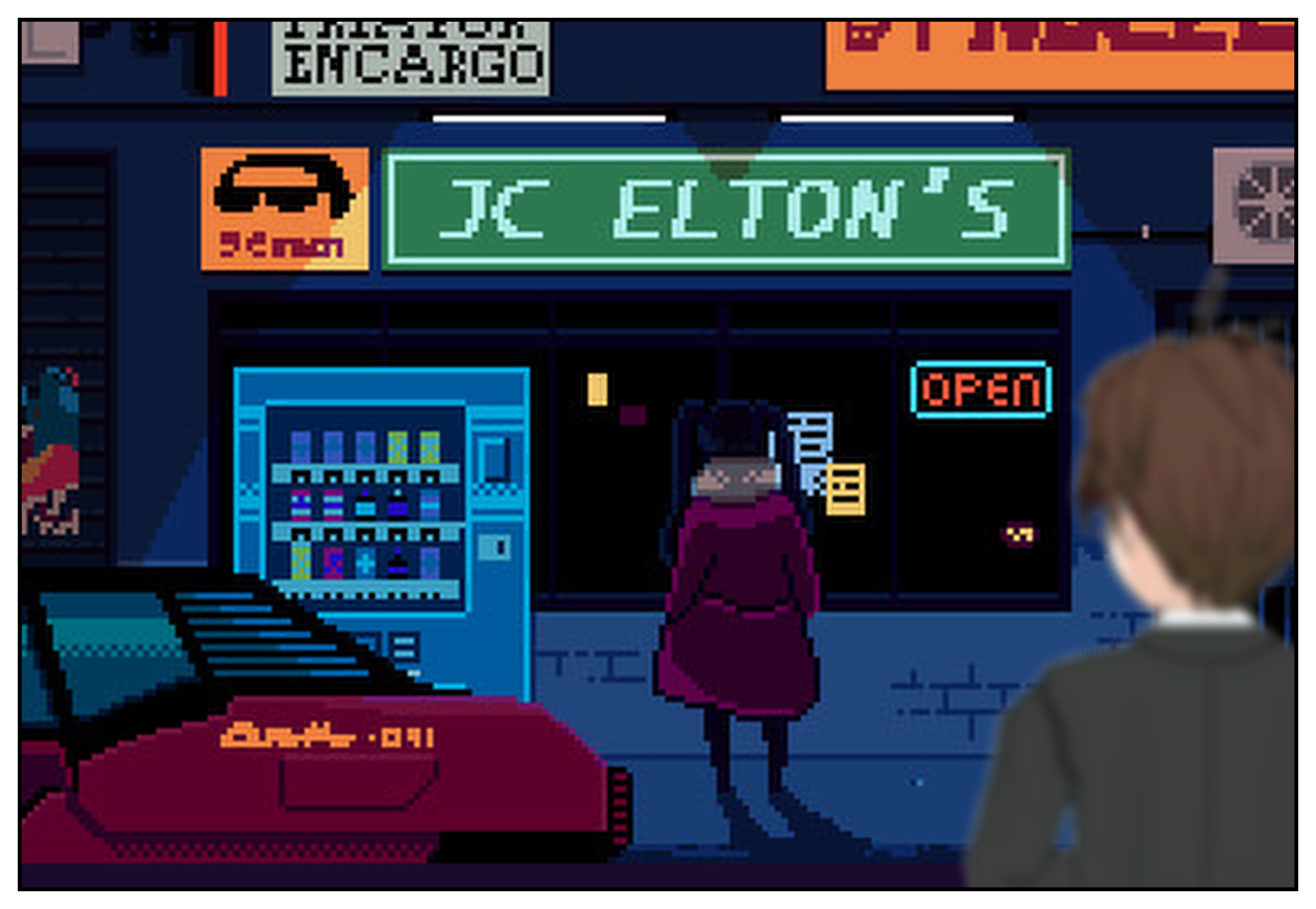
I've been playing a bunch of VA-11 HALL-A over the last couple of days, and I adore it. You can see some random screenshots and thoughts over on my Pile of Shame microblog.

I also wrote a review on Steam for it earlier, so I figured rather than spending time thinking of a different way to write the same enthusiastic words, I'd simply share it here, too.


I've been waiting to play the full version of this for quite some time now, ever since the very early demo enraptured me with its snappy writing, strong characterisation and wonderfully distinctive take on the dystopian future setting. And I'm delighted that the full version has, so far, surpassed all my expectations and hopes.

VA-11 Hall-A is kind of hard to pin down. At heart, it's basically a visual novel, but rather than making binary choices that filter you off down one of several discrete routes, the choices you make as protagonist Jill when going about her daily life at home and at work affect what happens next in the story, including the characters you encounter, how Jill gets along with her clients and co-workers and how everyone reacts to the events unfolding in the backdrop.

Interestingly, VA-11 Hall-A presents its overarching narrative almost entirely from the perspective of Jill behind the bar and in her apartment. Significant things happen in the world, but you don't see them directly; instead, you tend to see the people involved immediately before and/or after the events, or read about them on the news web pages and forums the morning after. Sometimes whether or not you dosed them up with alcohol before the event in which they were involved has an effect, too; prepare to feel guilty if that happens!

To give too many examples would be to spoil the experience, so I'll leave it at this: VA-11 Hall-A does a much better job of almost any visual novel I can name at making its world feel "alive" and like the actions you take actually matter, rather than simply picking a route through the story. There's nothing wrong with the latter approach, of course, but this way of doing things helps keep the people who expect a bit more in the way of traditional "gameplay" happy as well as those of us who are along for the ride primarily from a narrative perspective.

To sum up: great writing, wonderful characterisation, superb music and a glorious, beautiful PC-88 style aesthetic (with perfect pixel aspect ratio even scaled up to 1920×1080) makes for an absolutely lovely, unconventional and entirely memorable game.

I adore VA-11 Hall-A and pray with all my heart that it sees the success it deserves, both here on Steam and elsewhere on the Internet.


I haven't yet finished a playthrough, but you better believe when I do there will be some detailed thoughts and feelings about the whole thing going up either here or over on MoeGamer (from which my previous article on the game's demo is quoted on the Steam store page! Awesome!) — so watch out for those.

This is exactly the sort of highly creative, wonderfully inventive, beautifully presented and sharply written stuff I love to see from the indie scene. And I hope it becomes the sensation it sincerely deserves to be.

Find out more about the game and buy it — please, please, please buy it — on the official site.

2345: Keep Talking

0345_001

I went over to my friend Tim's house this evening for our semi-regular games and food event that we at least attempt to have on a fortnightly basis. Tonight it was just three out of our usual five members, so we spent the evening playing VR games on Tim's HTC Vive.

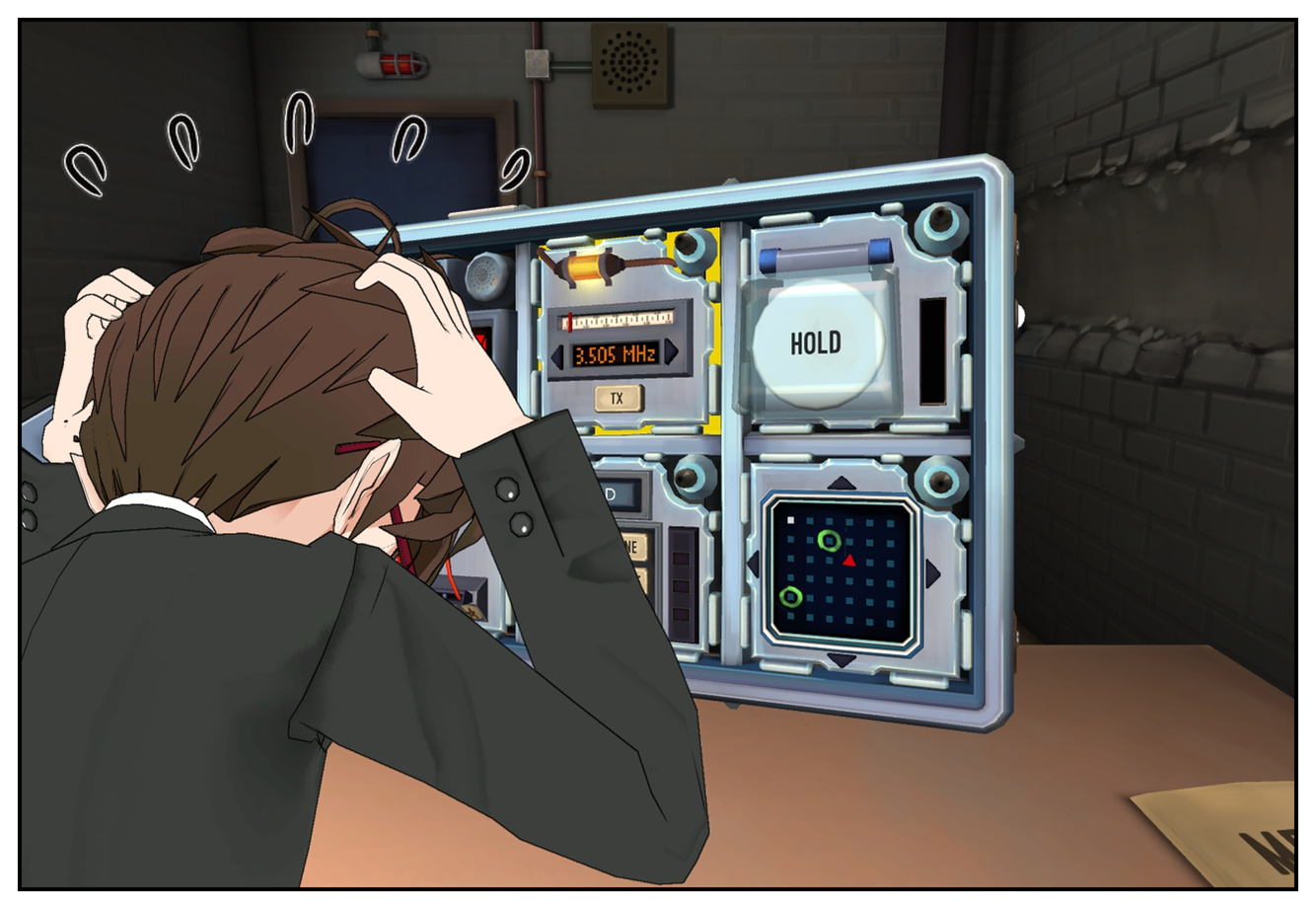
The most interesting experience we had was with a game called Keep Talking and Nobody Explodes, which I've been curious to try for a while. This is a game that doesn't actually need VR to play, but keeping one player quasi-isolated with a VR headset adds a great deal to the experience and makes it considerably more fun. It'll be even better when full support for the Vive controllers is added; at present, the room-scale movement works, but you have to interact with it using a standard gamepad.

Keep Talking and Nobody Explodes is a party puzzle game in the Spaceteam mould in that it's asymmetrical in terms of player roles and requires good communication in order to be successful. The player with the VR headset on is faced with a bomb consisting of a number of discrete modules, while all the other players (which can be literally as many as you want) are "experts" telling the VR player what to do. The twist? The "experts" can't see the bomb, so the VR player has to describe what they see in the hope that the experts can decipher the rather garbled instruction manual and make the correct decisions.

The bombs start off simple with modules such as collections of wires, which require you to read a sequence of logical statements and cut the appropriate wire according to which one is true. There are also buttons that require you to first of all determine a specific condition and then, in some cases, press and release the button with appropriate timing. These are pretty easy to work out and execute.

The more complicated modules range from a memory test that requires you to push buttons according to one of four logical statements, some of which refer to things you did in previous steps, to working out a five-letter password using the available letters in each position to determine what it's most likely to be from a list of possibilities. Then there's a more advanced wire-cutting exercise that requires deciphering a ridiculous Venn diagram according to the colour of the wire and whether or not lights and stars are lit up, and a maze that the VR player has to navigate without being able to see where the walls are.

After a little while, it's possible to "learn" how all these modules work, so at this point the game starts introducing distractions. Initially these are simple: the lights occasionally go off, meaning that you can't see the bomb (but can still interact with it if you remember what you're doing), or an alarm clock starts bleeping obtrusively. Later there are so-called "needy modules" on the bomb which can't be disabled and keep doing inconvenient things during your defusing attempts, so you have to divide your time between taking care of these persistent pests and making progress on the actual disposal effort.

I really liked it as a game. It's simple and intuitive to play, surprisingly immersive as both the "experts" and as the VR player, and has a real, genuine sense of tension to it all. Some of the modules are pretty difficult to work with — the Morse code one being the worst by far — but what's a game without challenge?

I'm glad we gave it a go, and I'm looking forward to playing it again sometime soon. If you're lucky enough to have a VR headset and at least one friend, I recommend grabbing a copy. Even if you don't have a VR headset, for that matter, it's worth a play — just make sure your "expert" players can't see your screen!

2342: A Belated Account of My First VR Experience

0342_001

It occurred to me a few days ago that I had a go in Virtual Reality recently and didn't write about it. Let's rectify that right now.

My friends Tim and Tom both grabbed the HTC Vive pretty much as soon as it became available, because both of them have disposable income and a gaming-related gadget fetish. Last week, I finally had the opportunity to give Tim's setup a go. And I came away rather more impressed with the whole thing than I was expecting to be.

The Vive headset itself is surprisingly comfortable and not ridiculously bulky like the Virtuality headsets of the '90s, which were my only previous experience with VR. The picture quality was reasonably good, too — certainly a far cry from the Virtuality screens, which felt like holding two Atari Lynxes up to your face — but I did find it a little tricky to position the headset absolutely perfectly so that everything on the display was in focus; I found stuff around the edges (particularly the lower edge) was difficult to remove the blurriness from, but I adjusted to it after a little while.

The first thing I tried was the Vive "training" setup, which gives you some examples of how to interact with virtual worlds using the headset and the two Vive controllers. It introduces you to the idea of "room scale" play — the ability to actually physically move around and have your body movements accurately reflected in your virtual viewpoint — and how the Vive controllers offer 1:1 motion tracking that is so accurate, even though you can't see your own hands while you have the headset on, you can still reach out, grab the controllers and press the buttons without any difficulty.

I think the most immediately striking thing about the Vive's VR is the room scale thing, which is, after all, that particular setup's unique gimmick. I was very surprised how natural it felt; there was no kind of input lag when moving my head around, nor when I moved my body; I could tell I wasn't actually in the location I was looking at, due to the lack of tactile feedback in the environment, but I could move around and interact with things as easily as I could in the real world. Particularly impressive in the training demo was the part where you inflate balloons using the controllers, and can then hit them around the room as if they were right there. Again, there was no tactile feedback, but the accuracy of the motion tracking was such that I could intuitively reach out to hit them with a controller, and they would react appropriately. Impressive.

The next thing I tried was Space Pirate Trainer, which is one of the first games to come out on the platform. It's a very simple affair that sees you standing on a platform wielding two pistols and having to shoot down waves of drones that pop up from all sides. The pistols can be switched to various different fire modes, and you can physically dodge the incoming laser bolts from the drones to avoid being hit.

This latter aspect was the thing I found most unusual and surprising to adjust to. I've played games that involve physical movement before — primarily on the Wii, but a couple of EyeToy and Kinect games, too — but I've never played a game where you can see a bullet flying at your face and actually lean out of the way of it. I mean, sometimes I instinctively do it when playing Overwatch (I can't help it!) but in Space Pirate Trainer you actually have to do it in order to survive. And it's not a Time Crisis-style situation where you can either be "hiding" or "shooting" — you can position yourself how you please. You can kneel down to crouch under the shots. You can sidestep them. You could probably even jump over them if you tried. It's kind of amazing, although the game itself is fairly bare-bones, to say the least.

Next up I tried Google's VR art package Tiltbrush. This is actually one of the things I was most interested to try, despite it being utterly "directionless" — it is what you make of it, in other words.

Essentially, Tiltbrush allows you to paint in 3D using various materials. The left Vive controller acts as an artist's palette with several sides, and the right Vive controller acts as your paintbrush and cursor to pick things from the palette. You can then paint with light, colour, fire and various other substances, then the truly impressive part is that you can physically walk around your creation in 3D to admire it from all angles. By extension, this also means that you can create 3D sculptures rather than just flat paintings, and indeed many of the example materials produced by both Google and the community are designed with this in mind. What's really nice about them, too, is that loading them up allows you to watch a recording of the exact strokes and steps they took to create the finished product; it can be fascinating to watch and, moreover, give you some ideas of your own on how to make some interesting designs.

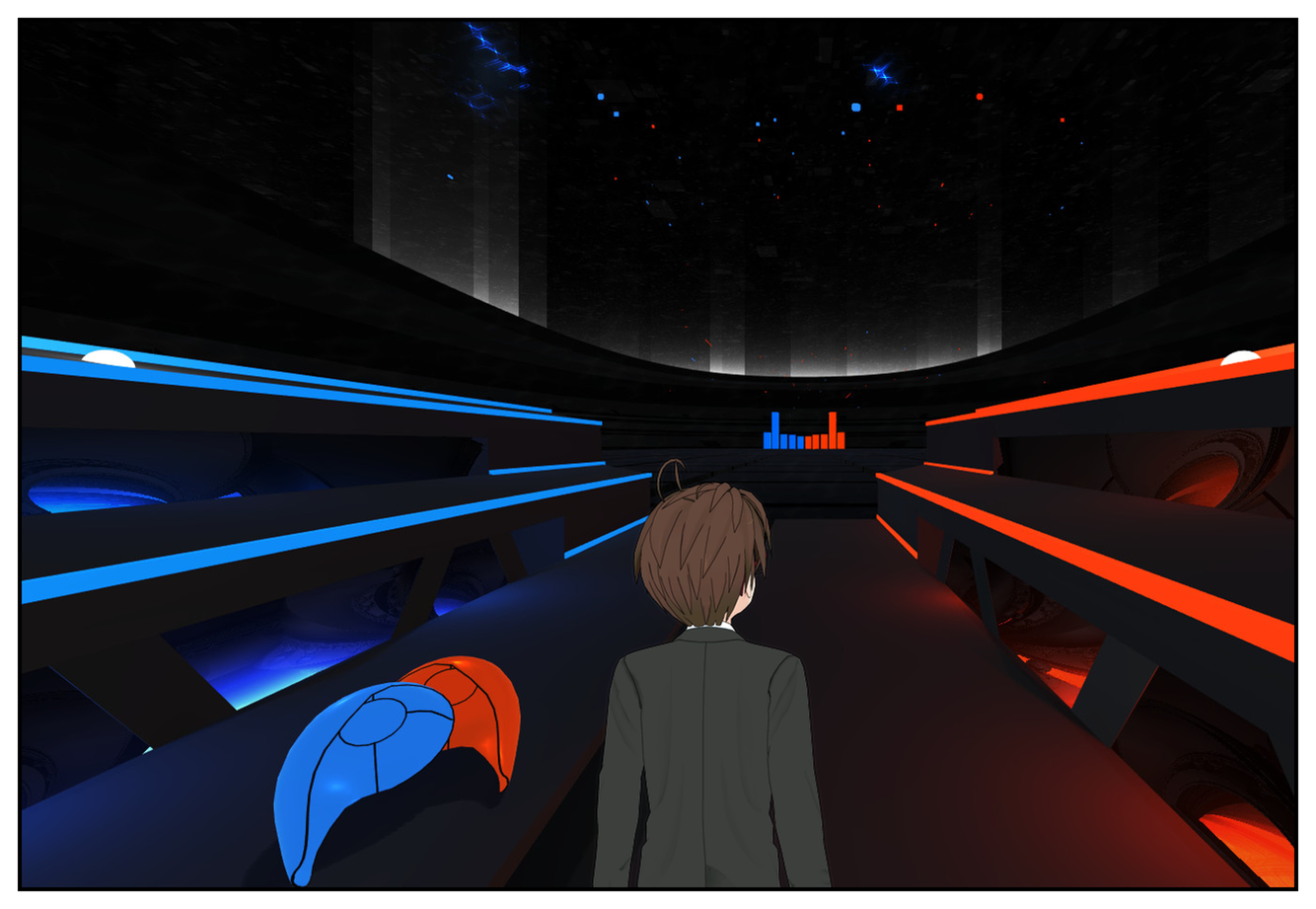
Last of all, I tried Audioshield, a game by the developer of the excellent Audiosurf, and a game designed in the same mould: create levels from your own music tracks or those pulled from Soundcloud, then play through them. In the case of Audioshield, you wield two different coloured shields, one in each hand, and have to block incoming coloured balls that reach you in time with the beats and sounds in the music. While there's less moving around than something like Space Pirate Trainer — the balls only come from one side, though you will have to look up and down — it's probably the most "physical"-feeling of the games I played, in that there was a very strong urge to "punch" the balls (hurr) as they arrived, rather than just blocking them. Indeed, the game rewards you for actually doing this, as well as moving around more than is necessary ("dancing", in the loosest possible sense of the word, in that convulsing like a spastic having an epileptic fit while in anaphylactic shock will also get you credit)  to actually block the incoming beats.

By the time I took the Vive headset off, I was actually sweating. The various games — particularly Audioshield — proved to be a surprisingly intense workout, although the foam thing on the headset that goes around your eye area also seems to just naturally get a bit sweaty. (That and Tim's flat is usually the temperature of the Sun.) I'd had a great time, and I came away much more convinced that VR is something that is going to be really cool in the near future than I had previously been. I'm still not necessarily convinced it's the future of gaming as some seem to think, but I'm certainly completely on board for experiences like Tiltbrush and its ilk.

I'm very interested to see how the launch of PlayStation VR in October of this year affects the VR landscape in general. I have a strong suspicion that it will help drive the technology into the "mainstream", and we'll start seeing a lot more interesting products than the current swathe of what are effectively tech demos that we have now. Very impressive, fun tech demos, admittedly — tech demos that make me kinda want a Vive of my own — but tech demos nonetheless.

So yes. VR looks like it's going to be around for a while yet; we finally have the technology that allows us to have fairly convincing experiences in our own home, which is considerably more than can be said for the last time VR tried to be a thing back in the '90s.

2340: The Rise of GOG

0340_001

I remember when GOG.com — or Good Old Games, as it was originally known — first launched. It was an exciting moment, because it promised to be a storefront absolutely filled with PC games from my childhood. PC games that it had previously been near-impossible to 1) acquire in the modern era and 2) get running on modern computers. (Okay, 2 was less of an issue because DOSBox was already a thing by then, but 1 was a problem, at least, and not everyone knew how to set up DOSBox properly.)

I've kept my GOG.com account since launch, and just recently I find myself starting to drift more and more towards them and away from Steam. I'm not going to abandon my Steam account, obviously, since there are several hundred games in there, but GOG is starting to prove itself to be a real contender in the online digital storefront battlefield.

The GOG.com of today is a little different from when it launched, as its change in name will attest. Rather than focusing entirely on retro PC games, GOG.com now provides a mix of both retro and modern titles, and has recently even started doing "Early Access"-style games, though not to the same degree as Steam.

In fact, "not to the same degree as Steam" is a running pattern when it comes to GOG, and the platform is benefiting from it. While Steam is presently suffering from a deluge of low-quality titles released on a seemingly daily basis — the mobile app store problem, now for your home computer! — GOG.com's marketplace is considerably more curated than Steam, and the few Early Access titles that are up on GOG are already decent quality rather than shovelware thrown out with an Early Access tag in an attempt to excuse shittiness.

In other words, discovering new games on GOG.com is a lot less of an issue than on the Steam of 2016 because you don't have to pick through pages and pages of shitty Eastern European games with "Simulator" in the title, or perpetually Early Access Minecraft knockoffs, or games by people who don't understand what the fundamentally appealing elements of pixel art are, or… you get the idea. This isn't to say that there isn't some shit on GOG, of course, but it's far from the flood of effluent that Steam has been suffering from for a while.

And then there's GOG's new client, Galaxy. While still lacking a few features to put it on parity with Steam's well-established client — most notably an in-game overlay for chat, achievements and web browsing — it's a very good start, offering a well organised, nicely presented game library and features like playtime recording and a datestamp for the last time you played a particular title. Perhaps most notably — and most understandably, given GOG.com's original pledge, which still holds true today, to remain a DRM-free digital storefront — is the opportunity to both automatically install games through the client a la steam and download DRM-free standalone installers for each and every game on the platform for backing up onto physical media or other hard drives. Coupled with the fact that GOG games often come with a variety of digital extras including manuals, soundtracks, artwork and all manner of other goodies, this is the next best thing to a physical copy — and if you feel strongly enough, you can even burn these installers to a CD or DVD and make your own physical copy using the materials provided. (I'm probably going to do this for the Ys games; I like them enough to want them on my actual shelves.)

GOG's summer sale has also been excellent, with deep, generous discounts on a variety of games as well as a fun metagame that was very generous with its prizes. Rather than providing useless shit like emojis, profile backgrounds and trading cards like Steam, GOG's summer sale metagame sees you earning experience points with each purchase and action performed on the site, with three free games on offer at various XP milestones. And they're good games, too — specifically, Spelunky, Gabriel Knight Anniversary Edition and Dreamfall Chapters.

I anticipate I'm going to be using GOG.com a lot more in the near future; there's still work to be done — some games promise achievements but they haven't been implemented yet, for example — but the future looks bright for this growing storefront that refuses to compromise its principles.

Keep it up, GOG; you've got a loyal customer in me.

2339: Adol Wins Again

0339_001

I finished Ys: The Oath in Felghana tonight, after a bit less swearing at the initially unassailable-seeming final boss than I anticipated.

That was an absolutely brilliant game. Well-paced, enjoyable to play, challenging but never insurmountable and certainly didn't outstay its welcome; my game clock read just over 12 hours at the end, although GOG Galaxy claims I actually played it for 24 hours, which can probably be accounted for with a number of boss fights that took a significant number of attempts to clear.

Make no mistake, Oath was a difficult game, but it never felt overly punishing. Indeed, any time that I found myself staring at a Game Over screen, I always knew that it was my fault. Specifically, it was usually the result of overconfidence: charging headlong into a group of powerful enemies, hoping to obliterate them all quickly and gain a ton of XP, but instead getting torn to shreds. Or, in the case of boss fights, it was a matter of learning the attack patterns and then being able to execute suitable countermeasures.

The boss fights were a particular highlight, because they featured an absolute ton of variety and mechanics to pay attention to. The first couple of bosses were very much about dodging and timing, while others were about inventive use of your skills to avoid damage. What I particularly liked were the several encounters that initially seemed absolutely impossible to complete, but which after a bit of practice and careful observation proved to be somewhat less of a problem than I initially believed they would be.

Oath is old-school in its sensibilities in that failure is part of the experience. When you first encounter a boss, you pretty much need to fail in order to understand what it's doing and how it affects you. I've said this before, but in many ways it reminds me of fighting fast-paced versions of Final Fantasy XIV bosses: all mechanics can be countered and dealt with in some way, whether that's through dodging, skill use or various ways of protecting yourself. There are always clear visual and auditory cues as to what's about to happen, allowing you to prepare yourself appropriately, and in situations where you're expected to perform more complex actions such as switching between skills in the heat of battle, the encounters are designed in such a way that you always have time to perform the actions you need to rather than suffering under a relentless assault. Indeed, it's certainly possible to defeat the final boss without taking any damage because there's an Achievement for doing so, and I imagine most of the others can also be handled in such a manner.

I also enjoyed the plot a great deal. While I missed the presence of Feena and Reah from Ys I, II and Origin, the new characters were well-defined and interesting. The villains in particular had some interesting plot arcs, and the game threw up several unexpected curveballs towards its conclusion.

Character highlights for me included series recurring character Dogi, who despite being big enough to crush walls comes across as one of the nicest people in the world, and this game's vaguely implied romantic interest Elena, who was both adorably cute and a genuinely likeable character. I felt a bit bad leaving her behind at the end of the game, but I'm getting the impression protagonist Adol is a bit of a player; I'm anticipating a variety of other cute girls over the course of the games in the series that I'm yet to play.

I've said it before, but I'll say it again; I'm sorry that I haven't checked out this series sooner. I'm having an absolute blast with it, and I'm very much looking forward to the upcoming Ys VIII, which I'll be very surprised if we don't see come West courtesy of Xseed Games in the near future. Given how much I've enjoyed the series so far, I feel fairly confident saying that I'll probably be there day one when it finally comes out.

2336: From the Shores of Felghana

0336_001

I started Ys: The Oath in Felghana today after finishing the main story of Ys Origin. (I do intend to go back and replay Origin on the harder difficulties as well as grind through its extra modes and unlockables, but that will be a gradual process!) So far I've played about two hours or so into the main story, beaten four bosses and yelled more curse words at a game than I can remember doing for a very long time.

Oath in Felghana is hard. Really hard. Like, really really hard. I did not know this going in, so feeling quite confident off the back of clearing Ys Origin (which was challenging, but not mega-hard) I thought I'd start Oath on Hard rather than Normal.

I started to think that I had maybe made the wrong decision when the first boss took me a good ten attempts. When the second one took me probably twenty or thirty tries — including having to stop after a few attempts because I was getting pretty wound up by the whole thing — I seriously considered restarting on Normal or Easy, but my pride prevented me from doing so.

Then I beat that boss, and I remembered what I had discovered during my first runthrough of Ys Origin. Ys games, so far as I can tell, are not games intended to be breezed through without any resistance whatsoever. They're short, yes, but whenever their diminutive length is quoted, it isn't taking into account all the times you'll have to retry the difficult bits. Because you'll have to retry the difficult bits a lot. In other words, Ys Origin and Oath in Felghana may well be "10 hours long", but that figure assumes that you'll beat all the bosses first time and won't make any stupid mistakes while exploring lava-covered ruins. And I can assure you that you won't beat all the bosses first time, and you most certainly will make stupid mistakes while exploring lava-covered ruins.

This difficulty makes it all the more satisfying, though. There's a feeling of genuine "release" when you finally overcome a difficult challenge, and much like Ys Origin, I've found that while the bosses in particular are difficult, you'll almost certainly find yourself getting a little bit further each and every time you try, rather than stagnating with absolutely no idea whatsoever what to do. Oath, like Origin, is so well designed that it manages to "train" you how to beat its bosses without giving you any explicit instructions. The animation and sound cues, the attack patterns, the overall "rhythm" of the encounters — all of them are carefully tuned to make each encounter surprisingly intuitive, and while many of them aren't especially complicated in terms of mechanics, you'll need to practice in order to perform what the game is asking of you flawlessly. And you will need to be as close to flawless as possible, because Oath in particular is very unforgiving.

It's funny. The Souls series kicking my ass and forcing me to learn encounters is one of the things that ended up putting me off it, but I'm really enjoying it in the Ys series. This leads me to believe that it's perhaps not this actual style of game that puts me off, but the aesthetic; Ys is colourful, cheerful and energetic, while Souls is dark, dreary and depressing. While there's a time and place for dark, dreary and depressing, I tend to prefer that sort of thing in my survival horrors and adventure games; when I'm RPGing, I want to be heroic in a colourful fantasy land filled with pretty girls. And Oath in Felghana is certainly delivering on all fronts so far.