I finished Read Only Memories earlier. I liked it a lot! I posted a review on Steam, but I thought I'd post it here too because I'm feeling lazy.
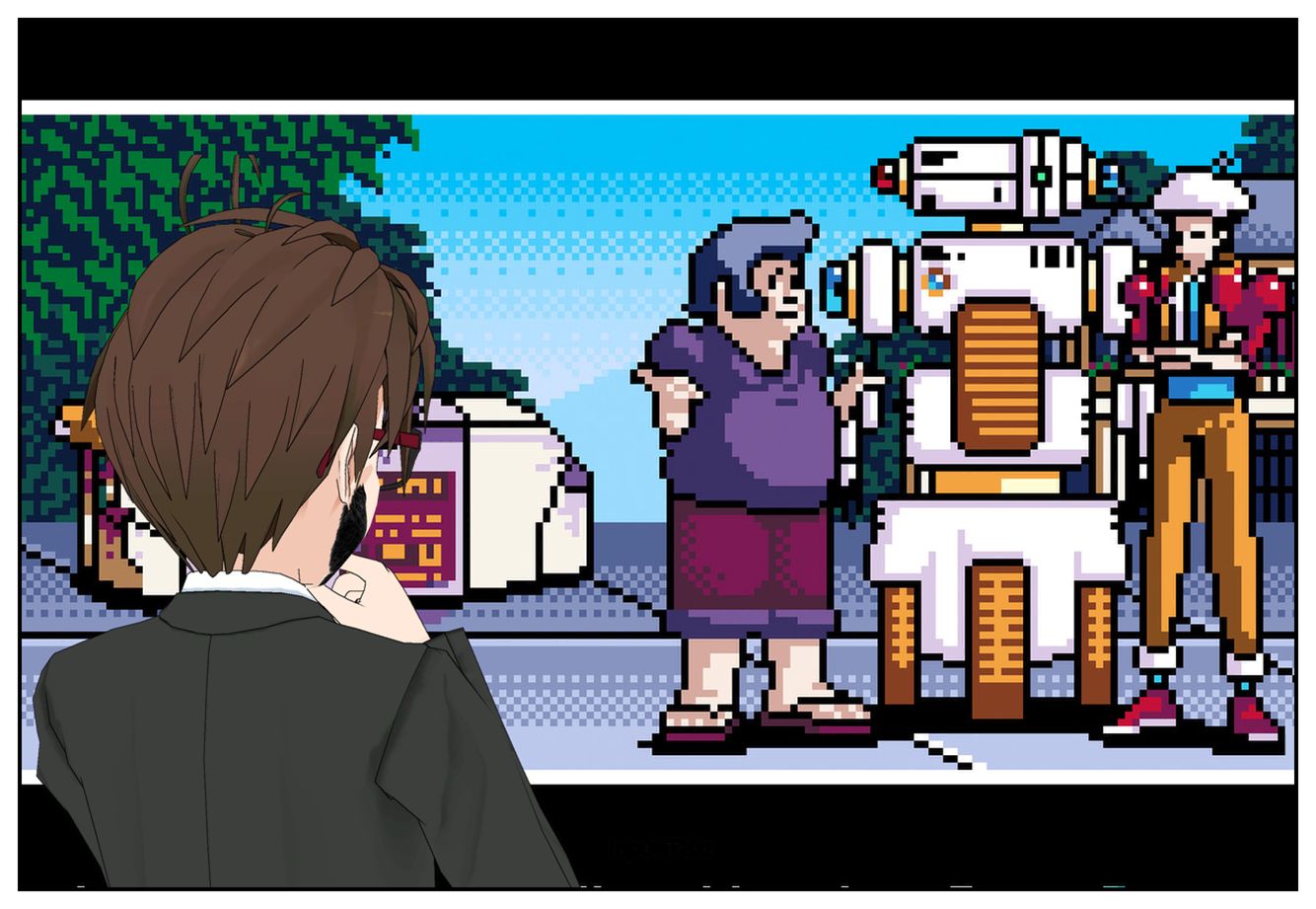
Read Only Memories is an adventure game in the '90s mould, seeming to draw specific inspiration from titles like Snatcher and Rise of the Dragon, and set in the same world as the (later, and wonderful) VA-11 HALL-A.
On the whole, it's a great experience. The pixel art aesthetic really works for the game and has clearly been designed by people who know what good pixel art looks like. Everything about the interface, including the font, is well-designed to look like a retro adventure game, and the FM-synthesis soundtrack complements it nicely.
Puzzles are relatively thin on the ground but in a couple of cases are more interesting than "use the thing on the thing", which is worthy of note, though the final puzzle in the game seems to play by some inconsistent rules that can lead to failure seemingly by no fault of your own.
The story is well-written and filled with interesting characters, plus deserves note for having a number of possible solutions to various situations, though not all will lead to the "best" ending. The game encourages you to consider the consequences of your actions and the things that you choose to say, even though those consequences may not become apparent until much later. I very much liked that your behaviour over the course of the whole game affected some later events rather than choices having an immediate impact on what was going on.
The overall plot is one of tolerance and understanding, and strikes a good balance between casting the player (whom you can name and gender as you desire, since you never see them) as an "everyman" sort of character prone to putting their foot in their mouth when confronted by groups they don't quite understand, and presenting a solid message about acceptance, learning to trust one another and personal growth.
The only real criticism I'd level at the game is that its handling of gay and transgender characters feels a little ham-fisted, with their presence and the "reveals" of their identity seemingly being calculated to go "SURPRISE!" rather than simply blending them into the setting. Big burly, manly bartender dude? SURPRISE! Next time you meet him, he has another big hairy dude all over him calling him "hon" at every opportunity (though that said, I couldn't help but like Gus). Meet an eccentric, long-haired, bearded TV producer? SURPRISE! They're a lady! That and the presence of a non gender-specific character demonstrates just how awkward using singular "they" as a pronoun is in dialogue.
Ultimately it doesn't hurt the overall plot at all, but these instances stick out like sore thumbs when they happen as they just don't quite feel like they're in keeping with the tone: the implication elsewhere in the plot is that society has moved beyond discrimination by gender and sexuality, and instead onto discrimination against those who are "augmented" in some way, either through cybernetics or genetic hybridisation. To specifically draw attention to gay and transgender characters in this way as the game does feels counter to this implication, which is otherwise well handled.
This game's spiritual successor VA-11 HALL-A handles gay characters much more elegantly by them simply… just being there, no big deal, no big fuss about who they are, no sense that the game is holding you down and urging you to admire how progressive its views are.
I played this game before the big update that adds voice acting, and if you're interested in this game, I'd encourage you to do the same. The few parts of the game that do already have voice acting (just the intro and epilogue at present) are immensely jarring with the rest of the game's presentation, and the delightful beepityboopityboop noise that dialogue makes throughout the rest of the game is a much more powerful stimulus to the imagination than a voice actor whose interpretation of the character may not match the one you have in your head after reading the text.
Overall, Read Only Memories is a game I give a solid thumbs up. The issues I mentioned above are minor in the grand scheme of things, but hopefully the team will learn from them — and from the things VA-11 HALL-A did better, despite being produced by a different team — and produce even greater works in the future.
I've been spending some time with Ubisoft's The Crew for the last few days. I actually picked it up shortly after release but didn't play it all that much. With the recent announcement that the base game would be free throughout September (you can still claim a copy here at the time of writing) I thought I'd give it another go.
What is The Crew? Allow me to elaborate in video form, because I can.
I'm left wondering why I didn't play The Crew more when it first released, because it occurs to me that it's what I wanted from a driving game for quite some time: the elusive ideal of the "caRPG", or an RPG with cars if you prefer less clumsy portmanteaus.
The Crew ticks all the boxes that I wanted. For one, it has a plot that is reasonably interesting and features some characters that, while a bit cliched, occasionally have some entertaining things to say — the protagonist offhandedly complaining to his FBI handler that he really wanted a shower because he'd been in his damn car for days was a nice bit of self-reference to the fact that The Crew doesn't have any on-foot missions. The plot itself may be Fast and Furious-level nonsense, but it works in context.
Secondly, it has a levelling system that is actually meaningful. Unlike games such as Forza Motorsport, which largely seem to have a levelling system just to show how long you've been playing, The Crew's levelling system actually works like one in a more conventional RPG — some gear is level-locked, your cars get more powerful as you level up and there's an MMO-style "endgame" once you reach the cap, further improving your abilities by getting better and better loot.
Which brings us on to the third point. The Crew is also a loot-whoring game, which is something I never thought I'd say about a racing game, but it's true. Any activity you complete rewards you with loot, with better results giving you better gear. You get immediate feedback on whether the gear is better or worse than your current setup by means of an "item level"-like system for each of your cars, and events have recommended vehicle levels so you never tackle anything that is going to be way too difficult for you.
In case you're still not quite convinced about The Crew secretly being an RPG, well, there are different classes of cars, too. Fullstock cars are exactly as they came out of the garage. Street cars are modified street-legal cars for road races. Dirt cars are suitable for offroading and stunts. Raid cars are powerhouses that can take a beating and dish one out too. Perf cars are extremely fast. And there's plenty more where that came from — even more with the Wild Run expansion, which adds several "extreme" specs to the list, too.
And then there's the multiplayer, which to be honest I haven't tried all that much yet. There's a sort of passive multiplayer a la Test Drive Unlimited as you zip around the open world, occasionally passing other players by. You can queue up for PvP-specific missions. You can recruit people to help you out with story missions, which then have to be played fully cooperatively — race missions, for example, mean that your teammates just have to make sure that you win by fair means or foul, whereas missions where you have to wreck a fleeing vehicle are likely to be much easier with company.
And on top of all that, The Crew makes driving around its vast open world interesting by 1) having some lovely scenery and 2) scattering Project Gotham-style skill challenges around the roads, tasking you with everything from slaloming around markers to simply getting as far away from your start point as possible. Each of these reward you with loot and experience, making them the equivalent of "trash" enemies in a more conventional RPG.
I'm enjoying the game a lot. Handling is enjoyably slidey and arcadey, just how I like it, and there's a ton of stuff to do, yet enough structure to ensure that you never get overwhelmed with too many options at any one time. And it feels like the best use of Ubisoft's open-world formula to date, with plenty of hidden things to find that reward you with experience, loot and even hidden cars to uncover.
The Crew is free for the rest of the month on PC. Be sure to claim your copy here.
I played my ten placement matches for season 2 of Overwatch's Competitive mode earlier. Nine out of those ten games featured at least one salty asshole quitting the game early because their team lost a round — both on the team I was on and on the opposing team on different occasions — and in Competitive mode, the game doesn't backfill positions with people queued up to play like it does in Quick Play; when you queue for a Competitive game, you're put into a game from the very beginning rather than immediately joining one in progress if a space is available.
This was mildly annoying the first time it happened, but with each subsequent time it got more and more irritating. It's not only bad sportsmanship to strop off in a sulk if you're losing, it's also a major pain in the ass to the rest of your team. It would be akin to Wayne Rooney suddenly deciding that he doesn't feel like playing any more and wandering off the pitch in the middle of a football match. Except in Overwatch, the teams are only six people, so the loss of just one person is keenly and immediately felt.
The trouble that these early leavers have is that they can't handle losing. They're unwilling to accept the possibility that the team who just "lost" could enjoy a comeback in the subsequent round — this can and frequently does happen in Overwatch, which is mostly very well balanced like that — and instead ditch the match altogether, leaving their team a man or more down and on the way to what is now pretty much a guaranteed loss rather than something that could be fought back from.
What's particularly dumb about early leavers is that when they leave a game, the match is counted as a "loss" in their records anyway, so they're taking the worse option — a 100% chance of getting a loss versus a less-than-100% chance of getting a loss by staying and trying to help the rest of the team to a comeback.
I sort of understand. It can be demoralising to feel like you were steamrollered by another team who perhaps genuinely were more skilled than you. But it's the very height of special snowflake syndrome to believe that you are entitled to win every game you play — perhaps these players were the kids who grew up in schools that had sports days with "participation trophies" rather than actual winners. And clawing your way to a victory when the jaws of defeat were closing on you is immensely satisfying — my favourite games of Overwatch are the ones that end up being really close, not the ones where my team smashes our opponents into the ground.
Blizzard have penalties in place for those who leave matches early, but they're clearly not severe enough. For the Competitive scene in Overwatch to succeed, early leavers need to be actively discouraged through harsh punishments. I hope that the Overwatch team are paying attention to this problem and that it gets resolved in the next season of Competitive play.
In the meantime, if you're an online player, do the decent thing and see your matches through to conclusion, even if they don't seem to be going all that well. As I say, you keep playing, you have a less than 100% chance of getting a loss recorded on your all-important statistics. Leave early, however, and you absolutely definitely will get that loss. So stop being selfish pricks and play your damn matches to completion.
Titan Quest Anniversary Edition is currently just £5 on Steam, and it's completely free if you own any other Titan Quest products already. You should go buy it and play it, because I have spent most of the evening doing so and I like it a whole lot.
Titan Quest Anniversary Edition combines the original Titan Quest and its expansion Immortal Throne into one package, cleans the whole shebang up for modern computers — the original came out in 2006, hence the "anniversary" thing — and unleashes it on the world for existing fans and newcomers alike to enjoy.
Having never played Titan Quest, I fell into the latter category. It had just never quite appealed to me for some reason, despite it being the sort of hack and slash loot-whoring game I enjoy coupled with Greek mythology, which I was in love with as a child — and despite the game often being discussed in hushed, reverential whispers any time anyone brought it up.
£5 for a remastered version of the game and its expansion in one complete edition was too good an offer to turn down, though, so I took the plunge and gave it a go, partly to sate my own curiosity and partly to have something to play online with my friend Chris, who had also been going back and forth about whether or not he wanted it.
If you, like me, have never played Titan Quest, here's the deal. You play a male or female Greek person who initially has no character class. You save a farmer's horse from being eaten by satyrs, then you embark on a journey to cleanse the land of evil seemingly for no other reason than "because why not". Your character is given precisely no backstory and no real motivation to do their thing, but in this sort of game that's probably a good thing. While the lore in the Diablo games is substantial and interesting, its execution in-game leaves a lot to be desired, and in latest installment Diablo III in particular, by far the most enjoyable way to play the game is in "Adventure Mode", which dispenses with the narrative and linear structure altogether in favour of giving you freedom to go anywhere at any time to chase down various objectives.
Titan Quest doesn't quite go that far in abandoning the traditional narrative structure — you still progress from "unknown Greek person" to "hero of legend" over the course of the game — but the plot is very much de-emphasised in favour of the excellent mechanics.
At level 2, you unlock a "specialism" — essentially a character class with its own skill tree plus a mastery meter you need to pump skill points into in order to unlock the next "tiers" of skills. (Said meter isn't entirely useless; each point you put into it gives you a substantial increase to your base stats.) Then at level 8, you unlock another specialism and can start pumping skill points into that as well, allowing you to effectively mix and match skills from two entirely different classes to create your own custom build.
And these classes aren't your usual warrior-thief-mage trinity, either — they're all interesting, and all present interesting combinations when combined together. All together, there is a caster type that specialises in cold and electricity; another caster that specialises in fire and earth; a close-range physical attacking type person; a highly defensive physical attacker (who can apparently do some tremendous things with shields later in the game); a tree-hugging hippy that can summon wolves, heal things and infect enemies with plague; a hunter type that is good with bows and spears; and a backstabby thiefy rogue type deal that is good at inflicting pain but not so good at taking it.
The great thing about this system is that you can make a variety of different character types — all together, there are 36 different combinations, each of which has its own unique name. You can combine the Defense and Warfare masteries to create Conqueror, for example, which is a tank that also hits incredibly hard. Or you could combine the Earth and Nature masteries to create Summoner, a character that is able to summon a variety of different minions to do their bidding, including an earth golem, some wolves and a nymph, and be able to sit back, pelt the enemies from a distance and heal their minions as needed.
The combat itself is fundamentally satisfying. Humanoid enemies are thrown around with satisfying ragdoll animation; birds explode in a shower of feathers; skeletons shatter into pieces. The variety of skills mean that there are a lot of different ways you can protect yourself or go on the offensive, too, and so far I haven't felt like there's a "bad" combination; with two different masteries, you can either cover the weaknesses of the first with the second, or enhance the first's strong points with the second.
Then, of course, there's just something wonderfully enjoyable about hacking and slashing through recognisable creatures from mythology. The game appears to act as pretty much an Ancient Greece's Greatest Hits, promising confrontations with Medusa, the Hydra and numerous others over the course of the adventure — and I believe you also take a trip to ancient Egypt and China later, too, which opens up possibilities for all manner of interesting confrontations.
I hadn't expected to like the game quite as much as I did when I booted it up for the first time. But, well, the 5 hours of playtime Steam has already recorded for me — I bought it earlier this evening — probably speaks for itself.
There's a sale running on Steam right now, centred around shoot 'em ups in the classic mould. You can see the full list here, but here are a few selections that I can personally recommend:
ESCHATOS
The follow-up to Judgement Silversword (which is also worth a go, and available in a bundle with ESCHATOS) is a Raiden-style shoot 'em up (i.e. non-bullet hell) that unfolds over the course of several stages, taking you from an Earth-like planet, into space and finally into the bowels of an alien world. It's a spectacular, thrilling journey, presented in uncomplicated but nonetheless impressive 3D polygonal visuals but playing from a top-down perspective.
ESCHATOS has a couple of ways to play depending on how complex you like your shmups. For my money, the simpler mode is actually a more enjoyable way to play — this doesn't involve any powering up of your weapons and simply requires that you defeat complete waves of enemies without missing any to build up your score multiplier. The higher the difficulty you play on, the higher the multiplier can go (and the faster it rises), so for the highest scores you need to take on the toughest challenges the game offers.
ESCHATOS has a fantastic soundtrack, fluid graphics with some wonderful setpieces, and gameplay to die for. If you're a shmup fan, this should without question be a part of your collection.
Deathsmiles
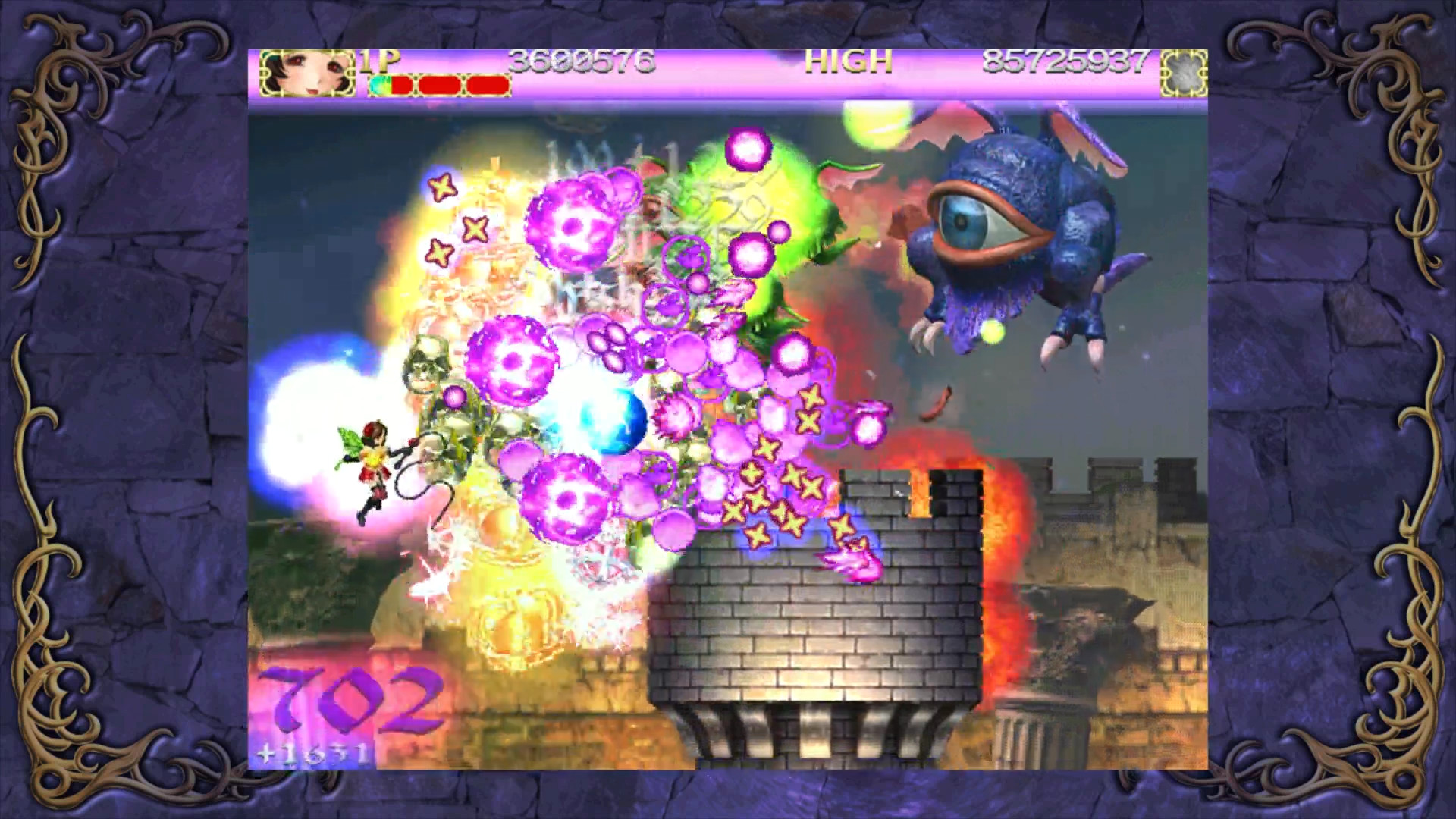
Regarded as one of Cave's more accessible bullet-hell shooters, Deathsmiles is a horizontally scrolling affair for one or two players where you take on the role of one (or two) of several different goth loli chicks, each of whom handle slightly differently. You can shoot in both directions using either a rapid-fire shot, a charged beam or a lock-on laser, and advanced players will need to learn which attack should be used for which enemy, since the scores and collectible items they yield vary according to how they were dispatched. If you're a shmup beginner, mind, you can ignore this aspect of the game completely and just try to get through the game, because that's challenging enough in itself.
Deathsmiles has a gorgeous Gothic rock soundtrack a la Castlevania, some varied levels and some brilliant boss fights, culminating in a battle against the spectacularly named "Tyrannosatan" accompanied by Bach's famous Toccata and Fugue. There's a lot of hidden depth to the scoring system once you get your head around the bullet patterns, and variable difficulty settings that you can change on the fly between levels help give it some longevity. It's one of Cave's finest games, and well worth a look.
Savant Ascent
Based around the music of electronica artist Savant, Savant Ascent casts you in the role of a masked alchemist who has to make his way up a tower to defeat the weird… thing that has manifested at the top. It's a twin-stick shooter with a twist — in each of the game's battlefields, the character can only stand in preset places, with pushing directions on the stick moving him from one to the other either by rolling or jumping between them.
The "Story" mode in the game lasts about five minutes and is easily beaten, but the meat of the game comes in the modes that unlock afterwards. Time Attack throws you into a horde of enemies and challenges you to 1) survive and 2) complete the game as quickly as possible. Endless, meanwhile, simply tasks you with surviving for as long as possible.
Longevity in the game comes through score attack and collectible CDs of Savant tracks, each of which unlocks a new gameplay element. What initially appears to be a very simple twin-stick shooter gradually unlocks new depths as you collect more of the CDs and progress further. It's a beautifully presented game, too, with lovely graphics and a thumping soundtrack courtesy of Savant, obviously.
Horizon Shift
An interesting twist on the genre, Horizon Shift is presented in a minimalist Geometry Wars fashion, with simple controls and visuals, a thumping soundtrack and immensely challenging gameplay.
Your job in Horizon Shift is to protect your "horizon", a line dividing the screen into two halves. Your ship can face either up or down, and you can use this ability to dodge bullets, since only bullets on the same side as your ship can destroy you. Your ship can also jump and double-jump, providing another means for avoiding projectiles on the occasions when the "horizon" disappears and requires you to face in one direction only.
Enemies in Horizon Shift are a combination of kamikaze types that destroy part of your horizon when they hit it — meaning you'll have to jump the gaps or die — and enemies that spew bullets at you. Blasting any type of enemy builds up a chain bonus, and unleashing a smart bomb (which must also be charged by killing enemies) allows you to "bank" this chain bonus; conversely, dying loses the chain bonus altogether.
Horizon Shift has a cool aesthetic, with simplistic visuals in the foreground and a busy but low-brightness backgrounds that evolves as you play through the game. Particularly cool (and cheesy) is the giant laughing "skull" face that dominates the background any time you're fighting a boss.
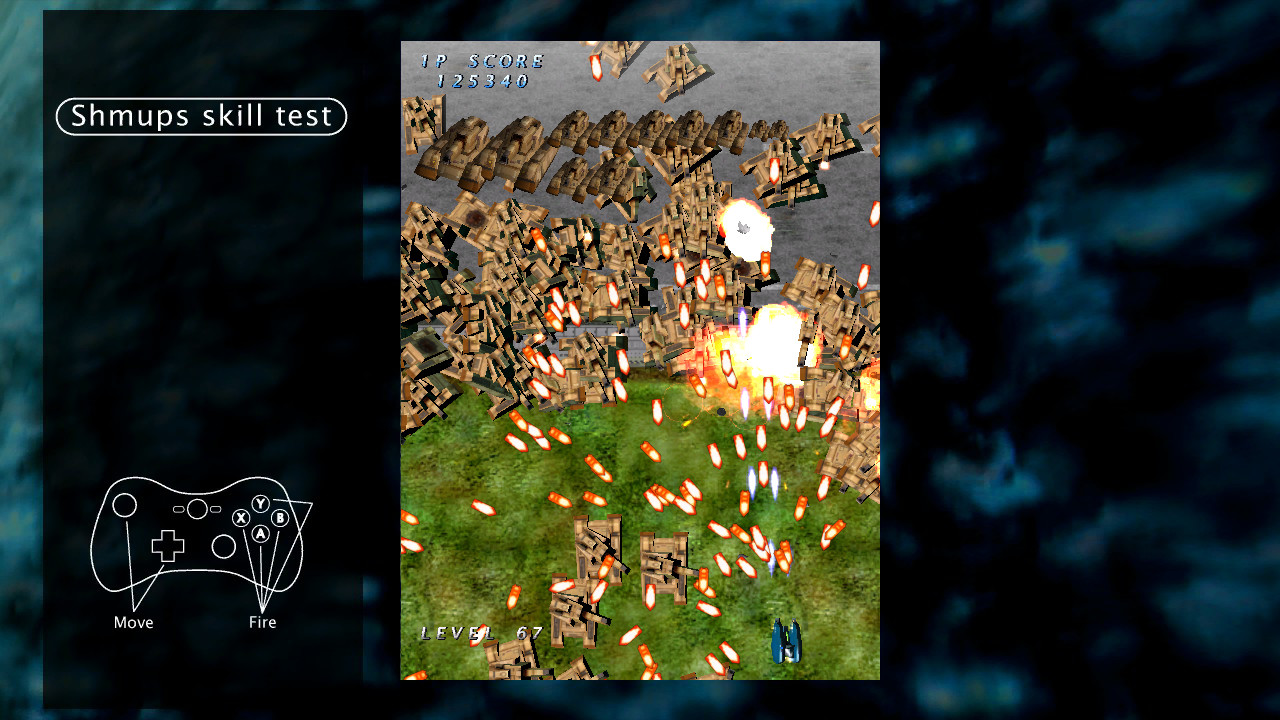
Shmups Skill Test
Blend WarioWare with a shoot 'em up and you have Shmups Skill Test, a short, quick-fire game that challenges you to complete several minigames in succession, then humiliates you about your lack of skill afterwards.
Minigames vary from the delightfully named "TANK TANK TANK TANK TANK" — in which there are lots of tanks to shoot — to one where you have to precisely shoot timebombs off the side of a rocket without blowing the rocket up, and all of them are very challenging indeed, with the possible exception of the one where you have to shoot tin cans (in space) into a giant waste-paper basket (in space) to "save the earth".
After you're finished, you're given a breakdown of your skills, a comparison to the online average rating and your "gamer age" is calculated a la Brain Age on the Nintendo DS — the lower the better.
This game is hard, but it has a lot of staying power thanks to a variety of minigames, online leaderboards and support for up to four-player competitive play. Plus, as its name suggests, it's actually good training for the various skills modern shmups demand of you.
The first MMO I really got into was Final Fantasy XI. This was after a few previous aborted attempts including EverQuest and Ultima Online (over dial-up — not recommended, particularly EverQuest, which crashed every time I zoned) as well as slightly lesser-known titles like Dark Age of Camelot.
I never stuck with the earlier games because they never quite resonated with me for one reason or another — perhaps it was their clunky interfaces or their painfully slow progression. All I know is that Final Fantasy XI, despite also having a clunky interface and painfully slow progression, managed to capture my attention for a decent period of time before I finally moved on to something else — Final Fantasy X-2, as I recall — and never went back.
Just recently, some Final Fantasy XIV friends and I have been getting nostalgic for XI, so I thought I'd go check it out, given that it's been a number of years and several expansion packs since I last tried it. And while the game is still recognisable as what it once was — a steadfastly traditional MMO more in the EverQuest mould than the now more fashionable WoW mould — it's been considerably streamlined to make the experience much more friendly to new players and solo players. On top of that, players now have a hefty amount of options to choose from when they log in and want to decide what to do next. This is not something Final Fantasy XI was ever lacking in, but the additions and refinements that have been added to the formula over the years benefit both new players and grizzled veterans.
Take the Fields of Valour and Records of Eminence systems, for example.
The former sees you examining "field manuals" in each zone and taking on a training regime of your choice. Completing said regime rewards you with experience, gil and a currency called tabs that can be traded in for various benefits ranging from teleporting back to your home city — a godsend if you've been grinding several zones away, since fast travel isn't anywhere near as accessible as it is in XIV — to having temporary buffs cast on yourself.
The latter, meanwhile, is accessed through your Quests menu and allows you to assign yourself up to 30 objectives at a time from an extremely comprehensive list of possible challenges that range from "defeat 100 enemies" to "deal 100,000 points of damage in total" via "loot 10 wind crystals from enemies". Most of these objectives are repeatable, and all reward you with experience points upon completion.
Just the addition of these two systems, which support the existing style of play FFXI veterans will be used to, makes levelling a considerably less painful, time-consuming process. What once took weeks of grinding can now be done in a few hours — to put it in context, I played for about 2 or 3 hours earlier and made it to level 16. First time I played this took me several weeks to achieve; in several months of play I never got any further than level 30.
It's a bit of an adjustment to go back to XI after the tightly structured gameplay of XIV. XI, by contrast, is much more freeform; there is a main storyline to follow, but it's of considerable benefit to players to go out and level up a bit first before even thinking about tackling these missions. The story can even be ignored completely if you'd rather just go out hacking and slashing monsters, unlike in XIV, where it was an integral part of overall progression by gradually unlocking game features and challenges as you went through.
One of the best additions to XI in recent years is the Trust system, which allows you to recruit "alter-ego" versions of various NPCs from around the game world after meeting the requirements to unlock them. Once unlocked, these "alter-egos" can be summoned at any time in the field for you to party up with, effectively allowing you the ability to take on considerably stronger monsters than you would otherwise be able to tackle solo, and all but eliminating the need for standing in Valkurm Dunes for hours at a time shouting "RDM LFG" in the hope that someone would pick you up to go and kill lots of crabs with.
One might say that the Trust system takes away from one of the key defining aspects of FFXI as a massively multiplayer online game, but in practice it's simply more convenient for many players. You still have the option to party up with other people, of course — and chances are they'll play their roles much better than the relatively limited AI of the Trust companions — but for those who prefer to play solo, Trust NPCs can form a formidable party with you once you've unlocked a few of them.
The other interesting contrast between FFXI and FFXIV is how it handles combat. XI's combat is relatively simple in the early levels, relying mostly on your auto-attack and occasional use of Weaponskills when your TP bar hits 1000 or greater. XIV, meanwhile, is much more active, demanding that you both dodge enemy attacks with telegraphed areas of effect and keep performing your class's combo or rotations as efficiently as possible, preferably without stopping. Both are considerably slower paced than true real-time combat, striking a good balance between a turn-based feel and actually allowing the player to feel like they are in full control of their character, but XI is even slower than XIV, providing you with plenty of time to pick abilities in advance from its traditional FF-style menu system rather than XIV's hotbars.
I've enjoyed returning to Vana'Diel so far; the experience contrasts well enough from XIV that the two games can sit quite comfortably beside one another in a gamer's collection, and the state they're both in in 2016 means that you can sit down for either a long or a short session with either and feel like you've achieved something.
Mostly I'm wanting to play through Final Fantasy XI to see its main story content, which is supposed to be good, but the sheer amount of stuff to do in the game — it's got over ten years on A Realm Reborn, after all — is more than likely to prove a bit distracting!
With it being Final Fantasy XIV's third anniversary it's only fitting that I take a look back at the reason I've been playing it since its closed beta — and why, even though on several occasions I've felt like I might be "done" with the game, I keep on coming back, time after time.
These memories are presented in no particular order, but it makes the most sense to start with this one.
Knowing FFXIV was going to be something special
I jumped into Final Fantasy XIV's closed beta after a casual discussion with a Twitter friend about Final Fantasy XI and how much I liked it despite never really getting all that far with it. Eventually I found myself with an invite to the testing period of the game, and I was immediately smitten with it. Everything about it felt Final Fantasy. The look, the feel, the music, the controls, the battles, the monsters — and yet, it had enough of its own unique identity to make it feel like far more than just series fanservice.
Specifically, Final Fantasy XIV adopts a somewhat "dark fantasy" tone throughout, clearly heavily inspired by works such as Game of Thrones and The Witcher in places. Sure, there are still moogles and chocobos, but there are also complicated political machinations, betrayal, murder and, technically, just prior to the start of 2.0's story, apocalyptic catastrophes.
I was immediately drawn into the world in a way that World of Warcraft never quite managed to enrapture me. NPC dialogue, although localised with more than a few liberties taken from the original Japanese, much to the chagrin of people who play with Japanese voiceovers, was beautifully written with an almost Shakespearean tone in places, blending old- and middle-English words and phrases with modern spellings to make it actually comprehensible.
The fact that Final Fantasy XIV placed any emphasis on its main story at all — let alone to the degree that it has ended up doing so — was a unique feeling for me. Even its predecessor Final Fantasy XI's main story had felt like a side activity you did when you had done enough level grinding to be able to take on the next mission; here, the main story was tightly tied in with your character's progression: you advanced through the levels and became more powerful both in terms of mechanics and narrative, until you eventually reached level 50 and took on your most terrifying challenges yet.
During the closed beta, I only played up to about level 20 or so, but that was enough to know that I wanted to keep playing — and to know that I wouldn't mind when the servers were wiped post-beta to prepare for the start of live service.
Making some great friends
My friend who had urged me to try out FFXIV was all set to assemble a Free Company — FFXIV's take on guilds — as soon as the facility became available, and many members of that free company, centred around the Giant Bomb video games website, became great friends. I even took a trip to PAX East to hang out with a bunch of them and had an absolute blast. And while I recently left said Free Company in favour of a smaller group who are more local to where my wife and I are, FFXIV's various ways of keeping in touch — as well as extra-game means of communication like Discord — mean that I'll never be far away from this band of loveable rogues.
Castrum and Prae keeping me up until 5am
When I reached level 50, I was proud. The only other MMO I'd ever reached the level cap in prior to that day was World of Warcraft, and I'd stopped playing shortly afterwards, as my lack of friends playing had made that game a rather lonely experience at high level — this was the days before its current Dungeon Finder system, itself inspired by FFXIV's Duty Finder.
I'd heard the final two story dungeons, intended to be done pretty much as soon as you hit 50, were quite an experience, and so I asked the Free Company very nicely to accompany me on my first run through them. This was — and still is — the best way to run these dungeons, since they're both full of cutscenes, and running with a completely preformed party means no risk of other people running ahead and starting boss fights while you're still watching dramatic scenes.
The experience of running Castrum Meridianum and Praetorium left such an impact on me that I immediately wrote about it on USgamer. It remains one of my fondest gaming memories to date, and it makes me a bit sad that people coming to it now will more than likely be partied up with a group of people who outgear it to such a degree that every boss fight is a complete steamrollering. Pro-tip, then — if you're just hitting 50 for the first time and you have 7 friends handy, queue up for Castrium then Prae and check the "minimum item level" option in Duty Finder in order to experience these two dungeons at their original difficulty level from shortly after launch.
Entering the Coil
I happened to be up and about one night when some Free Company-mates were heading into the endgame raid dungeon The Binding Coil of Bahamut. At this point, the raid had been "unlocked" because better gear than it offered was already available, and so it was there for people to run just for the experience of the unique story it offered, as well as unlocking subsequent chapters.
Coil was a whole other level of the game for me. The encounters were much more complex, they demanded much more coordination and awareness of what was going on, and the unique story, music and enemies you fought in there made it feel like a truly "special" experience.
Forming LoCoBomb and tackling Coil proper
Loose Cannons, or LoCo, were Giant Bomb's neighbours in the Limsa Lominsa housing district of Mist, and they're now my new Free Company. LoCo is a tiny little group compared to the hundreds of members of Giant Bomb (many of whom are inactive players, but still) but we struck up a mutual friendship with one another, even going so far as to put together a rather casual, slapdash static for tackling The Binding Coil of Bahamut, a little later than much of the rest of the player base, but tackling it nonetheless.
Raiding together was a great way for us to get to know one another better, and we had a lot of fun times working out way through the first four Turns until we hit our first real barrier: Turn 5.
Toppling Twintania
Turn 5 of Coil was originally the hardest fight in the entire game, facing a party of 8 players off against the rather angry dragon Twintania. Accompanied by the fantastic piece of music Thunderer, this was a genuinely terrifying confrontation in which you really felt like you were battling against insurmountable odds.
Twintania was our first real encounter with having to properly coordinate raid tactics thanks to now-notorious mechanics such as Divebombs and Twisters. Taking her down for the first time was an incredible feeling, only to be matched by the time we finally bested the final boss of the Second Coil of Bahamut.
Nailing Nael
Turn 9 of Coil — or Turn 4 of Second Coil, if you prefer — quickly took over from Turn 5 as being the hardest fight in the game, mostly due to how unforgiving it was. The fight featured a wide variety of tasty instant death mechanics and even a few sections where careless play could wipe the rest of the raid without too much difficulty.
After a long slog through Second Coil — Turn 6 gave us a lot of grief, though the subsequent two went a little smoother — LoCoBomb persevered and were eventually victorious, however, and we still weren't sick of the two incredible boss themes Tempest and Rise of the White Raven.
This encounter remains, to date, my favourite boss fight of all time in any game ever. Ten character levels, over a hundred item levels and one expansion later and it's still not particularly easy to clear.
Phoenix from the Flames
A lot of people will note that Turn 12 — Turn 3 of Final Coil — is as memorable an encounter as the grand finale Turn 13, and I'd certainly agree with that. Resolving a large number of questions surrounding what really happened at the end of Final Fantasy XIV 1.0, Turn 12 sees the party facing off against the iconic Phoenix, accompanied by this magnificent arrangement of the game's main theme Answers. I still get shivers every time I hear it. And the recent The Rising event in the game now brought it out at the perfect moment to genuinely give me goosebumps all over my body.
The Final Witness
The final battle in Final Coil is appropriately spectacular. It wasn't horrendously difficult by the time we got to it — each subsequent patch had increased the amount of bonus HP and damage you'd be blessed with when you went in, theoretically allowing more and more people of lesser skill and/or gear to enjoy all of Coil's story — but it was still an immensely worthy absolutely, positively, definitely final boss. And it made incredible use of Answers.
An in-game marriage and a real-life proposal
(if the embed doesn't work, go here to embarrass me)
January 3, 2015: Amarysse Jerhynsson married W'khebica Qimi (now Wuckle Bunny, because no-one can spell authentic Mi'qote names properly). During this process, the player behind Amarysse Jerhynsson — yours truly — made a rather lengthy virtual speech that culminated in him proposing to the player behind W'khebica Qimi, who was sitting in her study upstairs from him at the time.
We married in June 2015. And who says computer games are antisocial?
Heavensward and beyond
The first full expansion for Final Fantasy XIV was an exciting moment, as it would take us to brand new areas, see us tackling brand new dungeons and battling fierce new foes. It was everything most people hoped for, with an excellent story — to some, better even than A Realm Reborn's at times meandering narrative — and one hell of a final boss fight.
While the long lull between Heavensward's release and the first major content patch finally arrived with us was, I feel, largely responsible for the fact that my former Free Company are no longer quite as obviously "active" (at least in public channels) as they used to be, Heavensward has, on the whole, been a great evolution of A Realm Reborn's base, even introducing a number of brand new types of content to the mix, with my favourite being the new randomly generated Deep Dungeon.
Heavensward's raid scene hasn't appealed that much — I'm not really a fan of steampunk in general, and the narrative set up around Alexander was feeble and unmemorable compared to the majesty of Coil — but there's still been plenty of stuff to do, and as we saw with the Live Letter yesterday, there will continue to be more and more stuff to do as we start the buildup to the second full expansion, set to be revealed for the first time in October.
It's not many games you can play almost continually for three years and still look upon fondly, but I guess anything you spend that much time in the company of eventually becomes something you really, truly can't ever let go of.
It's hard to get this across to people who haven't been on the journey I've been on, and it probably won't be quite the same for someone who starts right now, but I stand by my nomination of Final Fantasy XIV as my Game of the Year for 2013 over on USgamer, and given the number of hours I've played, it's probably my GotY for 2014, 2015 and 2016 too.
Talking to some of my Final Fantasy XIV friends today, I realised quite what an impact XIV's predecessor Final Fantasy XI had on me, even though I never really got that far with it in the long term.
As with many other things throughout my life, the thing that has stayed with me for the longest ever since I played it for the first time is the music. (Incidentally, the music is, more than anything, the reason why I find I can't stay away from Final Fantasy XIV for long, even when, as I did recently, I think I'm "over it".)
Final Fantasy XI's music is not as well known as many of the other soundtracks in the series, primarily because XI itself is not as well known as the other Final Fantasy games that have been released over the years. It's not as technically accomplished as XIV's diverse soundtrack, and it's not the work of series veteran Nobuo Uematsu (who hasn't been quite as involved with the series in more recent years) but it is nonetheless made up of a selection of rather lovely pieces of music.
Here are a few that make me feel suitably nostalgic every time I hear them.
This music, simply called Ronfaure after the area in which it plays, is one of my favourite pieces from Final Fantasy XIV, because it pretty much sums up the overall atmosphere of the game: vaguely melancholic and rather traditional.
Final Fantasy XI is — at least, from what I remember — one of the more traditionally-set Final Fantasy games, with an emphasis on good old swords, shields, magic, orcs and goblins. Its soundtrack reflects this, and is a contrast to XIV's diverse track listing, which reflects the diversity of XIV's world itself.
The first character I played in Final Fantasy XI — and the only one that ever got anywhere to date — hailed from the Federation of Windurst, and thus his starting area was Sarutabaruta, which featured this wonderfully calming piece of music to accompany your exploration.
Sarutabaruta was a land of grassy meadows and sunshine; a thoroughly pleasant place to have a stroll, were it not for the monsters wandering here and there, of course.
One of the things I liked most about Final Fantasy XI, even after I played World of Warcraft for the first time, was the fact that it had a battle theme. Well, actually it had several according to your progress and whether or not you were in a party, but this one was likely to be the first one you heard as you stepped out of the gates of your starting city for the first time and prepared to have the shit kicked out of you by a small bumblebee. (FFXI was an MMO designed in the EverQuest mould, in comparison to FFXIV's rough adherence to the World of Warcraft formula, and consequently was brutally difficult, particularly at low levels.)
I always particularly liked that the battle theme for FFXI actually sounded like a Final Fantasy battle theme.
Final Fantasy XI's character creator was simple compared to those that came in later years, but one of the things I always liked about it was that each of the several races you could play as in the game had their own "theme tune" and even had their own signature animations to show you what they were all about while you were deciding. The Mithra, FFXI's take on the catgirl, were exactly how you would expect them to be from a game designed by Japanese people, and their music reflected that nicely.
Final Fantasy XI's group content was structured rather differently to XIV. It wouldn't be until about level 25 or so that you'd encounter your first real "boss", marked by a "Burning Circle" that you had to enter with a party of companions you'd previously gathered — no Duty Finder for you here.
Confronting said boss was A Big Deal, in other words, which is why I can remember it vividly: battling a dragon and his Ahriman companion, accompanied by this stirring soundtrack.
I never got far enough into the story to get properly into the expansion packs for FFXI, but I did visit some of the areas, because they were good for level-grinding.
I think, for once, YouTube comments sum up what I feel on hearing this piece of music better than anything I could say here:
"And here I am, 8 or 9 years later laying in bed listening to this music, wondering what ever happened to the people I considered my closest friends. Time is cruel, and one by one we each took a break from the game and never returned. If youre in a guild/ls/free company now, these will be the days that you someday look back on 😀 Dont let your friendships disappear, get on Facebook/Discord/Guildwork and keep in touch with them."
"Makes me tear up… I miss my old ls. r.i.p. Saints"
"comments like these make me wanna cry ;-; chemistry like this is so hard to find now. social life is so fast now"
Quite. For all their faults, for all the assholes who play them and all the whining that inevitably goes on around them, MMOs are, at heart, about people finding and connecting with one another, then sharing unforgettable experiences together.
I last played World of Warcraft in the Wrath of the Lich King era. I played it off and on ever since launch, to be honest, but it was Wrath of the Lich King that saw me finally get to the level cap, although looking back on my time with the game through the eyes of an experienced Final Fantasy XIV endgame player, I now realise that I barely scratched the surface of what WoW had to offer.
World of Warcraft is one of those games that I consider to be part of the ill-defined, amorphous "gaming canon" — it's a game that I thoroughly believe everyone should play for at least a short time to understand what an impact it's had on the games industry as a whole: its importance to popular game design, the influence it's had on other games, and the aspects that it's drawn from its successors back into itself to evolve and adapt.
Like most MMOs, it's fascinating to chart how WoW has changed over the years because it's virtually unrecognisable from when it first hit the market. This most recent time I've been taking a look at it represents probably the biggest change I've seen to the overall game structure and experience, and among other things it's put certain aspects of my Final Fantasy XIV experience into a broader context.
My time with Wrath of the Lich King was spent primarily playing PvE (Player vs Environment) in the game's open world. This is still an entirely viable way to play World of Warcraft right the way through until level cap, unlike something like Final Fantasy XIV, which gates significant portions of the main story behind group content, albeit only of the most casual, straightforward variety right up until you reach the original level cap of 50.
The pacing of WoW is also very different to Final Fantasy XIV. While Final Fantasy XIV is relatively slow-paced with an almost turn-based feel thanks to its long "global cooldown" — the period of time between which you can use most of your abilities — WoW is relatively fast-paced and frantic. This comes at a slight cost, though: whereas Final Fantasy XIV's encounters are, for my money, much more interesting thanks to their strong emphasis on dodging and being in the right place at the right time — a distinctly Japanese approach to encounter design — World of Warcraft appears to be, to my limited experience, much more about gearing up and overpowering your enemies as much as possible. There's still an element of "don't stand in the shit" at times, but not to anywhere near the same degree as Final Fantasy XIV.
The two approaches are both valid, although the fact that it's possible to WoW-style overpower some of what used to be Final Fantasy XIV's most formidable encounters leads to a certain feeling of dissonance at times; there's always that feeling of conflict between the beautifully paced and choreographed encounter that the designers of Final Fantasy XIV put together, and the players' desire to bulldoze their way through it as quickly as possible. It's sort of a shame to see what a mockery modern groups make of fights like Garuda Extreme, although when you take this in the context of Final Fantasy XIV being a JRPG at core, it could simply be likened to the experience of level-grinding to a ridiculous degree, then steamrollering everything that once gave you grief into oblivion.
WoW also feels a lot more "free" than Final Fantasy XIV thanks to its diminished focus on storytelling — something which I always used to regard as a bit of a drawback to Blizzard's game, but which with more seasoned eyes I can see allows it to feel much more explicitly "game-like" than Final Fantasy XIV. This may sound odd, but it's true: FFXIV very much likes to put everything in some sort of narrative context, necessitating unlocking everything manually by completing various quests, whereas modern WoW simply unlocks things automatically and organically as you level up; you can jump into a dungeon as soon as you hit level 15 without having made prerequisite progress through a questline, whereas Final Fantasy XIV brings you to your first dungeon as part of its main scenario.
Modern WoW also features something I like very much, but which further contributes to its "game-like" feel: the Adventure Guide. This screen can be popped up at any time after level 10 and gives you suggestions of what to do next, allowing you to automatically start questlines without having to manually go to the location first, jump into dungeon queues the moment you've unlocked them, and even review strategy guides for dungeon bosses to save the tedious cries of "go watch a youtube video, noob" when a more inexperienced player enters group content for the first time.
WoW also seems to have taken some inspiration from Final Fantasy XIV's FATE (Full Active Time Event) system in the form of its pre-expansion Invasions. These are events that occur in the open world and require the cooperation of multiple players (albeit not in an organised manner) to accomplish various challenges. WoW's Invasions are much larger in scale than FFXIV's FATEs, however; an Invasion typically encompasses an entire zone, with objectives scattered around the place, whereas FFXIV's FATEs are constrained to a smaller area.
WoW also makes use of an incredibly elegant scaling system for these Invasions, where the monsters that appear as part of the event appear at different levels according to each player's own level. For example, I was participating in one earlier tonight as a level 12 character, so the enemies were appearing as level 12 with appropriate amounts of health and damage. Meanwhile, my friend Cat came to join me on her level 100 character, and the enemies appeared to her as level 100, with appropriately inflated amounts of health and outgoing damage. The higher-level characters still have an advantage due to better gear and a wider selection of available abilities, but it's nice that it's so simple for people of different levels to be able to cooperate on something and get meaningful rewards from it — it's a bit more elegant than FFXIV's slightly clunky Level Sync system in that you're not artifically gimping yourself to participate; the encounter gimps itself to lower-level players.
One thing where I've felt WoW has always had the edge over Final Fantasy XIV is in terms of gear. FFXIV has a strictly vertical gear progression system, with very little in the way of variety within each tier of equipment. As you're levelling, you get a new set of gear roughly every 5 levels or so until you reach level 50, at which point a few dungeon runs will allow you to purchase gear that will take you to about level 58 before you need to replace it. Once you hit 60, there are generally two or three "tiers" of gear that are "relevant" at any one time — one that is available with the endgame currency that has no weekly cap on it, one that is available with the endgame currency that does have a weekly cap on it, and, depending on what stage in the patch cycle the game is at, one or more tiers of raid gear from either the 24-player "casual" raid or the 8-player super-difficult "Savage" raid. In other words, everyone at an equivalent gear level in FFXIV will be wearing the exact same stuff as other people playing that class, though the last set to be introduced did at least encourage the insertion of Materia for limited customisation of secondary stats.
WoW, meanwhile, has a huge variety of gear right from the get-go. Shitty grey gear, poor white gear, slightly more exciting green gear, very exciting blue gear, mega-exciting purple gear and OMG I GOT IT Legendary gear. (And possibly some more tiers besides.) WoW throws a lot more loot at the player than FFXIV, particularly during dungeon runs, with green gear in particular taking an almost Diablo-esque approach to itemisation with prefixes and suffixes denoting variations on a particular item level's gear.
FFXIV does have an item "rarity" system along these lines — there are white, pink, green, blue and purple items — but in practice, getting a blue item simply means that you've acquired some level-cap gear, and purple items are, so far as I know, exclusively for the grind-tastic Relic and Anima weapons at levels 50 and 60 respectively. The only items that have any real variety to them are the pink items you find in dungeons while levelling up; these have standardised basic stats for the item level, but randomised secondary stats. In practice, though, it never really feels like the secondary stats make that much difference; perhaps this will change at higher item levels, but at the moment, adding 5 points of Determination on to your armour doesn't feel like it has a big impact on how powerful you are, and this is, I feel, a real weakness of FFXIV that should be addressed in future expansions.
Do I like one better than the other? No, I actually like them both for different reasons, and can quite feasibly see myself playing both, since they're both enjoyable and distinct experiences from one another. Oddly enough, spending a few hours playing WoW and getting to level 20 has made me appreciate the things that FFXIV does better, and also given me a certain amount of understanding as to why some players are the way they are. That doesn't excuse their behaviour at times, of course, but if you look at how they play in the context of having had previous experience with how WoW does things, certain behaviours like the desire for speedruns or overpowering encounters start to make a little more sense.
All in all, it's been a positive experience — and if you're a lapsed WoW player who has been thinking about checking out what the game looks like in 2016, I'd encourage you to do so. The experience for new players has been made a whole lot smoother, and the whole package is significantly slicker than it once was. Plus, regardless of whether or not you bought any of the previous expansions, all WoW players now get all the expansions up to Warlords of Draenor completely free, with only the impending Legion requiring you to spend any additional money. The game as a whole seems much more friendly to short, casual sessions than it used to be, and that can only be a good thing — though naturally once you hit endgame, it doubtless won't be long before the desire to raid kicks in… and that's when things get a bit time-consuming!
Upon realising that the Spike Chunsoft enhanced remake of One Way Heroics was, in fact, coming out in just three weeks' time, I decided to revisit the original game, which has long been one of my favourite takes on the roguelike genre thanks to it being quite unlike pretty much any other game I've ever played.
For the unfamiliar, One Way Heroics places you in a randomly generated world map that continuously scrolls, like those old Super Mario World levels that everyone hated. This being a turn-based roguelike, however, One Way Heroics only scrolls when you take an action, be this moving, attacking or fiddling around with something in your inventory.
The aim of the game is ostensibly to defeat the Demon Lord and save the remaining part of the world from being consumed by the mysterious darkness that is just out of shot on the left side of the screen. More often than not, you will fail in your task, either by yourself being caught in said mysterious darkness by miscalculating how many turns it would take you to cross the mountain range you found yourself stuck in the middle of, by dying embarrassingly to a nearby feral dog who gave you a nasty nip right in your most sensitive areas, or by forgetting you had a bag full of highly flammable (and explosive) items and then going toe-to-toe with a fire-breathing imp.
It's not an insurmountable challenge, though. In fact, defeating the Demon Lord is more a matter of persistence than anything else; she (yes, spoiler, she's a she) appears at regular intervals throughout your journey, sticks around for a few in-game hours during which you can either attempt to do some damage or run away from her, then she disappears again for a bit. Damage you deal persists from encounter to encounter, though she does have the chance to heal a few HP and erect a few magical barriers in between your various clashes. As such, so long as you can keep yourself alive, you can eventually wear her down bit by bit rather than having to defeat her all in one go.
Except, if you look a bit deeper into the game, defeating the Demon Lord isn't the only way to finish the game. In fact, it's arguably the easiest way to clear the game, since the other endings mostly require all manner of convoluted requirements and lucky rolls on the ol' random number generator. That said, the game's "Dimensional Vault" system does at least allow you to carry useful items over from playthrough to playthrough, so you can effectively prepare for the more complex conclusions a bit at a time, much like preparing to fight the Demon Lord, only over the course of several playthroughs instead of just one.
The other ways to beat the game vary from defeating the Darkness itself (which requires a Holy weapon, a very rare find indeed) to reaching the End of the World at the 2000km mark. The subsequently released One Way Heroics Plus expansion also added a number of other ways to clear the game, including finding your way into a whole other dimension to discover who or what is really behind this whole creeping darkness thing, and then either surviving until the end of that dimension or defeating said ne'er do well once and for all.
On top of all that, there are character-specific endings, too. During each playthrough, you have a chance of encountering a number of different non-player characters who, assuming you meet the prerequisite requirements to recruit them (usually some combination of cash and charisma levels) can join your party. As they fight alongside you and you meet various conditions (different for each character), they gain affection for you, and after having had three separate conversations with them, revealing their backstory and the truth about themselves — including, in many cases, why there appears to be a version of them in each and every dimension out there, more than aware of what you're up to — clearing the game gives you their unique ending on top of whichever particular finale you went for.
These little stories that are attached to the party members are one of the most interesting things about One Way Heroics, because they elevate it above being a simple mechanics-based roguelike and give it a touch of narrative. Not enough to be obtrusive — the emphasis is still very much on preparing your character to clear the game in whichever way you deem most appropriate — but enough to give you a real feel for who these people are and what their place in the entire mystery of One Way Heroics is.
One particularly interesting thing about them is that you can go a very long time without encountering any of them at all, and thus assume that One Way Heroics is entirely mechanics-based. Another is that their storylines are all pretty dark in tone right up until the end, which is all the more effective due to the fairly breezy tone the rest of the game has going on. I defy anyone not to shed a tear at Queen Frieda's ending in particular, though I shan't spoil it here.
Replaying One Way Heroics over the last few days has reminded me quite how much I like this quirky little game, and I'm extremely excited to see how the new version pans out in comparison. From the looks of things, it takes the basic mechanics of the original and gives it a fresh coat of paint along with a new setting and storyline, plus a number of guest characters from other games including Danganronpa and Shiren the Wanderer.
All being well, I'm probably going to devote next month on MoeGamer to this game, its expansion and its new version, which will be out partway through the month. It's an underappreciated gem, for sure, and one which everyone the slightest bit interested in the more unusual side of RPGs owes it to themselves to check out.