And so soon after the last one! My goodness me. It's almost as if you don't listen or have any consideration for your audience whatsoever. Although if you're writing for "dead" people, I guess I shouldn't be all that surprised, since the dead don't usually talk back.
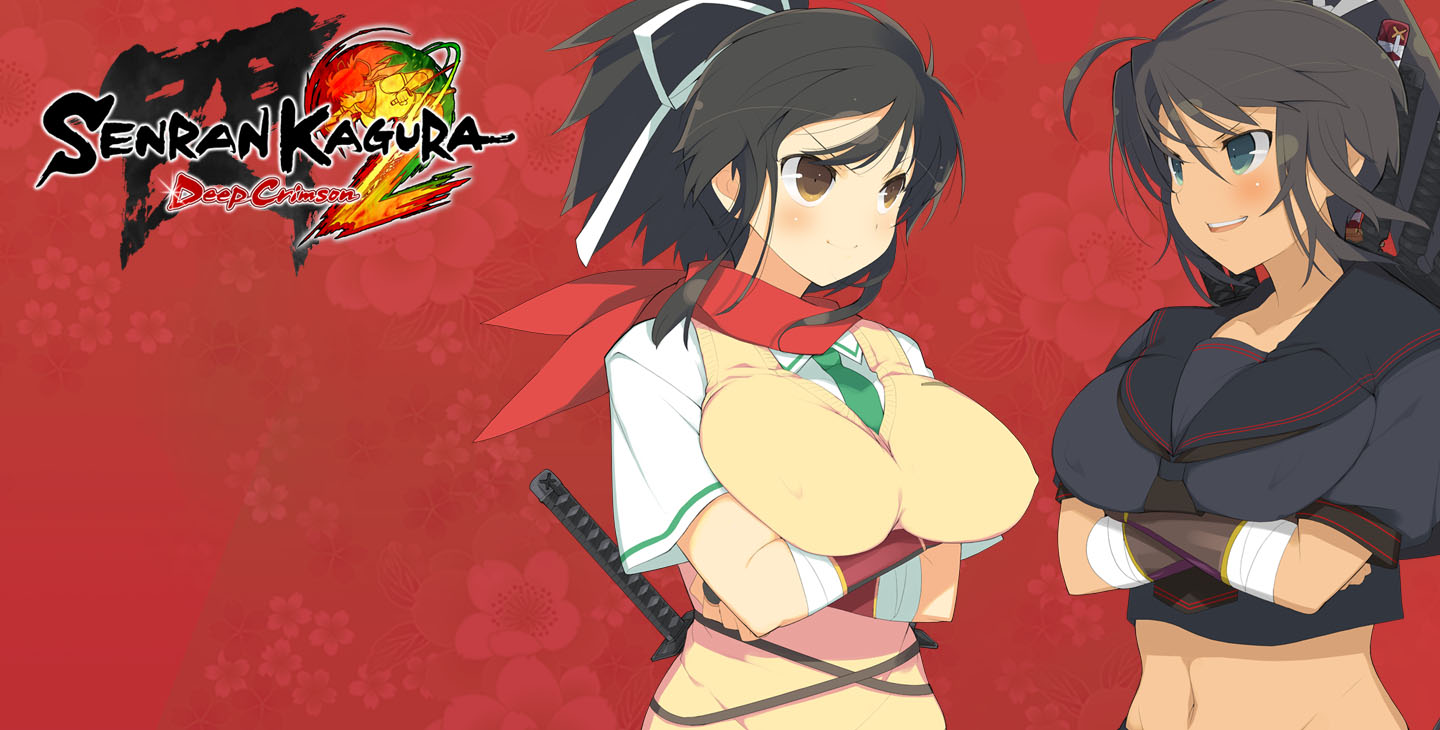
Today in Unacceptable Articles That Should Never Have Gotten Through the Editorial Process, If There Even Is One, I present Vice UK's depressingly predictable article "Is There Anything More to Senran Kagura 2 Than Big, Bouncing Cartoon Breasts?".
I learned early on that you should never write a headline that is a question that can be answered with a single word. There are a number of reasons for this, the most obvious being that most people will look at the headline, think of their own personal answer to the question and then not bother to read the article to find out what the author thought. But beyond that, these sorts of headlines are often inherently loaded questions, too, demonstrating clear prejudice before you even get into the article itself. In the case of the article here, it's immediately apparent that the author has come to Senran Kagura 2 with the assumption that there is "nothing more" to the game than "big, bouncing cartoon breasts" and, as such, will probably take some convincing that, in fact, the series is considerably deeper than that. Or, more likely, he simply won't even entertain the possibility that his prejudices might, in fact, be mistaken and based on flawed assumptions.
The author kicks off his article by burying the lede — admittedly only by a single paragraph, but he still opens the article by talking about Metal Gear Solid V, Mad Max and Super Mario Maker instead of Senran Kagura 2. This is an immediate warning sign; it sends the signal that he would rather be doing anything other than writing about Senran Kagura 2, which, of course, begs the question as to why he is writing about it in the first place, but I think we all probably know the answer to that already. (Hint: it rhymes with "dicks".)
The second paragraph then introduces Senran Kagura 2 by giving some important context: the fact that the author downloaded the game "a couple of weeks ago" and, since that time, has "played maybe an hour" of the game in total, across "five or six brief sessions" that we can extrapolate to have been no longer than ten minutes each. He also briefly discusses developer Tamsoft's history, implying that the PS1 era's Toshinden is their most noteworthy and "acceptable" work, while everything since (including Senran Kagura and Oneechanbara) has been "rather more exploitative fare". (He's not wrong to call Oneechanbara in particular exploitative, but in that game's case in particular, it's a direct reference to "exploitation" horror films and as such is rather more clever than he gives it credit for.)
"60 minutes is enough to know what [Senran Kagura 2 is] all about," the article goes. "Breasts. Boobs. Tits. Baps. Knockers, Bosoms. Norks. Melons. Insert your own local, colloquial variation, here. Seriously. That's it. Breasts. This is a game about breasts."
I would perhaps be more receptive to this appraisal were it not for the fact that the article contradicts itself in the same paragraph by saying "oh, sure, there's fighting too, and a storyline I cannot even begin to fathom on account of it directly following the events of its preceding game, Senran Kagura Burst, which I'd not even heard of prior to picking this up."
Hold on there. Hold on just a minute. There's a little thing that you can do as a journalist called "research". If you're not familiar with a series — and the fucking great "2" in Senran Kagura 2's title should be a pretty obvious tip-off that it is part of a series and a sequel to something — then you should probably find out a bit more about it before you jump in halfway. You wouldn't start reading The Lord of the Rings (or watching the movies) halfway through The Two Towers without at the very least familiarising yourself with a synopsis of what had come before; you wouldn't start watching Breaking Bad halfway through its third season and then whinge that you had no idea what was going on; you wouldn't read His Dark Materials starting at the third book. (Or at least, you shouldn't do any of these things, or if you do, you shouldn't moan that you "cannot even begin to fathom" what is going on, because it's your own stupid fault.)
"There's an extremely long, context-setting intro, but I fell asleep halfway through it," continues the piece, again contradicting itself by demonstrating that the game clearly does make an effort to get people up to speed even if they haven't played Burst, and also demonstrating a clear unwillingness to engage with the game on anything more than the most superficial level.
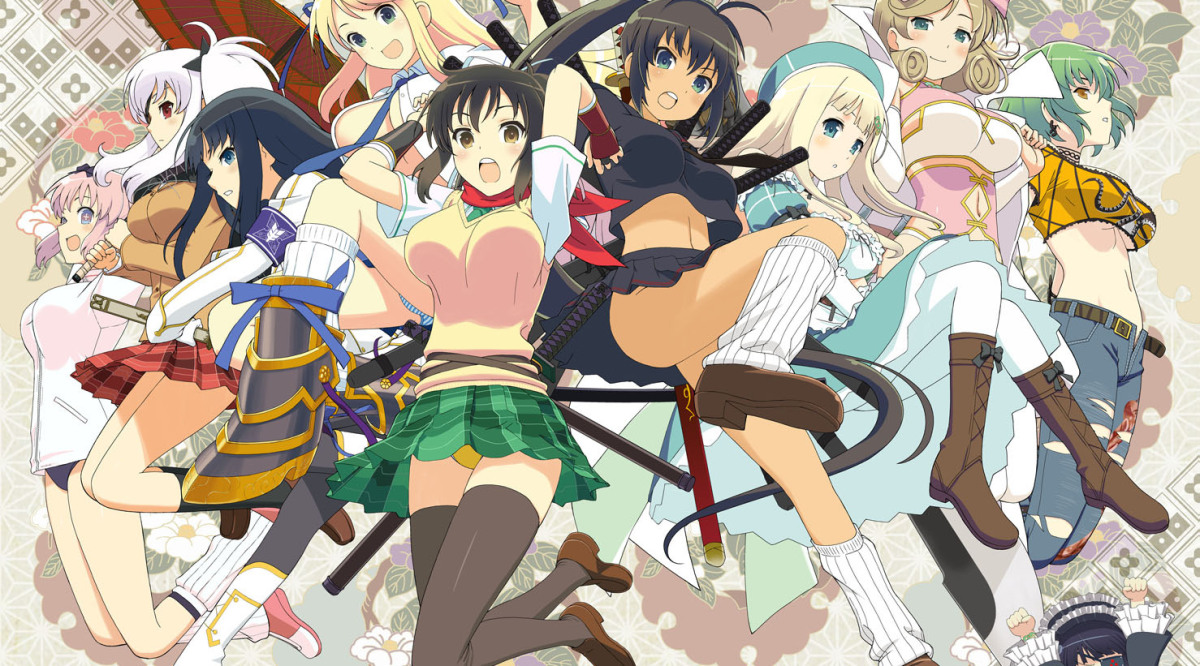
Here's the thing: Senran Kagura, as a series, is essentially a visual novel in which story sequences are punctuated by brawler-style action sequences — the 3DS games feature 2.5D-style fighting similar to arcade classics such as Streets of Rage, while the Vita and PS4 games feature 3D brawling somewhat akin to the Dynasty Warriors series. Although the games are regarded as "brawlers", their main reason for existence is not, as the article claims, "breasts", but to tell their stories. And they do this through a medium that Japan has proven time and time again to be an effective means of exploring and developing characters: the visual novel.
It is quite surprising to a lot of people coming to Senran Kagura for the first time quite how much effort the game makes with its storytelling. Certainly, it's not particularly flashy in its execution — it alternates between "NVL"-style full screens of text overlaid on static backdrops or event images for longer, more dramatic sequences or internal monologues exploring characterisation, and "ADV"-style head-and-shoulders conversations for shorter, more incidental and immediate conversations between characters — but it's an effective means of getting its point across. The longer NVL sequences put the story in context and often feature past-tense narration explaining things that happened in the past, while the shorter ADV sequences give us an insight into how the characters are right now, and how they are responding and reacting to one another.
In other words, ignore Senran Kagura's visual novel sequences — or "fall asleep" during them — and you are Missing The Point fairly spectacularly, not to mention completely invalidating your own assertion that "this is a game about breasts".

"That a game like this can come out in 2015 is ridiculous," continues the article, now in full-on table-thumping mode. "It's brazenly, unapologetically sexist. And it's all as arousing as a dinner date with Des O'Connor, where [at this point it trails off into the author's own bizarre fantasy which I will spare you for now]. The thin waists and titanic whimwams might represent wank fantasy material for teenage boys who, for some reason, can't bring themselves to find actual pornography on the Internet, but to a grown adult, a married man, a father of two, this is just the dullest, most tired tripe masquerading as titillation. I get more excited making toast."
Here we get to one of the important issues with this piece's appraisal of the series: the assumption that it is pornography. As anyone who has actually played the series will tell you at great length, Senran Kagura is most certainly not pornography. It has positive attitudes towards sexuality — most notably fetishes such as sadism and masochism as well as lesbianism — but that doesn't make it pornographic.
Even the game's notorious "clothes ripping" mechanic and its jiggly breasts don't make it pornographic; both of those things have been put in there for two reasons: firstly, simply as part of the game's aesthetic, in the same way that Bayonetta has masturbating angels and naked witches all over the place but isn't "porn" — to be honest, you sort of stop actively noticing it after a while, and it just becomes "the way the game looks" — and secondly, as a reflection of the characters' attitudes towards their own bodies, sexuality and selves as a whole. Compare Haruka's positive glee as her opponent shreds her defenses to Mirai's embarrassment at her skinny, childlike body no longer being hidden by her big, baggy Gothic Lolita dress as a great example of how this is used as a means of characterising the cast in a non-verbal manner.
The author then plays what he clearly believes to be his trump card: that he's a "grown adult, a married man, a father of two" and that this somehow makes him better than all this. To refute this, all we have to do is go back to his first paragraph, where he mentions Metal Gear Solid V (a game in which you can make a horse shit on command), Mad Max (a game in which you fix up a pretend car and blow up people you don't like) and Super Mario Maker (a game in which you fashion crudely-drawn penises out of platforms floating in the sky in a magical mushroom kingdom, and then invite your friends over to giggle childishly as they leap all over them). I don't actually think all of these games can be reduced down to these stupid descriptions, of course — but in the same way, Senran Kagura as a series cannot be reduced down to "this game is about breasts", particularly after just 60 minutes across five or six sessions with a single game in the fucking series.
It continues, though. "Yet this is a game — a series, which has spawned its own manga and anime offshoots — with so many fans," says the author with apparent surprise that something he doesn't like could possibly be popular or well-received. "Sales of the games to date have passed the million mark [significant for a niche-interest title like this] and coverage elsewhere has emphasised the gameplay improvements made to Deep Crimson, compared to its predecessor. And, you know, I'm absolutely fine with people playing this game, and enjoying it (be fair, most likely in the privacy of their own homes, despite the portability of the platform), and claiming that they're primarily in it for everything but what's inside all those fancy blouses."
No you're not, sir. You are not "fine with people playing this game, and enjoying it", as your incredibly judgemental parentheses indicate. But we've already covered this; in your five or six ten-minute sessions with the game, you made no effort to engage with its more interesting aspects, and instead chose to reduce it down to "what's inside all those fancy blouses". I feel that you, sir, may be the one with the issue here.
"Of course, they're fucking lying, as this is a game about breasts," continues the author, proving the point I made in the last paragraph. "And nothing else, so stop kidding yourself. You're not playing Deep Crimson for its multi-layered gameplay, for its sole playable male…"
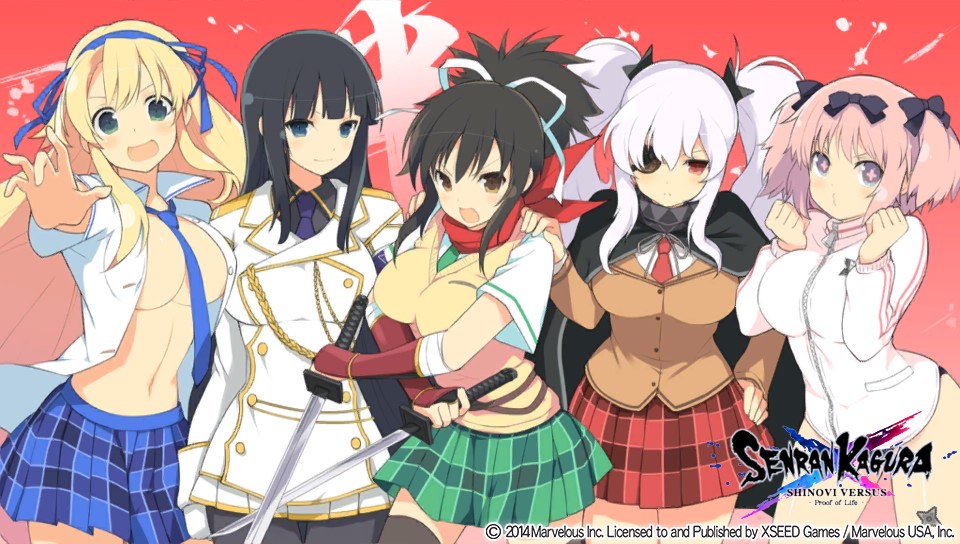
Hold on a minute. Games journalism as a whole is always whingeing about how there's no female representation in games, and yet here we have a game with eleven playable female characters, each of whom are developed and explored in great detail across the course of the series as a whole, and yet the "sole playable male" is something worth fixating on or criticising? I'm not even sure what point the author is trying to make by mentioning this — perhaps the mistaken assumption that horny young men refuse to play as women and as such will only want to play as Murasame? I don't know. But I digress.
"…its pair battles or its tangled tale of… sorry, again, no idea, but I get that the baddies aren't all that bad in the big scheme of things."
Senran Kagura's "baddies" want to summon youma and take control of these legendary monsters to assert their dominance over the world, and have no problems resorting to kidnapping and even murder in order to further their own goals. I guess the author is right about one thing: he really does have "no idea" about what the game's "tangled tale" is all about.

"You're playing it because misshapen cartoon girls with weirdly massive eyes, piss-poorly made outfits and ginormous gazongas do it for you," he continues. "And that's okay, I suppose. Better that you feel up fictional girls on your 3DS screen rather than grope a stranger on the bus."
Hold on a fucking minute there. The rest of this piece has been dismissive and judgemental, yes, but this particular passage crosses the line into just plain offensive. The not-at-all-subtle implication that people who enjoy Senran Kagura would be committing sexual assaults in public if they didn't have their terrible, awful pornographic games to sate their depraved appetites and slake their thirst for young flesh is absolutely unacceptable. I don't think any more really needs to be said about this, particularly as we've already had words about this. You do not imply that portions of your audience are criminals based on what kind of entertainment they choose to enjoy. You do not demonise people based on their open-mindedness. And you do not get to pass judgement on a game you have played for "five or six" ten-minute sessions without making any attempt to engage with it beyond "this is a game about breasts".
This article is completely unacceptable, and should never have made it through Vice's editorial process — if indeed there even is one. I've mentioned before that I strongly believe in a case for specialist writers who know what they are talking about in the field of video games, and nonsense like this just goes to prove the point. The article achieves nothing other than reinforcing prejudices and frustrating people who know better. It doesn't drive discourse about gaming forwards, it's utterly backwards and completely closed to debate; for all the author's protestations that he's "fine" with people liking it and that it's "okay, I suppose", it's abundantly clear that he believes anyone who has even a passing interest in the Senran Kagura series is a sexual deviant who is just one 3DS away from committing a criminal sexual assault in public.
Well, sir, your attitude is not fine. It is not "okay, I suppose". Your piece is a vile, hateful, ill-considered and poorly researched screed about a topic you clearly have no business writing about. Go back to Mad Max and pimp up your wasteland-mobile, since that's clearly what you'd rather be doing — though I'll expect a 3,000-word essay from you about how the game's depiction of women is "problematic" by the end of the week, assuming someone from Polygon doesn't beat you to it.
In the words of Senran Kagura creator Kenichiro Takaki, "the world is full of stuff people will think is fun to them. It just seems so pointless to waste your time on things you don't like or can't understand." If only a few more people took those words to heart.
 Whew,
Whew, 


 Otoha is arguably the "leading" heroine in the story due to the fact that she's introduced alongside the protagonist Takt. Otoha is a cheerful, positive, upbeat young girl who has always looked at idol culture — or, in the context of Omega Quintet, "Verse Maiden" culture — with starry-eyed awe. Although Omega Quintet's world is post-apocalyptic and in many ways both bleak and dystopian, Otoha's infectious energy allows her to bring a sense of brightness and lightness to even dark situations; fellow Quintet member Aria even says as much in a rare moment of lucidity.
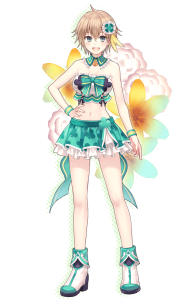 Kanadeko, meanwhile, is another energetic character. While Otoha is passionate and determined, Kanadeko is more concerned with having fun and being friends with everyone. This is reflected through everything from her perpetually wide-eyed facial expressions to her seeming inability to stand still and her loud voice. She's keen to do a good job as a Verse Maiden not because she's especially passionate about it in the same way as Otoha — though she is dedicated to her work — but because she thinks it will be a fun thing to do.
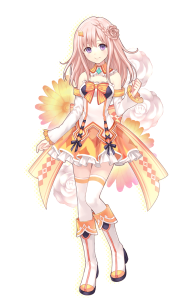 Kanadeko's perpetual companion is Nene, who in many ways is the polar opposite of her loudmouthed counterpart. Nene is shy, awkward and has a tendency to babble incoherently when she's feeling nervous — which is quite frequently. In extreme cases, this trait exhibits itself through her blurting out some things that make people feel a little uncomfortable — such as her enjoyment of and enthusiasm for firearms — usually closely followed up by some embarrassed awkwardness as she apologises for saying "strange" things.
 Kyouka, meanwhile is the character that is probably most directly concerned with her honne and tatemae. As a "class president" sort of character, Kyouka is serious and determined and almost painfully tsun at times, but she sees her lack of confidence in her performance abilities as a failing, and consequently tries to do something about them. She is also very concerned with what people think about her; she spends quite some time worried that her former mentor Shiori hates her for coming to join the other Verse Maidens, and it takes a reluctant intervention by Takt to help the pair at least start to realise that neither of them really resents the other, though they both find that impossible to admit.
 Finally, Aria is the most enigmatic of the Verse Maidens. Initially introduced as a happy-go-lucky, cheerful girl whom Kanadeko and Nene knew when they first joined the group long before Otoha and Takt came along, we subsequently discover that she suffered greatly at the hands of the Blare and went into hiding. When she re-emerges, she's seemingly emotionless — but not cold — and seemingly not quite aware of everything that's going on around her. The damage to her mind by the Blare, it seems, was severe.