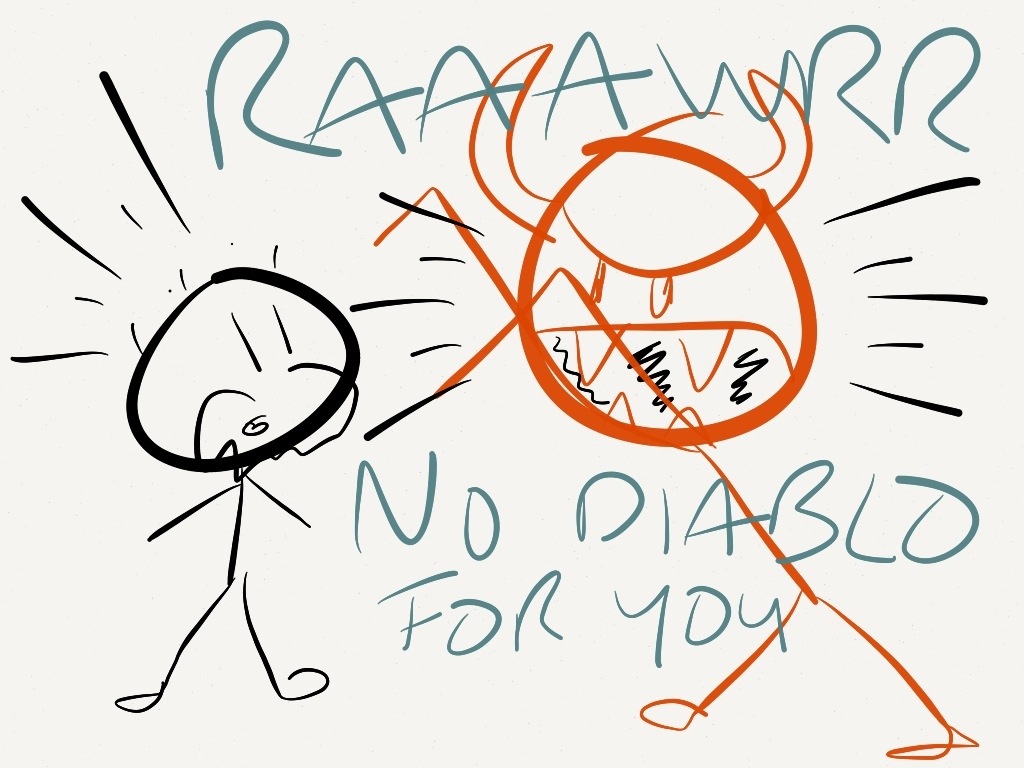
#oneaday Day 938: Stop Shouting, Start Talking

As I have said before on a number of occasions, I do not enjoy conflict, disputes, arguments or anything that gets a bit "heated". My own social anxiety tends to make me overthink it and repeatedly go over it in my mind and worry that it's "personal", even if it isn't. And the sort of passive-aggressive comments that inevitably come up when one of these situations arises inevitably make me paranoid that they're talking about me, even if they aren't.

But that's a little off the point of what I wanted to talk about, though it does involve conflict.

For those who weren't following the debacle on Twitter earlier, Gearbox Software, developers of Borderlands 2, chatted with Eurogamer about an addon character that would be following the game's launch. The developer in question (Hemingway? I'm writing this on my phone so can't be arsed to multitask) commented that this character had a skill tree called "Best Friends Forever" that provided a number of significant boosts to a less skilled player, allowing them to play alongside someone very familiar with first-person shooters and still have a good time. Things like being able to ricochet bullets into enemies if you aimed vaguely near them rather than having to be properly accurate — real noob-friendly stuff, and actually a really good idea to make the game accessible to less skilled players, or two co-op partners of uneven skill.

The trouble arose when the developer referred to this particular set of abilities as "for want of a better term, the girlfriend skill tree". This was misquoted by Eurogamer in its own article as "girlfriend mode" and the whole thing then spiralled out of control through the usual game of Chinese Whispers, making significant proportions of the Internet very angry indeed and effectively tainting what was actually a very good idea with the distinct whiff of sexism.

The dude's words were ill-considered and stupid and Gearbox should have apologised for them rather than poncing around trying to do "damage control" like they instead chose to. The fact they were said at all is symptomatic of a large sexism problem within the video games industry, and this is an issue that should be addressed.

Addressed calmly and rationally.

Unfortunately, that latter part is what is escaping commentators on both "sides" of this debate. One side starts yelling about how awful this is, making increasingly over-the-top arguments, then the other strikes back in exactly the same way, leaving everyone looking rather foolish. I of course understand that this is something that people are passionate about — particularly feminists who work hard to promote a much-needed female equality agenda — but "passionate" should not mean the same as "angry" or, at times, "disrespectful". Any time either side descended into all-caps sarcasm (and BOTH sides were guilty of this several times throughout the day) it just ruined the point of what they were trying to say and ended up looking rather childish, really.

I'll reiterate: I believe sexism is a problem in society, particularly in the video games industry. But spitting feathers, swearing, making false comparisons, wilfully misquoting things and taking a "who can shout loudest" approach is just counterproductive, surely. I accept that it is frustrating every time something this stupid happens, and I agree that it should be talked about — there were plenty of people out today just wishing everyone would shut up, which isn't a helpful attitude to take — but yelling isn't the right way to go about it because it just leads to a downward spiral of both sides becoming more and more defensive.

Instead, what is needed is rational, sensible, calm and honest discussion. Those upset by the comments should be able to point out that they were upset — and why — without fear of reprisal. Those who didn't see why there was a problem should open their minds and see the other side's viewpoint rather than immediately going on the defensive. And the hidden third faction who just wanted everyone to shut up should calmly accept that different people hold different views, and just because they don't want to hear about something doesn't mean that no-one should talk about it.

Unfortunately, the very nature of the Internet means that immediate, passionate knee-jerk reactions are the way most people go — and once someone gets up on their high horse it's very hard to get them down again, regardless of what viewpoint they hold. It becomes exhausting for everyone involved and everyone observing, and just ends up leaving a distinctly bitter taste in the mouth — one that could have easily been avoided had the issue been addressed promptly, calmly and rationally by everyone involved.

Instead, we get what we had today, which was a bit of an embarrassment for everyone involved. I sincerely hope that one day we can sit down and talk about these things without all of the RIGHTEOUS FURY, because then we're much more likely to get something productive done about it.

Because seriously, people, it's 2012 and we're still discussing gender issues. Surely the human race should have moved past this sort of discrimination by now?

At least there are certain corners of the Internet where sexism is tackled effectively, calmly and rationally — just as it should be. Check out this great story to see How It's Done.

#oneaday Day 848: I Can't Get Angry About Diablo III

20120515-224443.jpg

I know I have a track record of Getting Angry About Shit, particularly when it comes to things like DLC, DRM and other three-letter acronyms. But I'm finding it rather difficult to get riled up over the issues surrounding Diablo III.

For the uninitiated, Diablo III is the latest game from World of Warcraft creators Blizzard, who are part of Activision. Activision used to be gaming's resident Empire Of Evil, but that mantle has since passed to EA, and Activision are now simply Those Guys Who Killed Bizarre Creations, Pump Out Call Of Duty Every Year And Have Something To Do With Blizzard. But that's beside the point.

The point is that Diablo III was always going to be a massive seller and an immensely popular title. It's the long-anticipated third entry in a series with a long history, and one which a lot of players have been looking forward to for a long time.

It's also one which a lot of people are getting extremely angry about, largely due to what they describe as its "always-on Internet DRM". Said "DRM" has had difficulties today due to overloading, leaving many players unable to log in and play the game.

Here's how the system works. To play Diablo III, you have to log in to Blizzard's online service Battle.net. Once logged in, you can then play the game. You have to stay connected in order to play, even if you're playing solo. The benefits of playing in this kind of "always on" environment include the fact you can always see when your Diablo-playing friends are online, that you can jump in and out of each other's cooperative multiplayer games, and that you can make use of the game's auction house facility to trade items.

Some people are getting very upset about this — particularly the fact that you can't play single player offline. And while that may seem a bit silly, I can't help but thinking a lot of people are looking at this from the wrong angle — the "gamers are getting screwed" angle. This is perhaps understandable, given the amount of time gamers spend getting screwed nowadays, but I really find it difficult to agree with the people getting riled about this.

Here's the thing, though: Diablo has pretty much always been designed as an online game to play with either friends or random strangers online. The classes are designed in such a way that it's both desirable and fun to group up with other people and tackle the game's challenges cooperatively. You can play solo, sure, but the game has always been designed with online in mind. With this latest iteration, including the auction house and other mechanics, Diablo is now closer in execution to a massively-multiplayer online title than a single-player dungeon crawler like Torchlight. Sure, it doesn't charge a subscription fee or feature a truly massively-multiplayer open world to explore, but the game has been designed specifically to be an online title. People don't complain about World of Warcraft, Guild Wars or the like having to be always online — what, really, is different here?

I think the issue is that Blizzard hasn't appropriately set people's expectations for the game being an online-only title. We have no problem with games like the aforementioned requiring us to stay online in order to play, despite the fact you can play them solo. (In the case of Guild Wars, you can even team up with computer-controlled partner characters if you really can't stomach playing with real people.) So what, really, is different about Diablo III? Is it simply that the previous games had a discrete "Single Player" option that didn't require you to be online? (I haven't finished installing the new game yet so at the time of writing don't know if this is still the case.)

The other issue is that people believe Blizzard, being the company who runs the world's biggest massively-multiplayer online game, World of Warcraft, should have anticipated demand and made sure their servers were up to the job of dealing with the thousands (millions?) of people who were likely to be wanting to log in at the same time. This I sort of agree with, though there is no genuinely reliable way of predicting quite how much demand there is going to be for any given title. Blizzard underestimated demand, and it's caused problems — much like has happened with the launch of many other online-only games. That doesn't make this a "disaster" or a "debacle" or anything like that; it makes it an occurrence that we've seen before. An occurrence we should have figured out a solution for by now, yes, but one we shouldn't really be surprised about any more.

Within a matter of days, the whole issue will be completely forgotten about as everyone starts playing and enjoying the game, which kind of makes the whole RAGE!!! thing seem rather pointless, really.

But I guess you could say the same thing about any sort of "controversy" — including the Mass Effect 3 issues I wrote about a while back.

The fact is, though, this is an issue I find it very difficult to get riled up and upset about. So far as I'm concerned, Diablo III is an online game, almost an MMO, therefore I accept the fact that an unavoidable part of its existence is downtime, during which you cannot play. It's not as if I'm short of other stuff to try when that happens — and getting angry really won't solve anything. I accept that others' views may differ on this subject if Twitter today is anything to go by, but that's how I feel personally.

If you're getting upset, go play something else. Or, in the words of my good friend Jeff, GO OUTSIDE.

#oneaday Day 640: Defending the Dungeon

I find myself in vaguely familiar surroundings, though I'm not quite sure of the best way to proceed. Fortunately, one of my companions steps up to the plate. She's a young, pretty elf, and she packs a mean-looking minigun. I'm inclined to follow her suggestions.

"Put down a wall there," she says, clearly indicating the place she's referring to. I oblige, hastily battering together an impromptu blockade of wood, steel and spiky bits.

"Now one here," she adds, nimbly leaping over to another pathway towards the crystal. "And one over the other side, too." Her friend, clad in his robe and wizard hat, lollops over and drops a few mana crystals to help me pay for the defenses we're setting up. I follow her instructions, and soon enough we're ready.

"Chaaaaarge!"

We hear the cry from behind the door before they arrive. My mind wanders for a moment, thinking that it was awfully nice of the incoming hordes to wait until we were ready before attacking, but I am quickly snapped back to the present by the sight of what looks like a small army approaching.

I leap into action, swinging my sword wildly and knocking goblins left, right and centre. Green blood sprays from their lifeless corpses as they fall to the ground — they don't even reach my blockades, so weak are they against my swordsmanship. I glance to the sides and see my compatriots covering the other doorways in their own distinctive, inimitable styles. Our erstwhile leader is mucking in with her minigun just as much as the rest of us, and before long the doors slam shut, the crystal safe for a little longer.

This time, we agree that I should put some harpoon launchers behind my blockades just to make doubly sure that none of the advancing hordes get anywhere near the crystal. They prove surprisingly effective, especially when combined with the magical structures that my robe-and-hat-clad companion also summons out of thin air. Before long, we're taking another breather, but it's clear that this time, things are a little different. There's an air of tension about the group, as if it knows something terrible is about to happen.

The doors fly open again, and another swarm of enemies  troops into the chamber. I wade in, cutting through them like butter, knocking them aside, into pools of lava and down seemingly bottomless pits. These dungeons are dangerous, and surely having pools of lava beneath your castle can't be a great idea, I think.

Suddenly, the incoming enemies seem to stop, and there's a noise.

Thud.

There it is again.

Thud.

And again.

Thud.

Louder, this time.

THUD.

Something big is coming. We look frantically around the room to prepare for whatever it is that's headed our way, and our gaze falls upon the mysterious alchemical equipment left here long ago by our apprentice friend's forebears. The pretty elf nods, and we steel ourselves just before a huge demon bursts through the ceiling, roaring in fury.

I charge straight at him but am immediately knocked back by a wave of fire. The pretty elf gestures to one of the pieces of equipment down the side of the room and charges towards one herself. Following her lead, I smash the device as hard as I can with my sword, and strange, crackling, blue energy emits from it. Our two other companions do the same, and before long there's a whirling maelstrom of the crackling blue energy, converging on the demonic beast bearing down on the pretty elf.

It worked! He spasms and judders, unable to move. We immediately leap in and start attacking him — his thick skin is like stone, but from his howls of pain, it's clear we're hurting him. He breaks free of his energy prison and roars again, flames bursting forth from his body and knocking us back. He's on the ropes, though, so if we can just do it again…

He falls, the impact of his massive body hitting the floor making the whole room shake. Gigantic, valuable-looking mana crystals burst forth from his corpse and we gather them up greedily — this stuff is better than gold coins. There's an air of calm over the strange laboratory, and it's clear that this area is safe, for now. But this is just one of many of the Eternia Crystals that we've been tasked with defending. Can we live up to the bold example set by our ancestors?

Only time will tell — but we'll have a lot of fun doing it. So can you.

#oneaday, Day 63: Act Your Age, Joanna

Late again. And I hold one thing entirely responsible for this: Perfect Dark. Actually, two things. Perfect Dark and Cody "NintendoTheory" Winn.

I know I wrote about Perfect Dark the other day but I feel I should enthuse a little more about it because my experiences with it over the past few days have been highly entertaining. First up, I played some online co-op with Calin Grajko (who was brave enough to interview several members of the Squadron of Shame a while back and has stayed in touch since) – specifically, through the first few levels on Perfect Agent difficulty. This was great fun, as Perfect Agent difficulty is pretty brutal in its difficulty – you don't get much in the way of life, there are lots of (failable) objectives to complete and there are tough enemies all over the place. The best thing about playing co-op, though, is that it gives you the opportunity to have a laugh along with the game. Perfect Dark may appear at first glance to be taking itself rather seriously, but you only need to jump into a co-op game to see that really isn't the case. This is a game that shines when played with friends, be it co-operatively or competitively.

Which brings me to the next point – Counter-Operative mode. This is possibly the most broken game mode I've ever played, but it's brilliant in its stupidity. One player controls Joanna Dark, just as in single-player, and has to complete the missions. The other player, on the other hand, repeatedly respawns as random enemies around the level. Jo has one life. The Counter-Operative can keep coming back over and over again, and it's their job to make life a pain for Jo.

It's tempting for the Counter-Operative to rush in and confront Jo as soon as possible, of course, but if this happens the match can be over rather quickly. What is far more entertaining is when the Counter-Operative decides to play mind games with Jo's player, as Calin did to me.

As I made my way down the dataDyne building, I noticed it was oddly quiet, and there seemed to be something of a trail of destruction, like someone had got there first. The building was completely devoid of enemies, until I got to the bottom floor. I stepped out of the elevator and headed towards the level's exit when suddenly…

BIFF!

Jo's vision blurred and I whirled her round to discover an incompetent-looking guard in spectacles punching me repeatedly. It was Calin. He punched me again and knocked my gun out of my hand and suddenly, we were engaged in the sort of cack-handed fistfight that only ever happens in first-person shooters. As Calin realised that the enemy characters weren't capable of picking up weapons that had dropped to the floor, I seized my opportunity and grabbed my dropped pistol, shooting him in the head and escaping the level.

It's not entirely clear whether or not anyone bothered to playtest or balance Counter-Operative mode, but one thing's for sure – it's so ridiculous it is one hell of a lot of fun.

The thing that's kept me up tonight, though, is something which is always dear to my heart in online gaming: leaderboards. As anyone who battled against me in the Geometry Wars 2, err, Wars of last year will attest, leaderboards inspire great competition. And it so happens that Mission 1 of Perfect Dark on its easiest difficulty level provides an ideal arena for bitter competition to see who can clear it the fastest. Cody and I were ping-ponging times back and forth earlier until, as of this time of writing, I sit on the top spot of my friends leaderboard with a time of 40.95 seconds. I invite any of you to try and beat that – without using the apparently-infamous glitch that I'd never heard of before today which allows you to beat the level in 6 seconds flat. Challenge set!

As you can tell, I'm smitten with Joanna's adventures. I was back in the N64 days and I am again now. Perfect Dark is such a complete package that it is almost without a doubt one of the best uses of 800 Microsoft Points on XBLA. There is so much to do besides the basic single-player missions. There are the various multiplayer modes. There is co-op. There is counter-op. There are tons of secrets to discover in the Carrington Institute that forms the backdrop to the main menu. There are challenges. There are leaderboards. There are Achievements. It's a game that will keep you busy for a very, very long time.

The thing I'm most impressed by, though, is the fact that as a game it still plays brilliantly today – ten years later – with no modifications besides the resolution and framerate upgrades. It takes some adjusting to playing a game which doesn't point out your objectives in gigantic neon-coloured HUD arrows, but I find it far more satisfying than any shooter I remember playing in recent memory – both in single-player and multiplayer.

So if you haven't bought it yet, stop bitching about the N64, stop moaning about the framerate on the old version, stop complaining that it gave you motion sickness (at least until you've turned off "Head Roll" in the options to see if that makes you feel better), stop whingeing that the characters' mouths don't move when they talk… look, just buy it and enjoy it, okay?

Act your age, Joanna.

On Virtual Worlds

I haven't really blogged about this much on this particular site, but I figured it's time to sit down and talk about it as it's something that I've found consistently interesting for quite a few years now.

The subject is virtual worlds – online spaces where tens, hundreds, thousands of people can log in and join a virtual community for one reason or another… it may be purely to socialise, it may be to battle monsters, it may be to have fun, it may even be to have sex. And I'm not talking about community or social networking websites here, as those are a different beast entirely. No, I'm talking about actual virtual worlds, where you can wander around as an avatar, explore the world, meet other people and interact with them in any of the ways described above.

There's literally hundreds of virtual worlds available for people to use nowadays, of many types – some are more "gamey", others are more "social", others still are focused on the less salubrious side of online interactions. Today I want to focus particularly on the virtual world of Second Life and its appeal to me, despite its many, many flaws.

I remember first hearing about Second Life while I was big into The Sims. My whole flat at university became obsessed with The Sims shortly after I built our first house, made virtual representations of all six of us in the flat, then realised that we didn't have enough money to buy beds to begin with, so the whole "family" slept in recliners. Over the years – yes, I was that guy – I bought most of the expansions and later moved on to The Sims 2.

I was, like many other fans of the series, extremely excited at the prospect of The Sims Online, offering the opportunity to have the same kind of fun, but with other people involved. It never made it over here to the UK – at least, not in any prominent way – so I never got the opportunity to try it. I forget exactly how I came across Second Life as a result of this, but it was something I stumbled across without hearing anything about it beforehand, and I thought that the concept sounded rather like The Sims Online, with players being able to design their own virtual person and "live" in a virtual world. As it happens, it has very little to do with The Sims Online, but I wasn't to know that at the time.

For the uninitiated, Second Life is an ambitious virtual world project by Linden Lab, offering "players" (and I use the term loosely, as it's really not a "game" as such… unless you choose to make it as such, which we'll discuss later) the opportunity to enter a world that is almost entirely user-generated. Buildings, textures, landmasses, interface features, animations, body parts, clothing – everything is created by the residents of the virtual world, and this is the thing that initially fascinated me. I couldn't comprehend the idea of being able to log into something where the content was so fluid, where there wasn't a static virtual world that was always the same every time you logged in, with monsters in the same place, prime "camping spots" and so on. So I signed up and signed in, not really knowing what to expect.
at-the-gateSecond Life is a peculiar experience the first time you log in, especially if you're more used to aforementioned online games with static content, such as World of Warcraft. You quickly become used to the concept of "rezzing", which is the process whereby you enter a new location and you can see things downloading and appearing around you. This is disconcerting the first time it happens (and more than a little irritating if you find yourself stuck against a wall which hasn't appeared yet) but, like many things in the world, you become used to it the more it happens. Similarly, you become used to the fact that other residents' avatars also go through this rezzing process in front of you, so it's entirely possible that someone could appear in front of you with no hair and no face until the textures and shapes have downloaded. Rezzing accidents are the subject of many a good laugh amongst SL residents, but they are accepted as part and parcel of life in the virtual world. People more used to traditional MMOs will likely find it a complete turn-off though – at least until they accustom themselves to it.

Upon arrival in SL, the question on many residents' lips is "what on earth am I supposed to be doing?" And the answer is not simple. Explore, interact, build things, take photographs, join groups, play games, look at art, shop, fuck, roleplay, pretend to be a vampire… the list goes on for a mile, and all of these interactions are built using the basic engine of the Linden Lab-developed software, with extensions built, designed and scripted by residents of the world, just like everything else. People make in-world money either by paying out of their own pocket to buy "currency" – or by working a job, just like real life (albeit with MUCH better hours). It's always interesting to hear how seriously people take their SL jobs, whether they're a DJ in a club streaming their music through something like ShoutCast, a live musician, a virtual performer, a dancer, a greeter, a builder, an estate agent, a facility manger, a prostitute, a Game Master for roleplaying areas – again, the list of things goes on, and people have the opportunity to completely subsidise their virtual existence through virtual hard graft if they so desire.

Another thing that is almost immediately noticeable about SL is the sheer diversity of the avatars present. And we're not talking a set choice of races here, with arbitrary "body size" sliders. We're talking complete customisation. We're talking this situation here:
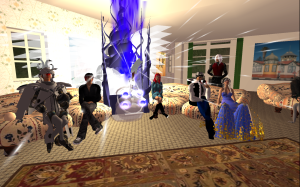
snapshot_111This wasn't anything particularly special happening – it was a discussion group where we sat down and had a civilised chat about a set topic. Like a real-world discussion group in fact.

And that's the thing with Second Life. It has this immensely odd (yet perfectly natural-feeling once you've been there a while) ability to combine the mundane and the absurd. Everyone is distinctive in Second Life – because you're not limited to hard-coded appearance options, you can be whoever you want to be. You don't even have to be human. I picked up an awesome Pac-Man avatar the other day that allows you to spawn dots and ghosts and turn any place you go into a game of 3D Pac-Man.

In fact, the question of not being human is one of the more interesting sides to Second Life that I haven't explored yet. It also happens to be the side that there's a lot of sordid assumptions about, particularly around the "furry" avatars. Yes, there are people who choose to represent themselves as furry animals and then have simulated sex whilst masturbating furiously at the sight of their interlocked pixels. But equally there are people who choose to represent themselves as furry animals just because they like them. On one memorable occasion I was spending some time at a hangout with my earliest friends in SL (who are still good personal friends to this day, I might add) and I was introduced to an immensely clever man from a university who was working on lots of exciting things to do with AI. My friend Lyndy, who introduced me, assumed that because I "knew about computers" I'd be able to chat to this guy no problem. However, he was explaining concepts that were way over my head… but they were interesting to hear. The really peculiar thing, though, was that he was dressed as a fox. Not a foxy lady, no, an actual fox. In a waistcoat. If anyone remembers a really old DOS point-and-click adventure called Inherit the Earth… the main character from that? Fox-in-a-waistcoat called Rif? That's about it.

Why do I remember that? I never even played it.

Second Life is flawed in many ways. I've talked about this many a time with Jennatar, and she suggested the notion that virtual worlds are a much younger technology than the Internet. Currently with virtual worlds, she says, we're at a similar sort of stage to the Internet was in in the early 90s in that there's a lot of stuff out there to explore, but navigation, user interfaces, efficiency and practicality haven't quite reached the level of stability you'd need to be completely "mainstream". This means that titles like Second Life are, at least for now, going to be "niche" interests. However, interestingly, the "niche" for Second Life perhaps isn't what you'd expect – an oft-quoted "statistic" is that of the many residents of the world, a significant majority of them are female and over 30. This is certainly true amongst my circle of online friends – I think there's one guy and about thirty gals on my friends list. This is also backed up by the fact that the "retail" sector in the world is very much female-dominated, with vast business empires and shopping malls devoted to female clothing, hair, animations and the like, with male products often relegated to the virtual equivalent of a dusty old cellar. One may argue that this may lead to a lot of males representing them as females, and of course this goes on – given the opportunity to live out a fantasy life, I'm sure there's plenty of men out there who wonder what it would be like to be a woman – and a hot one at that (no-one is ugly in SL unless you make a specific effort to do so!) – and give it a try.

There's a kind of implicit understanding amongst residents though – don't ask, don't tell. If someone doesn't want their "first life" brought into it, then you don't ask. If it's a female on the screen, then as far as you're concerned, it's a female you're dealing with. I actually don't have a problem with this. Perhaps it's because I'm not spending my time going around having sex with these people, but it certainly doesn't bother me – if they choose to represent themselves in that way, for whatever reason that might be, then that's their business.

Despite its many flaws and its perceived "niche" interest, I have a lot of time for Second Life. It's an experience that is very much made by the people you interact with. Without people to meet, talk to and interact with you're relying on stumbling across interesting content solo – and while there is plenty of interesting stuff to do by yourself, it's always better to share with other people. Much like real life, in fact.
quiet-thunder

I'll certainly be very interested to see how virtual worlds develop over the years. Will Second Life remain in its pioneering position of almost entirely user-generated content? Will it be overtaken by something else? Who knows. I do know that I have made some genuinely close friends in its strange world, many of whom I am unlikely to ever meet face-to-face. And I'm fine with that. By having their "virtual" face in front of me on the screen – even if it's nothing like their real-life face – I still feel like I "know" them better than people I interact with on the Internet in less direct ways. Perhaps "know" is the wrong word – it's difficult to describe, but knowing someone's avatar feels a lot more "physical" (for want of a better word) somehow than a username on a page of text.

It's not an experience for everyone by any means. It would bore the pants off someone expecting to play an exciting game, because it's not a game. But as a means for virtual social interaction, it's an interesting experiment… one that still has a long way to go, but also has an incredible amount of potential.

I blog about my experiences in the world in more detail here. I post my photos from the world here. Feel free to check them out if you're the slightest bit interested.