2472: minori

20161021152616_1

As I've noted previously, I'm going to do a full write-up on minori's kinetic novel Supipara Chapter 1 (localised by MangaGamer — if you feel like picking it up, doing so through that affiliate link gets me a few very welcome cents) at some point in the very near future over on MoeGamer, but I have to finish reading it first!

In the meantime, I wanted to take a moment to appreciate what developer minori has done with Supipara and, I believe, with their other works, which I'm yet to familiarise myself with, but which I have bumped right up the list after getting about halfway through Supipara.

Most visual novels fall into one of two categories.

Novel types fill the screen with a text box and narrate everything, just like a regular novel, and images appear in the background behind the text box — usually a combination of unique images for the situation, and character sprites to depict who is present or talking. Good examples of this approach include Kana Little Sister and Kira-Kira!, both of which are highly recommended if you want some compelling, character-driven stories that will make you cry your eyes out on numerous occasions.

Adventure types look more "gamey" in that they have a smaller text window, usually at the bottom of the screen, and for the most part they unfold from first-person perspective, with characters looking "out of the screen" at you, or, more accurately, at the protagonist. Particularly important scenes are marked by "event" images that eschew the usual perspective in favour of a unique image to depict what is going on. In adults-only visual novels, the sex scenes fall into this category, but they're also used to highlight important events in character development too.

20161021194816_1

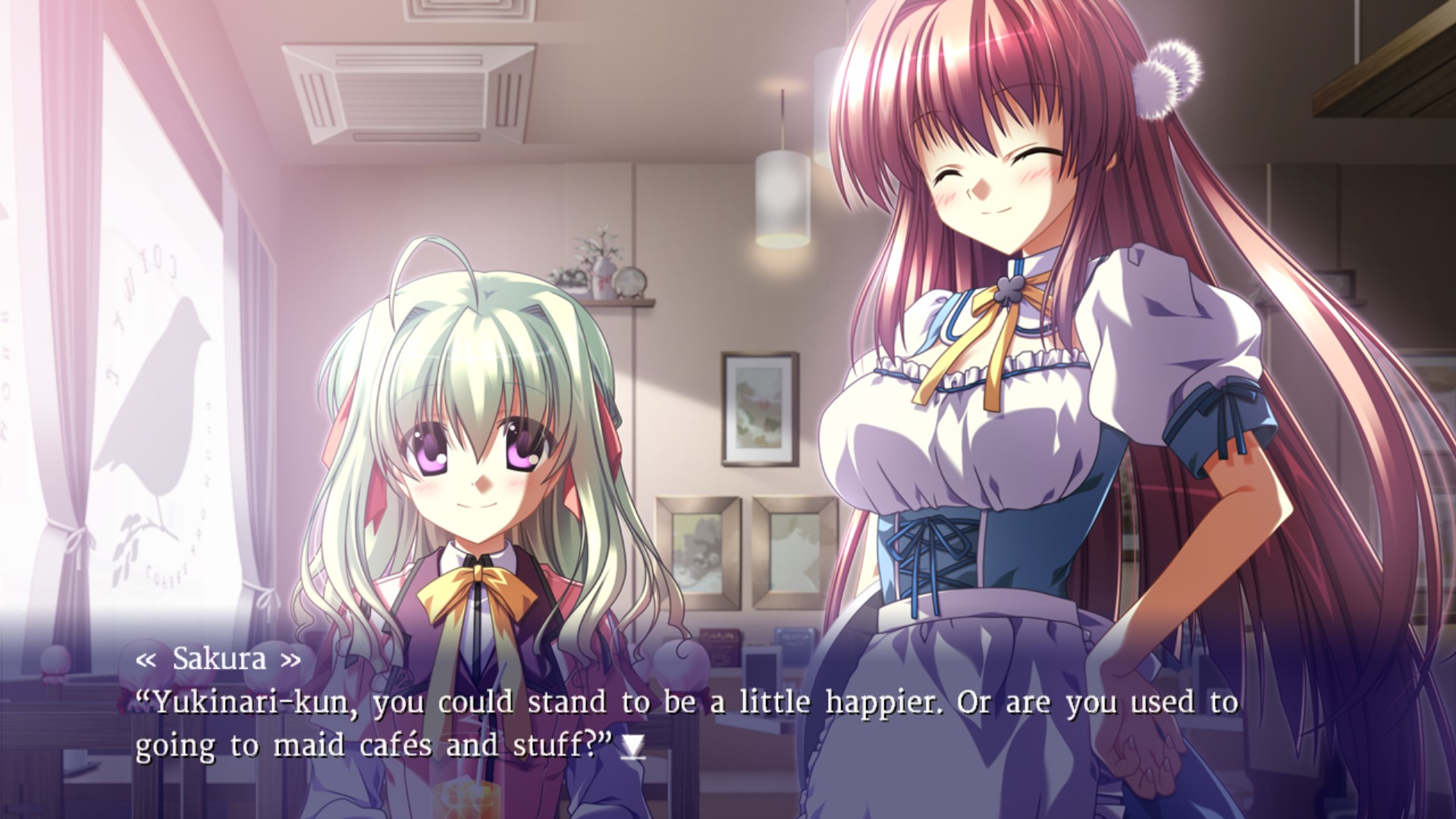
minori's approach is closer to the adventure type, but with a much less game-like aesthetic, more carefully crafted and directed to appear almost more like an animated movie than a typical visual novel.

Your typical adventure type visual novel doesn't tend to shift the perspective around too much. Characters all stand in front of the protagonist, regardless of whether they're talking to him or to each other, and they all look "out" of the screen. In Supipara, meanwhile, there's a much more dynamic approach to presentation: we get different perspectives and camera angles, mostly reflecting the protagonist looking in different directions, much as you would when interacting with real groups of people, but also to highlight important moments in conversations.

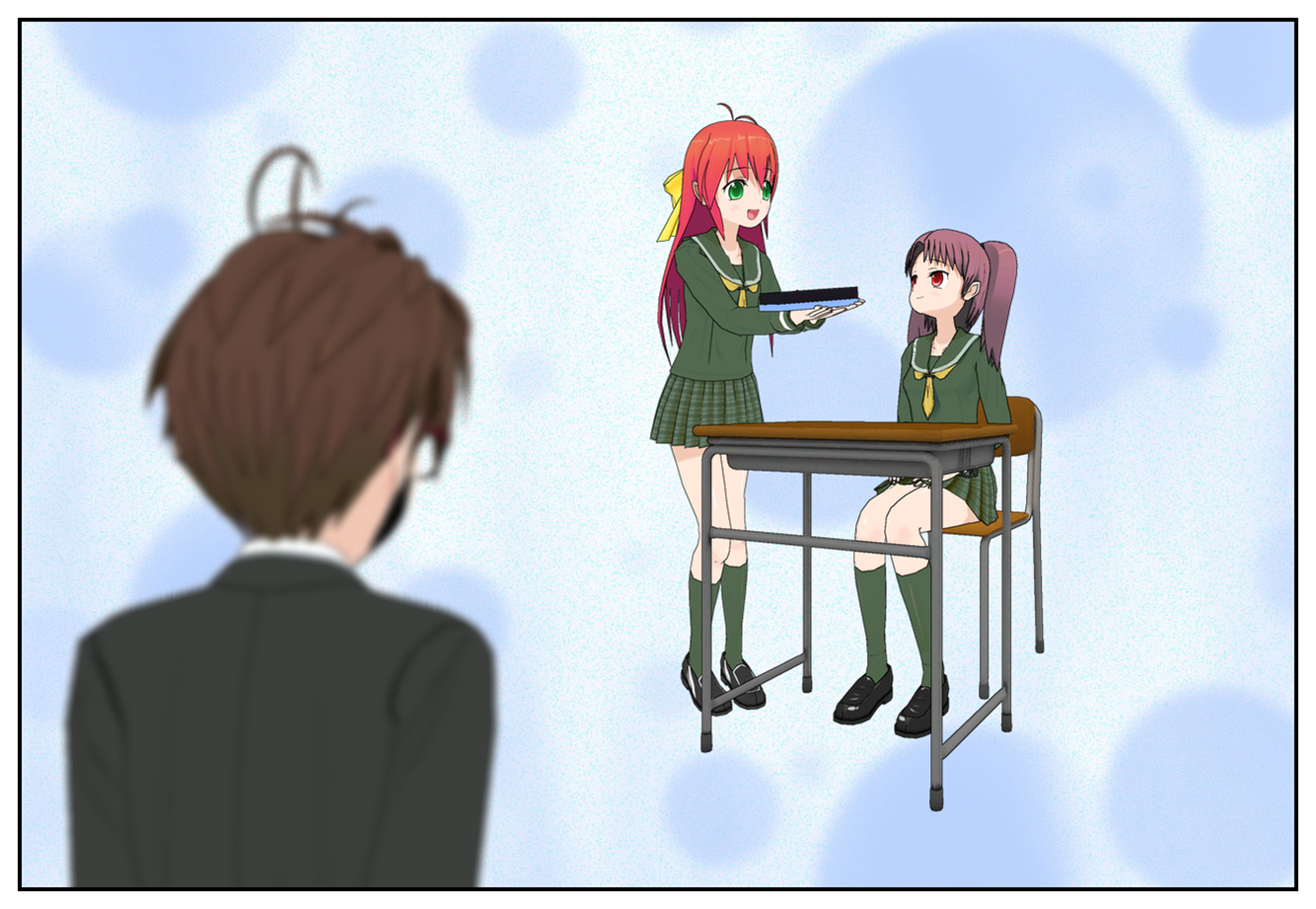
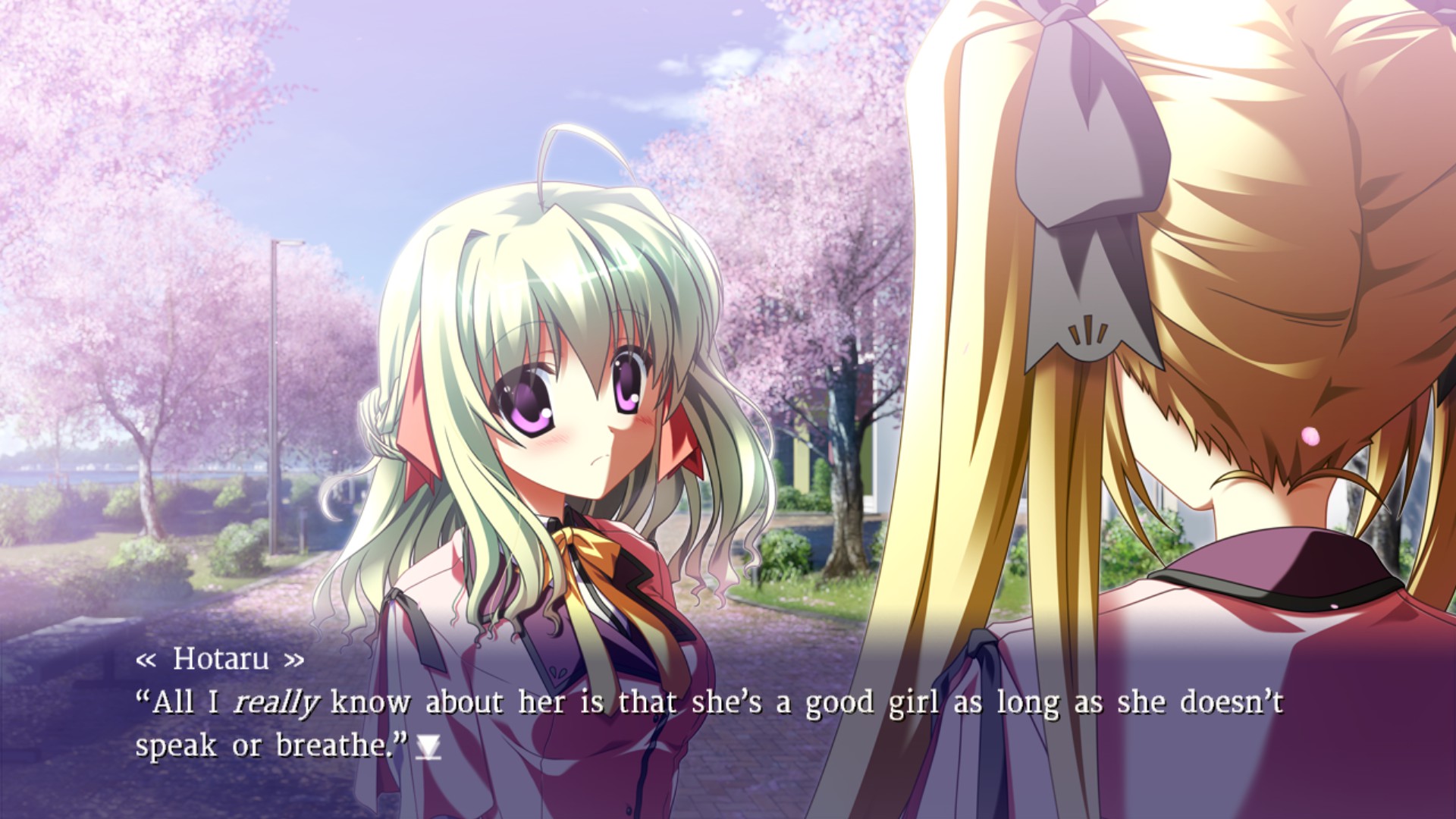
Perhaps most notably, minori isn't afraid to show the back of characters' heads, which isn't something you'd think is particularly unusual until you notice quite how much they do it. Only then does it dawn on you that no, this doesn't normally happen; the player-protagonist is normally the centre of attention, even if they aren't being directly addressed, and it's a little strange to see characters turning away from you to address other people.
20161024195811_1

This adds an interesting twist to the aesthetic at times, allowing you to feel like you're "standing with" a character while another addresses the pair of you. At other times, it is used to make it feel like you're walking along behind a character, or that they've turned to leave. It's a very effective touch that makes a big difference to the overall presentation.

And that presentation is overall absolutely stunning. Supipara is without a doubt one of the most gorgeous visual novels I've ever had the pleasure of reading, and its art is animated, too. Characters blink, mouths move, poses change in the middle of utterances. It gives the whole work a huge amount of personality and makes it enormously compelling. The characters are already well-written, but seeing them acting more "human" than simple static sprites helps make them even more adorable.

As for the story, well, I won't spoil anything for now — at least partly because I haven't yet finished it! — but it's an interesting blend between light-hearted high school slice of life and some stranger, supernatural goings-on. It has a very pleasant tone to it with some wonderful characters and a gorgeous setting that I want to spend the rest of my life in. And irritatingly catchy music.
20161024212913_1

Full write-up coming soon on MoeGamer, but in the meantime, pick up Supipara with confidence — both because it's a great visual novel in its own right, but also because doing so helps fund the rest of the series' development and localisation!

2471: Memoirs of an Ordinary Person

I've been listening to some audiobooks while I've been working the past few days. I've just finished Dave Gorman's Too Much Information — a work that resonated all too well with me, given my growing frustration with the cacophonous "noise" of everyday life — and have since started on Sue Perkins' Spectacles, her memoir.

One thing I've often wondered over the years is whether or not there's any perceived value in the memoirs of "ordinary people" — in other words, memoirs written by people who aren't celebrities, or even those who haven't had anything seemingly noteworthy happen to them. And I'm inclined to think that there is — after all, the best celebrity memoirs are the ones that talk not about being a celebrity, but about their childhood, or formative experiences growing up, or things that they've experienced that helped make them the person they are today. Things that are relatable to the audience; things that are relatable to "normal" people.

There's value in having a celebrity name attached, of course: someone who enjoys Sue Perkins' TV and radio appearances is likely to pick up her memoir simply because they like her, for example. But this doesn't mean her life story is inherently more valuable than anyone else's. In fact, I'd wager a guess that there are lots of people out there who have had lives far more interesting than today's celebrities have.

In my experience, whether or not the person whose life you are reading about is famous or not is largely irrelevant; what does, on the other hand, matter is whether or not they have interesting stories to tell.

And, well, I don’t like to blow my own trumpet too much, but I do feel I have more than a few interesting stories to tell. My life has certainly been eventful, if nothing else. This blog has occasionally dipped into memoir-esque territory, but as an idle side project, I've started writing down some of the things I remember from my past.

I am a normal human being. Well, as normal as anyone is these days, which is to say I’m riddled with neuroses, suffer from depression, anxiety and social anxiety—two very different, but related things.

I digress; I am a relatively normal human being. I haven’t survived some sort of unimaginable tragedy, I haven’t had to cope with a life-threatening illness or the challenges of a physical disability and the nearest I’ve come to being involved with a famous person is working in an Apple Store at the time John Cleese came in with a black credit card, proclaiming that it could “sink a bloody battleship”. I didn’t serve him, I was just there; that’s how much of a relatively normal human being I am.

Nonetheless, Things have happened to me, much as they have doubtless happened to you, your friends and the rest of your family. These Things may not have seemed like a big deal at the time, but if you’re anything like me, you’ll have found that the strangest things stick in your memories for many years, and it seems like quite a shame to run the risk of them, at some point, being filtered out of your mind in favour of some new and ultimately useless piece of information you picked up from Wikipedia. We live in an age full of constant noise, after all, with every piece of media around us vying for our attention and threatening to fill our minds with useless dribble that might get you lots of Likes on Facebook, but which doesn’t really compare to the fond memories of your childhood.

My memories aren’t all fond. Some of them are downright painful or embarrassing, and some of them, to this day, still make me feel overwhelmingly negative emotions such as anger or grief. It’s healthy to share such memories, though; otherwise, they just get bottled up inside, and, over time, you run the risk of them overflowing and forcing you to, I don’t know, run naked through a shopping centre with a chainsaw in each hand singing Stairway to Heaven. Or, you know, something.

With all that in mind, then, writing them down in some form seems like a reasonable idea.

2470: The Not-Games

0470_001

There seems to be a perpetual struggle in the world of video game enthusiasts to define exactly what is and is not a game.

At the head of this nontroversy is Fullbright Studios' Gone Home, a first-person interactive story where you walk around a house sans its inhabitants, piecing together a number of different plot threads scattered around the place, some of which are more explicit than others — and some of which are handled better than others. I liked Gone Home, but I felt like its "main" story — the one that lets you "finish" the game when you reach its ultimately rather mundane conclusion, despite what it has built you up to expect — was by far its weakest aspect, with much more interesting things going on through the "unspoken" stories: the bottle of whiskey hidden on top of a bookcase; the condoms in a drawer; the documents lying around the place.

To some people, Gone Home isn't a game, much as similar games in the genre that has become semi-derisively known as "walking simulator" aren't considered games either. Dear Esther, The Stanley Parable, Everybody's Gone to the Rapture, and others like them: all too many people are far too hung up on the rather dull question of whether or not they are actually a game rather than unpacking the dense, interesting narratives that each of these experiences feature.

For some reason, visual novels appear to largely escape this sort of discussion, despite being less interactive than a walking simulator. In your average visual novel, you click through reams of text for hours and hours and hours and occasionally make a choice. In a particular subset of the visual novel called the kinetic novel, you don't even make any choices: you just read and read and read, and then it's over with you not having actually done anything.

Even these almost entirely non-interactive affairs don't seem to get lambasted in the same way as Gone Home and its ilk, though, despite arguably being less of a "game" than something that has a 3D engine, WSAD movement controls and mouselook. In fact, even some of the most well-regarded games in the genre — The Fruit of Grisaia is the most prominent that springs to mind — only have maybe one or two meaningful choices to make in the whole game, with each acting as a fairly transparent means of setting a flag as to which character's route you're going to follow, and whether your get their Good or Bad ending.

I wonder why this is? Is it subject matter? No, I don't think so, because while, say, Gone Home has its narrow-minded detractors for being "progressive" — I think the statute of limitations is probably up on it by now and we can say its main story is actually about a young lesbian couple running away together — there are certainly plenty of well-regarded visual novels out there that deal sensitively with homosexuality, both male-male and female-female.

Is it about artistic intent and the overall "honesty" of the work? Perhaps. Titles such as Everybody's Gone to the Rapture often draw ire for being "pretentious" and, while I enjoyed all of the titles I've mentioned thus far, it's kind of hard to argue with that label. Everybody's Gone to the Rapture in particular feels very much like a case of "let's make this as arty and confusing as possible" before kind of running out of steam in its final moments and getting just a bit too silly and implausible. Dear Esther suffers from a similar problem, deliberately mixing a number of different narratives together — with some randomisation in the mix, too — to try and obfuscate what the whole damn thing is actually about for as long as possible. The Stanley Parable, meanwhile, completely runs with this and knows exactly what it is doing, laughing along with the player at every opportunity, too.

Contrast with a visual novel, such as the one I'm currently reading/playing: Supipara, by minori. Supipara is a kinetic novel: there are no choices whatsoever. Yet it's charming, compelling and addictive purely by virtue of its beautiful presentation, likeable and mysterious characters and intriguing premise that blends the mundanity of a slice-of-life tale with elements of the supernatural.

At no point does Supipara let any part of itself run away or overwhelm the rest of it. Its supernatural elements are incorporated honestly and without attempts to obfuscate or explain them away as quickly as possible, hoping we won't notice — Life is Strange, I'm looking at you. It just is what it is, and it invites you to judge it on that basis. There's no need to critically analyse it just to understand what the fuck happened in it — though this isn't to say there isn't value in applying some literary theory to unpack the various subtexts and themes in it — and thus it can be enjoyed on a number of different levels without Dear Esther's implicit suggestion that "you must be this smart to enjoy this ride".

I don't have an answer to the question "is [x] actually a game?" because your definition of "game" will doubtless be different from mine. Ultimately it doesn't really matter, anyway; the only thing you should be asking yourself when engaging with a piece of interactive entertainment — regardless of how interactive — is, quite simply, "is this a good use of my time?" If yes, great. If no, maybe put it down and try something else instead, while acknowledging the fact that some people might enjoy it more than you. There's really no need for the bitter arguments that have ensued since technology has allowed developers to get a bit more "artsy" with their creations.

Supipara is great, by the way. I'm going to do a full write-up on MoeGamer in the near future once I've read the whole thing, but for now I'll say it's one of the most beautifully presented visual novels I've ever seen, has a compelling, if low-key story, and some grade-A waifus. And what more, really, do you need to have a good time of an evening?


2469: OK Google

0469_001

With the courier work I've been doing for the past few days, I've been relying heavily on Google Maps for navigation around the area, and I've been discovering the benefits of voice controls — it's much easier to simply say "take me to…" and Google work it out for you than to type in a postcode using Android's cumbersome and clumsy keyboard.

I've actually been pretty impressed with the accuracy of the voice recognition, since it even recognises non-standard words such as street names without too much difficulty, and it uses your location to make an educated guess at which one of the many Alder Roads in the world you might have actually wanted to go to. I counted only two hiccups in an entire day's work: one when it wanted to send me to Hedge End (which is the other side of the Southampton conurbation to where I was working) and one when it wanted to send me to Birmingham. Granted, one of those mistakes was pretty large, but given that it understood me on all the 50+ other occasions throughout the day, I think I can forgive it.

I find myself wondering if voice recognition will actually become particularly widespread or accepted. Apple now includes Siri with Mac OS as well as iOS, Microsoft has Cortana in more recent revisions of its operating systems, Google seems keen to bake voice recognition into Android and all its services and even my TV will let you talk to it. The technology is certainly there and seems to work reasonably well in most cases — certainly considerably better than it did even just a few short years ago — but it's still painfully awkward to use, particularly if you're in an environment where there are other people around you. And while I've seen the benefit of being able to shout at my phone while I'm in my car, I don't see the same benefit from talking to my computer, TV or games console when its physical controls are right there and allow me to complete the task I want to complete just as quickly "manually".

I think we're still lacking a certain degree of artificial intelligence necessary to make voice activated technology truly useful, worthwhile and ingrained in society. The aim, presumably, is to have something along the lines of Computer in Star Trek, where you can say pretty much anything to the voice activated computer and it will successfully parse what you say (within reason) and perform any task from turning the lights on to inverting the phased magnetic resonance coils into a Gaussian feedback loop. Specify parameters.

I wonder whether that's something that is truly desirable, though. Is it really more convenient to be able to vocalise something you want your computer to do? It probably is for those who aren't as computer-literate, but then there's still a chunk of the population who don't use computers or mobile phones at all. A shrinking chunk, admittedly, but a chunk nonetheless, and I'm not sure fully voice-capable hardware — which will probably still be on the expensive end of the spectrum — will convert that sort of person into being a believer in technology.

Still. "OK Google" helped me find my way around today, and that, at least, impressed me. Perhaps I'll discover more interesting uses of it in the future.

2468: Empathy

0468_001

While I've worked a number of crap jobs over the years, one positive thing that I do feel I have taken from each and every crap job is a sense of empathy: a feeling that yes, I understand how people who do this every day have it.

Consequently, I find it pretty hard to get mad at people who are just doing their job, sometimes with all manner of obstacles not of their own making in the way.

I try and extend this attitude to everything about life, even those jobs that I haven't directly done myself; I know what it's like to have to pay your dues (and indeed am continuing to pay my own dues in the hope that something actually good will happen one day) and, as such, don't get mad when my order in a restaurant is late, or if a package doesn't arrive on time, or if someone in customer service isn't able to help me on this particular occasion.

This doesn't mean I blindly forgive, obviously; if someone has clearly fucked up somewhere then I'd expect them to be suitably apologetic about it. But the reason for them fucking up in the first place? I might be able to understand that, whether it's working long hours, working for pay well under what you deserve for challenging, demanding work or having to meet increasingly unreasonable targets from the higher-ups in the company who are completely out of touch with the man on the figurative street.

I like to think this is a generally positive quality in myself, and it's also one thing that keeps me hanging on when times are tough such as they are at the moment. If nothing else, I am developing "life experience", coming to understand how all manner of different people experience the world and what they have to put up with from Joe Public.

Joe Public can be an asshole.

Joe Public can, however, also be appreciative of someone who goes out of their way to help them, or someone who does their miserable job with a smile on their face, or someone who simply has a kind and friendly word to share.

I try and fall into the latter category whenever possible, even when it's tough to do so. To date, my attempts have usually been successful, and even, in a couple of instances, have defused situations of high tension that have arisen for usually stupid reasons.

I derive a small degree of comfort from the fact that every time I do this, I am helping to develop myself as a decent human being. I derive somewhat less comfort from the fact that having empathy for other people is, unfortunately, not a particularly marketable or profitable skill — at least not without expensive training to forge that raw material into something a bit more tangible.

My faith in myself may be at an all-time low thanks to being kicked around repeatedly by all and sundry over the years, but at least I still have this to hold on to, I guess. It's something. Not much, but it's something.

2467: Encylopaedia Eorzea

0467_001

I'm going to do a more detailed write-up on this over on MoeGamer when I've read and thoroughly digested everything in this massive tome, but I thought I'd give some initial thoughts here.

Encylopaedia Eorzea is here! Yes, for a long time the Final Fantasy XIV team had been suggesting that a lore book might be on the cards, and at FanFest last week, it was finally revealed. It was put up for sale at the start of this week and seemed to develop a waiting list very quickly; fortunately, I managed to get in early and snag a copy.

£34.99 gets you a formidable hard-backed book over 300 pages in length, printed on gorgeous thick, parchmenty paper and presented in full colour. The book is heavy enough that it would probably do some damage if you smacked someone with it — and you all laughed at Arcanist, Summoner and Scholar's auto-attack!

The tome as a whole is split into eight different "books", each dealing with a different aspect of Eorzean lore.

The first, and shortest, concerns "the basics" of the planet Hydaelyn and what makes Her tick, including geography, the relationship between Hydaelyn's light and Zodiark's darkness, the Twelve gods in the Eorzean pantheon, and the basics of "aetherology" — the underlying (fictional) science of how the elements interact with one another to create life, magic and other effects.

The second, and one of the longest, concerns Hydaelyn's history, reflecting on the world's cycle of Astral and Umbral eras, with the latter's arrival being heralded by a Calamity of some description — each elementally themed in the case of the first six, and the seventh (used as the initial story catalyst for A Realm Reborn) covering all elements in the sheer magnitude of its disaster. This book is particularly interesting because it gives some background reading on the mysterious ancient civilisations of the Amdapori, the Mhachi and the Allagans, all of whom are explored to a certain degree in the game itself. It also provides a good primer of the storyline for Final Fantasy XIV 1.0, which is no longer playable, but which is concluded through A Realm Reborn's cycle of raid dungeons, The Binding Coil of Bahamut, The Second Coil of Bahamut and The Final Coil of Bahamut.

The third book provides a primer on the different people of Eorzea and where they came from. It only explores the playable races of Hyur, Elezen, Lalafell, Miqo'te, Roegadyn and Au Ra — those hoping for some information about the Padjali or a hint as to whether or not we'll ever see Viera in the game will have to keep theorycrafting.

The fourth book is the longest and concerns the geography of Eorzea, including all the zones from A Realm Reborn and Heavensward as well as short look at Ala Mhigo (subject of the upcoming expansion Stormblood) and the Garlean Empire (recurring villains).

The fifth book concerns Hydaelyn's "servants", and explores the various characters that you come into contact with throughout the game, right from the main "protagonists" the Scions of the Seventh Dawn to the recently introduced Warriors of Darkness. This section also includes information about groups involved in sidequests in the game, too, such as Hildibrand's Agents of Inquiry, the organisation NOAH who spearheaded the investigation into the Crystal Tower and a section entirely devoted to more minor NPCs such as those who served as the face of the Relic quests, and poor old Edda, who has had a rough ol' time of it both during life and in death.

The sixth book looks at Hydaelyn's "disciplines" — in other words, the playable classes in the game. Interestingly, the book makes no mention of the base classes on which the more familiar "Jobs" are based; the focus is entirely on the higher-level incarnations of the Jobs.

The seventh book concerns Hydaelyn's "burdens" — the various beast tribes of the realm, and the Primals associated with each of them. This section also looks a little at as-yet underexplored groups such as the gigants, as well as the eikons of the Warring Triad, which we're halfway through the story for in the game at the time of writing.

The eighth and final book is a bestiary of monsters from around the realm, divided into the various "-kin" categories. It also incluides a look at voidsent, elementals and chimeras.

There is a lot of information in this book, and it's presented in a clear, enjoyable to read manner. The thing I've found most beneficial about it is that it provides a good summary of the various storylines that have unfolded during the game since its launch; this is several years ago now, so it's not surprising that some details may have slipped many players' memories! The lore book acts as a good reference guide for those who may have forgotten some of the finer details.

Above all, though, Encyclopaedia Eorzea is clear evidence that the team behind Final Fantasy XIV have built more than just a game. They've truly built a world for people to inhabit, which has its own history leading up to today, as well as many more stories yet to tell. And if you flip through it's pages, you'll understand just why so many people still like to call Eorzea home.

2465: Keijo!!!!!!!!

0465_001

I watched the first episode of a new anime called Keijo!!!!!!!! today. This is an anime that I became aware of after Kotaku did one of its sadly predictable outraged articles about, dubbing it "deplorable". (After that, a number of people I know actually watched it, and had good things to say about it.)

"I don’t care that it’s well-animated," writes the apparent latest "name to avoid" on Kotaku, Cecilia D'Anastasio. "I don’t care that the women have discernible personalities—no cookies for you. It is beside the point that Keijo!!!!!!!! was previously a manga. It could have died in obscurity. Now it’s on Crunchyroll."

But what has got this angry young woman so infuriated? Well, here's the premise: Keijo is a fictional sport somewhat akin to sumo wrestling, only on platforms floating on water. The aim of a Keijo match is to be the last one standing; if you fall into the water or touch the platform with anything other than your feet, you lose. It is a contact sport, but you are only allowed to touch other competitors with either your arse or your chest. In other words, it's Dead or Alive XTreme's "Butt Battle" taken to the next level.

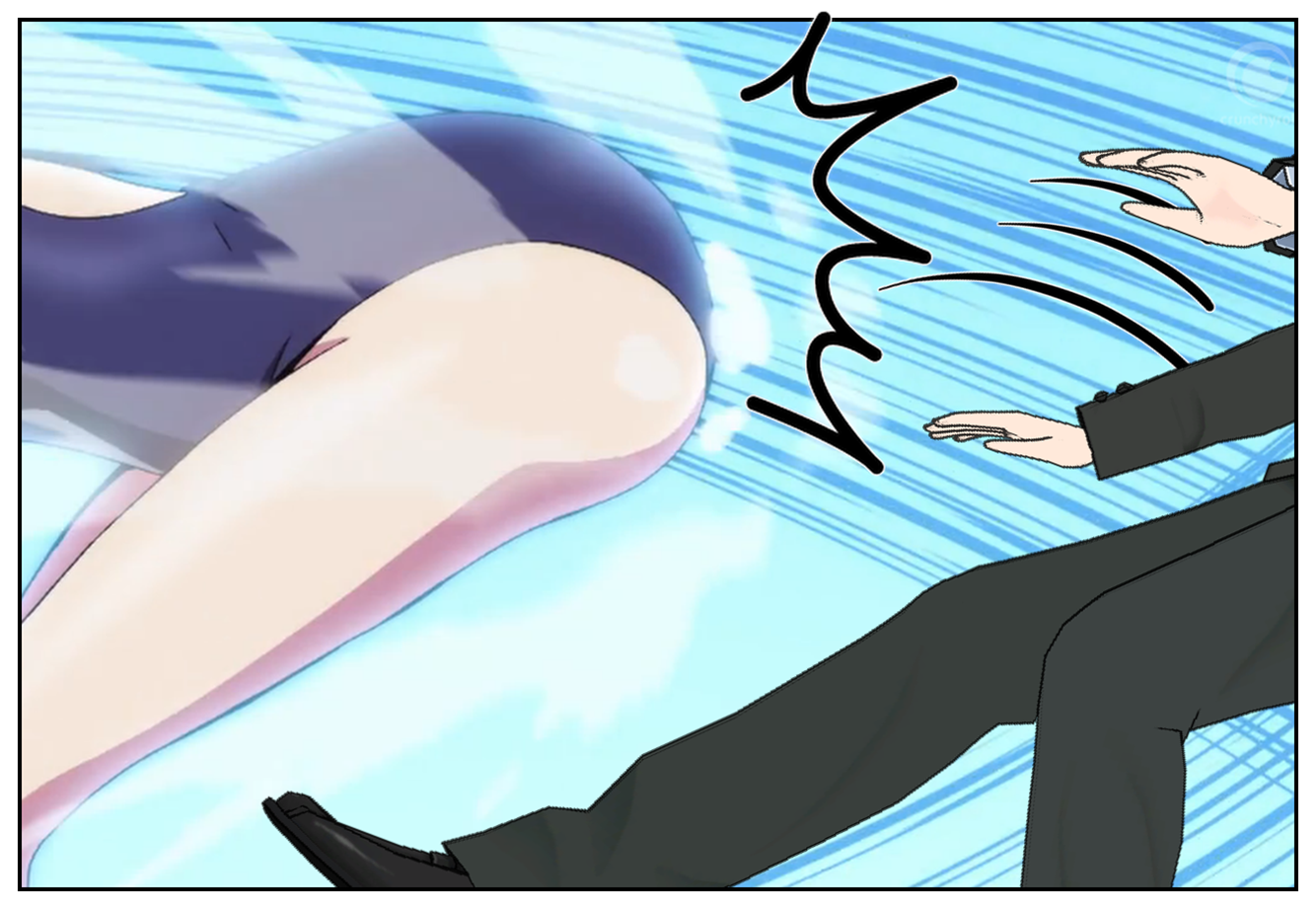
Keijo!!!!!!!! is a sports anime through and through, focusing on protagonist Nozomi as she strives to realise her dreams and be the best at a sport she has come to love. Like most sports anime, there's a heavy element of exaggerated action in there, with the Keijo battles themselves incorporating all sorts of physically improbable/impossible stunts, including a girl who is so fast she can smack people in the jaw with her arse and knock them out before they even have time to react to her presence.

I've only seen the first episode so far, but it's already clear that each of the cast members introduced are there for different reasons. Nozomi is there as the typical "underdog" that we're supposed to root for through the series, and she's a likeable, spunky character that sits well in the lead role. Besides her, we have the older woman that everyone looks up to, the "rival", the clumsy idiot, the shy one (who is inevitably going to "snap" at some point, since she was already showing signs of it when Nozomi got a bit too close for comfort in this episode) and plenty of others besides.

There's a wide variety of different personality types on display — and a wide variety of body types, too, unusually for anime that focuses on female characters. Nozomi is relatively "normal" in stature; her best friend is small but with a formidable butt; her comrade from trials is a tall, muscular young woman and their instructor — dubbed "The Siren" — is a rather portly mature woman who would doubtless be a formidable opponent in a Keijo match; the first episode ends just as Nozomi and her classmates are preparing for their first training session with her.

Inevitably, given the subject matter, there's a fair amount of fanservice going on, but any lingering boob or booty shots come during the Keijo matches themselves, which kind of makes sense, given that's where the "action" is, so to speak. Outside of the Keijo matches, we get to know the girls themselves and see that, so far, they all appear to be well-defined, likeable characters that I'd certainly like to know more about.

Keijo!!!!!!!! may not be an entirely original concept — aside from the fictional sport that it's themed around, the show seems to follow the standard "sports anime" formula fairly closely — but it proceeds with style, charm and so many likeable characters that I find myself wondering quite how joyless you have to be to dub it in any way "deplorable".

But then, if you read D'Anastasio's article you'll see that the sort of person who does think Keijo!!!!!!!! is "deplorable" isn't exactly the sort of person who seems willing to even attempt to engage with it or see what's really going on. Much easier to judge it purely on its premise than to actually do some research, after all.

Sigh. One day we'll have "critics" who actually care about their jobs… maybe.

2464: The Palace of the Dead (Savage)

0464_001

Final Fantasy XIV's patch 3.45 is coming in early November, and bringing with it an additional 150 floors to the game's current Deep Dungeon, The Palace of the Dead. I am excited.

Palace of the Dead is a great piece of content that I'm pleased has remained popular since its launch. It flips most of the conventions of MMOs on their head and provides something different for people to do, with meaningful rewards and a decent shot of experience points for those levelling alt classes.

Palace of the Dead, in case you're unfamiliar, is a 50-floor dungeon that you tackle in blocks of 10 floors at a time, with a boss on each 10th floor. Each floor consists of a number of rooms arranged in a randomised layout, with an exit portal in one room and a resurrection gizmo in another for if things happen to go south and you don't have a healer. Both of these things are inactive at the start of a floor, so you have to kill enough enemies to turn them on before they can be used.

Some rooms have treasure chests and occasionally monsters drop them too. These come in three different varieties: bronze chests hold consumable items such as Phoenix Downs to resurrect fallen comrades and potions to heal HP; silver chests have a chance to upgrade either your weapon or armour (with the chance getting smaller as they get more powerful) up to a maximum of +30; gold chests reward you with "Pomanders", which are items that have immediate beneficial effects such as increasing your damage, turning all enemies in the nearby vicinity into chickens or frogs, temporarily transforming you into a manticore or removing all the hidden traps on the current floor.

In the last major patch, the Accursed Hoard was also added to Palace of the Dead; these are hidden treasures that have a chance of spawning on each floor. Standing on a spot where a Hoard is hidden reveals it, and if you successfully clear the block of 10 floors, you get one sack per Hoard you found, each of which contains a randomly drawn item from what seems like quite a large selection, ranging from the useless (fireworks) to the very useful (grade V materia) via formerly expensive glamour items.

The thing I like about Palace of the Dead is it takes almost everything the rest of Final Fantasy XIV established in terms of gameplay and throws it out of the window. Item level doesn't matter, stats don't matter and even conventional party composition (one tank, one healer, two damage-dealers) doesn't matter. There's some variation in individual performance according to the upgrade level of your aetherpool gear (which you can only use in Palace of the Dead until it reaches its fully upgraded level of +30, at which point it can be exchanged for a level 60, item level 235 weapon that you can use in the rest of the game) and your character level in Palace of the Dead (which is different to your character level in the rest of the game; you level up at a considerably accelerated rate in the dungeon, but have to reset to 1 every time you restart from floor 1) but otherwise, how well you do in there is entirely down to how well you know how to play your class.

It's interesting to see people realising this for the first time. You can't just ignore mechanics in Palace of the Dead because it's literally impossible to outgear it. You can't stand in area-effect attacks and soak the damage because, again, you can't outgear it. And you can't pull 30 enemies at once and hope to survive because, you guessed it, you can't outgear them. It's all about careful use of your abilities, consumable items and the Pomanders; you have to be constantly aware of the situation of both yourself and your party members, as an unfortunate mistake could lead to a wipe — and if you wipe in Palace of the Dead, you fail that set of floors immediately and have to start again from the last "checkpoint" you reached. (This is particularly heartbreaking if you reach the final boss on floor 50 with 5 Accursed Hoards in your pocket and then wipe because you forgot to pay attention to mechanics.)

The reason I'm looking forward to Patch 3.45 is that it promises not just more of Palace of the Dead, but that its last 100 floors in particular will be very difficult. And not "very difficult" in the sense that the current Savage raids are very difficult — i.e. they get quite a bit easier if you take the time to buff up your gear level — straight up difficult in that you'll have to pay attention, dodge shit and play your class effectively, perhaps in an unconventional party formation.

I'm interested to see quite how they're going to make it difficult. People have been clamouring for difficult ("Savage") four-player content for quite some time now, and Yoshi-P and the team specifically said during the last Live Letter that the lower 100 floors of Palace of the Dead were designed to be just that. What I find particularly interesting is that this is (hopefully) super-difficult content that you don't need to have spent ages preparing to be ready for, because your gear level when you go in doesn't matter; everyone in the entire game, assuming they have Palace of the Dead unlocked (which they can do as early as level 17 rather than having to reach the current cap of 60), has the potential to be a "world first" clear, which is something that has never happened before. Previous "world firsts" in the game were by raiders who were at the absolute top of their game with the best possible gear available, so in most cases it was fairly predictable who the acclaim would go to. With this, however, the title is anyone's.

I'm also intrigued by the proposed ranking system and how it works, since that hasn't been explained in much detail before. We know that there will be rankings for both individuals and parties, and that rankings are stratified by class/job, but we don't know exactly what causes you to score the "points" that determine your place on the rankings. Progress through the floors is a given — the mockup leaderboards we saw during the Live Letter displayed both the floor the characters had got to and their score — but what else will contribute to it? Clear time? Damage done? Kills? Accursed Hoard finds? Treasure chests looted? All of the above?

If they handle this properly, Palace of the Dead has the potential to become an enormously compelling metagame in its own right within the wider context of Final Fantasy XIV, not to mention a great way to learn and level alt classes that you perhaps haven't used much before. I'm very much looking forward to challenging the lower floors of this Deep Dungeon, and hope that it provides a suitable alternative to raiding for those who seek a challenge but perhaps don't have a group, have difficulty getting everyone together at the same time, or simply aren't geared enough.

I guess we'll see soon enough! (Also, I really want to see what happens when you sit on that bench…)

2463: You Can't Win Them All

0463_001

"You can't win them all" is one of those platitudes we hear numerous times throughout our lives. In childhood, it's used as a means of attempting to stop the inevitable crying after we lose a game against a sibling or fail to achieve something we really wanted to achieve. And in adulthood, it's used in circumstances ranging from the loss of a job to the end of a relationship.

And yet I feel it's a saying that a lot of people these days seem to have forgotten.

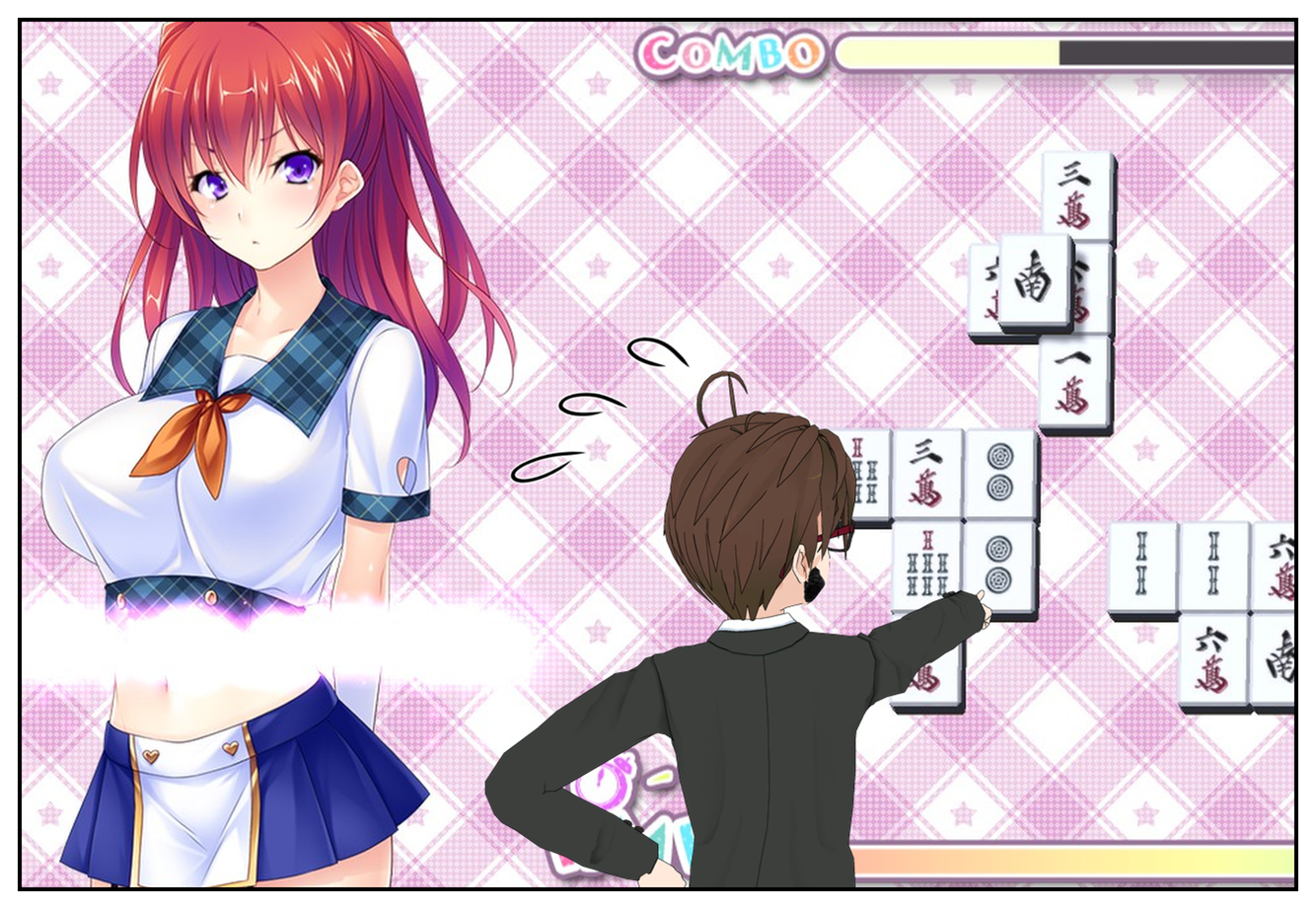
Today I've been playing a game called Delicious! Pretty Girls Mahjong Solitaire which, as I said in my writeup on MoeGamer earlier, is exactly what it sounds like. I've been having a lot of fun with it; mahjong solitaire is one of those simple-but-challenging things that I find enormously addictive, and Delicious! certainly likes to slap you around a bit with its various tile layouts. But that's all part of the fun, as is the case with pretty much any non-free-to-play-garbage puzzle game produced since the dawn of computing: the fact that victory always seems attainable, yet is often just beyond your grasp is what makes these experiences so enjoyable, exciting and addictive.

And yet, glancing at the Steam reviews and discussion pages, the most common complaint people seem to have about the game is that "it's too hard". The timer's too quick. The game gives you too many "unwinnable" layouts. In other words, it doesn't let you win every time. (A similar swathe of criticism was levelled at Frontwing's excellent ecchi puzzler Purino Party.)

"Victory" is something that people the world over seem to think they have become entitled to, with the fact that whenever you're doing anything competitive, the possibility of losing is what makes it competitive in the first place. You see it everywhere: in the Delicious! forums, where players complain that they have to keep trying levels until they get it right; in Final Fantasy XIV, where people vote to abandon a duty after the first party wipe rather than helping newcomers or people who aren't as familiar with the fights; in Overwatch, where someone will rant and rave at their team if they lose, completely ignoring the fact that there's always the possibility that you are, you know, simply outmatched.

It's hard to say exactly where this attitude comes from, but it seems firmly ingrained in society now, and repeatedly reinforced by lots of things that we do, particularly online with the growth of "gamification". "Well done!" everything seems to say, showering you with points, levels and achievements and inevitably begging you to "share" everything on social media. "You used this thing for the thing it was designed to do!"

People often joke about school sports days that don't have winners any more, but I've seen it happen: kids getting "participation trophies" even if they did the bare minimum. I've also seen "Celebration Assemblies", in which children get certificates for everything from getting 100% on a spelling test to — I'm not joking about this — sitting still in their chair for a whole lesson. This continues into adult life, too; at work Christmas parties, there's the inevitable cringeworthy "awards" ceremony, where whatever "lol, so random" douchebag who organised the whole debacle dishes out a series of completely arbitrary awards to ensure that everyone gets recognised for something, even if that thing is "drinking lots of coffee" or "being able to spell".

Failure is what makes experiences like games fun and exciting. If you win every time, you devalue the concept of winning until it is completely meaningless, and nothing feels worthwhile any more, which means you start to crave — or expect — more and more positive reinforcement with every passing day, and get annoyed or upset when your every whim isn't catered to, or things don't go the way you expect them to.

Me, I've had my fair share of failure, but every time I get a TIME'S UP or NO MORE PICK [sic] I just hit the Retry button, give it my best shot and eventually I might actually succeed.

Now, if only it were that easy to pick yourself up and start again after a repeated series of failures in life as well as games.

2462: I Don't Need Any More Tutorials or Updates

0462_001

I was out today, making heavy use of my phone to assist with some part-time courier work I've picked up recently. At some point during the day, the Google Maps app updated, at which point it felt the need to give me a tutorial.

Nothing, so far as I can tell, has changed in the Google Maps app since its last iteration, so quite why it felt the need to deliver an irritating and persistent tutorial is beyond me.

Google Maps isn't the only app to do this. Pretty much any "productivity" app on mobile these days feels the need to bore you with a pointless (and often non-skippable) slideshow before you can start using it — even in the most simplistic apps.

I get why these tutorials are put in there — it's to cater to stupid people and/or the technologically disinclined, who might not be familiar with the conventions of interface design. But they should be skippable. And if the app has clearly been on the device — and used heavily — prior to the latest update, it should automatically skip the tutorial by default.

And while we're on, I can do without pointless, unnecessary updates, too, even though App Store, Google Play and Steam reviewers seem to think that they're essential to an app or game remaining useful and/or fun. (These people never lived through an age where your word processor came on a floppy disk, and that was it, no more updates unless you shelled out for a new version.) These people are the reason why we get stupid, idiotic revamps to things that worked perfectly well the way they did before, like Twitter and Google Hangouts.

The latter is one I find particularly irritating, particularly in its Chrome extension incarnation. Previously, the Chrome extension was a discreet little affair that took the pop-up Google Hangouts interface from GMail and rendered it in an "always on top" version that could sit on your desktop — tucked away when you didn't need it, yet just a mouseover away when you did.

Now, however, it's in its own separate window for no apparent reason — a window that opens up every time you start Chrome, whether or not you have new messages to read — and, presumably in an attempt to "look like Android", it has one of those annoying mobile-style "drawer" menus on the left. These are fine on mobile as they're built to be usable with a touch interface, but on the big screen they're clumsy and unnecessary. I honestly don't know why we don't still use drop-down menus any more; they may look boring, but they work. At least Mac OS still uses drop-down menus for most apps, though Office for Mac still has that horrible "Ribbon" thing at the top instead of the old-school toolbar from early versions of Office.

Updates are fine when they add something meaningful: look at something like Final Fantasy XIV, which adds meaningful new content with every major version number update. But when they're change for change's sake — like Hangouts' new format, and Twitter's insistence on reordering your timeline even when you have repeatedly asked it not to — they're just annoying. And, moreover, that inexperienced audience the developers were hoping to capture with their tutorials will likely end up being turned off by having to "re-learn" their favourite app every few weeks.

And don't even get me started on the three system restarts I did the other day, with a notification that there were new Windows updates available every time. At least I managed to excise the cancer that is the Windows 10 nag prompt, so I should be grateful for small victories, I guess.