1837: A Trip to Akihabara

I've had a copy of Akiba's Trip: Undead and Undressed loitering in my backlog pretty much ever since it released over here, but I've never gotten around to playing it until recently. I'm not sure what convinced me to give it a go, but I decided that it was time, so I booted it up the other day.

Akiba's Trip is a game that proved to be notorious for two reasons: one, that supposedly, it was a game about beating up girls and pulling their clothes off; and two, it features the transphobic slur "trap" used for its intended purpose, i.e. to insult a transgender person.

Both of these things are accurate; however, as is usually the case with this sort of thing, the fact that they were focused on by loudmouthed critics almost to the exclusion of everything else about the game obscured the fact that the other 99% of Akiba's Trip is a very interesting, ambitious experience indeed, and a game very much worth playing. Not to mention the fact that both of the heavily criticised elements can be fully justified through the game's narrative context.

In Akiba's Trip, you play you, assuming you're a floppy-haired male anime protagonist. (After clearing the game once, you unlock the ability to play as other character models, so from that point onwards you can play as a lady if you so desire; canonically, however, the hero is male.) After answering a seriously sketchy-sounding job ad about taking part in a drug test in exchange for as many rare anime figures and other merchandise as you can handle, you find yourself turned into a Synthister, a man-made vampire with superhuman strength and the ability to absorb "life energy" from people around you. While Synthisters aren't vulnerable to crosses and garlic like "real" vampires, they are still extremely sensitive to sunlight, however, with something of a propensity for exploding into a cloud of dust if too much of their bare skin is exposed to the elements.

I'm sure you see where this is going.

In short order, you're rescued from your precarious situation by another Synthister called Shizuku, and you make your way back to your group of plucky gamer buddies who hang out in a cool bar run by an old dude everyone calls "Pops". From here, you're tasked with investigating the Synthister threat as well as helping out the locals of Akihabara, primarily by either finding things in the district or by beating up people until you can pull their trousers off: the game's combat system is primarily about damaging clothing until it's in a state where you can whip it off, rather than whittling down a more conventional health bar. In order to defeat most enemies, you need to remove their headgear along with their top and bottom clothing. Interestingly, in contrast to something like Senran Kagura, a game which also has a heavy emphasis on clothing damage, the "strip" mechanic in Akiba's Trip is unsexualised; it's simply part of combat, and is, frankly, hilarious. (Not only that, but you'll find yourself stripping men as well as women; I believe my session earlier is the first time ever in gaming that I have defeated a man in full motorcycle leathers by diving head-first into his crotch, grabbing his helmet and flinging it away, then whipping his trousers off and tearing his jacket from his chest.)

Stripping aside, the big hook in Akiba's Trip is that it features a lovingly detailed rendition of the real-world Akihabara district of Tokyo in Japan — a Mecca for otaku of all descriptions for sure. Featuring recreations of real-life shops, some excellently authentic-sounding ambient sound and a pleasingly diverse array of random people wandering the streets, it's an enormously atmospheric game that it's a pleasure to just wander around and explore — particularly when you start to notice interesting things happening without any intervention from you.

I was searching for some street thugs with Shizuku at one point, for example, and I decided to try and ask a suspicious-looking man in the street for directions. He responded that he "wasn't into dudes" and refused to talk to me. As I pondered what to do next, he then started to hit on Shizuku, who stood there patiently while he said his piece and then, marvellously, wound up one hell of a punch and socked him right in the face, flattening him. He then ran away crying. It was a beautiful moment that just happened to occur due to me being in the right place at the right time.

If there's one game that Akiba's Trip reminds me of so far, it's Yakuza. The lovingly crafted real-world environment; the blend of JRPG-style mechanics with action game brawling; the fact the game acknowledges the more unpleasant, seedier side of humanity without judgement. (The aforementioned "trap" comment, for example, comes in the context of a forum thread you read on your phone; said forum thread was clearly localised by someone who has spent a lot of time on real-world forums, since the text-based "dialogue" is some of the most convincing and realistic I've seen in an English localisation for a very long time — right down to the use, or lack thereof, of punctuation, and the way that anonymous people online are quite frequently complete shitheads to one another.) That and the endless stream of sidequests to complete that have nothing to do with the main story but provide a pleasing sense of "place" and "context" to the overall setting; the NPCs who are delighted to relieve you of your money through various scams; the strong characterisation.

I've only played a couple of hours so far, but already I like it a lot. I'm playing the Vita version, which has a few technological limitations, but is proving enjoyable regardless; I can imagine that the PlayStation 4 version would be a most enjoyable experience indeed, particularly with its additional features and enhancements.
1836: Making... The Opposite of "Gains"

Before I write what I want to write tonight, I'd like to address something first.

There are certain topics I write about on here that seem to attract comments more than others, often from people who don't comment a lot or whom I've never seen before. One such subject is weight loss and dieting. This probably isn't a coincidence, as weight loss, dieting and all that sort of thing are the kinds of subjects that seem to rank rather highly in terms of search engine optimisation and whatnot, and consequently a lot of spam is based around them, because presumably they're things that a lot of people are looking for.

Now, there's nothing wrong with a popular topic inviting comment from people who I've perhaps never seen around this site before, but I did want to address one specific thing: with regard to weight loss and dieting, I have made my choices. I've gone for Slimming World, because I've seen it work on people I know in the "real world". It fits in with my lifestyle and, importantly, doesn't interrupt the lifestyle of people I spend time with. Not only that, but I've found it, so far anyway, to be a programme that doesn't make me feel like I'm punishing myself for past food-related transgressions: I'm not starving myself and I'm not depriving myself of anything — I am, instead, simply moderating what I have of certain things and enjoying as much as I like of other things in order to fill full and satisfied.

Consequently, while I appreciate this is something that people have a lot of strong opinions on and, in many cases, believe that their way is the "best" way, I will reiterate that I've made my choices and I'm going to stick with them for the moment. It's great that paleo diets or cutting out [x] and [y] or whatever works for some people, but neither of those approaches are for me, for the reasons I've outlined above: they don't fit with my lifestyle, and they interfere with the lifestyles of people I spend time with. So, attempting not to sound too harsh here… I don't want to hear about these other approaches for the moment, at least not in a "this way is better than what you're doing" context. By all means share your stories if you've had success with them, but please, for the moment, as I begin down the long road to shedding as much weight as I possibly can, don't cause me to second-guess the choices I've made and think that I'm doing it "wrong". I need support in this, not criticism.

I thenk yaw.

Now, on to business.

It was my second Slimming World meeting this evening, and I'm pleased to report that I lost an impressive 8lbs over the course of the last week.

I'm frankly astonished. Last week I'd heard people talk about losing chunks of weight like this in one go, but having always been someone who's struggled immensely to get weight off, I had begun to think it was the sort of thing that could never happen to me. My body repulses me; it makes me feel guilty and horrible any time I see myself in the mirror, but doing anything about it always felt futile. I'd go to the gym and do intense (for a fat man) exercise routines, and would never see any difference even after months of effort. I'd try and eat better, but again I wouldn't see any results, I'd get depressed and end up bingeing on cake and sweets and crisps and whatever. But I still couldn't accept it. I couldn't be one of those people who could look at themselves, big belly and all, and say "yes, this is me, deal with it, I am happy with who I am." Because I am not happy with who I am.

Losing 8lbs in a week, though, has motivated me to continue with following the Slimming World programme, which has so far proven to be unobtrusive, despite it forcing me to make a few changes about my lifestyle with regard to food and drink. I'm under no illusions, though: I know that this rate of weight loss almost certainly won't continue past this first week, but frankly, so long as I can continue dropping a little bit each week — which, if I stick to the plan as much as I have this week, shouldn't be a problem — I will be happy and satisfied, and with any luck will eventually reach the goal I've set for myself. From there I can decide if I want to go further, or whether I'm happy with that. And by that point, I should hopefully have got into some good habits that will be the norm for me rather than a significant adjustment.

If it turns out that losing weight is actually really easy and I've simply been being stupid for these last few years, I won't lie: I'm going to be frustrated with myself for not having made these adjustments sooner. But at the same time it's pleasing to know that it's not impossible, that it's not too late for me and that it is possible to take aim for something a little more akin to what I'd consider a "normal" existence rather than the slight detachment from reality and normal society that I currently feel as a fat man.

It remains to be seen how much progress I will make in the next few weeks, but for tonight, I'm certainly feeling very positive indeed. Let's hope this feeling continues.

1835: More Five Tribes

Got the chance to break out my new board game acquisition Five Tribes at our fortnightly gaming evening tonight, and it seemed to go down pretty well. It's also an intriguingly different experience when played with four people compared to just two.

One nice thing about the game is that there's not really any randomness once you're into the game itself — with the exception of the available cards — but the setup is totally random, making for a very different experience each time you play.

This time around, it just so happened that a couple of the tiles we laid out at the beginning of the game had three of the same coloured meeple on them right at the start, meaning these spaces could be immediately claimed for some early points. This made for a peculiar dynamic that was something of an inversion of what you might expect from your typical Euro-style game: normally, the early stages of a Eurogame see you building up and preparing for the mid-to-late game, where you'll be scoring the majority of your points. This formula is clearly seen in everything from Settlers of Catan (early game: building roads; late game: building cities) to Agricola (early game: OMG HOW DO I FEED MY FAMILY; late game: OMG HOW DO I FEED MY FAMILY NOW IT'S EVEN BIGGER THAN IT WAS) but our playthrough of Five Tribes this evening proved to be the opposite: there was a lot of early point-scoring, and then things tailed off somewhat as "good" moves became harder and harder to spot, and play became a lot more strategic.

Five Tribes is apparently quite well known for inciting that perennial bugbear of board game gatherings, "analysis paralysis", or certain players' inability to take a turn without considering every possible option and all the potential consequences. Indeed, I can see how that would be the case — we saw a certain amount of it this evening — but at least the straightforward, simple game mechanics mean that actually taking your turn is quick and easy with minimal housekeeping required.

I like the game a lot. It's interesting, simple to understand but strategically complex. I don't think I've quite got my head around what winning strategies for it might look like, but I'm glad it went down well with the group, and I hope it hits the table again sometime soon. Its relatively short duration would seem to make it an ideal weeknight game, and everyone seemed to both pick it up quickly and enjoy themselves overall. So I call that a success.

I think I'm going to be seeing coloured meeples in my sleep tonight…

1834: Rate Us Five Stars

I rarely leave user reviews on things, be they App Store/Google Play downloads, Amazon purchases, eBay sellers or Steam downloads. And I've realised that in not doing so, I'm being a bit of a fool.

Why? Because whenever I consider purchasing something, one of the first things I do is have a look at the user ratings and reviews and determine whether or not they're 1) genuine 2) worth listening to and 3) something that might need to make me reconsider or confirm my purchase.

Of course, user reviews are very much open to abuse. You only have to look at some of the more notorious examples on Amazon or Metacritic to see the system at its worst… although these incidents can often provide a certain degree of amusement. (There's at least one Twitter account devoted to amusing Amazon reviews alone.)

But when they work, they can be extremely useful — and every time I write one, I'm reminded how much I have always enjoyed reviewing things. Not necessarily critiquing them in depth or from any sort of theoretical perspective, but providing a simple, straightforward analysis of how much I liked something, how it made me feel, whether I think other people would like it and all that sort of good stuff.

It's also really fun to write a negative review, though it's also very easy to be extremely unfair when you're doing so, which is why I try and remain positive most of the time. (People are also more inclined to disagree with something negative than positive in my experience, too, and I really don't enjoy arguing with people.) I have made one fairly consistent exception over the years, though, and that's with mobile games that have been truly, truly awful, particularly those that have desecrated beloved franchises like Dungeon Keeper, Theme Park and SimCity. (Oh, hi, EA.)

But I've decided as a belated and rather lame resolution that I'm going to start making an effort to review things that I've bought, played, used, whatever. Because if I make use of user reviews for their intended purpose — to find out what the average Joe on the street thinks of something that I'm considering purchasing — then I'm sure other people will do too. And, not to blow my own trumpet too much, but I feel like I'm quite good at expressing myself about the things I do and don't like about something.

I give it a couple of weeks before I stop doing it, but for now it's a little something I can do to help make the Internet as a whole a slightly better place. I made a start this evening by reviewing HuniePop on Steam; see if you can spot my review if you're pondering whether to drop some cash on a pornographic puzzle game!

1833: Sexy Puzzle Skills

I spent a significant chunk of time playing some more HuniePop today, and I'm thoroughly enamoured with it. It's a game for which it's abundantly clear the development team had an absolute blast making it, and it's particularly refreshing to see a game put out without any regard for (or perhaps more likely, a wilful disregard for) the Professional Outrage Machine that perpetually whirs on the Internet.

huniepop1

HuniePop is rude. It's even rude in its "censored" incarnation on Steam, but the uncensored version (available via MangaGamer or the game's official website) is marginally ruder. (To be exact, the uncensored version features visible vaginas both with and without man-juice spooged all over them, while the censored version covers such disgraceful shame-holes with panties, but is more than happy to still depict women masturbating, boobs and posing in distinctly provocative manners.)

Naturally, the rude bits are what people have mostly been talking about with regard to HuniePop, but as with most games that happen to include sexual content, there's a lot more going on than just a few (admittedly well drawn and rather erotic) pornographic pictures. A few days I talked a little bit about my first impressions of the gameplay; since that time, I've played a whole bunch more and got a good feel for the game; all that I have left to do now is seduce the love goddess Venus and two additional "secret" characters before I have 100% completed it… just in time for a promised Valentine's Day update which is coming down the pipe.

HuniePop has evolved quite a bit over its development cycle. Originally pushed as a bit more of a "life sim" where you'd have to manage your time effectively, make money from part-time jobs and take part in numerous activities, it was gradually simplified into its current form. Part of me is a little sorry that the full-on life sim incarnation never saw the light of day, but having spent over 6 hours now playing the final release, I can say that I think they made the right decision. The gameplay is kept simple and enjoyable, and that is, at least in part, what makes it so addictive.

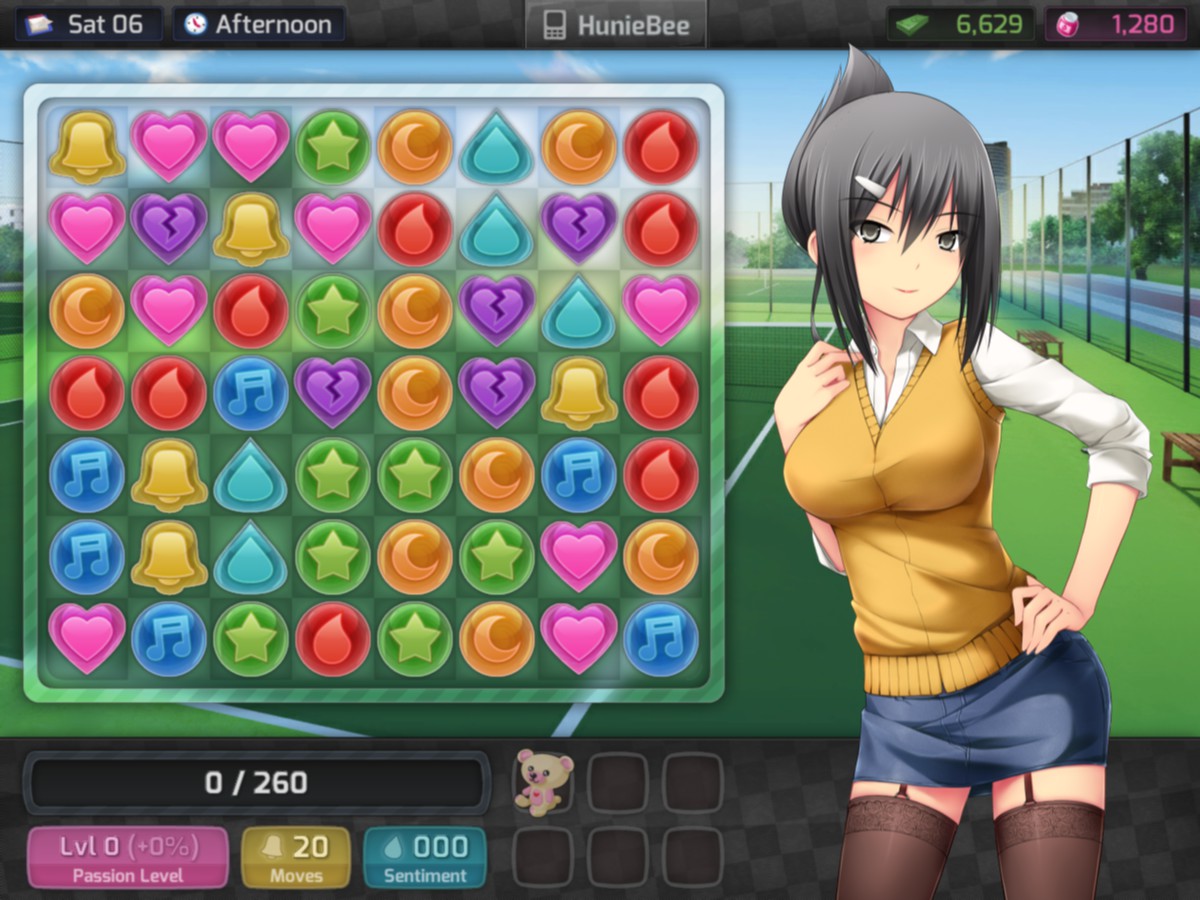
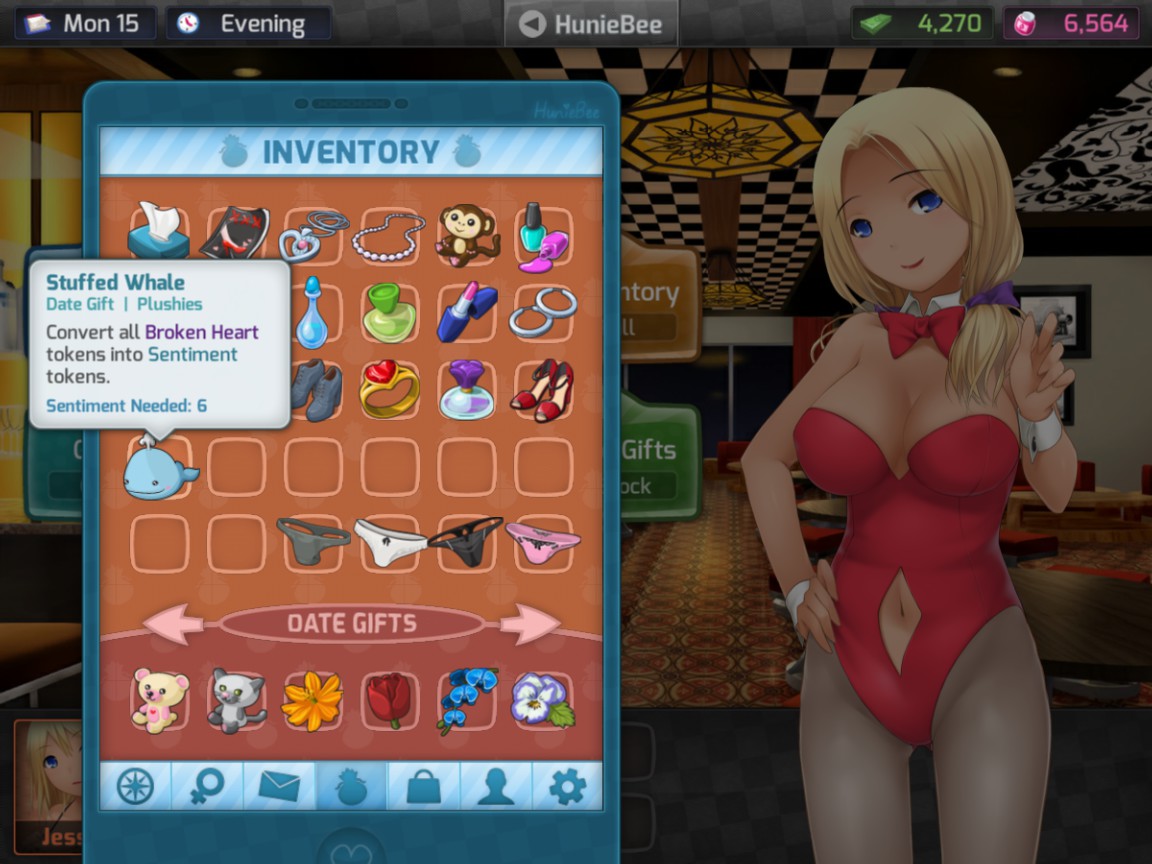
Even the match-3 puzzle gameplay has a surprising amount of depth to it. Match-3 is a hugely overused genre, but HuniePop puts enough twists on it to keep things interesting. There's the need to avoid harmful tokens, for example, and the fact that each girl in the game has a "favourite" token that is worth considerably more points than others. The main depth comes from the items you can take into a "date" puzzle, though; these range from increasing the likelihood that a specific colour or type of tokens will fall when you clear space on the grid, to immediately consuming tokens of a specific type or in a particular area. Given that each girl has her own preferences — and according to how you play the game, your character will have their own strengths and weaknesses, too — it's very important to take the right items in to a date, particularly when you're attempting to win over the somewhat more hesitant girls, who require a much higher score in the puzzle game to advance to the next relationship level.

Huniepop2

There's another enjoyable twist on the match-3 puzzle gameplay once you get the girls up to 4 or 5 "hearts" of affection and take them out at night, too: they'll demand to come home with you and that you give them a right old good seeing to. At this point, all nuance goes out of the window, and all you have to do is simply match as many tokens as you can as quickly as possible — no items, no preferences, no harmful tokens — while your partner for the evening moans and groans in what is, frankly, an exceedingly erotic manner through your speakers. It's a complete shift in pace from the cerebral, strategic gameplay in the normal dates, and oddly, it actually does a pretty good job of reflecting the intensity and passion of a sexual encounter through pure gameplay. It's difficult to describe; it's something that will be very clear if you experience it, however.

I'm developing a real soft spot for the characters, too. As I noted in my previous post, there's not a lot of plot development, though the developers have taken the time to give each character a distinct personality and relationship to the rest of the world. Porn star Jessie, for example, turns out to be the mother of college student Tiffany, though they don't speak and they never mention each other by name; it's something you'll figure out by yourself as you learn the various pieces of information you can pick up about each girl. And while the game is essentially about making sure you say what each girl wants to hear rather than necessarily what you really feel, there is nothing stopping you deciding to pursue a monogamous relationship with your virtual waifu and shun all the others — or at least try and remain consistent in your responses. (Okay, you won't get far and you're arguably missing the point of the game, but the option is there.)

Huniepop3

One particular highlight of the game is the love fairy Kyu, who introduces the game concepts to you at the outset of the game, and eventually becomes a dateable character in her own right once you successfully bed one of the other characters. Kyu is hilarious. She's the main source of the game's self-aware humour, since she's written to be fully conscious of the fact that she's a character in a dating sim, and that the whole situation is ridiculous. She also comes out with some brilliant one-liners over the course of the game and sounds a bit like Pinkie Pie, which makes it all the more adorable and amusing when she not-particularly-seriously berates you for buying her gifts "just because you want to fuck [her]".

I've enjoyed the game a lot and, having come this far, fully intend to 100% complete it in the next day or two. Politically incorrect it may be, but it's a whole lot more fun than getting mad about stuff on the Internet.

1832: Five Tribes

I got a belated Christmas present the other day: a new Days of Wonder board game called Five Tribes.

Days of Wonder games are always a pleasure to behold. They include high-quality components, look great on the table and, more often than not, feature a nice balance between simple, straightforward rules that anyone can understand and some complex strategy that will get your brain chugging away. Five Tribes appears to be no exception.

Unfolding on a randomly-generated map of a fictional sultanate in the lands of the 1,001 Nights, Five Tribes tasks you with taking control of as much of the map as possible, perhaps with a little supernatural assistance. This is achieved through an interesting mechanic slightly akin to how you move armies around in Risk.

Each tile begins with a few coloured meeples on it. These are drawn from a bag at the start of the game, so the arrangement of both the tiles that make up the map and the meeples on them is different each time you play. On your turn — the order for which is determined by a simple bidding system — you can grab a whole tile's worth of meeples and then move one tile at a time, dropping one meeple on each tile you pass through. The last tile you land on has to have at least one meeple of the colour you're trying to put on it already, and you then claim all meeples of that colour from the tile. If this empties the tile, you take control of it with a natty little wooden camel game piece.

That's the basic mechanic, and by itself this would make an interesting and strategic game. But things get interesting when you throw the different colours' special abilities into the mix. Yellow meeples can be kept and scored for points at the end of the game, for example; white meeples can either be kept for scoring at the end or spent on certain benefits throughout the game; red meeples allow you to either assassinate a meeple a certain number of tiles away (potentially allowing you to take control of another tile in your turn); blue meeples allow you to score points immediately according to how many specially marked spaces are surrounding the tile you finished on; green meeples allow you to take cards from the "market", which are either slaves (which can be expended in much the same way as the white meeples) or various luxury goods.

Then each space has a special ability that you use if that's where you finished your move: some force you to place a palm tree or palace marker on that space, making it worth additional points at the game's end for whoever ends up controlling the space, if anyone; others allow you to acquire the services of one of several different djinni, each of whom has their own active or passive abilities to further your own plans for domination.

The aim of the game is to score more points than anyone else; a nice twist on this is that your points is also how much money you have on hand to do things. There isn't a lot to spend your money on — it's mostly used on bidding for turn order at the start of each round — but there are plenty of means of acquiring more money as you progress. The cards depicting the luxury goods are particularly important here: selling a "suit" of these cards (a set where every card contained therein is different) allows you to earn amounts of money according to how many cards you get rid of at any one time. Some djinni can help you earn money, too; others provide a passive bonus that can make the difference between winning or losing.

It's an interesting game. My first game with Andie saw us flailing around a bit to begin with as we had no real idea of how it worked or what we should be trying to do. But it became clear as the game progressed, and I'm looking forward to trying it again sometime now I have a better understanding of how it all works.

1831: Second Fantasy

When I've had a free moment to sit down with the Vita, I've been continuing my Final Fantasy marathon with the second game, the imaginatively titled Final Fantasy II.

Final Fantasy II came to Western shores considerably after its original release; it wasn't until the PlayStation release of Final Fantasy Origins that we'd get to play it in English for the first time, but, like its predecessor, it's subsequently been enhanced and ported to a variety of different platforms. I've been playing the PSP version via the Vita, which, again like its predecessor, incorporates a bunch of extra content, though I'm yet to encounter any of it aside from the entrance to an ominous-sounding (and huge-looking) optional dungeon.

Final Fantasy II is thought of in somewhat mixed terms by many people, to put it politely. It's absolutely hated by others, and those who like it are in something of a minority. I'm one of them, though; it's an interesting game, and while its mechanics don't quite work as well as they could, it was a bold experiment whose systems we can still see at work today in games like The Elder Scrolls and its ilk.

Final Fantasy II's unique selling point was that it had no experience points and no levels. Instead, you levelled up individual skills and stats by making use of them. Want to get stronger? Hit things. Want to get better at casting spells? Cast more spells. Want to be able to take more damage? Take some damage. It's quite logical when you think about it, though it does tend to encourage a certain degree of gaming the system, and there's a number of glaring flaws in it, too, such as the fact that characters in the back row of your party (which one of them is in by default at the start of the game) will never take any damage except from things that affect the whole party, and thus their HP counts will be left trailing considerably behind the rest of the group. The game is also somewhat notorious for seemingly encouraging players to attack their own party members in the name of boosting their HP quickly.

The PSP version maintains this peculiar levelling system, but so far I haven't really encountered a major issue with it, and like the PSP version of Final Fantasy I, the pacing feels like it may have been tweaked slightly, though this is only my gut feeling rather than being based on any research. But it certainly feels like the game's been made to push you onwards rather than force you to grind; fight a number of battles, and your characters' HP totals will increase naturally, for example, even if they haven't taken any damage recently. You still need to make use of appropriate actions to build up your stats, but there's a certain degree of natural progression that comes from just playing the game.

The interesting thing about Final Fantasy II's system is that it essentially allows you to build your own characters — something that wasn't really possible in its predecessor aside from choosing which three of the four available spells for each magic level your White and Black Mages got to choose from — by naturally moulding them to fit your play style. Because of the flexibility of the system, this also means that you can create unstoppable, multi-talented characters who are strong, tough and capable of flinging devastating magic spells around when required. (In fact, the game's ultimate magic requires that your character has advanced in as many different areas as possible in order to power itself up.) In practice, though, you'll probably tend to find that the characters naturally evolve according to how you use them.

In my party, for example, I have protagonist Firion as a fighter/white mage type character, or probably a Paladin in Final Fantasy terms. He is good at fighting with swords and using shields, but is also able to cast White Magic spells such as Cure, Life and Protect. Several of these spells start off being next to useless — Protect often "misses", for example — so you need to get him to "practice" them in the field to make them worthwhile additions to your arsenal. Taking the time to do that is eminently worth it, however.

The other interesting thing about Final Fantasy II that is unrelated to its unusual progression system is the fact that it's so story-heavy compared to its predecessor. Final Fantasy I was essentially a case of "Bad shit is happening in the world! Go explore and stop it!" and little else; Final Fantasy II, meanwhile, has named characters, events, cutscenes and a genuinely interesting ongoing plot. It's not what you might expect from your typical NES-era game, in other words; and with its new coat of paint in its more recent PlayStation and PSP incarnations, it actually stands up pretty well as a modern RPG.

I'm enjoying it, in other words, but I still have a long way to go yet!

1830: A New Approach

Being something of a fat shit (yes, this is how I think of myself and, judging by comments I've had in the street in the past — though thankfully not for a while — how other people see me too) is depressing. I'd go so far as to say that my weight is the single thing that upsets me, makes me angry and demotivates me more than anything else. I hate being big. It's uncomfortable. It's exhausting. It's frustrating when it means that there's things I can't do. And, given the world's love of fat-shaming, it's embarrassing.

I've tried lots of different things to do something about it. I got into running and even got reasonably good at it — good for a fat guy, anyway — but then lapsed somewhat. There have been times when I had a decent gym routine going, but since my new job started the motivation for that has plummeted as all I want to do in the evening is just get home and relax. I tried Slim-Fast for a while, but there's only so long you can eat chocolate bars filled with wood chippings before it gets extremely tiresome. None of them seemed to have a noticeable effect, and all I've done is just continue to gain weight over time, not helped by the fact that I have a tendency to comfort eat if I'm feeling down. See how these vicious cycles start?

I took a positive step last night, though, and a risk: I stepped out of my comfort zone and went out to a local Slimming World group. A couple of people I know have had some success with the programme, and it appealed to me for its flexibility. The thing that has put me off other diets in the past is the amount of restriction and faffing around involved — all that weighing, measuring and feeling guilty. Slimming World, conversely, simply encourages you to think a bit more about what you're eating — which is the magic ingredient in weight loss — but not to deprive you of the things that you enjoy, just to perhaps cut down on them a bit.

The programme is in three parts: "free" foods, "healthy extras" and "syns". The "free" group includes stuff you can have as much as you like of — surprisingly, this includes things like pasta, potatoes, rice, (lean) meat and all manner of other things, plus, as you might expect, fruit and vegetables. The "healthy extras" group is subdivided into two sections: milk and cheese, and "other stuff" including cereals, grains, soups and all manner of other stuff. You're supposed to have one thing from each of these two sections per day. "Syns", meanwhile — short for "synergy" — are the extra things you can scarf down in a day. Different foods have different "syn" values — these values roughly equate to the number of calories in a dish — and you're encouraged to have between 5 and 15 syns a day. Today, for example, I had a latte at work (5.5 syns) and the last two Jelly Babies in the bag that was on the table in the lounge (2 syns) and was still comfortably within the day's "limits".

For the first few weeks, you're encouraged to keep a food diary to help you stick to the plan, and I can see it being a helpful thing to look at. Today I've been thinking about what I've been eating, but I haven't been made to feel guilty about getting hungry or wanting to have a snack partway through the afternoon, since I snacked on "free" foods rather than syns. I don't feel like I've been depriving myself, which in turn doesn't make me feel depressed and resentful like other diets have made me feel in the past.

So, while I realise it's Day One and thus there's plenty of potential for things to go horribly wrong, I'm presently feeling fairly positive about the whole thing, and hope it actually makes a difference for me. Because I'm sick of being the way I am, and I really hope that I can do something about it.

1829: Life with the Hunies

I took a gamble a while back and Kickstarted a game that looked potentially interesting. Dubbed HuniePop, it promised a Western take on dating sims combined with an anime-inspired aesthetic, and the team behind it appeared to be taking it seriously as a project. I tossed them my money and watched the development with interest as the team provided regular updates on what was going on and how development was going.

HuniePop finally released this week, and I've been playing it a bit. And, although it's the sort of thing that will make the social justice dickparade froth at the mouth (and indeed already has been, from what I've heard) it is, in fact, a whole lot of fun.

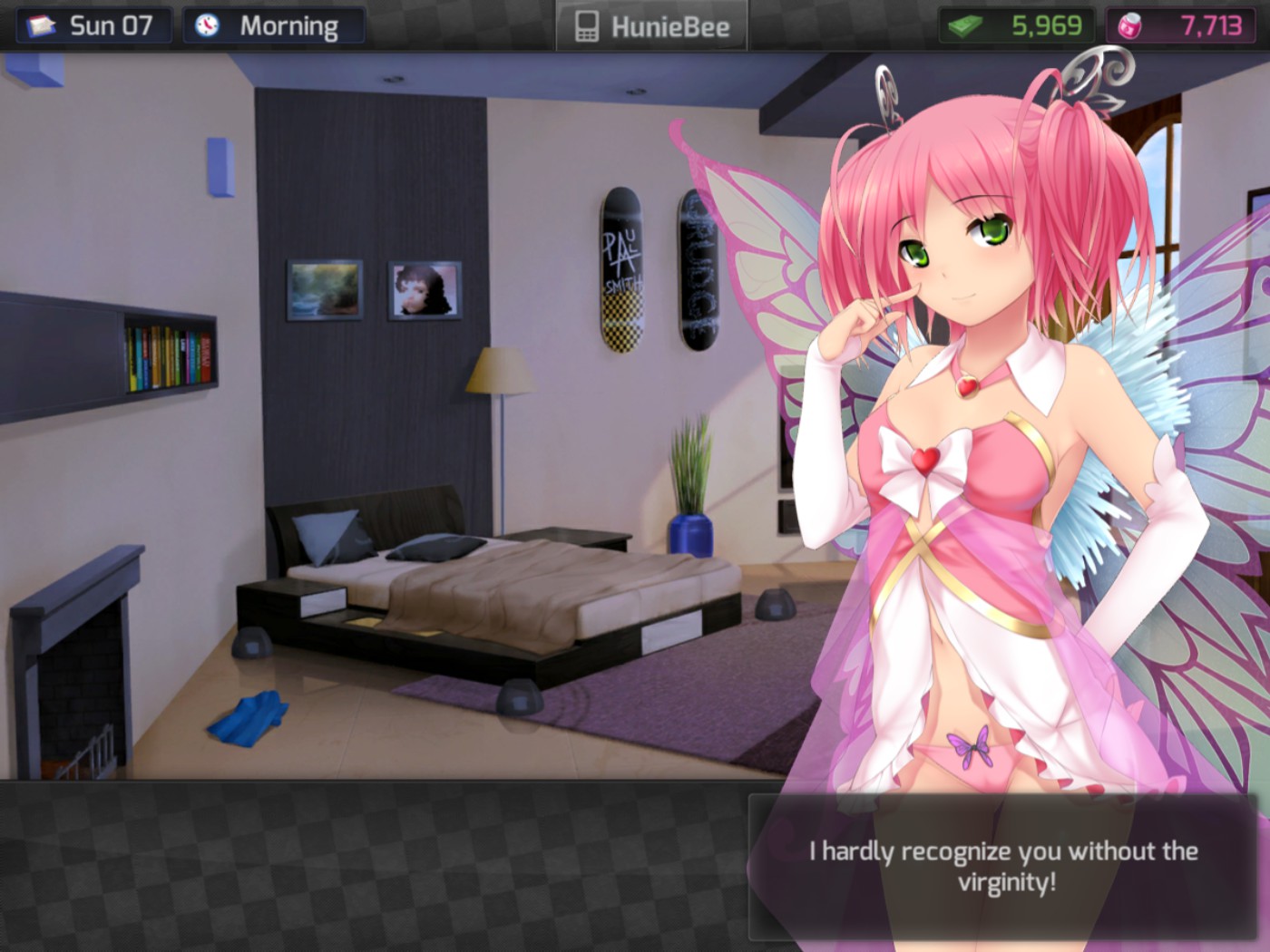
This is Kyu, the magic fairy who's going to make you better at talking to girls.

Unlike many "dating sims", which typically go down the visual novel route, HuniePop is a combination of mechanics from Dead or Alive Xtreme and Puzzle and Dragons. In other words, you move from place to place, buy gifts for characters and interact with them in order to build up your relationship values and other stats, then play an enjoyable little match-3 puzzle game to determine how successful your date with the girl you've been interacting with was.

It's a simple idea, but it's handled quite nicely. There's not a lot of ongoing plot throughout the game, but the girls have all been given their own distinct personalities, and are all introduced through a short, amusing scene where they interact with one of the other cast members. The "Western" angle comes in when these distinctly anime-esque characters open their mouths: rather than adopting the usual anime tropes seen in this sort of thing (tsundere, imouto, kuudere and so forth) the characters are… well, very Western. And very human. And not necessarily immediately likeable.

Take the character Audrey as an example. Audrey is quickly set up to be the Queen Bitch of the cast when you're introduced to her by witnessing her yelling at her hairdresser (also one of the game's dateable girls) with a string of obscenities and frankly rather unreasonable behaviour. Then once you start chatting to her she continually puts you down as some sort of colossal douchebag that won't get out of her way (largely because, well, you're pestering her with inane questions, so it's sort of justified) and threatens to "punch you in the dick" any time she gets too hungry to even think about doing anything else.

HuniePop's characterisation gives its characters some very human, relatable flaws without exaggerating too much.
HuniePop's writing gives its characters some very human, relatable flaws without exaggerating too much.

The other girls are a little more approachable than the rather abrasive Audrey, but they each have their own interesting quirks, and their personality traits affect the puzzle part of the game to a degree, too. The coloured tiles you're matching in the puzzle sequences represent different character traits such as sexuality, flirtatiousness, talent and romance, and each girl responds particularly well to one and not particularly well to another, with bonuses to matches made in those colours you've spent some "Hunie" (acquired by talking to the girls and saying the "right" things) building up the relevant stats for. Later "dates" with the girls — the ones that have the potential to lead to naughty picture shenanigans — have very difficult target scores to obtain, so you'll have to take full advantage of these systems to be successful.

HuniePop is charming, cheeky, lewd, rude and a whole lot of fun. It doesn't give a fuck what people think of it, and I think that's great — although in a pleasing nod to inclusiveness, you can play the game with your character as either male or female, with the girls becoming homosexual if you choose the latter option. While it may not have the narrative depth or character development of a more visual novel-style approach to the dating game, it's a solid and enjoyable game in its own right, and I'm glad I Kickstarted it. I can see it providing a good few hours of entertainment yet.

1828: #FFXIV Before the Fall: Some Initial Impressions

There are spoilers for Final Fantasy XIV's latest patch ahead. You have been warned!

Before the Fall released today, opening the final chapter on Final Fantasy XIV's 2.0 storyline and preparing to usher in the age of Heavensward. For those who have been following the game, you'll know that major version updates such as this one — updates that come every three months like clockwork — tend to include a whole host of exciting new things to do, and this one is certainly no exception. In fact, I think I'd go as far as to say it is the absolute best update Final Fantasy XIV has received since its (re)launch in August of 2013.

I haven't been through everything yet, but here are a few thoughts on what I have taken on so far.

The Wanderer's Palace (Hard)

Many FFXIV players have fond (and not-so-fond) memories of The Wanderer's Palace, since it's the first level 50 dungeon you get to run that isn't story-related. Back in the 2.0 days, before Roulettes and Challenges and all manner of other weekly bonuses, speedrunning Wanderer's Palace (or WP, in FFXIV player parlance) was a popular pastime as it was a quick and efficient means of earning the "Tomestones" used to purchase gear post-level 50. It was also noteworthy as being a dungeon that featured the iconic recurring Final Fantasy enemies the Tonberries — a popular creature owing to their extreme cuteness and propensity to inflict horrible, horrible violence on people with kitchen knives.

In the original WP, the Tonberries were the bad guys. You fought a bunch as you progressed through the dungeon, were pushed ever onwards by giant Tonberry Stalkers that you couldn't kill, and eventually killed the Tonberry King at the end of the dungeon. WP's Hard incarnation, meanwhile, sees the Tonberries freed of the curse brought about by their King's rancour, and in need of help from an invading force of Mamool Ja beastmen.

With Tonberries being such a popular Final Fantasy mainstay, naturally players jump at the opportunity to "Save the Tonberries!" and thus I can see WP Hard being a favourite dungeon of many people — particularly as it's very well designed indeed. Its encounters are well-paced and interesting, and the dungeon does an excellent job of introducing a variety of mechanics throughout that are eventually all used in its final boss fight. It's a satisfying dungeon, and its "victory" cutscene is one of the most grin-inducing things in the entire game, so be sure not to skip it!

Amdapor Keep (Hard)

Poor old Amdapor Keep has had a rough life. Originally the toughest 4-player dungeon in the entire game at FFXIV's 2.0 release, it was subsequently made considerably easier until now, with most dedicated players outgearing it by a considerable margin, it is but a shadow of its former self.

Which, of course, is where Amdapor Keep (AK) Hard comes in. Because it's hard.

I must confess that having run it twice today I still don't really know how the first boss works, but I haven't had any trouble clearing — perhaps after a wipe or two if the party is new. It's cool to see the dungeon running with its creepy theme and a "headless horseman" boss, though; it looks great.

The second boss was a highlight for me, particularly as the first time I ran it my friend was bellowing "Whooo! BOOGYMAN!" in my ear. Because the second boss is indeed the Boogyman, and he enjoys hiding in the shadows, only to be revealed by a pulse of light from an enterprising (and irradiated) adventurer. "What you can't see cannot hurt you," he taunts, shortly before he hurts you very badly indeed.

The best thing about the dungeon, though, is the "gauntlet" before the final boss. Trapped in a room with fiery walls and four Demon Walls closing in on you, you're challenged to take down an intense few waves of enemies before you get squished between our demonic friends. It's exciting, and every time I've done it so far it's been thrillingly close to complete failure when we pulled it off — though I'm sure it will get easier with time (and gear).

The final boss, whom I now can't call anything but "Firedad" after a friend misread his name earlier, is a distinctly Kefka-esque entity with some nasty attacks. It's an extremely well-designed, challenging but enjoyable encounter, and a fitting finale to a difficult but satisfying dungeon. Good stuff.

The Keeper of the Lake

The main "story dungeon" for Before the Fall is essentially a lightweight Praetorium, complete with overdramatic music and tons of Imperials to fight. It's an extremely attractive dungeon with a variety of different landscapes to enjoy as you climb up its towering structure, but the real highlight is the final boss encounter against Midgardsormr, a giant and rather terrifying dragon who is so big you can only fight his head… and his two smaller dragony friends that wake up over the course of the fight.

The encounter is a good one because there's lots to do. There are many different things to dodge, and it keeps you on the move throughout. It's no "tank and spank" encounter, in other words, and while not particularly mechanically complex, it's a real challenge.

In fact, it's a good example of what appears to be a recurring theme for this patch: challenge. In previous patches, people were well overgeared for the dungeons the moment they were released, but this time around even those who are sporting item level 120-130 gear are being given a run for their money with some tough encounters. I'm pleased to see this; one of the most common criticisms levelled at FFXIV is that it's too easy — despite having one of the most notoriously challenging endgame raids in the entire MMORPG genre — and these dungeons more than make up for this.

Speaking of which…

The Chrysalis

The "secret" Trial that was teased prior to release is a fight against an Ascian, and unlike the pathetic dickslapping you give Lahabrea at the end of Praetorium, this one actually puts up one hell of a fight.

It's mechanically fairly simple, as the Trials go, but it's a challenge to coordinate, since the damage comes thick and fast and the healers need to keep on their toes to keep both themselves and the tanks standing, particularly once our Ascian friend starts casting Quake III to damage everyone.

One of the most enjoyable parts of the fight comes where the boss slows down time by sucking you into an aetherial rift, and you're pulled into an inverted-colours landscape where all your buffs and debuffs last ten times longer than they would normally. And yes, this includes things like Paladin's invincibility buff Hallowed Ground, which literally makes you invincible for this entire phase if you pop it just before getting sucked in.

Again, like Keeper of the Lake, The Chrysalis is a challenging fight that keeps players on their toes, unlike a number of the earlier story encounters. (Leviathan in particular springs to mind; it's all but impossible to fail that Trial unless you are a terrible, terrible player.)

World of Darkness

The main event for many people in 2.5 is the grand finale to the Crystal Tower side story, a sprawling homage to Final Fantasy III in which three parties of eight players each (making a total of 24 players, maths fans) journey through the Labyrinth of the Ancients to the base of Syrcus Tower, climb Syrcus Tower and eventually leap through a tear in reality to pay a visit to the World of Darkness.

The previous two parts of Crystal Tower have been enjoyable raids designed to be completable by casual players. They demand significantly less in the way of coordination than The Binding Coil of Bahamut does, but they still put up a fight with complex, interesting mechanics that people need to understand.

World of Darkness dials this up to the maximum though, with some of the most interesting fights I've seen in all of Final Fantasy XIV outside of Coil. A particular highlight is the battle against Cerberus, in which a key mechanic is one of the three parties of eight getting shrunken down to tiny size and eaten by Cerberus, at which point they beat him up from inside his stomach before being vomited back out as the giant hellhound howls in pain. Meanwhile, the other two parties need to take advantage of the distraction created by the stomachache you cause and chain him back up again. It's unlike anything else in the rest of the game, and it's absolutely great.

The final battle against Cloud of Darkness is a good one, too. Again, not hugely mechanically complex, it's a thrilling, exciting battle where there's a lot more to do than just fling fireballs at the boss or poke it with pointy things. There are lasers to dodge, snakes to whack and clouds to disperse, and while it's challenging — particularly while people are still learning these encounters — it's a lot of fun. We finished our run with less than 10 minutes left on the clock.

Urth's Fount (Odin)

The Trial against Odin, last seen at the FanFest live events, is an enjoyable battle against one of the game's most notorious "FATE" bosses that has been in the game since launch. Odin shows up every few (real-time) days and terrorises one of the areas of the Black Shroud forest, at which point scores of adventurers dogpile him in an attempt to defeat him before he unleashes his devastating Zantetsuken move, killing everyone. (In many cases, it's a lot more likely that he completely eviscerates everyone well before he starts charging up Zantetsuken, but I have been present for several victories over him.)

The Trial version of the encounter uses many of the same things you see in the FATE battle, but by limiting it to eight players makes it seem a lot more manageable. The main tank takes a lot of damage, so the healers have a big challenge, and everyone else has tons of AoE skills to avoid throughout the fight, so it's another one where you can't be standing still for too long.

Ultimately, it's not a very difficult fight so long as you're used to dodging things, but it is an enjoyable one. It's nice to finally lay the smack down on Odin once and for all — although the post-quest cutscene neatly explains how and why even after you defeat him he keeps showing back up in the Black Shroud again and again and again.


There's a lot more I haven't explored as yet. Tomorrow is a day for the Hildibrand questline, a real highlight of the game for many people, and for checking out the new "Slaughter" mode in Player vs Player play, which sounds like it might be a lot of fun. For now, though, I've been playing all day, so it's probably time I got some sleep!