2224: Megadimension Neptunia: 50 Hour Report

0224_001

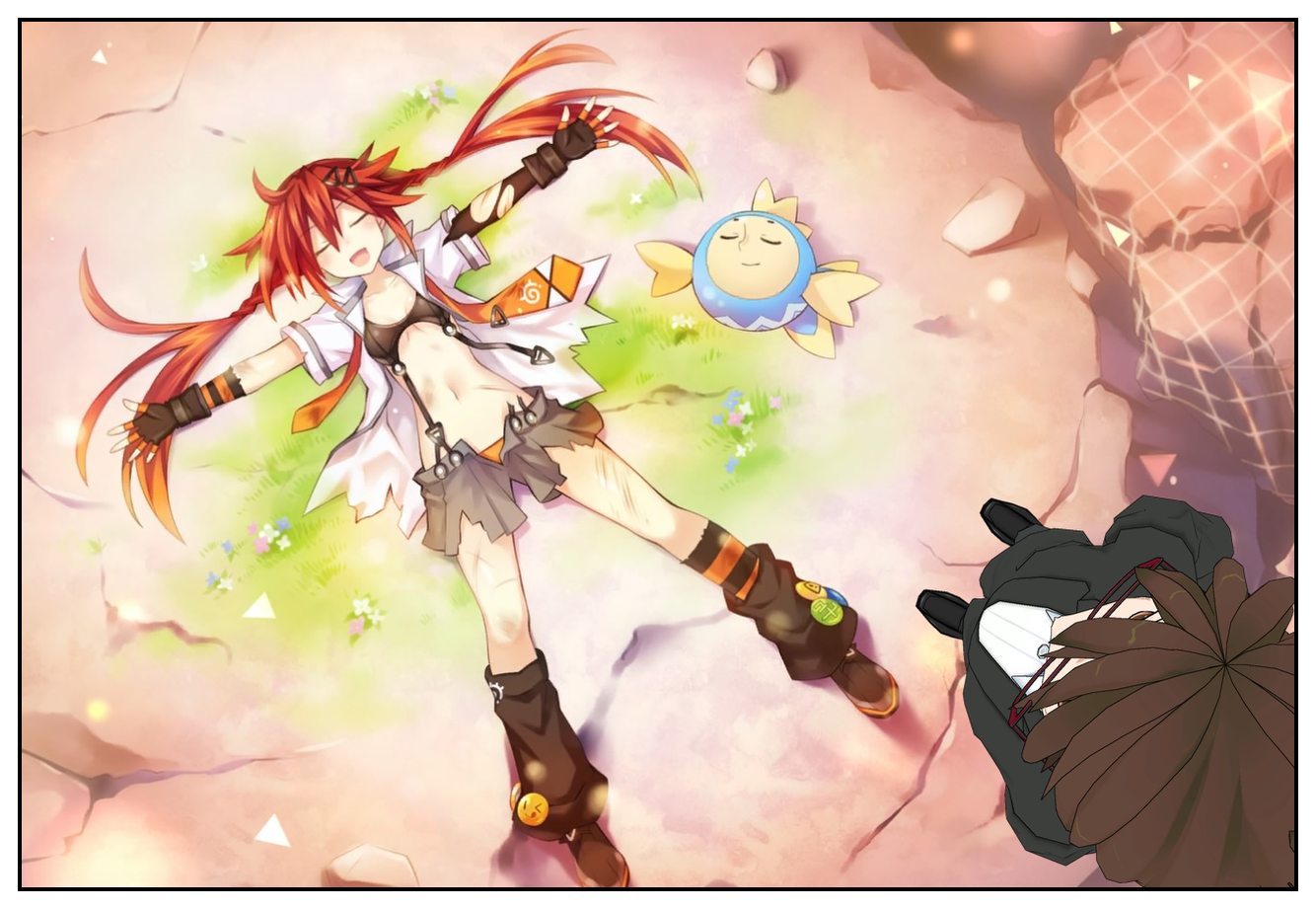
50 hours deep in Megadimension Neptunia VII and I'm just starting the third and final "episode", Heart Dimension Neptunia H. So far I haven't set foot in the titular Heart Dimension, but the plot has been set up; in the meantime I've been doing a little bit of questing and grinding with the CPU Candidates, who are the focus of the initial part of the arc.

The game continues to be the most enjoyable Neptunia game yet. Everything about it is honed and refined to round off the scrappy edges of the previous installments; while the Re;Birth remakes provided small, incremental improvements on the format set in place by Hyperdimension Neptunia VictoryMegaNep is, as I've previously noted, a complete overhaul of pretty much every system in the game, from the battle mechanics to the way "shares" work.

Perhaps one of the best changes is how unique each character now feels to play in battle. Rather than all essentially working in the same way outside of the SP-powered special skills and super-powerful EXE Drive attacks, now each character very much has their own distinctive feel and circumstances in which they are useful. This is achieved in several ways, largely to do with the weapons and combo attacks they are able to use.

Each weapon in MegaNep not only has the usual stats, but it also has a specific arrangement of combo slots, split into three categories: Rush, Power and Standard. (Break attacks have gone the way of the Guard Points bar that they were used to damage; I can't say I miss the system, since it became largely irrelevant after a certain power level in the old games.) As in previous games, Rush attacks focus on a high hit count, with less power per individual hit, and also have a more significant impact on the EXE Drive meter, which now, incidentally, resets between every battle rather than carrying over as in the previous games. Power attacks, meanwhile, have fewer hits, hit harder and in many cases carry an elemental affinity, allowing you to exploit weaknesses. And Standard attacks are somewhere in between the two.

Where things get interesting is in trying to arrange these combos optimally. Characters learn new combo moves as they level up, but each can only be put in a single slot. Moreover, the first attack a weapon performs is fixed and not tied to the character's unlocked skills; this comes into play when considering the individual combo moves' Combo Traits, which, if fulfilled when you use them in battle, means that the combo move that triggered it will 1) be guaranteed to hit and 2) be guaranteed to crit with every hit, increasing overall damage considerably. Combo Traits vary from "All previous attacks did not use a Combo Trait" to "Haven't used Power attacks" and numerous others besides. The challenge when customising a character is to give them as many workable combos with Traits as possible, enabling them to respond to different situations in an optimal manner. It seems to be impossible to build the "perfect" combo — every move triggering a Combo Trait — at my current level, but I wonder if it will be an option with later weapons and/or combo moves.

Anyway. Given that each character has their own set of combo skills and their own set of weapons (each of which has its own arrangement of combo slots as well as its own area of effect) there's a considerable degree of flexibility in how you set up your party, particularly with the sheer number of playable characters on offer in the game. And you'll want to rotate them around, too; back-line characters no longer gain experience points (with a couple of exceptions) and there are certain circumstances where you're obliged to use one or more specific characters in a fight, so they better be suitably set up when that time comes! The series' Lily Rank system is back, too, only this time Lily Ranks are gained by characters fighting together in the front row, making them somewhat easier to gain — at least it feels that way so far — and in order to max these out you'll need to tweak your party arrangement every so often, particularly if you're Trophy hunting.

Elsewhere in the combat, while there are a lot of disposable popcorn enemies — particularly on the world map, where after a certain point random battles become more of an inconvenience than an actual hazard in getting to your destination — the highlights of the game are the boss fights. The game knows this, too, presenting you with unique interface elements, including one thing that I oddly like very much and can't quite explain why: the boss HP meter with multiple bars. Yes, rather than depleting one bar very slowly while battering down a boss-level enemy, MegaNep takes a Final Fantasy XII-esque approach of having a number of "lights" beneath the main HP bar for a boss, with a light dimming each time you empty the bar. Dim all the lights and you've won. It's essentially a variation on the system that was used in titles like Shining Force and Senran Kagura, where different coloured HP bars represented how many "extra" bars a character or enemy had over the maximum possible to display on screen proportionally.

Outside of my rather specific, peculiar tastes in HP meters, though, back to the boss fights themselves: a lot of them are pretty good, and this is largely thanks to a couple of new mechanics introduced in MegaNep. One is the "Parts Break" system, whereby certain enemies have breakable sections with their own durability counts. In order to damage the part, your character needs to be standing in an appropriate place when they either unleash their combo or a special move. Break the part and you get extra XP, credits and a chance at some extra drops. In many cases, breaking the part also has an effect on the boss, either reducing an aspect of its defences or removing the capability for a particular attack. In one particularly memorable confrontation, a boss is completely immune to all damage except Parts damage until you break the cape on his back — to make matters more challenging, the cape can only be damaged by attacks with an elemental affinity. The fight quickly turns into an entertaining dance as you decide whether to try and break his gauntlets and the horn on his head to cripple his special attacks, or whether to focus on trying to get behind him to destroy his cape and be able to deal some real damage.

The new EXE Drive system works well, too; rather than encouraging you to get into a bunch of random fights in a dungeon just to charge it up before a boss fight, the fact it 1) resets at the start of combat and 2) fills much more quickly than in past games means that you're much more likely to be using the spectacular, entertaining EXE Drive moves, which is good, because there are a lot more of them, including several multi-character ones that necessitate surrounding an enemy in appropriate formations. Transforming the CPUs and their sisters into their HDD (and, later, their Next Form) incarnations also costs a bar of EXE Drive rather than SP, meaning you can pretty much guarantee the ability to transform in every fight if you need it — to discourage spamming this, however, transforming now costs Shares, though getting KO'd costs significantly more Shares, so you'll want to weigh up the pros and cons before doing anything rash. Shares work like their original intention in the first Hyperdimension Neptunia game: the more shares one of the nations has, the stronger their CPU (and her sister) is. They're no longer a zero-sum game, however; increasing one nation's shares no longer means taking them from someone else; it's possible to have all four nations with maxed-out share bars, all enjoying the benefits of being Top Nep.

Anyway. I've waffled on for over 1,300 words on the systems in this game and not even mentioned the story and characters, which are still my favourite bit of the series. I'll save that for another day, though, perhaps when I've finished my first playthrough: there's a lot to talk about, with this being by far the most interesting Neptunia game story-wise as well as in terms of mechanics.

It's pretty good, in other words. Very good, in fact. Buy it. Support it. I want to see more Neps. (At this point, I don't think we have a lot to worry about there.)
2223: Exploring Record Keeper a Little Further

0223_001

On the assurances of others who have played it a lot further that it does get a lot more interesting and challenging later, I've been idly trying a bit more of Final Fantasy Record Keeper. And I'm starting to "get it", I think.

One of the issues I have with mobile games of this type is that they often throw too much content at you at once, much of which is well out of your league and is just a waste of the limited "stamina" resource to participate in. Record Keeper does suffer from this to an extent, but it is at least pretty up-front about the fact that you should probably play what it calls the "core dungeons" first in order to upgrade your stamina bar, then challenge either the Elite versions of the core dungeons or the daily event dungeons.

Record Keeper takes a slightly interesting approach to powering up your "account"; rather than having experience points and a level, in order to increase your maximum amount of stamina — and, consequently, the amount of dungeons you can challenge in a session without spending the "Mythril" currency to recharge — you simply need to repeatedly collect five "Stamina Shards", which are crystals awarded to you when you finish a dungeon. Normally you get one the first time you finish a dungeon and another the first time you "master" the dungeon by completing various rather straightforward objectives along the way; this usually means that the first time you run a dungeon, you're pretty much guaranteed two Stamina Shards, which means you can upgrade your stamina bar and keep playing fairly easily, especially as your stamina completely replenishes when you upgrade the bar.

So clearly the "best" way to approach the early game in Record Keeper is to grind your way through the core dungeons to get your stamina as high as it can possibly go, then once you have a decent stock of that — and, in theory, some good characters and equipment by then, too — you can challenge the game's more, well, challenging content. Makes sense, for sure.

Trouble is, the core dungeons… well, they're quite boring, or rather they're painfully easy. When you can get through each one almost entirely by using the "Auto-Battle" function, perhaps unleashing a special Soul Break ability from a character you've borrowed from another player on the boss to one-shot it in most circumstances, that's not particularly compelling gameplay, though I suppose it does allow you to play the game almost as an "idle game" a la those endless "clicker" games that infest Steam.

This isn't all that unusual for mobile games, though. Mobile games, despite their reputation for being disposable, throwaway experiences, are often designed with the long tail in mind. That means being as accessible as possible to as many people as possible. That means catering to all ability levels, including "dribbling idiot". That means if the early game of your mobile game isn't easy as fuck, the "dribbling idiot" end of the spectrum — which, I theorise, is the end of the spectrum most likely to spend money on the game in order to ease their progression — will lose interest and drop off quickly. More hardcore gamers, meanwhile, are used to piss-easy early games in RPGs and MMOs, and are usually willing to put up with this for the promise of challenging content and amazing rewards in the endgame. I can't speak for Record Keeper's "endgame" at present, but there's certainly scope for the collecting aspect to become rather compelling.

So that's where I am quite now. It's proving to be quite a nice diversion for while I'm, say, queueing for a dungeon in Final Fantasy XIV, and a suitable toilet game in that I can set them off battling on auto-mode while I'm having a shit, then reap the rewards afterwards. Unlike Brave Frontier, the mobile game that previously grabbed me, Record Keeper's dungeons and battles seem to be kept reasonably short and snappy, at least in the early game; eventually, I tired of Brave Frontier because it became too time-consuming for something I originally only started playing to "fill gaps" in time, but if Record Keeper remains pacy I can see it being a nice thing to have on my phone for quiet moments.

We'll see if it maintains my interest. I'm intrigued to start looking at the Elite Dungeons and the daily events, but I'm going to continue grinding my way through some more core dungeons first of all; while the depth of gameplay in these early battles is nothing special, it is nice to revisit monsters and locales from classic Final Fantasy games from a new angle, and getting loot and XP is always fun, isn't it?

On the offchance you want to "follow" me in the game, my Friend ID is rfEj.

2222: I Can't Decide if Final Fantasy Record Keeper is Good or Not

0222_001

I've been having a sporadic go at Final Fantasy Record Keeper on mobile recently. I sort of like it, but I also sort of think it's rubbish. It's hard to say which opinion carries the greater weight at the moment.

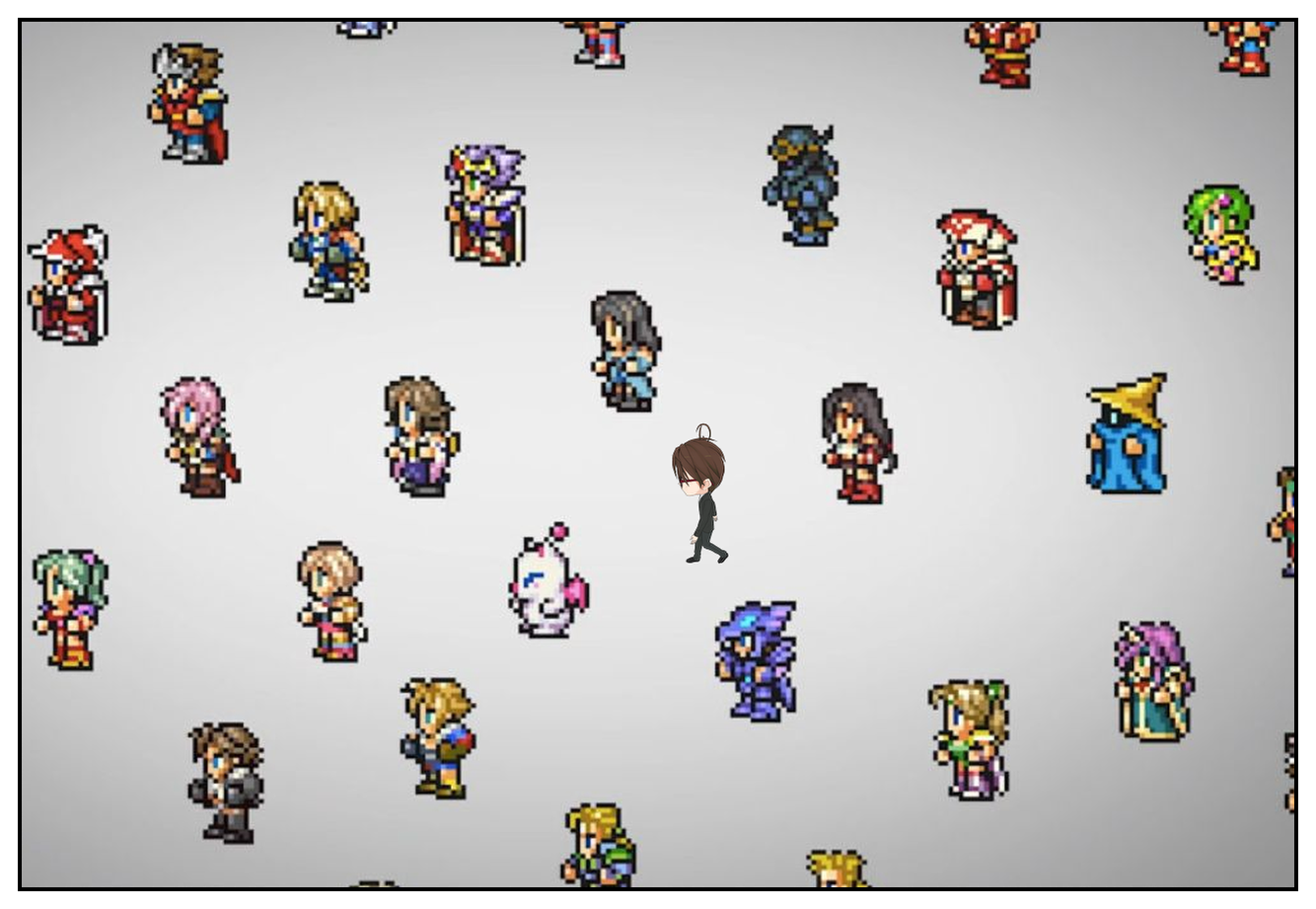
For the unfamiliar, Record Keeper is a Final Fantasy fanservice game in that it allows you, as an original (and rather dull) character created specifically for the game, to venture into the worlds of most of the mainline Final Fantasy games from I-XIV and engage in some of the iconic battles from the series. Major plot beats are presented as "dungeons" in which you have to complete several different stages concluding with a boss fight against a boss from that point in the original game, complete with its original attack patterns.

As you progress through the game, you unlock various characters from Final Fantasy history, and you're encouraged to swap them around and experiment with different party combinations, as a character running a dungeon from their "own" game gets significant bonuses. You can then get equipment — again, sourced from all the various games — and give them to characters to power them up and make them stronger, as well as crafting "ability orbs" that allow them to cast spells and skills that deal more damage or have special effects.

There's actually quite a lot to it, but the fact that it's a free-to-play mobile game means that it's riddled with irritating features. Firstly and perhaps most significantly is the fact that it's entirely dependent on being online, with painfully sluggish menus and lengthy load times, even when the game has cached its data. Worse, if your network connection flakes out while you're playing, the whole game freezes until connectivity is restored, even if you're in the middle of battle.

Then there's the social features, which actually weren't in the game when it originally launched. As is usually the case in mobile games of this type, you have the opportunity to "borrow" another player's showcase character when you run a dungeon, and make use of their special ability a limited number of times during the dungeon. A nice idea, for sure, but completely unbalanced; most other players are well above my current level and consequently inflict one-hit kills on bosses, making strategic play unnecessary. It would perhaps be better if you were matched with players who were of a similar level or amount of progress through the game to you.

Free-to-play also means gacha, and in this case that comes in the form of the "relics", the equipment you give to your characters. Rather than purchasing these from a shop, you "draw" them, either one crap one for free per day or a chance at better ones if you spend money or use the rarer "Mythril" currency you acquire through playing. Relics can be levelled up and upgraded in rarity independently of characters, so the main metagame comes from collecting and fusing these items together to form a powerful (overpowered?) party to challenge the content in the game.

There's a lot to dislike about Final Fantasy Record Keeper, but a lot to like, too; the developers are clearly very much in love with Final Fantasy as a whole, incorporating authentic graphics, sound, music and animations into the game. The fact that the boss fights make use of authentic attack patterns — even from less "conventional" Final Fantasies such as XIV — is a really nice touch for longstanding fans of the series, and the Relic and Ability systems provide plenty of scope for customising and upgrading characters.

It's a nice idea, in other words; I'm just not sure that a free-to-play mobile game was quite the optimal way to do this. Still, it's significantly better than many other mobile games I've fiddled with in the past, so I'll give it a chance for a bit longer and see if it holds my interest.

2221: Seeing the Final Product Forming

0221_001

I spent a chunk of time today porting the work I've already done on a story from Google Docs online to Scrivener on my Mac. Scrivener is a piece of software I picked up quite a while back and have used sporadically whenever I feel creative; it's a lovely piece of software to keep written projects of any size manageable and organised.

For the unfamiliar, Scrivener allows you to organise your whole project into a single file, including the chapters and sections/scenes of your book, research material, front matter and general notes. Within the file, you have a tree structure of folders and items, with numerous templates available for various types of project. When you're all done, you "compile" the project like a computer program, and Scrivener spits the finished product out in the format of your choice, be it double-spaced manuscript for sending to a publisher, attractively laid out pages ready for self-publishing, or various popular eBook formats. You can even export it to a word processor if you so desire, allowing you to format it further using tools beyond that which Scrivener offers.

I was surprised what a feeling of motivation I felt from porting the existing content over to Scrivener, and I attribute this primarily to the fact that what you bung into Scrivener looks remarkably like what the finished product will end up being. In fact, if you compile a project in progress to a PDF just to have a look at how things appear, it's even more motivating, because you can imagine holding the finished book in your hands. That's quite exciting.

Just the fact that Scrivener uses some very attractive, convincingly "book-like" default fonts helps with this feeling of seeing the final product coming together, though. Couple that with the fact that Scrivener's interface is designed to be as clean and distraction-free as possible, and all in all you have a piece of software that is eminently suitable for creative types to realise their written ambitions — even if you barely use a fraction of the functionality the software has to offer, which I suspect is a category I will probably fall into unless I want to get really anal about page headers or something.

Anyway. This is a long-winded way of saying that I have been successfully motivating myself to continue with my creative writing project while I still don't have any full time work. I'm under no illusions that I'll be able to make money from this — at least initially — but the story I'm working on at present is a passion project that it will simply be satisfying to see completed at last, and released into the wild. If anyone ends up actually buying it, so much the better, of course, but if nothing else completing a project of this sort will 1) show me that I can do it, and hopefully inspire me to do more that take less than 15 years to complete and 2) stop my mother telling me every so often that I should "write that book". (She hasn't done that for a while, to be fair, which probably means it's due a mention sometime soon… I know you're reading, Mum, so take this as assurance that I'm doing it.)

So that's that. Writer? Windows or OSX-equipped? Give Scrivener a go, and you might just be surprised how much you can get done.

2220: Evasive Action

0220_001

"What’s the most significant secret you’ve ever kept? Did the truth ever come out?"
Daily Post, February 17, 2016

To be honest, I don't have all that many secrets. I spew most of the things that many people might keep private on this blog most days, as I figured out a while back that keeping secrets from people is a sure-fire way to lead to mistrust and awkwardness.

As such, I have to look back to my past to ponder the subject of secrets. And, I have to say, even then, I didn't have that many in the way of significant secrets. For the teenaged me, though, no secret was more sacred than who I fancied at any given moment.

Deciding I liked someone always felt like a significant moment when I was young. It was always a conscious decision, and there was always some sort of stimulus that triggered previously dormant feelings of attraction and affection towards someone. I've never been someone who was solely attracted to others based on physical appearance; even as a teenager, I could appreciate how aesthetically pleasing someone might be, but I would never consider myself to like them until I had some idea of what kind of person they were.

I didn't need to know a lot about them, mind; being shy and socially awkward from a young age, a member of the opposite sex giving me the time of day and actually talking to me without being obviously repulsed by my bad hair, bad skin and periodic outbreaks of zits was usually enough to trigger a feeling in the pit of my stomach that was both delicious and uncomfortable; I tended to think of it as the old cliche "butterflies in the stomach", and while there was not one single instance while I was still a teenager where my feelings were requited — my first girlfriend was more a case of circumstance rather than prior attraction, but perhaps more on that another time — I secretly rather enjoyed the feeling of liking someone from afar.

This would lead to internal conflict. My feelings towards that week/month's object of affection would grow and grow, but with them being a sacred secret to me, I wouldn't breathe a word about them to anyone, because I'd got into my head that if anyone found out that I liked them, they'd immediately and automatically start hating me. On the few occasions where I did successfully pluck up the courage to admit to someone that I liked them "that way", not one of them automatically started hating me, which was always a pleasant surprise, but it didn't stop me feeling that way until… well, perhaps not ever. I'm quite insecure.

Anyway. Eventually those feelings would reach boiling point and despite them being a sacred secret, I'd have to tell someone. Not the person in question though, of course, absolutely not. No, I'd usually tell one of my friends, who would then, usually, proceed to either immediately tell the person in question or, more commonly, hijack one of my school exercise books and scrawl the name of my desired paramour across the middle pages in rather ornate, artistic text. On one particularly memorable occasion the book was returned to me with the name in question actually painted with watercolours, which I thought was rather more effort than warranted by the news that I, once again, fancied that girl I sat next to in orchestra who played the clarinet with me. Perhaps it was my friends' own peculiar way of demonstrating their affection and support for my numerous doomed, unrequited loves.

Regardless, though, that sort of thing makes up the majority of what I'd consider to be significant secrets in my life to date. I'm not sure if I should be pleased I haven't felt the need to keep many things secret, or a little despondent at the fact I apparently live quite a boring life…

2219: Picking at the Scab of Creativity

0219_001

That's a horrible metaphor, I know, but the more I think about it, the more that it seems to make a certain amount of sense.

I've been picking at said scab for the last few days, as I said I was going to. I haven't been spending all day on it or anything, but an hour here and an hour there has meant that a story I've been wanting to finish since my teenage years is finally making some progress further beyond the point where it typically stalls any time I attempt to form it into some sort of… well, format.

I'm taking a different approach to what I usually do, and it feels like it's working. Those who have read my various month-long sort of NaNoWriMo projects and other creative pieces will know that I have something of a tendency to write in a fairly spontaneous manner — in other words, I don't really plan anything out in advance, and this usually serves me well but occasionally sees me writing myself into a bit of a dead end I'm not sure how to escape from. In contrast, then, said scab-picking has involved not just continuing on with what I've already written — which is a substantial number of words that I'm actually quite pleased with so far — but instead planning out a synopsis, chapter by chapter, of what's coming next.

Doing this has helped me get over the biggest creative block I've had with this work — a creative block that has lasted a good 15 years or so at last count. The trouble with this story is that I know how it begins and I know roughly how it ends, but I've never quite figured out what happens in the middle of it or the specifics of the ending. Now I'm planning each chapter out in general terms rather than trying to write meaningful scenes as I get to them, I feel like I'm developing a much stronger sense of the work's complete structure, and those middle bits are starting to fall into place naturally. It's that old thing where a huge job looks daunting if you look at the whole thing, but if you take it a single task at a time it suddenly seems a lot more manageable.

So picking a scab then — why? Well, because I've been picking at it for the last few days, and each time I do so, I feel my creativity loosen up a bit. It's surely — hopefully — only a matter of time before that scab comes off completely and creativity comes gushing forth from a newly reopened wound, splattering the walls and desk with… you know what? Maybe I didn't think this metaphor through as much as I thought I had.

Anyway. Disgusting mental imagery aside, I'm pleased with my progress, even though it's relatively minor in the grand scheme of what I need to do to finish the damn thing. It is progress, though, and while I'm still not feeling great about bumming around at home all day rather than having a proper job, it is at least helping me to feel like I'm achieving something, however miniscule that something might be. And that's pretty important.

Let's hope I can keep that motivation going, a bit at a time.

2218: Megadimension Neptunia: Report from 21 Hours In

0218_001

Good Lord, this game is good.

As I mentioned the other day, Megadimension Neptunia V-II marks something of a watershed moment for the series in that it's no longer "good, but [insert caveat of your choice here]" and is just plain good. Great, even.

I'm about 21 hours in so far. I've finished the first of the three main stories that make up the complete experience — Zerodimension Neptunia Z — and am now in the second, Hyperdimension Neptunia G. This part — at least the first bit of it; I don't know how long it is in total — is split into four distinct scenarios, each of which focuses on one of the four main goddess characters (and one of the four new "Gold Third" characters, who personify various Japanese game companies from Capcom to Square Enix), and so far I've played through Blanc's route from start to finish.

Like Compile Heart's previous game Omega QuintetMegaNep spreads out its mechanics over the course of quite a few hours. 20 hours in, I'm still getting tutorial messages when I'm afflicted with a status effect I haven't suffered before, though I think that most of the main core mechanics of the game have now been introduced by this point. Unlike Final Fantasy XIII, which often draws the ire of commentators for taking a similar approach to spreading out its new mechanics, MegaNep never feels like it's artificially constraining you, though; the new systems I've seen so far were all introduced at the changeover between Zerodimension Neptunia Z and Hyperdimension Neptunia G, which was an eminently sensible way to do things, since it allows to stand by itself as a complete-feeling experience, then to move on and feel distinctive in its own right thanks to the additional things you have to juggle.

What of those additional things, though? Well, aside from the things that already shook up — the world map is now node-based a la Final Fantasy Tactics, and you can have random encounters while moving from place to place; the battle system has been completely revamped from previous installments — introduces (and, in some cases, reintroduces) a number of new systems.

First is the Scout system originally seen in Hyperdimension Neptunia Victory. Essentially, this is a small army of chibi characters (series veterans will recognise them as the "Chirper" characters who fulfil the role of incidental NPCs) that you can send out to dungeons, and they will then report back with what they find. Whereas Victory's Scout system simply required you to enter and leave locations a certain number of times before the Scouts would return, MegaNep's Scouts head out in real time and then report back with items, money, new dungeon features (boss monsters or clues to hidden treasure) or whole new dungeons. There's still a heavy degree of RNG involved, but it's a fairly painless process, and the real-time element means you can easily leave it running while you're doing other errands in-game. Scouts also provide passive bonuses to you if you're exploring the same dungeon they're deployed to, so they're helpful in ways other than just finding stuff, too.

Next is the Investment system, which allows you to develop towns by spending your hard-earned Credits in three areas: Commercial, Industrial and Public Relations. Upgrading Commercial increases the stock in the shops; upgrading Industrial gives you access to new crafting recipes; upgrading Public Relations triggers events that can reward you with items, new Scouts or simply an entertaining scene. That's pretty straightforward.

Then you have the Route Building system, which is also reasonably straightforward. Discover a new dungeon and you can't just click on it on the map like in the older games; you have to build a node-based pathway to it first, which costs money.

Then you have the Hidden Treasure system for each dungeon, which replaces the old games' spamming the "sonar"-type ability to find invisible items. Here, to find a hidden treasure, first of all you have to have a Scout discover a clue to its location, then fulfil the conditions in the clue, then collect the treasure. Sometimes dungeons have more than one treasure, which means you have to do the process twice, though the conditions are usually different. The conditions make the dungeon-crawling a bit more interesting, because they have a decent amount of variety in them: some require you to collect all the regular treasures in a dungeon (some of which may be in awkward places or behind barriers that require the "Breaker" ability to smash) while others require you to execute 8 "Symbol Attacks" in a row without getting spotted by any enemies, which challenges your stealth and pattern-spotting skills. Others still require you to defeat each and every enemy symbol in the whole dungeon at least once — they don't all have to be dead at the same time, but you do have to keep track of what you've already killed and what you haven't.

In Blanc's route, we get a number of different characters to play with, each of whom handles rather differently, fixing the issue from the older games where most of the characters felt rather interchangeable with the exception of their special skills. Blanc herself has a marked disparity between her physical and magic defense, for example, while her sisters Rom and Ram have half of Blanc's HP but much stronger magic resistance and the ability to attack both at range and over a wider area. The brief time you get to play with Capcom personification C-Sha is a ton of fun, too; her combo skills are all named after fighting game terminology, and it's more fun than it should be triggering Rush attacks called simply "PPPK" then seeing her doing a punch-punch-punch-kick combo on the enemy.

The story is proving to be surprisingly compelling so far, too. The Zerodimension episode had a mixture of lightheartedness and post-apocalyptic bleakness and worked well. Blanc's route of the Hyperdimension story deals with a plausible view of a dystopian society where everything and everyone is controlled by the state, and how revolutionaries fighting against this sort of regime aren't always in it for the right reasons. Neptunia's stories have always been far more clever than most reviewers give them credit for, being heavily allegorical for the most part, but so far MegaNep seems to have taken things to a new level. The writing and localisation is good (aside from a few easily ignored typos here and there) and, crucially, the new characters — of whom there are quite a few — fit right in to the world without breaking a sweat.

It does feel very different to previous Neptunia games, but after the three Re;Births that all had the same basic mechanics, it's refreshing to have a game that feels both comfortingly familiar and fresh at the same time. I'm delighted with the experience so far, and am looking forward to playing it to death over the course of the next few weeks. Expect further reports to follow.

2217: When You Have No Occupation, You Should Stay Occupied

0217_001

One of the things that is most difficult about being out of work is keeping yourself occupied without falling into unproductive routines. It would be extremely easy to not bother doing anything useful at all each and every day, treating the time "off" as a kind of holiday, watching television, playing games, listening to the radio or falling into a deep, existential depression while staring at the ceiling of one's bedroom. I say it is extremely easy to do these things because I have done all these things while out of work at various points. Sometimes you need that time to yourself, but unfortunately, said time to yourself doesn't pay the bills.

Doing nothing but hunting for jobs isn't necessarily the most productive course of action either, though. Job-hunting is an enormously demoralising experience, since by its very definition you're going to be faced with more inexplicable rejection than acceptance in most cases. At other times, you'll find yourself faced with an opportunity that just doesn't seem quite right, but which you feel guilty turning down because you need work. (I say this having turned down two opportunities recently that didn't feel right at all. Like, a big ol' "bad feeling in the guy" not right at all.) That can be exhausting, and the toll it takes on your mental faculties can have an adverse effect on your subsequent attempts to find work as you lose patience with it and get tempted to apply to any old thing on the off-chance someone will find you in any way employable.

Therefore, it's important to find other ways to occupy yourself, and to divide your days up into various things that, if they're not necessarily directly productive, they at least provide you with the opportunity to feel like you've accomplished something. Indulging in a creative project, learning something new, practising your skills in something — all of these things are good ways to spend your time and if you're out of work, it's an ideal opportunity to spend some of those empty hours doing them.

You'll notice that I'm writing this and using the word "you" a lot, as if I'm giving advice to someone else. Really, I'm giving advice to myself, to be perfectly honest, since as previously noted, I find it much too easy to sink into depression and just want to comfort myself with things that don't require too much in the way of effort. But that way leads further into bad situations, so from tomorrow, I'm going to make a particular effort to spend a bit of time each day doing something that makes me feel like I've accomplished something. I don't think I'm going to go so far as to schedule what I should do when — not for the moment, anyway, though that has worked for me in the past — but I am going to ensure that I do at least one thing every day for a minimum of an hour that leaves me feeling satisfied that I'm not completely wasting my time.

Activities that spring immediately to mind to accomplish this include music practice, music composition, creative writing (both fiction and non-fiction — I have a number of ideas for both), Japanese language studies, developing my computer skills (particularly with regard to things like programming and/or web design), working on the next edition of the magazine I shared with you a while back and making more gaming videos. That should keep me busy on a fairly regular basis; some of those things may even lead to further actual paying opportunities of various descriptions in the future, if not immediately.

Mostly they're attempts to keep myself occupied and feeling positive. I feel I'm at a particularly low ebb right now, if that wasn't already abundantly clear from my recent entries, and I want to feel like I'm making the best of a bad situation rather than wallowing in sadness. It won't be easy, but I feel it's probably the best way to approach what I'm dealing with at the moment.

Wish me luck.

2214: Blue Estate: A Love Letter to Lightguns

0214_001

The lightgun shooter is a genre of gaming that has been pretty much dead for a long time — at least partly because the tech that made lightguns work doesn't work with modern LCD or LED TVs. That said, there have been a few attempts to bring it back using alternative methods, most notably motion controls which, while not quite the same as pointing a gun at the screen and pulling the trigger, at least have the "aim and fire" aspect handled nicely, and arguably in a more accessible manner than traditional light guns.

A while back, I picked up a game on PlayStation 4 called Blue Estate. It was on sale for something ridiculous like £2, so I thought I'd take a chance on it as it sounded interesting. It's based on a comic, I believe, though I hadn't heard of it, and it doesn't appear to be necessary to be familiar with the comic to enjoy the game.

That's because the game is very much an old-school arcade-style lightgun shooter. And it's cracking fun.

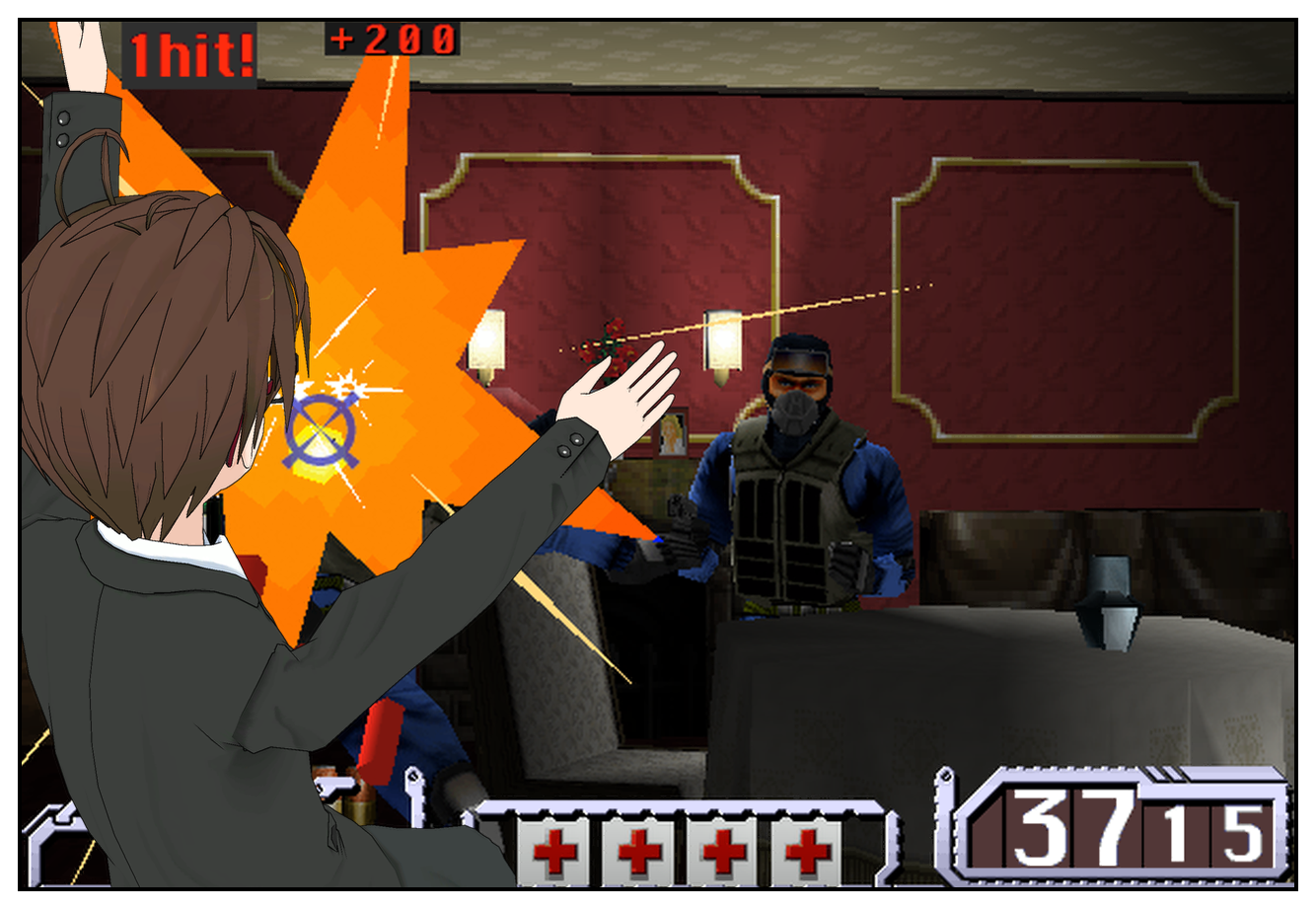
In the absence of a next-generation GunCon peripheral, Blue Estate uses the motion sensors in the DualShock 4 controller to move a gunsight around on screen, coupled with the L1 or D-pad up buttons to recentre the crosshairs if they drift off a bit as a result of you moving your hand position. They drift off quite frequently, but the ability to snap them back into position means that this isn't really an issue. (This wouldn't be an issue with the Wii Remote, which recognises its position relative to the television rather than just responding to movements; the DualShock 4, however, doesn't work in the same way, and thus this method is necessary.)

Playing Blue Estate is extremely simple. You point with the motion controls, you shoot with a squeeze of the R2 button. Occasionally you'll be tasked with swiping the DualShock 4 touchpad in a particular direction to perform an action like a melee attack or dodging an incoming projectile, but for the most part this is a game about blasting hordes of goons as quickly, accurately and efficiently as possible in order to rack up 1) a big combo and 2) a big score.

Shooting games of various descriptions were often maligned in the early days of gaming as being the most simplistic, mindless types of games, but this absolutely isn't true; even Space Invaders taught players the importance of performing quick quasi-mathematical calculations in their heads in order to fire their shots at an appropriate position to intersect with the moving aliens as they descended the screen. In Blue Estate's case, the quick thinking required is less mathematical and more observational: it's about prioritising targets and responding to things quickly.

One thing lightgun shooters used to struggle a bit with is how to handle presenting a risk to the player without looking silly. Older lightgun shooters tried several methods — enemies not shooting particularly quickly to give players time to hit them before they got a shot in; enemies focusing on melee attacks; in more advanced games like Time Crisis, a cover system — but it could still sometimes seem a bit convoluted. Blue Estate goes for a hybrid approach of these techniques: as you proceed through each level, sometimes you'll have the opportunity to pop in and out of cover Time Crisis-style, while at others you'll simply have to prioritise your targets appropriately to avoid taking damage. The latter case is handled reasonably elegantly with an on-screen "warning" system showing which enemy is going to score a hit on you next, allowing you to pick a suitable order to blow your foes' heads off.

Blue Estate is, despite its extremely silly story, which I won't go into here, a surprisingly skilful game that has a ton of replay value for score attack enthusiasts. The combo system rewards accurate, skilful shooting, and star ratings in various categories at the end of each level encourage you to try and better yourself in various ways. The basic blasting action is also broken up with several challenge-style objectives in the middle of each level, which task you with everything from quickly shooting enemies that pop up from one of several marked locations to killing a group of enemies in the correct order. There are also some rather wonderful boss fights, which are heavily pattern-based but a ton of fun to fight your way through.

The whole thing has the feel of an old-school arcade game: one that you can "learn" in order to get better at. Learning the position and order of the enemies that show up in each level; learning the bosses' attack patterns; practising your ability to prioritise and quickly respond to targets in order to chain an entire level together — all of these things prove rewarding and fun, even once you've seen the story through to its conclusion. And the story provides good incentive to play through the whole thing at least once, even if you have no intention of score-attacking: it's genuinely amusing but convincingly written with some solid, fun characters and sufficient justification for each of the game's characters to blast their way through scores of henchmen.

If you haven't given it a shot — no pun intended — and you're a fan of the more arcadey side of life, I recommend Blue Estate highly. It may not be a game you've heard of, nor may it be a game that many people are talking about, but it's a whole lot of fun, and worth your time.

2213: Paying Not to Play vs. Games That Let You Break Them

0213_001

I'm currently grinding my way through to the Platinum trophy on Hyperdimension Neptunia Re;Birth 2, and in the process I've unlocked a considerable number of the "Plans" in the game's "Remake" system. For those who haven't played any of the Re;Birth games, these are essentially a crafting system that allow you to bolt various bits and pieces onto the base game. These bits and pieces range from a boost to the amount of experience points you gain from battle to new items being available to purchase in the shops.

Re;Birth 2 goes further than its predecessor did with the Plans by pretty much allowing you to break the game altogether. Between the Plan which allows you to automatically defeat enemies you outlevel on the dungeon screen without having to actually do the battle and the "Symbol Attack Gains" Plan, which allows you to still get experience, credits and items as if you had done the battle, grinding to the game's various endings is arguably a little too easy, particularly if combined with boosts to experience and suchlike.

At least, I'd say this was a little too easy were it not for the fact that I've played a bunch of Compile Heart games now, and their endgame is always like this: characters continuing to level after the usual cap of 99, stats increasing to ludicrous levels, superpowered equipment boosting them still further. In Neptunia's case, the exaggerated power levels of the endgame is arguably all part of the satire and parody that the series is based around: RPGs are known for having big numbers in them in their final hours, so here are bigger numbers than you've ever seen (outside of the Disgaea series, that is) popping out of enemies as you batter them around the face and neck repeatedly with various sharp implements.

In the case of the Re;Birth games, how much you break the game is entirely up to you. You don't have to turn any of the plans on if you don't want to, but if you do so, it makes working your way through the alternative endings considerably easier — and manages to remain fun in the process, since there's more to the game than just battles. It's inherently satisfying to see Nepgear closing in on level 400 as I approach the "True" ending on my third playthrough, and I'm fully intending on blasting through the other endings after this too.

Hyperdimension Neptunia U allows you to completely break it, too, particularly in its endgame. As you clear various components of the game, you unlock various cheats which range from having infinite EXE Drive power for super-special moves to not actually taking any damage from enemies, essentially making you invincible. And yet that game managed to remain fun despite the option to completely break it; testament to its overall charm and the fact that it had a metagame structure that I found enjoyable to grind through in the name of a Platinum trophy.

As I play these deliberately broken games, I can't help but compare them to what a lot of mobile games do. In the case of mobile games — free-to-play ones, anyway — you generally have the option to pay real money to break the game in some way, be it eliminate grinding, get an overpowered new character/item/weapon or somehow otherwise break the usual rules of the game. Some games are more aggressive than others in trying to convince you to part with your cash, with the most egregious technique being the vile "Energy" bar that throttles how much you're allowed to play in a single session without either waiting or paying up.

In essence, by paying up to get an advantage in mobile games, you're more often than not paying not to play the game: paying not to have to collect things, or grind experience points, or earn money, or fuse cards to make better cards, or whatever. Most well-designed free-to-play mobile games do have a means of earning the premium currency required to do most of these things, but in many cases this is painfully slow — fast enough to give you a taste, but just slow enough to make you think it can't possibly hurt to pay 99p for 15 gems or whatever. And once you do that, any sense of achievement is gone, because you know you didn't really "earn" whatever you got from it: you just bought it.

Contrast with, say, the Plans in Re;Birth 2, which are also providing the opportunity to not play part of the game — battles with enemies much lower level than you — but demand that you earn the right to do that before you're able to take advantage of it. Or contrast with Neptunia U's cheats, which unlock by completing aspects of the game: again, you have to earn your right to make the rest of your grind easier.

In the latter cases, it's still a player-friendly move that helps save them some time while still being able to explore and enjoy everything the game has to offer, but it carries with it a sense of achievement: the feeling of having earned and unlocked something, rather than just reaching for the credit card when things get a bit tough.

I sincerely hope free-to-play games don't become the norm, simply for this reason. Paying to skip things or acquire things without having to earn them makes the whole thing feel rather meaningless to me. I know not everyone feels this way, but so long as there are still full-price premium games that don't want to keep charging me to keep playing — or to not play — then I'll keep buying 'em.