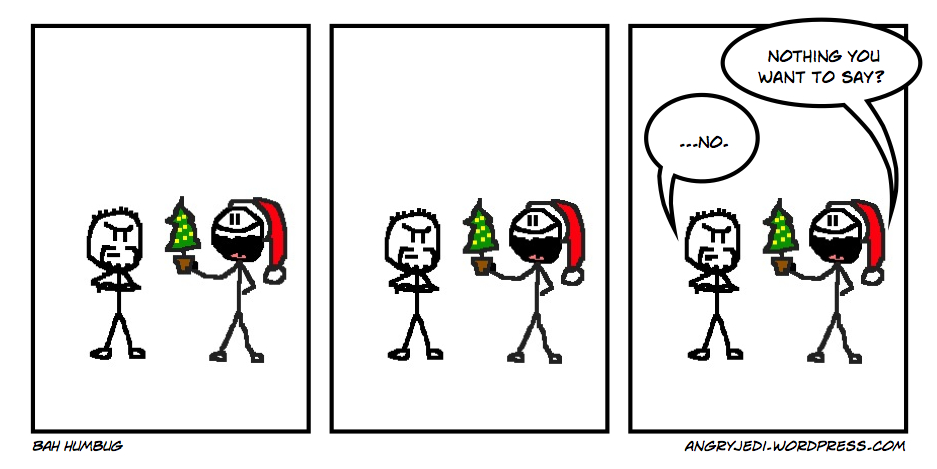
#oneaday, Day 324: Humbug

It's easy to be cynical about Christmas these days, given that it starts in mid-September and proceeds to get increasingly more present in the months leading up to December until it is eventually omnipresent. (Happy, Mr Hussick?) By the time it actually arrives, people are so thoroughly sick of the whole "Christmas" thing that they just want it over and done with for another few months until the whole thing starts over again.

It's not like that for everyone, of course. I doubt that the kids out there are as cynical about Christmas. I certainly wasn't when I was a kid; Christmas was a time to be excited. There was a different atmosphere about the whole day, and not just the tangible excitement over getting presents or eating copious amounts of turkey dinner. It felt like a special day when nothing could possibly go wrong, when it would be impossible for Bad Things of any description to happen.

I haven't felt like that for years now. I forget the last time I felt that way, but I'm pretty sure it was back in my childhood. Perhaps there's more to be said for the belief in Santa Claus than people give credit for. It doesn't help that the last few Christmases I've had were pretty underwhelming at best and downright unpleasant at worst. The Christmas that I had to work over and then spent the best part of Christmas week lying in bed alone suffering with a strong bout of flu—proper flu, the "can't get up because your whole body aches too much" flu—was a particular lowlight, but the events of the past year haven't made me particularly feel like celebrating anything at any point.

I am spending this Christmas abroad, though, away from this cold, grey, depressing land. I'll be over in the States, where I'll be spending most of the time with my family, including my brother, his wife and his kids, whom I haven't seen for some time. I saw John earlier this year, but it's still been a while. I'll also be spending at least one weekend with my very good friend Mr Chris Whittington, former host of the Squadron of Shame SquadCast, and hopefully we'll get the chance to put together a special seasonal/end-of-year show for everyone to enjoy. Then we can kick 2010's ass out the door and let it rot in the gutter like it deserves to.

I seem to recall having similar thoughts at the beginning of this year; that 2009 had been, on the whole, shitty for most people involved including myself, and many of us started 2010 with hope for the future. I can say with some confidence right now that I'm just happy to get to the end of each day at the moment. Any time I've had a bit of long-term hope for the future, what with job interviews for positions I'd give my right arm for, those hopes have ended up being dashed for one reason or another. So right now it appears to be something of a case of taking each day as it comes and hoping something good eventually happens.

Not a great way to do things, but little else I can do right now. So you'll forgive me if I'm not exactly full of festive cheer.
#oneaday, Day 323: A Little Balance On The Gaming Issue, Please

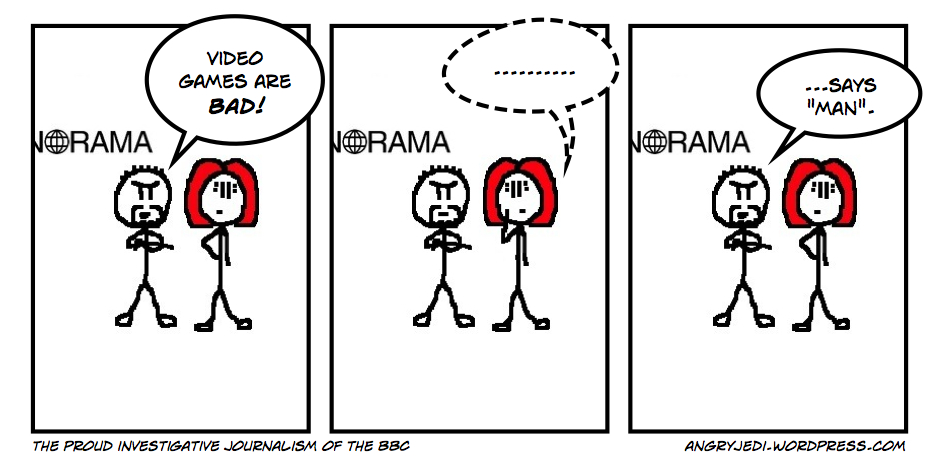
An hour ago, the BBC aired an episode of Panorama, our go-to investigative journalism programme, on the subject of video games. The subject, predictably, was the ever-present "are video games addictive?" question that has been raised and not answered many, many times prior to now.
The programme made a few fair points that are more common sense than anything else. Firstly, those with addictive personalities are prone to becoming addicted to games. Many games have in-built reward mechanics which those who get easily addicted to things will… well, get addicted to. Social games like Farmville, MMOs like World of Warcraft and popular multiplayer titles like Call of Duty all take great pains to ensure a regular stream of rewards and gratification being sent in the player's general direction. Whether it's a "medal", a "completed quest" or simple experience points, there's a constant flow of something that leads the player to believe they're achieving something. Those who become addicted to things easily can use that as a justification.

Secondly, the programme pointed out that parental controls need to be used more effectively. Many children and teenagers are given free reign on their use of video games and as such don't limit themselves on how much to play, to the exclusion of other things. Parents need to get better-informed about the facilities available to them to control their children's playing habits. This is, sadly, something that many parents are very resistant to, despite the fact that the tools are there for use, particularly on the Xbox, which offers some of the most robust family controls that there are—as does the Mac, oddly enough.

There were no concrete conclusions drawn, however. The "conclusion", if you can call it that, was that more research was needed from an independent body.

The thing is, this discussion has been going on for decades now, and no-one has thought to actually do that research in an appropriately investigative and non-biased manner.

I was reading through a few Formspring answers from Leigh Alexander (I think) the other day and she made the very good point that those of us out there who write about games can't be called "journalists" in the same sense as those who write for, say, national newspapers on breaking stories. Our role as members of the games press involves reporting on carefully-disseminated information provided by PR companies, critiquing products on general release (occasionally before general release) and sometimes interviewing a developer from the industry. There's no real "investigation" there, there's no hard-hitting stuff. That's not necessarily a bad thing, but given that mainstream media tends to come down on the more negative side of the fence when investigating gaming, I think there's certainly scope for a counter-argument: someone who does know the industry well investigating the burning issues. And investigating them thoroughly using established journalistic, sociological research techniques.

Who's going to be the first person to step up and do that, though? More to the point, would anyone read it or take it seriously? Gamers, by their very nature, are defensive creatures, having been made out to be "the bad guys" by the mainstream media once too often. And those not "in the know" are often inclined to have their minds made up by sensationalist stories in the aforementioned mainstream media.

What we need is balance. What we need is a hero.

Wait, what?

#oneaday, Day 322: Chinese Whispers

Goodness me. Thank you to everyone who read yesterday's post, including the unprecedented 602 of you who showed up today. Whether or not you agreed with the sentiments therein (and whether or not you were polite about it), thanks for reading.

There have been some interesting developments in the whole thing over the last 24 hours or so. On the whole, the whole thing can actually be said to have had a positive outcome, though not quite through the means the originators of the meme intended.

In fact, the originators of the meme had nothing to do with the NSPCC, as predicted. Fellow blogger, Commodore 64 enthusiast and all-round fine, upstanding gentleman Glen McNamee did a bit of research on the issue and uncovered the fact that the whole thing had actually originated in two separate places in November as a bit of fun, with no charity links whatsoever. Read Glen's blog post about it here.

Dave Gorman also wrote an excellent post on how this sort of thing can undermine genuine fundraising attempts with honourable intentions. Also worth a read.

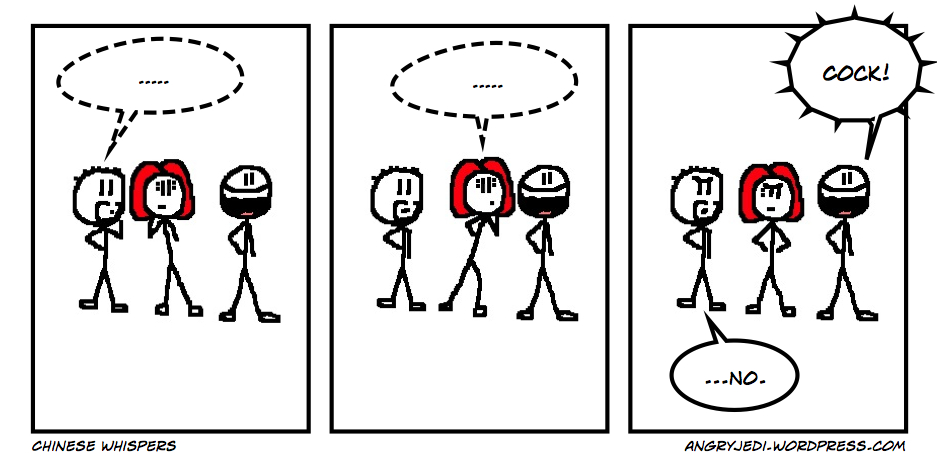
The interesting thing about all this, though, is the whole "Chinese Whispers" nature of it. By looking at people who had changed their avatar/status throughout the course of the day, you could see the gradual evolution of the whole thing. To start with, it was a "campaign to end child abuse". Then it was a "campaign by the NSPCC to end child abuse". And by the time people like me had written posts on the topic pointing out the flaws in the whole plan, people were taking great pains to explain that as well as changing their avatar, they had, in fact, donated, too. There were also a few people who were up-front about the whole thing and said they changed their avatar purely because they thought the cartoon characters were cool. Fair play to both parties; at least you're being honest. There was also a considerable proportion of people around Facebook who tried to convince everyone that the whole thing was a scam by a bunch of paedophiles aiming to lure children in with cartoon avatars. This last part is bollocks, by the way, in case you were worried.

So on the whole, the whole thing had a positive outcome. It provoked discussion (or rather, argument) and had the net result of shaming at least a few people into tossing a few quid the NSPCC's way, which I'm sure they're very grateful for, though they probably wouldn't have chosen to go about promoting it by people yelling at one another.

The thing is, though, couldn't the whole thing have been resolved without the need for drawn-out arguments in the middle of it? Probably. It's ironic; Web 2.0 is full of narcissism and vanity, but is also a breeding ground for sheep mentality. Some people copy and paste things or blindly follow instructions without considering the implications. Think before you post!

Let's leave it at that. The matter's over and done with. Resolved. Until everyone forgets about it and it happens all over again. When that does happen, just remember that famous and rather offensive comment about arguments on the Internet and the Paralympics.

Also, don't be a dick.

#oneaday, Day 321: Charities Have No Use For Your Avatar

Are you morally-conscious? Feel like you should be doing more to help your fellow man, but feeling a bit strapped for cash at the moment? Don't feel like putting together some sort of fund-raising event because, after all, it is a bit cold outside and it might snow.

Never fear! Web 2.0 is here to allow you to assuage your guilt without any need for financial or time outlay! All you need to do is change your profile picture and/or status to something vaguely related to the charity that you would like to support and that counts as you having Done Your Bit when it comes to Judgement Day. Me? I like the Cats Protection League, so I shall be donning a LOLcats avatar for the day.

Grumble, moan etc. I know. And I have a sneaking suspicion I may have mentioned this before.

The above piece of sarcasm is proudly sponsored by today's Facebook and Twitter campaign to get as many people as possible to change their avatars to their favourite cartoon characters of the 80s or 90s. This, apparently, counts as you "joining the fight against child abuse", and has been attributed to the NSPCC by several people. Go look at the NSPCC front page right now. Do you see any mention of any campaign "not to see a human face on Facebook until Monday, December 6th"?

No. I certainly don't. Probably because it actually has nothing to do with the NSPCC whatsoever, and probably because the NSPCC would rather you got off your arse and either did something to raise money for them or just reached into your pocket and sent them a tenner.

"Donating" your Facebook status or a tweet means nothing. And the "it's just a bit of fun" defence is bollocks, too; there are plenty of people out there who feel like changing their avatar (a task which takes, ooh, a minute at most?) and/or copy-pasting a status is absolutely "doing their bit" and absolves them of any sense of responsibility, putting them on the same level as someone who has diligently, say, organised a sponsored run, bake sale, 48 hour Desert Bus marathon, three-week charity wankathon, whatever. It doesn't.

This isn't a rant saying that everyone should donate to charity. I don't—at the moment I can't afford to. It's up to everyone whether they would like to support a charity that deals with an issue they feel strongly about. But "supporting" that charity means just that—supporting them and the work that they do. That means giving them some money, or some of your time, or just walking into one of their shops and buying a dodgy velvet jacket for a 70s night or something.

It doesn't mean changing your fucking avatar. How many people out there copy-pasted that status and changed their avatar and then felt all smug and self-righteous before going on to do other things, forgetting all about the fact that they hadn't actually donated any money to the charity in question, who probably had nothing to do with the campaign in the first place?

So don't let me stop you changing your avatars to your favourite cartoon characters. If you do, though, at least be honest about why you're doing so—perhaps you think Superted is awesome, in which case, say so and don't hide behind some kind of false altruism—or actually follow up what you're doing with a donation.

Rant over.

Actually, no it's not.

Girls, next time you feel tempted to post something that the "men won't get" in an attempt to "promote breast cancer awareness", realise that we all know what you're doing and would again much rather you just donate to a worthy cause like MacMillan, rather than supposedly "raising awareness" by being deliberately obtuse. How the fuck does that even work?

Rant over. For reals, yo. Take care of yourself. And each other.

#oneaday, Day 320: Achievement Locked

I've just done something I haven't done for a while. I've beaten a game with no Achievements. No, I don't mean that I played the game so terribly that I didn't get any Achievements (I don't think there's a single Achievement-supporting game out there that will allow you to do that)—I mean I started, played, enjoyed and beat a game which did not support Achievements of any kind, be they Steam Achievements, Xbox Achievements, PSN Trophies or a built-in Achievement-like system.
Said game was Recettear: An Item Shop's Tale, which I enthused about at some length a few days ago. I beat it tonight, but there's a load of stuff after the ending, too, so this isn't the end of my time with the game. I am, however, glad that there were no Achievements along the way.

Achievements are generally considered to be a good thing. And for some games, they are. Freeform games like Crackdown use Achievements to encourage players to try crazy things that they might not have thought to do otherwise. Skill-based games like Geometry Wars use Achievements to display player skill. But when you get into the territory of "Fire your gun 500 times", you know it's getting a bit silly.

I played Oblivion a while back and greatly enjoyed it. I got all 1250 Achievement points in it. The thing is, though, that wasn't the whole game. There are tons of sidequests in Oblivion which don't have associated Achievements. How many people do you think bothered to do them? Not many, I'd wager.

Achievements often direct your experience and encourage you to play in a specific way. For some types of game, that is good. In others, it's not. Part of the joy of Recettear is the discovery of how different things in the game work. Over time, you naturally figure out which customers you can get away with charging a bit more to, which ones will come in at what times of the day, which products appeal to which people and all manner of other things. Even the adventurer characters you can take into the dungeons have their own individual quirks for you to learn. As soon as you add Achievements like "Sell 20 Baked Yams" to that mix, you start playing differently in order to get that Achievement. You start focusing on becoming the best damn Baked Yams supplier there ever was, to the exclusion of more profitable things like treasure and adventuring equipment.

Achievements are, on balance, a good idea, I think. They provide an additional reward mechanic above and beyond that which the game should be offering anyway. But it's when they start to take over, to become the most important reward mechanic—more than the inherent rewards built into the game itself—that things aren't quite right with the world. It's a fine line, and I don't think making the support of Achievements mandatory is the correct way to be. Or if there's no way around that, let's see more games like DEADLY PREMONITION, which simply has an Achievement for beating each chapter, one for each difficulty level and one for 100%ing the game. Nothing more. Nothing more needed. Even then, I'm pretty sure there will be at least one person out there who will go back and replay the whole game just to get all three difficulty level Achievements. That shouldn't be why you replay DEADLY PREMONITION. You should replay it because it's awesome.

So, anyway. Don't be afraid to pick up a game with no Achievements. You might be surprised. Games can be fun without having to tell you how awesome you are every ten minutes.

#oneaday, Day 319: Report This Post, It Contains Opinion

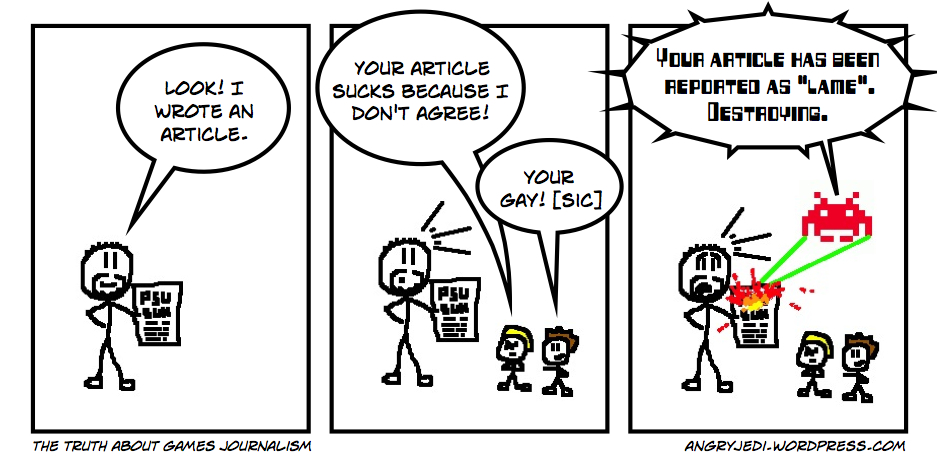
There is an increasingly popular—and increasingly worrying—tendency for games journalism and writing about games (which some people are keen to point out are two different things) to be judged as "broken" or "lame".

On paper, you can perhaps understand why this is. Gaming is one of the most popular subjects for wannabe writers to pebble-dash the Internet with, and there are so many people out there who want to do it "professionally" that a good 90% (I made that up) of gaming-focused sites out there can't even pay their writers, however awesome they are. As such, there is a lot of crap out there, but it's generally quite easy to spot, and there's certainly no need for sites like this.

Fellow #oneaday-er and all-round lovely grumpy chap Ian Dransfield of Play Magazine wrote an impassioned rant on this subject. I highly recommend you go and read it. Now. Go on.

I agree with the Dransfield. No kind of journalism should be homogenised, automaton-written garbage. It should have scope for individual opinion and comment, and certain outlets should have the opportunity to develop distinctive "voices" on the matter. It's worked for our newspapers for years, after all—for all the shit everyone gives the Daily Mail about their bizarre and often misguided opinions, at least they stick to their guns. Similarly, were the Daily Express ever to write about anything other than Princess Diana, the nation would be in uproar.

One of the things that bugs me most about today's games journalism is the plague that is N4G. For the uninitiated, N4G is a community-driven news-aggregation service. Community members may post articles to a "pending" queue, and they then have to get ten "approvals" in order to show up in the main news feed.

Fair enough, you might say. It separates the wheat from the chaff, surely. And surely the people who have approval rights must all be published professionals, right?

Wrong. Anyone can submit any page to N4G with no requirement that the article be your own. Get three articles approved by the community (a simple case of rounding up ten Twitter/Facebook friends to help you) and voila—approval rights. This then means that your opinion has as much weight as someone who's been doing the job for fifteen years.

This may still not sound unreasonable. So let me show you the drop-down menu of options available for "reporting" an article if you believe it to be "inappropriate":

Yes, you have read that correctly; one of the options for reporting an article as unworthy of appearing in the N4G news feed is that it is "lame".
N4G is seen as a primary means of promoting games-related articles, and sure enough, it does seem to generate a lot of hits for sites, so I can't fault those people who do take advantage of it to get more readers to their sites—fair play to you. I can say with some honesty, though, that I have never used it as a place to go to find out the latest news. The whole thing is too chaotic, too run by people who write comments after reading only the headline and not the article and—ugh—it makes me mad, I tellsya. I can't take it seriously in the slightest.

My main issue with it is one of the things Dransfield points out in his article: who are these people to say what is and is not "relevant"? What gives them the right to brand something as "lame" simply because it doesn't have "HALO IS A REALLY COOL GUY" in the headline? What gives them the right to ignore a supposed "duplicate article" on a subject which offers some opinion or additional facts over and above what has already been written first, in haste?

Absolutely nothing. Traditional news outlets and even longer-established specialist press (such as publications for music and films) aren't held to account in the same way. But games journalism, being a younger industry, seems to be held to entirely different standards, and judged unnecessarily harshly. There is a lot of negativity surrounding the games press, and not enough positivity. Trolling and flame wars are particularly prevalent on articles about games, and platform-specific articles seem to bring out the very worst in the community.

Here's food for thought then: in a world where we're so concerned about free speech a goodly proportion of the Twitter population in the UK (and beyond) is supporting the legal fees of someone they've never met, why are we so harsh on this particular breed of writers? Why shouldn't they be able to write what they feel, rather than what will "get hits"?

If you would like to share this post with the community, then please feel free to make use of the buttons below.

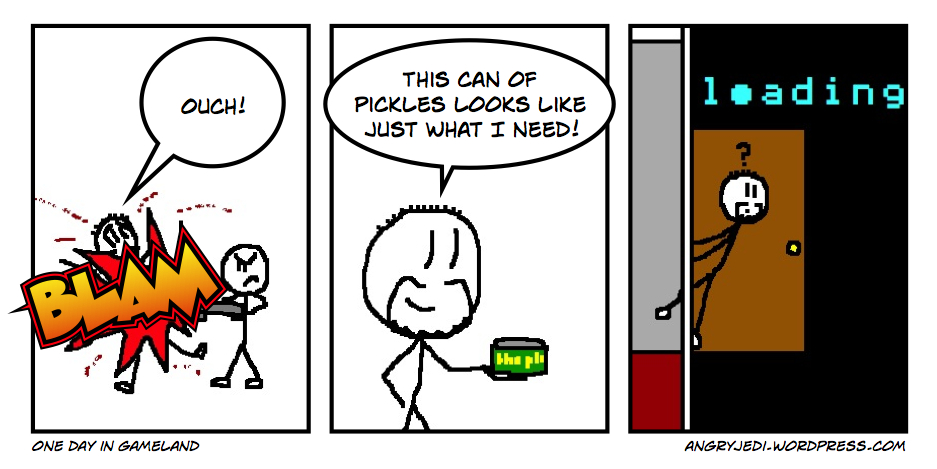
#oneaday, Day 318: One Day in Gameland

In discussing Deadly… I mean DEADLY PREMONITION with a couple of others recently, we came to the conclusion that the universe of games has such a distinct logic, such a distinct culture, that you could probably write an entire treatise on the culture, physics, metaphysics and theology of Game-Land.

I will settle for one blog post.

  • When you wake up in the morning, any and all injuries, however serious, will be completely healed, unless you make your home in a post-apocalyptic wasteland, in which case you will either need to give yourself an injection in the affected limb or visit a doctor, who will be able to heal absolutely any injury and make you completely intact within a matter of minutes.
  • If there is food on a shelf, pick it up. No-one but you needs to eat.
  • By extension, eating food also heals injuries, unless you're in Greenvale.
  • If you're in Greenvale, no-one gives you a second glance if you're standing in the middle of the road chugging back a can of Hollandaise sauce followed by wolfing down a turkey sandwich which cost $75.
  • People only open doors if they absolutely have to and frequently just walk through them instead. This includes you. If you were planning on going outside, open the door, wait for 30 seconds, then step outside. Otherwise there will be nothing to walk into and you'll simply fall into the void, never to be heard from again.
  • You can survive approximately 1.5 point-blank shotgun blasts directly to your face without permanent disfigurement.
  • In fact, you can survive any injury without permanent disfigurement.
  • If something "really important" is about to happen, no-one will mind if you do something else—anything between popping out to shop for some groceries to going on holiday to the other side of the world. The "really important thing" will still be "about to happen" when you get back. Enjoy yourself for a while.
  • After completing a repetitive task such as stuffing envelopes or chopping onions, you will notice yourself getting noticeably better at said task at increasingly-longer but predictable intervals.
  • Chop 200 onions in a row without hurting yourself for a special prize!
  • Sometimes when you talk to people you will have to read something they've written on a piece of semi-transparent plastic while they flail their arms around like a Thunderbird.
  • Occasionally, people will sound like they are speaking Japanese at you, but the semi-transparent piece of plastic will have English writing on it.
  • All shops you visit will sell exactly four items in an extremely niche category, but will purchase anything you have in your pockets/backpack/suitcase/on the back of your pack mule.
  • On that note, you will own a backpack which is capable of holding twenty suits of armour, four hundred weapons of different varieties and up to 99 bottles of each and every liquid you find. This backpack is invisible.
  • You will never, ever need to go to the toilet, even if you have drunk all 99 bottles of one particular liquid, unless 1) you feel like you are being forced by a giant green diamond above your head to do things in your own home that you probably would have done anyway, 2) your son has been kidnapped or 3) you know, or are about to come into contact with, someone whose son has been kidnapped.
  • Anything red will heal all your injuries if you imbibe it somehow.
  • Anything blue will make you less tired if you imbibe it somehow.
  • People with long white hair are always evil, even if they seem to be quite nice chaps.
  • People with short white hair are often sullen, but good people.
  • People with spiky hair or who are bald are probably on the way to save the world, especially if they are carrying a sword and/or a gun. Be nice to them.
  • Be careful when stacking shelves: lining up three or more of the same thing in a row always causes them to disappear. Stack tins of soup in a checkerboard pattern to prevent this from happening.
  • Pick up every flower, bird feather, human-looking bone or flag that you see: there will be someone somewhere in your neighbourhood who will give you "something good" if you bring them enough.
  • Having a conversation with someone doesn't require any actual interaction on your part. Just bump into them and they'll tell you something about the nearby caves, forest and/or the local big corporation.
  • Talking to yourself is absolutely fine. You may either do this by voicing your internal monologue, especially when looking closely at inanimate objects, or keeping a semi-transparent piece of plastic and a marker pen in your invisible backpack at all times.

Sounds like a simple life, doesn't it? Ah, if only we could apply game logic to the real world sometimes…

#oneaday, Day 317: Snow Joke

First up: DO YOU SEE WHAT I DID WITH THE TITLE IT'S CLEVER AND FUNNY AND BUGGROFF
Ahem. Anyway. It has been snowing. It being winter, it thankfully hasn't caused anywhere near as much panic as the last time it snowed, when it was headline news pretty much 24/7. Granted, it did snow quite a lot, though I got the impression that Canada and Scandinavia and, err, other places it snows a lot were laughing at us quite a bit for our complete incapability to deal with a bit of the white stuff.

Snow is a mixed bag. Some people love it, others hate it. As with most things, though, there are good and bad things to it.

Bad: cold.

Good: pretty.

Bad: wet.

Good: inspires creativity.

Bad: receiving a snowball.

Good: sending a snowball.

Bad: walking when dressed inappropriately.

Good: walking when dressed appropriately.

Bad: driving.

Good: not being able to drive and getting a day off work.

You get the picture.

It actually snows here in the UK—at least in places where I've been living—rather less than you might think, with whole years going by sometimes without a trace of the cold stuff. Even so, it always astonishes me quite how surprised people seem to be when there is even the slightest bit of snowfall. It inspires panic buying and the importing of grit. Grit! The stuff you find on the ground. Yeah. Ridiculous.

I just went out for a run in the snow. It's cold, snowy and icy. It is also difficult to run in, though I found that after about ten minutes or so, I didn't feel it any more. This was perhaps due in part to the number of layers I was wearing (which probably also contributed to my relatively slow speed tonight) but also due to actually being active. Or perhaps I was just so frostbitten all my extremities had fallen off.

I have one particularly enduring memory of the snow from my childhood: out in the garden with my brother and some of his friends, carving a lovingly-crafted likeness of Arnie from snow. This lovingly-crafted likeness of Arnie was wearing a jock strap which was lovingly carved with a little bit too much care and attention, as I recall, but the finished product looked awesome. There are probably some photos floating around somewhere, but this was the days long before the Internet, let alone Facebook, so you won't find those pictures anywhere online.

Most recently, my experiences with snow have been negative. Driving in the snow is particularly unpleasant. I recall one night I was driving home from the school I worked at at the time—a trip which normally took about 50 minutes—and it took six hours. Six hours. At least one of those hours was spent in a genuinely terrifying position halfway up a steep hill with traffic in front and behind, praying to God that my brakes worked properly.

Right now, though, I can look out of the window at the thin white covering on the street and admire its pleasantness. All the more so having just been out in it.

Doesn't stop it being bloody freezing even inside, though. Wrap up warm.

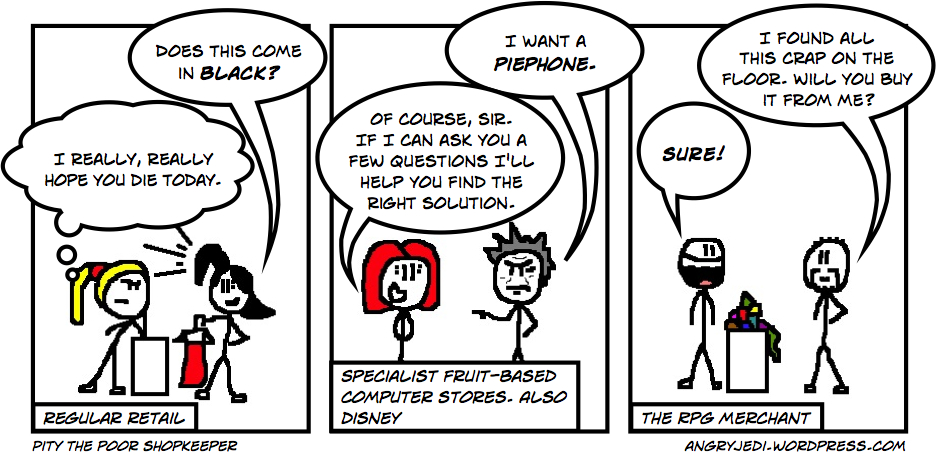
#oneaday, Day 316: Pity The Poor Shopkeeper

The poor shopkeeper doesn't have it easy, whatever form they take. If they're a retail monkey working for minimum wage in some sweaty hell-hole where chavs repeatedly come up and ask if the nearly-black garment they have in their hands is available in black, then they're probably losing the will to live by the second. If they're working in a, shall we say, "premium" retail environment they're probably having a better time but rapidly growing sick of the fixed grins they're forced to wear, not to mention the stock phrases that spew forth from their mouths like some form of verbal effluvia.
And then there's the poor, downtrodden RPG merchant, forced to sell all manner of crap, apparently only to adventurers, who then helpfully restock them with an endless supply of boar intestines, bits of wood, crystal chippings and used swords that they don't need any more. It must be a difficult life. And frequently a tedious one, as anyone who entered the online world of Ultima Online with lofty ambitions of owning a huge retail empire will attest.

It's this odd premise that quirky Japanese indie game Recettear: An Item Shop's Tale (available on Steam, as well as directly from the distributor's website) decides to explore in great depth. Playing the role of Recette, an adorable young girl with an absentee father, it's the player's job to help her run a successful RPG item store and make enough money to pay off the debt her father left her with. She's not in it alone, of course. She has a fairy assistant named Tear. Tear works for the financial institution with which Recette's father took out the loan, "because fairies are good at administration" and is there to help Recette pay off the debt she's been saddled with. The two become friends quickly, but should Recette be unable to make any of the weekly payments she's required to, Tear will quickly repossess her house and leave the poor girl living in a box.

So far, so Animal Crossing, you might say. And you'd kind of be right. Except not. There really isn't another game quite like Recettear out there. There are games which focus on individual elements of the game, sure. But none which blend together such peculiar and diverse elements with such successful results.
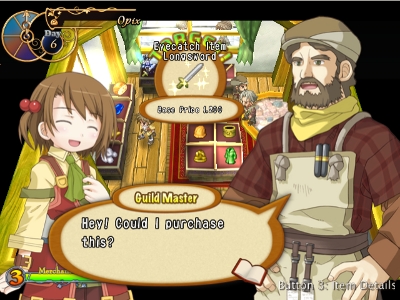
The game is split into three main sections. Firstly, there's the item shop itself. Recette can dump anything from her inventory onto the shelves in the store. Stuff in the window is likely to attract customers. If she chooses to open the shop, she has to deal with a flow of customers coming in and asking for things. If they're on display, all she has to do is agree a suitable price with the customer. If they agree, cha-ching. If they disagree, Recette has one chance to make a more reasonable offer before they leave.

Simple enough. As the game progresses, though, more elements are added to this formula. For starters, in true RPG tradition, people start selling stuff to Recette, too. This can be a good way for her to build up stock, as she can often get stuff for knock-down prices with a bit of shrewd haggling. Then people will place special orders, requesting that she deliver, say, three hats in two days' time. Recette has to not only make sure she has the hats in stock but also remember to have the store open when the customer plans to return. And finally, some customers will come in not quite sure of what they want, and Recette will have to make recommendations from the stock she has on display and in her inventory.

It's a straightforward mechanic, and you soon get to know how much certain customers are willing to pay over base prices. A few twists come in later with a news ticker informing Recette of increased or decreased prices in the market, but it's mostly a case of buy low, sell high.

If Recette chooses to leave the store, she can wander around town and occasionally bump into the people who frequent her store. These come in the form of random townsfolk and adventurers. Completing requests for adventurers will sometimes net her their Guild Card, which enables her to make use of them for expeditions to the local dungeons.

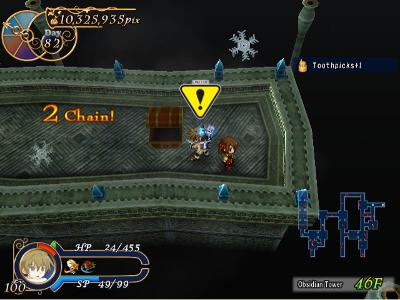
Yes, there are dungeons. Because sometimes the local markets just don't have the things people want to buy. When that's the case, Recette is free to pop down to the local Adventurers' Guild and hire one of the guildies she's made friends with. It's then into an action-RPG dungeon crawler to kick monster booty and gather lots of crap that people might want to buy.
It works, brilliantly well. The item shop stuff occurs quickly enough that it never gets tiresome. The storytelling scenes feature attractive artwork and a truly excellent localisation from the Japanese. And the dungeon-crawling, while simplistic, is fun and satisfying, broken up by regular boss battles and in-dungeon special events.

The whole game is distinctly adorable, but deceptive. The artwork, music and squeaky-voiced Japanese girls make it look like something which should be incredibly embarrassing and cringeworthy to play. But in fact, there's a distinctly acidic sense of humour underneath all the sweetness, and a large number of the dialogue exchanges are genuinely laugh-out-loud funny. The kawaii presentation coupled with fairly sophisticated, intelligent humour and a wonderfully self-aware nature reminds me a lot of the Disgaea series.

I'm probably about halfway through the game now, having made two of Recette's repayments successfully. There's the hints of a bigger plot at work, and a bunch of new characters have been introduced, most of whom will presumably end up being playable adventurers for the dungeoneering sections.

If you're after something that is both comfortably familiar and quite different to any JRPG you've ever played, then Recettear: An Item Shop's Tale is well worth checking out. I fully intend on posting a full review somewhere once I've beaten it.

#oneaday, Day 315: Mad, Bad, Sad, Glad Men

I started watching Mad Men recently thanks to the generous loan of the Season One and Two DVDs from my old school friend and fine, upstanding gentleman Mr Andy Plummer, with whom I met up with for the first time in nearly ten years recently. Of the last two times I saw Mr Andy Plummer, the first involved the pair of us, drunk as skunks, consuming a pound of Tesco Value Mild Cheddar cheese between us at about 3 o'clock in the morning. No bread, no crackers, just cheese. It seemed like a fantastic thing to do at the time. The second time involved someone (I forget exactly who, though I know for certain it wasn't me) vomiting copiously out of a mutual friend's bedroom window onto the corrugated plastic roof of their student house's conservatory. The next morning involved dangling a mop out of the window and attempting to remove the… actually, this is completely beside the point, not to mention disgusting so I shall leave the rest to your imagination.

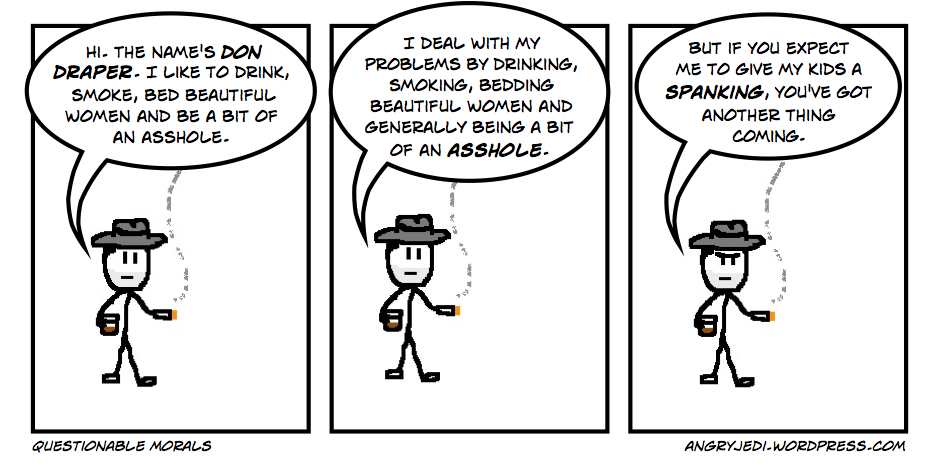
Anyway, Mad Men. I didn't know anything about it prior to watching it save that it was set in the 60s, featured the delectable and hefty-bosomed Christina Hendricks and involved a character named Don Draper. Beyond that, I just know that a lot of people whose opinion I trust and respect were going crazy over it, so I figured I probably ought to check it out.

I'm glad I did. I'm taking my time getting through the series as it's the sort of show that you have to pay attention to. The characters featured, while mostly obnoxious, chauvinistic pigs, are all individual and interesting, and you end up liking them against your better judgement. Or if not "liking", then at least being interested in seeing what happens to them next. Draper, in particular, has a lot of baggage which may go some distance to explaining why he is the way he is.

The upshot of the characters being such arses all the time is that when one of them does show some humanity and vulnerability, it's extremely affecting. Towards the end of the first season (trying to avoid spoilers here for those who intend to watch it), one character takes very ill, for example, and the fact he's shown to be a human being with real emotions as he faces his own mortality is a deeply affecting, poignant moment.

One of the best things about the show is its casual acceptance that it is the 1960s and Life Was Different Then. Characters drink and smoke to excess without a second thought. No-one has ever heard of "drunk driving", or if they have then no-one cares. Parents get their kids to mix their cocktails. Disciplining children through the medium of giving them a good hiding is accepted and even, in some cases, encouraged. And there are constant references to events that really happened throughout the time period. But it never feels like the show is ramming "IT'S 1960!!" down your throat—it feels like a natural, organic setting and after a few episodes of culture shock, you're right there with them. Just make sure you come out again afterwards.

If I could level a criticism at the show it's that I'm not sure where it's "going". It's very character-driven and there doesn't appear to be much of an overarching "plot" as such. This is fine, as I'm a fan of character-driven material, and the developments through which even minor characters in the show go are fascinating, entertaining, often amusing or tragic to watch. I've certainly found myself flip-flopping back and forth on a number of characters, thinking they were arrogant, greasy, disgusting assholes one minute and figures to be pitied the next.

Where it'll all end, I have no idea. But I'm certainly enjoying the ride so far.