#oneaday, Day 334: That Seems A Bit Expensive

Those who doubt the value of the iOS platforms as serious gaming devices should take a look at some of the stuff that's come out recently. The iPhone and iPod touch are becoming gaming powerhouses, and not just for portable versions of timewasters like Bejeweled Blitz and Farmville.

No, in just the last couple of weeks, we've seen some spectacular games show up. Epic's Infinity Blade, for example, provides spectacular graphics and a cool update on, of all things, Punch-Out!! Trendy Entertainment's Dungeon Defenders gives us an interesting multiplayer twist on both the action RPG and tower defense genres, despite being a little bit too ambitious for its own good on the small iPhone screen. (Stick with it past the tutorial, though; once you're done with the screen-filling tutorial text, the interface is still a little bit cluttered, but less burdensome). Lara Croft and the Guardian of Light provides the same experience as the console and PC versions—complete with co-op. And Aralon is pretty much Oblivion in your pocket.

Stop and think about those for a minute. Those are all pretty fucking impressive games to run on a phone. Things get even more impressive when you look at the prices for each—the most expensive of those mentioned is Aralon, which is three English pounds and ninety-nine pence. Compare and contrast with Oblivion, which launched at £40 on consoles.

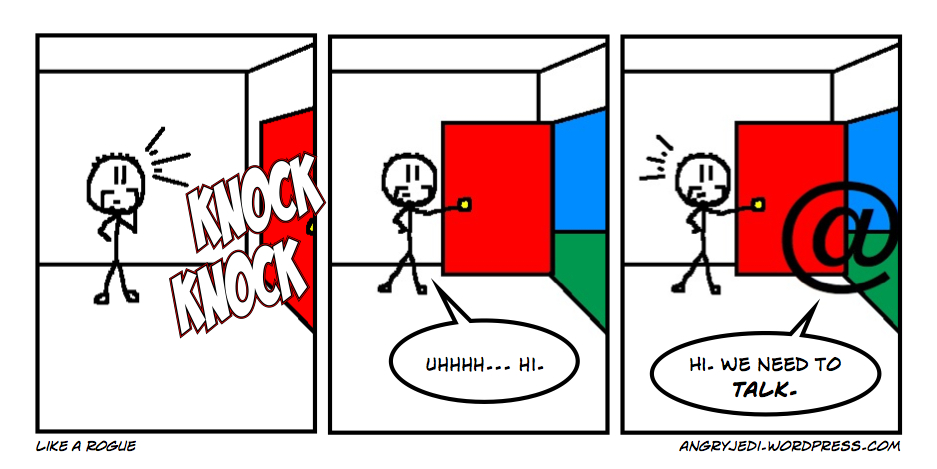
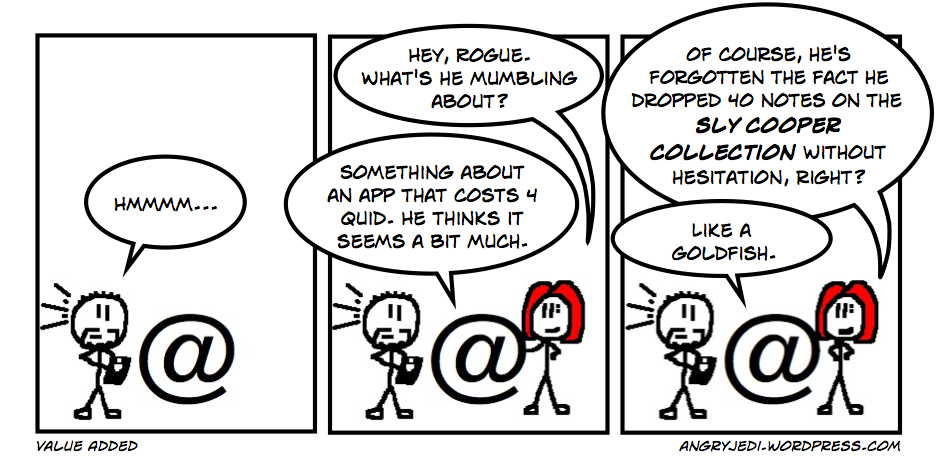
The thing is, though, the App Store and its customers appear to operate in some sort of weird parallel economy. Aralon's predecessor, Ravensword, sells for 59p and offers a pretty thorough RPG experience. And yet there are reviewers who say that they have "wasted their money" because it didn't have one feature they thought it should have in it.

Seriously. These people need to get a little perspective. 59p for 20-30 hours of entertainment is pretty outstanding value whichever way you slice it. £3.99 for the same amount of gameplay is still pretty fucking amazing value. There are games that are considerably technically inferior to these games we're getting on iOS devices now selling for £20-35 on the Nintendo DS. Ace Attorney on the iPhone is a tenth of the price it is on the Nintendo DS, and it's the same game. Lara Croft and the Guardian of Light is 1200 Microsoft Points on XBLA, whatever that means. It's 4 quid on the App Store. And again, it's the same game—except it actually shipped with co-op built in.

iOS gamers, you've never had it so good. At some point, developers will figure out that they're vastly undercharging people for these awesome games, and prices will rise. So stop bitching and make the most of these incredible experiences while they're still the price of a coffee in Starbucks.
#oneaday, Day 333: Internet Games #1: The TwitPic Game

You're sitting in front of your computer right now. You're either working, or bored, or wondering what on Earth you should do with yourself. You probably wouldn't be reading this otherwise.

So today, I present to you a simple and fun game which you can play whenever you've read the whole Internet and are at a loss for what to do next. It's a simple game, and there's no real "winning" as such. But it can be played solo, or as a social game with the aid of additional participants on Facebook, Twitter or the social network of your choice. You can even play local multiplayer with people in the same room, either hotseating on one computer, or with a collection of different computers.

The game is very straightforward to play. The image-sharing website "TwitPic" is used to share images on Twitter. The URL format for TwitPic is http://twitpic.com/stringoflettersandnumbersgoeshere. You can probably guess the rest, but for those of you who haven't cottoned on yet, simply replace "stringoflettersandnumbersgoeshere" with a code of your choice (keep it no more than 5 letters or numbers in most cases) and then see what out-of-context images you can discover.

Here's some samples from a quick go today:

http://twitpic.com/spack comes up with this delightful image of someone's dinner. The plastic tray and plastic cutlery seem somewhat at odds with the battered shrimp, corn and unidentifiable green shit in the corner.

http://twitpic.com/felch comes up with this image, with the caption "THIS. My cousin is me all over", worryingly, though as the astute commenter beneath the picture observes, there is no actual felching in the picture.

http://twitpic.com/crunk displays this disappointingly dull image of someone on their way to Charlotte for training. Unless Charlotte is a person, in which case the implied "training" which will be going on can take on an altogether more interesting meaning.

http://twitpic.com/arse gives us more food. People really love to show each other what they're eating on Twitter, it seems. It appears that one of the stereotypes about Twitter users is true.

http://twitpic.com/butts gives us a sleeping man. Why is he asleep? No-one knows. But the cameraperson is certainly very close to this sleeping man. Sleeping man also appears to not be wearing a shirt and have slightly flabby shoulders.

And finally, http://twitpic.com/dirty gives us a collection of jazz music, thereby confirming something we've all known for a very long time: the fact that jazz music is dirty. The internet has proved it.

This game also works with a variety of other sites, including imgur, yfrog and numerous others. For the truly brave, you could also try it with URL shorteners such as bit.ly and tinyurl. There's no telling where you might end up with those, and so that, dear friends, is a game we shall save for another day.

Found any awesome TwitPic URLs yourself? Do let me know. That's what them thar comments are for.

#oneaday, Day 332: Fire The Canon... He's Not Pulling His Weight

What are those games you have to play?
The answer, of course, is none at all, but there are plenty of people out there who believe that you can't call yourself a "true gamer" (whatever that means) unless you've played this game or that game. And for sure, at one point that was true, simply because the volume of games being released was such that it was easy enough to keep up to speed on at least all the big releases, if not absolutely everything that was available.

Nowadays, though, gaming is such big business that it's impossible to keep up with triple-A releases, let alone delve into the increasingly-awesome pool of independent and/or smaller titles out there.

Rather than this being a frustrating thing, though, this is a very positive sign. Speak to someone who's a film snob and they will probably turn their nose up at the prospect of a Michael Bay film, yet there are plenty of people out there who go and watch various childhood-raping movies that ensure you can never look at Transformers in quite the same way ever again.

And it's the same with gaming. There is no one set "canon" of games that you absolutely must play. I've come around to this idea, having had it first mooted by my good buddy and fine, upstanding gentleman Calin. There are games that are important to the history of gaming, sure. But they're not things that everyone has to play. If everyone plays all of the stuff from history that is supposedly "important", they'll never get to anything from today. It's a balancing act.

What I've been wondering is if it's possible for someone who is a full-on gaming enthusiast to spend their time playing nothing but non-triple A titles. Surely there are enough indie and "cheap-fu" titles out there now to enable someone to have an enjoyable experience without having to spend $60 a time for the privilege? And yes, I'm using dollars to illustrate my point because I'm in the States. When in Rome and all that.

This approach isn't for every gamer, just like watching only foreign and/or arthouse movies isn't for everyone who purports to "like movies". I love ASCII-based roguelike Angband, for example, and have sent any number of heroic @-signs to their death now, but I don't expect everyone to find that sort of experience palatable. I can certainly play that game and find it enjoyable, however, and there are times when I'd pick playing that over something like, say, Halo. I'd certainly always pick it over Call of Duty.

But there are people who feel the opposite too. And it's pretty cool that we've reached a stage where we can say that about the gaming industry. The only difficulty that comes with this territory is the fact that the gaming press is not able to cover everything that is out there, meaning some spectacular stuff can get completely overlooked, or sell poorly, or be unfairly judged.

This is where word of mouth comes in. You found something awesome you think friends might enjoy too? Tell them. Don't keep it to yourself. I know that I've convinced at least a few people to play Recettear: An Item Shop's Tale since I started banging on about it a few weeks back, and I'm sure there are others out there who might be interested in trying other things I've mentioned. Similarly, my obsession with Persona 3 and 4 can be entirely attributed to a blog post my friend Mark wrote extolling the virtues of Persona 3, a post which was enough to make me think "I have to play this game."

We're in an age of active involvement and active socialisation. The gaming press still certainly has a place—I should hope so, anyway, since I'm involved in it—but there's just as much importance, if not more, on word-of-mouth recommendations and discussion.

Think about the last game you played. Was it something you played because reviews were good? Because people were talking about it? Or something you took a chance on and then felt like telling everyone how good/bad it was?

In my case, the last two games I played (Recettear and DEADLY PREMONITION) were the latter two. I took a chance on Recettear and adored it. And I couldn't not play DEADLY PREMONITION after hearing some of my closest friends discussing it in appropriately reverent tones. I actually can't remember the last time I bought a game purely on the strength of a review.

#oneaday, Day 331: Like A Ro-ogue, Killed For The Very First Time

Horatio Spankington was one of several children to a Serf, and a credit to his family. He had brown eyes, curly red hair and a dark complexion, lending him a somewhat distinctive look that his father often joked would probably "end him up in some freak show somewhere".

He joined the ranks of the Paladins at an early age, and by the time he was 18 he had determined that it was time to go dungeon-delving. He rented a room in a small village above a notorious dungeon, and prepared for the long quest ahead.

One morning, he awoke, and his God spoke to him, granting him the power to detect evil things. Rushing straight for the stairs down into the dungeon, he was eager to try out his new power. Concentrating as hard as he could, he prayed fervently for sight beyond sight, to see where the evil things dwelled.

The effort caused him to faint out cold for a few minutes. When he awoke, all was as it was before, though he wasn't in a hurry to ask his God for anything else for a little while.

He pulled out the makeshift weapons and armour that he had acquired, and lit his torch. He looked around.

"What a boring place," he thought.

He looked around the room he found himself in and found a curious scrap of paper on the floor. It read "pro redam."

"Pro redam," he said out loud. Suddenly, he felt more knowledgeable, and figured that he could probably figure out exactly what the next thing he looked at was, whatever it might turn out to be. He stowed the magic scroll in his pack and headed for a tunnel in the wall nearest to him.

The tunnel was quite long, and went around several twisting corners, but eventually led him to a long, narrow room. There was a curious smell in the room. He gazed around, looking for the source of the stench and eventually found it in the form of a patch of grey mould. Figuring that he may as well cleanse the dungeon of filth as well as evil, he strode boldly toward the grey mould, broadsword in hand.

The mould let out a cloud of spores, which tickled his nose and made him sneeze. Undeterred, he whacked the patch of mould with the flat of his sword, dispersing it.

He looked around the room. There was nothing of interest here, save several tunnels in the walls. He chose one and strode valiantly into it.

After a couple of twists and turns, he came to a closed door. Trying the handle, he found it to be unlocked, so he opened it carefully and peered into the room beyond. He couldn't see anything in there, so he stepped through the archway and took a look around.

The room was pretty dark, so he walked along the walls, using the light from his torch to get his bearings. His first impressions were correct; there was little of note here. In fact, the room was more of a wide corridor, with two tunnels leading off in different directions at one side, and another closed door at the other.

He tried the handle on the door, and found it to be locked. Pulling out a safety pin he always kept for emergencies such as this, he inserted it into the lock and fumbled around inexpertly and to his surprise, succeeded in opening the door. He stepped through the doorway cautiously, unsure what he might find beyond.

The corridor beyond the door extended for a short distance and turned a few corners before opening up into a large, light room. This, too, was empty of interesting details, but there were tunnels leading off in a number of directions, along with another door in one wall.

Figuring that the doors hadn't steered him wrong yet, he headed for the door and tried the handle. It was locked, but again he tried his safety-pin trick and to his surprise, it worked.

Beyond the door was a long, twisting and turning corridor that seemed to go on forever. Eventually, it opened up into a long, thin room, and there was that terrible smell again. Another patch of mould sat waiting for him. Feeling bold, he charged for it.

Suddenly, an acrid black smoke filled his nostrils and stung his eyes. He tried to brush it away, but he couldn't. He tried to blink his eyes clear, but he couldn't see anything. The smoke was too thick. He staggered around blindly, setting off the trap several more times, stinging his eyes more and more each time.

The stench of the mould was getting stronger and stronger. He flailed wildly at the mould, trying to destroy it, but he felt the spores blow up his nose, into his throat, filling his lungs. He began to feel sick.

Something crawled on him. It felt blubbering and icky, and he heard a chewing sound. He still couldn't see, and the foul smell and darkness were confusing him.

He felt weak. Finally, coughing up blood and vomit, he barged head-first into a granite wall, collapsed onto his back and whimpered.

Horatio Spankington died just 50 feet below the surface of the earth. Few people mourned his passing, least of all the family of the drooling village idiot he claimed to have "accidentally" killed upon leaving a shop one morning.

The dungeon lay unconquered still. Many had come to tackle its dangers. None had survived so far.

Try it for yourself if you can stomach a bit of hardcore ASCII dungeon-crawling. Download Angband here.

#oneaday, Day 330: On Death And Videogames

Kids today, huh? Don't know they're born. Want everything on a plate. In my day, we died by touching a piece of wall that was the wrong colour. And then we had to start all over again!
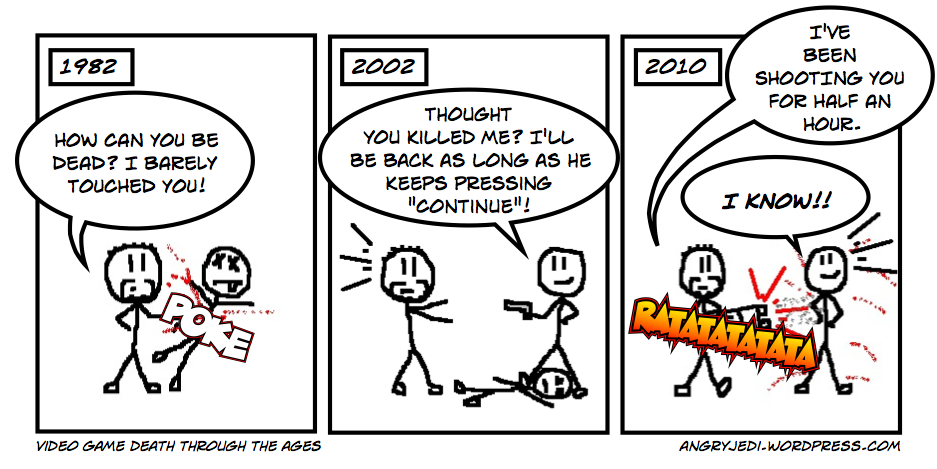
I am, of course, referring to the changing face of failure in video games. Failure happens these days, particularly in shooters, but nowhere near as much as it used to. And certainly the penalties are far less harsh than they used to be. In days of yore, you ran out of lives, that was it. A few years later, we started to see the arcade-style "credits" system in our home games. Later still, we had games in which you could continue indefinitely. And today, we have games in which it is almost impossible to fail because of the abundance of checkpoints, regenerating health and the like.

I picked up the Sly Cooper Collection for PS3 this week, and I've been playing through Sly Cooper 1. I was a little surprised to discover that it is a pretty punishing game. Our hero doesn't have a health bar and dies at the faintest hint of water, spiky things, fire or dogs with giant hammers. This was initially frustrating, but it was a simple matter to readjust to the way we did things in 2002. It was also marginally less frustrating in the fact that this was the era of unlimited continues, making the use of "lives" almost irrelevant.

I say "almost", because running out of lives does send you back to the start of the level instead of your last checkpoint, so there is incentive to take a bit more care. But it's not frustrating, particularly as the game is designed so well that any screw-ups are usually the player's fault, not the game's.

It got me thinking, though. The Sly Cooper Collection is bringing this style of gameplay to a whole generation reared on regenerating health—heroes who can simply hide behind a pillar until they wipe all the jam off their eyeballs—and is a very different approach to what people might be used to. While many modern games encourage experimentation and exploration, Sly Cooper punishes stupid moves by killing you immediately. This has the side-effect of keeping the player on track and discouraging them from going too off-piste or attempting to "break" the game (or, heaven forbid, encouraging those assholes who use the word "glitch" as a verb) but I can imagine it would be frustrating to "modern" gamers.

I understand the later Sly Cooper games do have a health bar, suggesting that the latter years of the PS2 may have started gamers' shifting towards being the pussies they are today.

Yeah, you heard me. Pussies. You don't know pain until you've got to the last level of Castlevania only to lose all your lives and have to start all over a-fucking-gain.

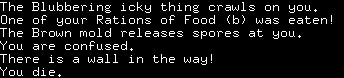
The nearest to this experience we have these days is in the humble roguelike, which has the decency to delete your save game once you die. Better not get too attached to that awesome set of armour you found, because this might happen:

And no-one likes to die by stumbling drunkenly into a wall, having had a blubbering icky thing crawling on them and brown mold spores spurting up their nose.

#oneaday, Day 329: Be A Dick Mode

With the increasing mechanical complexity and narrative ambitiousness of many modern games, it's easy to forget the purity of how gaming used to be. Just a player, a joystick, and an arbitrary number representing how "good" the player was at the game. In other words, the score.

Games with scores aren't dead, though. Far from it. And in this age of global communication thanks to the Internet, one could argue that games with scores are more relevant than they've ever been.

The reason for this? The hidden option that you won't find on any game's menu. The mode that allows you to compete against your friends and mercilessly taunt them when you prove yourself—with numbers—to be objectively better than them.

I am talking, of course, about Be A Dick Mode.

Be A Dick Mode crops up in many game, though it's not just any game with a score and leaderboards that it works with. Shatter on PSN and Steam, for example, is not an example of a game featuring a Be A Dick Mode, despite being in possession of leaderboards and scores which frequently extend into the hundreds of millions. Geometry Wars 2, conversely, has Be A Dick Mode in spades. After Burner Climax? No dick action there. Pac-Man Championship Edition DX? Dickishness in spades.

There are few games with a more powerful, potent Be A Dick Mode than Adult Swim's seminal two-button masterpiece Robot Unicorn Attack, however. It was bad enough when the game was first released on Adult Swim's website. Twitter became awash with screenshots of everyone's latest and greatest high scores.

But now, they've gone and embraced Be A Dick Mode with open, err, arms.

How have they done this, you may ask. Simple: put it on Facebook.

For all Facebook's faults, privacy concerns and stupid, stupid UI redesigns, the one thing that it is magnificent at is promoting friendly (and not-so-friendly) competition between diverse friends across the globe. The ability for Facebook applications to access your name, profile picture and activity in applications you have in common with your friends was a masterstroke, privacy concerns aside. There's nothing better than looking at a leaderboard filled with the real names and photographs (or avatars) of your friends and seeing yourself at the top of it.

And there's nothing worse than seeing yourself in second place, with first place tantalisingly out of reach. There's nothing worse than knowing that the next time you log onto Twitter, there will be an @mention in your direction inviting you to check out Facebook and suggesting you might want to play some Robot Unicorn Attack instead of whatever it was you were planning on doing.

And then you play Robot Unicorn Attack. And you fail to beat your friend. And then you play it again. And some more. And then you get annoyed, so you go and play Bejeweled Blitz instead, but then you realise that someone else has pipped you to the top of the scoreboard on that too, so you go back to Robot Unicorn Attack and play it until that Erasure song has burnt itself into your memory and you can't see a field of horses without wanting to sing and fart rainbows at them.

In short, Be A Dick Mode will ruin your life and the lives of your friends. But you know you wouldn't have it any other way.

#oneaday, Day 328: Hi, America

Hai, America. You know, I've been looking at you for a while and I thought, you know, you're kinda cool and I wondered if you'd, you know, like to hang out some time, maybe, and get a coffee or something. Cause, you know, I, like, think you're pretty cool. And stuff.

I'm serious! I like your food. You sure know how to do a good breakfast. It's a breakfast worth getting up for in the morning. Sure, a typically British bacon sandwich is all very well and good, but there's little that can beat a stack of pancakes, some waffles, some French toast or indeed the wonder that is Eggs Benedict, which I discovered the other morning after spending the night with you.

You know what else? And this is going to sound a bit weird, 'cause I wonder how many people compliment you on this, but I think your bread is awesome. Sure, you can get fancy-pants bread from fancy-pants bakeries in the UK, but your everyday sort of bread, the sort that you make everyday toast and sandwiches from? That's functional at best, dry and sawdusty at worst. You make me appreciate a good sandwich. And I like sandwiches at the best of times. But you make me appreciate them more. I like that.

You also seem to have the art of the takeaway down to a fine art. We Britons of Britainland believe that we are the masters of the Chinese and Indian takeaways, but I can honestly say that I think yours are better. Your Indian curries are creamy and smooth and delicious, and your Chinese meals are full of flavour and they come in those awesome little cardboard boxes with the lids that are a good shape to eat the food straight from with a pair of chopsticks, instead of those foil trays with the cardboard lids that are always way too hot to put on your lap.

Since we're being honest here, I don't like how you use the word "an" before words that start with an "h", which isn't a vowel, and you spell "aluminium" wrong, not to mention your seeming aversion to the letters "u" and "s". Also, as our beloved comedian Eddie Izzard says, "herb" is pronounced "herb" because "there's a fucking 'H' in it".

But you know what? I don't care. I can accept your flaws because they make you more colorful (see what I did there?) and interesting. I can accept that you use the word "momentarily" different to the way I do, and I think it's charming. All your sweet, nutty bread and pancakes and Hollandaise sauce on eggs and love of good coffee and ability to put free Wi-Fi hotspots in places other than Starbucks just make me think that, you know, you're pretty sort of kind of cool and I think it'd be, you know, nice if we could, um, spend a bit more time together. If you know what I mean.

#oneaday, Day 327: LOOK AT MY FACE.

There are people out there who are paid frankly obscene amounts of money to develop a company or brand's "social media strategy". This is a position that wouldn't have existed five years ago, yet now it's the new hotness. If you've got anything to do with marketing, social media is where it's at.
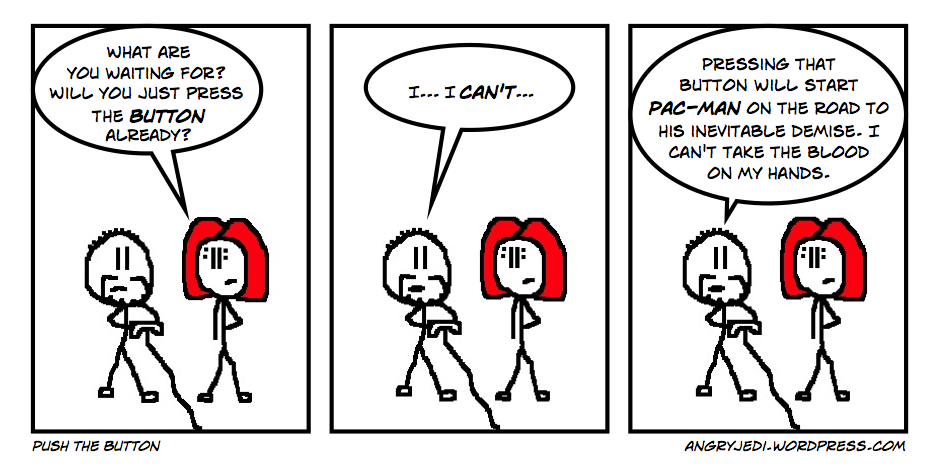
These "gurus" have come up with their own set of arbitrary rules about what "works" and what doesn't. Supposedly, following their bible of social media norms helps you to get hits and be more influential online. Perhaps they're true. But some of them strike me as a little odd.

Take the way social media news website Mashable presents itself on Twitter, for example. Actually, first of all look at Mashable itself. Not the most personality-filled site at first glance, is it? Sure, the personalities come out in the writing, but at first glance it looks like just any other tech news site.

So then, take a peep at Mashable's Twitter account. Notice anything odd?

Right. Despite obviously being the official account for Mashable the site, and posting little more than links to their articles with little to no interaction with their millions of followers, they have taken the inexplicable decision to present the site not as a site, but as the face and name of CEO and founder Pete Cashmore. Thus, when something from Mashable comes up in your Twitter timeline, depending on how you've got it set up, it looks like these links are being posted by a person, not by an automated RSS-to-Twitter doobriewotsit. But they're not. Unless there's a very bored intern at Mashable in charge of doing that.

Now, the theory behind this is that putting a human face on a Twitter account makes it inherently more "trustworthy". As anyone who's used Twitter before will know, bots are a pain in the arse and should be killed with fire, but it's usually reasonably obvious that they are bots. There's the odd exception, but for the most part, it's very clear.

So, with that in mind, isn't it actually rather more dishonest to post automated updates from a website pretending to be an individual person? I honestly can't understand the logic behind it. I'm sure some social media guru out there will be able to educate me. But I know that generally speaking, if I'm looking out for an update from a particular website in my Twitter timeline, I'll be looking out for that website's logo, not some bearded guy with a slight sneer.

Unless Pete Cashmore thinks he genuinely is the logo for Mashable, in which case the website should replace its header with a GIANT PICTURE OF HIS FACE. Possibly with a big flashing logo saying "OBEY".

Maybe.

#oneaday, Day 326: Time Zone Trauma

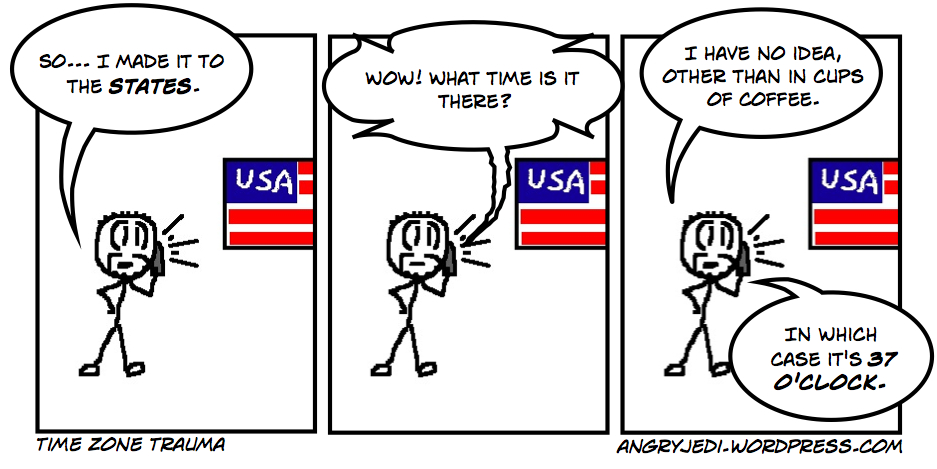
It's rather late, I know. Although it's not late where I am, because as I may have intimated rather subtly above and in a post a few days ago, I'm in the States. Yayness, as Recette might say. In local time back home, it's currently 4:30am, while here it's 8:30pm. I have been up for over 24 hours. Hardcore.

Time zones are a bugger at the best of times, let alone when your own body clock is buggered beyond all recognition. There are a curious mix of influences at work here, as a combination of insomnia, stress, depression, lack of desire to go to sleep any earlier and friends in time zones other than my own all conspire to bugger up my sleeping patterns. In fact, I'm actually anticipating that I'll sleep better and at more "normal" times here than back home.

Before I left Southampton, I got chatting to a very lovely person online who happened to live in mountain country in the US. We were frequently up until 4 or 5am GMT talking about things, and that made getting up the following morning rather more difficult. However, being jobless and, at the time, shortly to be homeless, there didn't feel like much of note worth getting up for in the mornings. So, well, I didn't. Actually, I haven't heard from her for a while, so after writing this post I will email her, you see if I don't.

This had both benefits and drawbacks. Benefits included the ability to play Alien Swarm online with people I didn't normally have the chance to play online with. Which was nice. Drawbacks included going to the local shop in the afternoon, the man with the smelly armpits behind the counter asking "how my day had been" and me being able to answer quite honestly that it had been just fine, conveniently omitting the fact that I'd actually spent most of it asleep.

A mixed blessing, I'm sure you'll agree. But at least the shop was open until 10pm in the evening, so even though my day was 6 hours out of sync with everyone else, I could still, you know, buy bleach. Exciting is the life of the unemployed.

I'm actually quite looking forward to (hopefully) getting back into some semblance of normality if (when) I get a job. That or I should just move to the States, which I know there are a number of you currently reading this would be a plan you could firmly get behind. Well, I've got nearly a month to enjoy being on Pacific Time, so we'll call it a test run or something.

So then, who wants to sponsor my visa application?

[If the comic looks a bit different, it's because I forgot to bring my template with me. Whoops. Ah well. I got it near enough.]

#oneaday, Day 325: Interactive Fiction

There's a lot to be said for interactivity (or at least the illusion of interactivity) in storytelling. It allows things to be done that are simply impossible with non-interactive media such as books, TV and film.

I spent a couple of hours this afternoon playing Digital: A Love Story, a wonderful game set on the desktop of an Amiga "five minutes into the future of 1988". If you haven't played it yet and are intrigued by the premise, I suggest you play it before reading on, because I'm probably going to spoil some things about it. I'll try not to be too explicit.

At the outset of the game, the player is the proud recipient of a brand-new "Amie" computer with a built-in modem. Your benefactor also provides you with a phone number of a BBS that you might want to check out. And so the story begins with the player dialing into the BBS, complete with terrifyingly authentic-sounding dial and modem tones screeching from your computer's speakers. The player quickly gets friendly with a person named Emilia and things develop quickly in a manner that will be immediately familiar to anyone who has ever had an online relationship.

All is not as it seems, however, and the player, through a bit of investigation, discovers that there are strange things at work. The BBS crashes, and there is no way of getting in contact with Emilia. Just prior to the crash, she said she was "leaving home" and "getting out". Thus begins a quest across several BBSes, ARPANet and Sprint's long-distance calling-card system to track down Emilia and discover what happened.

The game is completely linear. Things happen in a set order, right up to the ending, when the player is faced with an inevitable conclusion that there really is no way around. At this point, we reach one of the most powerful things that gaming can do, and ironically one of the least interactive things about narrative games.

Offer the player the opportunity to do two things: do something, or walk away. Walking away is usually not an option, though Heavy Rain managed to convincingly offer this as an alternative at several points throughout its narrative. Digital: A Love Story, however, makes it abundantly clear that there is only one course of action open to you, and it's an unpleasant one. Given the great pains that the game has taken up until this point to make you "feel" for the characters involved, despite being based around screens of text, it is difficult to make that final mouse click.

This is something you just can't do with a book. Stopping halfway down the page and printing "Turn the page to see what happens next" is not an established literary convention, nor should it be. Same with TV and film; with those media, we're just along for the ride. It's the reason very few books save the Fighting Fantasy and Choose Your Own Adventure series are written in second-person perspective.

But with a game, the player has been driving the story all along, even if there is only really ever one thing they can do at a time to advance the plot to the next "event". That illusion of interactivity allows the player to be all the more invested in the story, as if they're part of the game world. This is further aided in titles such as Digital: A Love Story, which don't break "character" for a moment. As far as the player is concerned, they're using an Amiga… sorry, "Amie". They're not playing a game, they've been transported back in time to 1988, a land of 320×200 graphics, questionable multitasking capabilities and scanlines.

The ending of Digital: A Love Story is bittersweet and if you've engaged with the game up until that point in the way it is intended to be engaged with, you'll find it genuinely emotionally affecting. It's always interesting when a title which looks so unassuming can actually end up being more powerful than self-consciously "epic" CG cutscenes and over-the-top orchestral music with people singing in Latin.

So, if you remember 1988, if you ever had an Amiga or you remember the golden age of the BBS, check out Digital: A Love Story. It's free, and well worth your time.