#oneaday Day 719: Being a Further Missive on the Excellence of Community (the Televisual Entertainment Programme, Not the Social Concept)

I've now watched every currently-available episode of Community, in some cases more than once. And doing so has confirmed the show as a new favourite, ranked right up with Spaced and some of the best of recent British comedy.

(I'm going to get mildly spoilery at various points throughout the next few paragraphs, so if you care about that sort of thing, then stop reading now.)

Here's why Community is so wonderful, then.

First up, it strikes the perfect balance between the mundane and the absurd. The main cast's backstories are all somewhat tragic and quite serious in some cases, but the situations into which they all get are frequently bizarre, odd and downright hilarious. But when the time comes to drop the stupidity and "be serious" for a moment, the show always manages to do so with dignity and without feeling overly "preachy". Jeff's speeches are a predictable part of the show — so much so that the characters even reference them on regular occasions — but they often provide a good amount of "closure", either to an episode, or to one act at least. In some ways, it's like South Park, with bizarre, frequently borderline-offensive humour punctuated by material which is making a point — be it satire, moralising or simple observations on life.

Secondly, the characters themselves are interesting and well-defined. They all have two specifically-identifiable features: a character trait and their appearance. Every character has their own unique way of responding to the situations the group comes across, and every character has their own unique, instantly recognisable look. This isn't to say they become predictable, however (Jeff's speeches notwithstanding) — on a number of occasions we find out more about them when they don't do what we expect.

Britta is a particularly good example of this. In the first episode, she's introduced as "the hot girl", the impossibly beautiful eye candy whom all the male viewers would very much like to… well, you know. Jeff (the impossibly beautiful eye candy whom all the female viewers would very much like to… etc) wants to get into her pants, so he sets up the fake study group, thereby setting up the whole series. It'd be easy for the show to have been all about those two, with both Jeff and Britta remaining somewhat shallow, predictable characters. But any time we see Britta making the hideous social faux pas that she becomes known for ("turning it into a snake!"), we suddenly have sympathy for her. She's no longer the unattainably attractive perfect blonde girl, she's a human. Jeff finds himself the subject of similar sympathy on a number of occasions throughout, though generally not for making social faux pas.

Thirdly, and continuing on the subject of the cast, the chemistry between them is excellent, and a real highlight of the show. The show doesn't make a big deal out of the blossoming, budding, potential relationships among the group — it's somewhat more natural, and that's what makes it all the more powerful. Every stolen glance, hint of a smile, lingering hug — it all adds up and makes each and every relationship feel real, and you're right there with them, feeling that "will they/won't they" feeling as if you were the one hoping to steal a kiss from your favourite. It's a far cry from Ross and Rachel, anyway — there's no angst, no whining, no "on-off-break" drama, just realistic, adult relationships between people who are convincingly awkward about such things.

Jeff and Annie's relationship throughout the show is a particular highlight, and this was a surprise for me as I watched each episode for the first time. I was expecting the show to focus on Jeff trying to convince Britta that he was worth bothering with, but in fact the relationship which seems to be explored the most is that between Jeff and Annie — and it's between these two that the on-screen chemistry is so utterly compelling. When the first season ends with that kiss between the two of them after all the drama with Britta and Professor Slater, it's a surprise, but a welcome one. There's a lot of subtle setup prior to this point, with things looking like they were coming to a head with the "debate" episode, but then tailing off as the two seemed to think it'd be "wrong" somehow — largely due to the age gap between them.

As of the time of writing, whatever electricity is between them hasn't been fully resolved, and there's growing tension between Troy and Britta, too. It'll be interesting to see how these are developed when (not "if", at last!) the show returns later in the spring.

It's not all about the main cast, though. A big part of the humour in the show comes from its supporting actors, too. While we don't learn a lot about Leonard, for example, we do pick up a number of nuggets of information during his brief appearances and a memorable shot of his frozen pizza reviews YouTube channel in the credits of one late episode. The Dean, conversely, gets plenty of screen time and we get to know quite a bit about this character. Initially appearing to be something of a predictable camp, gay stereotype, we gradually come to discover his hidden nuances, particularly in later episodes, with it all coming to a head (no pun intended) with his revelations in the episode where he shoots the new Greendale commercial.

And all this isn't even getting into the wonderful "special" episodes. The paintball episodes, the Dungeons and Dragons episode, the stop-motion Christmas special, the spectacular anime sequences in the fussball episode, the Glee episode which rounded out the first half of the third season — some of the most memorable moments in TV right there. But I digress.

The sign of a good show of this type is if you'd want to hang out with the characters in your own time. And I can say with some certainty that if I had the opportunity to join that study group, I'd do so in a heartbeat. Sure, I'd probably fail every exam I took, but I'd have formed some of the most memorable friendships of my life.

The cast and crew of the show have done an astonishingly good job on creating one of the best shows in recent years. I hope against hope it isn't made to die before its time due to its apparently poor ratings — but at least fans can take comfort from the fact that the show has been confirmed to be returning to complete its third season in the spring of this year. Beyond that, who knows?

Would that this desk were a Time Desk, so I could travel forward to the future and see if it runs for six seasons and a movie…
#oneaday Day 718: Job Hunting... Again

I was turned down for a job today after two strong interviews. I can probably mention what it was now that it's all done and dusted — I was looking to return to working in the Apple Stores, only this time in one of the three stores near me over at Bath or Bristol (which has two, the greedy pirate-talking bastards).
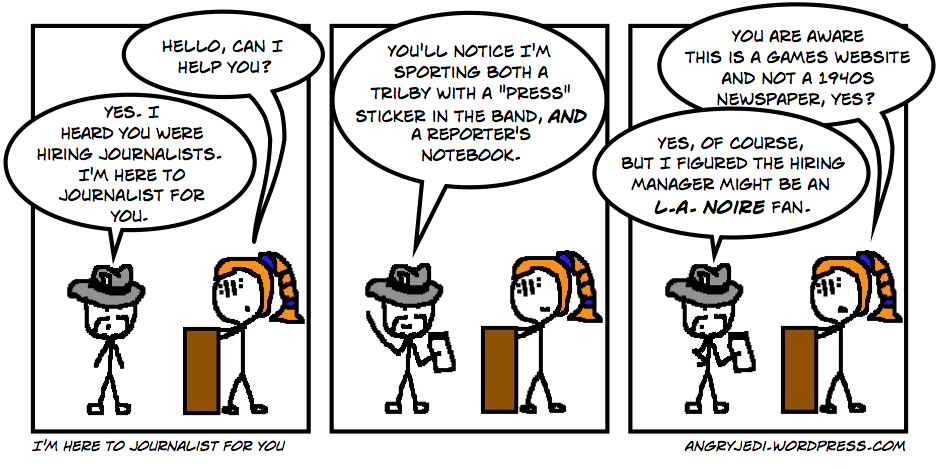
I'm not too cut up about it. I'm sort of surprised I got as far as I did as, to be perfectly honest, my previous stint working for aforementioned fruit-based corporation didn't end on the best of terms — though I hasten to add it wasn't anything to do with the company itself, or indeed anything I did wrong. Rather it was the result of standing up to what essentially amounted to workplace bullying from several senior staff members, and me tending my resignation before things really got out of hand. I bear Apple the company no ill will, though I do find myself wondering if I blotted my copybook somewhat by leaving in the circumstances I did. I contemplated not mentioning my past stint at the company, but in all honesty, the good times at Apple far outweighed the bad; lying is not something I'm good at (nor do I want to be good at it); and, to be frank, I was an awesome employee there that customers liked, and I had sales and satisfaction metrics to back it up. I wanted to talk about my past times there; it's just a shame they ended the way they did. (And yes, I'm still a bit bitter about it.)

Ah well. This is the second attempt I've made to rejoin the company, and the second time I've been turned down after getting quite a way through the process. I think I'm calling it quits now, particularly as things are making movements in other territories.

You may already have noted that I'm writing for Inside Social Games and Inside Mobile Apps, covering the latest in Facebook and iOS titles. While these games aren't the most compelling things in the world for those of us who have been raised on computer and console entertainment, the fact that there are fucking millions of the bastards means that there's always something to write about, and the different audience of Inside Network's sites presents an interesting new challenge for my writing skills — now I'm essentially writing for professionals, specialists and businesspeople rather than consumers. While this means that the things I'm writing aren't as "general interest" (or at least "general gamer interest") as the things I was covering for GamePro, there is an audience, and plenty of things to cover. Which is good.

As well as this, I got an Exciting Email today which I'm not going to go into details about as yet because maybe nothing will come of it. But if something does come of it it could be potentially Very Exciting News Indeed. And Very Exciting News Indeed is always pleasurable to share, because it leads to lots of comments and Facebook Likes (as lazy a social gesture as they are, getting a bunch of Likes on some Very Exciting News is always quite satisfying). But I'm getting ahead of myself. We are in the territory of naught but Very Exciting Potential right now, but just keep your fingers crossed for me, and I'll either explain soon or babble on about something completely different in an attempt to make you forget I ever mentioned it.

To any prospective employers who happen to be reading this: hire me. I'm super-awesome. If you want evidence of how committed I am to projects, take a look at the number on top of this post. That's seven hundred and eighteen days I've been posting blogs for. Every day. Even while going through some of the most difficult periods of my life, and even while holding down a full time job which also demanded me writing a ton of stuff every day. I say I'll do something, and I'll do it, and I have plenty of highly respectable people who will vouch for that fact. Just ask 'em.

No? Ah c'mon. I'll do a stickman caricature of you and everything.

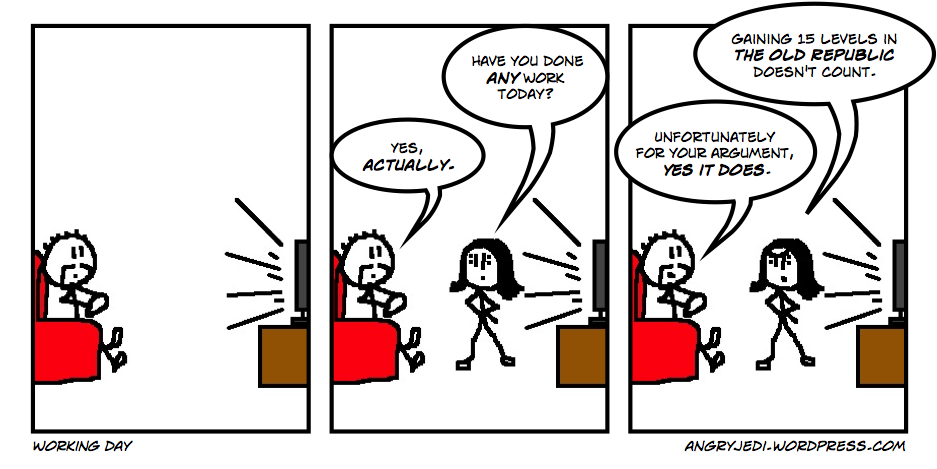
Fine. But know that all you're doing is enabling my Civ V and The Old Republic addictions.

#oneaday Day 717: Just One More Turn

I've been playing Civilization V. It's now 3AM. The two facts may be somewhat related.

I've only been playing the Civ series since its fourth instalment, and while I've found it entertaining and fun, like many heavily strategic board games, I find it difficult to actually succeed at it. It's a challenging series of games, for sure, and there are lots of things for you to focus on all at once — thankfully with the infinite time offered by turn-based games.

Civilization Revolution on consoles provided a different experience which I liked a whole lot. What we had in that game was a simplified (but not dumbed-down) Civ experience which could be played in relatively short sessions, and which was set up to encourage players to be at each others' throats almost constantly.

And now we have Civ V. I know we've had Civ V for a while now, but I've only just started playing it thanks to a generous Christmas gift. (Thanks, Paul!) Civ V, for me, is resonating nicely, offering a pleasing middle ground somewhere between the simplicity of CivRev and the depth of Civ IV. It's certainly a different beast from Civ IV, and those who have grown accustomed to the functions of the various buildings in IV will have to relearn everything for V. Thankfully, the game does a pretty good job of explaining what each building does, and offering enough suggestions to help you out without feeling like you're being shunted down a specific path or letting the game "play itself".

There seems to be a nice balance between number of players and game time, too. In Civ IV, I often found that playing a game with any more than two or three players total often meant it would stretch on into the "days long" territory, making it all the more disheartening when something went disastrously wrong in 850BC and you then spent the rest of the game playing catch-up, with no hope of winning. The game of Civ V I played tonight, however, went on for about three and a half hours. That's not short by any means, but it's certainly doable. A tabletop game of Arkham Horror takes three hours. And, of course, with Civ you can always save and come back to it later.

Except you can't. Because there's something in that game that means you can't just leave it alone. Something deep within the coding that taps into the pleasure centres of your brain and wants you to keep playing — yes, for "just one more turn". It's difficult to pin down what it is — certainly it doesn't resort to Skinner Box tricks like social games, but there's definitely something in there giving it a particularly addictive quality. Perhaps it's the fact that you have to come up with a long-term strategy and aim for a specific type of victory. (Cultural in the case of the game I just played, meaning my empire focused almost entirely on developing culture, and I spent the entire game hoping my neighbour to the North wouldn't feel the need to attack me. Fortunately, he was more interested in subjugating the city-state of Singapore to pay too much attention to me.) Perhaps it's the little countdowns showing how many turns until you complete that piece of research or build that cool building. Perhaps it's the little mini-rewards — famous quotes when you research a tech, short movies when you build a Wonder. Or perhaps it's just the satisfaction of seeing your empire grow and grow and grow and thinking "I made that."

Whatever it is, I say simply DAMN YOU, SID MEIER.

#oneaday Day 716: Games Media Shakeup

Interesting news out of the game journalism industry today, as luminaries from Joystiq, Kotaku, The Escapist and MTV news come together to form the Voltron of writing about games, Vox Games (final name TBD).
The "dream team" assembled for the new venture has the potential to provide a serious shakeup to video game news and journalism if handled correctly. All hail from some of the most popular, well-known sites in the oversaturated field of games writing, and all will have their own take on how to push the medium forward. Hopefully Vox Games, or whatever it ends up being called, will prove to be a site that dares to be different.

But what does that mean? What could a "different" games site look like? Let's brainstorm.

For starters, the idea of "consensus" among the media needs to go out of the window. Jeff Rivera wrote a good piece on this subject over at Gamer Theory recently, and he's on the money. All too often we see outlets appearing to predetermine which games are going to be the hotness of the season, sometimes offering review scores which don't necessarily match up with the words being written. Battlefield 3, for example, was almost universally lambasted for its (apparently — I haven't played it) woeful single player campaign, but that didn't stop it picking up a ton of perfect scores and awards. In some cases, this is likely something of a hangover from Gerstmanngate, as outlets don't want to piss off their advertisers by rating the game that is on the background of every single page of the site less than a 9 out of 10.

Alongside this, the audience needs to be re-educated away from thinking that anything under a 9 isn't worth bothering with. Eurogamer ran afoul of commenters on several occasions last year by daring to rate big releases with an 8. They weren't wrong to do so, but commenters were wrong to assume that 8 meant "bad". This is a hole we've dug for ourselves over the years, and it's going to be very difficult to get away from. It's tied in to the "consensus" thinking, though — it's entirely possible that those reviewing a game for a particular outlet might feel the desire to see what other places have rated it, and, whether consciously or subconsciously, seeing these other scores can colour the writer's judgement.

Which is ridiculous, of course, because scores are completely arbitrary and borderline meaningless. There's no way to quantify "how good" a game is. There's no universal measure of "quality" because everyone's tastes are so different. Some people might think Modern Warfare 3 is game of the year, while I might think it's the most insulting game I've ever played. (I do, incidentally.)

But the review scores debate is well-worn, so I'll step away from it at this point and consider some other ways in which game journalism can evolve and develop.

Chief among one of the things which needs to adapt is the relationship between developer, publisher, PR and press. At present, publishers and PR hold all the power. Developers are muzzled from talking about their game if it doesn't fit into the publisher and PR teams' tightly-controlled marketing plan. We get press releases announcing when trailers will be released. We get countdowns to countdowns to exclusive reveals of some stupid thing on YouTube which they hope will go viral but won't because it's trying too hard. Many newshounds in the industry get reduced to little more than PR mouthpieces, frantically rewriting the press releases that flood their inboxes on a daily basis rather than going in search of the "real story". And why? Because uncovering a "real story" might compromise a relationship between an outlet and a publisher/PR team.

This isn't an anti-PR rant, of course. Many PR types do a fantastic job of facilitating communication between different branches of the industry, acting as a "gobetween" or "messenger" rather than an impenetrable wall through which information cannot pass. Aubrey "Chupacaubrey" Norris (Deep Silver), Tom "Evolve PR" Ohle (CD Projekt, Larian Studios and numerous others) and Jeff Green (PopCap) spring immediately to mind here, and are certainly a far cry from the PR teams from certain large publishers who take days to reply — and don't even bother at all sometimes. For the industry as a whole to evolve, we need more people like this who are willing to work with the press rather than, as sometimes seems, against them.

And what can the writers in this brave new world do, besides not feeling obliged to fit in with the consensus of the rest of the industry? Branch out. Explore. Raise the profile of small-scale projects and the underdogs of the industry. Review the crap games as well as the awesome ones. Provide something unique — truly unique, rather than the press release meaning of "unique" — as opposed to what many other sites offer, which is an interchangeable retread of the exact same story also posted on all of the other outlets. Different sites should have their own "voice" — and this doesn't necessarily mean being snarky, which is a somewhat overused form of humor in the industry today. What I mean, rather, is that different outlets should have their own take on events that are transpiring — editorials, comments, analysis, rather than the same dry old press release facts and improbable quotes from CEOs and VPs of Five Different Capitalised Titles.

Will Vox Games be the outlet to give the industry a good shakeup? I certainly hope so, and should the opportunity ever arise to become a part of it, I'll be sure to do my bit, too.

#oneaday Day 715: Try Again Tomorrow

Well, gym plans were stymied by feeling like I might throw up; likely a combination of tiredness, illness, inactivity, too much crap Christmas food and various worries weighing on my mind.

Ah well. There's always tomorrow.

So it is, then, that I'm lying in bed at 9:15 in the evening, feeling a bit queasy and unsure as to whether the Lemsip I just had was a good idea or not. Too late now, anyway; time to just ride it out until I (hopefully) feel a bit better later. At least it means I didn't have to put the groceries delivery away, not that I mind helping with that under normal circumstances.

I may have mentioned this on this page before, but I hate being ill. I try not to use it as an excuse not to do things but sometimes you just have to heed your body and go take a rest for a while. It's frustrating when it's difficult to tell what it might be that's making you feel sick, though; was it something you ate? Something you did? Or just your body failing to obey Wheaton's Law?

In this case, couldn't tell ya. I know I'm anxious about a bunch of things including an upcoming job interview (not to mention the collapse of my precious regular employment) so that may well be the root cause of all this. Or it could just be that something I nommed on today was a bad idea.

Perhaps I'll try and get some rest now, then, and I'll either wake up refreshed tomorrow morning, or wake up at about 3AM, unable to get back to sleep. One or the other.

#oneaday Day 714: Run, Fat Boy, Run

It's back to the gym tomorrow and, all being well, sticking to a relatively healthy eating plan. No, we're not following a "diet" or anything, but we are going to cook a lot more rather than picking up convenience foods and nomming on whatever takes our fancy. It's always good to kick off the new year with something like this, even if it doesn't stick — the new year is, after all, a time for good intentions and all that jazz.

For me, it's a topic that plays into one of my very many neuroses. I hate being fat, but unfortunately I enjoy the taste of food about as much as I hate being fat. I loathe my own body, but find myself eating things when I get depressed or upset or just for the hell of it at times — a habit which hasn't exactly been helped by the enormous amounts of food we acquired over the Christmas break. If it's there, it gets eaten, and it's often hard to resist.

Why do I hate being fat? Fat people are supposed to be jolly, after all. Well, there are many reasons. First of all, I hate seeing myself in photographs and seeing that I'm bigger than I think I am. Given that I usually see myself from the inside out, it's perhaps understandable that I have a slightly distorted view of my own body, but I still hate seeing myself in photographs. I hate seeing myself generally. I hate the way clothes hang on me, I hate it when clothes are too tight or I can't fasten them up, and I hate it when I see photographs of myself from a few years back, when I thought I was fat, but was actually a fair bit slimmer than I am now.

I also hate people's attitudes towards fatness. I follow a few people on Twitter who are otherwise lovely people, but have seriously discriminatory attitudes towards obesity. I've bitten my tongue a few times when reading what they had to say about fat people. I know they perhaps don't mean it in the way I'm reading it — and since they haven't met me face to face, they have no way of knowing what I really look like or how I feel about it — but it still stings a bit sometimes.

Along the same lines, I really hate it when random strangers feel the need to point out that I'm fat. This hasn't happened for a while, but it really hurts when it does. The last time it happened, it was shortly after I'd split with my wife, and I was sitting in a park in Southampton by myself just trying to have a bit of peace and quiet. Some prick decided to start on me with his friends. It was all I could do to turn the other cheek and ignore him — something I've trained myself to do from a very early age, as I've always seemed to attract bullies. I take small comfort from the fact that I'm a better person than a dickhead who insults people he doesn't know, but at least he wasn't fat.

This may all sound like self-absorbed whining, and it may well be. The fact is, though, it's not as if I haven't tried to do anything about it. For a goodly proportion of last year, I was running, going to the gym, doing situps and pushups and all manner of other stuff. It had a small but relatively noticeable impact on my body, but I always seemed to "plateau" after a certain stage, and it gets a bit demoralising to continue on that path without seeing visible effects. I know it's not just about the effects you can see but also those that you can feel, but it's always far more satisfying to see a substantial dent in that belly than just to feel a bit better.

From this week onwards, then, I'm committing to a long-term plan — gym three times a week as a bare minimum, and running on the days when I don't visit the gym as a filler activity. I'm going to put myself through the Couch to 5K programme again since it's been a while since I did any endurance running, and I'll certainly consider doing something like the BUPA 10K again. Andie will be joining me for the gym activities at the very least, and hopefully our making "proper" meals each day will help also.

Whether or not there will be any noticeable effects remains to be seen, but it's better than doing nothing. Doing nothing just leads to a downwards (or, more accurately, outwards) spiral.

First day back at the gym tomorrow, then. If you want to follow what I get up to, then feel free to follow me on Fitocracy.

#oneaday Day 713: Welcome to 2012

So here we are in 2012, wondering how Sophia Hapgood got mixed up with the Nazis. Or something.

As mentioned in my brief, hastily-composed post last night, Andie and I (along with a number of others) saw in the New Year in style by eating our own bodyweight in puddings. ("Desserts" to you Americans out there.) There was a wide selection of gooey goodness on offer, ranging from a delicious steam pudding through an excellent trifle all the way to our friend Ben's creation, a chocolate tart of such gooey, rich darkness that we quickly dubbed it The Black Hole of Puddings. It brought many a pudding-scoffer to his knees, I can tell you that. At least it did until the late-game entry of the minted lamb pudding (not a dessert, but still a pudding — are you following?) which turned out to be delicious.

But anyway. Enough of the puddings. Let's look back at the year that was, as that's traditional to do on the first day of the new year, or the last day of the old as the case may be. As a matter of fact, I did exactly that on the last day of last year.

As I recall, my general reaction to 2010 was "fuck you". This, I feel, was fairly understandable, given that it was the year I found myself sans wife, job, place to live, money, dignity and hope. It was not, shall we say, Good Times. It was with some sense of trepidation that I began 2011 with only a part-time gig writing the news for GamePro to cling on to, but the year built its way up to if not "awesomeness" per se, then certainly a significant improvement on the previous.

Let's start with GamePro, since I just mentioned it. I spent a goodly proportion of the year acting as a newshound for the website in question. My work was appreciated and praised by colleagues and readers alike (mostly, apart from one commenter who accused me of being a paedophile for writing a news story about a game which explored LGBT issues — he got moderated, blocked and banned out the ass for that one) and as the months rolled by, I built my way up to being able to make a decent living from the work.

When layoffs started hitting the website later in the year, I figured something was wrong. When your managing editor is out of the door, you start to fear for your position. Things continued as normal for a while, albeit with a slight "edge" to them, but then at the end of November, the thing I'd expected to happen happened. GamePro folded.

This was sad to see for a number of reasons. Firstly, it was my job, and no-one likes having their job scooped out from under them — least of all a job that they actually like. (I felt bad when I was made redundant from the first school I worked in, and that was a shithole. I actually enjoyed working for GamePro.) Secondly, there are family ties to the brand — my brother spend a goodly proportion of time there rethinking the magazine and the website for the 21st century. And thirdly, GamePro is — was — one of the longest-running games magazines in the States, and to see it go under really is the end of an era.

I'm sad to see it go, but I'm grateful I had the chance to meet some great people (mostly via email, but some face to face) and hopefully sow the seeds for some future opportunities. I was also grateful to work for an editor who actually provided helpful feedback rather than simply letting things slip by. I feel my writing has improved as a result. This is a Good Thing.

As for the future jobs-wise, I couldn't say what will happen next in the long term. Starting on Tuesday, I'll be contributing to Inside Social Games and Inside Mobile Apps on a regular basis. This will bring in a fair amount of money each month, but ideally I need something more to top that up with. I have an interview for a job I won't talk about for the moment on January 5, so we'll have to wait and see how that goes. Otherwise it's back to prostitution for me. Wait, no, that's not right…

Outside of work, 2011 brought other Good Things my way, chief among which must be Andie, the lovely lady (though she may disagree on the use of that term) with whom I now live and whom I can hear playing Groove Coaster in the next room at the time of writing.

I shan't get embarrassingly mushy or anything here, but suffice to say that Andie appreciates me for who I am, doesn't mind watching me play video games and enjoys playing multiplayer Minecraft with me. She is also a good teammate in a game of Pandemic, willing to try her hand at Dungeon Defenders and makes a mean fried rice. She is, in short, pretty awesome, and I love her very much. She's also a sign that if things go horribly wrong in your life, then very often there are better times around the corner if you just have the patience to ride out the storms that are thrown your way.

Personally speaking, I still find myself visited by Des from time to time, and it's still difficult to deal with sometimes, particularly when what had started to feel like a period of stability was interrupted by the dissolution of my job. I'm hanging in there, though, and feeling quietly confident about what 2012 has to offer. It surely can't be much worse than 2010, after all.

(While we're here, did 2011 feel like it absolutely flew by to anyone else? It doesn't feel like that long ago I was writing my "end of the year" post for 2010 going into 2011.)

(Also, happy new year.)

#oneaday Day 712: Five Minutes to Midnight

It's New Year's Eve. I am writing on my phone. There are five minutes to go before the aforementioned New Year. At midnight I am going to press Submit regardless of whether or not I've finished a sentence.

Tonight we have celebrated the New Year by eating a shitload of puddings which everyone brought over to my friends Ben and Amy's house. By about half ten, most of us had eaten at least eight puddings, with some going as far as ten. Shortly after midnight, the last arrival showed up with an amazing-smelling savoury pudding — lamb and mint in a big crusty lump of suet. Amazing.

As midnight approaches, I'm grateful to ring in 2012 with good friends, and curious as to why the iPhone keeps wanting to correct "2012" to "2013".

The countdown has begun. Champagne is being poured. Celebrations are imminent.

HAPPY NEW YEAR EVERYONE!

#oneaday Day 711: The Ancient Craft of Mining

Andie and I may have inadvertently spent pretty much the whole day playing Minecraft. I've spoken at length on the virtues of this game on several occasions on this blog, but every time I play it I find something new to appreciate, a new way to play or a new way to look at the game.

This, of course, is the central beauty of Minecraft as a game. No-one is telling you how to play it. The Achievements which were added a few updates ago give you a nudge in several possible directions — enough to get you started, anyway — but beyond that, it's entirely up to you what to do.

On the Squadron of Shame SquadCast, we've had a number of discussions on the subject of games that plonk you down into the game world and simply invite you to "get on with it". Traditional RPGs followed this format, though often had a questline to follow. Bethesda RPGs, too, follow this approach after a linear introductory sequence. But none do it quite like Minecraft, which is refreshingly old-school in its approach.

Minecraft doesn't have a story. At least, not an explicit one. Nowhere is it made clear exactly why you've been thrown into this blocky landscape with nothing to your name but your wits. Nowhere is there an introduction describing how and why the monsters that plague the landscape after dark came to be. And not once are you told what your "goal" is.

In some senses, this is a return to gaming's roots, when all the information you needed to know about the game's plot and setting could be fit on the back of the box. Minecraft's retro aesthetic would certainly seem to fit with that theory, but the complexity, depth and freedom that the game offers is something that simply wouldn't have been possible with older systems.

I do most of my playing on a small private multiplayer server which is in "survival" mode. This is fundamentally identical to the single player mode, where you're tasked with surviving against the elements (or, indeed, monsters) with only your wits and what you can scavenge. You start playing in a very small area, gathering resources and building materials near where you started in an attempt to create a convincing shelter before the sun sets and the monsters come out to play. As time goes on, however, you spread your wings and start to explore the randomly-generated landscape. In single player, you'll find yourself discovering a variety of different natural biomes — forests, swamps, mountains — but it's in multiplayer that the world of Minecraft truly comes alive.

Round a corner of a mountain, you might find a mysterious door set into the hillside. Entering, you might find some chests containing tools, food and building materials — along with a sternly-worded sign informing you that this stuff is not yours.

The beauty of it, though, is that if you want to be a complete git about it, you could just take all that stuff and run. The facility to leave signs with your own custom wording on them, too, means that it's not beyond the realm of possibility to, say, nick someone's hoard of diamonds, bury them in a chest somewhere in the depths of the desert and leave them a trail of clues to reclaim them. I hasten to add that I haven't done this, but it is enormously tempting to do so.

A multiplayer Minecraft server becomes something of a community. How active that community is depends largely on how many other players there are and how often they play. On a big, busy server, you'll find impressive structures all over the place as players attempt to outdo each other with outlandish construction projects. On a small, private server such as ours, the world will change gradually, evolving piece by piece as each player stakes out their claim to their own piece of territory. It's fascinating to watch — the fact that the world is persistent so can be changed by other players when you're not online means that there's often something new and player-made to take a look at when you next log in. It also means that eventually you'll have to start either competing for the finite resources that there are, or travelling further afield to locate the items you'll need to survive and/or complete your latest building project.

There are so many ways to play Minecraft, and the situations I've described here barely scratch the surface. It's whatever you want it to be, and it's for that reason that I believe that outlets "reviewing" the game when it finally reached Version 1.0 is an utterly futile gesture. For one, everyone's experience with the game is somewhat different — some are switched off by the lack of direction and give up in frustration; some "powergame" by building the bare minimum they need to survive and progress, attempting to reach the newly-added endgame; some take their time to build impressive structures; some roleplay in their mind, casting themselves in the role of a town planner, laying out buildings and imagining what each might be used for; some do everything they can to make life hell for other players. Not one of those ways to play is "wrong" — even the griefer — and that's why the game is such a work of genius, despite its glitches and flaws, of which there are still many.

Minecraft will continue to develop over time, though now it's emerged from beta and its creators are working on other projects, new versions will be released at a slower rate. There's still an enormous amount of potential there, though, and it's exciting to imagine what might come next. By putting the creation of the game world and its character in the players' hands, the team at Mojang have created one (or indeed many) of the most compelling game worlds ever seen in interactive entertainment. There really is nothing like strolling down a street you've built yourself, defending it from monsters who want nothing more to 1) kill you and 2) blast big holes in your hard work.

If you're yet to try Minecraft, then get yourself over here and join the 4.3 million people — yes, wow — that have bought the game to date.

#oneaday Day 710: On the Brink

I got a copy of Pandemic and its expansion On The Brink for Christmas. I've played Pandemic a few times with my semi-regular board game buddies, but I've never owned my own copy until now. (Obviously. Otherwise it'd be a fairly poor choice of gift.) As such, I've been taking advantage of actually owning it by playing it a good few times. We had a three player game on Christmas Day, I tried a solo game (me controlling two characters) last night, and Andie and I played (and won!) a two player game this evening.

"But whoa there, hold up, soldier," I hear you say. "What the hell is this game and why should I care?"

Well, I believe I've mentioned it before on this very blog, but I don't expect you to go digging back through over 700 posts to find it, so allow me to explain. Those of you who already know the game, shush for a minute.

Pandemic is a cooperative game based on, as you may have gathered from the title, attempting to cure a series of particularly nasty diseases which are attacking the world. (The game never gives the diseases names beyond "blue", "red", "black" and "yellow" but players inevitably come up with their own interpretation of what each colour represents.) There are four diseases which players must cure in the base game, and the expansion adds a couple of optional scenarios which can introduce a fifth "purple" disease into the mix via various means.

Players win if they cure all four (or five) diseases. This is achieved by collecting cards — the base mechanic is that collecting five cards of the same colour and using them at a research centre allows you to discover a cure of that colour. Cards are acquired either by trading with other players — a somewhat difficult process due to the requirement for both traders to be in the city depicted on the card which is being traded — or drawn at the end of each turn.

Simple enough so far. A twist is added by the fact that each player has a "role" which gives them some form of special ability. The Scientist player, for example, only has to collect four cards of a colour to discover a cure, while the Researcher is able to give any card to a player they share a space with, not just the card depicting the city they're in.

Alongside this, each turn the diseases spread. The board starts with nine different cities being infected to varying degrees, represented by coloured cubes. Each turn, a number of different cards, also depicting cities, are drawn, and a cube is added to each pictured location. Should a location "overflow" by adding a cube beyond the maximum of three, an "Outbreak" occurs, spreading the disease to all surrounding cities, adding a cube to all of these as well. This can cause chain reactions if players are not careful, so an important part of the game's strategy is knowing when to focus on getting cards to whoever is working on the cures, and when to travel around the globe treating the most pestilent areas. When players are drawing cards to take into their hands, there's also the possibility of an Epidemic occurring, meaning one city immediately gets blasted with three cubes' worth of infection (potentially causing an Outbreak if it's already infected) as well as reshuffling all of the previously-used Infection cards back together and placing them on top of the unused cards — meaning that previously-infected areas will see the disease spreading again, rapidly spiralling out of control if steps aren't taken to contain the contagion.

The Outbreaks are an important factor to consider, since if eight of them occur in a game, everyone immediately loses. Everyone also immediately loses if there aren't enough cubes of a particular colour left in the supply to put on the board (representing the fact that the disease is so out of control it will never be cured) or if the "draw deck", from which players pull two cards each turn, runs out of cards (representing the team taking too long over their objective). Conversely, the only way to win is to discover all four (or five) cures, though it's not also necessary to wipe the board clean of cubes. That said, curing then wiping out (or "eradicating") a disease has a big benefit for players — an eradicated disease never comes back, not even in an Epidemic. (There's a variant in the On The Brink expansion which allows a disease to come back after being eradicated if it's been selected as the Virulent Strain, but I haven't tried this yet.)

If all this sounds complicated, don't fear. The people I've played this with to date have all picked up the mechanics very quickly. It's actually very straightforward to play and features a nice blend of theme, strategy and luck. There are times when the deck is stacked against you, leading to seemingly unwinnable situations, but the lovely thing about the game is that everything can turn at a moment's notice. Victory can be snatched from the jaws of defeat — and vice versa. And because everyone's in it together — this is a cooperative game — it's a wonderful moment when victory finally comes.

In short, then, if you're getting in to the world of board games beyond Monopoly, Pandemic is one you should definitely check out. From what I've seen so far, the expansion adds a significant amount of good content to the game — the base game can simply be enhanced by the addition of a number of new roles if you're not feeling confident enough to take on the Virulent Strain, Mutation or Bio-Terrorist challenges — but the basic package will provide you with many hours of fun, whether you're playing with friends or solo. (Don't be fooled by that "2-4 players" on the box — you most certainly can play with one or five people, especially with the expansion, but be warned; adding more players to the mix actually makes the game somewhat more difficult.)

Want to know more? The ever-helpful BoardGameGeek has more information than you could ever want.