#oneaday Day 899: I'll Be There For You

I have social anxiety. I may have mentioned this before once or twice.

What that means is that sometimes I get tongue-tied and don't know what to say. Sometimes I let conversations run inside my head but worry about what the possible outcome of them will be, and end up saying nothing. Sometimes I quite literally have nothing to say whatsoever. And sometimes I do say something and don't get the reaction I expected and consequently feel weird.

As you might expect, this makes the prospect of "making friends" a fairly terrifying one. Obviously I have made friends over the years, otherwise I wouldn't have any right now, but I can never quite remember how it happened. In some cases, it was a simple matter of being thrown together in some context — living together, studying together, working together — but in others, it's not quite so clear.

While I am more than happy with the friends I do have, I do sometimes wish I could have more. That may sound greedy, but the fact is that I don't get to actually see the friends I have all that often. The vast majority of them live in the States (thank you, Internet) and the others live just far enough away for it to be A Big Effort to go and see them. And, you know, sometimes I just want people to play board games with. I bought a copy of Legend of Drizzt, one of the cooperative Dungeons & Dragons adventure games, this week and I'm hoping I get the chance to play it more than once or twice. If I had more friends (who liked board gaming) then I'd be able to play it more often — at the moment, however, it's determined largely by mutual availability and whether at least one of us can be bothered to drive about 50 miles. I'm more than happy to for the prospect of board game fun, but it's the former bit that can be tricky sometimes. Hopefully if and when Andie and I manage to move a bit closer to Southampton it'll be a bit easier to be more spontaneous — as it stands, however, it's a relatively rare treat to see people.

This is all rather self-pitying I know, but I direct you back to the first line of this post. Social anxiety makes the act of making new friends — even the prospect of just talking to strangers — a terrifying and difficult prospect. Even in an environment that should be "friendly" — I know there's a local board game shop in Bristol that does games evenings, for example, but I don't even feel especially confident about that. My mind gets caught in a cycle of "what ifs" and I just end up deciding not to go.

Perhaps one day I'll get over this social anxiety and be more confident about making new friends and considering that people might actually want to spend time with me if they don't have to. That day is not today, however, which means that I'm all the more grateful for the friends I do have and the time I do get to spend with them.

Anyone fancy a game of Legend of Drizzt?

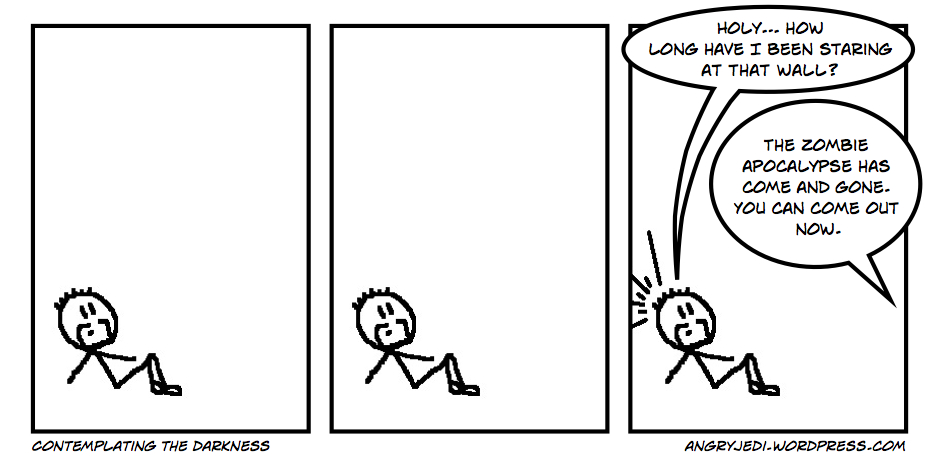
#oneaday Day 898: Contemplating the Darkness

I'd like to share a couple of posts with you. First of all, this piece by Jeff Green, published today. (If you don't know who Jeff Green is, he's currently PopCap's director of editorial and social media and used to work on U.S. games magazine Computer Gaming World, later Games for Windows Magazine.) Many people expressed surprise at Jeff posting this, because, to quote several commenters, "you wouldn't know he had depression." I've only met Jeff maybe once or twice, but it's true; he "hides it well," as it were. That doesn't diminish his suffering in any way, of course — it simply means that he's found ways (and help) to deal with it in a way that doesn't affect his public persona.

Second of all, and related, this post from January of last year by me. I shan't talk about that post too specifically right now since you can just go and read it, but I did want to contemplate the subject a little further today, as reading Jeff's post shortly after he published it (and undoubtedly went back and forth on whether or not he should share it with the world) got me thinking.

I am a lot better than I was. I hit my lowest ebb just over two years ago when my wife and I decided to split. I won't go into the specific details of that right now, but suffice to say that it was a mutual decision by the pair of us that was partly a consequence of, ironically, my own depression. I had left a job I hated, gone to PAX East for the first time (and had an amazing time) and then came back home to no job, no prospects and a thoroughly bleak outlook for the future. Depression at my situation (which was at least partially self-inflicted, I will freely admit — I could have stuck at the job I left, but it probably wouldn't have been good for me at all) sapped my motivation and just made me want to curl up into my own private little world and not talk to anyone. It wasn't the first time it had happened to me. It was a recurring pattern. And, realistically, there are times when it will likely happen again in the future.

The one thing that people don't seem to mention about depression is that it can be addictive. Sometimes, when given the choice between 1) getting up to do something positive that you know will make yourself feel better and 2) slumping on the sofa staring at an interesting spot on the wall for several hours, all your brain wants to do is 2). It gets into the habit of doing 2) and it becomes a natural, conditioned response to anything that upsets you or frustrates you. Over time, it gets harder and harder to not do 2) even though there's usually at least a small rational part of your brain saying "STOP IT! STOP IT! STOP IT!" That rational part gets drowned out by the bit going "staring at the wall is comforting, safe, and you won't have to talk to any people."

Getting over that stage is the difficult part. Fighting against the desire to do nothing and wallow in your own self-pity is one of the hardest things anyone suffering from depression has to do. Only then can you figure out exactly what to do when you pull yourself up off the floor/bed/sofa and make a conscious decision to do… something. Whether that's simply trying to "get on with your life" or actively seeking help to if not "cure" your condition then at least improve it.

Sometimes even the most straightforward tasks can be made to feel like insurmountable obstacles to those suffering a depressive episode. That in itself can cause people to feel ashamed of their condition and not want to talk about it. Thankfully, I've seen a heartening trend recently: people overcoming the stigma attached to talking about mental health issues and publicly baring their souls about these important topics. Jeff Green's post is just the latest example of people with higher profiles than me publicly "coming out", as it were, and talking about this aspect of themselves that, however unpleasant it may be, helps define the person that they are.

Feeling able to write about it publicly and talk about it face-to-face are two very different things, however. I know that personally speaking, I still find it difficult to talk about depression with anyone except my very closest friends, but I'll happily (perhaps the wrong word, there) post things like this to an (admittedly small) audience the world over.

The important thing to remember if you have ever suffered from depression, though, is that you most certainly are not alone and that there is nothing to be ashamed of. You may hate the condition and what it does to you, but that doesn't mean you should hate yourself or feel you should lock yourself away in isolation. On the contrary, you should seek out people you feel able to talk about it with and then get some things off your chest. And you should seek help if you need it.

#oneaday Day 897: Dungeon Crawling

20120704-013250.jpg

I'm a big fan of board games, as regular readers will know. And I have fairly diverse tastes, too — I like everything from Eurogames such as Catan to theme-heavy Ameritrash like Last Night on Earth. Exactly what I want to play at any given moment is largely determined by my mood at the time, but I can pretty much always muster up enthusiasm to play a dungeon-crawling game.

I own several dungeon crawlers, but I'm planning on picking up the very interesting-looking Descent: Journeys in the Dark Second Edition when it releases, as it sounds like just the sort of game I want to play. It also sounds like it's been improved significantly over the original edition, which could take up to 4 or 5 hours to complete a single quest. The new version reportedly keeps play sessions down to much more manageable lengths while incorporating a solid "campaign" system for character advancement and a branching narrative. I'm looking forward to it a lot.

As for the ones I already own, each of them have their pros and cons, and I like them all.

Starting at one end of the spectrum we have Games Workshop's Dungeonquest, which saw a rerelease by Fantasy Flight Games recently. Dungeonquest is gloriously random and is best left on the shelf if you like to plan out what you're doing well in advance, because progression is determined largely by the luck of the draw. Consequently, it is a very difficult game to "succeed" in — even the instruction manual helpfully informs you that players have approximately a 34% chance of survival in any given playthrough.

In Dungeonquest, players take it in turns to draw dungeon tiles from a pool in order to build the dungeon as they go. If it's a corridor, they get to move again. If it's a room, things happen, determined largely by drawing cards and making skill checks. If it's a special room, super-special things (usually bad for the player) happen. Many of these things end in instant death for the player, meaning games can be over relatively quickly if you're unlucky.

The aim of Dungeonquest is to make it to the middle of the board to raid the slumbering dragon's massive treasure pile, then make it out again before the sun rises — the time limit in question being represented by an ever-advancing "track" at the side of the board. If players don't get out before sunrise, they die. If they run out of health, they die. If the fall down a bottomless pit, they die. Hilarity (and, usually, frustration) ensues. It's not a great game, but it is an entertaining one.

Moving up somewhat is MB and Games Workshop's Hero Quest. This was my introduction to fantasy role-playing when I was a kid, and it still holds a very fond place in my heart to date. It's an adversarial game where a team of up to four "hero" characters of varying classes take on the forces of darkness, controlled by a single "evil wizard" player. The evil wizard has a book of preset quests with which to challenge the heroes, and following these through in sequence provides a rather loose narrative. The game was later expanded with a number of additional packs that broadened the scope somewhat with new monsters, traps and additional rules to make things more interesting.

Hero Quest is good because it bridges the gap between traditional "family-friendly" board game conventions and the more abstract, strategic nature of role-playing games. It's accessible enough for pretty much anyone to understand, has high-quality components and a wide variety of things to do — plus is very expandable and customizable.

Advanced Heroquest not only changed the "correct" way to punctuate the phrase "Hero Quest"/"Heroquest" but also revamped the game completely to be significantly closer to a Dungeons & Dragons-style role-playing game. It also incorporated rules for limitless replayability including random dungeon generation, character advancement and a heavy emphasis on customization. While the original Hero Quest released an expansion allowing players to create their own adventures, Advanced Heroquest practically demanded that the Games Master (or "GM" — effectively the "evil wizard" player by another name) come up with some of their own creative, fresh ideas. And it was up to the GM in question how far they wanted to take it — Advanced Heroquest's rules catered for simple story-free "hack and slash" dungeons as much as elaborate, story-driven scenarios featuring light role-playing. The game even came with full rules for solo play, which was a godsend for me when I was a kid, as short on nearby friends as I was.

Then came Warhammer Quest. This is pretty hard to find now, which explains why I paid nearly £100 for a copy on eBay. Warhammer Quest takes the formula of Advanced Heroquest and shoots off in a different direction rather than necessarily making it more complex. Warhammer Quest has a lot more in the way of random elements, but also features a lot more rules to prevent the game from running away from the players. Where Advanced Heroquest often had dungeons that spiralled off into myriad dead ends, Warhammer Quest's dungeon generation rules ensure that players move quickly from encounter to encounter on a much more linear path, giving the game a much faster pace. That's not to say that either approach is "better" as such — Advanced Heroquest had the thrill of exploring the unknown, while Warhammer Quest always had something interesting through the next door — but it marked a significant difference between the two.

Warhammer Quest contains a fairly heavy degree of luck. If you were playing a campaign, after completing a dungeon you then had to roll repeatedly on a table to determine the events that happened during the journey back to town. These frequently got rather ridiculous, as demonstrated abundantly through the adventures of Kurt von Hellstrom and his friends.

Warhammer Quest has one cool thing over its two predecessors, however — it can be played without a GM/evil wizard. The base rules for the game include an artificial intelligence system for the monsters that determine how they move and attack, allowing all the players at the game table to cooperate and take on the dungeons together rather than one being forced to constantly be "the bad guy." Rules were there to allow the game to be played with a GM, too, but for those craving a purely cooperative experience, Warhammer Quest was a great one.

I don't get to play these games nearly as often as I'd like to. I'm hoping that I'll be able to get Descent out regularly once I get my hands on a copy — and I'm also pretty curious about the Dungeons & Dragons boardgames, too. Full reports on each and any of those I get the chance to play will, naturally, follow.

#oneaday Day 896: Gravity Rush

20120703-010706.jpg

I've been playing a fair ol' bit of Gravity Rush on the Vita recently. My feelings about it are somewhat mixed, but on the whole it's a very good game, and certainly one of the most impressive handheld games I've ever played.

Of all things, my least favourite thing about it is the name. "Gravity Rush" is not the name of an epic, sprawling, visually sumptuous adventure. "Gravity Rush" is, to me, the name of an iPhone game — perhaps an Angry Birds Space ripoff — or an obscure downloadable console title at best, perhaps. (Or perhaps I'm just associating it too much with Gravity Crash on PSN, which is nothing to do with Gravity Rush.)

That aside, though, there's a lot to like.

For the uninitiated, Gravity Rush is ostensibly an open world… platform game, I guess you'd call it if you had to pin it down to an established genre, but to pigeonhole it thus is to do it a gross disservice. It's a platform game. A racing game. A mindbending puzzle game. An air combat game. And plenty of other things besides. It actually has a surprising amount in common with underrated open-world gem Crackdown, of all things. Oh, and it was designed by Keiichiro Toyama, who true game geeks will know is the creator of the Silent Hill series. According to Wikipedia, Gravity Rush was the first game he ever wanted to create, but was only able to bring his vision to fruition recently.

In Gravity Rush, you play Kat, a young amnesiac girl with red eyes, blonde hair and surprisingly dark skin for an anime-style character. Kat is also clad in an outfit best described as "bizarre", and is accompanied by a black cat. Oh, and she can shift gravity at will with the assistance of said black cat, allowing her to "fall" in any direction she pleases, stick to walls, skid along the ground and do gravity-defying flying kicks.

Kat is far and away the highlight of the game. Despite her hackneyed amnesiac introduction, she quickly proves herself to be a fun character to play with. She's a bit dizzy, she's confused, she's obsessed with her own appearance and appeal to the opposite sex, and she's easily distracted. But despite these flaws, she has a noble streak — she wants to do the right thing and use her powers to help people, despite not really understanding where they came from or what they're for. As the game progresses, the residents of the city where the majority of the game is set go from fearing her strange powers to respecting and appreciating her talents.

Gameplay in Gravity Rush is mission-based, but it's up to the player when they want to trigger each subsequent mission. Between missions, it's possible to tool around any of the unlocked city areas collecting gems (which can be used to level up Kat's abilities), talking to residents to gain a greater understanding of the strange world the game is set in and taking part in "challenge missions." The latter are very difficult timed tasks of various kinds — some might see Kat having to defeat as many enemies as possible in a time limit, others see her racing through a series of checkpoints, perhaps with some limitations on her abilities in place. Each challenge has three tiers of rewards, with increasing numbers of gems available for completing these tricky tasks by more impressive margins.

This may all sound relatively unremarkable so far, but it's the excellent way that Gravity Rush makes use of the Vita's distinctive capabilities that make it interesting. The "gravity shifting" mechanic is a prime example. By tapping the R button, Kat floats up into the air; tapping it again causes her to "fall" forwards according to where the screen is pointing, regardless of which way is "up". The specific direction she falls can be controlled using the Vita's right analogue stick, but a surprising degree of precision can be attained by combining the stick controls with the tilt sensors in the Vita. If you're feeling completely un-self conscious, you can completely control the direction of the camera in these floaty bits by tilting and rotating the Vita, but that would be both impractical and undesirable for most people, so the combination of stick and tilt works very well.

Similarly, when Kat uses her "slide" move (accomplished by pressing and holding on the bottom two corners of the touchscreen), it's possible to steer her by tilting the Vita side to side and jump by "flicking" the device. You can also "drift" in a Wipeout style by releasing one corner of the touchscreen as Kat goes around a corner.

A more subtle use of the Vita's capabilities comes in the comic-style cutscenes that punctuate each mission. Tilting the device causes the perspective on the comic panels to shift slightly — unnecessary, but cool — while swiping with a finger advances to the next panel, just like in an iOS/Android comic reader app. These little touches arguably don't add much to the experience, but they certainly don't hurt it, either.

The game is a joy to navigate — gravity shifting and "falling" through the skies towards your destination is thrilling every time, and the world is an interesting, beautifully-designed environment to explore — but things do fall apart a little when it comes to combat. On the ground, Kat is limited to a not-particularly-effective kick attack as well as a useful "dodge" move achieved by swiping on the touchscreen. In the air, Kat can do a "gravity kick" manoeuvre where she "locks on" to an enemy then flies through the sky with high heel outstretched, with more damage being done if she "falls" on the enemy from a greater distance.

This is all very well and good and would be absolutely fine were it not for the fact that every enemy is only vulnerable in specific weak spots. Crash into an enemy anywhere other than their obvious glowing weak spots and you'll do no damage. Early in the game this isn't an issue, because the weak spots are in easily-accessible locations, but later enemies have multiple weak points all over their body and often thrash about, making it difficult to hit them. One boss in particular will have you flinging your Vita in frustration as it seemingly always dodges aside just as you get lined up perfectly. None of these challenges are insurmountable, but it does sometimes give the game some rather artificial-feeling difficulty spikes, which is a bit of a shame.

The game's considerable charms (mostly in the form of Kat and the interesting, mysterious story she becomes embroiled in) outshine its flaws, however — at least to me. I've been playing it quite a bit today and I've found it an engrossing, immersive experience. I think quite a bit of that is due to the fact it's a handheld game, which surprised me — traditionally, I've regarded handheld experiences to be less immersive, not more — but Gravity Rush draws you in like few other games I've played recently, and then doesn't let go.

If you have a Vita, be sure to grab a copy. If you don't have a Vita, it's certainly a great example of what the system can do. Is it a "killer app" for the system? Perhaps — it's certainly not perfect, but I can't imagine it working quite the same on, say, a console. The touch and tilt controls are excellently integrated into the more traditional button-based commands, and the whole thing feels like it was designed specifically for the Vita rather than envisaged as a console title with Vita features shoehorned in later. The gorgeous cel-shaded graphics, heavily influenced by a combination of French comics and anime, also make it one of the most distinctive-looking games I've seen for a long time.

If nothing else, it's a game I'd certainly like to see a sequel to in the future, so let's hope it enjoys some success.

#oneaday Day 895: Clip Show, Part 2

20120702-013141.jpg

That's right. Not only am I doing my own personal "clip show" (which actually proved a surprising amount of effort to compile yesterday), I am also making it a two-parter. Oh yes. Today's look back looks at some posts from my first forays into daily posting and beyond.

For the uninitiated, the whole One A Day thing came about towards the beginning of 2010. A number of writers from diverse corners of the Internet decided to try their hand at posting something on their blog every single day. I came to the whole thing a little late — my first post was on January 19 — but have kept it up ever since, which, it has to be said, is more than can be said for the vast majority of participants in the 2010 experiment. (The only other one I'm aware of who is still going is Play Magazine's Ian Dransfield, who remains consistently ahead of me in terms of "number of posts", though has resorted to the "miss a few days and catch up later" strategy a few times.)

Anyhow, the guiding principle of One A Day was very simple: just write. No rules, no minimum length, no set topics, just write. For you. If other people happened to enjoy it, so much the better, but it was primarily an exercise in churning out content on a regular basis and keeping those "writing muscles" well and truly exercised.

It's been an interesting experiment for me, as the things I've talked about on here have grown and changed over time according to my life situation and my own mental state. In the early days, for example, I was very much of the opinion that my career in the teaching profession was probably going to kill me, but I was also excited by the fact that I was going to escape my (temporary) position in time to go to PAX East. PAX East, as it turned out, was an amazing experience and remains, to this day, my Favourite Thing I've Ever Done.

It was around this time that I found myself with a lot of free time on my hands. I'd left my job and didn't have anything else to go to, and I was (foolishly, as it turned out) hoping that I'd be able to support myself with freelance writing and private music teaching. I got a bit of income coming in thanks to the fine folks at Kombo.com (most of whom I now count among my most beloved online friends) but that, unfortunately, didn't last forever.

Neither, to use a hideous segue that I don't particularly like thinking about, did my marriage. I was an absolute fucking wreck as a result of the events which came to a head in May of 2010, though in retrospect it helped me produce some fine, emotional work such as — bear with me — this rather personal ode to a bacon sandwich. It also encouraged me to unscrew my head and put it on a different way just to try and stop myself thinking about Bad Things. Or just to get really, really pissed and then take stock of the disastrous attempts at texting and social media I'd made while inebriated. Let's do itcagsin sometime.

Fortunately, I had Stick-Pete to keep my mind off things. (His first appearance was here.) Stick-Pete was a conscious decision to try and give my blog a distinctive aesthetic, and I make no secret of the fact that my decision to incorporate poorly-drawn visuals rather than the stock photography I'd been using previously was entirely due to my discovery of Allie Brosh's rather wonderful blog Hyperbole and a Half, which I extolled the virtues of here. I was initially worried that people might think I was ripping off Brosh's work, but I developed my own distinctive look over time which has, itself, changed and adapted as time goes on.

Stick-Pete and a series of characters I plucked out of my imagination seemingly at random were excellent ways to clumsily illustrate the things I was writing about, and a number of posts were designed with illustration in mind, such as this guide on How To Laugh on the Internet. Certain characters were, I noticed, making appearances more regularly than others, so I thought it would be an interesting experiment to start drawing a comic to illustrate my posts. Here's the first post in which that appeared. I kept that up for a surprisingly long time, though eventually guilt at not being able to post if I went away for a weekend (my comic-making tools of choice were on my non-portable Mac) got the better of me and I eventually stopped. Now I just feel guilty that Alex, Lucy and Phillipe aren't getting regular outings and opportunities to insult me, so it's entirely possible they may return at some point in the near future. (If you have no idea what I'm talking about, this post from the start of 2011 helpfully reintroduced them all.)

As time went on, the years passed and my life situation started to gradually improve once again, so I tried a couple of things, some of which you'll find linked to in the sidebar. Wasteland Diaries was a 30-day "improvised narrative" experiment, for example, in which I attempted to write a coherent(ish) story over the course of a month, similar to what those NaNoWriMo people do. (I had wanted to participate in NaNoWriMo for a while, but various circumstances had always made it impractical. This was my less-structured, less-disciplined approach — but I saw it through.)

I also cemented my view that writing on this 'ere blog was a good personal outlet. Obviously I don't mean that in the sense that I use it to badmouth people (I don't! You can look back and check!) but rather that it was a good place to get things out of my head and onto "paper" — things that other people might feel somehow "ashamed" to talk about. One such subject was the visual novel Katawa Shoujo which is, for those of you who don't know, a rather wonderful interactive love story set in a Japanese school for the disabled. It was a fascinating, well-written game worthy of some deep analysis and criticism, so not only did the Squadron of Shame take it on for a lengthy podcast, but I also felt inspired to write about it a great deal. It touched me deeply, and the subjects explored therein resonated hugely with me. I'm not disabled, but a lot of the underlying themes in the game's various narrative branches were actually nothing to do with the characters' disabilities, and really got me thinking.

As you can see, I've been busy. And somehow there's been something to write about every day, even if it hasn't been very interesting. (For that I make no apologies. Although I seem to have picked up a small but dedicated readership over time, I'm still writing this primarily for my own benefit.) There's plenty more interesting times in the future — good and bad, no doubt — so I'll look forward to sharing them (or avoiding thinking about them) via this page for a long time to come yet, I hope.

Now, to just resist the temptation not to post tomorrow and make everyone believe I'm dead…

Hah. Just kidding. Writing this blog is so entrenched in my daily routine now that I'm not convinced I could give it up, even if I wanted to. So like it or not, you're stuck with me. (And thanks for sticking around this long. Incidentally, if you want some more links to past material, here's another "clip show"-type post. Enjoy.)

#oneaday Day 894: Clip Show

20120701-004615.jpg

Clip episodes are TV shows' way of making a low-budget episode and not having to worry about being the slightest bit creative.

After 893 previous daily blog posts and having just been on my Couch to 5K run for the evening, I'm knackered and can't think of much to write about, so I'm going to do my very own clip show. In the process, I will highlight some posts from the past that you may have missed. There are likely to be a lot of these, as this blog currently has 953 posts on it (893 of which are, as previously mentioned, posted at daily intervals) so you would be forgiven for having not seen some of them in the past. (If, on the other hand, you have seen each and every one of these posts because you're good enough to read them daily, first of all, God bless you, and second of all… uh… thanks.)

I started blogging on this site back in July of 2008. I'd tried keeping a blog on a couple of other sites in the past — here's one from 2005 (composed almost entirely on a Nokia N-Gage, believe it or not) and here's another from the year prior on the subject of my experiences as a secondary school teacher. (The latter was a spinoff from a series of emails I used to send family and friends while I was training to be a teacher.) I did used to have a self-hosted blog on my own personal domain, too, but that is long since defunct. This ol' WordPress site here is probably my most long-standing web presence that is still actually updated. Which is nice.

Prior to starting posting things daily… well, things were pretty much the same as they are now. I'd post on a range of topics from video game-related business to board games, the death of a beloved family pet and even trying my hand at music review blogging. (The linked post there actually led to me being specifically invited along to another band's performance a short while later — the "review" in question is here.)

I've spent some time in curious virtual world Second Life over the years, and in February of 2009 I wrote a couple of posts on the subject — firstly, on the subject of virtual worlds in general, and secondly on the subject of how your on-screen persona can affect your own self-perception. You'll doubtless notice some parallels with my recent post on why I play as women in video games. I still find Second Life fascinating, sleazy elements and all, though I haven't paid it a visit for a very long time. Some of the people in that crazy world provided great comfort to me in lonely periods and just writing this is making me feel a bit bad that, to them, I must have just upped and vanished one day. Perhaps I'll return sometime — though whether it's as my male "real me" or female "total escapism" avatar I couldn't say! I certainly used to enjoy the whole "CG artwork" aspect of it, where I'd take pictures of things in the virtual world and then mangle them beyond recognition in Photoshop. (A great way to learn how to do crazy things in Photoshop, incidentally.)

In April of 2009, I revisited a game I used to play on the Atari 8-bit: Alternate Reality: The City. When I originally played it, I had no idea what a role-playing game was or what I was supposed to be doing. In 2009, I was armed with The Internet and a map I'd printed out, so was much better-equipped to go on some adventures. This post chronicled one character's ill-fated expedition into the cheerily-named city of Xebec's Demise, and I like to think it gives the reader a good feel for what this unusual game is all about.

A month later, I remembered that the "pictorial story" idea I'd done with Alternate Reality was rather fun (if time-consuming), and decided to give it another shot, this time with The Sims 3. Remembering my previous post on evil in games, I figured it would be interesting to see how messed-up it was possible to make a Sim. Very, as it happens; the many and varied mundane adventures of Lars the Bastard will attest to this fact.

You may remember the spammers' craze for sending bizarre narrative emails with unsubtly-embedded pornographic exhortations within from around September 2009. I took it upon myself to compile some of them and see if anything coherent came out. Nothing did, as you can see.

In December of 2009, I discovered Warhammer Quest. I also discovered the joy of writing down the emergent narrative which comes about during a game session of a theme-heavy board game such as Warhammer Quest. The result of this initial experiment was The Adventures of Count Kurt von Hellstrom and Company, a saga which hopefully will continue someday — though I haven't had the chance to play Warhammer Quest since writing that post, I don't think.

And in January of 2010, I started posting entries daily. But that's another story. And I'll compile a selection of my favourite One A Day posts for tomorrow's entry. I bet you can't wait.

#oneaday Day 893: The One Thing That Would Make Me Play a Sports Game

20120630-002820.jpg

I'm not a fan of sports, as I believe I've made abundantly clear on numerous occasions. Consequently, I'm not a big fan of sports-based video games either (though I am rather more tolerant of them than televised sporting events, largely because I get to interact with them and have fun with friends — but the point stands).

It doesn't have to be that way, though. I think there's scope for sports games to reach out to people like me and provide an accessible experience that I could enjoy — and potentially learn to be interested in the sport itself over time. I caught a glimpse of such a concept in practice today when checking out a Facebook-based game called I AM PLAYR, a rather nifty little game that casts players in the role of an individual player on an up-and-coming (and fictional) football (soccer) team. The game focuses on the life of the player's character both on and off the pitch, splitting the player's time between 3D training minigames, text-based matches punctuated by interactive 3D attempts on goal by the player character and full-motion video sequences with occasional moral choices to make. While the latter may sound rather late-90s CD-ROM in nature, it added a huge amount of personality to the experience and actually made me interested to play more.

The reason I don't find sports games very interesting, you see, is that there's no sense of narrative or drama. Sure, there's an argument to be made for emergent narrative in sports games just as there is in abstract strategy games, but when I'm not interested enough in the source material I'm never going to become invested enough in the game to start thinking of things in emergent narrative terms. As such, it turns out that the very thing I needed to get me interested in playing a sports game was a story.

I AM PLAYR sees the player character following a number of off-pitch narrative threads alongside the season's fixtures. We see the behind-the-scenes drama as the team's lead striker who claimed he was fighting fit was actually receiving injections from the team's therapist. We see rivalry between teammates — practical jokes, drunken nights out, ill-advised encounters with vapid glory-chasing women. We see the team's manager trying to stay positive even as the drama unfolds within his team. And amid all this, the player character makes choices that determine how different characters react to him — including his girlfriend, who is more than a little concerned that his new-found fame will see him drifting away from her.

It's a really neat system and made me feel far more attached to my character and the team than if they were simply a collection of stats and a polygon representation on a virtual pitch. I don't know enough about how to play football effectively to be able to play a full match and win, so I'm grateful that the actual "sport" element of the game simply focuses on set-pieces and chances on goal, and then allows me to get back to the clubhouse intrigue.

After playing the game for a while I was struck with how rarely this sort of thing is seen. I AM PLAYR has high production values — all of the video is shot with real people on location, including some actual real footballers, for example — but there's no reason a team couldn't do it slightly more on the cheap with CG characters and text-based dialogue if the budget wasn't there. So why aren't more people doing it? I'd certainly play it, and I'm willing to bet there are plenty of people out there who have a casual interest in football (but not enough to play a full simulation of it) who would join me.

It doesn't just have to be limited to football, either. This formula would work for pretty much any sport. You could have the motorsports game where you developed rivalries in the pit lane. The baseball game where you're trying to follow in the footsteps of a childhood hero. The tennis game where you're struggling to come to terms with your own anger management issues. (You cannot be… etc.)

There have been examples in the past — On The Ball from Ascon for MS-DOS computers springs immediately to mind, and apparently New Star Soccer for iOS follows a similar template — but I want to see more of this kind of game. They could be the catalyst to actually get me interested in a sport and be able to participate in a conversation come international tournament time, rather than simply wanting to snap off every England "car flag" I see.

The trouble with Arsenal, you see, is they always try and walk it in.

#oneaday Day 892: In Memory of Floppy Drives

20120629-015705.jpg

I was struggling to think of something to write about until an offhand comment on Twitter got me thinking about, of all things, floppy disk drives.

I miss floppy disk drives.

No, wait. Bear with me. Not in practical terms — I'm sure no-one misses the days when games had a whole disk just for their intro sequence, or the era when Microsoft Office came in a box roughly the size of a Borg Cube — but in terms of… of… you know what? It's hard to describe exactly, so let me just wax nostalgic about a few things.

I used to find something oddly comforting in the sound of floppy drives whirring away doing their thing. Every floppy drive sounded different, too — the ridiculously huge 810 drive for the Atari 8-bit computers snarked and farted; the later 1050 was a little quieter (though had squeaky mechanical parts sometimes); the external floppy drives for the Atari ST made a pleasant frog-like croaking noise; the internal Atari ST drive was subtler, giving the occasional chug; and the drives in our first PCs were pretty quiet, putt-putt-putting away, usually installing something.

Their uses varied over the years, too. Up until DOS and Windows-based PCs started to take off as a serious gaming platform and required you to install everything, pretty much all software ran directly from floppies, making it necessary to have lots of those big plastic disk boxes (inevitably full of pirated software) — organised alphabetically if you wanted to remain sane. In practical terms, this meant things often took quite a long time to load, which brings us to something that is all but forgotten these days except in the most inefficiently-programmed and/or massive video games: the loading screen.

Loading screens used to be the place where the graphic artist for the game could really let rip and show off what they could do with the limited colour palette and resolution of the hardware they were working on. My most fondly-remembered loading screens were the work of Herman Serrano, a dude who could really make the Atari ST sing. (Visually. Whatever the visual equivalent of singing is. Oh, be quiet.) He did good loading screens for companies such as Argonaut and Psygnosis, and always signed his name prominently on them, which is something you don't see these days, either. Often they were just pixel-by-pixel recreations of the box art, but sometimes there were variations, and it was fun to look carefully at them, pick out the details and spot the occasional Easter eggs. You didn't have much choice, really, since there was nothing else you could do while it was loading.

While games still ran from floppies, loading breaks — now considered to be a thing of great evil that should be avoided at all cost — were considered something of a perk, as they generally indicated that you had done something good. This was true whether you were playing an Infocom text adventure on the Atari 8-bit or a LucasArts adventure on the Amiga. If the disk started chugging immediately after you did something, you were usually on to a winner. (Unless you were playing a Sierra game, of course, in which case it was entirely possible it was simply loading one of its many elaborate death scenes for your long-suffering character.) Some emulators of old systems even allow for the simulation of these loading breaks for the fully-authentic experience — though without the sound of a disk drive chugging away it loses something.

So yes. I miss floppy drives. I don't begrudge the 21st century's massive storage capacities and lightning-fast access, of course, but I do miss that comforting feel of sliding a disk into a slot with a satisfying "clunk", turning the computer on (yes! Remember having to turn the computer off every time you wanted to run something else?) and then sitting listening to the distinctive mechanical whirrs, groans and farts of the disk drive as it loaded whatever it was you wanted to play or use.

Rest in peace, floppy drives. You're missed!

#oneaday Day 891: Summer Nights

20120628-005617.jpg

It's crazy hot and humid at the minute. Thankfully, as I type this, the weather has deigned to grace us with some rain, which will hopefully eliminate some of the horrible "closeness" that has been plaguing us for about the last week.

You can't really win with regard to weather in this country. It's rarely "just right". It's often either too wet, too hot, too cold, grey and miserable or too humid.

Of course, in actual fact it likely is "just right" more than we realise because you only tend to notice the weather when it's hitting the extremes that are irritating enough to make you question the wisdom of actually leaving your house.

I actually quite like some weather conditions that would traditionally be considered "bad". The rain that it happening right now, for example, is lovely. There are few things nicer than being out in a rainstorm after it's been incredibly hot and humid all day (or, in some cases, all week). It's one of those times when I can be quite happy to just stand outside without any particular "protection" and get absolutely drenched without wanting to run to the nearest shelter as soon as possible. It's even quite nice to run in — though on tonight's run I did manage to get back before the heavens opened.

(As I continue to type this, the rain seems to have stopped. This is disappointing.)

Heat in general, though? I'm not a fan, as I believe I've said a number of times here in the past. I don't really understand the attraction of going on holiday to some place so hot it will literally burn your face off. I still have memories of a trip to Gran Canaria with a school friend and getting so badly burned I was peeling off my skin like a lizard for a couple of weeks afterwards. (When the burns faded, however, I looked like I had changed race, which was quite satisfying, apart from the pasty-white Speedos marks I had. It was enough to make a boy not want to take his pants off, ever — not that I was doing a lot of taking my pants off in public at the age of 12.)

Rain can be a nice relaxing background noise, though. When I ballsed up my body clock completely shortly before leaving Southampton a couple of years ago (how time flies, huh?) I often found comfort by simply listening to the sounds of rain. If it was raining outside, great; if not, I had a nice app for iPhone called Ambiance that could do a fairly convincing impression along with stuff like white noise, city noise and all manner of other sounds. You could even mix sounds together to create the sounds of camping in a rainy wood, or being in a city street in a thunderstorm. Or, indeed, being in a room full of static and wind chimes.

This post has been rather disjointed. I apologise. My brain isn't really working right now as it's quite late and I got back from a run relatively recently but I'm not really tired enough to go to sleep. I'm thinking probably a bit of Quest for Glory before bed, then back to the grindstone tomorrow.

#oneaday Day 890: Glorification

20120627-011456.jpg

I'm probably about halfway through Quest for Glory IV so far and I have to say, I'm a big fan of the series. Back in "olden times" our family were pretty big fans of Sierra adventures, but the Quest for Glory series was one which passed us by for some reason. While the games have aged better in some respects than others, one thing has become very clear from playing them: the combination of adventure game and RPG works. And it works very well indeed.

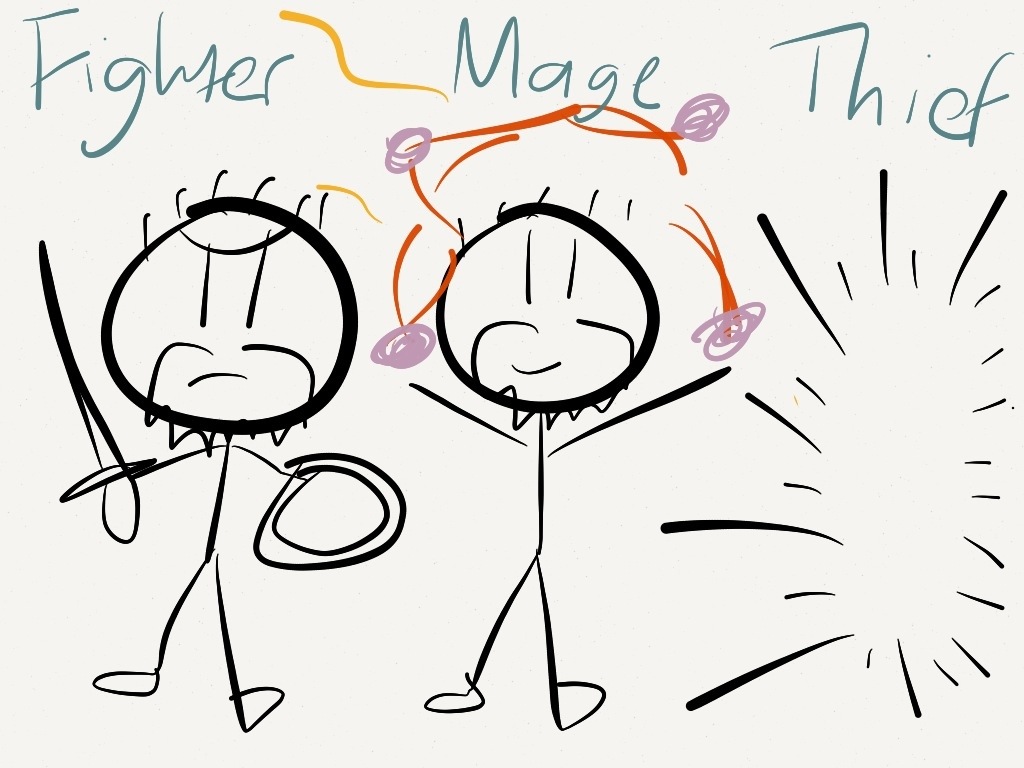
The reason it works so well is because the two aspects are intertwined so seamlessly with one another. Rather than being an interactive storybook with battles (as I once heard Final Fantasy VII described ) the RPG elements are woven into the adventure gameplay. Your character's stats are for more than simply how tough they are in battle — and in fact, combat plays a relatively minor role in most of the series. Instead, standard adventure game actions in Quest for Glory often involve a behind-the-scenes "skill check", with the on-screen character either succeeding or failing at the action in question according to his skill levels. What this means in practical terms is that there are multiple solutions to every problem according to the player's chosen play style and character class. A wizard might get through a problem relatively simply with a flick of the wrist and the cast of a spell; a fighter might have a more direct approach; and thieves have plenty of their own nefarious plots to get up to at night. Yes, here we have a thief character who is actually a thief rather than simply a DPS.

In terms of mechanics, the closest equivalent today would probably be one of the Elder Scrolls series, though it's not a great comparison. In both series, you gain in power simply by practicing skills; in both, there are multiple solutions to problems that are often related to skills; but where the two diverge is in the amount of character and personality they're infused with — not to mention the fact that The Elder Scrolls' idea of a puzzle is rarely anything more complicated than switch-flipping.

The Elder Scrolls has rich lore but I've never felt like I was a particularly important part of the story. I was just "that guy" who turns up and solves problems whom everyone then promptly forgets about — in Oblivion, for example, you do all the hard work but then Sean Bean gets to do all the spectacular stuff at the end. Meanwhile, in Quest for Glory you are the hero. You are the most important person in the room when you walk in, and the game's characters quite rightly come to love and respect you as you systematically sweep through, right all their wrongs and proceed on to your next adventure.

There's a number of contributing factors as to why this works so well in Quest for Glory yet feels so bland and uninspiring (to me, anyway) in Bethesda's epics. The main issue is one of scale — while it's unquestionably impressive to explore all of Skyrim, Cyrodiil, Morrowind or the other provinces seen in the earlier Elder Scrolls games, this vast scale means that you never really get to know the locales and the people therein. The vast majority of characters are templates who say the same thing to you, and most of them have no personality whatsoever, acting simply as walking quest-giving machines and information kiosks.

Contrast with each Quest for Glory game, each of which is set in a very tightly-focused locale — usually simply a single town and its surrounding environs — and it becomes abundantly clear why it has that much more personality. Because there's not so much vast empty space to fill with NPCs, quests and random events, everything was hand-crafted rather than resorting to templates. As such, everyone you meet in Quest for Glory is an interesting character — often with hidden depths. The plot for each game manages to remain mostly non-linear, with the required steps to proceed to the climactic "endgame" scenario in each usually completable in any order, but somehow it manages to provide a far more satisfying, compelling experience than I ever got from 50 hours in Skyrim.

The comparison between these two series isn't fair at all, of course, as I've already said, but it's somewhat telling that the closest equivalent to Quest for Glory I can find in modern gaming is so vastly different from these fascinating old titles. Why did the adventure/RPG crossover never take off? It's clearly a combination that works, and imagine what a great job we could do of it today. One could argue that games such as Dragon Age and Mass Effect from BioWare take heavy cues from the adventure game genre, particularly with regard to interpersonal interactions, but even in those indisputably excellent games it's still pretty rare that you'll find yourself solving problems in creative, class-specific ways. They're still stat-based, combat-focused RPGs first and foremost (with Mass Effect becoming more of a shooter as time went on) rather than adventure games that use RPG mechanics to help colour and direct the experience.

Part of the reason we haven't seen more of this type of game is, of course, due to the supposed "death" of the adventure game as far as the press and, presumably, publishers are concerned. But look around for a moment; the adventure game most certainly is not dead. High-profile developers such as Telltale are putting out some high-quality, well-written point and clickers. The genre is having something of a resurgence on touch-based devices such as the iPad. And some developers are even still releasing 320×200 super-pixelated traditional point-and-clickers like the recent Resonance. Why hasn't anyone just lifted Quest for Glory's system and applied it to a whole new adventure, perhaps in a new setting? I'd play a Quest for Glory in space, or in a 1920s noir style, or… you get the idea. The stat-based adventure game where the outcomes of your actions are determined by your skill values has a lot of scope for exploration, and I really wish we'd see more of it. Unfortunately, it seems that despite the universal adulation the Quest for Glory series receives, no-one is willing to defile its long-dead corpse and resurrect this fascinating subgenre for a modern game.

The first developer who does shall most certainly be in receipt of some of my money.