1195: City of Horror

It's my birthday on Monday, so we decided that today would be a good day to celebrate it while people were around. As has been the tradition among the more geeky portion of my circle of friends, we decided to mark the occasion with a day of board and computer games, including Surgeon Simulator 2013, a failed attempt at getting Artemis to run due to the iOS versions not matching the PC versions, some NintendoLand (still a firm hit with everyone, and a good reason by itself to own a Wii U and four controllers) and, on the board game front, Descent and City of Horror.

It's the latter that I'd like to talk about today, as it's a very interesting game indeed, and quite unlike anything I've really played before.

For the uninitiated, City of Horror is a semi-cooperative survival horror game themed around a zombie apocalypse. Each player takes control of several survivors and then, over the course of four turns, moves them around, fends off zombies, makes deals with the other players and tries to end the game with as many points as possible. In order to acquire points, your characters have to be alive, and in order to ensure they are alive at the end of the game, they must have an antidote on hand and not have been devoured by zombies. To gain more points, you can grab food supplies or additional antidotes. Each character is worth a particular number of points at the end of the game, but loses value if they use their special ability, which can only be used once per game unless they "recharge" themselves using special cards or locations.

The gameplay is surprisingly free-for-all once it gets started, and reading the rules doesn't really make it entirely clear how things are going to unfold until you start playing. Essentially what happens is this: everyone secretly makes a decision as to which of the game's locations they are going to move one of their characters to this turn, then reveals this plan simultaneously. Then, zombies appear and move, and sometimes supplies in the form of action cards and antidotes are dropped in. Then, characters move in a set order; if there isn't a space in the location they're trying to move to, they end up in the streets in the centre of the board.

After this comes the tricky bit. Each location is "resolved" in order. Firstly, each player gets an opportunity to use the location's special ability, which usually involves discarding a card to get some sort of benefit. This happens in turn order. Next, all players — even those who don't have a character present in that location — can play action cards, negotiate, lie, cheat and backstab their way into an advantageous position. Action cards allow for the manipulation of stuff that is on the board — some allow you to move or add zombies to particular locations; others let survivors kill zombies; others still have special abilities such as guaranteeing safety from a zombie attack.

Each location has its own criterion for triggering a zombie attack — usually an upper limit of zombies milling around the outside of the building. If this criterion is met, then one of the characters present in the location will die after everyone has finished playing their actions — exactly which one is determined by a simultaneous vote among everyone present. Consequently, there's a lot of scope for making deals with other players and then stabbing them in the back by siding against them when it comes to the time when someone has to be thrown out through the window into the slobbering hordes.

In many ways, it's a nasty, horrible little game that is best played among a group of friends who won't take it personally. If you're not willing to be a complete asshole to the people you're playing with, you will not succeed — it's as simple as that. In many ways it's rather refreshing — rather than being directly competitive based on skill, random elements or accumulated resources, it's all about interacting with other people and determining where everyone's weak points are. There's a lot of bluffing, a lot of lying and a lot of outright cheating (within the confines of the rules) and I seriously doubt it's possible to finish a game with everyone still standing.

It's great fun, in short — just be sure not to play it with anyone who might get upset when you promise not to let them get killed and then promptly let them get killed!

1194: Courting the 'Core'

Social games, it's fair to say, have a bad reputation among those who are euphemistically referred to as "core gamers". This bad reputation isn't altogether unjustified, of course — social games are, in many cases, derivative, exploitative or just plain boring — but despite the prevalence of Men In Suits (or, probably more accurately, Men In Trendy T-Shirts And/Or Turtleneck Sweaters) who have never played a video game before in their life running the show for the most part, there's a lot of talent in that particular sector of the industry.

So why the hell doesn't this part of the industry do more to attract the "core"?

It's at this point that, if I was talking about this in person with someone directly involved with the industry, that they would point to one of the following facts: 1) Candy Crush Saga having approximately 15 million daily active users; 2) CSR Racing on iOS earning somewhere in the region of $12 million a month when it launched; 3) The Top Grossing chart on iOS being dominated by games that are free to download.

These are all facts, and cannot be ignored. However, that doesn't necessarily mean that they're good things. As I've said many times in the past, just because you can do something doesn't mean you shouldCandy Crush Saga has 15 million daily active users because it nags them via notifications to come back and play; CSR Racing earned $12 million a month by forcing people to pay up for "gas" for their cars if they didn't want to wait; and don't even get me started on what I think of the Top Grossing chart on iOS and the awful crap therein.

Aside from these matters, the fact that the social and mobile games sectors aren't courting the "core" more aggressively is just baffling to me. While those who identify as "core" gamers — i.e. those who will happily sit down in front of a computer or console for several hours at a time to use it as their primary means of entertainment rather than an idle timewaster — do not exist in as vast a number as those who have a Facebook account and who have tried Candy Crush Saga at least once, there are some important things to bear in mind.

Most crucially, of those 15 million daily active users that Candy Crush Saga has, only a tiny fraction of them actually pay anything. Some of them might pay a lot — these people are rather revoltingly referred to as "whales" by people in the industry — but an awful lot of them will either refuse to pay out of principle or just not enjoy the game enough to want to spend money on it.

Here's the thing: "core" gamers spend a lot of money. "Core" gamers will happily spent £40 on a brand new game without having read a review. "Core" gamers will pay a premium to get pointless cool stuff that they can show off. "Core" gamers are a lucrative source of income, in other words. Much as it pains me to break it down that way — I'd much rather games be seen as creative works than business products — it is, in fact, true.

So, then, I have to question why more of an effort isn't being made to make "core" gamers take social and mobile games seriously. Because it's not. "Core" gamers see the majority of social and mobile games as a massive joke — a festering boil on the arse of the industry; a source of interactive entertainment that doesn't create "proper games" and instead puts out the very worst sort of shovelware.

They're right, to an extent. So here's a few things the social and mobile sectors could do to be taken a bit more seriously by potentially one of the most lucrative markets out there.

Stop ripping the same things off all the time.

Seriously. Cut it out. We've all played Puzzle Bobble. We've all played Bejeweled. Stop trying to make out your puzzle game is new and innovative when, in fact, it is simply either Puzzle Bobble or Bejeweled (or, in a few cases, Jawbreaker).

If you must draw inspiration from past titles, that's fine; just stop drawing inspiration from such a small pool. Just in the puzzle game genre there are hundreds of great games begging for a social adaptation — Columns, Klax, Super Puzzle Fighter II Turbo, Puzzle League, Dr Mario, Baku Baku Animal… I could go on — so why are we constantly subjected to the same "match-3" bollocks over and over?

This isn't just an issue in the puzzle genre — social RPGs all rip off Mafia Wars; farming sims all rip off FarmVille; citybuilders all rip off CityVille, and none of them were actually that good in the first place.

Stop ripping yourself off.

If you already have a match-3 puzzle game in your portfolio, you don't need another one. King, currently the biggest social game company in the world thanks to the aforementioned Candy Crush Saga, is terrible for this. Now that Candy Crush Saga is the top performing game on Facebook, they've put out another game. What kind of game do you think that is? That's right; a game where you swap coloured things around to make groups of 3 in horizontal or vertical lines. Only this time they're fruit and vegetables!

Or how about Kabam, who have now released the exact same game with slightly different graphics and a different name four times (Kingdoms of Camelot, Kingdoms of Camelot: Battle for the North, Arcane Empires, The Hobbit: Kingdoms of Middle-Earth) and no-one (except me) has called them on it.

The fact that people buy into this is just depressing.

Hire some fucking writers.

Quite a few social games these days are very well presented, with quality graphics and decent sound and music. In many cases, they actually create quite an impressive atmosphere… until the player is asked to read anything and it becomes very apparent that the "plot" of the game, such as it is, was written by a dyslexic Russian 10-year old who had just played Magic: The Gathering for the first time.

Good writing is just as important as the more immediate parts of your game's presentation. Don't skimp on it. And even if you're not going for an epic plot in your game — incidentally, puzzle games do not need plots, so just stop trying to cram one in — at least get someone to proofread the in-game text, fix any typos and glaring grammatical errors… and make sure if you're releasing it in English-speaking territories that all of the game's text is actually in fucking English.

A shout-out to 5th Planet Games here, who actually make an effort with this sort of thing, even if the gameplay of the games sometimes isn't up to much; Legacy of a Thousand Suns may be a Mafia Wars ripoff in terms of gameplay, but at least it has some consistently well-written story text throughout, unlike Mafia Wars, which didn't even try in this regard.

Stop using outdated tech.

Adobe is winding down Flash support, so it's time for Web-based games to do the same. Relying on Flash means that you limit yourself to those using a computer that supports Flash, and excludes those on tablets and mobile phones. There are a ton of cross-platform solutions available now that allow you to deploy an app on the Web, mobile platforms and as a standalone PC, Mac or Linux executable, so there's really very little excuse for not using one.

Not only that, but your average computer these days is more than capable of dealing with some simple 3D graphics — in fact, most are more than capable of handling decent-quality 3D graphics. Unity is a solid option that makes porting between platforms a snap; use it.

Stop using stupid, inappropriate aesthetics.

This is what the artwork for the CSI Miami Facebook game looks like:

622367_325365960890338_170300072_oThis is a screenshot from the official House M.D. Facebook game, developed by the same team:
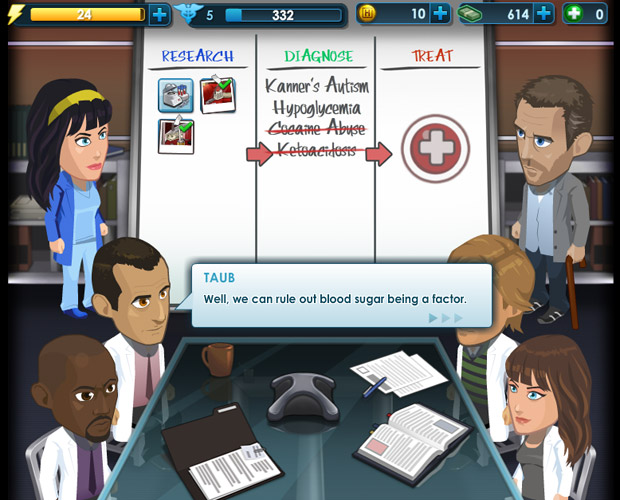
house_1And this is what a zombie looks like in the Walking Dead social game:
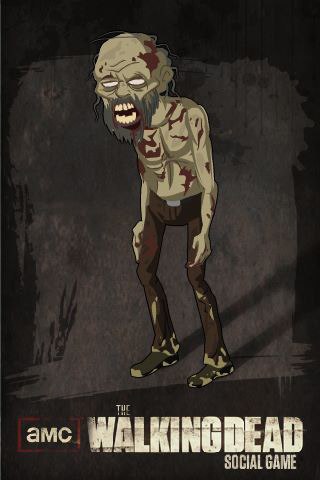
Social_Game_Zombie


I don't think I really need to say anything else on that note.

If it doesn't belong in the game, don't put it in the game.

You want to keep your players coming back day after day? Don't shoehorn in a stupid roulette game that makes absolutely no thematic sense whatsoever; instead, simply make a good game that people will want to keep playing.

Stop assuming I'm an idiot.

"Core" gamers have played games before. They don't need your tutorial to unfold over the course of the first 20 levels of your puzzle game. Make it brief, and make it skippable.

Along the same lines, it's okay to tell someone to do something and then not put a gigantic flashing arrow over the top of it and simultaneously darken the rest of the screen, just in case they missed the gigantic flashing arrow. Allow the player to experiment and discover things for themselves rather than pointing every single thing out to them. At the same time, provide a detailed Help file and/or tooltip system so that they can look things up if they aren't clear.

On a slightly different but related note, it's okay for games to be complex. Again, "core" gamers have played games before and are okay with complex mechanics. Important note: "complex" is not the same as "boring". Kabam and anyone else making "midcore strategy games", please learn this.

Make it so fun I want to pay, not so inconvenient I have to pay.

This is the biggie. Monetisation is the biggest challenge in free-to-play gaming in general, and particularly in mobile and social games, which often attract huge audiences but relatively tiny proportions of paying customers.

"Core" gamers do not like feeling nickel and dimed. Look at the negative response to stuff like Dead Space 3, or Real Racing 3 — both of which, not coincidentally, are by EA.

"Core" gamers also do not like having their time wasted. This does not mean that they will pay to bypass wait timers in your game; it means they will simply stop playing.

Provide "core" gamers with stuff they can buy that improves their experience, but which doesn't break the game. Throw out that stupid energy system — a "core" gamer will stop playing when they're good and ready, not when you tell them to stop. Throw out that "it takes three hours of real time to harvest your crops" bullshit — if you explicitly send them away, they won't come back. Instead provide them with cool stuff that they want to show off — new outfits for their character, new paint jobs for their car, new background music or even whole new levels or areas to explore. If you want a good example of how to do it right, look at stuff like DC Universe Online and Perfect World's free-to-play MMOs — all are satisfying to play for free, but all offer a ton of non-game-breaking benefits to those willing to pony up and buy some premium currency.

Talking of which…

Quit the "pay to win" crap.

"Core" gamers complain. A lot. Particularly when they believe that a game isn't being fair. They'll whinge about mages being nerfed, shotguns being OP'd and generally anything else that breaks the game balance. "Core" gamers play a lot of games and are thus very good at spotting when a game is unbalanced to an unfair degree. Do not make your game so that a crap player can buy their way to dominance over a skilled player; make it so the crap player wants to get better at the game. Reward the skilled player with cool stuff and allow the crap player to see all the awesome stuff they could earn if they were just a bit better; but don't allow them to buy their way to success.

Along the same lines, quit the "Get More Coins" nonsense. Part of the satisfaction of experiences like role-playing games and business sims for "core" gamers is feeling like they've struggled against all odds to earn their rewards. The second you allow them to simply purchase all the money in the game world for $50, you devalue those rewards and make them meaningless. You also, again, break the game balance. Instead, pace your game in such a way that the rewards are earned at a good, satisfying rate, and save the paid stuff for purely cosmetic items. If you must use a virtual currency for premium items, make it a completely separate currency that it's clear can only be acquired through spending money. Keep the "Cash Shop" stuff separate from the normal shop. And for heaven's sake stop plastering the screen with special offers and other sparkling icons — nothing breaks the atmosphere of your otherwise well-rendered fantasy world quicker than a large flashing icon bellowing about "20% Off Gems!"

____

I accept that many of these things are more difficult to implement than what is being done by many mobile and social games now. But they, among other things that I've undoubtedly forgotten — feel free to chime in in the comments — are why "core" gamers do not take mobile and social games seriously.

Court the "core" and you'll make a lot of money. Continue to alienate them, however, and you'll always be a big joke to a significant proportion of people who are willing to spend a lot of money on their favourite hobby.


1193: London Calling

I went to London today. I do not like going to London. I do not like London generally, in fact.

Fortunately, my trip to London today meant that I didn't have to go very far, as in I didn't have to catch the tube or the train or the bus or anything like that. We got a coach in (which, yes, did require getting up at 5 in the morning, but which was a relatively painless experience) then were able to walk to where we were going (the passport office, if you were curious) and then walk back, catch the bus home and not have to piss about with Londoners and their attitudes towards other people.

For many, living in London appears to be some sort of ultimate goal, some sort of Ultimate Cool Status. It is, of course, certainly true that a lot of industries make their home in the nation's capital — the UK video games industry barely acknowledges that any other city exists, for example — but I cannot possibly imagine ever living there. It must be hellish. And expensive. Why would you want to pay a fortune to live somewhere that is hellish?

I had a job offer a while back that would have required me to move to London. I've thought back on my career path since then, which has been entirely working from home for American companies, and I wonder if I might have been better off taking that one as it was a more inherently "stable" position. The conclusion I inevitably reach is "no", incidentally, with a large contributing factor to feeling that way being the fact that I don't have to live in London. (The others being that I wouldn't, by now, be living back in Southampton near my friends and with Andie, which are all awesome things in my life that I'm happy about.)

I'll tell you why I don't like London. Well, some of the reasons, anyway.

The weather is never right. When it's grey and miserable, it's really grey and miserable, and the dirty streets and oppressive, cramped way in which all the buildings are crammed together just emphasises how grey and miserable it is. When it's hot, meanwhile, like it was today, it's really hot, and humid, and the thickness of the dirty air from the hordes of cars who inexplicably think it's a good idea to drive around Central London (hint: it's really not) just makes it all the more unpleasant to immerse yourself in. Particularly when, yes, you've been up since five in the morning.

As I said above, thankfully I didn't really run into my other London bugbears today as we were pretty much "in and out" — or as close to "in and out" as is possible when riding a bus from a couple of hours' drive away. For the record, though, said bugbears largely revolve around people who have to be wherever they're going faster than you getting wherever you're going. This most commonly shows itself on the Underground escalators, where the left lane is the "dickhead" lane of people who think that barging past people who are often carrying large, heavy suitcases and/or bags will get them where they're going a bit faster. (Hint: it probably doesn't, given that when you get to the bottom you all have to wait for the same train.) It also shows itself on the street, where if you dare walk anywhere except smooshed up against a wall, some jerkoff in a suit will come charging past you on Important City-Boy Business and make you — just for one, single, blissful, homicidal instant — consider pushing him into the path of the open-top tour bus that is coming around the corner.

As I say, though, thankfully I didn't encounter any of these issues today, and instead we saw some ducks, geese and other unidentified (well, someone has identified them, obviously) birds in St. James' Park. Which was quite nice.

I still hate London, though. Even with its "nice bits".

1192: Take That!

(Because it's just too obvious to start a post about Ace Attorney with the word "Objection!" these days.)

I've started replaying the Ace Attorney series, largely because I recently reacquired the two installments I used to have in my collection that went missing when I loaned them to someone unknown a while back. (The person I thought I loaned them to swears blind he doesn't have them, and I believe him, sooo…) After finishing Lifesigns in all its Ace Attorney-esque glory, I was keen to revisit Nick, Maya and the rest of the gang for some happy fun times.

And I'm reminded why this is still one of my favourite game series of all time. It pushes all my buttons. Visual novel? Check. Adventure game elements (i.e. puzzles?) Check. Interesting characters? Check. Anime silliness? Check. Overdramatic music? Check.

It's testament to the quality of this game series that, even remembering most (though not all!) of the solutions to the various puzzles throughout, it's still a compelling experience I'm happy to sit through again, primarily because of the characters throughout.

Phoenix himself is a good protagonist. He doesn't enforce his personality on the player too much, but he's very much his own person rather than a blank slate. His growth from constantly-sweating, nervous rookie lawyer in the first game to confident giantkiller over the course of the entire series is heartwarming to see, and as I recall, taking down the villain in the final case of the third game was an immensely satisfying experience on a par with, say, defeating Sephiroth for the first time in FFVII.

One thing I like about the series is that it manages to successfully involve the player in a sense of "conflict" without ever resorting to violence. Not once does Phoenix draw a gun or any other weapon over the course of the game, yet the courtroom showdowns are as thrilling and exciting as any lengthy RPG battle sequence. This is one thing that actually improves slightly as the game progresses — in the first game, you simply have five "lives" in the courtroom sequences, whereas in later games you have a "health bar" that depletes by various amounts when you make an incorrect answer or accusation. This is a much better solution, as it allows for a storytelling trick that is unique to games — drama through interface. When the judge says that you'd better get your facts straight before you answer and you see that an incorrect response will drain your entire health bar in one go, you think damn carefully about what you're going to say next.

Ace Attorney is also pretty much the poster child for why it's a good idea to have a "companion character" with the protagonist — particularly if you're not going to go full-on visual novel and have them narrate everything they do. The chemistry between Maya and Phoenix — which successfully manages to get a cross a real sense of love between the two of them without ever once getting the slightest bit sexualised — is a real highlight of the series, and again it's something that grows and changes over the course of the three Wright games. It's a tradition that's continued in the fourth game Apollo Justice, too, albeit with a different companion character, and again in Ace Attorney Investigations (again with an all-new companion), which brings the wonderful Miles Edgeworth to the fore and inverts the series' usual format.

The game looks great on the big screen of the DSi XL, too. I'm rediscovering a bunch of great DS titles on those lovely big screens, and I'm really looking forward to playing the other Ace Attorney games in succession. It's actually been quite a few years since I last played them, and I don't think I've ever played all five one after another. I'll be interested to see how "coherent" they end up being. We'll see!

1191: Social Burnout

I've been thinking this for quite a while, as you've probably noticed from past posts I've made on the subject, but I'm beginning to feel completely burned-out on social media. Everything has to be social these days. Everything has to have little like buttons and little comment buttons and allow every denizen of the Internet to spew their ill-informed thoughts and opinions over it, or to share it pointlessly to Facebook.

Earlier today, I was distressed to discover that an official Pizza Hut app is coming to Xbox 360, presumably aimed at those people who find phoning, using a mobile phone app or using the Internet to order a pizza too easy and would instead prefer to do so by navigating the monstrosity that is the Metro interface. One line in the Polygon article about it — here — jumped out at me and kind of drove it home how "way too far" we've taken social media these days. Here it is:

"After submitting an order, users can share their choice with friends via Facebook."

Why. Why. Why why whywhywhy would you want to do this?

Pizza Hut aren't the only offenders in this regard, of course — Amazon offer a convenient facility to tweet or share on Facebook anything that you've just bought, as do a lot of other websites. You can even set up the PlayStation 3 and Vita to automatically share every purchase you make on PSN to Facebook. And every time I see this facility, I wonder why on Earth anyone would want to use it. But apparently people do.

This glut of auto-sharing is killing the original point of social media, which was to allow people to engage in conversations with one another by sharing things that were important to them. Now, it's more like a convention of ADHD sufferers running around going "I JUST BOUGHT A PIZZA! LOOK AT THIS VIDEO OF A DUCK RUNNING! HERE'S A PICTURE OF A CAT! I'D SAY SOMETHING PASSIVE-AGGRESSIVE BUT 'SOMEBODY' WOULDN'T LIKE IT!" rather than what I remember my early experiences with Facebook being like.

I vividly recall resisting signing up to Facebook in its early days, because everyone seemed to be doing it and I just couldn't be arsed with it. When I eventually started using it, however, I was impressed to discover a site that was seemingly built for real-life friends. Any time I added someone to my friends list, I had to indicate how I knew them, and the other person had to verify that story. My profile was only visible in full to those whom I had marked as a friend, and there weren't really any privacy settings to worry about. Stuff that was shared was the sort of stuff you'd share if you were actually in the same room with friends — what you'd been up to, some photos from your holiday, perhaps a longer piece of writing in the form of a "Note". No games, no spam, no "I Fucking Love Science" posts. Just actual interactions. The Like button was there, but it didn't have the all-encompassing power it has now, and people hadn't really started using it as a substitute for actually saying things.

Now, though, with the proliferation of "LIKE IF YOU HATE CANCER, SHARE IF YOU LOVE KITTENS" posts, the signal-to-noise ratio is all out of whack, and people are used to posting tons of crap while simultaneously saying nothing of value. This has the side-effect of meaning that when you actually want a response from someone, it's quite difficult to get one. The other day I attempted to find someone to take care of our pet rats while we're on holiday in Canada; the only responses I got were jokey, non-serious ones, and within a couple of hours it had dropped off the face of everyone's News Feed, never to be seen again… unless I were to slip Facebook $7 to "promote" it, of course.

Or take today, when I saw someone post an actual non-rhetorical question that needed an answer, and the first response was a "Like".

Not helpful. At all. You "Like" my question? Great. Do you "Like" it enough to actually fucking answer it, perhaps? No? Then piss off. I'm not so desperate for validation that I count the number of "Likes" a particular post gets and see it as some form of brag-worthy e-peen.

That said, if you want to "Like" my new "K-On Girls Wear the Union Jack" fanart cover photo, feel free.

Sigh. I'm such a hypocrite.

I've been rediscovering forums recently — I was a member of a My Little Pony forum for a while before it shut down due to admin drama, and I'm currently taking some tentative steps into the RPG Maker community. While forums have their own issues — largely people being a little lawyerish about the community rules and regulations — I'm beginning to think they're not such an outdated means of discussion as many seem to think…

1190: Dev Diary 5

I've been thinking about interface design today. I told myself that I wouldn't faff around with the default RPG Maker bits and bobs too much so as not to hold up actually writing the story, but in practice it's so simple to tweak this stuff that I couldn't help myself. In doing so, I've immediately made a difference to the game that makes it look a little less like a half-arsed default RPG Maker project and has a bit more individuality, despite still largely using stock assets.

As a reminder, here's a typical shot of how it looked before:

oneyearlater5And here's how a different moment in the game looks as of today:

oneyearlater14Not a huge difference, I know, but the astute among you will notice two things: firstly, the colour of the text box has changed to a deep navy blue rather than the default gradient fill, and the main game screen now has a Persona 3-style "clock" in the upper-right corner of the screen, indicating what time of day it is. Presently, this only shows the time of day, but I'm toying with it showing what day it is, too — my hesitation on this note is that which day it is is only relevant for part of the game rather than the whole thing.

Earlier today, the "clock" was much bigger and looked a bit like this:

cRuISM7 - Imgur


I actually kind of liked it at the larger size, but it was overlapping the portraits of characters who appeared on the right-hand side of the screen a bit too much for my liking, so I reduced it a bit.

The reason I changed the colour of the text box was because I was experimenting with some scripts that changed the behaviour of the menu. Specifically, they allowed a "wallpaper" image to be applied, so my menu screen now looks like this:

oneyearlater10I figured I'd run with the "flat blue" colour scheme, and add a nice silhouette of Ami in the background for a bit of visual interest, and tweak the message box colour to match for consistency's sake. The silhouette image shows up nicely in the various menu screens without being too obtrusive, as you can see from this shot of the save menu:

oneyearlater15

In fact, it shows up particularly nicely when choosing to quit or return to the title screen — a happy coincidence of the fact that selecting this option darkens the screen somewhat:

oneyearlater16

Those of you who know RPG Maker well will also notice I've replaced the default font with the nice, simple and clean lines of Verdana. This was primarily to match the default font used in a message box script I'm using, because it was bugging me a bit that the font in my message windows and in the rest of the interface didn't match.

Oh, God. What is happening to me?

I jest. Fact is, today I'd reached a good natural "stopping point" in terms of composing the story, and it was as good a time as any to fiddle around with the "look" of the game a bit. I'm pleased with the effect it's had — they're only subtle little changes, but they've had a noticeable effect.

Now it's time to stop farting about with all this and move the plot onwards. To give you an idea of how things are going, the game is structured in several parts: firstly, there's a prologue; then there are five in-game days, during which a whole host of different things can happen according to exclusive choices the player makes in each of the morning, afternoon and evening time slots; then there are four unique "second parts" to the game, and one "true ending". So far, I've completely and totally finished the prologue, and I've finished the morning of the first day. If you're actually reading all the text like a normal person and not fast-forwarding it like me when I'm testing (yes, there is a fast-forward function) then there's probably just under an hour of Stuff to Do and Read so far. After I've created various environments once, I can reuse them for other events, which means that development will continue to accelerate as I progress through the story.

oneyearlater11Environments like the one seen above are quite complex, and most stuff in the game is "examinable", so there's a lot of flavour text in there. Now it's done, though, if I want Ami to come back here with another character — which I probably do — I don't have to design that map all over again. Which is nice.
Anyway. I'll leave that there for now. Just wanted to share how things were going!


1189: Lifesigns Critical

I completed a playthrough of the DS game Lifesigns last night, wrapping up a pleasantly satisfying experience that I enjoyed very much as a whole.

For those who haven't read my past enthusing on the subject, Lifesigns is an Ace Attorney-style adventure game/visual novel for the DS that happens to be set in a hospital and occasionally involve surgery sequences using the DS' touchscreen. Unfortunately for the game, on its original release this caused it to be compared unfavourably (and unfairly) to Atlus' excellent Trauma Center: Under the Knife, and as such it was passed over by many due to some rather middling reviews that missed the point somewhat.

Lifesigns proved to be a great experience for me, though, and it made me think about all the potential genres of gaming we simply don't get all that often. And when I say "genre", I'm not referring to whether something is a shooter or a platform game or an adventure — I'm talking about subject matter. Lifesigns is a medical drama, pure and simple, and that's something we simply don't get much in the gaming space. Trauma Center approaches it, but then veers off into crazy sci-fi town partway through — though the more recent Trauma Team does a much better job at remaining at least semi-plausible rather than going quite as batshit as its two predecessors. Then there was 1988's Life and Death and its sequel Life and Death II: The Brain, but both of those were more simulations of the surgical aspects than narrative-centric medical dramas. And don't even get me started on Surgeon Simulator 2013 — hilarious it may be, but realistic medical drama? No no no.

As you have probably gathered from my past enthusing on the subject, the strange and wonderful land of visual novels is one of the most forward-thinking subdivisions of the games industry in this regard. In visual novels, we have "slice of life" games that are about interpersonal relationships (too many to name); games about suffering with chronic conditions (Private Nurse); games about supporting people with terminal illnesses (Kana Little Sister); games about being a member of a rock band (Kira Kira) and plenty more besides. The freedom to pursue these rather unconventional subjects — unconventional for gaming, anyway — is due to visual novels' strong focus on narrative over gameplay rather than the other way around.

But that doesn't mean that there can't be any of what we'd traditionally call "gameplay" in there — Lifesigns is a great example of how you can keep something narrative-focused and still provide the player with things to do. The player has the option to move between different locations at will rather than being railroaded around the place by a completely linear plot; the player can ask various characters about pieces of information they have gathered; the player occasionally has to convince various characters to do or think things by presenting them with appropriate pieces of information; and, of course, the player has to pick up the scalpel and perform everything from appendectomies to emergency open-heart surgery.

Basically I think what I'm trying to say is that I'd just like to see more games about relatively mundane subject matter — and they don't have to be visual novels to be that way. I want to see an interactive sitcom in which you play one of the characters and interact with the others, but in which nothing of earth-shattering importance happens. I want to see more interactive medical dramas. I want to see more games like Ace Attorney where the focus in criminal investigations is on the lawyers, not the police or private detectives. I want to see more "slice of life" games like Cherry Tree High Comedy Club. And, should I find myself never having to look down the iron sights of a realistically-rendered machine gun ever again, I most certainly won't be sorry.

Note that as ever, I'm not saying that massively popular subsections of gaming such as competitive first-person shooters should go away. But I am saying that those of us who prefer something a little more sedate and cerebral should be catered to a bit more, that's all. We're getting there, slowly — I've certainly found enough to keep me entertained without even looking at the triple-A sector for a very long time — but there's still some distance to go before the same people who tune in to House every week are picking up a controller to play a new Lifesigns game.

1187: Dev Diary 4

This is actually more of a "writing diary" rather than a dev diary, because I'd like to talk specifically about the way I write, and how this relates to the game I've been making.

I've never been the sort of writer who plans things out in exhaustive detail. I know, I know, this is probably woefully self-evident from the nonsensical ramblings I've been posting here for the last 1,187 days (and more occasionally beforehand, too) but it works for me. It got me through all of school, all of university and what has so far been a relatively lucrative career in writing professionally.

Note that I'm not saying I don't plan things out at all. (Although some better planning would have probably avoided that awkward double negative right there.) No, instead what I tend to do is get things firmly in my mind in fairly broad terms, then "fill in the blanks" as I go along. It's not quite writing by the seat of my pants, but it's also not doing a detailed, bullet-pointed list of every single point I'm going to cover over the course of the complete piece. It gives me a sense of structure, but also allows me the flexibility to veer off in another direction if I want to. Those of you who have read my past month-long creative writing endeavours on this site will have likely spotted the points in the (largely improvised) narratives where I had what I thought was a great idea at the time and proceeded down that path with gay abandon, sometimes to discover I'd written myself into a corner and promptly had to dig my way out somehow. (Oh, God. I shouldn't have said that. You'll all be looking for those moments now.)

Anyway, how does this relate to One Year Later? Well, quite a lot, as it happens. Writing an interactive game isn't quite the same as writing a novel. Even writing a visual novel isn't quite the same as writing a regular novel, since you (usually) have to deal with branching plot paths and whatnot. In the case of One Year Later, there is a linear path of "story beats", for want of a better word, but each of those has several different possible things that could happen, and within those several different possible happenings comes a series of optional things that people might not see at all. These optional things let me play with various aspects of the characters while still allowing the plot to continue moving forwards.

This is all very vague, as I'm trying not to spoil things, but let me give you a specific example to make things a bit clearer.

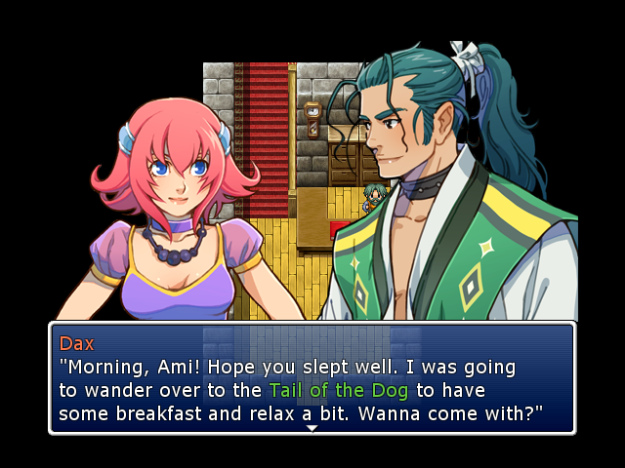
Who wouldn't want to go and have breakfast with Dax here?

Early in the game, the protagonist Amarysse wakes up bright and early in the morning and goes out into the city. As she's leaving the inn where she's staying, she's accosted by Dax, one of the other main characters, who invites her to go for breakfast with him. If she accepts, they go for breakfast, they have a nice chat and various tidbits of information about both Ami and Dax are revealed, after which time passes and it becomes the afternoon. If she refuses (or, more accurately, defers his invitation until she has all the information available to make a decision) then she can go out into the city streets, where she comes across Feena, another one of the main characters, who invites her to go shopping. The player can only pick one or the other during this particular "time slot" of the game; both focus on Ami and a different main character, and both have the potential to reveal some new information, but they also exclude each other.

Someone who wants to go shopping with Feena, obviously.

This, naturally, presents a challenge in later scenes, where I can't really refer to information in scenes that the player might not have seen. However, what I can do is use the built-in game mechanics to determine whether or not Ami knows about a particular subject, and if she does, trigger some different (or additional) dialogue to if she was discovering this information for the first time. An example of this comes if Ami chose to speak to Feena earlier in the game and revealed the information that Feena is, for some reason, not as happy as she could be. In game terms, hearing this information for the first time rewards Ami with a "topic" item called "Feena's Worries"; later, asking Feena specifically about it when given the opportunity upgrades the topic item with new information (she's not happy with her work), allowing Ami to then automatically pick up on little things that Feena says about her work and put them in context — something that she doesn't do if she doesn't have any knowledge of the topic at all, or if she doesn't know that the thing that's making Feena antsy is her work.

It's very interesting (and challenging!) to write this way, as it really forces me to think about the characters and how they might have interacted in the past, and how that might inform their future interactions. One Year Later is a game all about dialogue and interpersonal relationships, so it's important to get this right. I hope I do!

This particular piece of dialogue only shows up if, indeed, Amarysse discovered Feena's real age the previous night -- an optional bit of dialogue that some players might miss.
This particular piece of dialogue only shows up if, indeed, Amarysse discovered Feena's real age the previous night — an optional piece of information that some players might miss.

What this brings me on to is something I suddenly noticed very consciously earlier on while writing some optional, missable incidental dialogue between Ami and Feena: I very much get "into character" while writing.

I say I noticed this earlier; I've actually been conscious of it for quite some time when doing more traditional writing — it's one reason why I enjoy writing stories from the perspective of a first-person participant narrator — but it seemed particularly pronounced earlier. I very much felt like I was "inside the heads" of both Ami and Feena as they talked to each other about, frankly, fairly mundane things — things that those racing through the game would miss, but which those who wanted a deeper understanding of these characters would appreciate as a reward for thorough exploration and investigation.

The thing to be careful of when feeling like this, of course, is getting that characterisation across to the player, who doesn't "know" these characters in quite the same way as I do. Since while I'm writing the dialogue between these characters I'm effectively "role-playing" them, hopefully this will give the dialogue a reasonably natural-feeling flow. This is something that I won't be able to tell for sure until someone else who doesn't know these characters at all plays the game — which is a scary prospect, for sure!

Anyway. That's it for today. I've been doing some good work on the game recently and making some good progress. There's not enough there to proudly show off in playable form yet (though there is just under an hour of "Stuff to Do" implemented now, which feels a significant amount!) but there will be before long. In the meantime, I intend to post some occasional thoughts on the subject of its development on this 'ere blog as I (hopefully) continue to make progress.

One day you might even be playing it. Who knows?

1186: Don't Hate

There's a curious phenomenon in comments sections around the land. And that phenomenon is that it is seemingly the law that someone, somewhere, must hate everything. Actually, that's badly phrased; I don't mean that one person hates everything — though I'm sure there are people who do — but instead I mean that whatever the thing that has been posted, there will always be at least one person who dislikes it for some reason and is inevitably the sort of person who is very vocal about their dislike of it.

This seems to happen particularly frequently in sectors that already have passionate userbases, or in which the userbases are seen as being a "subculture" and/or outside the "norm" somehow. I'm thinking specifically of the video games and anime sectors here — and before you start on me, for all the massive steps forward these media have made in terms of mainstream acceptance over the last 20-30 years they are still indelibly tarred with the "geek" brush to one degree or another.

Today, I was exploring the RPG Maker community who, by all accounts, appear to be a fairly friendly and helpful bunch for the most part, as I've previously mentioned. I was curiously browsing through some of the other users' projects in progress and came across a few interesting-sounding games. One of the users noted that they had submitted their game to Steam Greenlight, the process whereby a game can end up being sold on Valve's popular PC gaming digital download storefront if it gets enough positive votes from the community.

The game, by all accounts, sounded interesting and unconventional, and something I'd be intrigued to play. It was an "artistic" game, for want of a better word, designed as a means for the author to show what it was like living with depression. The author said upfront on the site that it was a mostly-linear, narrative-centric experience with a lot of text, and made no apologies for this fact. (For people like me, the terms "narrative-centric" and "lot of text" are selling points, not things to be ashamed of!)

Sadly, the Greenlight comments section was less than supportive for various reasons, featuring disparaging remarks for everything from it being "another depression game" (oh, sorry, there have been so many of those) to dismissing it simply because it's an RPG Maker game. I've made my feelings on the latter point quite clear in the past, but they bear repeating: if a tool is available to help someone realise their artistic vision, there's no reason why they shouldn't use it, regardless of how many other people are also using it. And besides, some of my favourite games in recent memory have been RPG Maker titles — Corpse Party, To The Moon, Cherry Tree High Comedy Club… all of them were made in earlier versions of RPG Maker that were considerably less sophisticated than the excellent toolset that is VX Ace.

But I digress. The point is that the comments section was filled with hate for the sake of hate rather than actually constructive feedback. The fact that the game in question (Actual Sunlight, I believe it was called) was "another depression game" and an RPG Maker project had nothing to do with its quality, or its "value" to the Steam community as a whole, and yet these things were used as reasons to reject it, without even bothering to check it out.

In the anime sector, it seems that it's fashionable to hate on whatever the biggest name show is at the time. Most recently, this has been seen with Sword Art Online, which I found to be a rollicking good time with an astonishingly spectacular soundtrack, some memorable characters and an interesting, intriguing and pleasingly mature (for the most part, anyway) storyline. It was a good show, in short; while it perhaps wasn't the most intelligent anime you'll ever see, it was certainly far more than a dumb, formulaic show.

Perhaps not something everyone would want to watch, no, but certainly far better than the overly-negative comments that would appear on J-List's Facebook page any time site owner Peter Payne posted a piece of artwork relating to SAO. (Granted, J-List's Facebook page is a place where any time a picture of a vaguely attractive anime girl is posted, one specific user will always be along within three comments of the start of the thread to helpfully inform everyone that "[he] would fuck her", so it's perhaps not the best place to go for objective criticism, but still; you'd expect a community of Japanophiles such as the followers of J-List's page to be a bit more enthusiastic about the things they supposedly like!)

I honestly don't get why this happens, and it seems to happen a lot. Why waste your time on hate when there is so much stuff out there to get you excited? Wouldn't you rather feel happy and intrigued by something than angry or upset?

1185: Top Ten Panty Shots in Video Games

I'm not normally a big fan of Ben Kuchera's work (for reasons I won't go into right now because they're not relevant to what I want to talk about) but he's bang on the money (no pun intended) with this piece.

I shan't reiterate Kuchera's points here — read the feckin' article! — but I will say that on this note, I do agree with him.

The Internet's (and tech in general's) reliance on advertising has to end. It's not sustainable. It simply isn't. And in the meantime, all it's doing is devaluing content, pissing people off and causing us to continually circle the plughole, drawing ever closer to being sucked into oblivion forever, or at the very least into that weird, disgusting black smelly goo we found in the end of the pipe the last time our sink got blocked.

Whenever a site like, say, Kotaku (who are usually the ones who get picked on for this sort of thing, but they're far from the only offenders) posts some bullshit story that gets everyone riled up about how irrelevant/pointless/offensive it is, the war cry that goes up is that they're doing it "for the hits". More accurately, as Kuchera says, they're doing it for the pageviews, because like it or not, the bullshit stories that make everyone angry are the ones that lots of people take a look at "just to see what the fuss is about". The Daily Mail makes a living from posting this sort of garbage on a daily basis; Kotaku at least punctuates its rubbish with some interesting and thought-provoking pieces, while the Mail is just uninterrupted crap. As Kuchera notes, though, the bullshit more often than not pays for the interesting and thought-provoking pieces.

It's not just professionally-written content that suffers from this problem, though. Look at Facebook and the idiotic, illiterate ads that festoon its sidebar on every page. Look at Facebook (again) and its obnoxious, obtrusive "Sponsored Posts" thrusting themselves in your face uninvited. Look at Twitter and its "Promoted Tweets" that you don't want to see. Look at whatever bullshit ad WordPress has decided to serve up underneath my writing on this site (although only on the mobile site, seemingly) Look at the mobile app I reviewed today, which rammed two full-screen ads down my throat before I could even open the main menu, and two more when I started picking a photo from my device's photo library to manipulate. (I was not kind to said app in the review.) Look at the ads you get for casinos and shady-sounding "download services" any time you browse for porn or torrents or anything else you wouldn't admit to looking for in polite company, but which we all know everyone looks for. (Yes, even you, you pervert.)

Internet advertising isn't positive or helpful. It is, for the most part, shady, misleading, obnoxious and obtrusive. Which is, of course, why it's so understandable that so many people — particularly the tech-savvy among us — run ad-blockers and thus deprive many sites of what little revenue they are scraping in from these revolting blights on the otherwise awesome nature of the Internet's global community.

I don't run ad-blockers. Honestly, this isn't for any particularly noble reason — I simply haven't set one up. But knowing what I know of the online publishing industry from the inside, I don't intend to run one, either. Those "One Weird Tip to Peel Your Skin Off and Whiten Your Teeth in the Casino that One Weird Old Florida Mum Found While Downloading Now!!" ads are many sites' main means of income. This isn't the magazine industry — there's no "cover price"; no newsagent looking over your shoulder and asking rather bluntly "you gonna buy that, mate?" (The magazine industry is, of course, in decline, meaning its model isn't necessarily particularly desirable either — but what do you think damaged it beyond repair in the first place?)

It's clear that this situation has to change. But it's not going to be an easy process. Readers used to consuming content for free and blocking ads are going to have to suck it up and start paying for their content. Content creators need to be confident enough in their work to make it worth paying for. And those responsible for the sort of bullshit ads you see on the Internet every single day… well, frankly they need to find a new career, because they've done more than enough damage to the media biz already.

If things don't change, there are going to be big problems down the line. Whether these problems take the form of the entire "new media" industry turning into the most stupid parts of your Facebook News Feed over and over again or the business collapsing entirely remains to be seen — but I'd rather not see either of those things happen if at all possible.