1205: Long Live the Queen

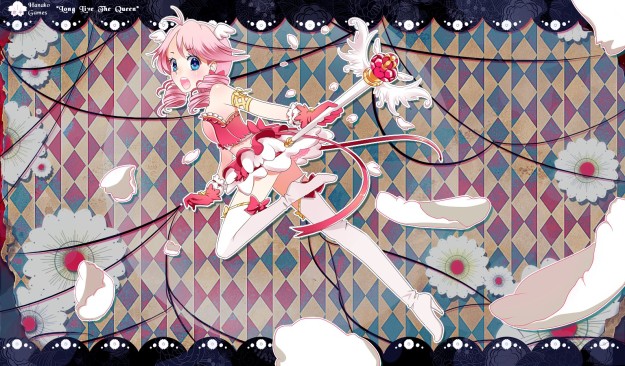
lltq_wallpaperA short while back, a few indie developers that I enjoy the work of very much released a bundle of games that looked interesting. Among this selection of games was a title known as Long Live the Queen by Hanako Games, developer of Magical Diary, a game which I enjoyed very much. I picked up the bundle and, as tends to happen frequently with this sort of thing, forgot all about it completely until recently.

The specific circumstances which caused me to remember the existence of Long Live the Queen as a Thing were catching a glimpse of it on Steam Greenlight earlier. The premise of taking a young anime girl, dressing her up and then watching her die horribly sounded appealing and interesting, so I decided to check the game out for myself.

What I discovered was a very interesting "life sim"/strategy game with a surprising amount of hidden depth. Since Hanako Games is a small developer with only a couple of people to its name — creator Georgina Bensley and one or two others — it's a game that was obviously made relatively "on the cheap," as it were, with relatively little in the way of graphics and sound/music, but that doesn't stop it from being very interesting indeed.
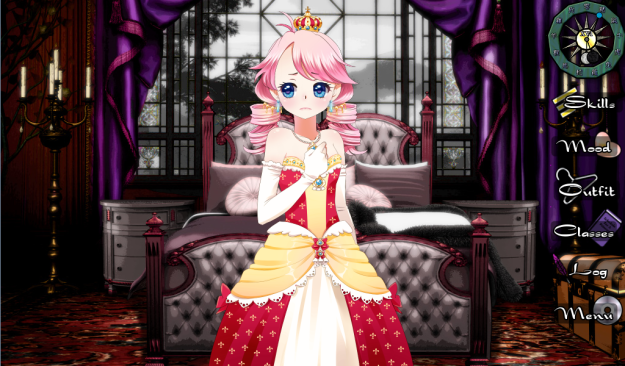
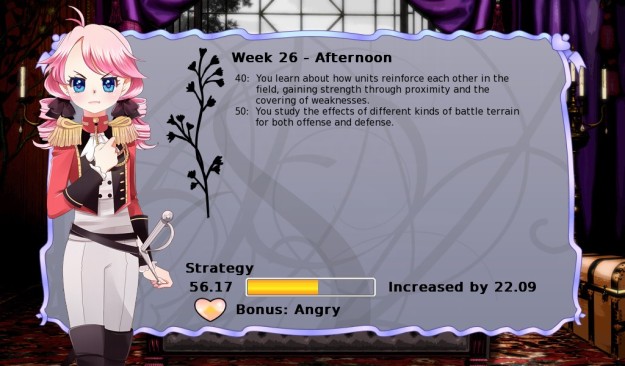
steamworkshop_webupload_previewfile_142369710_previewEssentially, Long Live the Queen is a game somewhat akin to old Japanese games like Princess Maker, in that you have a young anime girl to take care of and must train her up to deal with various situations appropriately. The course which the game's plot takes depends on the skills which you choose to train up, and the skills which you can train most effectively are determined by Our Heroine's current mood — for example, if she's depressed, she's particularly wont to express herself through things like music and singing, whereas if she's angry, she can channel her aggression into training in things like military strategy and proper use of weapons. Training to particular levels in things unlocks various costumes appropriate to the skills she's learning — for example, learning a lot of spiritual skills unlocks a priestess outfit, while becoming a "Lumen" and awakening to her family's magical heritage unlocks a particularly awesome "magical girl" outfit.

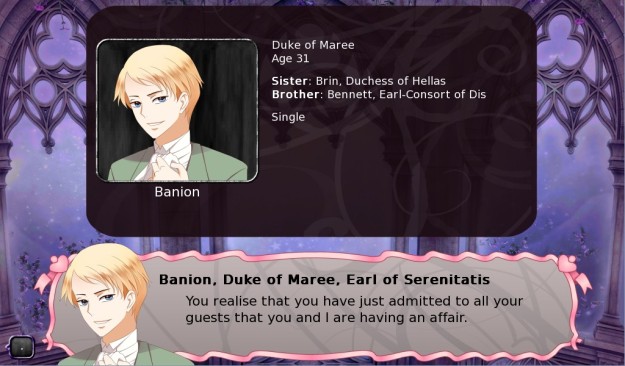
These skills aren't just for bragging rights, though. Each in-game "week" sees various events happening, many of which require a skill check to successfully resolve. Failing the skill check isn't necessarily a bad result, though — it simply means that Our Heroine doesn't have the requisite skills to resolve a situation in a particular way. For example, early in the game, she's sent a necklace by a Duke who is proposing marriage to her, but having a distinct lack of knowledge of the way things work in the royal court means that she doesn't recognise the gift for what it is and instead responds with a rather unqueenly "Oooh! Sparkly!" — but it cheers her up.
steamworkshop_webupload_previewfile_142369710_previewMaking it through the game without dying horribly is a case of carefully making decisions and levelling up skills appropriately, and it's not at all uncommon for Our Heroine to meet a sticky end — in fact, it's positively encouraged via the "collect them all!" death checklist in the game's main menu. It's almost preferable to play the game like a roguelike — starting from the beginning, only saving when you're stopping playing rather than before you make a critical decision, and dealing with the consequences of your actions. In a nice touch, reaching the end of a game — whether with Our Heroine's coronation as Queen or with her death — allows you to export a complete log file of everything that happened so you can perhaps figure out what on Earth went wrong.

In short, it's a very interesting game, and well worth checking out. Don't go into it expecting something spectacular — the music loops are nice, but very short and repetitive, and there's not a lot of variation in the graphics (though Our Heroine's various costumes are all great) — and you'll have a great time building your own custom princess and seeing how she survives in the world.
steamworkshop_webupload_previewfile_142369710_preview (1)

Find out more here.

1204: Torontonia

We went out and about for a bit in Toronto earlier, primarily to pick up some computer bits for my friend Mark to build his "Steam Box" PC but also to get some dinner and have a little wander. Again I was struck with this city's enormous diversity.

It is, for me, one of Toronto's most defining characteristics, and one which you can notice very quickly upon spending some time downtown, or even out in the greater Toronto area. Go for a walk and you'll be in one distinctive district one moment — perhaps Chinatown — but then you'll round a corner and suddenly it'll be suburban-style houses with lots of greenery. It's quite disconcerting at first, but you soon realise it's part of the city's character.

Today we had a wander in the Kensington area, which is fascinating to walk around. It's difficult to describe exactly what it's like, but there's a definite sort of Latin/Central American vibe going on, with lots of pokey little shops, many of which have their wares strewn all over the street outside them.

We happened to find an amazing video games shop in the middle of all this. From the outside it looked like just another crappy used games store, but inside it was like a treasure trove of Every Game I Want To Play Ever. Seriously. I have either played or very much want to play every title on the back wall of that place. It even had some rare offerings, such as the original Persona games for PS1 and rare stuff like Dracula X, Chrono Trigger and Mother 2 for SNES — all of which cost a pretty penny!

It's very warm here at the moment, which makes going out and walking for too long a little uncomfortable. I think I might invest in a pair of shorts while I'm here as I feel like wearing jeans is suffocating my legs!

1203: Back to the Mansion Again

I played a bit more Luigi's Mansion 2 earlier. Haven't played it a lot yet, but I'm really liking it for a number of different reasons.

Firstly, the single-player mode has a very strong "adventure game" feel about it. Specifically, it features frequent occurrences of getting "stuck" — something which is not altogether common in modern games that hold your hand quite a lot. Luigi's Mansion, though, despite appearing quite tutorial-heavy in the first couple of levels, very quickly turns into a game where you're expected to work things out for yourself, to remember things from earlier and to explore thoroughly rather than just following the handy glowing trail of breadcrumbs on the map.

Secondly, the multiplayer mode is awesome. It hadn't occurred to me that multiplayer in Luigi's Mansion 2 might actually be good, but by golly, it really, really is. I've only tried the "Hunters" mode in Download Play so far — this apparently means it's a "limited" form of the full multiplayer experience — but it was a blast by itself.

Essentially, the multiplayer mode is a cooperative ghost hunt for up to four players at once. Before starting the game, the players choose how many floors of a mansion they want to tackle and must then clear each of them against a strict time limit. Each level is randomly generated, requiring methodical exploration to locate where all the ghosts are and then to take them down. Communication between players is also helpful, but for those who don't want to actually talk to each other — or those who are unable to due to playing online, for example — there's a handy little "quick chat" thingy on the D-pad, allowing you to make Luigi say various things, but more importantly, display a callout on the map indicating that the other players' attention is required in a specific location.

It's a really interesting mode because it's simple but extremely flexible. If you want a short game, you can play just 5 floors. If you want a longer game, you can play up to 25 floors, and successfully clearing this opens up an "Endless" mode, which sounds like a lot of fun. Within the individual play session, players earn points towards upgrades that are valid just for their single play session, making a single multiplayer game feel like a microcosm of the main game's upgrade and reward structure. It's really, really neat and I can actually see myself playing it quite a bit.

The Download Play functionality also reminds me of one of the great unsung features of Nintendo's handhelds. It is absolutely awesome to be able to wirelessly beam a limited version of a game over to your friends and play them without them having to own the game. Wireless multiplayer on its own is great — remember the awkwardness of hooking up link cables? — but when your friends don't have to have their own copy of the game? Brilliant. The only thing about this that I hate is the fact that the 3DS' stupid region locking prevents handhelds from different regions downloading these multiplayer-specific packages. Sometimes. (If it was consistent, I might not be quite so mad about it, but still.)

Anyway. Luigi's Mansion continues to be an entertaining experience, and I'm looking forward to investigating it further. For now, however, I bid you good night!

1202: Say Anything

We're in Canada! Also quite jetlagged. Andie flaked out pretty early and went to bed, but I powered on through and played a bunch of board and card games before being introduced to Adventure Time (hilarious) and Polar Bear Cafe (also hilarious, but in a completely different way).

We played a few games this evening, including Love Letter, Magical Athlete and Say Anything. All of them are pleasantly lightweight, quick games that can easily be slotted in to an evening, and they're also particularly friendly to casual players or inexperienced gamers.

Love Letter is an exercise in simplicity. Each of the players are a prospective suitor to the princess, and they're trying to get their love letter into her hands. The card they have in their hand at any one time represents who has their letter at any given time, and the numerical rank on the card represents how "close" to the princess the love letter is. When the deck — which is made up of just 16 cards — is exhausted or all players except one have been eliminated, the surviving player with the highest-ranked card is declared the winner of that round. Play then repeats until someone has won four rounds.

The interesting part of Love Letter comes in the special effects all the cards have. Each turn, you draw a second card, and you must then "play" one of your two cards by discarding it. Discarding any card causes its effect to occur, and these range from swapping hands with other people to being able to peek at their cards or potentially eliminate them from the current round. As you might expect, the princess card is the strongest if you survive to the end of the game, but if somehow you find yourself having to discard it, you're immediately eliminated.

It's a very simple game that is easy to understand, and there's a surprising amount of hidden depth to it — card-counting, bluffing and working out the best way to pull the wool over the other players' eyes.

Magical Athlete, meanwhile, was described to me as "Snakes and Ladders with special powers", and that's a fairly apt description. The game unfolds in two phases — firstly, each player must assemble a team of five magical athletes, each of whom have their own special abilities, and secondly, everyone then has to compete in five rounds of roll-and-move racing using a different one of their chosen characters each time. The player with the most points at the end wins.

While roll-and-move games rely heavily on luck, Magical Athlete sidesteps the experience being completely random through the aforementioned special abilities, many of which are designed to either help the owner out, hinder the others, or sometimes both. Many of the abilities are also designed to interact with one another to various degrees, which makes for some interesting encounters. By far the most memorable race we had earlier included the combination of the Siren, who pulls every other player towards her — forwards or backwards — by a single space at the start of her turn; Cupid, who moves forward five spaces any time a male and a female character occupy the same space; and the Pirate, who can "kidnap" any player and bring them back to their space. Consequently, the race became a farce: Siren constantly pulling people onto her space activated Cupid's power, which meant that Pirate would inevitably pull him back every turn.

It's a fun game — perhaps light on the strategy, but a lot of entertainment to be had here from simply observing how the different cards interact with one another.

I think my highlight of the evening had to be Say Anything, though, which has a certain degree in common with Cards Against Humanity, only with dry-wipe markers and less filth provided up-front.

In Say Anything, players take it in turns to read one of several different questions from a card, and the other players must then scrawl an answer on their own personal whiteboard and put it in the middle of the table. The asker then picks their favourite and secretly records their choice, then everyone else bets their two coins on which one they think the asker will pick. Points are then awarded according to whether players bet on the asker's pick and various other means.

The beauty of Say Anything is that it "scales" to any type of social group — I'm not talking about difficulty or group size, but subject matter. The questions are all fairly "general" and you can literally write anything you want on your whiteboard as an answer — even if it's not "true". Like Cards Against Humanity, there's an element of playing to your "audience" when providing an answer, but unlike that game, there's no obligation to delve into depravity unless you really want to. Cards Against Humanity is as filthy as you make it to a certain extent, but there's little denying that a card that reads "Pac-Man uncontrollably guzzling cum" is anything but questionable in nature. There's nothing stopping you writing exactly the same thing in Say Anything, but equally you're not forced into the less salubrious side of things unless you want to. This means it can be played with the whole family, as opposed to Cards Against Humanity's well-deserved "mature" rating.

I'd write more about all of these but I feel like I'm about to pass out from tiredness/jetlag. So, hello Canada, goodbye U.K. for a couple of weeks — expect updates at strange times for the next two weeks! 🙂

1201: WE AR GOINGON HOLLYDAY TUMOROW

Well, we are. I'm looking forward to it a lot, even though my innate Britishness prevents me from showing any outward signs of it.

It's the first proper holiday either Andie or I have had for quite a while, and it's the first one I've had for ages where I haven't had to do at least some work in it. (As it happens, depending on when my new gig starts, I may find myself having to do some work while I'm out there, but at present I'm as free as a bird, which is a very pleasant feeling indeed.)

Holidays are ludicrously expensive, aren't they? Well, depending on where you go, obviously. But for the most part, if you want to go somewhere nice and/or abroad, you'll generally find yourself having to pay through the nose just to get there, and then a whole bunch on top of that once you are there, assuming you actually want to, you know, do stuff. Fortunately, we're lucky enough to have some friends where we're going (all right, the primary reason we're going on holiday is to visit them) and as such the expenses while we're actually there will be significantly less than had we had to find a hotel for the time we're out there. So thank you enormously to our gracious hosts for putting up with us!

This will be the second time I've visited Toronto. I really enjoyed my last trip there, as it's an interesting city. Those who live there probably take it all for granted by now, but I was struck by its incredibly multicultural nature. I'm not talking like British multicultural, either, where you have districts that are predominantly Asian, Polish, whatever — no, I'm talking about this strange and wonderful thing Toronto has going on where you'll be walking down one street and it's Chinatown, then you'll walk down another and the architecture is completely and utterly different and the people are likewise completely and utterly different. It's quite chaotic, in a sense, but in a thoroughly pleasant sort of way.

The other reason I'm looking forward to visiting Toronto, of course, is the people we're going to visit. Mark and Lynette are some very dear friends whom I haven't seen face-to-face since 2010 and my trip to PAX East, at which I got to meet a whole bunch of people from the Squadron of Shame for the first time. I've often said that that trip was one of the most genuinely happy times of my life, and I stand by that; the fond memories are made all the more potent by the fact that everything else in my life pretty much fell to pieces shortly after that trip, but fortunately, as long-time followers will know, things are in a much better place for me now.

I'm looking forward to seeing Mark and Lynette (and their friends, too, some of whom I'm already acquainted with) because they are My Kind of People — people with whom I can nerd out about Persona, anime, JRPGs, board games and all manner of other geeky stuff. Don't get me wrong, I very much enjoy spending time with my friends who live near me here in Southampton, but very few of them are "into" the same things to quite such a degree as I am. Sure, a lot of them are gamers to varying degrees, but an unfortunate side-effect of the games industry's diversity these days is that not everyone is into the same things. One of my regular board gaming buddies is massively into Minecraft and Skyrimfor example, whereas I think I'm pretty much "over" both of those games, largely because I have such an astonishingly huge Pile of Shame to play through and thus don't really want to devote any time to two potentially endless experiences. I don't really know many people in this country — certainly not anyone I can just pop over for a coffee with — who would get quite so excited about, say, Ar Tonelico or Trauma Team as me.

Still, I guess in one sense this is a sort of good thing — I'm grasping here, I know — because it makes those rare opportunities to get together with Your Kind of People special occasions to be enjoyed and treasured. I'm hoping the coming two weeks will be memorable and fun not only for me and Andie, but for Mark, Lynette and anyone else who gets involved, too. There will doubtless be plenty of board and video games along the way, plus eating good food with good friends.

Can't wait. So I should probably get to bed so I don't miss our flight in the morning, huh? Catch you on the other side of the Atlantic, then.

1200: It Was Just a Joke

Playing Robot Unicorn Attack 2 on the toilet earlier, a question came to me. It's been lingering in my mind for a few days, actually, but as I was there attempting to better my score and ensure supremacy for Team Rainbow in the twilight hours of the second of May, 2013 — Team Inferno probably have it in the bag, sadly — it struck me that perhaps Robot Unicorn Attack 2 is taking itself a bit too seriously.

And then this, naturally, led my mind on to ponder "how far is too far?" for things that are, essentially, jokes, memes, gags, whatever you want to call them. Because that's what the original Robot Unicorn Attack was — a joke. An immensely popular joke, yes — one million plays within a week of its release, apparently, and plenty more since then — but still a joke. This much is probably self-evident from its title. It is a game called Robot Unicorn Attack. No-one has called a video game something quite so literal and ridiculous and meant it since the 1980s.

And yet here we are in 2013 with Robot Unicorn Attack 2, a surprisingly well fleshed-out expansion of the original's "endless runner" gameplay that features online asynchronous cooperative "community" goals, an upgradeable unicorn, a levelling system, downloadable content, a bonus level unlockable if you either progress far enough in the game or stump up enough in-game currency, and all manner of other things. It's not the deepest game in the world, but it is a mobile phone game — and, more to the point, it is a mobile phone game that understands the sort of experience that is sensible and practical to put on a mobile phone. (It's also one of the less offensive examples of the "freemium" model I've seen recently, though the pop-up adverts are a bit gross.)

It's hard to explain, but it just feels a bit "wrong". It feels like it's not a joke any more. I hesitate to use the words "sold out" but… well, yes, it's sold out. It's Robot Unicorn Attack, but monetised out the wazoo to be profitable, whereas the original was a freeware Flash game that anyone could play without having to pay a penny.

I think that "monetisation" part is the key defining characteristic that determines "how far is too far" when it comes to jokes — particularly ones which started on the Internet. By the time money gets involved — i.e. it gets incorporated into something which is sold, or used to advertise something else for profit — it is probably already well past its sell-by date.

I can think of a number of examples where this has happened in advertising in particular. Take the advertisements for the price comparison website Go Compare, for example. For quite a while, these featured an irritating moustachio'd arsehole singing the service's jingle over and over again in various different styles. Everyone got immensely irritated with it. So, naturally, what the "clever" marketers did was leverage the fact that everyone was irritated with the "Go Compare Man" and put out some ads in which he was subjected to various indignities. But by that point, everyone had already pretty much just moved on to wanting to fire everyone involved with Go Compare into the sun and never hearing of their stupid company ever again. (Any time I need insurance, I will not go to their stupid site on principle any more.)

See also: the number of pointless mobile apps that have attempted to incorporate any combination of Nyan Cat, Gangnam Style, the Harlem Shake or any other "viral" sensation out there. Viral sensations are a marketer's dream — they provide a ready-made audience, so long as you can inextricably link one annoying thing with a specific brand. The audience doesn't even have to like the annoying thing — they just have to start thinking of these things not as "Gangnam Style" but as "that music off the [Brand X] advert".

I often wonder how a lot of marketers sleep at night knowing that their career is, essentially, to irritate people as much as possible. It surely can't be satisfying to flick on the TV, see a Go Compare advert and think "I did that."

Still, I guess they'd probably say the same about a games journalist's output. Oh well. Each to their own, I guess.

1199: Back... to the Mansion

I never played the first Luigi's Mansion, to my shame, but I understand it was a good time, if perhaps not quite up to the standard of some of Nintendo's other, more high-profile titles.

I have, however, been playing the second Luigi's Mansion game thanks to a copy generously provided to me by my brother for my birthday. Yes, it's the second 3DS-related post in as many days, but I actually want to talk a little more generally about Nintendo and how they do things rather than go into the specifics of the console and the game itself.

Luigi's Mansion 2 doesn't come with a manual. It comes with a pathetic little single sheet of paper that outlines the basic controls, plus all the other usual health and safety crap that Nintendo always bundle all their products with.

What struck me in the couple of levels of Luigi's Mansion 2 that I've played so far was this, though: it doesn't need a manual, because it is so immaculately and intuitively designed that even someone completely unfamiliar with the original game will be up and ghost hunting within seconds, and all without any real "tutorial". Okay, there are a few messages the first time you get items, but an awful lot of stuff isn't explicitly explained at all — it just makes perfect sense.

This is in direct opposition to the way that a lot of mobile and social games work — pretty much every mobile and social game out there begins with a long, tedious, badly-worded and unskippable tutorial that literally doesn't allow you to do anything but the thing it's telling you to do. No sense of exploration, no means of discovering things for yourself, no means of skipping the bullshit if you're already familiar with how to "Build Your Own Town!" and then spend the rest of your life tapping on things every time your phone lights up.

I found this interesting, because ostensibly a lot of Nintendo's games target a similar demographic to those who play mobile and social games. This isn't to say that they're dumbed down or "casual", I hasten to add — but their recognisable, consistent, family-friendly aesthetic and "pick up and play" nature makes them ideal for pretty much anyone to try for themselves and probably have a pretty good time with.

I think it's a difference in approach. Nintendo comes at it from a rather welcoming angle that is friendly to both experienced gamers who have been helping Mario out since the '80s, and newcomers who are coming to a Nintendo game for the first time on the 3DS. "Come on in," their games say. "We're going to have some fun. If you know what you're doing, go right ahead and enjoy yourself. If you're not sure what to do, though, don't worry — we'll help you out."

Compare and contrast with the way that, say, Zynga treats you when you start one of its games. "YOU!" the game seems to say. "You are STUPID. You are a WORTHLESS IDIOT who has NO IDEA how to play a fucking video game. Why else would you be playing one of OUR games? Let me walk you through everything EXTREMELY SLOWLY. No, I don't believe that you know how to play this game already. SHUT UP. You can start playing when I say so. Don't click there, click here. I said CLICK HERE. I'm going to wait here until you click here. No, I don't care if you want to make it full screen. I say click here, so you DAMN WELL BETTER CLICK HERE. Twat."

I'd never really noticed this strong distinction until recently, but by golly it is noticeable. And it makes the difference between me playing a Zynga game and feeling like I'm having my intelligence insulted at every turn, and playing a Nintendo game and wanting to show everyone how awesome it is.

1198: ThreeDeeEss

After some hesitation — and despite owning several games for it — I finally got my own 3DS today. We've actually had one in the household since Andie's last birthday — it belongs to her — but with the combination of Fire Emblem: Awakening and the copy of Luigi's Mansion 2 my brother got me for my birthday (thanks!) I figured it was probably about time I got my own rather than depriving Andie of the opportunity to play Harvest Moon whenever she pleased.

And, as predicted, just a short period of time with the 3DS has reminded me once again that people who claim traditional handhelds are on the way out and that mobile phone/tablet gaming is the future are talking out of their arse. Yes indeed.

The quality of the experiences on the 3DS and Vita is just in a completely different league to that you get on a smartphone. Completely. It also makes the rapidly-widening schism between free-to-play/"freemium" and traditionally-sold "pay once, play forever" games extremely apparent.

Today, for work (last day! Woo!) I reviewed the new Transformers game for iOS and Android. Said game is the latest in the interminable string of "card battle" games that are available for those two platforms, which means it's a monotonous, tedious, strategy-and-gameplay-free experience that has only the most tenuous link to its source material. It is, in short, designed as little more than a means of getting people addicted enough to the sight of little bars filling up to want to pay money to "collect" virtual cards that don't actually exist. "This is a super rare card!" they'll say, failing to point out that it is data rather than a physical object and is thus only as "rare" as they decide it should be at any given point in time. There's no joy in playing that game; it's mindless busywork — something to do for the sake of having something to fiddle with rather than something that actually engages your brain and makes you interested in what's going on.

The phrase "mindless busywork" describes probably 90% of the new mobile and social games that are released every day. Which is why I have no desire whatsoever to play them in my free time.

Compare and contrast the crap that is Transformers Legends to Fire Emblem: Awakening on 3DS, then. Ostensibly, the two games are of the same genre: RPG. And yet the difference in quality is apparent from the moment you fire up the game. And it only gets more painful to even contemplate this difference as you go on.

Fire Emblem is a game designed to entertain you and challenge you. It's not designed to massage your ego through giving you tasks to do that are completely free of any sort of challenge, and then extract money from you while you're feeling good. It has the means of extracting money from you through its paid (optional) downloadable content, but the experience in and of itself is complete, and it doesn't nag you at any point to do something that will cost you money. It doesn't tell you how long you can play before you have to either stop or pay, it doesn't tease you with "if you pay $5 you might get this awesome hero" nonsense — note, "might" — and it doesn't thrust gigantic screen-filling adverts in your fucking face every five minutes like most modern mobile games do. Nothing breaks immersion for me more quickly than happily playing a game then suddenly everything stopping and the device on which I'm playing said game asking me if I want to download another, completely unrelated free game. The answer is, without exception, "no, fuck off."

And if the adverts don't break immersion, the "user retention" strategies certainly do. "Play the Daily Spin now!" announces a game that is attempting to be a gritty depiction of medieval life, failing to see how completely inappropriate a slot machine is in this context. "Spin the wheel for prizes!" barks Gollum in the official mobile game of The Hobbit. "Get free coins every day!" bellows whatever shitty puzzle game has ripped off Bejeweled and monetized it out the arse this week.

No. So long as mobile phone gaming is the preserve of sleazy chancers who prey on the weak and stupid, traditional handhelds have absolutely nothing to worry about.

Were you an advocate of mobile and tablet gaming, you may well point to the disparity in price between mobile games and 3DS/Vita games and make some sort of non-specific sneering noise at this point. My response to that is very simply "you get what you pay for."

1197: 32-Bit Power

It's my birthday today. I am 32. Big fucking whoop.

I still have a somewhat childish outlook on a lot of things, I will freely admit — come on, it's endearing — and birthdays are one of those things. I still feel that birthdays are special days, that they should be celebrated and enjoyed — and that preferably, nothing unpleasant should happen to you on them. Ideally, you wouldn't even have to work on your birthday — it would be a guaranteed holiday for each individual person — and you could just spend the day eating cake, reading cards, opening presents and wondering how you'll spend your birthday money.

Which is why I'm here at just after 10pm in the evening feeling a bit glum. Today has… well, not "sucked" exactly, but it has been nothing but a normal day in which I got a significantly larger number of posts on my Facebook Timeline than usual. Don't get me wrong, I'm grateful for people taking a moment to wish me happy birthday after Facebook reminded them to do so, but it's not really the same as, you know, something exciting happening. And absolutely nothing exciting has happened today. At all. It has just been a Monday. Any other Monday.

It doesn't help that Andie is ill and thus we can't really do anything exciting and celebratory, though we are going to Canada at the weekend, so I'll look at that as a slightly-belated birthday celebration. I also had some friends over at the weekend for board and computer games, and had the chance to catch up with some other friends I haven't seen for ages on Sunday, so that was nice, and I'm grateful for that.

I can't shake the feeling that today should have been more "special" than it was, though. It just wasn't. At all. And I know that as you get older, birthdays do get less and less special — largely because you've had so many of them, but also because you start to get to a point where you want to forget about them — but, you know, I still like to feel like there's a day that's "mine"; a day when I can enjoy myself, when I can be immune from the unpleasantness of the world and just enjoy a bit of selfishness for once.

Today wasn't that day.

Oh well. There's always next year.

BALLS

1196: What's Yours is Mine

My good friend Mark and I played a bunch of Monaco: What's Mine is Yours What's Yours is Mine (damn it all to hell, I KEEP getting that the wrong way round) via the wonder that is the Internet this evening. It's rather fun.

If you haven't come across this peculiar little game before, it's essentially a multiplayer stealth game in which you cooperate to complete various heists as efficiently as possible. This isn't a ludicrously violent first-person shooter-style heist as in Payday: The Heist, however; no, these are missions where you have to sneak, think carefully about what you're doing and occasionally frantically improvise while being chased by a pack of slathering dogs.

Monaco's main distinguishing feature over many of its peers is its heavy sense of style. Levels are depicted from a top-down perspective as a black-and-white "blueprint" of the building the team are currently plundering, with only the regions visible to the player's current position "lit up" and showing their full detail. The rest of the blueprint is marked with various icons showing objects that can be interacted with, treasures to find and the eventual mission goal.

Controlling Monaco is extremely simple. Most actions are performed simply by walking into the object you would like to interact with — walk into a locked door to pick its lock, walk into a computer to hack it, walk into a safe to crack it. Each of the game's character classes, each of whom are unlocked over the course of the complete campaign, have their own special abilities that can help the team as a whole. The Lookout, for example, displays the locations of all guards and civilians (who alert guards) on the map when she is either standing still or sneaking. The Locksmith, meanwhile, can pick locks and crack safes more quickly, while The Cleaner can knock out guards or civilians that are unaware of his presence. Each level also has certain items that can help out — sometimes there are guns which can be used to kill guards, sometimes smoke bombs to sneak past, sometimes EMP grenades to disrupt electrical systems.

The interesting thing about Monaco is that it doesn't spoon-feed the player everything. You're given basic tutorial text through prompts on the floor as information becomes relevant, but the specifics are up to you to determine through experimentation. For example, on the last level Mark and I played this evening, we came across doors marked with a "hand" symbol that appeared to set off alarms if we successfully opened them. We subsequently discovered that these doors and the alarms could be bypassed by either hacking a nearby computer or cutting the power to the area they were in. The game didn't tell us this — we had to find it out for ourselves. I'm all for this.

This lack of spoon-feeding extends to the visual information provided to the player, too. The top-down display of what's going on is presented in a rather abstract manner, so you have to use your imagination to picture what's actually going on. In many ways, it's quite like a board game — albeit one you play in real-time — as you spend a lot of time looking at abstract representations of things rather than what they actually are. Nice little touches are there to stoke the fires of the imagination, however — the "blueprints" for the buildings are all marked with the names of each room, for example, so you can picture the purpose of each place you visit and why you're there. Some truly excellent (and easy-to-miss) ambient sound gives a wonderful sense of atmosphere to the whole experience, too. This is a game worth wearing headphones for, as just by using speakers you'll miss out on a lot of interesting audio cues.

Perhaps most pleasing is the fact that it's a cooperative game that can be played either online or off. Up to four players can cooperate with one another either all on the same computer, over a LAN or via the Internet. The game can also be played solo — and is a completely different experience when doing so, as you can't rely on the other players and their characters' abilities to back you up.

On the whole, it seems to be a really interesting game that I'm looking forward to trying again with friends. It's noticeably different from the "norm" and a lot of fun to play. It's also just twelve quid, so grab a copy today.