1224: The Clue is 'Tits'

I'm away on an (almost) full weekend of board gaming fun as I write this. Today we were particularly pleased that we actually managed to finish a complete game of Mage Knight — albeit the "quick" scenario, which still took from 10am until 6pm. (Granted, we did go out to the pub and have lunch halfway through, but still.)

What I really wanted to talk about today, though, was an interesting little game I picked up having heard it was good, but not really knowing a great deal about it. That game is Dixit, and I can see now why it's so highly-regarded by many gaming groups.

Here's the gist. You're dealt a hand of six oversized cards, each of which depicts some gorgeous storybook-style imagery that doesn't necessarily tie in with a specific concept — instead, they're all deliberately ambiguous. The reason for this is that it's up to the players to come up with descriptions for them.

Each turn, the player assigned as the "storyteller" must secretly pick a card from their hand, then lay it face-down on the table. They must then describe it using a word, sentence, phrase or even guttural noise, at which point the other players at the table pick the card from their hands that they think most closely fits the storyteller's description. The submitted cards are then jumbled up and revealed, and everyone except the storyteller has to secretly vote on which one they think was the original card. If either everyone or no-one gets it right (indicating that the storyteller was either too obvious/specific or too vague respectively) then the storyteller scores no points, while everyone else scores two points plus another one per vote that was on their card. If at least one person got the storyteller's card right, both they and the storyteller get three points each, and the other players still get one point per vote on their card.

Play then proceeds until you've exhausted the deck, at which point whoever has the highest score wins.

It's a really interesting game. The mechanics are super-simple and for some groups it might be kind of a hard sell, because it sounds like fluffy filler with no real substance. And perhaps in some respects it is. But on the other hand, it's also an extremely clever game about bluffing, misdirection and understanding the people who are sitting at the table with you. As storyteller, your ideal approach to your turn is to play a card and make an appropriate reference that only one other person at the table — preferably the person in last place — will get. Too obvious and you'll score nothing; not obvious enough and, again, you'll score nothing. It's a fine line.

Where the strategy of the game, such as it is, comes in is in the combination of playing appropriate cards and giving appropriate clues while simultaneously getting your head around how the other players are playing. Do they tend to make literal references? Do they try and be deliberately obtuse? Are they obviously trying to pander to someone else's sensibilities? In short, can you figure out how they think?

It may sound like a somewhat flimsy premise for a game, but we played two full games this evening and it became clear very quickly that you could spot patterns in people's behaviour and adjust your own play style accordingly — while the mechanics are simple, the real complexity of Dixit comes in reading your fellow players and determining what they're likely to do next. Knowing the people at the table obviously helps, as this enables you to describe a card using carefully-selected words or phrases that will mean something to some, but not all of the people you're playing against.

I was very pleasantly surprised at how enjoyable the game was, and I'm looking forward to playing it again sometime — its simple nature means that it's particularly well-suited to both those who are unfamiliar with more complex board games as well as established gaming groups who are looking for something a little "lighter" between bouts of Power Grid or Agricola.

1223: Chronicle of the Godslayer

cardsOne of my favourite iOS games also happens to be one of my favourite physical multiplayer games. Dubbed Ascension: Chronicle of the Godslayer (not Wrath of the Godslayer as I seem to keep thinking it is), it's what's known as a "deckbuilding" game, and it has numerous attractive qualities. It has simple to understand rules, it plays at a pleasingly rapid pace, and it provides a lot of the fun found in expensive collectible card games like Magic: The Gathering and its ilk without requiring that you obsessively try and collect rare cards via fair means or foul.

Okay, it doesn't have anywhere near the depth of Magic, say, but it provides its own entertaining experience that is eminently worthwhile.

Here's the gist of Ascension for those who have never encountered either it or a deckbuilding game before. You begin the game with a deck made up of Apprentices and Militia cards. Each of these is worth one of one of the game's two currencies: Apprentices are worth 1 "rune" while Militia are worth 1 "combat". The basic mechanic of the game involves you playing cards from your hand and then using the total accumulated value of "rune" cards to purchase new cards to add to your deck, and to use the total accumulated value of "combat" cards to defeat monster cards and score points. Once a communal pool of points has been exhausted, the game draws to a close and whoever has the highest total score acquired through both defeated monsters and purchased cards wins.

Simple, right? Where it gets interesting is in the fact that most of the cards you purchase or defeat in the game have some form of special effect that gets resolved when you play them. Some are "constructs", which means that they remain in play and have an ongoing effect, in the Storm of Souls variant, there are also monsters that provide you with "trophies" to hold on to that can be redeemed at a later time for various benefits. The particularly fun thing about the game is in spotting which cards will be most advantageous to you and purchasing or defeating them. As you buy cards, your deck expands — this potentially provides you with more options, but at the same time makes it harder for "favourite" cards to come around more quickly; conversely certain cards' special abilities let you "banish" cards from your deck to whittle it down to size if necessary.

Finding a good balance between acquiring cards and offloading trash is key, because simply having the biggest deck isn't a guarantee of success; at the same time, though, the point value of the cards you have purchased is secret until the end of the game, so it's entirely possible for someone to have been apparently ahead of you on points for most of a match, only for you to swoop in and defeat them with the value of the cards you've acquired over the course of the game.

The nice thing about the iOS version of the game is that it's a totally faithful recreation of the card game experience, only with nice 21st-century benefits such as asynchronous online multiplayer — play your turn when it's convenient to you — and, well, the ability to play without faffing around with all those cards. (That said, there is something rather pleasant about playing a card game's physical incarnation.)

The iOS version of Ascension is developed by a company called Playdek, who are also responsible for a number of other excellent board and card game ports for iOS, including Nightfall, Summoner Wars, Can't Stop, Penny Arcade: Gamers vs Evil and Fluxx. They're also responsible for the upcoming iOS version of Agricola, which I'm hoping will help me end my long-standing losing streak on that bloody game by allowing me the opportunity to practice a bit more regularly. If you're an iDevice-toting board game fan, you could certainly do far worse than check their various pieces of awesomeness out.

1222: Stupid Acronym, Great Game

May 24 -- FEARI've been playing First Encounter Assault Recon, or F.E.A.R. to its friends, recently. And while its acronym-based title is mildly cringeworthy — look, it must be scary, it's called F.E.A.R.! — what I've discovered is that it's actually a rather magnificent game that I'm sorry I haven't got around to sooner.

I'm not normally a big fan of first-person shooters because all too many of them these days follow the Call of Duty model — linear pathways with no divergence punctuated with predictable shooting galleries coupled with a story which neither I nor the developers could give a shit about because the focus of the game is squarely on multiplayer. That's not to say Call of Duty is necessarily a bad thing, of course — the millions of people who buy every single installment prove this fact — but it's just not for me.

For me, however, I grew up with first-person shooters as single-player experiences: Wolfenstein 3D, Doom, Quake, Duke Nukem 3D, Shadow Warrior, Blood, SiN, Half-Life… the list goes on. And while many of these had a multiplayer component, it was only really Doom and Quake that (arguably) pushed it to the forefront. Given the time they came out, it wasn't practical for me to explore multiplayer at all due to the poor quality of your average Internet connection — most of us here in the U.K. were still using dial-up at that point, after all. As such, I still tend to prefer the solitary experience of a good first-person shooter.

Which is why I'm enjoying F.E.A.R. so much. While it did launch with a (now-defunct, save for a fan-run service) multiplayer component, the focus of the game is very much on its single-player story. While perhaps a little slow to get started, after playing for a few hours last night, I found myself well and truly enraptured by the curious tale it has to tell.

To say too much about the story would be to spoil it, but suffice to say all is not as it first appears, as you might expect. The story is paced extremely well, flip-flopping between relatively conventional "military types barking orders at each other" and some seriously weird shit going on. Monolith, the developers of F.E.A.R., clearly played a lot of System Shock 2 at some point as a lot of the "weird shit" going on in F.E.A.R. is of a similar ilk to the "weird shit" that goes on in System Shock 2 — hallucinations, ghosts and all manner of other quasi-supernatural phenomena, all of which is kept tantalisingly mysterious throughout most of the game.

F.E.A.R.'s protagonist is the very embodiment of a silent protagonist the player is supposed to superimpose their own personality over the top of. He doesn't even have a name, for heaven's sake, being referred to only as "point man". Unlike many other first-person shooters, however, Point Man very much has a sense of presence in the game world — look down and you can see your feet; wander into an area where you're backlit and you'll project a shadow in front of you. While you never see your character from outside the first-person perspective, this gives a much better feeling of being "part of the world" than many other games of this type.

F.E.A.R. adopts a similar storytelling style to Half-Life in that the story unfolds as you play, and you never "break character" to see things from a third-person perspective. Much of the narrative is revealed through rather one-sided radio conversations between Point Man and other members of the F.E.A.R. team, but there are also numerous things throughout the game's levels that let you delve deeper into the details of what is actually going on. By hacking laptops to recover data files and listening to voicemails, you gradually start to get a very strong sense of who is who in this game world, even though you meet relatively few of the characters involved face-to-face. While I initially thought the story was going to be somewhat throwaway when I started playing the game, after about 6 hours of the campaign mode, I'm genuinely interested in what is happening and what will happen next.

The voicemails and laptops are, of course, simply variations on the oft-derided "audiologs" that are found in games like the aforementioned System Shock 2 and Bioshock, but somehow they seem to make a lot more thematic sense here. Because you're listening to messages — fragments of conversations — between people rather than someone inexplicably babbling all their innermost thoughts into a tape recorder, there's a much better sense of context, and of these characters having relationships. Similarly, the laptops simply contain data files that gradually reveal the facts of the events rather than incongruous audio logs or personal diary entries. It makes a lot of sense, and gives you a very strong feeling of "following the trail" to unravel the mystery of the game's strange goings-on.

I mentioned earlier that I disliked the Call of Duty way of doing things in single-player campaigns — linear corridors punctuated by shooting galleries — and it is in its level design that F.E.A.R. really shines. Most of the levels take place in realistic environments such as office blocks and service tunnels, but it rarely feels like you're being pushed down a single path, because there's often more than one. Charge into an enemy encounter and get shot to ribbons and it's probably because there's a better way to approach it. Come to a junction and choose one of two or three ways to get to your destination, some of which might offer some hidden goodies. Levels often require that you double back on yourself and discover pathways that have opened up as a result of various events, too, so there's a real sense of being in a real place rather than simply running forwards until the end. Likewise, it's not non-stop action — many levels feature long expanses of simply running around exploring and admiring the environment before coming across another squad of enemies. It's hard to explain how excellent and satisfying the pacing is without simply plopping you down in front of it to experience it for yourself.

And my God, you don't realise how much fun waypoint markers suck out of first-person exploration-based games until they're not there any more — F.E.A.R. doesn't once patronise you with a "FOLLOW" marker over anyone's head, and instead trusts that you have the intelligence to explore the level for yourself and determine what the correct route is. While this could easily lead to confusion and running around in circles, F.E.A.R.'s levels are so well-designed that the correct way to go tends to feel very "natural" — highlighted in subtle ways through environmental cues rather than big flashing arrows or golden breadcrumb trails. It's a good way of doing things, and one I wish modern first-person shooter makers would go back to.

Suffice to say, I've been having a blast (no pun intended) with F.E.A.R. and if you, like me, are weary of modern military shooters but still enjoy occasionally shooting the heads off people with a shotgun in slow motion, then I strongly recommend you check it out — particularly if you're a fan of intriguing, creepy horror as well as action. I haven't yet finished the game, but I'm hooked on the story. It's dangling enough clues in front of me to keep me interested, yet keeping me in the dark enough that I can't quite tell where it's going. I'm looking forward to seeing how it ends, and if the expansions and sequels are even half as good as this, I'll be very happy indeed.

1221: How Do You Make Friends Again...?

May 23 -- FriendsOne of my earliest and most enduring memories of my time at secondary school is also, coincidentally, the first time I was consciously aware of what I now recognise to be a longstanding case of social anxiety.

It was the first day of secondary school. Everything was big and new and scary — I'd come from a small village school in which the entire school population was roughly the size of a single year group in my secondary school. I'd chosen to go to said secondary school because a lot of my friends were going there, and also my brother had attended there some years previously and had come out of the experience as what is generally accepted to be a Good Person. Also, a lot of the people who had been bullies to me in primary school were going to a different secondary school, so I knew that I wanted to avoid that one like the plague.

But I, as ever, digress.

It was the first day of secondary school. I was sitting in my new seat in my new tutor group, and our tutor, Miss Quirk (yes, really), had tasked us with spending a few minutes getting to know the people around us.

I gazed around me. I was sitting next to a boy named Murray whom I didn't know. In front of me was a girl named Claire, whom I had instantly fallen in love with due to her long shiny blonde hair and the fact she wore short skirts with tights — something which I found (hell, find) inexplicably attractive. (Hey. I was eleven years old and easily pleased — but to be fair, she did remain consistently stunning throughout our entire school career.)

Behind me was my sometime best friend from primary school, Matthew. I say "sometime" because he wasn't always my best friend — he was a somewhat fickle chap rather prone to occasionally deciding he'd rather hang out with the "cool" kids, whose opinion of me tended to flip-flop back and forth on an almost weekly basis. Needless to say, I ditched him fairly soon into my secondary school career as a result of two events: one, him sneezing so hard he snotted over his hands and then ate it — mmm — and two, him deciding that sitting in his chair, miming masturbation and bellowing "I'm a wanker! I'm a wanker!" would be somehow amusing. (To be fair, it was sort of amusing, but perhaps not in the way he intended; needless to say, I didn't really want to be associated with him after that.)

Anyway. Our seating arrangements were the way they were in order to encourage us to interact and get to know each other. We'd been deliberately seated next to people we didn't know to encourage us to break out of our primary school "cliques" and widen our friendship circles — a theoretically sound idea that even at that tender age, I could see the benefits of.

Unfortunately, I couldn't act on it. Given the prospect of being thrown into enforced interaction with someone I didn't know from Adam, I froze up. I had no idea how to begin a conversation, how to get to know this person. Frantically, I turned around to gaze at Matthew (a pre-"I'm a wanker! I'm a wanker!" Matthew, I might add) and looked at him pleadingly.

"I can't remember how to make friends!" I said quietly to him. He just laughed and motioned for me to turn around and talk to Murray. He obviously hadn't taken my statement seriously, and that was frustrating, but I had little option but to try. It was a terrifying experience, though, and obviously I didn't set a particularly good first impression on Murray, because he became a complete bellend who bullied me on a regular basis. (I got my own back by punching him in the face just as the principal was walking around the corner and, although I was punished for lashing out like that, the unspoken consensus between my parents and the teachers involved was that he probably deserved it — and to be fair, he didn't bother me again after that.)

That first day and that pitiful statement — "I can't remember how to make friends!" — stuck with me, though. Because I can't remember how to make friends. It just sort of happens. I have made friends with people over the years, of course — the friends I made after I abandoned Matthew following the "I'm a wanker!" incident (such as Edward James Padgett, who has been mentioned in this post since it was first written, he just didn't see it); my university flatmates; my fellow students on my music course (though not on my English course — I didn't really get to know anyone on that side of things); and people I've worked with — but if I'm thrown into a new situation with unfamiliar people, or simply decide that I want to get to know new people who perhaps share my interests… I still have no idea how to do this.

This is, as I'm sure you can appreciate, frustrating, particularly as at the age of 32 I finally feel that I have found a number of geeky "niches" that I fit nicely into, and would like to share these experiences with like-minded people. I greatly enjoyed spending time with Mark and Lynette while we were over in Canada because they are both My Kind of People who enjoy the things I do — but I also found myself somewhat envious of them for having a group of friends they play Dungeons & Dragons with, watch anime with while drinking cocktails and all manner of other things that are in keeping with their interests.

This isn't to say I don't have friends, obviously. The friends I see most frequently are my regular(ish) board gaming group, and I wouldn't exchange them for anything, since I really, really appreciate the time I spend with them indulging in our mutual hobby. However, we do have our own incompatibilities — two of our number are really into football, for example, while the rest of us either have no strong feelings or actively hate it. (I fall into the latter category.) Similarly, I very much like Japanese video games, while several of the others cling to common misconceptions about them and thus either refuse to play them or have little interest in exploring them and having their misconceptions disproven — though at least they are patient and willing to listen to me talk about them. Conversely, a couple of our number are big into Skyrim, a game which I found almost unbearably tedious after a while. To continue the pattern, I'm a big fan of anime and would really like it if I could have a semi-regular viewing session with a small group of people, but no-one from that particular group is biting for various reasons — some don't like or don't see the point of sitting and watching something together as a group; some aren't interested in anime.

You get the picture, anyway. I obviously don't begrudge my friends these incompatibilities we have — everyone is different, after all, and thus has their own tastes — but I find myself wishing on a regular basis that it was a bit easier to find additional friends (note: not "new" friends, because to me that implies a degree of "replacement", which I don't want) who have common interests.

Actually, let me qualify that somewhat: I find myself wishing that it was a bit easier to find additional local friends who have common interests. It's obviously no problem whatsoever to find new friends on the Internet who have similar tastes to me, and I'm very grateful for the fact that I do have so many people on the Internet that I can rant and rave about how awesome Ar Tonelico is or how much Kana Little Sister made me cry or whatever. But as much as I appreciate these friends in far-flung corners of the world, it's not quite the same as having someone you can just pop over and see at short notice, hang out and do some things that you both enjoy.

So, uh, anyone want to hang out, play some games and watch some anime?

1220: An Open Invitation to My Friends in the Southampton Area (and Anyone Who Can Get to Southampton Relatively Easily)

May 22 -- Board GamesHello! This is a curiously specific post, I know, but looking at my frankly quite impressive board game collection, I realise that I'm keen to share it with more people than I currently do. Don't get me wrong, I greatly enjoy playing with our regular board game group — this very weekend we're taking a trip away to do nothing but play board games for several days — but as a group we have specific tastes that means certain games get to the table more often than others, and certain other games rarely get to the table at all. Everyone has different tastes, of course, so it would be good to try out these games on a selection of people — plus it'll give me some practice in teaching them to people, as well as the opportunity to socialise with people a bit more than I do currently. (Part of the reason I wanted to move back to Southampton, of course, was so I could see my friends more often — something which I could probably do more of now I'm here!)

What I thought I'd do, then, is outline the games in my collection in one or two sentences each rather than detailed writeups, then if any sound interesting or appealing to you, dear Southampton-based friend, you can let me know and we can arrange an evening of gaming good times. Sound good? Of course it does. Let us begin, then.

Here's what I have to offer you:

Advanced Heroquest: More complex version of Hero Quest. Explore dungeons, fight monsters, solve puzzles. Best played as a long-term campaign in which your characters grow in strength over time.

Agricola: A game in which you play a medieval German farmer. By carefully assigning your family members to perform various activities, you must build up your farm to be as successful and profitable as possible while ensuring you can still feed everyone. You will probably beat me at this.

Arkham Horror: A long, cooperative game in which everyone teams up to battle one of the Old Ones from H.P. Lovecraft's Cthulhu mythos. Relatively complex, but a lot of fun — particularly if you enjoy some light role-playing.

Ascension: A "deckbuilding" card game in which you gradually acquire more and more cards which can be played to either buy further cards or defeat monster cards to score points. Simple to learn, quick to play but a surprising amount of depth.

Blokus: A simple, abstract game in which you have a selection of oddly-shaped Tetris-style pieces and must arrange them so that they only touch corners. Meanwhile, your opponents are doing the same, and whoever uses the most of their pieces by the time no-one else can put a piece down wins. Available in four- and two-player formats.

Catan: A building and trading game in which three or four players compete to settle an island. Acquire resources, trade with your opponents and attempt to be the first to score ten points. I also have the Seafarers expansion, which adds a few extra mechanics and more variety.

Catan Card Game: A two-player card game loosely based on Catan in which players compete to build the best kingdom before their opponent does.

Carcassonne: A simple to understand but highly competitive tile-laying game in which players compete to control the most areas of French countryside by the time all the tiles have been laid.

Cards Against Humanity: One of the best "icebreaker" games I've ever seen — in Cards Against Humanity, one player asks a question or provides a "fill-in-the-blank" phrase from a black card, while all other players submit their answers using white cards with various words and phrases printed on them. The answers are then jumbled up, and the one who asked the question chooses their favourite, who then scores points.

Chess: It's chess.

Chez Cthulhu: A gang of Old One-worshipping slackers must make use of their items and spare time in order to gain as much "Slack" as possible without going mad… or while going as mad as possible.

Cleopatra and the Society of Architects: A beautifully-designed game in which you collect various cards in order to construct Cleopatra's palace. Similar in many ways to Ticket to Ride — see later.

Cranium Cards: I'm yet to play this, but it looks like a fun party game. Lots of vaguely cerebral, creative and improvisational challenges.

Defender: A board game adaptation of the '80s arcade game. Yes, really. Not really the best game in the world, but I keep it around for novelty value.

Descent: Journeys in the Dark: While resembling a "dungeon crawler" (a la Advanced Heroquest above), Descent is actually more of a team-based strategy battle game. A team of "hero" players, each controlling one unique character each, take on the forces of the Evil Overlord player to complete various scenarios which can optionally be linked together into a story-based campaign.

Dixit: A simple game about creative descriptions, knowing your friends and bluffing. Each player is dealt a hand of unique cards with pictures on them. The player who is currently the "storyteller" secretly chooses a card and describes it with a word, phrase or sentence. Everyone else then picks a card from their hand they think relates to the sentence, then the storyteller shuffles and reveals them. Player then vote on which one they think the storyteller's card was, with points being scored according to various criteria.

Dominion: A card game somewhat similar to Ascension in that you gradually build up a deck of cards as you play, but where instead of fighting monsters you are attempting to build up a kingdom. A lot of variety due to the fact the game doesn't use all its cards in a single play — instead, a random selection is chosen for each session.

Dungeons and Dragons Adventures: The Legend of Drizzt: A simple cooperative dungeon crawler loosely based on the popular Dungeons and Dragons role-playing system. This is strictly focused on exploring dungeons and battling monsters rather than role-playing, however, and makes use of an easy to understand system that is quick to play.

DungeonQuest: A heavily-random, brutally difficult game in which four players compete to make it to the dragon's lair at the centre of the board, nick as much treasure as possible then escape without dying in the process. Harder than it sounds. Not very strategic, but amusingly fun.

Flash Point: A cooperative game in which players control a team of firefighters as they attempt to rescue survivors from a burning building. Each player has their own special abilities, so collaboration and cooperation is a must.

Fluxx: A card game whose rules change as you play.

Gold Thief: A simple card game in which you use various "character cards" to add or remove to your personal stash of gold coins in an attempt to have the specific amount requests on a "goal card" at the start of your turn.

Guildhall: A simple, quick card game in which you must collect "sets" of cards with the same job on them in order to purchase cards with points on them. Each card has its own special ability that becomes more effective the more copies of it you have in your "Guildhall".

Hero Quest: Super-simple dungeon crawler with a wide variety of quests that can either be played as one-offs or as a longer campaign.

King of Tokyo: A very silly dice game in which you play one of several B-movie-style monsters as they attempt to take over Tokyo. Shouting "RRAAARRGH" while playing is optional, but encouraged.

Last Night on Earth: A survival horror game in which one team of players controls the survivors in a small American town, while the other controls the zombies as they attempt to eat their brains. Several different scenarios give this one a good amount of variety.

Lord of the Fries: You are a zombie that runs a fast-food restaurant. Compete against your friends to be the first to create various dishes and score points.

Monopoly Deal: How do you make Monopoly good? Ditch all the rules, pieces and board and turn it into a card game with lots of screwing each other over. Simple, quick and fun.

Munchkin: A humorous card game based on the "kill enemies and take their stuff" formula of most dungeon crawler games. Not to be taken seriously.

Mystery of the Abbey: Cluedo for grownups. Taking on the role of a monk in the titular abbey, you must use your deductive skills to determine who the murderer is while going about your usual monkly duties.

Mystery Express: It's Murder on the Orient Express: The Game. To be honest, I am yet to play a complete game of this, so I wouldn't mind busting it out with some people who would like to learn it.

Pandemic: A cooperative game in which players team up to battle four virulent diseases that are taking over the globe. Like Flash Point, each player has their own unique special ability to contribute to the team's effort as a whole.

Pit: A game in which you shout at each other in order to trade cards and attempt to be the first to collect a set.

Risk: It's Risk.

Scrabble Dash: A simple word game in which you must be the first to lay down letter cards from your hand to make a word that meets the requirements.

Smash Up: A simple and hilarious card game in which you combine two "factions" together to make a single deck of cards, then use these factions' abilities to smash the crap out of various bases and score points. The factions include zombies, pirates, ninjas, robots, fairies, dinosaurs, aliens and wizards. So yes, you can be robot pirates. Or dinosaur wizards. Or ninja fairies.

Shadows over Camelot: A cooperative game with a twist: one of the Knights of the Round Table might be a traitor secretly scheming to undermine the others' hard work questing around the realm.

Space Crusade: The classic Games Workshop game in which up to three Space Marine players enter an alien spacecraft in an attempt to take down the forces of the Alien player and complete a specific objective.

StarCraft: The Board Game: A board game adaptation of the popular computer game that actually has relatively little in common with its source material save for the factions and units. In StarCraft, you're competing against your opponents for control of the galaxy and its precious resources while attempting to wipe your rivals out.

Ticket to Ride: A fun, easy to understand game in which you collect sets of coloured cards in order to claim train routes across America and score points. Bonus points at the end if you complete specific routes on cards handed to you at the outset; penalty points if you don't complete them.

Uno: Simple card game, popular with naked people on Xbox Live.

Warhammer Quest: Variant on Advanced Heroquest and its ilk. Warhammer Quest is quite heavily randomised, but a lot of fun and friendly to both individual sessions and ongoing campaigns.

Whack a Catgirl: An anime-themed card game in which you lure an adorable catgirl over to you with various "bait" items, then whack her over the head with other amusing items to score points.

1219: Yes, The Third Xbox Really Is Called 'Xbox One'

May 21 -- Xbox OneSo Microsoft announced the third-generation Xbox console today, and just to confuse everyone they called it the Xbox One. I can't quite make up my mind whether this is more or less stupid than the "Xbox 720" moniker that everyone inexplicably latched onto a while back, but the fact remains that it's a stupid name. And not stupid in the same way that the Wii has a stupid name; no, calling the third Xbox "Xbox One" is stupid in that it is misleading and confusing. Have Microsoft learned nothing from Nintendo's apparent difficulty at communicating that the Wii U is a completely separate system from the Wii?

It seems not. And apparently Microsoft are not particularly keen to learn from anything either — least of all the general buzz surrounding the machine prior to its official reveal today.

No mention was made of the rumoured "always online" requirement, at least — though that doesn't mean it won't be there, of course — but in possibly the biggest facepalm news of the day, it was revealed by Wired that the Xbox One will indeed feature some anti-used games technology — not an outright block as was originally rumoured, thankfully, but instead an apparent requirement that all games be installed, and that once a game is installed it is tied to a single "account". Other "accounts" (and it's not clear whether this refers to a single console or literally a single user) may install and run the game by paying a fee. It's not yet been announced what this fee will be… but it's there.

Here's the quote from Wired:

There’s one feature of Xbox One from which we can infer quite a few conclusions: You can install any game from the disc to the console’s hard drive, and then play that game whenever you like without having to put the disc in.

Wired asked Microsoft if installation would be mandatory. “On the new Xbox, all game discs are installed to the HDD to play,” the company responded in an emailed statement. Sounds mandatory to us.

What follows naturally from this is that each disc would have to be tied to a unique Xbox Live account, else you could take a single disc and pass it between everyone you know and copy the game over and over. Since this is clearly not going to happen, each disc must then only install for a single owner.

Microsoft did say that if a disc was used with a second account, that owner would be given the option to pay a fee and install the game from the disc, which would then mean that the new account would also own the game and could play it without the disc.

But what if a second person simply wanted to put the disc in and play the game without installing – and without paying extra? In other words, what happens to our traditional concept of a “used game”? This is a question for which Microsoft did not yet have an answer, and is surely something that game buyers (as well as renters and lenders) will want to know. (Update: Microsoft called Wired after this story was originally published to say that the company did have a plan for used games, and that further details were forthcoming.)

Some of that quote is, of course, drawing conclusions from the things that Microsoft said (and, for that matter, didn't say) but the fact that this "fee" is present at all is further evidence of the growing anti-consumer trend in the mainstream gaming industry. Between all the stupid preorder bonuses, season passes, DLC that should have been part of the game in the first place, Online Passes (recently discontinued by EA — now we know why!), the "business" side of things is not presently particularly friendly to the people who, ultimately, hand over the money at the end of the day: the consumers.

The fact that Microsoft implemented this system at all is utterly bewildering. Surely someone at the company noticed the overwhelmingly negative attitudes expressed towards even the slightest rumour that the new Xbox would either block or restrict access to used games. There is absolutely no way that no-one at Microsoft would have noticed this — which means that they've taken an executive decision to simply ignore public opinion. This smacks of arrogance — and of pride before a fall. Although there are already Microsoft apologists in comments sections across the land saying that they "don't mind" this proposed "fee" system, there are significant numbers of people saying they will jump ship to Sony if this is the way that things are going to be.

Sony learned this lesson the hard way after enjoying the huge success of the PS2 and then falling on their asses when they tried to overreach with the PS3 — something they still haven't quite recovered from. That left room for Nintendo to swoop in and corner the market with the technologically-inferior Wii, and then for Microsoft to catch up with its successful courting of the casual gaming "dudebro" contingent who play little more than Call of Duty and Madden. While Microsoft has built itself a considerable degree of brand loyalty over the last few years, they're in serious danger of "core gamers" (ugh) leaving them in favour of the PS4 if they're not careful.

But perhaps this doesn't worry them at all. The Xbox brand has gone from a hulking dark grey slab that featured a warning not to drop it on children in its manual (really) to an all-in-one entertainment solution with an appalling interface and an all-but-mandatory subscription fee if you want to do anything vaguely cool with it. People are still buying the 360 even though its user experience has gradually got significantly worse over the years — and despite a proven track record of hardware failure. The Call of Duty loyalists still see their beloved game as an Xbox-centric title. With all these people, perhaps they don't need the support of the more dedicated gamers who want to do more than indulge in brown-tinted manshoots. Perhaps the Xbox One will be little more than a Call of Duty machine so far as games are concerned.

To be honest, if that happens, it's actually fine with me — it saves me a few hundred quid. It's just a bit sad that what should be something exciting — new consoles for the first time in quite a long while! — is instead reacted to with caution and cynicism rather than genuine enthusiasm. How the times have changed.

I'll revisit my opinion on the Xbox One once I see some games for it. But for now, Microsoft have done a very bad job of selling it to me — someone who has been playing games since he was old enough to pick up a joystick. And I'm not alone in that viewpoint.

1218: Sins of the Fathers

May 21 -- Gabriel KnightI've been replaying Gabriel Knight: Sins of the Fathers recently. I've been meaning to do this for some time now and have in fact restarted it several times, but never got around to finishing it for various reasons. This time is "the charm", though, and I intend on running through the whole series — I can't remember much about The Beast Within (except, bizarrely, for the puzzle solution "Thomas? Thomas? Herr Doktor Klingmann here. Show our wolves to Mr. Knight.") and I've never finished Blood of the Sacred, Blood of the Damned. Perhaps more impressively, I've managed to survive this long without having the latter spoiled at all, though I do know it ends on an apparently-infuriating cliffhanger that will likely never be resolved. Oh well.

Back to the subject, though: Sins of the Fathers is still a cracking good time, and one of the best adventures that ever came out of the Sierra stable. Sure, it's not quite as elegant as LucasArts' best work — the lack of smart cursor is still somewhat exasperating when hunting for teeny-tiny interactive hotspots on the screen and the game has a peculiar habit of adjusting its animation speed seemingly at random occasionally — but the important thing is that it tells one of the best stories ever seen in video games. And it's a well-written story, too, because having a good story and being well-written aren't necessarily the same thing.

I first played Sins of the Fathers when I was but a teenage whelp. I enjoyed it a lot and have thought back fondly on it and its successors ever since, but playing it now at the age of 32, I find myself wondering how much I truly appreciated it when I first played it. Playing it now, it's abundantly clear that it's a genuinely mature game, written for adults. This doesn't mean it's full of sex, violence and bad language — though it does contain all three to varying degrees — but that it doesn't treat its audience as idiots. The characters are written in such a way as to be realistic and believable, even once the plot starts entering its stranger territory in the latter half of the game.

It's also a wonderful example of pacing. By splitting the game into "days", it has a somewhat episodic flavour that helps structure the story and gradually ramp up the intensity as it progresses. The activities you're doing on Day 1 of the game are rather mundane — they're the interactive equivalent of "establishing shots" — but by the end of the game, you're thoroughly immersed in the game's small world, feel like you know the game's cast of characters extremely well and you're emotionally invested in seeing things through to their conclusion.

The amount of detail in the setting is impressive, too. The topic-based conversation system allows you to quiz most of the game's characters on any of the subjects Gabriel has found out about throughout the course of the plot, and most people have something to say about most of them. Whether it's discovering Gabriel's family history or delving into the historical roots of Voodoo, there's a massive amount of obviously well-researched material in the game — much of which can be safely skipped past if you just want to get to the meat of the plot, but much of which provides some wonderfully flavourful background information on the game world, plot, characters and real-life concepts on which the narrative is based.

Also, mid-'90s all-star voice cast? Tim Curry! Mark Hamill! Leah Remini! Michael Dorn! Efrem Zimbalist Jr!

In short, if you haven't yet played Sins of the Fathers, you should rectify this as soon as possible. It costs just $5.99 over at GOG.com, so there's really no excuse. Get to it, Schattenjäger!

1217: Board Game Geek

I really like board games, as those of you who have been reading for a while will know. While I'm perhaps not quite as "hardcore" into the hobby as some on the Internet — largely due to not getting to play quite as often as I'd like — I do firmly count myself in that contingent of geeks who enjoy shuffling cards, fiddling with cardboard chits and moving wooden and/or plastic pieces around on a table. There's something inherently fun about it as a physical activity, and the social side of things shouldn't be understated, either — it's a great thing to do with friends if you don't feel like going out, and is an activity that can easily be "scaled" according to how many people you have and how much time you have available.

Next weekend, I'm taking a short trip away with some friends of mine to make merry and play a ton of board and card games. I'm really looking forward to it, since it will be some uninterrupted time to enjoy ourselves without having to worry about being home on time or anything like that. (I will add at this juncture that Andie is enormously understanding and patient regarding my geeky hobbies, and that I appreciate it enormously — especially when she joins in!)

Anyway, in preparation for said weekend, I catalogued the games I have available, and it seems I have amassed quite a sizeable collection over the last few years. I am happy about this, and I like displaying them as a talking point. (If you come over to our place and you see anything exciting-looking that you'd like to play on my shelf, just say the word and I'll be more than happy to bust it out.)

For those less familiar with the hobby, it's difficult to know where to start. So I thought today I'd spend a moment going over some of my favourites from "The Davison Collection" and why they're worth a look. Not all of these games hit the table regularly in our gaming group due to our varying tastes, but I enjoy all of them for various reasons.
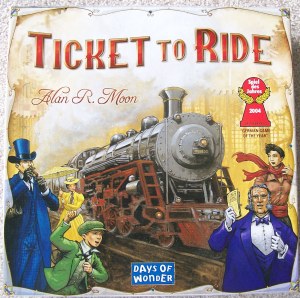
tickettoride_boxTicket to Ride

If you're just getting into board gaming — and by that I mean "ready to step beyond Monopoly and Scrabble" — there are few games I can recommend more than Alan R. Moon's classic Ticket to Ride. It's as simple as that.

Ticket to Ride's theme is that you are claiming train routes across North America, circa 1920. (Alternatively, in one of the many other versions of the game, you might be traversing Europe, Scandinavia or all manner of other places — each alternative version also features slightly-modified rules for variety.)

This isn't a dry, complicated business simulation, though; quite the opposite. Ticket to Ride is actually a relatively simple game of set collection. You're dealt a hand of coloured cards at the outset of the game, and on each of your turns you can do one of three things: draw two more cards, either from the selection of five face-up cards on the table, or from the face-down draw pile; claim a route by playing the corresponding number of like-coloured cards to the discard pile and scoring points for it; or drawing new "route tickets" that provide long-term challenges to be scored at the end of the game. That's essentially everything you need to know to get started — there are a couple of extra rules involving when you can and can't draw rainbow-coloured "locomotive" wild cards, but essentially those three actions are all you need to know to start playing Ticket to Ride.

Once you've got the rules down, a game of Ticket to Ride is done and dusted in maybe 30-45 minutes, depending on how many players you've got. It's a great game to introduce "non-gamers" to the hobby, and a good "start of evening" game to get everybody warmed up.
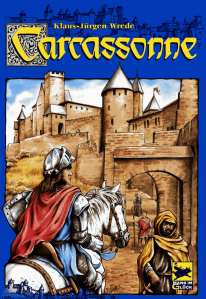
carcassonne_boxCarcassonne

Staying with the theme of "easy to understand, hard to master" games, we have Klaus-Jürgen Wrede's Carcassonne, a deceptively simple yet enormously competitive game that is as fun with two players as it is with five.

There are very few rules to learn in Carcassonne. On your turn, you draw a square tile from a face-down stack, then place it somewhere on the table in such a manner that it connects to something else. Pretty much every tile connects to something, so I believe it's impossible to get into a situation where you can't play anything at all — though clever play by your opponents may mean that you might not be able to play exactly where you want to.

Points are scored in Carcassonne by completing "features" on the map. These include cities, roads and cloisters. Each of these is claimed by placing one of your little wooden "meeples" on the tile you just placed to mark your ownership of the feature, then completing it. Cities must have a complete wall; roads must terminate at junctions, cities or cloisters; cloisters must have the eight tiles surrounding them filled. You don't get your meeple back until you complete the feature, so one strategy is to make it as hard as possible for your opponents to finish their features, thereby depriving them of further point-scoring opportunities in the later game. You also can't "share" a feature with another player unless you claim an unconnected part of it and later join it up. You can add more than one meeple to a feature to defend it more strongly in the same way — you can't, however, simply add multiple meeples to connected tiles of the same feature.

Carcassonne's "long game" comes in its "farming" mechanic, the exact implementation of which depends on how old the edition you're playing is. In most current editions of the game, farms are claimed by lying a meeple down on its side in the grasslands between roads and cities. This meeple can never be reclaimed, and scores no points at the end of the game. When the game ends, each field enclosed by cities and/or roads is calculated separately — the player with the most meeples in that field scores three points per city. Again, you can't add meeples to a farm that has already been claimed except by claiming an unconnected area and later joining it up — a process which can often be quite tricky to complete.

Carcassonne has extremely simple mechanics that belie a huge amount of tactical depth. It's quick and easy to play, yet has the potential to get enormously competitive — in other words, it's a great game for board game newbies to cut their teeth on, and one that remains relevant even as you get deeper into the hobby.
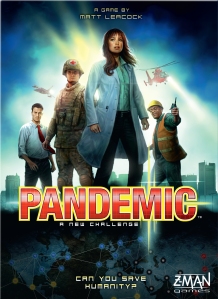
pandemic-2013-box-art-fullPandemic

Pandemic is a cooperative board game in which players take on the role of disease control specialists attempting to cure four viruses that are spreading across the world. Each player has unique special abilities, and a significant amount of collaboration is required to beat the challenges the game provides.

Like the other games on this list, Pandemic's mechanics are fairly simple. To cure a disease, all you have to do is collect a set of like-coloured cards, then ensure you're in a research station to discard the cards and discover a cure. The twist is that it's a bit fiddly to trade these cards between hands, and all the while you're faffing around collecting cards, the disease is continuing to spread across the world, meaning you occasionally have to prioritise charging off on an aid mission to stop the viruses spreading unchecked.

Pandemic is a challenging game. There are several ways to lose: running out of cards to draw; running out of coloured cubes to represent a disease; or allowing the number of "outbreaks" — occasions where an already heavily-infected city causes nearby cities to be struck down also — to reach its maximum. It is fairly likely that the players will lose the game, particularly when playing on the harder difficulty levels — but it is still fun despite its challenge factor.

Pandemic is a good game to encourage cooperation, communication and collaboration, and it's great for those who aren't good with super-competitive games or direct conflict. It's strictly the players against the game — unless you're playing the "bio-terrorist" mode that comes with the "On the Brink" expansion set — and thus either everyone wins together… or more likely, everyone loses together.

catgirl-coverWhack a Catgirl

I'm not going to pretend this is the best game in the world, but it is silly and enjoyable — and not only that, it plays super-quickly, too.

In Whack a Catgirl, you are attempting to pelt an irritatingly cute anime-style catgirl with a variety of amusing objects. The basic mechanics of the game consist of drawing cards from a central face-up pool and either playing them immediately if they are an action card, or putting them in your "arsenal" in front of you if they are item cards. Once you have at least two "hearts" worth of items in front of you, you can lure Neko-chan the catgirl over to you with them — discarding them in the process — and then batter her over the head with another one or two of your items, depending on how many "hearts" you expended to lure her. Flinging items at Neko-chan allows you to discard them into your face-down score pile, which is totted up at the end of the game.

That's basically it. The game mechanics are super-simple, but the fun in Whack a Catgirl comes from the silly cards and the theme. It's fair to say that the humour and references on the cards are probably best suited to anime fans or at least those familiar with Japanese popular entertainment, but anyone can get a kick out of the amusing artwork and inherent ridiculousness of the theme.

Fun fact: this was one of the first games from Asmadi Games, who have come to somewhat greater prominence recently through their chaotic card game We Didn't Playtest This At All.
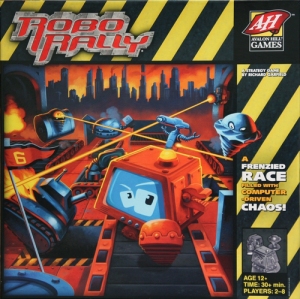
RoboRallyRobo Rally

This is basically Logo: The Game, a reference which was totally lost on everyone I last mentioned it to. Come on! PEN DOWN, FORWARD 100, RIGHT 90? No? I'll be over here, being an old fart.

In Robo Rally, you take on the role of one of several amusingly-named robots and must proceed through a series of checkpoints before the other robots do. Simple as that. Except it's not quite that simple — the courses are extremely hazardous, the other robots have a habit of shooting at you if you're in their firing line, and the amount of control you have over your robot can occasionally be inconveniently unpredictable.

A single turn in Robo Rally consists of drawing cards, then using them to "program" your robot's actions for the turn. Cards allow robots to move forward and backwards and turn left and right. Once everyone has programmed their robots, everyone resolves their moves one step at a time. If a robot ends a move facing another robot, it fires at it and causes damage. If a robot moves into another robot, it pushes it along — something which can seriously fuck up a carefully-laid plan.

As a robot gets more damaged, more of its cards become "locked", which means that the robot must perform that same fixed action on its turn. As you can probably imagine, this can be enormously inconvenient, particularly if it's a "move forward" card that carries a significant risk of throwing you down a pit. Further complications are added by environmental hazards such as conveyor belts, lasers, walls and all manner of other problems. What initially appears to be a simple task quickly becomes very challenging — particularly with the chaos of the other players thrown into the mix.

Robo Rally is simple to pick up but hard to master. It's a lot of fun, particularly for those who enjoy thinking about things logically, but be warned, it's pretty rare you'll be able to pull off the "perfect" plan every time!
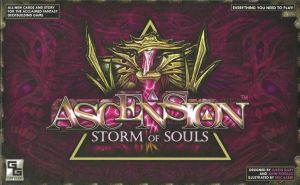
Storm-of-SoulsAscension

This is a "deckbuilding" game — a game where you start with a fixed deck of cards, shuffled randomly, and then gradually acquire more and more cards as the game progresses. These cards fall into two main categories — cards which help you buy things, and cards which help you fight things. Your points largely come around from fighting things by playing a high enough value of "fight" cards on the table — but in order to acquire said fight cards you will, of course, have to spend some time acquiring some cards that help you buy things.

Ascension's mechanics are easy to pick up and games flow quite quickly, even with four players. The deckbuilding mechanic is a lot of fun and helps ensure that games are never quite the same, and it's just thematic enough to keep fans of fighting fantasy monsters happy, while providing enough strategy for beard-scratching tactical fans to have things to think about.

Talking of deckbuilding…
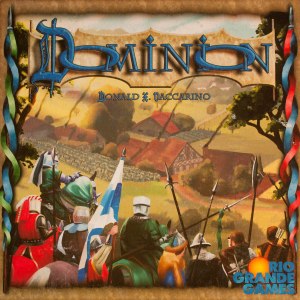
dominion_boxDominion

Dominion is an interesting game that has a lot of potential variations. Each time you play, you pick a random selection of card decks to use, meaning that each game has a different combination of special abilities available to you. Thematically, you're building a kingdom by purchasing territory and constructing facilities, but in practice you're collecting cards that work well together and allow you to do more with your turn than you can at the outset of the game. The basic mechanics are relatively simple, but the tactical possibilities provided by the cards mean that the game grows gradually in complexity as you collect more cards for your deck.

Dominion perhaps isn't quite as accessible as Ascension is, but it's probably the deeper game. Once you get your head around the rules and become familiar with the cards, games can flow pretty quickly — until then, however, be prepared to spend a bit of "thinking time" determining how the various cards can benefit you.
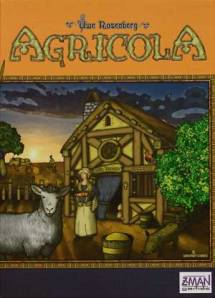
Agricola-box-artHonourable Mention: Agricola

I feel honour-bound to mention Agricola because my gaming group is such a big fan of it, but I honestly don't enjoy it all that much when it does come out. This is largely due to the fact that I'm not very good at it, which I appreciate is a somewhat shallow reason to dislike it, but there you are.

Actually, the thing I dislike more than anything about Agricola is not that I always lose at it, but it's that I don't really understand why I lose, or how I can do any better. And looking up potential strategies online doesn't really seem to help either. It's just something I need to become more familiar with, I guess. I can certainly appreciate the interesting, complex but accessible mechanics at work in the game — I just have no idea how to do any better than I already do.

Time to practice, I guess.

 

1216: Hometime

I am writing this to you from English soil. Boooooo!

Yes, that's right; we're back home. Apologies to those of you who are in the Toronto area who maybe wanted to catch up and we didn't get the opportunity to — turns out we filled two full weeks pretty nicely with Stuff to Do.

A very public "thanks" to Mark and Lynette for putting us up for two weeks at their lovely house with its regular squirrel visitors, and thanks to our mutual friend Jonathan for providing us with some board and card game entertainment on more than one occasion. It's a shame we didn't have more time to try some games a little more than we did — I would have liked to play A Touch of Evil again, and I'm bummed we didn't get time to play Mice & Mystics — but we'll just have to save those for next time, I guess!

The flight back was uneventful, and unusually for me, I managed to actually sleep for most of it. This was perhaps at least partly due to the fact that we had to be up at some ungodly hour in the morning to actually catch the plane, but perhaps it was also a case of the prior two weeks catching up with us somewhat. It wasn't the most hectic, chaotic holiday I've been on — thankfully; I'm not a big fan of holidays where you're constantly doing stuff and never get any time to just kick back and relax — but it had enough stuff going on to keep things interesting while wearing us out somewhat. To be honest, my main priority for the trip was to see my friends rather than do the "tourist" thing, but I'm glad we had the opportunity for a jaunt around the ROM and the zoo while we were there.

I think the highlight of Toronto for me has to be the board game cafe Snakes & Lattes that I mentioned the other day. If there was such a place here in Southampton, I think I would probably spend a lot of time there — so long as I could find people to go with, of course.

There actually is a regularly-meeting board game group here in Southampton, but I have held off attending thus far due to my own issues with social anxiety and meeting new people. I have little doubt that I would probably have a good time if I just went along and met some new people, but it's getting over that initial hurdle that's the tough bit. Of course, if I lived in Toronto and attended Snakes on a regular basis, I'd probably run into the same issue, so… well. That's something to contemplate another time.

It is both nice to be back and sad to be home. We both had a great time, and I hope we get the chance to do it again sometime soon. For now, however, I think it's probably time to get some sleep!

1215: Zoology

Derrrrrp.Andie and I took a trip out to Toronto Zoo today. Getting there from Mark and Lynette's house was quite a trek on public transit, but it's eminently possible. (For those curious, you ride the subway all the way to the east end of the green line — Kennedy station — then catch an 86A bus to the zoo. Said bus stops approximately every 100 yards on the way, lengthening the journey by a considerable degree, but you do get there eventually.)

I've been to the zoo here before, but Andie hasn't. (Obvious, really, since she hasn't been to Toronto before.) Like much of my wanderings around the city in general over the last couple of weeks, I was surprised by quite how much I remembered. A few things have changed since I last came — some exhibits have opened and closed, and we were just a day too early to get a chance to see the zoo's newly-acquired giant pandas — but for the most part it was pretty much as I remembered.

I'm generally not particularly big on "cultural" trips. Museums often bore me if there's not much in the way of interactivity, and my appreciation of the visual arts (or lack thereof) limits my enjoyment of an art gallery. I'm not even a huge fan of live music in many cases, despite being a musician myself, because I'm more interested in the music itself rather than the performance more often than not. (The exception to this rule is live performances of jazz/soul etc, which often have a lot more "personality" than live performances of art music. But I digress.)

IMG_2551Where was I? Oh yes. I'm not generally that big on "cultural" trips, but I must confess to having something of a soft spot for a good zoo. I think it's the simple fact that animals are interesting and unpredictable to watch, and it can be fascinating to discover a creature you were previously unfamiliar with. Particular highlights today, for example, included a "tree kangaroo", which looked rather cat-like; the discovery that bats can and will climb around like monkeys as well as hanging there being boring and/or flapping around wildly; that tigers actually do say "rawr"; and that somewhere in deepest darkest Africa there's a ridiculous-looking bird with an enormous beak that would apparently rather jump between tree branches than actually fly.

Toronto Zoo is a good zoo if you enjoy looking at animals (derp) because there's a lot of them in a variety of different environments. It's quite a trek to get around the whole thing, but it's a worthwhile experience, as you'll have the chance to see all manner of different things. Although today, being a weekday, was relatively quiet, it was clear what the "highlights" for the general public were — the polar bears were winning by a long shot, though I suspect once the new panda exhibit is open to the public it will prove similarly popular, if not more so.

We also took a ride on the "zoomobile" electric car tour thing. This initially appeared a bit steep at $8 each, but after riding it all the way around and being taken into some "zoomobile exclusive" safari park-style areas with free-roaming animals, it proved a worthwhile experience, so be sure to check it out if you're in the area.

IMG_2568Oh, and also we saw a horny male zebra with a gigantic dong trying to boff a female who wasn't having any of it. Poor chap.