1234: Not Going to E3 2013? Here's What to Wear

Jun 05 -- Style FileAre you a video game developer?

Or perhaps a programmer, graphic designer or other exec working in the video game industry?

Or perhaps you're a video game journalist?

If "yes," then it's entirely possible that, much as you would like to go to the upcoming Electronic Entertainment Expo (E3) — the premier trade show for the computer and video game industry — it's just not practical for you to do so. Perhaps you don't have the finances to subsidise a trip there. Perhaps your company won't pay for you to go. Perhaps, if you're a journalist, you actually prefer covering it on the home front.

It's a terrific opportunity to sit back and watch what's hot in your market without actually having to get hot and sweaty in those crowded exhibition halls.

If you've not been to E3 before, you know the challenge. How do you remain comfortable working far away from the convention centre while simultaneously maintaining a professional attitude?

Many people who are not going to E3 prefer to keep a low profile, wearing casual clothes like a baggy t-shirt and jeans. But in an industry increasingly based around remote working, it's worthwhile to spend some time thinking about how what you wear can have a significant impact on your comfort level, while simultaneously allowing you a certain degree of decency if the postman comes to the door with that package you've been expecting for a while.

jpeg-1My suggestion for the gentlemen is this rather fetching Marks & Spencer stretch cotton "Grumpy and Grumpier" two-pack of trunks, with a design copyrighted by Disney. For just £15 GBP, these trunks offer a soft, comfortable fit and add variety to your underwear drawer while simultaneously accurately reflecting your mental state at not being invited to any of those E3 parties.

The trunks include an elasticated waistband for added comfort while consuming entire "sharing bags" of crisps at your desk, and also have a keyhole fly opening for easy access when the beer you're drinking has its inevitable effect on your bladder.

jpeg-2The more modest man-in-his-home office may wish to pair the trunks with this cotton-rich towelling dressing gown. Made from soft and comfortable cotton-rich fabric, this dressing gown has a rich texture for rapidly absorbing moisture, making it ideal for after a bath or shower, or just if you're rather sweaty. It is getting quite warm out, after all. It's also snag-resistant, meaning it stays looking newer for longer.

This product was rated 4.5 out of 5 by people who cared enough to rate it on Marks & Spencer's website, leading some to refer to it as "the Citizen Kane of towelling robes" — an accolade sure to be plastered all over adverts for the robe soon.

For the ladies… I don't know, wear whatever the fuck you want, and don't let Forbes tell you what to do.

1233: Playing It for the Articles

Jun 4 -- StoryI overheard a Twitter conversation the other day (yes, I'm back on there, largely to make my professional self easier to reach if necessary) in which disparaging comments were thrown around regarding people who "play games for the story".

As someone who primarily plays games for the story, I feel honour-bound to take exception to this line of argument, though I forget exactly what the actual point of the discussion in question was. Anyway. Allow me to describe what being someone who plays games for the story — a self-professed "narrative junkie" — means.

Quite simply, it means that I am extremely forgiving of a wide variety of "sins" on a game's gameplay front if — and it's a big if — the narrative content of the game in question keeps me interested and compelled. (Caveat: the only unforgivable sin that I simply can't get past is a free-to-play game putting up a paywall with an energy system or similar mechanic; no matter how good your narrative is, if you actively stop me from playing your game before I'm good and ready to stop, I'm not coming back. Ever.)

Said narrative doesn't have to be big and clever, or trying to be anything more than a piece of enjoyable entertainment. But it pretty much needs to be there to keep me interested.

Similarly, I can happily take a game with practically no "gameplay" in a traditional sense — see: interactive movies like School Days HQ or any of the myriad visual novels available — so long as the narrative entertains me and keeps me interested.

I'm relatively easily pleased when it comes to storylines. About my only real requirement to enjoy a video game story (or any story in any medium at all, really) is that there are some characters in it that I either like or find interesting — because those two feelings aren't necessarily the same thing. Give me something in which relatively little "happens," but in which I gain a deep understanding of the characters involved, and I'll be very happy indeed.

It's this love for the art of the story that has led me to give a whole bunch of much-derided games the time of day where others would pass them by. The titles which spring most readily to mind are the Hyperdimension Neptunia series, which is riddled with technical flaws, dull gameplay (in the first game, at least; I actually thought the second was genuinely fun, and I'm yet to try the third one) and various other issues; and Nier, which everyone seems to have decided looked drab and boring and thus was unworthy of further exploration. (I never quite understood this; I thought Nier was actually a pretty good-looking game — it certainly had a lot of personality.) Even the Ar Tonelico series, which I've been playing through for the last… quite a while isn't widely regarded as providing shining examples of "good games".

For the record, I found the Neptunia series genuinely amusing as well as being a wonderfully on-the-nose parody of both anime and video game culture; I found Nier a fascinating, deeply moving experience; and Ar Tonelico… well, having known nothing about it when I started playing, this is now a series I would happily defend to the death.

It's this attitude which brought me to the realisation I'm not really a fan of Western-developed role-playing games any more — particularly those of the "open world" variety favoured by Bethesda. I enjoy a good dungeon crawl, sure, but when your lovingly-crafted game world behaves more like a diorama with animatronics than a living world with actual people in it, I get a bit bored.

I realise there's a certain degree of irony in accusing titles like Skyrim of having diorama-like worlds when most JRPG towns are populated by NPCs who constantly stand in the same place and spout the same crap every time you talk to them. But for me, paradoxically, that gives them a lot more personality. Rather than constantly running into the same recycled guard model and wanting to throw a brick through the TV every time someone makes an "arrow to the knee" reference, each NPC is unique and, for those one or two lines they speak, vaguely interesting.

Ar Tonelico handles this rather well by having the NPCs' lines change according to the point in the story you're at. The stories of all three games in the series take place over a relatively small geographical area, so you're revisiting locations a lot; it's a fun little "unofficial" sidequest to check in with your favourite NPCs and see how their own completely irrelevant story arc is progressing. Will the little kid outside the General Store ever get up the courage to ask Sasha to come and play with him? Will Skycat ever actually make a move on Luca or is she just flirting? Will those weird furry creatures ever say anything other than "Poo"?

This is all a matter of taste, of course, and I'm well aware that there are thousands — millions? — of people out there perfectly happy with the way Skyrim does things. And that's fine. Just, as always, be aware that not everyone enjoys the same things in the same way — no-one's way of enjoying a creative work is inherently "wrong", so live and let live.

1232: Knell of Ar Ciel

Jun 03 -- Ar Tonelico 3I haven't posted about Ar Tonelico for a while, and having just witnessed the "bad ending" of the third game (ooh, it's bad) I feel now may be a good time for a progress report on my thoughts thus far before I jump in and try for the other endings.

Ar Tonelico Qoga, as the third game is known, is a peculiar beast. While it's the most outright "perverted" of the series — the previous two games had plenty in the way of innuendo but stopped short of being overly fanservicey, a couple of scenes where the heroines were clad only in towels aside — it's also probably the most open-minded of the three with regard to the subject matter it tackles. This is a game that revels in sexuality in all its forms as one of its themes, and if you feel somewhat uncomfortable playing it, I feel I know Gust's work well enough by now to say that it's probably intentional that you feel that way.

Let me qualify the above statements a little. Insofar as the game is "perverted", one of its core gameplay mechanics involves the female "Reyvateil" characters (essentially glass-cannon mages if you want to assign them a traditional RPG party role) stripping off their clothes throughout the course of battle. While, yes, this is gratuitous and unnecessary and etc. etc. (for the record: I am an unabashed (well, mildly abashed) pervert and have no issue with pervy fanservice in my entertainment) they do at least make an attempt to justify the reason for this happening to a certain degree in a narrative sense: Reyvateils are artificial human-like life forms that are basically equipped with Wi-Fi (bear with me) and communicate wirelessly with the titular tower of Ar Tonelico in order to produce the magic-like effects of their Songs. By stripping — or "purging", as the game calls it — the Reyvateils are able to get better reception, so to speak, and can absorb more magic from the tower. This translates, in gameplay terms, to the "Burst" gauge, which represents how powerful the Reyvateil's spell will be if you set it off right now, increasing at a much more rapid rate according to how few clothes she is wearing. (They stop short of her getting fully naked, I might add — after purging three levels of clothing, she's down to her skimpies, and purging a fourth time triggers her powerful (and surreal) "Flipsphere" über-attack, at which point her clothes magically reappear.)

Read all that back again, and I'd forgive you for never wanting to give this game the time of day. A game whose female characters strip off in exchange for increased magical capabilities? Sounds like some sort of Male Power Fantasy™. And perhaps it is.

Thing is, though, Ar Tonelico Qoga is far more interesting and intelligent than just pretty girls getting almost-naked. For starters, it's worth noting that after a certain point in the game, all the male characters will strip off at a moment's notice too — performing each character's best attack causes all their clothes to fall off and for you to get a good look at what each of them are packing underneath their armour. Doctor Hikari Gojo's fundoshi in particular is a sight to behold.

But no. It's not even about characters getting naked. Much like the previous two games in the series, the really interesting stuff comes about thanks to the "Dive" mechanic — a system whereby you can increase the power of the two Reyvateils by taking a wander through their "Cosmosphere" — a multi-level psychic world that exists within their subconscious. By exploring the two heroines' Cosmospheres, you learn a great deal about them — facts that simply don't come up explicitly in the game's "normal" plot, but which can help inform your reaction to things that go on once you know them.

As is par for the course in the series, each level of the two heroines' Cosmospheres focuses around some sort of problem that they are having — be it a difficulty coming to terms with who they are, the strange influences other aspects of their personality have on them, or simply something they're having trouble admitting or dealing with. By interacting with the Reyvateil and the other characters in her Cosmosphere, the protagonist Aoto forges an incredibly strong, incredibly intimate bond with the heroines and gets to know them in a way that no-one else in the world does.

This leads to some really interesting scenes, many of which are touching on territory I can't recall exploring in a game before. And unlike the gaudy excesses of the strip-centric battle system, they're handled sensitively and with care; clearly composed by someone who knew what they were talking about.

I'm trying not to spoil anything here for those of you who are reading this and intend to play through this fascinating game, but I feel I should give one example to highlight what I'm talking about, and that is the character who, in one of her Cosmosphere levels, essentially "comes out" as being a submissive or "bottom" with somewhat masochistic tendencies. Given what you know about this character by this point, her confession is not altogether surprising, but what is surprising is that it is actually referenced and explored through more than simple innuendo.

"Don't take off the chains," she says after a convoluted, embarrassing and humiliating sequence of events for her, where Aoto is about to give her her freedom. "I feel safe when I'm in the chains, so long as you're there."

I'll confess to not knowing anything about BDSM and related sexual preferences, but I found it fascinating to see this character opening up about her secret passions and desires like this. It wasn't treated as a kind of "wish fulfilment" scene for male players, either; it was simple, to the point and helped me to understand one aspect of this particular character. In short, it's the sort of thing I'd like to see explored in more games; sadly, it's abundantly clear that very few "triple-A" producers would greenlight a game that delves into such subject matter, though thankfully there's always the "lower-tier" games such as Ar Tonelico willing to step up to the plate and try something new.

As guilty as I feel for what occurred in the bad ending, I should probably go to bed now and absolutely not try to get a better ending now. Right? Right. Suuuuuure.

1231: On Your Doorstep

Jun 02 -- DessertSomething sprang to mind for me and Andie while we were over in Toronto. Our friend Mark was taking us out for lunch to an intriguing little Vietnamese place called Banh Mi Boys that served all manner of interesting sandwiches and meat buns and the like, and we suddenly realised that were the roles reversed, there weren't all that many interesting places we'd be able to take visitors to our fair(ish) city of Southampton.
This evening, then, we went out in an attempt to start rectifying this situation just so, on the off-chance that friends from abroad do come and visit, we'd have somewhere more interesting that Burger King or a Wetherspoons to take them.

We actually visited two different establishments this evening. The first of these was La Cantina (or just Cantina as it appears to be known now) in the Bedford Place area of the city, just on the outskirts of the city centre. This is a Mexican place that I'd heard good things about in the past, but had somehow never made it to. They serve you standard Mexican platters like nachos, burritos and whatnot, but they also do tapas servings of tacos and various other tortilla-based dishes whose names I've forgotten. Andie and I had a sharing platter of nachos with beef mole and two of these tapas dishes each, and that was plenty of food for the pair of us.

It was some tasty food, and a good level of spice — just enough to get you sweating a bit, but not so much that your tongue goes completely numb and you can no longer actually taste what it is you're eating. The beef mole had a bit of a kick, though I suspect this came from the seasoning of the meat rather than the slices of chili pepper that were in it, which actually turned out to be pleasantly mild-ish.

After dinner, we decided to drop into a brand new establishment that has just moved in almost next door to Cantina — Tutti's Gelato. This is, to my knowledge, the second dedicated gelato shop that has opened in Southampton — the first being Sprinkles in "student central" area Portswood.

Tutti's offers a wide variety of gelato flavours, available either as scoops in a cone or little bowl, or as part of a bigger dessert. Said bigger desserts — crepes, waffles, sundaes — all look like they'll probably give you a heart attack, but I most definitely intend to give them a try at some point in the near future, perhaps when I haven't filled myself up with Mexican food beforehand.

My only real criticism of Tutti's — which was clean, looked good, served delicious desserts and had some comfortable seating — was that their menu was riddled with spelling and punctuation errors, and wasn't even consistent about the mistakes they made. If you can correctly pluralise "crepe" into "crepes", then why the fuck did you put an apostrophe in the word "sundaes"? And don't even get me started on how they spelled "raspberries" (hint: it involved an apostrophe, and did not involve the correct "-ies" ending.)

This aside, though — which, after all, isn't really the most important thing (yes, I winced a bit writing that, but it is true) — Tutti's was a great place to go, and I've been all for the "late night dessert" thing ever since I was taken out to a shop that specialised in chocolate-based desserts in New York several years ago. (I can't remember the name, but by God it was amazing. They had a chocolate pizza that looked like instant diabetes.)

Anyway, my rambling point in all this is simply that now, if someone comes to visit, I have two places I can take them. And hopefully we'll discover some more in the near future.

1230: In Pursuit of Score

Jun 01 -- HiscoresThe sole aim in a lot of video games circa the '80s and early '90s used to be to attain a high score. But in all but a few genres of gaming, that simple pleasure of watching a number get steadily higher — a number which proved indisputably how much better than your friends you were — has fallen by the wayside. This is kind of a shame because, having been playing a bunch of games recently in which the old-school objective of "score as many points as possible" is their reason for existence, it's, you know, fun. Lots of fun.
My fondest memories of high-score chasing in recent years came with two different Xbox Live Arcade games: Geometry Wars 2 and Pac-Man Championship Edition DX. Both of these games got their hooks into both me and my friends and saw us eschewing bigger, more exciting, more impressive releases that were around at the time in favour of simply pumping in virtual quarter after virtual quarter. Geometry Wars 2 in particular completely monopolised the gaming time of a number of us for a good several weeks, as each of us vied for dominance of the game's six different leaderboards. It became a sort of hypnotic ritual — fire up the game, start up (say) Pacifist mode, play, die, immediately restart and repeat. Three hours later, I'd look up and see that, well, three hours had passed, and that my hands had locked into a claw shape only suitable for 1) holding a controller or 2) in a pinch, wanking.

Since those two games, however, there haven't been that many other titles that have drawn the attention of my friends and I quite so consistently. This is a shame, as I greatly enjoyed that feeling of competition, and relished the opportunity to take a snapshot of my latest high score and rub it in the face of a competitor via some form of social media. (This is where the term "Be A Dick Mode," often stylised as the hashtag "#beadickmode" on Twitter, originated.)

I've been thinking about how and why there hasn't been a simple score-attack game to get everyone's teeth into for a long time. And the only plausible reason I can think of is the fact that gaming has grown even more broad and diverse since that time. The rise of mobile phone games in particular has all but eliminated the perceived need for "simple" arcade games with a score attack mechanic, which is somewhat sad.

Bejeweled Blitz remains popular, of course, but I now refuse to play that game because it's become infested with pay-to-win crap. Leaderboards are utterly meaningless if you sell advantages to players, which is what PopCap's doing. Unfortunately, I appear to be in a minority thinking this, as the "Blitz" puzzle template is immensely popular — in-app purchases and all — with the latest addition to the formula being a rather sorry addition to the Tetris legacy from EA. I'm just not interested; what's the point in playing if all it takes to top the leaderboards is being more willing to dip your hand into your pockets than your rivals? Bullshit, I say. Bullshit!

Fortunately, there is a degree of respite, albeit one that I'm yet to convince my friends to engage with. The shmup genre — which people on the Internet don't quite seem able to agree as to whether it's flourishing or dying — remains a resolutely score-focused genre, and demands a great deal from its players both in terms of simple manual skills and in the learning of often-complex scoring mechanics. Like a good fighting game demands that you spend time exploring its systems and getting to know how everything fits together, a good shmup demands that you study it, figure things out and then try to put all that knowledge into practice while attempting to avoid fiery laser death.

It's immensely satisfying when you figure out how a particular game "works", and the first time you see your score skyrocketing into the high millions or even billions. It's a genre that brings thrills and excitement with minimal effort expended on storytelling or trying to do anything particularly "artistic", but at the same time the finished result can be oddly beautiful — hypnotic bullet patterns; the "dance" of the player's ship navigating through these perilous onslaughts; the sheer, unrelenting energy of most of these games. But these games aren't trying to say something in the same way that an arty indie platformer is trying to say something; no, instead, all they're trying to say is "c'mon, one more try and you'll beat that score" or "c'mon! Bet you can't clear me in one credit."

1229: What's Next

May 31 -- SqueeThose of you who have me on some form of social media will know this already, but I've started my new job. Excitingly, this is the first ever new job I've had that was accompanied by an official press release. Yes, really — check it out.
For those of you too lazy to check out that link I've so graciously provided for you, allow me to explain as much as I'm able to at present.

You may be familiar with the video games website Eurogamer, home of some fine commentary on games, the games industry and all manner of other things. Eurogamer is one of the few European (specifically, British) sites that has risen to prominence amid the dominance of primarily American publications such as Gamespot, IGN, Kotaku and Polygon. However, one thing Eurogamer lacked — as you might expect from the name — is a presence in the US.

Enter USgamer, a new site set to launch into beta next week, and a site on which I'm officially acting as News Editor, but in practice will be contributing a whole lot of lovely stuff to on a regular basis. USgamer will be more than just a reskin of Eurogamer — it's going to be a great, very distinctive site, but you'll have to wait until next week to see exactly how and why it's great.

I've been preparing some content this week in preparation for the site's launch, and I've been surprised how refreshing it's been. After over a year of writing about mobile and social games — a good 80% of which were total bobbins — it's an absolute pleasure to be able to get my teeth back into writing about the industry as a whole, and specifically to explore, criticise and wax lyrical on the parts I'm truly passionate about.

It pains me a little to admit, but there were times when I was ashamed to be associated with the mobile and social side of things. There are too many companies out there peddling products that are just flat-out sleazy in the ways they attempt to coerce their audience into paying exorbitant amounts of money for "consumable" digital goods; in the way they shamelessly clone other people's work (or even, in some cases — *cough*Kabam*cough* — their own); or in their gross, misleading, often sexist or otherwise offensive advertising (Hai, Wartune!). I made a point of calling out these objectionable titles whenever possible, but I fear my criticisms may have fallen on deaf ears in most instances. So long as you keep pulling in the monthly and daily active users, it seems, it doesn't matter if you steal a bit of artwork here, outright lie about your game there, charge £70 for in-app purchases everywhere.

The mainstream games industry isn't free of sleaze and anti-consumer practices, of course, but at least it's easier to avoid, whereas it's fast becoming the norm in mobile and social, disappointingly. But I digress. My thoughts on social games and how they fail to cater to lifelong gamers have been well-documented.

No, the thing that is nicest about my new position at USgamer is the fact that I get to write about things I truly care about. I'm currently preparing a feature on the history of a particular game genre (find out what soon!), for example, and I'd forgotten quite how enjoyable it is to research and put together pieces like this. Gaming is a rich and diverse art form, and it's exciting to look back on how far things have come since the inception of the medium. It's also exciting to look forward to the future and imagine where we might be in a year or two — and it's also exciting to explore the sheer breadth of content that's available now. For every Call of Duty, there's an Ar Tonelico, Fez, a Dungeons of Dredmor, a Long Live the Queen, a Deadly Premonition… there's certainly more to talk about than one person could ever manage in a lifetime, and new things happening all the time.

As you can probably tell, I'm very excited about this new position and about the site as a whole. I'm aware of the irony of me — an Englishman in, well, England — writing for a site called "USgamer", but I'm extremely happy to be working with the team that's in place, which includes some industry veterans as well as some old colleagues from my days on GamePro. It's going to be a fantastic site once it's up and running and available to the public, and I can't wait to show it to you when it goes live.

1228: Dungeon Delving

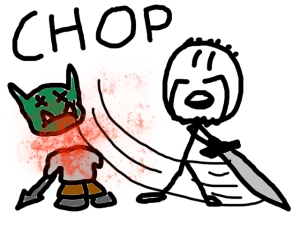
May 30 -- ChopWay back before I started doing this daily blogging shenanigans — yes, there was a time when I was an erratic blogger, just like normal people on the Internet — you may recall that I once gave a harrowing account of the adventures of Count Kurt von Hellstrom and his merry band of warriors, otherwise known as the characters my friends and I rolled to play a campaign of Games Workshop's tabletop roguelike Warhammer Quest. On the off-chance you haven't been reading this blog since December 2009, here's a link for your delectation.

I greatly enjoyed my experiences with Warhammer Quest, though it hasn't hit the gaming table for a good few years now, which is a shame. It takes quite a long time to set up, you see, and the heavily-random nature of the game's encounters wasn't altogether to the taste of a couple of our group; our more recently-acquired Descent: Journeys in the Dark 2nd Edition is scratching the dungeon-crawling itch a bit better for the group as a whole. Despite this, I still consider myself highly privileged to own a copy of this much sought-after collector's item, and one that is in pretty good (certainly playable) condition, too.

As such, it will probably not surprise you to hear that when Rodeo Games, developer of the excellent Hunters series of XCOM-style turn-based strategy games for iOS devices, was working on a digital adaptation of Games Workshop's classic, I sat up and paid attention. Hunters and its sequel already played more than a little bit like Games Workshop's Space Marine-based board games such as Space Hulk and Space Crusade, so I was confident that they were a good team to take on the challenge of porting Warhammer Quest to the small screen.

And you know what? They've done a great job. The iOS version of Warhammer Quest, which hit the iOS App Store around midnight last night, is a fantastic adaptation of the board game and its various foibles, tweaked just enough to feel like an original video game rather than a straight-up port of the board game's mechanics.

The iOS version of Warhammer Quest features a substantial single-player campaign in which the player's party of heroes moves between various towns in the Warhammer Old World, and takes on quests, as all good heroes should do. Most quests are introduced by some well-written text that gives a good feel of context to the dungeon crawling, and these are supported by various encounters in the dungeons themselves.

The actual dungeon-crawling gameplay is very similar to how the board game works. Characters have a particular move allowance for each turn, and a certain number of ranged and melee attacks available, assuming they have the appropriate weapons equipped to perform these. The wizard character may cast spells on his turn as well as moving and attacking, and all characters may also use items or certain other special abilities as well as moving and attacking.

Fans of the board game will recognise certain specific quirks of the tabletop version — for example, rather than having a set pool of magic to cast spells at will, the wizard character is dependent on the randomly-determined Winds of Magic that change each turn and provide the power required to cast spells. Likewise, the satisfying "Deathblow" rule is in effect, which means any time a character defeats an enemy in a single mighty blow, they can automatically attack any other adjacent enemies and sometimes clear out a room rather quickly.

A few changes have been made, however. The level-up system, which was simply based on the amount of gold acquired in the board game version, takes the form of a more traditional experience point-based system in the iOS version. This works just fine, and a helpful breakdown of who killed what (or healed whom) at the end of a quest helps you easily figure out which of your characters is pulling their weight and which ones need to step up to the plate a bit more readily in the next adventure.

There's a couple of frustrating bugs present in the current version, which mars the experience a little — firstly, occasionally the game will get "stuck" while resolving an encounter upon entering a new room tile and require a restart to proceed. (Thankfully, the game autosaves regularly, so you'll be back before the move you made that froze the game.) Secondly, the game's "hardcore" mode, in which characters can die permanently, doesn't appear to work correctly at present — I lost a character in an early quest, completed the rest of it and was very surprised to discover them waiting for me back in town when I returned.

The game also falls into the trap of offering obnoxious "Get more Gold" in-app purchases for players too lazy to earn their way to higher-tier equipment. Not only does the ability to purchase in-game currency remove all need to manage your finances carefully — an important part of the game if you're playing it properly — but it also raises questions over how well-balanced the in-game economy actually is. Is the rate of gold acquisition in the game deliberately slow in order to push players in the direction of the in-app purchases? It's hard to say at this early stage, but it's something that will be on the mind of some players.

The game also includes a selection of day-1 DLC — three new characters and a bolt-on series of quests. Normally, I object thunderously to day-1 DLC but when the game itself is just £2.99 it's hard to get too mad, particularly when each package adds a significant amount of cool stuff to the game and is still pretty cheap even if you buy all of them.

Despite these issues, the iOS version of Warhammer Quest is well worth your time if you're a dungeon-crawling fan. An update should hopefully fix the bugs described above, and with any luck Rodeo will continue to support the game with new content over time. As it stands, they claim there's 25-30 hours of single-player content in the game already, which should keep you busy for a while.

Download it here.

1227: Cards of Love

May 29 -- Love LetterOne of the games I had the chance to try out during my recent trip to Canada was a charming little card game called Love Letter, the brainchild of Seiji Kanai and the fourth entry in AEG's Tempest series of games that share the same setting. Today, my own copy of it finally arrived, so I thought I'd talk about it a bit. I know I already mentioned it a number of posts ago, but I thought I'd dedicate a whole post to it.

In Love Letter, players take on the role of potential suitors to the princess of Tempest. Unfortunately, grieving for her arrested mother — presumably an event which occurred in one of the previous games — the aforementioned princess has locked herself in the castle and is not receiving visitors, let alone missives declaring various eligible bachelors' undying love for her.

Or is she? Fortunately, there is a selection of people around the castle who are able to get your sweet words of love to the princess, and it's entirely possible that you might be able to get her to come out of her room, if only you can just get that message to her.

These people — including the princess herself — are represented by the 16 cards that make up the complete Love Letter deck. Each is marked with a number, which denotes how "close" that person is to the princess, and each number also corresponds to a particular type of character. All the "1" cards are guards, for example, while number "8" is the princess herself. Certain cards, such as the princess, her best friend the Countess, the prince and the king, only have one card each; others have several duplicates, with the most numerous being the guards.

A round of Love Letter runs thus: first a single card is removed from the deck, without anyone seeing what it is. Following this, each player is dealt a single card, which becomes their hand. On each player's turn, they draw a card from the communal stack of remaining cards and either discard it or the other card in their hand. When a card is discarded, its special ability must be resolved. If a player discards the princess, they are out of the round as the princess has thrown their letter into the fire. Other cards are laid face-up in a stack in front of the player, allowing the others to see which cards have been discarded already, and thus deduce which ones are probably in the other players' hands.

Knowledge of the other players' hands is extremely important, as several of Love Letter's cards have special abilities that can knock out players if you correctly identify their cards. Guards, for example, allow you to ask another player if they have a specific card in their hand, and if they do, they are caught by the guards and are out of the round. The Baron, meanwhile, sees you compare your other card's rank with that of another player, and the highest rank wins. This has the unfortunate side-effect of also revealing your hand to the player you're comparing against, so you'd better be sure you'll win before pulling out the Baron.

It quickly becomes apparent after a short session that Love Letter is a game about bluffing. Certain cards are clearly designed with this in mind — for example, the Countess card, which is second only to the princess in terms of rank, must be discarded if the player has the prince or king as their other card, since they don't approve of her. However, there's nothing stopping you from discarding the Countess when you don't have either of these cards in hand — purely to make people believe that you do.

The round ends either when all players except one have been eliminated, or if the draw deck is exhausted, at which point all surviving players reveal their hands, and the highest-ranked card wins a token of the princess' affection. The cycle then repeats until someone gains the required number of tokens, determined by how many people are playing.

Love Letter is a simple production, but it's, if you'll pardon the phrase, lovely. It doesn't come in a standard game box — rather, it comes in a charming little red velvet bag with the game's name embroidered on it. The cards themselves are of decent quality and sport some lovely artwork, and the tokens of the princess' affection are that kind of little coloured transparent plastic cube that look like they'd be delicious but will actually probably cause you to choke.

The game itself is ideal filler material, as it's over and done with within about 15-20 minutes, which makes it a great pre-dinner game, or a great game to play while you're waiting for one of the rest of your group to finish having a long poo or something. It's also quite ridiculously cheap, though it is a tad hard to find at present due to its sudden explosion in popularity.

In the meantime, find out a bit more about it over at BoardGameGeek, the best resource for board game information on the whole Internet.

1226: Call Me 'Pan'

May 28 -- ImmaturityI have been contemplating my own mortality lately.

Actually, that's a total lie. I've simply been pondering what it means to be 32 years old, and whether society expects something different of me to what I am providing.

You see, in many ways I consider myself to be a "grown up" but in lots of others I feel very immature, and I'm actually quite pleased about the latter part. I still feel odd when I hear, say, a mother in a supermarket refer to me as "that man" rather than "that boy" when telling her child to get out of my way. Conversely, I don't feel any shame in purchasing things that are for adults (get your mind out of the gutter) such as alcohol, 18-rated videos or mature-rated games or other media. I occupy a sort of weird middle ground where I'm aware I'm an adult, but I have no particular desire to start acting like one.

Why am I babbling on about this? Well, it stems from a conversation Andie and I just had where we both agreed that when I'm 60+ I will probably still be happy to sit around in my pants playing video games where girls' clothes fall off to allow them to absorb more magic from the air, or to bust out the board games for a social occasion rather than doing something more dignified like a dinner party or whatever. I will also probably never stop finding burping, farting and the word "cock" funny.

I feel pretty confident that that is how my life is probably going to go. And I have absolutely no problem with that whatsoever. (Neither does Andie, I might add.)

Why? Because being a grown-up is boring. Being a grown-up means being interested in things like bank accounts and shares and insurance providers and all manner of other equally tedious things. I'm aware that many of these things are essential to survival, but I just don't have the time, energy or inclination to waste on them any more than necessary. I keep my financial arrangements simple but effective, for example, and so long as service providers such as insurers and utilities aren't actively robbing me, I'm happy to pay them their money just so I don't have to think about complicated things. About the most "grown-up" thing I'm prepared to entertain the thought of is buying a house, and even then that's largely because 1) I want a cat and 2) I want to be able to put up awesome pictures without having to worry about where I'm putting holes in the walls.

There are doubtless some people out there who would chide me for this arguably reckless attitude, but the fact is that — at present, anyway — I'm happy with the way my life is in terms of boring things like financial security and who supplies electricity to my flat. And, frankly, my own ultimate goal for existence isn't particularly lofty or ambitious — I just want to be happy. As longtime readers of this blog will probably know, I have had more than a few lengthy periods of unhappiness over the years, so my current state of reasonable contentment is quite enjoyable, frankly. Long may it continue.

The only really frustrating thing about taking this approach to life is, of course, the fact that not everyone around shares the same desire to remain "young at heart". Some people I know actively want to be grown-ups, and to have grown-up responsibilities and whatnot. Some people I know get excited about things like extensions and gardening and their new investments and all manner of other things. And fair play to them, if that's what makes them happy. I just don't find anything either interesting or desirable in behaving in that manner, and that's why I intend to stay the way I am for as long as I possibly can.

And if you don't like it, you can &c. &c.

1225: Red Wizard Needs Z's Badly

May 27 -- SleepyI'm exhausted. I'm not quite sure why I feel so utterly exhausted because I slept well last night and today hasn't exactly been a particularly strenuous day. We played a couple of short games this morning before departing the pleasant country farmhouse we'd been staying in over the weekend, drove back, then, presumably, did our respective "Things" once we got home rather than immediately falling into a coma like I feel like doing right now.

The only thing I can possibly attribute it to is the two gin and tonics I had last night. I don't really drink any more so even a tiny bit of alcohol tends to have quite a strong impact on me — disappointingly, this doesn't tend to take the form of getting amusingly giggly or wobbly any more; rather, it tends to just make me a bit tired, particularly the day after I've been drinking. I guess what I'm enduring is a sort of hangover, albeit a rather pathetic one that will be immensely disappointing to those who used to enjoy past drunken (and post-drunken) ramblings.

The other thing it could be, of course, is the fact that we stayed up until about 2 in the morning playing various combinations of board, card and computer games, then tumbled into bed (not together) before waking up relatively early (for a bank holiday Monday, anyway) today.

Either way, it's not a particularly good show, is it? I vividly remember the days when I'd happily stay up all night just for the hell of it (and regret it for the majority of the following day, particularly if there were any university lectures involved) and consume several gallons of alcoholic beverages before texting people I fancied messages with lots of X's on the end of them (the number of X's was typically proportional to how much I fancied them) and collapsing into bed, quite possibly fully-clothed.

Depressingly, the time when I was able to behave like that on a regular basis was over ten years ago now. Longtime readers will doubtless note that the posts I linked to above were from relatively early in this whole #oneaday lark, but they were isolated incidents rather than something I was doing on a regular basis.

Actually, I say "depressingly", but I don't really feel the need to stay up until ungodly hours in the morning and stagger in as pissed as a fart on a regular basis. At the tender age of 32, I'm more than happy to spend my evening lounging on the sofa watching some entertaining videos or playing a game. It doesn't stop me from indulging in a late night once in a while, of course — apparently I just have to be prepared to deal with the consequences the following day!

Now I am going to go to bed and possibly sleep for about a thousand years. (Note: It will probably not be about a thousand years. Probably more like 8 hours or so, I imagine.) Good night, and hopefully I'll have a more lively brain that is willing to talk about something a bit more interesting on the morrow.