1286: Take a Note, Nep-Nep

When was the last time you played a video game that required you to either 1) map it yourself or 2) make notes while playing? I'm willing to bet it's quite a long time, unless you've either 1) been playing the Etrian Odyssey series or 2) been playing an old-school Sierra game.

I've been playing a much more recent game and making notes, however. The game isn't demanding that I make notes, but I'm getting a strange sense of satisfaction from figuring the game out for myself rather than immediately reaching for the walkthroughs, as is the common approach these days.

The game in question is Hyperdimension Neptunia Victory, which I'm now 40 hours into and probably about halfway through the plot, I estimate. I could have raced through and finished by now, I'm sure, but there's something about this game in particular — even more than the previous two Neptunia games, which I adored in all their flawed glory — that is making me want to take my time and soak everything up.

It's a different kind of wanting to soak things up to something like Ar Tonelico, though. In the case of Gust's oeuvre, I wanted to continue immersing myself in the world; spend more time with the characters; see every possible conclusion to that lengthy story that I'd been enjoying so much. With Victory, meanwhile, my enjoyment is coming from the game mechanics as much as the setting and characters.

The three Neptunia games have a fun setting and some immensely entertaining characters, you see, but I wouldn't call the world especially "immersive". The only real "exploring" you do is going into dungeons, and these are primarily designed for being 1) a place to fight monsters and 2) a place to harvest items for use in crafting and/or quests. There's a lot of repeated content — some dungeons are just variations on the same map, a la Phantasy Star Online and Dragon Age II — and thus they're best regarded as a backdrop for the more interesting stuff that's going on with the game mechanics.

More so than any of the previous Neptunia games, Victory is a case of a number of individually simplistic systems and mechanics coming together to create something significantly more complicated and deeper than the sum of its parts would appear to create at first glance. Sure, you can play through Victory without exploring these aspects of it, and that's a perfectly valid way to play. But since mk2 in particular, I've found the gameplay of this series so satisfying that I want to indulge myself in all its nuances as much as possible.

Let me explain what I've been doing and taking notes on this evening. In doing so, you'll hopefully see how the different individual systems at play in Victory combine to make something that is a surprisingly deep experience.

Each dungeon in Victory has a bank of monsters you'll encounter. Like mk2 and unlike the first game, you can see the monsters on the map and attack or avoid them as you desire, though a single monster figure on the field actually represents a party of enemies that might include other opponent types.

Each monster drops at least one item, most of which are "trash" items that don't have any use by themselves. But most of these items are used either in crafting recipes — crafting an item once means that it's then available for purchase in all of the game's shops, so it's something you need to do — or for completing quests. Already we have several overlapping systems here — exploring dungeons leads to combat, which leads to the acquisition of items, which can be sold, used in crafting recipes or traded in for quest rewards.

As well as tangible rewards, quests also manipulate the game's "shares" mechanic that has been around since the first game. I haven't studied the effects these shares have in great detail yet, but if it's anything like the first two games, the characters associated with a particular nation will be powered up or down according to how high their shares are. In my experience, it's not a huge increase or decrease, but I'll need to analyse things more comprehensively to figure that out. In mk2 the shares values also determined which ending you got; I don't think that's the case in Victory but I could be wrong.

Now, here's the twist on the usual "monsters drop shit" thing — partway through the game, you gain access to a mechanic called Scouting, whereby you can send several NPCs off to scout dungeons while you do other stuff. Depending on how much you pay them and their level of proficiency, they may come back with items, money or, more importantly, a report that something has changed in the dungeon they were scouting. This could be a change in the amount of credits monsters drop or the experience points they award, or it could be a shift in the harvestable items or the monsters wandering around the dungeon.

The latter two are significant, because they are the only means of acquiring some items that are, again, used for crafting or completing quests. Most dungeons have at least one optional boss monster, and it's usually these that are manipulated through the Scout system. Normally, these optional bosses are referred to as "Dangerous", which simply means they're tougher than the other stuff in the dungeon and have their own cool battle theme. However, a Scout spotting a shift in the monster patterns may turn them to either a "Risky" monster, which drops chips that can be used to burn discs with specific characteristics, abilities and stat improvements on, or a "Tough" monster, which drops medals that can be traded in to acquire the actual discs required to make use of this mechanic.

Whether a "Dangerous" monster becomes "Risky" or "Tough" when a scout finds it — actually finding something at all is determined largely by chance, but is influenced by both how much you pay the scout and their own abilities — is decided by whether a "flag" item in a dungeon is standing or broken. If it's standing and your scout spots a change in monster patterns, you'll come across a "Tough" monster; if it's broken, you'll meet a "Risky" monster. These shifts in monster patterns only last for one in-game "day", though, so if you've sent your scouts off to random places all over the world and they've all found new monsters, you'll need to decide which ones to take on. It becomes necessary to think about where you send your Scouts and why, otherwise it's a bit of a waste of time.

This "flag" system also determines which harvestable items become available when a scout spots a change in the items available in the dungeon.

Confused? I was initially, too, because the game doesn't explain this in great detail, which I was initially a bit annoyed about. However, having sat down and actually taken some notes this evening on each dungeon — what the normal lineup of collectable items and monsters are, and the differences that successfully Scouting it has, both with the flag broken and standing — I now feel like I understand this game mechanic. It isn't explained in great detail because it's not something you need to use to finish the game. You're told regularly by NPCs that you don't need to do quests and you don't need to use Scouts, but if you do, you'll find more cool stuff.

I could, of course, have simply gone to GameFAQs and looked all this shit up myself. But there's something inherently very satisfying about figuring out how it all works myself. It makes me feel like I'm really "beating" the game at what it's doing — learning how to leverage its rules to my own advantage, rather than simply getting someone to tell me how to do it. It's something I can see myself doing a lot more in the future, as I'm appreciating the game a great deal more as a result.

1285: Wake Up Club

I hate mornings.

Actually, that's not quite accurate. I don't mind mornings in and of themselves, and in fact if I get my day started early enough I'm always pleasantly surprised how much free time I have left at the end of it. What I actually hate is the combination of waking up and getting up.

Waking up is the first challenge. Or rather, remaining awake after waking up for the first time is the first challenge — the actual act of waking up isn't, in and of itself, especially difficult.

I've mentioned this before, but I tend to have very vivid dreams in the morning after I've woken up for the first time and fallen asleep again. Sometimes I have very vivid dreams immediately before I wake up for the first time, too, and the immediate temptation is to fall back asleep again to "finish" them, because waking up almost inevitably interrupts them at an interesting, exciting or otherwise pleasing point. (Sometimes they're nightmares — err, morningmares? — but even then there's a sort of morbid curiosity to see how things pan out.)

It's so easy to just close my eyes and drift back off to sleep again, particularly if Andie has gone out to work and I've been left by myself. Without anywhere I "have" to be and with a job that I don't need to start until late morning, I can quite feasibly fall back asleep again if I want to.

Doing that isn't really compatible with having a productive day, though, and certainly isn't compatible with the programme of light exercise (walking 3-4 miles a day at a fairly leisurely pace) I've been following for the past couple of weeks. So I've been forcing myself out of bed in the morning, even if I don't really want to. And this morning I really didn't want to, but I managed it anyway.

One tool I've found quite helpful in making myself wake up and get up first time is a freebie download for Vita called Wake Up Club. This is basically little more than an alarm clock app, but it has a few little features built in that engage the brain enough to prevent you from falling asleep again.

There are two main ways it does this. Firstly is the fact that in order to get it to shut up in the first place, you have to actually pick up the Vita, press the "Yes" key when it asks if it's all right to let the Wake Up Club app bring the Vita out of sleep mode without you having to touch the power button. Once the app is open, you then have to tap on a leisurely bouncing image of your PSN avatar to actually get the thing to be quiet.

Except there's another step after that, too, which is where the "club" bit of the app's title comes from. Every morning, Wake Up Club picks a bunch of people who have all set their alarm for the same time and invites them to harass each other if they don't wake up immediately. You do this by tapping on their avatar, which causes their Vita to yell at them until they, too, inform their device that they have indeed woken up and could they please stop shouting at them?

I'm actually yet to have to do this on other "players" who are using the app, since everyone seems to wake up fairly quickly. The only time I get to tap on other people's avatars are if there's no-one else "playing," or if the Vita has had some sort of PSN-related meltdown in the night and has lost connection. Then you get to tap on the avatars of computer-controlled "club" members until they wake up, which takes a good few seconds. By the time you have finished tapping on things, you're well and truly awake, those simple motor actions being enough to get your brain moving beyond that point that will allow you to fall asleep again as soon as your head hits the pillow.

Also there are trophies if you are a trophy whore and like receiving arbitrary rewards for "gamifying" your life. So there's that.

Anyway. Yeah. If you're having trouble waking up, get some form of alarm clock that requires you to do something more than just hit it to shut it up. If you have a Vita, Wake Up Club is as good as anything, particularly as it's free.

1284: MIRAKURU ROMANSU

I'm a little further into Sailor Moon now. (That sounds a bit wrong. Never mind, let's just run with it.) Still not a long way, but long enough for both Sailors Mercury and Mars to have shown up, which has thrown an interesting twist into things.

As I suspected, both Mercury and Mars are considerably more competent than poor old Usagi, who is still a clumsy crybaby even when transformed. That said, it's interesting to see the different ways that Mercury and Mars come to "competence" — Mercury, in keeping with her "normal" incarnation as Ami, is quiet, intelligent and thinks things through; Mars, meanwhile, is aggressive, quick to anger and courageous. Mercury is by far the most "mature" of the bunch, despite Mars clearly being the oldest (I assume, anyway; I'm judging largely on the basis of their physical development and the fact that Mars has a job rather than attending school) [correction — the episode I watched the day after this post was written saw Mars turn up in a school uniform, so scratch that!] — the episode I watched today featured Usagi and Mars arguing throughout, with Mars in particular betraying the facade of maturity she clearly tries hard to keep up by getting sucked into Usagi's ridiculous world. I'm spotting a bit of a tsundere streak in Mars, too (well, mostly tsuntsun at present) which, of course, means I find her tremendously attractive.

The show continues to be simplistic, entertaining fun at its current stage. I don't know if it gets any more complex later on, but to be honest, I don't mind at all if it continues in its present, rather formulaic fashion. You don't have to think too hard about it or try to hunt for hidden meanings; you can just flop down in front of it and enjoy the silliness. It's the Saturday morning cartoon formula — predictable villains who are always after the same thing (the curiously non-specific "energy" in Sailor Moon's case), a predictable main cast who get to do one majorly awesome thing per episode that can be easily represented through the insertion of stock footage, and a comic sidekick character. (That said, Sailor Moon's sidekick character Luna the cat is actually the most mature, sensible one out of all of them.)

What's interesting about Sailor Moon at this early stage — and I could be wrong about this, since I'm only ten episodes into the whole run — is that it's essentially a superhero show, focused almost exclusively on female superheroes, in which said female superheroes don't appear to be there just to be "sexy". Sure, they're all in short skirts, Sailor Mars is wearing some distinctly impractical-looking high heels and there was a rather gratuitous pantsu shot (Sailor Mars again) in the last episode I watched, but for the most part when they're in their Sailor Senshi forms, it's all business, bubbles, fireballs and Moon Tiara Action. (Incidentally, I feel that Sailors Mercury and Moon drew the short straws when it came to their awesome powers — Sailor Mars can set things on fire, while Mercury can, err, make a lot of bubbles, and Moon can throw her tiara at things. Granted, getting hit by Sailor Moon's tiara generally appears to make things turn into dust, but still. Sailor Mars can set things on fire.)

Anyway, yeah. Sailor Moon is awesome. I'm disappointed in myself I haven't watched it sooner, but at least I can make up for lost time now.

1283: Dislike

I find myself thinking more and more about deactivating my Facebook account. I realise that in this day and age doing such a thing is tantamount to unplugging yourself from The Matrix, but I really don't feel there's a lot of value there for me any more.

The thing that has stopped me from closing my Facebook account in the past is the fact that "it's the only real means I have of staying in touch with certain people." That may be true, but the real question is how often I actually speak to the people for whom the only means I have of reaching them is Facebook? I have a lot of doubling-up between Facebook and Twitter, and in the case of most of my "real-life" friends I have their phone numbers. If I want to make plans with someone, I'll generally text them. If I don't have their phone number, I'll reach for Twitter. Facebook messages are frequently ignored.

The reason Facebook's value has declined for me over time is because the social media landscape has changed. What was once a cool means of communication has been roughly shoved in the direction of "branding" and advertising. It's obvious the moment you read anything in tech journalism about social media, whether it's Facebook or the latest pointless mobile app that lets you manipulate photos no-one cares about in a slightly different way to all the other apps that let you manipulate photos no-one cares about. None of the press coverage about new social media apps has anything to do with people communicating with one another; it's all about how brands can leverage their social graph and monetize their core demographics. It's about how a seemingly innocent app that allows you to subtly manipulate photos no-one gives a shit about is actually a means of getting your "brand" in front of as many people as possible. It's about "engagement", "ROI" and "CPC".

I don't give a fuck. And I don't want to be a part of it. I don't want to be confronted with an ad for an app or game I don't give a shit about before I see anything my friends have posted — which, nine times out of ten, I probably don't give a toss about anyway. I don't want to be continually confronted with "sponsored posts" festooned with comments from complete imbeciles who think telling an ad to "fuck off" will make it go away. And I really couldn't give a flying honk what George Takei's PR team (spoiler: that's not George Takei writing those posts) saw on Reddit last week and is only now getting around to sharing with everyone on the Internet.

Even outside of "branding" and advertising, though, the way people use Facebook has changed, too. With more and more different types of post available, the service has become more of a means of simply broadcasting pointless, impersonal shit into the void of the Internet rather than a way to start discussions or have conversations. What was once a two-way discussion is now a largely one-way street. (I'm aware a blog is exactly the same, but at least a blog is under no illusions about what it is and is not; Facebook, meanwhile, has always marketed itself as some form of communication tool, when this is, in fact, a relatively minor part of its reason for existence these days.)

All this may be hypocritical, because I've been guilty of all of the above at one time or another. But that was a process of discovery and exploration, leading me to the realisation I'm at today: aside from Twitter, which genuinely is still a reasonably useful means of communication for me, most other forms of social media carry little value to me besides giving me something to fiddle with on my phone when small talk dries up and I don't want to just sit there looking like some sort of mute twat.

I haven't decided yet whether or not I'm actually going to close down my Facebook account, but now I don't work reviewing awful, exploitative and, hell, just downright crap social games for a living, I have no real "need" for that particular ball and chain any more. I'm going to do some very serious thinking about whether Facebook has a place in my life any more in the next week or two, and come to a conclusion then. If you've been having similar thoughts to me, then I urge you to do the same. I have a strange feeling we'll feel better without that particular annoyance in our lives.

1282: Dead Body Gathering

I've been replaying Corpse Party recently due to the fact that I've owned the sequel Book of Shadows for ages and haven't gotten around to it yet. Since Book of Shadows is more of a spinoff that tells other concurrent stories that take place during the first Corpse Party, I figured it would probably be a good idea to refresh my memory on the original.

I'm reminded how much I liked the game first time around, for a number of reasons. It has its frustrating elements, sure — chief among which is the lack of a "fast forward" function for scenes you've seen before and want to skip after reloading from a "Wrong End" — but there's a lot more to like than there is to dislike.

The most impressive thing about Corpse Party is still its sound. Not only does it have some fantastic music, but it also makes use of some utterly brilliant 3D sound effects that are alarmingly realistic when listened to on headphones. There's one sequence partway through where a character is listening to someone's voice on their phone, and the way the sound is positioned actually makes it sound like a phone held up against your ear. Elsewhere, careful positioning of sounds in the stereo field can make it sound like they're coming from over your shoulder, or off in the distance.

Alongside the marvellous 3D sound is some incredible voice acting. I have pretty limited knowledge of Japanese seiyuu, but it's clear that those who signed on to voice Corpse Party's cast really know what they're doing. The delivery of their lines is packed with character and some really genuine-sounding emotion. When a character shouts, they sound angry. When a character is crying, it's heartbreaking. When a character screams, it's enough to send shivers down your spine.

The game, as I've said on a few occasions previously, is also a masterclass in that essential part of horror — "less is more". While Corpse Party has its share of explicitly gory moments, its most horrifying scenes are completely invisible in terms of visuals, instead unfolding entirely through sound effects, text and occasional flashes of colour. The imagination really gets to work in these scenes, filling your mind with some truly, truly unpleasant mental images that are all the worse for the fact you know that you're responsible for picturing them. I often find myself wincing at explicit, gory horror movies, but Corpse Party is the only game that's managed to genuinely get me squirming using nothing but a minimalist approach.

I'm into the game's fourth chapter, so I'm making good progress on my playthrough. I've managed to avoid a lot of the "Wrong Ends" so far, though the growing completionist streak I appear to be developing will probably insist I go back and get them all in order to fill in all those "Ending List" stars at some point. And this time I will actually play the "Extra" scenes that you unlock as you play through, too — for some reason I didn't get around to those last time around.

Anyway. Yeah. Corpse Party. If you're yet to experience this creepy classic on PSP and Vita and are hungry for something scary, get on that right now.

1281: MIRACLE ROMANCE

SMoonI guess about now is a good time to admit that I've started watching Sailor Moon and, predictably, enjoying it a great deal.
In my defence, after watching Revolutionary Girl Utena and finding it enjoyable but immensely confusing, I felt obliged to check out Sailor Moon for further education in the ways of the magical girl. I have a sort of ulterior motive for educating myself on this particular aspect of anime — for starters, I've always been interested in it, but never got around to checking any of it out; secondly, I hear that Puella Magi Madoka Magica or whatever it's called is very good, but is something of a deconstruction of the magical girl genre as a whole and consequently is best appreciated when you have more than a passing familiarity with its tropes.

So, Sailor Moon, then. In stark contrast to Revolutionary Girl UtenaSailor Moon is charmingly unsubtle about everything it does. The lead character Usagi seems to do nothing but shout or cry all the time, and the show's moral messages are only a couple of steps removed from He-Man's posturing. While there's no "Hey, Kids!" moment at the end of a Sailor Moon episode, the inherent "message" of each chapter is so startlingly obvious within about five seconds of it starting that it becomes more of a Columbo-style show, where you're waiting to see how it reaches the conclusion you already know from the outset, rather than holding on tight for some narrative twists and turns.

That's not to say it's bad, though; simple is good sometimes, and God knows it's appreciated after UtenaSailor Moon's characters are charming and endearing, even if they're loud, and they've all grown and developed even in the space of the few episodes I've watched to date. I'm looking forward to seeing how Usagi — who, spoiler, is also Sailor Moon — develops over the course of the 300 bajillion episodes there are, because she is comically incompetent at present, despite ostensibly being the show's heroine. Her "sidekicks" who are teased in the show's opening titles haven't shown up yet, but I assume it's only a matter of time.

It's clear even from this early stage that Sailor Moon was very influential, however. I'm seeing elements of its humour and characterisation in the latest Hyperdimension Neptunia game, for example, where Neptune takes on the Usagi role of "amusingly rubbish protagonist who's aware she's rubbish", and her companions are actually far more capable than she is. There's also the more obvious fact that Neptune and co are all themselves magical girls, able to transform into their "Hard Drive Divinity" forms to power up and become stronger — though there's less "identity hiding" in the world of Neptunia than there is in the more "grounded in reality" world of Sailor Moon.

And that music. Amazing. While the copies of the episodes I'm watching aren't brilliant quality — or perhaps they really were that poor quality when originally broadcast — the amazing background music still stands out, if only for the fact it sounds like it belongs in a 1960s TV series rather than the 1992 anime from which it actually hails. Huge string orchestras, wakka-wakka guitars, choirs of singers mewling "oooooooh, oooh-ooooooohh, Saiiiiloooor Mooooooon…" as Usagi transforms. Marvellous stuff.

Anyway. I'm going to watch a lot more of Sailor Moon, I predict. I have the whole series to hand, but it remains to be seen if I can manage all of it. I'm sure I can, and I'm sure I will feel suitably satisfied at its conclusion. I hope there's a good ending. Please don't tell me if the ending is rubbish!

1280: More Truckin'

I had an all-too-brief chat with my good friend Mr Alex Connolly earlier today, during which I briefly extolled the virtues of Euro Truck Simulator 2, which I played for a good few hours today. This post is primarily intended for Alex — and anyone else who is similarly curious about Euro Truck Simulator 2 — since we only had a brief moment to talk earlier.

Here's what Euro Truck Simulator is all about, then.

ss_e6136cb13ef9a7c8f920319d096eac97985ee1c8.1920x1080

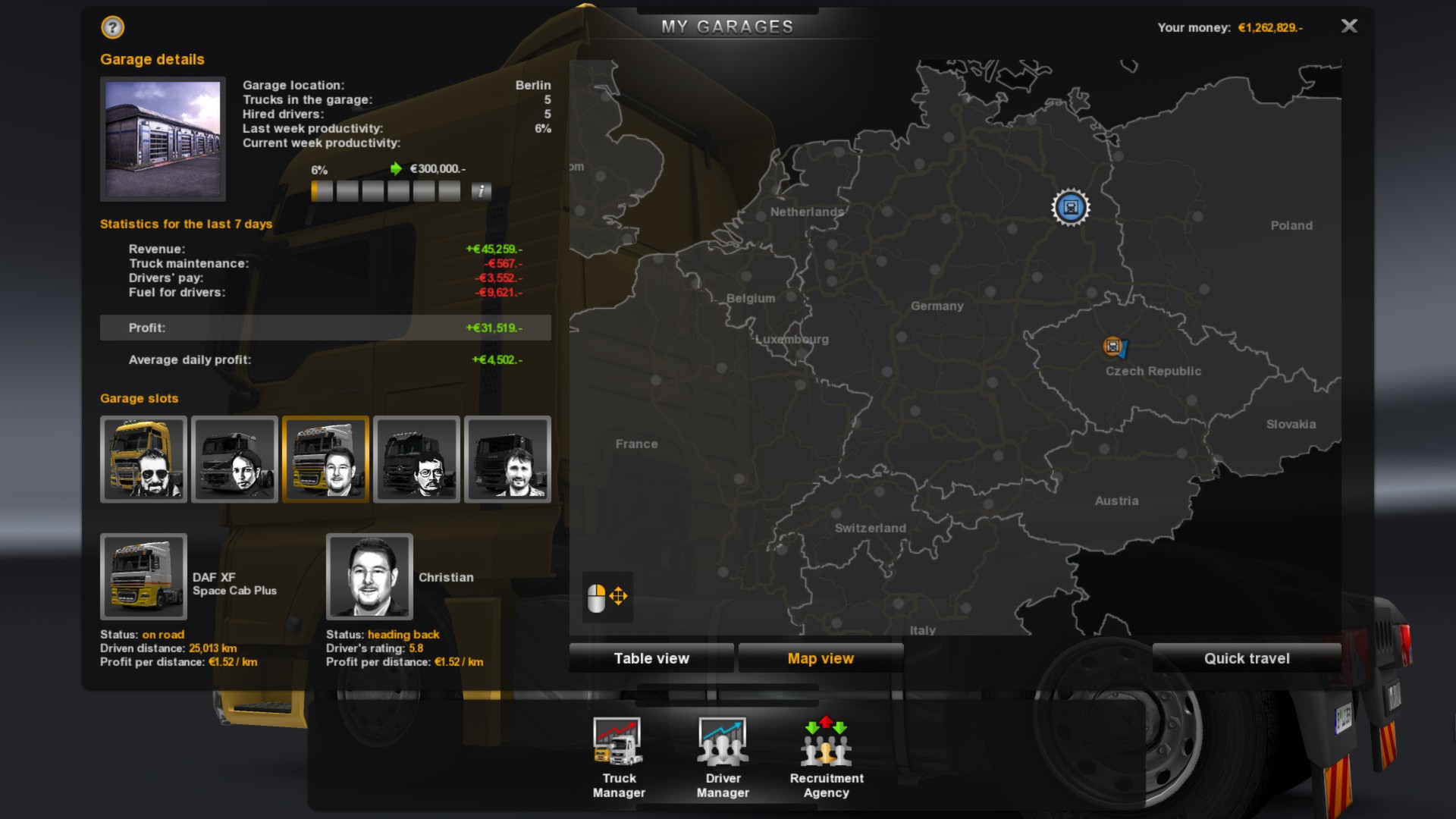
You start the game by creating your driver profile by giving yourself a name, naming your haulage company-to-be, choosing a logo for yourself and selecting a truck you like the look of. You then choose a home base somewhere in Europe, and then it's off to work you go.

Your first job is what is later referred to in the game as a "quick job" — you're provided with a truck already loaded up with cargo, and all you have to do is deliver it to the destination. If you elect to follow the tutorial, you're walked through various elements of the interface, though you're not told where a few important keys (headlights, windscreen wipers, indicators) are, so you'll need to check the options menu for that. (I recommend assigning all of those controls to a controller, if you're using one.)

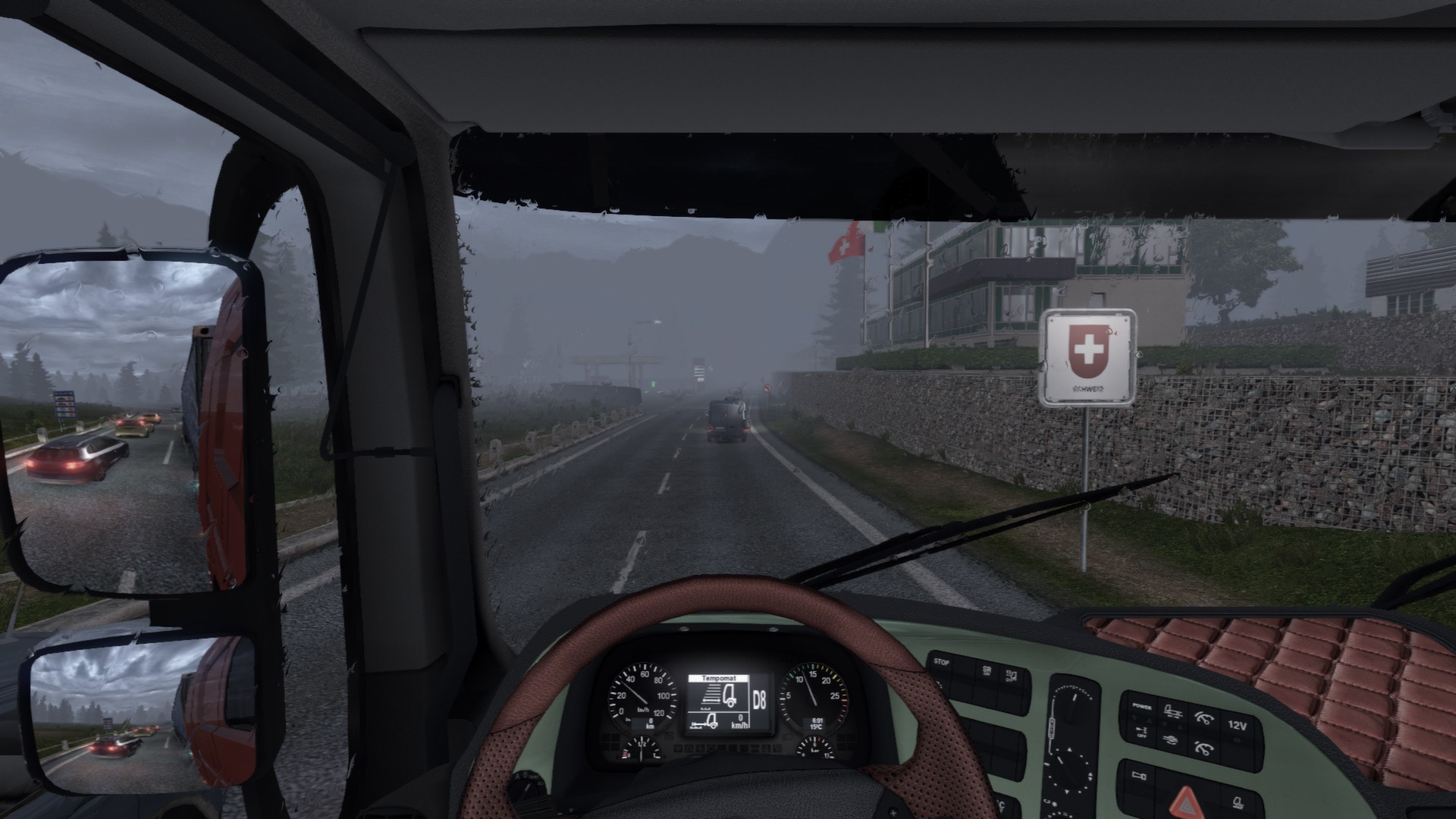
Delivering cargo is a simple matter of following your GPS, which sits in the corner of the screen like a space sim's multi-function display. (Indeed, here it is multifunction, too, allowing you to switch between views of your route, diagnostic information and other helpful bits and pieces.) While driving, you'll have to be reasonably careful. Hitting things can damage your truck and potentially cargo, too — the latter will cost you some of your fee at the end of the run. Similarly, breaking the rules of the road will cause you to be fined, though much like reality, you can get away with speeding so long as no-one catches you doing it.

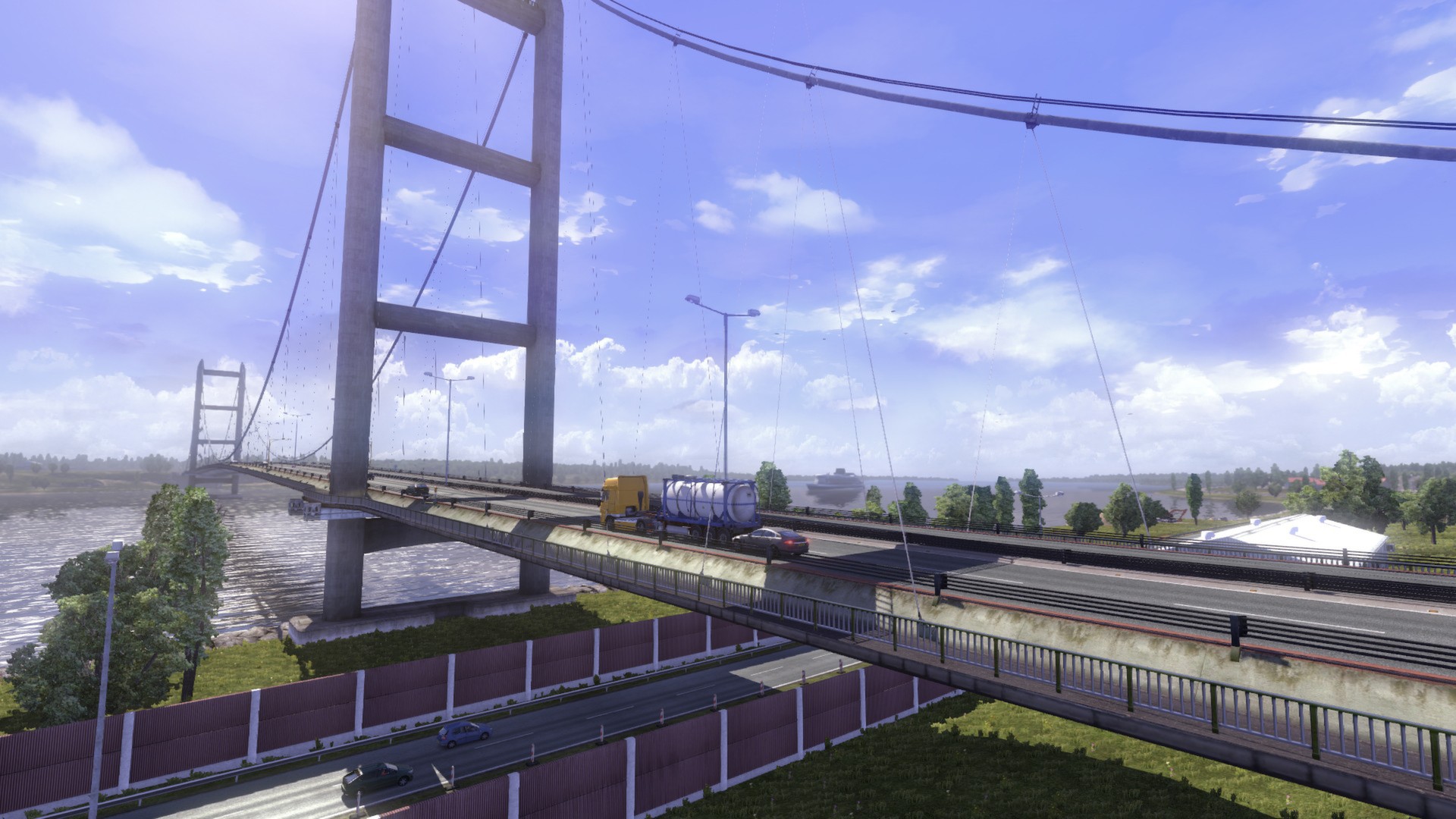
The roads are convincingly rendered, meaning you'll have to merge carefully onto motorways, slow down for country roads, and stop-start-stop-start at the traffic lights found in city centres. If you're driving in the UK, you'll have to drive on the left; head out onto the continent, meanwhile, and you'll be on the right. Both left- and right-hand drive trucks are available.

Once you reach your destination, there'll be a glowing parking space that you must reverse into. This is harder than it sounds, as trucks and trailers behave strangely when in reverse. You can, of course, press the "auto-park" button, but if you do so you're effectively declaring that you're a big wuss.

Once you've successfully parked and detached your cargo, you'll be rewarded with money and experience points, with a bonus if you parked yourself. Levelling up rewards you with skill points, which you can plug into one of several different skills — one allows you to transport hazardous (and consequently higher-value) cargo of various types; another allows you to take on more long-distance jobs; another still provides you with larger rewards for heavy, oversized or otherwise valuable cargo. You can effectively tailor your driver's profile according to the types of job you like to do.

ss_17df8ee8a12f3fdf9b862ee6ffec89e893aaab1d.1920x1080

After a couple of successful runs, you'll be invited to head along to a truck dealership that sells the type of truck you indicated was your "preferred" type at the outset of the game. A new truck will inevitably be much too expensive for you to afford with the few thousand Euros you've acquired from a couple of jobs, so you'll receive an email shortly afterwards from the bank inviting you to take out a loan. Here you have a choice; keep doing quick jobs for reasonable pay until you can afford to buy a truck outright, or take out a loan, buy your own truck immediately, and ensure you make enough money each in-game day to pay off that particular instalment.

Once you have your own truck — which can be customised in numerous ways, more of which open up as you level up — you have a lot more freedom. You can freely drive around Europe at your leisure, and the in-game map keeps track of how much of the road network you've explored. Arriving at new towns "discovers" them and unlocks them as a starting point for future jobs; coming across "?" markers on the map reveals new truck dealerships, recruitment agencies for hiring additional drivers for your fleet and other facilities; stopping at petrol stations or hotels allows you to restore your fuel and fatigue levels respectively.

ss_e06178175ea311428d1123f3655d4eb189140c35.1920x1080

Having your own truck allows you to take jobs from the "Freight Market" rather than the "Quick Job" menu. Here, you have to actually drive to the place where the job offer is — they expire after a while, so if you don't get there quickly enough, you're not doing the job — and then manually attach the trailer to your truck.

From here, it's a case of proceeding to do more jobs and build up your available funds, then gradually build up your fleet of trucks and drivers so it's not just you hauling shit around Europe, but your very own army of bearded chain-smokers too. Each of your hired drivers can be levelled up the same way as your own character, so you can get different drivers to specialise in different things.

All in all, it's a really neat game. I didn't think it would have much to offer beyond the initial appeal of "WOW I'M DRIVING A LORRY" but there's actually a surprisingly competent game in there, too. And even if you struggle to handle one of these many-wheeled beasts, you can have some fun by causing chaos on the open world. Which is nice.

Anyway, there's my enthusing on the subject of Euro Truck Simulator 2. It's surprisingly worth your time, particularly if you like open-world driving games where you just pootle around rather than killing everybody. Plus there's something inherently satisfying about driving such a gigantic vehicle and not killing everyone around you, or ending up on your side. (Though it is possible to end up on your side.)

So there you have it. Euro Truck Simulator 2. Enjoy.

1279: Hauling Ass (and Wood, Propane and Other Exciting Things)

I picked up Euro Truck Simulator 2 in the Steam Sale the other day on a bit of a whim. This is one of those simulator games that, like Farming Simulator, was roundly mocked upon its original release, but promptly turned out to be a rather good game.

I haven't spent a huge amount of time with it so far and I don't know how much time I will spend with it in the long term, but early impressions are that it is basically a game that I've thought should exist for a long time — that is to say, it's Elite, but on the roads instead of in space.

Okay, that's perhaps not quite accurate; you're not really "trading" stuff, you're simply taking jobs and hauling shit (sometimes literally) from one place to another, and there's certainly no "combat" besides any accidents you deliberately cause yourself, but the idea of fusing a management/business game with a vehicle simulator is a sound one, and it has always surprised me somewhat that we've only ever seen it happen in space, really.

Euro Truck Simulator 2 is an odd experience. It's a driving game, but without all the jostling for position and chaos that normally accompanies driving games that focus on racing. It's an open-world game, but without anything to really "do" besides seek out truck dealerships, try and visit every road in the game and sightsee. I haven't got far enough into the game to look at the business sim side of things yet, but I assume that will add an element of light strategy to the mix, particularly once you start hiring other drivers, too.

It's a peculiarly relaxing experience to play. Once your truck is out on the open road, you don't really have to do a lot besides ensure you don't hit anything, and try not to get caught by speed cameras. But it's pleasingly chilled out to just trundle along at 50mph down some convincingly-realised (if geographically-inaccurate) roads that go to real, actual places with recognisable landmarks. It also implements another feature that I've always thought should be in open-world driving games — the ability to stream Internet radio stations as the soundtrack to your drive. I was listening to some pleasingly mellow German jazz while I drove from Southampton to Dover earlier.

I say it's a relaxing experience to play. Well, that's only mostly true: it's relaxing until you reach your destination and have to reverse the fucking thing into a parking space. Parking a truck is horrendously difficult and I have new-found respect for anyone who is able to do it successfully, particularly in a yard that doesn't have very much space available. I don't really understand how to make it go the correct way when I'm reversing it yet, but I'm sure it's something that comes with practice.

Anyway, I guess what I'm saying in a roundabout way is that if you've seen Euro Truck Simulator 2 in the Steam sale and are mildly curious about it, do yourself a favour and download it. You might just find yourself enjoying the experience. It's just a shame there isn't multiplayer; hauling stuff around Europe with a friend would be a lot of fun, I feel.

1278: Christopher Walkern

So the whole "go for a walk for some exercise" thing has been going pretty well. I've managed to get up early and get out every day since I said I was going to, which bodes well. I am, however, probably going to take the weekend off so I can enjoy a lie in.

I've been walking for at least an hour each day, usually covering a distance of just under 4 miles or so. I usually follow pretty much the same route — up the road to the Common, wiggle around a bit in this side of the Common, cut across, walk down the road into town, walk through the vaguely attractive parks on the edge of the city centre, walk past the station and back up the other end of my road to finish where I started. It's a big loop, and there's a mix of flat, uphill and downhill walking all the way, so there's a bit of variety and challenge in places. It's still relatively "leisurely" compared to gasping and wheezing my way through a run, though, which makes it infinitely more appealing for the moment even if it isn't quite as good for me.

One of the helpful inspiring factors while I've been walking has been the use of audiobooks. I don't normally listen to a lot of audiobooks or podcasts any more, because I don't really have a suitable situation in which to listen to them. I can't listen to them while I work, because I have proven to myself on numerous occasions that I absolutely, positively 100% cannot write anything more than notes while someone else is talking in the same room, whether they're a real person or a recording. However, when all you're doing is walking aimlessly for the purposes of exercise, an audiobook or podcast is ideal listening. You're not running, so there's no real need for some music with a sense of "pace" to it; you can take your time and take in the words of whatever it is you're listening to.

The accompaniment to my walks this week has been the audiobook of a Dean Koontz novel. I had a couple of Koontz works recommended to me a while back and enjoyed them — I read those, rather than listened to them — so I decided to take a chance on another one. It's a bit bigger of a "risk" to try out an audiobook, since they're significantly more expensive than eBooks or even just, you know, books. Still, I haven't been disappointed so far; the story is interesting and the narrator appears to be pretty good, too, which is nice. (The novel is "Lightning," if you were wondering. I have no idea if this is considered "good" or not by Koontz fans, but I'm enjoying it.)

The other nice thing about audiobooks is the fact that it allows me to enjoy books without having to actually read them. I have nothing against reading and actually enjoy it rather a lot, but it's quite hard to make time for it when I have lots of other things I want to do as well. Reading is something I like to do when it's quiet — much like writing — so I can't really do it in front of the TV, and I certainly can't do it while I'm doing something else. Audiobooks allow me to enjoy a book while I'm doing something else, which is ideal.

So that's that. I'll be taking it easy for the weekend, then continuing this new regime next week. Let's see if it helps at all.

1277: Failing to Resist the Urge to Call This Post 'Rim Job'

I'M SORRY. (I'm not sorry.)

I went to see Pacific Rim this evening with my similarly-named friends Tim and Tom. This, along with Akira the other night, means that I've officially been to the cinema more times in the past week than I have in the last year.

As for Pacific Rim, it was enjoyable, if cheesy. Good, dumb fun on the surface, but a movie clearly designed with an appreciation — possibly even reverence — for Japanese giant robot anime. Throughout the whole thing, I couldn't help thinking that the movie might have been better just as a straight-up anime. In fact, partway through the movie, I found myself making mental comparisons with the visual novel Deus Machina Demonbane, with which Pacific Rim actually shares a significant number of similarities.

Lest you're unfamiliar with Deus Machina Demonbane but have seen Pacific Rim, the former is a visual novel about giant robots battling monsters loosely inspired by the work of HP Lovecraft; the latter is a movie about giant robots battling monsters with too many mouths. Already quite similar, albeit the Lovecraftian twist on Demonbane is a pleasant break from the norm.

Then we have the whole "you need two people to pilot a giant robot" thing, which is present in both Demonbane and Pacific Rim; in the former, the pilot is paired up with a "tome" (in the case of the protagonist, an absolutely adorable personification of the Necronimicon), while in the latter, two people have to "drift" together and share their consciousness, or memories, or something.

Then there's the fact that the main "hero" robot gets the crap kicked out of it repeatedly, yet somehow always gets repaired to immaculate condition every time, which is present in both works.

And the fact that the giant robots fighting do just as much damage — if not more so — to the places they're trying to protect than the monsters they're fighting, which is, again, present in both works.

Demonbane does have a bit of a twist in that the antagonists are given personalities and stories of their own, rather than just being "GRRR ARRGH MONSTERS". There's an overall "bad guy" in Demonbane, who is responsible for the Lovecraftian beasts invading our dimension, and there are some truly loathsome "lieutenants" who give the protagonist and the other characters in the story a lot of grief, to say the least.

Also, there is more fucking in Demonbane, while there is none in Pacific Rim, what with it being a 12A and all while Demonbane is an adults-only title. For the most part, the sexual scenes in Demonbane are more horrific than titillating, though; it's one of those "I can't fap to this!" games, unless you have some seriously weird tastes. Likewise, you cannot fap to Pacific Rimbut for different reasons.

Anyway, I guess what I'm saying is that if you enjoyed Pacific Rim and you're open to the idea of playing sexually explicit visual novels, then you should give Deus Machina Demonbane a look. It's one of the more memorable, well-written visual novels I've played in my time, and it's satisfyingly hefty in length, too, particularly if you go for all the endings.

I am hot and sweaty. I am going to drink something cold and go to bed. Good night.