1297: "Remember When..."

"…games were fun?"

It's a question often trotted out any time there's some sort of controversy in the video games medium, whether it's someone saying something stupid, or something in a game offending someone. Basically any time there's discussion beyond "this game are good, I liked the graphics the best".

Actually, that's grossly unfair to those who do good work on video games criticism when there isn't some sort of overblown controversy going on, but it is accurate to say that there are some people out there who use "remember when games were fun?" as a method of attempting to shut down discussion beyond simple, relatively superficial comments.

"Games are fun" isn't even a particularly accurate statement to make these days, because there are plenty of experiences out there that are specifically designed to be not fun. Take something like Corpse Party, which I wrote a little about yesterday, or Silent Hill — neither of those series are intended to get you thinking "this is fun; I'm having a good time". Quite the opposite, in fact — both are intended to unnerve, disturb, frighten and depress you. This doesn't make them bad games, however; in fact, it makes them extremely good games, because they both succeed admirably in achieving what they set out to do; both are genuinely unnerving, disturbing, frightening and depressing experiences.

Take something like Journey or Flower, too; neither of those carry the deliberately negative emotional baggage of stuff like Corpse Party or Silent Hill, but neither are they particularly designed to be "fun". Rather, they're artistic, contemplative experiences that are enormously open to interpretation; your own personal interpretation of both games might be that you find them fun, but likewise you might find them sad, or they might make you angry, or they might leave you awestruck at the scenery, or… you get the idea.

Visual novels, too, aren't designed to be "fun", at least not in the traditional sense of "having fun gameplay". No, you might find the characters, setting or story of a visual novel to be fun to hang out with or immerse yourself in, but the actual act of "playing" a visual novel is not fun at all. And that's fine — it's not a negative thing at all. In the case of visual novels, "gameplay" can distract from the narrative, which is the reason to play (or, more accurately, as many fans say, "read") these games in the first place. (There are exceptions, of course; Aselia the Eternal strikes a great balance between narrative and gameplay, and successfully integrates both into a surprisingly coherent, if technologically rather primitive, experience.)

So yeah. I remember when games were just fun. That was cool, I guess, but I'm much more of a fan of the diversity of experiences we have today. I enjoy the fact that modern games make me think or make me feel something. I'd be kind of sorry if we didn't strive for anything more than "just fun" in interactive entertainment.

1296: Repeated Fear

After re-finishing Corpse Party for the second time (and this time around actually playing through all the bonus chapters) I moved straight on to its sort-of-sequel Corpse Party: Book of Shadows, a game which I've owned for quite some time but haven't got around to because I wanted to replay Corpse Party first.

So far, I'm very impressed. Book of Shadows maintains the things that were great about Corpse Party — its dark, mature storyline; its realistically flawed but likeable characters; its unusual but startlingly effective soundtrack; and its incredible, incredible sound design and voice acting — while making a few significant and notable changes.

The most notable change from the previous Corpse Party is that it's no longer a top-down RPG-style affair and has instead become a first-person perspective point and click adventure with lengthy visual novel-style sequences to advance the plot. I'm fine with this, but I was also fine with the top-down nature of the original. I actually really liked the fact that the first Corpse Party had all the trappings of a JRPG — top-down perspective, a menu you pop up with the triangle button, hit points — without any fighting whatsoever. (That said, the PC-98 original version of Corpse Party, of which the PSP version is one of several remakes, concluded with a boss fight.)

Book of Shadows' shift to the first person is an interesting one, because despite the change in perspective and despite the change from tile-based backdrops to hand-drawn environments, it's still recognisable as Heavenly Host Elementary School. The map is the same; the rooms are laid out the same; you're just seeing them from a different perspective. This gives a pleasing degree of consistency to the experience.

The concept is peculiar but kind of neat, too. One of the "wrong ends" of the original Corpse Party saw the band of unfortunate teens travel back in time after successfully reversing the charm that had got them into the school in the first place, only to find themselves repeating the same events exactly as they were before — thereby dooming themselves to the same fate. Book of Shadows runs with the idea that the characters being aware of this "time loop" might see them try to cheat their fate, and the first chapter at least explores what happens if a particular tragedy that occurred early in the first game was averted. In doing so, we get a chance to spend a lot more time with characters who didn't get a great deal of screen time in the original game (because they were the first to be unpleasantly murdered) and gain a greater understanding of both them and their relationships with others in the process.

I'm digging it so far. The palpable sense of menace of the original is very much intact in this new game, as is the wince-inducing violence — though as with the previous game, Book of Shadows has a wonderful understanding of the concept of "less is more" when it comes to horror. The most effective scares come from the imagination rather than gory scenes on the screen — and while Book of Shadows, like its predecessor, certainly isn't afraid to show the aftermath of a violent event, the actual instance of something unpleasant happening tends to be depicted through nothing more than text and sound.

Book of Shadows deserves particularly special mention for its sound. The original Corpse Party made magnificent use of fake 3D effects in the stereo field to make it sound like people were whispering in your ear, standing behind you and all manner of other things. Book of Shadows continues this and somehow manages to be even more effective. In an early scene, for example, you're playing the role of the character Naomi, who finds herself in bed with her possibly-a-lesbian best friend Seiko, who is over for a sleepover. When the lights go out and Seiko falls asleep, you can hear her soft breathing and occasional murmuring to herself in your left ear while Naomi ponders things to herself; when Seiko is roused by Naomi's mumbling, her voice sounds like she's lying right next to you. It's unnerving in its realism, but startlingly effective for immersing you in the game world and story.

I'm partway through the second chapter of Book of Shadows so far. I'm enjoying the "what if?" nature of these chapters, but what I'm really looking forward to is the not-so-secret final chapter that actually acts as a sequel of sorts to the original story. I'm intrigued to see where the story goes, and despite the fact it's such a consistently unpleasant, depressing series, I really hope we see more in the future.

1295: Co-Op, Counter-Op

I like cooperative modes in games, though usually only when I get the opportunity to do so with people I know and trust. Co-op gameplay is often reliant on communication, you see, and as has been well-documented here in the past, I often feel a little uncomfortable when forced to communicate with strangers. I'm usually all right when it comes to text-based chat, but voice chat? No no no. Thank you.

I've had a few great co-op experiences over the years. Actually, one of them wasn't co-op at all — it was "counter-operative" in Perfect Dark for the Xbox 360. This mode, somewhere between traditional co-op and competitive multiplayer, cast one player in the role of the usual protagonist, and the other in the role of all the enemies in the level. If the protagonist character dies, the counter-operative wins; if the counter-operative player dies, meanwhile, they simply shift to another body and continue until no enemies are left.

One of my favourite instances of this game mode came when I was playing with my friend Calin on the first level of Perfect Dark — a level that had already played host to some frighteningly competitive speedruns between my friends and I. Calin was the Counter-Operative, I was the protagonist. Wandering through the level, I was surprised to discover there didn't appear to be a single trace of any enemies. I made my way down through the building, as you were supposed to do in the level, and got to the bottom. Still no enemies.

Suddenly… BIFF. My gun was knocked from my hand and my vision blurred. I'd been hit over the back of the head. I wheeled around to discover the only remaining enemy in the level — Calin had been through and, before I'd got there, systematically eliminated all his "extra lives," as it were — and it was coming down to a fist fight. By this point, we were both in stitches, which made flailing wildly at each other all the more difficult. I forget who "won" — probably me, because the protagonist has significantly more health than generic fodder enemies — but it was a hilarious experience.

My other favourite co-op experience is in Saints Row The Third. Saints Row's co-op is great because it's just the exact same game as in single-player, only there's two people running around causing chaos instead of just one. You can work together to complete missions, or participate in all the silly activities together, adding your scores together in an attempt to reach the various targets. Alternatively, you can both just tool around the open world completely separately if you desire, independently causing chaos. It's a lot of fun, particularly given the diverse array of different activities on offer in the world of Saints Row — one minute you might be flinging yourself in front of vehicles in order to commit insurance fraud; the next, you might be working your way through a "killing floor" gauntlet on the city of Steelport's favourite hyper-violent gameshow.

Having completed Saints Row IV over the weekend, I'm particularly keen to try that in co-op, as the single player was ridiculous enough. For those unfamiliar with the fourth installment, it's set in the same game world as Saints Row The Third, albeit a computer simulation of it instead of the "real" world. This means there's Tron-style visual effects all over the place, but more importantly it means you have "superpowers" such as super speed and a ridiculous Crackdown-style jumping ability. I can only imagine the ridiculous situations that will result from not one but two superpowered nutcases boinging around the city rooftops. I'm looking forward to trying it when the retail version of the game becomes available in two weeks.

1294: Campaign Mode

Random bit of gaming trivia for you: the word "campaign" wasn't always synonymous with "single-player story mode." In fact, in the 16-bit era I recall playing numerous games in which the "campaign" was actually just one of several different game modes — it most commonly cropped up in flight sims, but occasionally made an appearance in other types of game, too.

Taking flight sims as the main example, a "campaign" mode tended to be what it sounds like: an ongoing campaign of the player against computer-controlled enemies, either through a linear sequence of missions like we have in many of today's single-player modes, or through a more dynamic, strategic sort of affair that changed and evolved as the player took various actions.

One particular example I can think of was the then-popular flight sim Falcon 3.0, which was one of numerous F-16 simulators around at the time. Past incarnations of Falcon had generally seen players taking on one-off missions, raising in rank and collecting medals through grinding the same missions over and over again. What Falcon 3 brought to the table was what was regarded as one of the best campaign modes ever seen in the genre at the time — I'm sure it's been bettered by all manner of other games since, but I remember it being quite impressive at the time.

Looking the game up to better refresh my memory, in fact, it seems that Falcon 3.0 was, in fact, one of the first games ever to incorporate a dynamic campaign mode, and this is what drew praise. In fact, so confident were developers Spectrum Holobyte that they even gave the campaign engine its own branding: "Electronic Battlefield."

Electronic Battlefield was originally intended to be a campaign engine that transcended individual games and allowed for multiple different products to interlink with one another for network games. Three games eventually made it to market: Falcon 3.0 itself, MiG-29: Deadly Adversary of Falcon 3.0 (for it was tradition that the F-16s in flight sims at the time would spend most of their time fighting MiG-29s, their biggest rival from the Soviets) and Falcon 3.0: Hornet: Naval Strike Fighter, which simulated the F/A-18 Hornet. These three games could all talk to each other in network sessions, but I never got a chance to try it; sadly, this was in an age prior to widespread use of the Internet and online play in general, so when it says "network game" it actually means LAN play — a luxury only really afforded to those who worked in offices.

So how is this kind of "campaign" different from what we have today? Well, the main thing is that it's not scripted, and there doesn't necessarily have to be an "end". Falcon 3.0's campaign simulated a conflict in which the player is just one element; through completing or failing various missions, they could help or hinder the war effort as a whole, presumably eventually culminating in one side or the other declaring victory. I never saw that as I wasn't really very good at flight sims, despite enjoying them as a young 'un, but I could tell my efforts were having an impact on the virtual war as a whole.

It was kind of cool, really — despite the fact there was no ongoing "story" like in, say, the later Strike Commander (which again concentrated on F-16s, but had a much more arcadey flight model), there was a real sense of emergent narrative — of things happening due to your actions rather than just being plopped down in front of either a limited selection of missions, or randomly-selected scenarios. It was pretty neat.

I'm not sure why I blabbered on about all that — I just find myself thinking back to that every time a game makes me click on the word "Campaign" when what it really means is "Story".

1293: [Incredibly tough][Miq'ote][rod]

I'm getting a bit antsy for Final Fantasy XIV. I haven't felt genuinely excited about an MMO for a while — the last one I played, which was The Secret World, was something I picked up more out of idle interest than anything else. Final Fantasy XIV, meanwhile, is something I'm really looking forward to.

While I'm waiting for the announcement that the open beta has started and I can finally start building what will become my "permanent" character in the game, I've been reading back over some of the forum posts, and particularly about people who once played Final Fantasy XI and ended up leaving.

I enjoyed Final Fantasy XI a lot. I didn't play it for anywhere near long enough to reach the level cap or anything like that, but I enjoyed the experience of what I played. It helped that I had some good friends who played regularly, but it was also just an experience that I found enjoyable. I'm hoping Final Fantasy XIV recreates that kind of feeling, though I'm already aware it's a very different game — and I'm glad about that.

Final Fantasy XI was hard. Really hard. This was the kind of game where if you inadvertently got a monster chasing you that was too strong for you to beat, you'd better outwit them and run away as fast as possible, because they would chase you across the whole map, and they would kill you. To add insult to injury, Final Fantasy XI also penalised your experience each time you died, meaning that dying too much could actually result in you losing levels if you weren't careful — something I haven't seen in any MMO since. This gave the game a real feeling of consequence — if you got yourself into a situation you couldn't handle, you had better either figure out how you were going to deal with it, or accept your fate.

This sort of "penalty" thing is something that people praise Demon's Souls and Dark Souls for, because it makes death meaningful. And that's good. In World of Warcraft, death just means your equipment gets a bit damaged and you have a bit of a run back to your corpse, but otherwise there aren't really any major penalties you have to deal with. This means that in many cases, challenges can be brute-forced by simply chipping away, dying, running back, repeating. This isn't really possible when you're by yourself, as monsters who aren't being actively attacked tend to run back to their spawn point and heal fully, but if you're in a party it was most certainly possible.

In Final Fantasy XI, meanwhile, you had to work together. It was one of the most intensely cooperative games I've ever played, and while this sometimes led to player tempers flaring, I was fortunate enough for the most part to group with people who both knew what they were doing and were patient with newbies.

Getting into a fight in Final Fantasy XI was a big deal. It wasn't a hack-and-slash game; it was something where, when you saw an enemy, you had to carefully weigh up your chances of victory as a group. Once the battle began, everyone had to play their part and know what they were doing — even in combat against non-boss enemies. Battle was an intricate dance led by the Warrior, who maintained the enemy's attention while other classes dealt damage or healed the party. It was stressful, but in a good way; as I say, it was intensely cooperative, and the knowledge that what you were doing was important felt great. Contrast this with something like World of Warcraft, where I often felt rather detached in party play, particularly playing as a Mage. Combat often boiled down to little more than standing back and spamming the same few attacks over and over again while other people did their thing independently.

(Aside: I have no idea what "Abyssea" is, but people who stuck with Final Fantasy XI longer than me seem to complain about it an awful lot.)

I'm not yet sure how Final Fantasy XIV's cooperative play will work as I didn't get a chance to try it during closed beta. I am curious to see, though, since from what I've heard from other people, each class plays noticeably differently from the others. The Pugilist class that I experimented with had a strong focus on quickly triggering attacks in a specific order to form combos, and this was probably most like what I was doing as a Mage in World of Warcraft. You had to memorise the combination of buttons that was most effective, then repeatedly trigger them as appropriate. Final Fantasy XIV added a bit of extra depth, though; positioning is important, as you can dodge area-of-effect attacks and do extra damage from certain angles.

Party play in Final Fantasy XIV also features the return of the Limit Break gauge from Final Fantasy VII, which I'm interested to see — in this particular incarnation, it's a meter shared between the whole party which any member can use when it's charged. The exact effect it has is determined by who triggered it. I'm wondering how sensible and restrained people will be with this feature, or if it will end up getting spammed by people. We'll see.

With the recent announcement of Everquest Next and its impressive dynamic quests and terrain deformation, attention seems to have swung off Final Fantasy XIV a bit, but I'm still intending to give it a good shot. I really liked what I played in open beta, and I anticipate it's something that I'll enjoy sticking with — particularly if I get the opportunity to play with some people on a regular basis, which is looking likely.

Hopefully not too long to wait until open beta. Count on some enthusing on these very pages when it does arrive.

1292: LFRP

I haven't done nearly as much role-playing in my life as I'd like to have done by now. No, I'm not talking about sexy role-playing (although now that you me– huh? You're still here? As you were.) but rather role-playing in the, you know, role-playing game sense.

I play a lot of RPGs on computer and console, of course, but those aren't the same thing. True role-playing is the opportunity to become someone else for a while; to take on another persona and enjoy a complete escape from reality.

I've indulged on online role-playing a few times in an attempt to get my fix. The earliest time I tried was when I gave the original Everquest a go out of curiosity. I joined a "roleplaying" ("RP") server, created my character and jumped in. The first person I ran into, I spoke in character, the message log at the bottom of the screen noting that I was speaking in Elvish. The response? "lol". I was disappointed, to say the least.

Later attempts yielded somewhat better results. My fondest memories of online role-playing — and probably my fondest memories of playing any sort of game online, for that matter — come from the game Neverwinter Nights, the spiritual successor to the Baldur's Gate series and an unusual multiplayer game. Neverwinter Nights was based on the popular pen-and-paper Dungeons and Dragons role-playing game, see, and in keeping with that, the multiplayer mode allowed one player to be the "Dungeon Master" and take control of the game world and all the characters in it. This meant you could run adventures that simply weren't possible using pre-scripted modules; instead of being railroaded down a plotline, things could go off in unusual directions.

I had a group of people I played with semi-regularly that I met via the website Neverwinter Connections — said site still seems to be there, but it doesn't look like it's really very active these days, which is sad. I'm not entirely sure how I came to Neverwinter Connections in the first place, but that's where I met StarStuff, Scorpio and several others. I've since lost touch with them — this wasn't entirely my fault, as they moved on to Guild Wars, a game I didn't really stick with, but I do regret not being able to count them among my friends any more. We had some good times.

One of my favourite games we played together was a lengthy quest that went on for several hours. I forget the exact circumstances of the quest itself, but I remember my character: Jay Wrekin the sorcerer. Jay was a middle-aged wizard with a pixie familiar named Sianie, and a quirk of the Neverwinter Nights engine allowed you to take direct control of your familiar if you saw fit — including making them speak. This led to the interesting role-playing challenge of speaking for both Jay and Sianie simultaneously, though Jay chose to keep Sianie's existence a secret initially, with her only appearing when he sneezed (or possibly the other way around).

Later in the quest, we found ourselves in a tricky situation — again, I forget the precise circumstances, but I do remember that for whatever reason, the only option was for Jay to reveal the existence of Sianie to the rest of the party, and for Sianie to go off and complete some sort of tricky challenge on her own. It was great fun and, although I felt I was monopolising the role-playing at times, the rest of the troupe all complimented me a great deal after the adventure was over. It was a significant challenge role-playing one character, they said; to manage two and make them distinct in personality from one another was an impressive achievement.

Later, I played a bit of World of Warcraft off and on with some friends. Like my initial abortive foray into Everquest, I picked the role-playing server, only this time I found a lot more people willing to indulge in role-playing fantasies. My friend and I decided how our characters related to one another before we started, and over a long period of time we developed their relationships and personal stories, culminating in us role-playing a run on the original form of the Stratholme dungeon. This was a surprisingly dramatic experience, since we'd agreed between us that, in terms of our character backstory, we both grew up in Stratholme and were driven out during the events of Warcraft III; consequently, we were hungry for revenge, and the long time it had taken us to get up to an appropriate level to beat Stratholme comfortably meant it really felt like we'd been on an epic journey.

There's a bit of an issue with role-playing in massively multiplayer games like World of Warcraft, however: they're not really designed for it. Oh sure, you have emotes and can sit in chairs and whatnot, but there aren't really the tools available to get some really good role-playing going. There's also a constant nagging feeling of conflict — while you're sitting around chatting in character with friends, you could be outside bashing goblin heads together for experience points. There's no inherent rewards for role-playing in World of Warcraft, only the satisfaction of creating an immersive environment with friends.

I'm intending on playing Final Fantasy XIV when it launches later this month, but I don't think I'm going to be role-playing — it just doesn't seem to be the right kind of game for it, though I can probably have my arm twisted if people I play with are into it. I am not, however, ruling out the possibility of other forms of online role-play in the future — I do find myself wondering if it'll ever match up to the adventures of Jay and Sianie, though.

1291: The Gentrification of Snack Foods

Have you noticed how it's increasingly difficult to buy a bag of salt and vinegar crisps these days?

I don't mean that they're hard to find — they're still everywhere, and still the second-best flavour of crisps (the best being, of course, prawn cocktail) but rather it's increasingly difficult to find a bag that just says "salt and vinegar" on them.

No, these days it's all "sea salt" and either malt, cider or, in extremely pretentious cases, balsamic vinegar. Granted, each of those does have a distinctive taste from the others, but it's a distinction we didn't used to make because no-one knew what the fuck balsamic vinegar was.

Crisps aren't the only type of food that has undergone gentrification, though. We now have "fruit terrine" rather than "jelly with fruit in"; "artisan bread" rather than "crusty bread" (or, you know, "bread"); and almost everything that involves chocolate that isn't a chocolate bar has suddenly become "Belgian chocolate" as if its Flemish origins somehow make the poor-quality chocolate sauce you get with a chocolate pudding magically better.

There's probably some sort of deep-seated sociological reason for all this happening that marketing people have picked up on. At a guess, I'd say it's something to do with people having aspirations towards being "middle class", and what's more middle class than balsamic vinegar? Slap that on your bag of crisps and you immediately no longer have crisps — which are clearly a working class food — but instead you have posh crisps or, more accurately, "nibbles". The sort of things you pour into a bowl because eating them out of the bag is just so frightfully common.

Where does it end, though? Wagon Wheels become Alloy Rims? (with Jammy Alloy Rims being marketed as "a delicate berry jus nestled in a bed of delectably fluffy mallow, all encased in rich, smooth Belgian chocolate") Cheestrings launch a new "Cheestrings Pro" range made out of suitably pongy blue cheeses? Cheetos complement their Pepsi flavour (yes, it totally exists — see?) with an array of flavours based on popular wines and ports?

I jest, of course. I'm not annoyed about all this; I just think it's an interesting cultural phenomenon that appears to have been growing over the last few years in particular — or perhaps it's been going on for a lot longer and I just never noticed. When I was a student, for example, I didn't go looking for pretentious crap like balsamic vinegar; I bought value goods. (Actually, that's not so bad; cheap crisps are frequently the best due to the sheer amount of flavouring crap they cover them with. Plus you'd never get Tangy Toms rebranding themselves as "Sundried Tomato Flavour Bites".)

Anyway, I'm off to enjoy a cool glass of triple-filtered cow beverage, and perhaps a Belgian chocolate chip Snack Disc.

1290: The Never-Ending Battle

Oh, God. Reviews for Dragon's Crown came out today, and I had a feeling there was going to be at least one shitstorm over it.

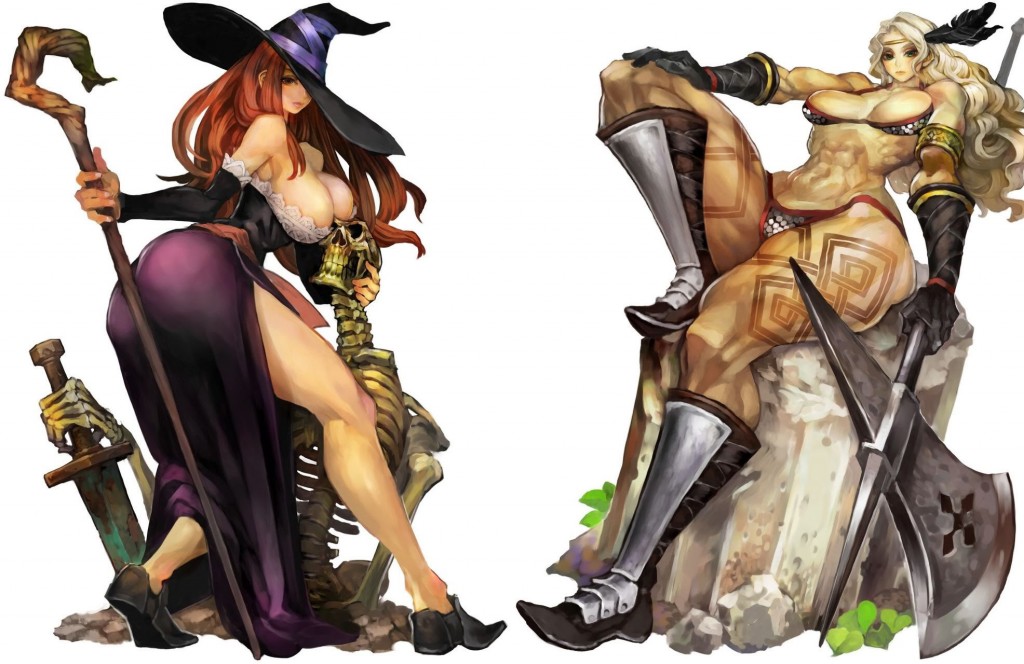
Dragon's Crown, lest you're unfamiliar, is a new game for PS3 and Vita loosely inspired by the brawler classics of yesteryear such as Golden Axe, fused with some modern ideas from roguelikes and action RPGs. It gained notoriety prior to release for featuring some heavily exaggerated, almost abstract art, in which the "Amazon" character is a gigantic, musclebound behemoth of a woman; the "Sorceress" character has boobs that will give her significant back problems later in life; and the "Fighter" character has armour that would put the COGs from Gears of War to shame. The female elf ranger, meanwhile, looks almost normal, though she has some grade-A zettai ryouiki going on with her boots.

Here's the Sorceress and the Amazon.

SorcererandAmazon-1024x664Now, you may have one of several reactions to the art used in this game. You may find it offensive in its overly sexualised depictions of women. You may find it ludicrous and amusing. You may find it beautiful. You may find it erotic or arousing. You may find it kind of cool in a stylised sort of way. Or you just might hate it not for what it represents, but simply because the style doesn't appeal to you.

Here's the thing: all of those opinions are "right". Or, more accurately, none of them are "wrong". Your opinion is your own, and you should take ownership of it, not be pressured into thinking what other people seem to think you should think.

Unfortunately, there are people on both "sides" of the argument that has sprung up around this game — leaving aside the people in the middle who either think it's "kind of neat" or "meh" — who are being a little unreasonable about all this. Not everyone, by any means — both Polygon and GamesBeat's reviews, for example, while differing wildly in their final evaluation of the game, read as fair comments that accurately reflect the authors' perspectives as people who strongly disliked the art — but there's a significant proportion of people both on the "pro" and "anti" sides of the debate who are, frankly, being a bit dickish.

The most obviously obnoxious side is, of course, the group of people who have just become collectively known as "the misogynists". The young men who enjoy their T&A and get defensive any time they feel someone is attacking them and their tastes. The same people who, in extreme cases, send death threats to people like Anita Sarkeesian simply for exploring depictions of women in video games.

However, I've seen equally obnoxious comments today on the side of people who dislike the art style and think it's sexist, misogynist or otherwise discriminatory. I've seen Dragon's Crown referred to as a "wank game" (by a woman) and numerous snide comments from people (men and women) on Twitter calling it "juvenile" or being otherwise disrespectful towards those who either don't have a strong opinion on the art style, or those who actively like it. I've also seen people implying that the people who do like Dragon's Crown will never get laid, and are just pathetic losers for whom, I quote, "the closest u will ever get 2 a woman is ur miku miku dominoes figurine" [sic — in reference to Hatsune Miku, the popular animated Japanese mascot who was recently used in a Dominos Pizza campaign in Japan.] Real classy, there.

When you see this going on, it's sort of understandable why the "misogynist" side gets overly defensive and wants to lash out at the people criticising them. It's not acceptable. The ones attacking the art style of Dragon's Crown are the same ones criticising others for disrespectful comments and behaviour — particularly towards women — and yet they're engaging in it themselves simply because someone disagrees with them. Not good at all.

Where do I stand on Dragon's Crown? I think it's cool. It's distinctive, heavily stylised and immediately recognisable — not to mention memorable. I don't find it erotic or arousing, personally — it's just too exaggerated for my particular tastes — but acknowledge that there may be some people who do. For context, I enjoy the art style of modern anime — particularly the more "moe" end of the spectrum — and freely admit that I believe drawings and animations can be as sexually arousing — sometimes more so — than photographs and videos. I also like looking at — and, even better, playing as — attractive female characters in video games, because they're everything I'm not, and I often identify or empathise with them a lot better than beefcake males.

Most importantly, I acknowledge that not everyone agrees with the way I feel and I wouldn't expect to make anyone feel the same way if they're just not into it. Similarly, I acknowledge that some people find Dragon's Crown's art distasteful, but I do not expect those people to be patronising, condescending and even, at times, outright aggressive towards those who do like the way it looks.

Let's maybe try to respect each other a little more, even when we disagree — even on controversial topics.

If only.


1289: Oh When The... You Know

I've been playing a game for review this evening, but I can't talk about it yet because blah blah embargo, etc. So instead I'm going to talk about Saints Row The Third, which, conveniently, is available for whatever price you please as part of the latest (pretty incredible) Humble Bundle.

Grand Theft Auto has been losing me for a while. It took me a long time to get around to finishing Vice City — though I eventually did — and I never finished San Andreas or Grand Theft Auto IV at all. (I also own the two Grand Theft Auto IV side stories, but haven't touched them at all.)

The problem is that Grand Theft Auto had started taking itself a bit seriously. While it's still full of cringeworthy puns and scathing putdowns of American culture, the stories themselves have been getting a bit too "gangsta drama" for me; there seemed to be less of the colourful characters from earlier installments and more in the way of people calling each other "bitch" and "motherfucker". (Confession: I actually had to turn the subtitles on in San Andreas not because I couldn't hear the speech, but because I couldn't understand what the characters were saying.) This is probably a grossly unfair assessment, but I've been struggling to maintain interest in them for quite some time, and Grand Theft Auto V doesn't really have me hyped at all. (This makes the fact the Internet collectively jizzes its pants every time a new screenshot appears especially frustrating, as I'm sure you can sympathise.)

I'm not sure what prompted me to pick up Saints Row The Third for PC. I don't even think it was a Steam sale — I'm pretty sure I bought it at full price shortly after it came out. Reviews I'd read had been mostly positive, with a few criticising it for not having as interesting a setting as Grand Theft Auto, but most had mentioned one important thing: fun.

I'd never played a previous Saints Row game, so I had no frame of reference to compare The Third to except for Grand Theft Auto. And it quickly became apparent that Saints Row The Third was the game I'd been wanting Grand Theft Auto to turn back into ever since Vice City. Freedom to run around causing chaos; lots of side missions to do; a plot that was enjoyable, silly nonsense; and the fact that if you wanted to run down the street punching everyone in the face, it didn't really feel "out of character" for the protagonist.

Saints Row The Third is a playground. Sure, there's a plot to follow, but the main attraction is the "activities" scattered around the map. These vary from destroying as much shit as possible while on foot and equipped with infinite ammo to destroying as much shit as possible while in a bloody great tank. There are also missions where you have to drive around with a tiger in your car, arena challenges where you have to defeat enemies and avoid traps, and "insurance fraud" missions where you have to fling yourself into traffic and injure yourself as much as possible against the clock.

By far my fondest memory of Saints Row The Third is the one and only time I've had the chance to play multiplayer with my good friend Mr Alex Connolly, though. We just so happened to actually be online and available at the same time for once, so we jumped into a game together and caused chaos. There's really nothing quite like rolling up to a character you know is another real person, letting them jump in your Tron-style car and then tearing around the city to cause some havoc. Saints Row The Third doesn't significantly change its structure when played in co-op, but the simple presence of another player helps make it even more fun than it already is.

If you've never played Saints Row The Third and like the sound of a chaotic romp through something like Grand Theft Auto used to be, that Humble Bundle I linked above is a fantastic deal. Or, let's not forget, the fourth entry in the series is coming soon. But that… that I can't talk about right now.

1288: Final Fantasies

I've been thinking a lot about the Final Fantasy series recently, prompted in part by the impending release of the third Final Fantasy XIII game Lightning Returns, which is actually looking rather spiffy. It's a series that, as I've noted a few times before, I've followed from VII onwards, though I later went back and educated myself on earlier installments in the series.

As such, here's a few thoughts on each mainline entry.

FINAL FANTASY I: Generic as hell, right down to the monsters ripped straight from the D&D Monster Manual and its high fantasy setting. Minimal plot, incomprehensible plot twist right at the end. Worth playing to see the series' origins, but feels very grindy these days.

FINAL FANTASY II: Very interesting, particularly when you compare it to other JRPGs around at the time. Not only was it an early example of a Final Fantasy game focusing on plot, its mechanics were kind of cool. Okay, they had their problems, too, but indirectly Final Fantasy II set the template for the "use it to improve it" skill system seen in, among other things, the Elder Scrolls series.

FINAL FANTASY III: By now, the pattern of odd-numbered Final Fantasy games focusing on mechanics and even-numbered ones focusing on plot was set in place. Final Fantasy III had minimal plot, even in its later 3D remake, but it's a game worth playing to see the genesis of the Job system that made frequent reappearances throughout both the mainline series and its numerous spinoffs.

FINAL FANTASY IV: Heavy on the plot, light on the mechanics. In Final Fantasy IV, you're stuck with whatever party members the plot dictates you have at any one point, with minimal customisation. This isn't necessarily a bad thing, though; it allows you to focus on the plot which, while basic and clichéd these days, was impressive, epic stuff back when it first came out, and noteworthy for having characters with distinct personalities.

FINAL FANTASY V: I must confess to never having finished this one, but it has one of the best implementations of the Job system of the whole series, allowing you to blend abilities from two different Jobs, assuming you've already learned some from the Job you're not actively equipped with. Once again, it's an odd-numbered Final Fantasy so the plot is somewhat disposable, but again, the mechanics are the reason to explore this game.

FINAL FANTASY VI: For many, the best Final Fantasy but again, I must confess to never having beaten this, and somehow never having had the ending spoiled for me. VI gives a good balance between the predefined characters of IV and the customisation of by having distinctive characters whom you could teach spells to. The plot, meanwhile, was excellent, if arguably overly ambitious for the technology it had available to tell it.

FINAL FANTASY VII: I'll always have a soft spot for this one, what with it being the reason I like JRPGs as much as I do today. I haven't played it for probably a good ten years or so, but I'm open to the idea of revisiting it at some point. Those awful field screen character models bugged me even back then, though; I believe the PC version allows you to mod them.

FINAL FANTASY VIII: Much-maligned, but this is one of my favourites of the series. A touching love story coupled with some world-shattering silliness, with one of the best final encounters of all time — even if the finale itself was somewhat nonsensical.

FINAL FANTASY IX: One of the best battle themes in the series, though the child-like characters looked a little strange after the realistically proportioned people in VIII. IX has a ton of series fanservice, as it was the series' swansong on PS1.

FINAL FANTASY X: The change to PS2 and full 3D was very jarring to me, especially when combined with the move to a fully turn-based system. Said turn-based system was great, though, particularly the way you could manipulate the turn order to your advantage. This mechanic would later be seen in a whole bunch of other JRPGs — Trails in the Sky is one that springs to mind — so it proved to be massively influential. Also noteworthy for having a cool level-up system that made for highly customisable characters… and for having a terrible conversion to PAL consoles, with ugly black borders at the top and bottom of the screen and a frame rate significantly slower than the NTSC (Japan and US) versions.

FINAL FANTASY X-2: Gloriously camp, and delightful as a result. Final Fantasy X-2 may have taken place in the same world as X, but it had a completely different character. was melancholy throughout; X-2 was rambunctious and joyful. This ultimately wasn't to everyone's taste, but the game certainly didn't suffer as a result. A non-linear structure combined with a fantastic implementation of the Job system made Final Fantasy X-2's small party of three immensely customisable, and there was a ton of stuff to do in the game, much of it optional. Highly recommended.

FINAL FANTASY XI: The first of the two MMOs in the series, Final Fantasy XI is noteworthy for being one of the first games of its type to actually make an effort with narrative progression alongside the otherwise relatively straightforward MMO gameplay. There was a story, there were bosses, there was even a final boss. Subsequent expansions continued the stories into ever more exciting encounters, but you had better be ready to invest a lot of time — the game had one of the slowest rates of levelling of any MMO, and though this was marginally improved over time, it's still painfully slow and dependent on playing in parties.

FINAL FANTASY XII: XII took a bunch of ideas from the MMO XI and transplanted them into a single player game. It was the biggest shift the mainline Final Fantasy series — many fans don't count Final Fantasy XI due to its online nature — had seen for a long time, since it abandoned the old-school turn-based or active time battle systems in favour of a quasi real-time system somewhat akin to that seen in a Western RPG like the later Dragon Age. In fact, Dragon Age pinched a few ideas from Final Fantasy XII itself, such as being able to program the game's AI to respond to specific circumstances.

FINAL FANTASY XIII: The first HD Final Fantasy divided opinion significantly. I really liked it, but others didn't appreciate the streamlined first 20 hours or so, in which you have a bunch of options locked off as you're forced by the game to familiarise yourself with specific party setups with limited — but still some — customisation. The battle system shifted from micromanagement to switching character classes on the fly, and was very fast-paced. When the game opened up very late on, there was a ton of side content to do, and you could go back and do more after you'd beaten the final boss. Whatever you think of the game, though, it's hard to deny the fact it's one of the most beautiful games you'll ever see on any platform.

FINAL FANTASY XIII-2: Many of the criticisms against Final Fantasy XIII were addressed with XIII-2, but the previous game had built up such an inexplicable bank of ill-will that many people never even bothered with it. The time-travelling story was convoluted and hard to follow, but the non-linear game structure provided a lot of interesting things to do. There were also some actual puzzles in the game, which the series hadn't seen for quite some time.

Lightning Returns: FINAL FANTASY XIII: Details are relatively thin on the ground for this upcoming new entry in the series too because everyone's so angry about the fact that Lightning has jiggly boobs, but it sounds like it's going to be more "actiony," but provide you with a number of different means of tackling various situations. An open world section is also promised, along with some Final Fantasy X-2-style dress-up funtimes that I'm looking forward to very much.

FINAL FANTASY XIV: The second massively multiplayer incarnation of the series was reportedly awful, but I never played it.

FINAL FANTASY XIV: A Realm Reborn: The second incarnation of the second massively multiplayer incarnation of the series is simply marvellous, however, and I'm looking forward to playing it when it releases later in August. It takes the good things about Final Fantasy XI — the Final Fantasy-like presentation, the music, the diverse characters, the implementation of a plot into a massively multiplayer game — and throws out the grindy stuff in favour of a wide variety of stuff to do, friendly to both solo and group players, and a number of mechanics inspired by other successful MMOs such as Guild Wars 2.

FINAL FANTASY XV: Details are scant on this one as yet, but early videos look pretty spectacular. Will it be a next-gen system seller? Who knows? I'm certainly looking forward to finding out.