#oneaday Day 454: The Black Crochan

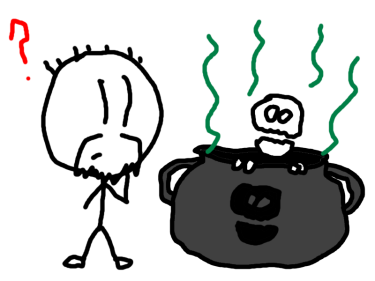
I mentioned a while back that I'd started reading The Chronicles of Prydain by Lloyd Alexander, the series of novels that the Disney movie The Black Cauldron was loosely based on — and which, in turn, the Sierra adventure game The Black Cauldron (my first encounter with the series) was even more loosely based on.

The other night, I finished reading the second book in the series. Much like the best-known book in the Chronicles of Narnia series is the second one (The Lion, The Witch and the Wardrobe), so too, it seems, is the case for The Chronicles of Prydain. Because the second book in the series is the one called The Black Cauldron. But if you're only familiar with the Disney movie or the Sierra game, it's around here that things diverge a bit more wildly.

Y'see, in the Disney movie, the Big Bad of the piece was the Horned King. And he was terrifying. He was terrifying in the 160×200 chunky pixel graphics of the Sierra game and, while I haven't watched the Disney movie yet (though I did acquire it on DVD recently) I am given to understand that he is even more frightening in fully animated form.

But in the actual books — spoiler, I guess, though I'm not apologising for it, given that we're talking about a series from the mid-1960s — The Horned King is offed rather unceremoniously at the end of the first book, The Book of Three, and this is well before protagonist Taran and his buddies have come anywhere even vaguely close to the Black Cauldron itself. As the name suggests, it's not until the second book, The Black Cauldron, that Taran and company set off on a quest to deal with the infernal thing once and for all, and the whole situation is resolved rather differently to how things happen in the movie — and in the game, which is different again.

To be clear, I don't mind these differences at all. If anything, it makes experiencing The Black Cauldron in all its different forms all the more worthwhile. It makes sense for the movie to have a more self-contained story with fewer characters — and for the game to be even more limited in scope. The book has no such constraints, meanwhile, and as such there's a much stronger feeling of "fantasy epic" to the whole thing.

Thus far I've found the whole thing to strike an excellent balance between readability and not treating the reader like a moron. Lloyd Alexander respects the intelligence of his readers, but he doesn't overwhelm them with difficult prose, over-elaborate descriptions or pretentious language. Instead, we get a clear story with some well-crafted characters and some genuine stakes to the action.

I particularly want to highlight his character work. While many of the characters in the series are relatively simplistic — Taran in particular is clearly intended for the young male reader to project himself onto — there are some definite standouts. As mentioned in my previous piece on The Book of Three, I am thoroughly enamoured with the Princess Eilonwy, who takes her place alongside Ce'Nedra from David Eddings' The Belgariad/Malloreon and Lady Mandragorina from Douglas Hill's Talents series as one of my favourite spunky, sassy princesses. She might even be my favourite to date. The girl's got bite, but she also knows when to switch it off and be supportive. Since she and Taran are clearly going to end up together, I'll preemptively say that he's a lucky man.

Anyway, I'm yet to start the third volume of the series — I'll likely kick that off once we're on holiday — but I've been really enjoying it so far. Looking forward to reading the rest, for sure — and, as I've previously said, very sorry and frustrated with myself that I've never read it prior to today!


Want to read my thoughts on various video games, visual novels and other popular culture things? Stop by MoeGamer.net, my site for all things fun where I am generally a lot more cheerful. And if you fancy watching some vids on classic games, drop by my YouTube channel.

If you want this nonsense in your inbox every day, please feel free to subscribe via email. Your email address won't be used for anything else.
#oneaday Day 442: Munchings and crunchings

After listening to Danny from Game Grumps play Sierra's The Black Cauldron game while falling asleep the other evening, I decided that it was high time to do something I've been meaning to do for… probably several decades at this point, which is to actually read Lloyd Alexander's The Chronicles of Prydain, the books The Black Cauldron is based on. (I've still never seen the Disney movie either, for that matter, but I did collect several of the plastic figures you got free in boxes of Corn Flakes back in the day! The Horned King made a great Chaos Sorcerer for Advanced Heroquest.)

Thus far I'm about 75% through The Book of Three, the first in the series, and I am really enjoying it. Really enjoying it. Like, "wish I'd read this much earlier in my life" enjoying it. I'm finding it kind of fascinating quite how differently it is unfolding from The Black Cauldron game — which I'm sure was partly out of technological limitations necessitating a simpler narrative, and partly out of the Disney movie almost certainly diverging from the source material somewhat — but yeah. Really enjoying it.

As someone with a major soft spot for spunky princess characters (see: Mandra from Blade of the Poisoner, Ce'Nedra from The Belgariad/The Malloreon) I am absolutely a thousand per cent in love with Eilonwy, who has some of the most formidable sass I think I've ever seen committed to paper. The fact that she consistently delivers some truly wonderful withering lines at the expense of our protagonist, Taran, while being incredibly well-spoken the whole time is just… ah, man. I live for it. Absolutely live for it.

But anyway, it's entirely possible that you, dear reader, are unfamiliar with either The Black Cauldron of The Chronicles of Prydain in general, so here's the gist.

We join the story in Caer Dallben, a peaceful little farm seemingly in the middle of nowhere, where nothing ever happens — but with a slight air of mystery around it due to the fact its master is a man of nearly four hundred years in age who is in possession of a magical tome known as The Book of Three.

Taran, an orphan boy on the cusp on manhood who helps out around Caer Dallben, is discontent with this simple life, and wishes to know more of the world. After successfully being granted the rank of Assistant Pig-Keeper to the oracular pig Hen Wen — and after having burnt his fingers attempting to consult the magical Book of Three against Dallben's wishes — finds himself forced to set out on a journey when the aforementioned Hen Wen escapes following some grim omens.

The Book of Three follows Taran's journey to track down Hen Wen, during which he encounters several thoroughly interesting companions — including the warrior-prince Gwydion, the subservient and obsequious man-beast Gurgi, the bard-king Fflewdur Fflam and the aforementioned Eilonwy — and learns a lot more of the peril facing the world. The setting's great evil is positioned as Arawn, lord of the lands of the dead, but the more immediate threat is the Horned King, a frightening figure who roams the land in search of conquest — and, it seems, Hen Wen.

For context, The Black Cauldron game has none of this — at least, not in the exact same form. The game opens with Taran feeding Hen Wen, then her having a vision of the Horned King, then Taran being tasked with taking her to a safe haven with the Fair Folk to keep her safe from harm. Along the way, he encounters several of the characters introduced in The Book of Three, but in somewhat different contexts. This doesn't make the game a bad adaptation — as I say, for all I know, it's entirely possible that the Disney movie also played this fast and loose with the narrative, since I haven't seen it — but it is interesting to have all this additional context.

So anyway, yes. I am really enjoying The Chronicles of Prydain so far, and I will be moving straigh on to the other four books in the series once I've finished The Book of Three. Which will be pretty soon at the rate I'm going!


Want to read my thoughts on various video games, visual novels and other popular culture things? Stop by MoeGamer.net, my site for all things fun where I am generally a lot more cheerful. And if you fancy watching some vids on classic games, drop by my YouTube channel.

If you want this nonsense in your inbox every day, please feel free to subscribe via email. Your email address won't be used for anything else.

#oneaday Day 429: Past poisonous pleasures

After finishing Jane Eyre, I find myself pondering what I might want to read next. At the moment I am torn between wanting to keep my sufficiently "Victorian-calibrated" reading mind in practice by reading something else from the 19th century — I have several things in mind, including things that are both new and familiar to me — and wanting to read something simple, straightforward and, let's be honest, dumb.

There's a certain appeal to reading something that is well below your ability level. I'm obviously not talking about regressing to See Spot Run or suchlike, but returning to what tends to be lumped under the all-expansive "YA" (Young Adult) umbrella today offers a compelling prospect. Not only are titles from this particular part of the literary sphere easy to read, they also tend to be short, which, after ploughing through Jane Eyre (which had been formatted incorrectly on Kindle so it only displayed the amount of reading time remaining in the book rather than in your current chapter as it is supposed to) is definitely appealing.

One pair of books I'm actually quite interested to return to is Douglas Hill's Poisoner duology, which consists of Blade of the Poisoner and Master of Fiends. These were probably some of my earliest exposure to fantasy fiction, and I remember absolutely loving them as a kid. Well, more accurately, I loved Blade of the Poisoner; I never had my own copy of Master of Fiends, though I believe my friend Matthew had a copy that I borrowed on more than one occasion. I definitely read it at least once.

Blade of the Poisoner is fairly traditional, unremarkable fantasy with a touch of childish wish-fulfilment in there. The protagonist is a 12 year old boy called Jarral who, in fantasy novel tradition, grew up as a country bumpkin. Through certain misadventures, the details of which I forget, Jarral becomes marked by Prince Mephtik's magic blade; specifically, he gets a big letter "M" carved on his chest, and the nature of Mephtik's blade means that anyone given so much as a scratch with it will die on the next full moon, hence his colloquial name, "The Poisoner". You probably see where this is going.

Blade of the Poisoner does indeed go exactly where you expect it to, but that's what made it appeal to me as a kid. I enjoyed the simple, straightforward fantasy story of good versus evil, and even though I knew things were almost certainly going to be all right for the good guys by the end of proceedings, I still enjoyed reading it. Blade of the Poisoner, I recall, stood quite well by itself, but Master of Fiends was a solid sequel that raised the stakes somewhat.

I also remember being quite taken with the descriptions of the Lady Mandragorina as a kid; from what I recall, she was a pretty young woman around a similar age to Jarral (and me, when I was reading the book) and… well, there was definitely some teenage wish fulfilment going on there. These days, I suspect the formidable figure of Archer may have some appeal for me, from what I remember of her powerful thighs and suchlike.

Sorry, where was I? Oh, right. Yes. I think I might actually re-read Blade of the Poisoner (and possibly Master of Fiends also) if it's available on Kindle (it is!) and see how well it holds up to my old, jaded eyes. And then I'll jump back into some sort of Victoriana. Maybe.

Aside: The cover for the Kindle version sucks. Look at this low-effort photoshoot of a dude in an anorak in someone's back garden:

And compare, if you will, to the cover of the version I grew up with:

Yeah. C'mon. That's more like it.


Want to read my thoughts on various video games, visual novels and other popular culture things? Stop by MoeGamer.net, my site for all things fun where I am generally a lot more cheerful. And if you fancy watching some vids on classic games, drop by my YouTube channel.

If you want this nonsense in your inbox every day, please feel free to subscribe via email. Your email address won't be used for anything else.

#oneaday Day 427: Reader, I married him

I finished reading Jane Eyre last night. I can't quite remember exactly what prompted me to read it again — for it was the third time I've read it in my life, having read it once at school, once at university and a third time now — but I'm glad I did read it. I suspect it was most likely on my mind after playing, writing about and making a video about the rather fabulous adventure game, The Excavation of Hob's Barrow, which is very much steeped in the ideas of "the female Gothic" and particularly that style of literature's distinctive breed of heroine.

But I feel like it was also a bit of a challenge to myself; in recent years, all I've really read in book terms are modern English novels and serialised (translated) light novels that originated in Japan — not that there's anything wrong with either of those, but they're not exactly one might call a challenging read for the most part. And that's fine; sometimes you don't want to have to work to enjoy something.

Going back and reading literature from the past, though, is always interesting. I found with this most recent re-read of Jane Eyre that, as I expected, it took a while to get back into the swing of 19th century English. This is a particularly interesting time for the language when there is a lot that is perfectly recognisable and parsable to a modern audience — we had reached a point where most words were spelled as they are today, for example — but there are a lot of more subtle things, like structural elements, turns of phrase and the way sentences are constructed, which can be challenging to dive headlong into. Take a look at this, for example, which is technically all one sentence:

He was, in short, in his afterdinner mood; more expanded and genial, and also more self-indulgent than the frigid and rigid temper of the morning: still, he looked preciously grim, cushioning his massive head against the swelling back of his chair, and receiving the light of the fire on his granitehewn features, and in his great, dark eyes—for he had great, dark eyes, and very fine eyes, too; not without a certain change in their depths sometimes, which, if it was not softness, reminded you, at least, of that feeling.

(Jane Eyre, Chapter XIV)

I'm willing to bet that, unless you make a habit of reading 19th century literature on the regular, it probably took you a scan or two to read and fully parse that single sentence. There's nothing there that is particularly difficult in and of itself — there are no complex, archaic words to decipher, no random untranslated French phrases (which do occur elsewhere in the book) and not even any particularly complicated concepts to understand — but the sheer number of subordinate clauses, semicolons, colons, dashes and suchlike means that the sentence, as a whole, goes several "layers" deeper into nested punctuation marks than a 21st century copy editor would be altogether comfortable with.

And so it was for me when I started re-reading Jane Eyre. I remember having this struggle when first I beheld it for (I think) A-level English Literature, and being actually quite relieved when it came up early in my university studies, as it was still fairly fresh in my mind, meaning I wouldn't have to go through the whole "calibration" process again. But it had been long enough since those university studies and today that this time around, I did have to recalibrate my mind somewhat — and I wasn't sure I'd be able to do it at first.

But, to my surprise (and delight) it happened a lot quicker than I thought it would. The thing with pre-20th century literature (heck, anything from before the mid-20th century, even) is that you kind of have to bang your head against it repeatedly until it yields enough to let you in. And when it does — because it will, eventually, given sufficient perseverance — you will be rewarded. Because as complicated as that sentence quoted above is, it's also terribly evocative. If you're the sort of person who can derive mental pictures from the words you read — and I'm aware not everyone can do that — then you probably got a pretty strong one from the above description of Mr. Edward Fairfax Rochester.

The thing that makes Jane Eyre particularly enjoyable to me is its first-person narration. You're not just listening to a disinterested narrator explaining what has happened; you are, instead, listening to a participant of the story recount and reflect on the things that happened to them. I've always been rather drawn to first-person narratives — many of my own prior creative works are written in first-person — and I suspect that Jane Eyre was one of several influences on me in that regard. For me, a first-person narrative style really allows you to get to know the protagonist of the work; it's why I resonate so well with Japanese visual novels and light novels today, I think, which are also typically written from the first-person. It gives you the sense of separation that you are not the star of the story — this is a contrast between visual novels and traditional adventure games, for example, as the latter use second-person narration — but also allows you a particularly intimate relationship with the protagonist; one that even the protagonist's closest confidantes in the narrative itself don't enjoy, in many cases.

For example, consider the relationship between Jane and Rochester in Jane Eyre. Many of their interactions between one another take the form of verbal sparring, with Jane's sharp wit matched by Rochester's sarcasm; both spend a significant portion of the novel trying to get the full measure of the other, with each concealing their true feelings for reasons that are their own. If this were presented from a disinterested outsider's perspective, we might not get the same understanding of the situation, as to someone who doesn't know at least part of what is going on, their interactions might look like genuine snippiness with one another.

In the case of us, the audience, we only get to learn the absolute truth of Jane's take on the situation, which is that part of her wants to keep Rochester at arm's length because she senses a certain degree of danger from him (which, it turns out, is not entirely unjustified) but also because she detects he enjoys their repartee. We later, of course, learn from Rochester himself that he has been playing his own little game with Jane — with certain members of high society forming his playing pieces — but without Jane's suspicions about the situation or Rochester's eventual admission, it would have been very easy to misinterpret everything.

It's interesting to contemplate the book's viewpoints on certain matters, given how society has changed since the time it was written. Jane Eyre is often cited as one of the first great feminist works, for example, and it's not hard to see why. Jane herself is a powerful figure who is, for the most part, in control of her own destiny; she learns and grows stronger from hardships and adversity, and it's only at one point in the narrative — where she flees Thornfield Hall after learning of Rochester's mad wife in the attic, then accidentally leaves her meagre worldly possessions in a coach before getting stranded on the Moors in the middle of nowhere — that we ever see her display what one might call "weakness". Even during that time, however, she's shown to have a good head on her shoulders, and makes some wise decisions that ultimately pay off, despite the indignity of collapsing on a stranger's doorstep.

The book is surprisingly scathing about religion — a fact which caused some critics to baulk at it on its original release — but it makes a solid argument. The figure of St. John Rivers, a character from the latter part of the narrative, presents an interesting challenge for Jane; up until now, she has attempted to live her life in a good, Christian sort of way, but St. John shows that one can perhaps take things in that regard a little too far — particularly once he starts proposing a loveless marriage to Jane (who, we have learned by this point, is actually his cousin) on the grounds that she would "make a good missionary's wife". Jane is having none of that shit, of course, and tells him so; even so, the fact that she does start to wonder if she might be coming around to his way of thinking by one point presents a surprisingly potent exploration of how abusive relationships work, because this crack in her resolve is the result of St. John's unrelenting dickishness towards her after her initial rejection of him. St. John is a cunt and I'm glad he died alone in India. There, I said it.

Anyway, yeah. Jane Eyre was a good read. This is, of course, something of an understatement given what a classic work of literature it is considered to be — and how it ranks highly in various "greatest books of all time" polls — but I think it's easy to forget that pre-20th century literature can just be "enjoyable" as well as "great" and "important".

I certainly enjoyed re-reading Jane Eyre. Now I have to determine whether to continue riding this wave of enthusiasm for classic literature, given that my brain has been successfully recalibrated for 19th century prose, or if I should read something for a bit of light relief. I haven't quite decided yet, but I will definitely be making more time for reading.


Want to read my thoughts on various video games, visual novels and other popular culture things? Stop by MoeGamer.net, my site for all things fun where I am generally a lot more cheerful. And if you fancy watching some vids on classic games, drop by my YouTube channel.

If you want this nonsense in your inbox every day, please feel free to subscribe via email. Your email address won't be used for anything else.

#oneaday Day 332: From the brain to the page

I've been feeling kind of in the mood to do a bit of creative writing recently. I have not yet actually acted on this impulse, because I haven't yet decided what the optimal means of doing it is. Longtime readers may recall that I did not-NaNoWriMo (before NaNoWriMo became a dirty word) a few times on this very site, using my daily #oneaday posts to compose a story 1,000+ words or so at a time. If, for whatever reason, you're interested in reading those, you can find them with their first chapters starting at the following links:

  • Wasteland Diaries, a post-apocalyptic tale I inexplicably decided to write as someone who isn't the biggest fan of post-apocalyptic settings.
  • Untitled, a story I don't remember writing and can't remember anything about. I'm going to have to re-read this one, I think.
  • Special Measures, a novel about a teacher in a struggling school. (There's even an Actual Book version of this, though I did it through Blurb before I found out about their absurd shipping costs. You're welcome to buy a copy though.)
  • Unfinished, an unfinished project.

There are also a few other bits and pieces here and there, such as an extremely short-lived "collection" of two short stories about a school (number 1 here, number 2 here), and another extremely short-lived collection of short stories based around the themes of "beginnings and endings" starting here. And probably some other stuff I've forgotten. Like this!

I think I just want to "write a story" again. It's something that used to bring me great joy when I was younger, particularly when I was at school — I was notorious among my English teachers for creative writing projects that were several orders of magnitude longer than anyone else in my cohort — and I feel like it's one of those things that is probably good "therapy" of sorts, too.

The thing I'm umming and ahhing over is whether I should start a new site specifically for the creative writing stuff, or if I should just do what I've done previously and host it here. My concern if I host it here is that I'll lose it, or forget about it, such as what has apparently happened with Untitled, above. But then at the same time it's nice to dive back into the archives sometimes and stumble across something like that. So perhaps I will just host it here, and maybe make a bit more of an effort with the menus to make accessing things like those past stories a bit more straightforward.

Okay, then it's settled. Maybe. I will start Writing Stories again. Whether these stories will form part of my #oneaday efforts or be something completely separate I haven't yet decided. But creativity will happen. Oh yes, it will happen. You just wait. And without even a whiff of generative AI bullshit, because generative AI, particularly anyone attempting to make out that using it is somehow "creative", can eat my entire ass.

Now to ponder what I might want to write about, I guess!


Want to read my thoughts on various video games, visual novels and other popular culture things? Stop by MoeGamer.net, my site for all things fun where I am generally a lot more cheerful. And if you fancy watching some vids on classic games, drop by my YouTube channel.

If you want this nonsense in your inbox every day, please feel free to subscribe via email. Your email address won't be used for anything else.