#oneaday Day 551: Mobile gaming is perceived as a "world of predatory monetisation and low quality" because that's what it is

A recent article on Gamesindustry.biz drew attention to a LinkedIn (ugh) post from one Christian Lövstedt, CEO of a company called Midjiwan AB, who is complaining that people don't take mobile gaming seriously.

Midjiwan AB, if you were curious, apparently make a mobile game called The Battle of Polytopia, which I've never heard of, which I suspect is at least partly what this is all about. In fairness to all the following, The Battle of Polytopia does not look all that bad… but I'd still rather play a game like that anywhere other than my phone. But I digress before we've even begun, so let's get back on track.

"Mobile gaming is one of the most played and most profitable platforms in gaming," Lövstedt says, "currently representing 55% of the global gaming market, but is often ignored and looked down on [because] it is perceived by too many as a world of predatory monetisation and low quality."

Okay. Let's start with this. People love to trot out that "over 55% of the market" figure (with variations on the exact figure quoted) but let's be real about this: the reason why mobile accounts for so much revenue in the global games market is precisely because it is a world of predatory monetisation and low quality.

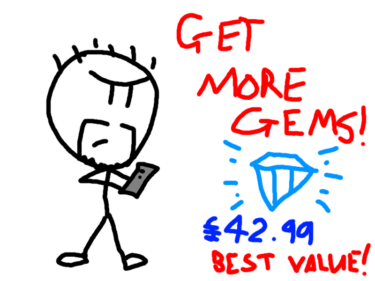
Consider some of the most popular mobile games out there. Candy Crush Saga, which charges up to £34.99 for cheats that allow you to bypass levels — coupled with design that makes it near-impossible to win without buying these cheats. Gacha games such as Azur Lane, Granblue Fantasy and Fate/Grand Order, which exploit horny young people (particularly, though not exclusively, men) with attractive JPGs of hot anime characters, necessitating that you pay at least £20 at a time to be in with a reasonable chance of actually getting the character you want. And I'm pretty sure there are still plenty of "tap and wait" games out there that ask you to pay up to make things go faster or be able to simply play the game more.

When you consider that the term "whale" was coined to describe those who spend excessive amounts of money on free-to-play games, particularly in the social and mobile spaces — and that pursuing these whales to exploit them (at the expense of providing a good experience to free players) is a primary goal of the developers of these popular games — you will perhaps start to see exactly why mobile accounts for so much of the "market". It's because one user playing one heavily monetised mobile game will account for considerably more revenue than one user playing one pay-once-play-forever premium game on PC or console.

Games like this, you see, don't just ask you to buy them and are then happy with that. No; the most "successful" mobile games — measured by most folks who complain about mobile not getting its dues as the ones that generate the most revenue — are the ones that provide the opportunity for perpetual monetisation: the ones that entrap players into dark patterns that make them feel like they have to continually pay money into the game, month after month, in order to remain "relevant" and "current".

When you start from there, it's understandable why people see mobile gaming as rife with predatory monetisation and low-quality games. But let's look at the rest of this open letter.

"While some amazing mobile-first titles, like Monument Valley, manage to get the industry's attention," Lövstedt continues, "many other extremely popular and successful titles do not."

Monument Valley came out in 2014. That's over ten years ago! If you can't think of a more recent example than that of Doing It Right, I think we may have found the problem!

But he continues:

"Mobile games like Clash of Clans, Temple Run, Crossy Road and Candy Crush Saga are critically and commercially successful, yet are never or rarely acknowledged at game awards."

Perhaps that's because Clash of Clans, Temple Run and Candy Crush Saga are all prime examples of games with predatory monetisation and low quality? I actually don't know about Crossy Road, so I am willing to take a moment to actually research it before I brand it with the same scarlet letter. Give me a moment.


Tangent: Pete tries Crossy Road

"Contains ads. Contains in-app purchases". We're not off to a good start already. But let's download this and see.

After an initial tutorial, during which the simple tap-and-swipe, Frogger-inspired gameplay is introduced, I am given a "free gift" of in-game currency and then immediately invited to "win a prize". It costs the 100G of in-game currency I was just "gifted" to draw from a virtual gacha machine, which awards me with a mallard duck avatar to play in the game instead of the default chicken.
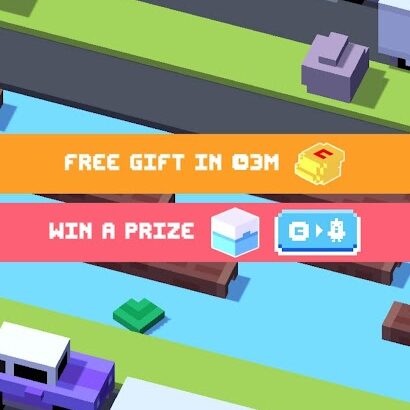
I am then taken to a main menu screen where I get an immediate popup about a new time-limited game mode and "sweet sales in the store". I'm then taken into that mode without having asked to play it. After playing it briefly, I am shown my top score with two non-descript icons, the purposes of which are not made entirely clear. It seems the one that the eye is most immediately drawn to — i.e. the one where you'd expect an "OK" button to be in typical UI design — is a "share" function for you to send a screenshot of your concluded run to any of your phone's connected social services or contacts.

After that, I am given a timer countdown to my next "free gift" and informed how many "G" of in-game currency there is "to go" until my next blind box of whatever the fuck you unlock in this game.

To Crossy Road's credit, it has no play-throttling energy system, no paying to bypass timers and it does have a one-off payment of £7.99 to remove all ads (if you're not already blocking them), but it also sells extra game modes, has "limited time sales" on special characters and sells a power-up to double your in-game currency income. And you can bet that it gets regular "content updates" to ensure there are always new things for people to pay for.

But it's just not very fun, the countdown timers and grind for currency make it feel more like work than play, and the "business" part of it being so front and centre is exactly why people don't take it as seriously as premium, pay-once games for PC and consoles.

So in conclusion to that little bit, while Crossy Road isn't as egregious as the other examples cited, it's still not… great. And certainly not the sort of thing that is in any way deserving of an award.


"Just because [low-quality] games [with predatory monetisation] like that do exist in the mobile market, it should not diminish the achievements of the market's best games," Lövstedt continues. "It perhaps makes them more impressive. And if we're honest with ourselves, there are AAA industry darlings crammed with the same monetisation mechanics."

Two things to pick out here: firstly, outside of the aforementioned Monument Valley (which, again, is eleven years old at this point), he cites no specific examples. And yes! Yes, triple-A does pull all this shit, too! And you know what? People hate it there, too!

"D.I.C.E., one of the better award bodies for acknowledging mobile gaming, has only ever nominated a mobile game for Game of the Year twice," he continues. "Angry Birds HD and Pokémon Go. And they were the only dedicated game awards body to nominate them, despite how commercially and culturally impactful both games are."

Okay. I have to look into this. Bear with me.


Tangent: Pete looks into the D.I.C.E. Awards

Angry Birds HD was nominated for Game of the Year in 2011 alongside Mass Effect 2 (which won), Call of Duty: Black Ops, God of War III and Red Dead Redemption. Honestly, the fact that it was even nominated is borderline laughable, because Angry Birds is not a particularly amazing video game. It's fine for what it is, but in 2011 people were still feeling the novelty of playing games on a tablet — the iPad first launched in 2010 — and the calibre of the other games that were nominated is just in a completely different league. What Lövstedt doesn't mention is that Angry Birds HD did win a D.I.C.E. Award that year — for Casual Game of the Year. Which is absolutely fair, although given it was up against Pac-Man Championship Edition DX, Plants vs. Zombies and Bejeweled 3, it wouldn't be my vote. (And I don't even like Plants vs. Zombies.)

Pokémon Go, meanwhile, was up for the 2017 Game of the Year award, where it was up against Overwatch (which won), Battlefield 1, INSIDE and Uncharted 4. My personal tastes put that as a much weaker overall lineup than that of 2011, but there's still a world of difference between gamifying Google Maps and the cultural phenomenon that was Overwatch in its first year. And, again, Pokémon Go won a perfectly acceptable award for what it is: Mobile Game of the Year.

Lövstedt is right; Pokémon Go in particular did have a certain amount of cultural impact, particularly as we moved into the pandemic years. But, again, it's just not a very good video game, which is why it lost out on the overall Game of the Year award. "A lot of people played this because they were bored" is not the same as "this is an incredible video game that should be celebrated as the pinnacle of its medium".


In conclusion, then, I have to reiterate that mobile gaming's reputation as being filled with low-quality games with predatory monetisation is well-earned. This isn't to deny that there are developers apparently doing interesting things on mobile — Lövstedt's own The Battle of Polytopia looks quite worthwhile, so I might have to actually give it a go — but at this point, the damage done by Apple introducing in-app purchases (and Google following suit) has already been done. There's no easy way to turn that back; no easy way to reclaim mobile gaming's reputation from those who, thanks to their greed, generate enough income to account for a supposed 55% of the global games industry's revenue.

Because what are Apple, Google and the other app store platform holders going to do? Just suddenly give up such a profitable revenue stream? Because let's not forget they get a cut of every purchase, so it is absolutely not in their interests to try and fix this.

Also, playing games on a touchscreen — particularly on small ones like those found on phones — sucks ass. This, honestly, is one of the biggest reasons I have zero desire to play any games on my phone today — even if they weren't low-quality games with predatory monetisation. Which a significant portion of them are, so I have precisely zero incentive to look any deeper — particularly because the vast majority of those which are cited as "good examples" (including the aforementioned Monument Valley, plus titles like Stardew Valley and Vampire Survivors) are available on platforms with control schemes that don't suck!

So in summary: if you want to be taken seriously, release your game on a platform that people will take seriously. Have you seen the shit they let onto Steam these days, recent examples notwithstanding…?


Want to read my thoughts on various video games, visual novels and other popular culture things? Stop by MoeGamer.net, my site for all things fun where I am generally a lot more cheerful. And if you fancy watching some vids on classic games, drop by my YouTube channel.

If you want this nonsense in your inbox every day, please feel free to subscribe via email. Your email address won't be used for anything else.
#oneaday, Day 881: Vita Killed Mobile Gaming for Me

20120618-003330.jpg

I wanted to expand on a few things I talked about in my Vita post yesterday, specifically with regard to the differences between mobile (i.e. smartphone/tablet) and handheld (i.e. dedicated game-playing system) gaming.

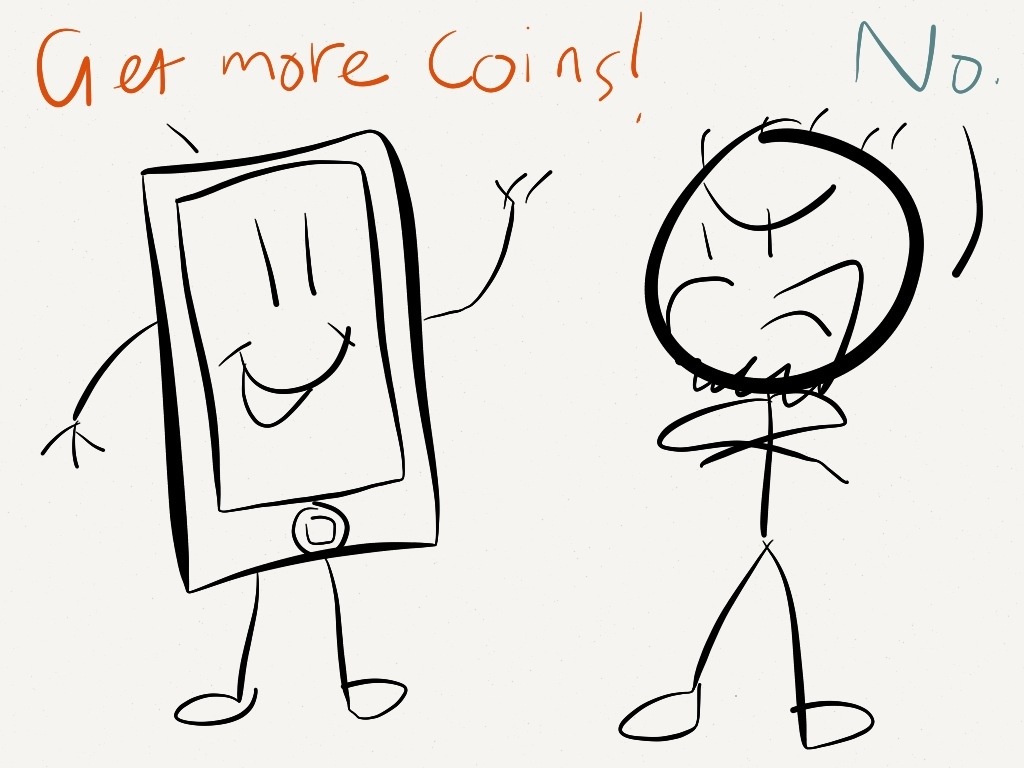
A single day with the Vita has been utterly refreshing. I've played a number of games on the system, including Everybody's Golf, Lumines Electronic Symphony, PS mini Velocity, Frobisher Says! and a couple of augmented-reality titles. Frobisher and the AR titles were free, Velocity was about 3 quid (PS minis are Sony's "app-tier" games — in fact, many iOS and Android games are ported to the PS minis catalogue) and the other two are "full-price" titles (though Everybody's Golf currently sells for a very reasonable 8 quid on PSN right now). In every instance, I was able to start up these games and enjoy them without being nagged to buy additional content or "Get More Coins!" even once. There were no exhortations to share things on Facebook or Twitter (though PSN can automatically share Trophies to Facebook) and no demands on the player that detracted unnecessarily from the immersion factor of the games in question.

This was the most striking thing about the whole experience. It's practically a given that a mobile phone game will have some form of "Pay To Win" button these days, usually in the form of the ability to purchase in-game money, items or even experience points using real currency. These are usually positioned as "timesavers", preventing players from having to "grind" to earn these things in the first place, though the fact is that the games themselves are very often designed in such a way that grinding (or paying) is necessary to progress. The game is designed to fit the business model, in other words.

Now, let's look at Everybody's Golf as a case study here. In Everybody's Golf, you earn points through play. Skilful shots, sinking the ball under par and winning tournaments nets you varying amounts of these points, which can be used as a cumulative expression of your skill and the currency through which you unlock additional content in the game — characters, costumes, equipment, courses and other bits and bobs. In other words, the better you are at the game, the more quickly you can progress at unlocking stuff. This is a simple "carrot and stick" approach, but it provides a powerful motivation for the player to actually work hard to improve their game — particularly when coming up against an apparently-notorious difficulty spike partway through the single-player component of the game. If the player was simply able to drop a few quid on purchasing additional points (which, thankfully, is not an option), all meaning of the content they acquired using these points would be lost. The unlocked characters, the new costumes, the new equipment — none of it would be a trophy of the player's achievements any more. Instead, it would simply be something that the player had thrown money at. Not only that, but the player's cumulative score would cease to be an accurate depiction of their skill and play time. It would simply become just another meaningless currency — one with an exchange rate with real-world money.

This might not sound like a massive issue but the difference is profound. When playing a mobile phone game, the near-constant presence of "shop" buttons or "Get More Coins" interface elements makes it abundantly clear to the player that they are making use of a service rather than enjoying a creative work for art's sake. That questioning feeling — "am I being screwed while I play for free? Should I pay for some coins?" — is ever-present in the player's mind. In the most egregious cases, developers even make the "cash shop" option glow or flash on screen to deliberately distract the player and draw their eye to it. (This happens in free-to-play PC titles, too.)

Now, I will point out at this juncture that I am not condemning this business practice as "wrong" necessarily — when you release your game for free or a ridiculously low price on the App Store or Google Play, you need to take steps to ensure that you at very least break even. Rather, I am saying that it has had a significantly negative impact on my personal enjoyment of mobile games of late. I find a game which doesn't ask me for more money after installing to be a pleasant surprise these days, rather than the norm. It wears you down after a while, particularly when you play as many iOS and Android games as I do — it is, after all, my job — and when I sit down to play a game just for fun, I simply don't want to be bugged by the "business" side of things.

Everyone plays games for different reasons. Some play games as simple timewasters while they're in a boring meeting, sitting on the toilet or waiting for a bus. Others use them as a high-tech equivalent of fiddling with a pencil. Others still want to compete against their friends, or express their creativity, or as a social outlet, or… you get the idea. There are probably as many reasons as there are people.

I play games purely for enjoyment and entertainment, usually in substantial, continuous sessions. Games are my primary form of recreation — where some people watch movies or TV, I play games. As such, in most cases, I'm not in it for a few seconds at a time — I'm there for an hour or more at once. During that time, I want to be immersed in the game experience without interruptions, particularly if I'm playing a story-heavy game. I do not want to be reminded that I'm playing a game if at all possible — unless it's built in to the experience in an entertaining, self-aware sort of way — and I certainly do not want to be reminded that making games is big business. I know this. I read all about it most days. I do not need to be reminded of it during play. Because there is nothing more immersion-breaking for me than exhortations to "Share this with your friends! Buy more coins now! Play again tomorrow for bigger daily rewards! Try our other games!" Even popups demanding that I rate an app 5 stars "now" or "later" have a negative impact on my enjoyment of a title.

This is where the Vita has provided the most pleasant surprises of all for me. Across everything I have played, I have been left alone to simply enjoy the game for what it is. In some cases, where competition is an inherent part of the game (like in Lumines), I am informed of my friends' high scores, but I'm not invited to brag to them. I'm certainly not confronted with half-finished games sporting interface elements that just say "Coming Soon!" and big flashing buttons to "Add Cash". It's been a blessed relief.

Couple that with the fact that the Vita games I've played so far are all deeper experiences designed to be played for longer periods at a time rather than five-minute timewasters, and a lot of the anxiety-inducing sense of ADHD that the diversity of mobile gaming offers is gone. I had to give up playing asynchronous iPhone games with friends because I found that keeping up with them was genuinely stressful. It felt like work, and it wasn't fun any more, so I stopped. I am sorry to any former Draw Something or Hero Academy players, but once something stops being fun, there's no point dragging it out unnecessarily.

All this may be painting an unnecessarily negative view of mobile gaming, but that's not the case at all — this is purely a personal response with regard how I want to spend my own free time. These ADHD games have a place and a massive audience — much larger than the audience the Vita currently boasts, as it happens. There's a lot of money to be made through "cash shops" and "get coins" buttons, so I can't blame publishers and developers for wanting to capitalise on this, whatever my own personal opinions on the matter.

Alongside this, there are some genuinely good games on iOS and Android that don't fall into these excessive monetisation traps — though interestingly, even Epic's Infinity Blade, one of the most impressive and supposedly "hardcore" games on iOS, now boasts the facility to purchase in-game currency with real cash, as do otherwise-excellent titles like Hunters 2. Equally, some free-to-play games — like the excellent Pocket Planes I talked about a couple of days ago — leave the decision of whether or not to pay entirely in the player's hands, and are generous enough to make the game perfectly playable to those who do wish to play for free.

A single day with the Vita, though, has been enough to convince me that dedicated handheld gaming most certainly still has a place, and I'm more than happy for it to be a part of my life. I can see myself leaving the vast majority of iOS gaming behind — board game adaptations and Pocket Planes (until it gets boring) excepted — in favour of the deeper, more rewarding, less skeezy-feeling experiences that Vita titles offer.

And let's not even get started on how fucking nice it is to have buttons again. Or how nice it is to have an online store that is not filled with endless regurgitations of the same FarmVille formula with zombies/fantasy kingdoms/monsters/pets attached. Or… I could go on. But I won't.

#oneaday Day 879: Flying Away

20120616-014758.jpg

Having gone off on one somewhat about the fetid pile of toss that is Rage of Bahamut yesterday, it's only fair for balance's sake to talk about a free-to-play game that is well-designed, player-friendly and actually rather fun.

I am referring to Pocket Planes, the newest game from Nimblebit, developers of the astronomically popular Tiny Tower, a game which made "tap, tap, tap" gamers out of even the most jaded hardcore members of the games industry.

Tiny Tower, as most people realised after varying amounts of time, was little more than a mindless busywork generator, as RedSwirl over the on Squadron of Shame Squawkbox puts it. You built floors, you attracted people, you stocked up your floors with stuff that made money, you went away, you waited for your phone to shout at you that something needed restocking, you tapped on it to restock it and repeated the entire process for more hours than you really should until you either keeled over dead or got bored.

Tiny Tower, then, had very little in the way of strategy and certainly wasn't a modern-day SimTower, as some referred to it on its original launch. It was an interesting little timewaster with an adorable pixel-art aesthetic, however, and crucially, it allowed the player to make progress without battering them over the head to invite friends, share achievements or purchase things with real money every five minutes. The game featured a premium "hard currency" that allowed you to do things quicker or rapidly acquire more cash, but it was handed out fairly generously just through play, so those who wanted to play for free could.

Pocket Planes builds on this formula and puts a more complex game atop it. There's still not a huge amount of depth there, but it's definitely more than simple busywork now.

In Pocket Planes, you run an airline company, and your goal is to own all the airports in the world. (This alone distinguishes the game from Tiny Tower, which had no long-term goal besides "build a fucking huge tower") You begin the game in one of several regions around the globe with a small fleet of rather crap planes and a desire to make money. Fortunately, there are plenty of jobs waiting for you that want to give you money, so getting started is a simple matter of loading up your planes with passengers, cargo or both (depending on what type of plane it is) and setting them on their merry way.

It's here that an element of very light strategy comes into play. Sending your planes off costs money, and you don't receive payments for flights until they're completed. To be efficient, you might want to try and hit several stops in a single run, but when doing so you need to note whether there's a big enough profit margin to make it worthwhile. Sometimes leaving passengers behind rather than fully loading is more profitable, and scoring a jackpot of customers who are all going to the same place nets a 25% bonus on the income attained.

That's it for the basics of gameplay. Beyond that, once you've earned enough money you can purchase new airports, which allow your flights to go further afield and also provide you with plane parts which can be subsequently assembled into new members of your fleet, assuming you have space for them. Old, crap planes can be retired to make room if you don't have the capital to expand your fleet's maximum size, or you can simply try to get as many aircraft in the air as possible. Plane parts and complete planes can also be purchased through the Market page, which restocks with a random selection of items every few minutes, and parts can also be traded with friends for a small fee.

Like Tiny Tower, a lot of these actions use the game's "hard currency", or "Bux" as they are known, but again like its predecessor, Pocket Planes is generous about handing these valuable commodities out through play. If anything, Pocket Planes is more generous than Tiny Tower, rewarding the player with Bux simply for completing certain jobs, levelling up and various other actions. Sometimes they even just float past the planes in flight, to be collected with a simple tap.

Pocket Planes also includes an interesting social mechanic in the form of its "Flight Crew" system. By simply typing in the same crew tag as other airline tycoons, players can team up in an attempt to complete as many jobs in special global events as possible, with flight crews ranked on a worldwide leaderboard and prizes awarded when the time expires. You can also see how you stack up to the rest of your crew and figure out who needs to pull their weight more — though those players who join your crew but aren't on your Game Center friends list simply show up as anonymous benefactors, which is a shame.

The interesting thing with Pocket Planes' social mechanics is that it assumes the player already knows how to socialise. There are no screen-filling exhortations to share achievements with friends; no "friend gating", where progress becomes impossible unless you have a certain number of friends playing; no demands that you "visit" friends and "help" them. In fact, the game's social mechanics are kept pleasingly minimalist — most screens offer the facility to tweet a screenshot using iOS 5's built-in Twitter functionality, but in the case of Flight Crews and the like, it's up to the player to encourage their friends and acquaintances to join in the fun however they see fit rather than spamming them in-game. This is a Good Thing.

Pocket Planes is, at heart, a simplistic game with very little substance, but it offers the same sort of idle satisfaction that Tiny Tower did with a bit more sense of structure. It will undoubtedly be another big success for Nimblebit and fair play to them for that — their recent games are proof that you can adopt a free-to-play business model without being jerks about it. The goodwill that builds will likely encourage many more people who wouldn't think to purchase virtual goods otherwise to dip into their pockets purely to show the developer their support.

Pocket Planes is out now for iOS. An Android version is following in the near future, but a release date hasn't been announced yet.

#oneaday Day 734: Pay Attention

20120123-000024.jpg

Since getting an iPad a few short days ago it's become more clear to me than ever that if you are ignoring the iOS platform on the grounds that it's "just mobile games", then you are Doing It Very Wrong.

Let's face some home truths first of all, however. Traditional control schemes suck on touchscreens. The lack of tactile feedback is the main thing — you can't feel those buttons under your fingers, so it's all too easy to drift away from them, particularly if they're of the breed that are fixed in place. Alongside that, your thumbs blocking part of the play area isn't a great look, particularly on the small screen of the iPhone and iPod touch.

That is the main issue with iOS gaming, but also a blessing in disguise.

The fact that traditional control schemes sucking is such a well-established fact by now means that iOS developers are forced into making some important decisions when creating their games. Do they remain steadfast and shoehorn in a virtual joypad control method? Do they support external controllers such as the iCade and make the assumption that anyone serious about playing that kind of game on iOS will already own one? Or do they throw conventional thinking about what makes a good portable game out of the window?

It's the latter option that leads to the most interesting experiences, and it tends to lead in one of two directions. The first direction leads to the explosion in new styles of gameplay we've had since gaming really started to take off on the platform. Granted, some of these existed in the form of independent and Flash games prior to iOS' emergence, but Apple's platforms have very much brought them to the masses. Physics-based puzzlers. Line-drawing games. Match-3 puzzlers. "One-touch" games. All of these provide simple mechanics that are surprisingly versatile. In the case of the line-drawing genre, for example, go play Flight Control, DrawRace 2 and Heroes vs Monsters and tell me that isn't an incredibly versatile control scheme.

The second direction is in the resurgence of genres which have lain all but dormant everywhere except the independent PC game development community for many years. Turn based strategy titles. Board game adaptations. First person flick-scrolling dungeon crawlers. Deep, hardcore roleplaying games. Roguelikes. All have made something of a comeback on iOS, and it's no coincidence that these games provide some of the most satisfying experiences on the platform. It's also these titles which provide the strongest, most compelling evidence that yes, you do get "proper" games on iOS, and there's no reason to believe that you're getting a "lesser" experience than what you would get from a console, except perhaps from some diminished graphical quality — and even then, that gap is rapidly closing.

iOS does also bring with it its share of controversial topics. The monetization of games in particular. It's not unusual these days for games to have the option to purchase in-game currency or even skip out parts of the game altogether. I'm not a big fan of this practice, but if done correctly, it can actually have several benefits for both consumer and developer alike.

Firstly, it allows the game itself to be released at a far cheaper price point than you'd ever see it on 3DS or Vita. I bought a racing game today for 69p. It has impressive graphics, fun gameplay and is certainly on a par with the PSP version of Burnout in terms of depth. 69p. You can't even buy a cup of coffee for that anywhere, yet here I am paying it for a game that would have been at least thirty quid a few years back. And how can it afford to do that? Because of the few people out there who value their time more than their money and would rather unlock content in the game quickly through dropping a few pounds on it rather than playing through it normally — which, I hasten to add, is very much still an option.

The downside to above is that it has affected the perceived value of these games. If you paid 69p for a game — or even got it for free in some cases — are you more or less likely to play it through to completion? I'm guessing "less", because if you're anything like me, that feeling of "I just spent forty quid on this, I'd better bloody play it" just isn't there. This factor is actually mitigated somewhat by the titles that are considered "expensive" on the platform — look at Square Enix's £10 RPGs, for example, or £5 titles like Infinity Blade and Galaxy On Fire. £5-10 is considered "expensive" for an iOS title so people are more likely to think before they buy, and by extension take a bit more time to play through these less "disposable" titles.

I think by far the greatest thing about the platform, however, is how there's something to appeal to pretty much everyone. In my circles of family and friends, there are kids and grandparents who like playing Angry Birds; hardcore strategy gamers who like deep, complex mechanics; commuters who appreciate having something quick and low-maintenance to play on said commute; hardcore gamers who crave the depth of a console or PC title in a format they can carry around with them; people who don't have time to immerse themselves in the sprawling experiences that are today's interactive entertainment titles but appreciate the opportunity to play a quick game of Words, Scramble or Hero Academy with friends. All of them are catered to, and there's a bunch of crossover between the groups too. That's amazingly awesome, and it's probably done more to help the image of gaming in the mainstream audience than any other technological innovation we've had over the years.

So in summary, then, if you arestill of the belief that iOS as a platform isn't important to the games industry and games culture at large, I say again: you are Doing It Wrong.

#oneaday Day 697: The Sims FreePlay

I was harsh on EA the other day, and I stand by most of my comments. Theme Park is a disgrace to the memory of Bullfrog's classic, the handling of Tetris was ridiculous, Origin is still a load of old wank and the company's insistence on using it rather than established networks like Game Center and OpenFeint is just plain arrogant.

However, they have got one thing right recently, and that's their latest iOS release: newest entry in the The Sims family The Sims FreePlay.

The Sims has been undergoing quite a few changes over recent years. First The Sims 3 brought open-world gameplay to the series. Then the World Adventures expansion gave the game a (very light) sense of narrative and some dungeon-crawling, puzzle-solving gameplay. Then Ambitions allowed us to follow our Sims to work for the first time in quite a while. Late Night brought new social interactions, Generations fleshed out the gameplay of various underused life stages and Pets brought, err, pets.

Meanwhile The Sims Social launched on Facebook and proved enormously popular despite not actually being that good. The Farmville-esque mechanics of "get your friends to help" seemed somehow more appropriate in the setting of The Sims, however, and there was a very, very mild hint of asynchronous multiplayer as you occasionally saw what your friends had done while they visited you the last time they were playing. I saw many people who didn't typically try Facebook games giving The Sims Social more of a chance than they would normally. Ultimately, though, it was an exercise in extracting as much money from you as possible, with a wide variety of in-game items only purchasable through the premium hard currency of SimCash. It also uses the immensely irritating (but profitable) "pay to play" system of slowly-recharging "Energy", only allowing you to perform a certain number of actions in a set time period.

Yesterday, The Sims FreePlay launched for iOS devices. There have been several previous The Sims 3-branded iOS games, but none of them have been that good, somehow missing out on the magic of the PC originals, much like The Sims Social. The Sims FreePlay takes a radically different approach to the whole series, however, and one which fits ideally with an iOS player's lifestyle.

There's one simple, fundamental change which has occurred to make this possible: make it real-time.

The Sims has typically operated with vastly accelerated time, so we can witness their birth, growth, life and death over the course of a few days rather than a lifetime. And in gameplay terms, this has fit the series well — part of the appeal of The Sims 3 in particular is building a dynasty of Sims who have grown to dominate the town in which they live. If you had to live out their lives in real-time, this would lead to a lot of downtime.

However, think about when you pick up your phone. You do it during a lull in conversation, when you're on the toilet, when you're bored, while you're watching a TV programme that you're not really interested in but your significant other wants to watch. The Sims FreePlay is designed for these situations. Pick it up and there'll be something to do for a few minutes, whether that's collecting money from your Sims, sending them to work, forcing them into a party situation or gathering them all together for a collaborative gardening effort. Once they're busy doing whatever you've told them to, you can leave them to it — for hours at a time, in many cases.

The game experience is tied to a social game-style levelling system, but this isn't a social game. There's no visiting neighbours, no helping friends with quests (which begs the question why it requires an Internet connection to play, but we'll leave that aside for the moment), no Energy system — just you and your Sims. Or, specifically, when you start, your Sim. Singular.

When you start the game, your town will be empty aside from the Sim you created. As you complete tasks and get your little person to engage in activities, however, you gain XP. The longer an action takes, the more XP you get. As you level up, you unlock the right to have more Sims in your town — though bringing them in either costs Simoleons (money) to build the house, or Lifestyle Points (earned through completing goals, reaching "relationship milestones" and numerous other criteria) to build a prefabricated "theme" home. Both of these currencies can be purchased with real money if you desire, but, crucially, you're not nagged to do so (unlike in Theme Park, which gives you a quest teaching you how to purchase premium currency — shameless much?) and you can earn both through normal play if you're patient enough. If you're determined to play for free, you're going to have to think carefully about your time management and what you want your slowly-expanding army of Sims to accomplish, because once they start a task, it can't be stopped except by expending your finite supply of Lifestyle Points to "rush" finishing it.

This actually adds an interesting degree of light strategy to the gameplay. If one of your Sims has a large variety of garden plots that could potentially prove profitable, you're going to need to enlist the other Sims in the neighbourhood to help out, because one Sim can only plant and tend one plot at a time, and needs to be present for the entire period of the seed's growth — up to 24 real hours in some cases. This means if you have a garden with, say, five plots, you'll need five Sims to be able to take full advantage of it — and while they're doing that, they can't be doing anything else. It becomes an exercise in weighing up whether it's worth committing a Sim to a lengthy and potentially profitable project, or whether you'd rather take a more active role in their life and guide them through a number of smaller tasks. Do you send them to work for six hours, thereby guaranteeing a nice paycheck, prospects for promotion (leading to more money in the future) and the ever-important XP? Or do you leave them behind looking after their house?

This shift in focus away from managing the needs of an individual Sim (or family) to overseeing the entire community works well for the series. It's a markedly different experience from, say, The Sims 3 — but we already have The Sims 3 so why reinvent the wheel? What we have in The Sims FreePlay is a game you can pick up for a couple of minutes at a time, set your little people off doing something and then safely forget about until a Push notification pops up reminding you that Pete Davison has finished his bath. In this sense, it's a bit like Nimblebit's Tiny Tower, a simple but effective game which has proven enormously popular, even among those who typically decry this style of simplified sim (no pun intended) as being "rubbish" — myself included.

Perhaps the most interesting thing about The Sims FreePlay in the context of EA's recent actions is that the company appears to be experimenting. It's undergone a considerable period of expansion in recent years, gobbling up a large variety of studios from all sectors of the "games industry" at large — ranging from triple-A developers to social game specialists. The different approaches taken by its most recent titles make it very clear that the company is trying to find the "best" (i.e. most profitable) approach to move forward. We have the subscription model (Tetris — not the first game I would have picked to try that model on), the "gouging whales" model (Theme Park and its $70+ rides) and the "patient people play for free" approach of The Sims FreePlay.

It's fair to say the publisher pissed off a lot of people — including me — with Tetris and Theme Park in particular. But, as they say, we learn from our mistakes — if there's any justice, The Sims FreePlay will prove the most popular of EA's recent titles and show them that this is the way to treat iOS and casual players: with respect, not expecting them to pay to play, but offering them the chance to if they do happen to appreciate the game in question.

EA's still got a long way to go to prove to me that they're not money-grubbing bastards who care more about their bottom line than the goodwill of their player base(s). But The Sims FreePlay is a good start.