2238: Mobile Games Aren't Always Shit: Mister Smith Edition

0238_001.png

A lot of mobile games are shit. Some are just a little bit shit. Some are really shit. The upside of this unfortunate situation is that when something enjoyable and fun comes along, it's all the more noteworthy as it becomes as a sparkling diamond, floating majestically atop the sea of shit that is the mobile games marketplace in 2016.

The trouble with a lot of mobile games is that they try to be something they're not: they try to be big-budget, triple-A experiences — inevitably using the term "console quality" somewhere in their description — but then more often than not ruin the experience in two major ways: firstly, by hobbling the player experience by making it free-to-play and consequently limiting their enjoyment unless they repeatedly pay up (or, in some cases, grind until they want to kill themselves), and secondly, by using god-awful touchscreen approximations of joypad controls, which never, ever work because touchscreens don't have buttons you can feel and consequently you can't do the "muscle memory" thing you can do with an actual controller in your hand.

No indeed, the best mobile games out there make the best use of the platform that they're on and the context in which people use them. Mobile phones these days are used 1) when you don't want to talk to people around you, 2) when you're on the toilet, 3) when you're waiting for some form of public transport and/or friends to arrive and 4) when you can't sleep. As such, the ideal mobile gaming experience is something that you can do during any of these activities without having to think too much, display any sort of manual dexterity beyond tapping a few clearly indicated things with your fat, greasy fingers or commit yourself to any sort of lengthy play session — that train might turn up any minute, after all, despite the automated announcement assuring you that it is "very sorry" for the delay to this service.

Anyway. I found a good mobile game the other evening while I couldn't sleep. It's called Mister Smith and His Adventures, it's published by Ayopa Games and penned by Scotland-based comedy writer Steven McDade whose work, in his own words, "hasn’t quite crossed the line to allow for fame, fortune, adulation or comedy legend status". Based on Mister Smith, however, McDade should have a bright future ahead of him, as his breezy, conversational writing style is immediately appealing, and an excellent fit for a game such as Mister Smith and His Adventures.

But what is Mister Smith and His Adventures? Put simply, it's a very straightforward interactive novel with quizzes. Telling the story of Mr Mister Smith [sic], it unfolds over the course of several distinct stories, during which you have the opportunity to make a number of choices to determine how things unfold, and how farcical the outcome of Mister Smith's various adventures will be. Along the way, based on your choices, you'll be presented with a number of quiz questions in various categories, which will ultimately score you in the fields of Knowledge, Bravery, Friendship and Love and present you with a final score for the story based on how many questions you got correct and how quickly you answered.

To be honest, the quizzes seem a little forced at times, but McDade recognises this and lampshades them effectively during the narrative, and given the light-hearted, silly tone to the narration, it's not a big problem; it gives the game a degree of replay value, after all, particularly as it's riddled with achievements for making different choices and answering certain particularly challenging questions correctly. For those who particularly enjoy the quizzes, there are some "stories" that focus exclusively on the quiz aspect, though these are still written in McDade's distinctive authorial voice, which makes them a lot more entertaining than other, drier quiz apps on the App Store and Google Play.

McDade's business model for the game is a good one: you can download it for free, and play the tutorial and first story without paying a penny, after which you have a few choices. You can unlock new stories by repeatedly playing the ones you've already done to earn "Smiths", which can be spent on the new stories and quiz packs currently available. You can purchase bundles of Smiths to selectively purchase stories without grinding. Or you can slip McDade a couple of quid to unlock the game completely, remove all advertising (mostly for itself) and gain immediate access to all new stories as McDade writes and publishes them into the game through automatic updates.

After playing the first two stories, I was more than happy to take the latter option; McDade's writing is very readable (although there are a couple of typos here and there), the game presents it in short, easily digestible sections with endearing stylised illustrations, and each story is enjoyable and self-contained while helping us to build up a more complete picture of who Mister Smith (and Paul) really is as a person.

It's an extremely simple idea, and one that works very effectively. It's a well put together, well-presented game that uses the mobile format well, and I hope to see a lot more of in the coming months; I sincerely hope that McDade finds some success with it, and that it helps him to kickstart his comedy career.

You can download Mister Smith and His Adventures for iOS here, or Android here.

2223: Exploring Record Keeper a Little Further

0223_001

On the assurances of others who have played it a lot further that it does get a lot more interesting and challenging later, I've been idly trying a bit more of Final Fantasy Record Keeper. And I'm starting to "get it", I think.

One of the issues I have with mobile games of this type is that they often throw too much content at you at once, much of which is well out of your league and is just a waste of the limited "stamina" resource to participate in. Record Keeper does suffer from this to an extent, but it is at least pretty up-front about the fact that you should probably play what it calls the "core dungeons" first in order to upgrade your stamina bar, then challenge either the Elite versions of the core dungeons or the daily event dungeons.

Record Keeper takes a slightly interesting approach to powering up your "account"; rather than having experience points and a level, in order to increase your maximum amount of stamina — and, consequently, the amount of dungeons you can challenge in a session without spending the "Mythril" currency to recharge — you simply need to repeatedly collect five "Stamina Shards", which are crystals awarded to you when you finish a dungeon. Normally you get one the first time you finish a dungeon and another the first time you "master" the dungeon by completing various rather straightforward objectives along the way; this usually means that the first time you run a dungeon, you're pretty much guaranteed two Stamina Shards, which means you can upgrade your stamina bar and keep playing fairly easily, especially as your stamina completely replenishes when you upgrade the bar.

So clearly the "best" way to approach the early game in Record Keeper is to grind your way through the core dungeons to get your stamina as high as it can possibly go, then once you have a decent stock of that — and, in theory, some good characters and equipment by then, too — you can challenge the game's more, well, challenging content. Makes sense, for sure.

Trouble is, the core dungeons… well, they're quite boring, or rather they're painfully easy. When you can get through each one almost entirely by using the "Auto-Battle" function, perhaps unleashing a special Soul Break ability from a character you've borrowed from another player on the boss to one-shot it in most circumstances, that's not particularly compelling gameplay, though I suppose it does allow you to play the game almost as an "idle game" a la those endless "clicker" games that infest Steam.

This isn't all that unusual for mobile games, though. Mobile games, despite their reputation for being disposable, throwaway experiences, are often designed with the long tail in mind. That means being as accessible as possible to as many people as possible. That means catering to all ability levels, including "dribbling idiot". That means if the early game of your mobile game isn't easy as fuck, the "dribbling idiot" end of the spectrum — which, I theorise, is the end of the spectrum most likely to spend money on the game in order to ease their progression — will lose interest and drop off quickly. More hardcore gamers, meanwhile, are used to piss-easy early games in RPGs and MMOs, and are usually willing to put up with this for the promise of challenging content and amazing rewards in the endgame. I can't speak for Record Keeper's "endgame" at present, but there's certainly scope for the collecting aspect to become rather compelling.

So that's where I am quite now. It's proving to be quite a nice diversion for while I'm, say, queueing for a dungeon in Final Fantasy XIV, and a suitable toilet game in that I can set them off battling on auto-mode while I'm having a shit, then reap the rewards afterwards. Unlike Brave Frontier, the mobile game that previously grabbed me, Record Keeper's dungeons and battles seem to be kept reasonably short and snappy, at least in the early game; eventually, I tired of Brave Frontier because it became too time-consuming for something I originally only started playing to "fill gaps" in time, but if Record Keeper remains pacy I can see it being a nice thing to have on my phone for quiet moments.

We'll see if it maintains my interest. I'm intrigued to start looking at the Elite Dungeons and the daily events, but I'm going to continue grinding my way through some more core dungeons first of all; while the depth of gameplay in these early battles is nothing special, it is nice to revisit monsters and locales from classic Final Fantasy games from a new angle, and getting loot and XP is always fun, isn't it?

On the offchance you want to "follow" me in the game, my Friend ID is rfEj.

2222: I Can't Decide if Final Fantasy Record Keeper is Good or Not

0222_001

I've been having a sporadic go at Final Fantasy Record Keeper on mobile recently. I sort of like it, but I also sort of think it's rubbish. It's hard to say which opinion carries the greater weight at the moment.

For the unfamiliar, Record Keeper is a Final Fantasy fanservice game in that it allows you, as an original (and rather dull) character created specifically for the game, to venture into the worlds of most of the mainline Final Fantasy games from I-XIV and engage in some of the iconic battles from the series. Major plot beats are presented as "dungeons" in which you have to complete several different stages concluding with a boss fight against a boss from that point in the original game, complete with its original attack patterns.

As you progress through the game, you unlock various characters from Final Fantasy history, and you're encouraged to swap them around and experiment with different party combinations, as a character running a dungeon from their "own" game gets significant bonuses. You can then get equipment — again, sourced from all the various games — and give them to characters to power them up and make them stronger, as well as crafting "ability orbs" that allow them to cast spells and skills that deal more damage or have special effects.

There's actually quite a lot to it, but the fact that it's a free-to-play mobile game means that it's riddled with irritating features. Firstly and perhaps most significantly is the fact that it's entirely dependent on being online, with painfully sluggish menus and lengthy load times, even when the game has cached its data. Worse, if your network connection flakes out while you're playing, the whole game freezes until connectivity is restored, even if you're in the middle of battle.

Then there's the social features, which actually weren't in the game when it originally launched. As is usually the case in mobile games of this type, you have the opportunity to "borrow" another player's showcase character when you run a dungeon, and make use of their special ability a limited number of times during the dungeon. A nice idea, for sure, but completely unbalanced; most other players are well above my current level and consequently inflict one-hit kills on bosses, making strategic play unnecessary. It would perhaps be better if you were matched with players who were of a similar level or amount of progress through the game to you.

Free-to-play also means gacha, and in this case that comes in the form of the "relics", the equipment you give to your characters. Rather than purchasing these from a shop, you "draw" them, either one crap one for free per day or a chance at better ones if you spend money or use the rarer "Mythril" currency you acquire through playing. Relics can be levelled up and upgraded in rarity independently of characters, so the main metagame comes from collecting and fusing these items together to form a powerful (overpowered?) party to challenge the content in the game.

There's a lot to dislike about Final Fantasy Record Keeper, but a lot to like, too; the developers are clearly very much in love with Final Fantasy as a whole, incorporating authentic graphics, sound, music and animations into the game. The fact that the boss fights make use of authentic attack patterns — even from less "conventional" Final Fantasies such as XIV — is a really nice touch for longstanding fans of the series, and the Relic and Ability systems provide plenty of scope for customising and upgrading characters.

It's a nice idea, in other words; I'm just not sure that a free-to-play mobile game was quite the optimal way to do this. Still, it's significantly better than many other mobile games I've fiddled with in the past, so I'll give it a chance for a bit longer and see if it holds my interest.

2213: Paying Not to Play vs. Games That Let You Break Them

0213_001

I'm currently grinding my way through to the Platinum trophy on Hyperdimension Neptunia Re;Birth 2, and in the process I've unlocked a considerable number of the "Plans" in the game's "Remake" system. For those who haven't played any of the Re;Birth games, these are essentially a crafting system that allow you to bolt various bits and pieces onto the base game. These bits and pieces range from a boost to the amount of experience points you gain from battle to new items being available to purchase in the shops.

Re;Birth 2 goes further than its predecessor did with the Plans by pretty much allowing you to break the game altogether. Between the Plan which allows you to automatically defeat enemies you outlevel on the dungeon screen without having to actually do the battle and the "Symbol Attack Gains" Plan, which allows you to still get experience, credits and items as if you had done the battle, grinding to the game's various endings is arguably a little too easy, particularly if combined with boosts to experience and suchlike.

At least, I'd say this was a little too easy were it not for the fact that I've played a bunch of Compile Heart games now, and their endgame is always like this: characters continuing to level after the usual cap of 99, stats increasing to ludicrous levels, superpowered equipment boosting them still further. In Neptunia's case, the exaggerated power levels of the endgame is arguably all part of the satire and parody that the series is based around: RPGs are known for having big numbers in them in their final hours, so here are bigger numbers than you've ever seen (outside of the Disgaea series, that is) popping out of enemies as you batter them around the face and neck repeatedly with various sharp implements.

In the case of the Re;Birth games, how much you break the game is entirely up to you. You don't have to turn any of the plans on if you don't want to, but if you do so, it makes working your way through the alternative endings considerably easier — and manages to remain fun in the process, since there's more to the game than just battles. It's inherently satisfying to see Nepgear closing in on level 400 as I approach the "True" ending on my third playthrough, and I'm fully intending on blasting through the other endings after this too.

Hyperdimension Neptunia U allows you to completely break it, too, particularly in its endgame. As you clear various components of the game, you unlock various cheats which range from having infinite EXE Drive power for super-special moves to not actually taking any damage from enemies, essentially making you invincible. And yet that game managed to remain fun despite the option to completely break it; testament to its overall charm and the fact that it had a metagame structure that I found enjoyable to grind through in the name of a Platinum trophy.

As I play these deliberately broken games, I can't help but compare them to what a lot of mobile games do. In the case of mobile games — free-to-play ones, anyway — you generally have the option to pay real money to break the game in some way, be it eliminate grinding, get an overpowered new character/item/weapon or somehow otherwise break the usual rules of the game. Some games are more aggressive than others in trying to convince you to part with your cash, with the most egregious technique being the vile "Energy" bar that throttles how much you're allowed to play in a single session without either waiting or paying up.

In essence, by paying up to get an advantage in mobile games, you're more often than not paying not to play the game: paying not to have to collect things, or grind experience points, or earn money, or fuse cards to make better cards, or whatever. Most well-designed free-to-play mobile games do have a means of earning the premium currency required to do most of these things, but in many cases this is painfully slow — fast enough to give you a taste, but just slow enough to make you think it can't possibly hurt to pay 99p for 15 gems or whatever. And once you do that, any sense of achievement is gone, because you know you didn't really "earn" whatever you got from it: you just bought it.

Contrast with, say, the Plans in Re;Birth 2, which are also providing the opportunity to not play part of the game — battles with enemies much lower level than you — but demand that you earn the right to do that before you're able to take advantage of it. Or contrast with Neptunia U's cheats, which unlock by completing aspects of the game: again, you have to earn your right to make the rest of your grind easier.

In the latter cases, it's still a player-friendly move that helps save them some time while still being able to explore and enjoy everything the game has to offer, but it carries with it a sense of achievement: the feeling of having earned and unlocked something, rather than just reaching for the credit card when things get a bit tough.

I sincerely hope free-to-play games don't become the norm, simply for this reason. Paying to skip things or acquire things without having to earn them makes the whole thing feel rather meaningless to me. I know not everyone feels this way, but so long as there are still full-price premium games that don't want to keep charging me to keep playing — or to not play — then I'll keep buying 'em.

2201: Game Time is Precious

0201_001

As I get older and — when I'm working, at least — find myself with less time on my hands to devote to gaming, I've found myself having to make tough decisions about what I do and don't play. Having taken a step back from my beloved Final Fantasy XIV and found myself surprised at how little push I'm feeling to go back, even if a new content patch were to drop tomorrow, I find myself feeling disinclined to check out things that are very obviously timesinks and nothing else.

This doesn't mean I'm not interested in long games; on the contrary, the games I tend to gravitate towards tend to be Japanese role-playing games that are often in excess of 100 hours in length, and I don't begrudge them being that long, particularly as I've come to enjoy the pursuit of Platinum trophies in many cases.

No; I'm referring more to games that either artificially constrain your progress, or which don't feel like they have a real point to existing beyond being something to do with your hands if you have nothing better to do.

MMOs certainly fall into this category, but these at least have a skill-driven aspect that makes them satisfying: the best gear in the world won't let you clear Alexander Savage in Final Fantasy XIV if your skills aren't up to the job.

No, I'm largely referring to mobile games here: a phenomenon that I've been becoming increasingly aware of in recent years, and which was painfully obvious when I took a casual browse through the Google Play store earlier today and found nothing whatsoever that I wanted to download and play on my phone, for various reasons.

By far the most common type of mobile game we get these days is based on the "gacha" principle, whereby at regular intervals or by spending in-game currency, you have the opportunity to "draw" new "cards" (I put that in inverted commas because sometimes they're units, characters, weapons or whatever) and add them to your collection. You can then form a "hand" of these "cards" and use them in whatever the game's core mechanic is — usually some form of combat. Between fights, you can generally use additional, unneeded or weak cards to power up your main cards, allowing you to take on stronger and stronger challenges as you go.

A lot of these games are well-presented and initially appear to be reasonably fun. But there's so little depth to them that I find them ultimately unsatisfying — particularly when, as with something like previous favourite Brave Frontier, the mobile game that I've spent the most time with, they become extremely time-consuming to play for very little feeling of reward.

When I play a game, I like to feel like I'm achieving something, at least partly through my own knowledge and skills. I like the feeling of progressing against a difficult encounter, beating a difficult dungeon, clearing a complicated quest. And while many of these mobile games do pay lipservice to a feeling of progression through any combination of advancing through a linear world map, levelling up your character or levelling up your characters, I never, ever feel like they're rewarding anything other than persistence — and, in some cases, a willingness to pony up cash to guarantee the best possible draws.

These games pale in their unappealingness when compared to the new sensation that is "idle games", though, the appeal of which utterly eludes me. My wife Andie has been "playing" Clicker Heroes recently, and I don't understand why; I tried Sakura Clicker a while back, and despite me clearly being its target audience, found it utterly tedious and pointless.

For the uninitiated, an idle game is one that you start playing and then don't have to do anything with, outside of occasional upgrades and suchlike. In Clicker Heroes, for example, killing monsters earns gold, which allows you to hire heroes, who automatically deal damage to monsters, allowing you to just leave them to it while you go off and have a big poo or something; you can also upgrade your heroes in various ways, largely by throwing more money at them. The sole appeal element of these games appears to be making numbers as big as possible — which, as an RPG fan, I do totally understand the appeal of — but the trouble is, I personally don't feel any sense of accomplishment from making those numbers get bigger, because I know that I haven't really "earned" any of those rewards through anything other than remembering to check in on it every so often. I'm sure there is some sort of appeal factor that I'm missing somewhere along the line, since I know numerous people who spend a hell of a lot of time playing Clicker Heroes and its ilk, but… well, I just don't get it, and not through lack of trying. Sorry!

To return to my original point, the feeling that my gaming time is precious has only grown over the last few months in particular, and so every time I find myself tempted to download a new mobile game, or try out another clicker game to see if I can understand why so many people are seemingly addicted to them, I hit a new mental checkpoint in my head that reminds me how many unplayed games stretching back to the PS1 era I have on my shelves, and suggests that I should probably work my way through those rather than wasting my time on something that has no real sense of closure or completion.

With that in mind, I'm heading back into the world of Hyperdimension Neptunia Re;Birth2; gotta get through that before V-II arrives on the 12th!

2100: Mobile Games that Don't Suck

0100_001

Occasionally, I take a peek into the murky waters that is mobile gaming because among all the crap you occasionally find some good things. There's a lot of derivative stuff, which can make it difficult to determine which games are worth spending your time and/or money on, and some of them do a better job of iterating on existing formulae than others.

Two games in particular spring to mind as having been casually keeping my attention lately; neither are fantastic games, but they're good for a few minutes on the toilet or in bed or waiting for the kettle to boil or something.

I Love Pasta

I downloaded this for two reasons: the endearing name, and the cute artwork. Turns out it's actually quite a nifty little restaurant management game that initially looks like a Zynga-esque "tap and wait" game, but which actually opens up and has an intriguing amount of depth the more time you spend with it.

The game opens with your father buggering off and leaving you with a pasta restaurant to take care of, and little in the way of training. Fortunately, a local chef comes to your aid and starts giving you some advice, and from here it's up to you to make your own pasta, develop a range of dishes to serve on the menu, keep your customers happy, make as much money as possible and ultimately help build up the area of town around your shop.

As I said, the basic gameplay is rather Farmville-esque — you tap on a pasta machine or cooker, choose something for it to produce, then wait, either for the machine to make the pasta or the food on the cooker to sell out. Then you repeat. This is the basic activity you'll be doing all the time, because it earns you money and experience points. From here, though, things get a little more interesting.

Rather than always serving the best meal you possibly can, for example, you might want to consider mixing things around a bit. Dishes each have their own experience level that rises as you make them more times, and levelling up a dish not only improves its quality, it allows you to add items to its "set menu", which confer various bonuses when the dish is sold. Some dishes also have prerequisite experience levels in other dishes before you can learn them, too.

Learning a new dish sees you playing two minigames: firstly, a game of Concentration with the main ingredients, followed by an inexplicable but fun rhythm game in which you fend off ingredients being hurled at you with a frying pan in time to some delightfully upbeat music. After this, you're able to sell the dish whenever you have cooker space available, though you'll also need to manage your inventory of ingredients, as you can't make a bolognese without tomatoes, for example.

Other activities include sending your employees into town to shop — they can do this a certain number of times according to their HP value and become exhausted after a while, but while they have the energy they'll bring you stuff back from the market for free. Alternatively, you can order specific items, but these take varying amounts of real time and money to arrive at your restaurant.

There's also an obligatory gacha component to the game, though it's not immediately obvious: each of your employees have various equippable items which contribute to their HP, cooking and attractiveness stats, each of which allow them to perform more efficiently for you. As with most games of this type, you can fuse items together to increase their effectiveness, and draw new ones using in-game currency, the "friendship currency" of puzzle pieces or the hard currency that you buy with real money — naturally, the best items are more likely to appear if you spend real money, though I've still nabbed an A-rank top from a puzzle draw.

The game dribbles out new mechanics at a nice rate as you level up; initially it's very simple, but later you'll be catering to specific characters to raise their affection levels, building up a separate Market Town area, hiring people to staff the shops in the square around your pasta restaurant, and serving food to people on the street according to clues they give you. It's a fun little game with adorable artwork and a surprising amount of depth; it's no true simulation, of course, but as something to while away a few minutes with it's worth a look.

Mabinogi Duel

mabinogiI was introduced to this game by someone over on the new Niche Gamer Forums, who said it was a genuinely good game. And it is! It's a card game, but unlike most mobile card games, it's an actual card game rather than a collectathon. It most closely resembles Blizzard's Hearthstone in execution, but it has plenty of unique mechanics of its own that distinguish it — plus, for what it's worth, I much prefer the art style to that seen in Hearthstone, but that might just be me.

The basic gameplay involves using collected mana points of various elements to summon creatures and cast spells. So far so Magic, and indeed the game wears its inspiration on its sleeve. It works well, though, with nicely streamlined game systems and one or two things that would be difficult to implement with physical cards. While in a fight, you can "level up" up to twice, for example, with a higher level making all your cards more effective and allowing you to take multiple actions per turn.

The game features a fun tutorial with an overwrought but surprisingly humorous tale about a half-elf suffering racism and wanting to turn himself fully human. His journey provides a convenient excuse for you to be presented with an array of different opponents who provide a good means of teaching you various different mechanics. By the time you've cleared the scenario, you'll be ready to play more freeform games, and that's where what looks to be an interesting metagame comes into play.

Unlike many games of this type, you can actually trade cards with other people in this one, as well as purchasing booster packs to bolster your virtual ranks. You can also use "rental decks" until you collect enough cards of your own to be competitive, and there are various Mission and Arena modes that allow you to participate with various restrictions and special conditions in place, for those who enjoy that sort of thing.

For a game I'd never heard of before the other day, Mabinogi Duel is one of the most impressive mobile games I've seen for a long time, and I'm looking forward to learning a bit more about its meta. If you're a fan of Magic-style card battling, it's well worth a go.

2063: No, Apple TV Isn't "Game Over" for Xbox and PlayStation

0063_001

Cometh the new Apple announcements, cometh the silly season of people making all sorts of bold statements about how what Apple is doing is somehow The Future, even if what Apple is doing is actually the same thing as other people have been doing for several years, only with more shiny knobs on.

The latest instance of this happening comes courtesy of Forbes, where contributor David Thier gave Smule's Jeff Smith the opportunity to wax lyrical about How Amazing iOS Is, and How Amazing tvOS Will Probably Be.

Smith brings up some good points about "mobile" development (I'm going to keep calling it that, even if we're referring to Apple TV, because the iOS and tvOS ecosystems are intertwines) — the most important being the fact that iOS and Android are both relatively "open" platforms so far as development is concerned; pretty much anyone with the knowhow can download development tools and crank out an app or two if they have the inclination to learn the ins and outs of both development and the two platforms' respective publishing processes.

This is admirable in some respects: it lowers the barrier of entry to fledgling developers and allows them to get their name known without being subject to the whims of a monolithic megacorporation like Sony or Microsoft, though it's worth noting that the barrier isn't completely gone; Apple still has a reasonably rigorous approvals process for the App Store, though unfortunately this isn't always enough to prevent some fetid turds from filtering through.

We've seen more than a few success stories over the last few years, where small developers put out a simple game that turned out to be a huge success, though, as with Flappy Bird creator Dong Nguyen (who was unprepared for the attention his shitty but popular game attained and subsequently retreated from the Internet) these tales don't always end entirely happily.

But unfortunately a low barrier means that it's easier for people to get over it, and, as well as allowing talented but unknown developers to get stuck in, it also allows the very worst kind of shovelware to get churned out by the bucketload. And, as we've already seen over the last few years, neither Apple nor Google are inclined to do anything about the massive "cloning" problem on mobile, where the market is flooded with literally hundreds of knockoffs of a popular game, all in the hope that, in the best cases, they can score some sweet income from people who think they're downloading the actual popular game, and in the worst cases, mislead ill-informed customers into downloading something outright malicious.

We see this elsewhere, too. Popular PC digital distribution storefront Steam used to be much more heavily curated than it is now, and while its somewhat more relaxed approach these days means that we get lots of stuff on there that we wouldn't have seen three or four years ago, it also means that there's a veritable deluge of crap hurled at an unsuspecting public on pretty much a daily basis. This is bad for customers, who are forced to wade through lots of inferior products in order to find what they're looking for, but it's also bad for developers, because it absolutely tanks discoverability; sometimes word of mouth is enough to mitigate being pushed off the front page of "new releases" by the latest triple-A game, but more often than not something small-scale gets released on Steam and is promptly never heard from again.

Smith's assertion that Apple TV means "game over for console" appears to be otherwise based on the fact that the iPhone and iPad made fairly rapid leaps in graphical fidelity and performance over the course of several hardware generations. But what this — and his enthusiasm for the relative "openness" of the iOS and Android marketplaces — doesn't take into account is the quality issue. Sure, there are developers putting out decent-quality games for mobile devices (and, Smith clearly hopes, many of these will jump to Apple TV when the new tvOS arrives) but I am yet to play any mobile game that truly competes with a game on a dedicated games-playing platform, be it a handheld like the Vita, a console like the PlayStation 4 or a gaming-spec PC. The experiences you get on the latter platforms are just more fleshed out; they may be more expensive to buy a ticket for in the first instance, but once you're in, you're in for a good long while, immersed fully in the experience.

By contrast, the sort of games that iOS and Android developers are mostly inclined to put out are short, bite-sized experiences designed to be dipped in and out of throughout the day. This is fine for those who just want a bit of lightweight entertainment or brain exercise, but it's far from ideal for those of us — and there are many of us! — who take our gaming time seriously, sitting down with a game much like an avid reader would sit down with a book, or a movie buff would enjoy their favourite director's works. Mobile platforms treat gaming as disposable, moment-to-moment entertainment; the market for Xbox, PlayStation, PC and handhelds, meanwhile, expects more substance — something more than a timewaster: something they can truly call a hobby.

So no, Apple TV isn't "game over" for Xbox and PlayStation. It will probably do quite well, sliding nicely into the niche the Wii left behind and which the Wii U has subsequently struggled to fill — family entertainment for people who don't really know a whole lot about gaming and are disinclined to explore in great detail — but there's no way it's ever going to replace dedicated gaming boxes for those who take their playtime deadly seriously.

1983: Drifting Along

Wedding in a couple of days (well, technically tomorrow at the time of writing), but there's not a lot to say about it right now other than "it's happening on Saturday". So in an effort to write about something else — and spare you Heavensward gushing for another day or two, at least until I finish the main storyline — I thought I'd talk a little more about Drift Girls, a mobile game I discovered a short while back and have been playing at least a little bit every day ever since.

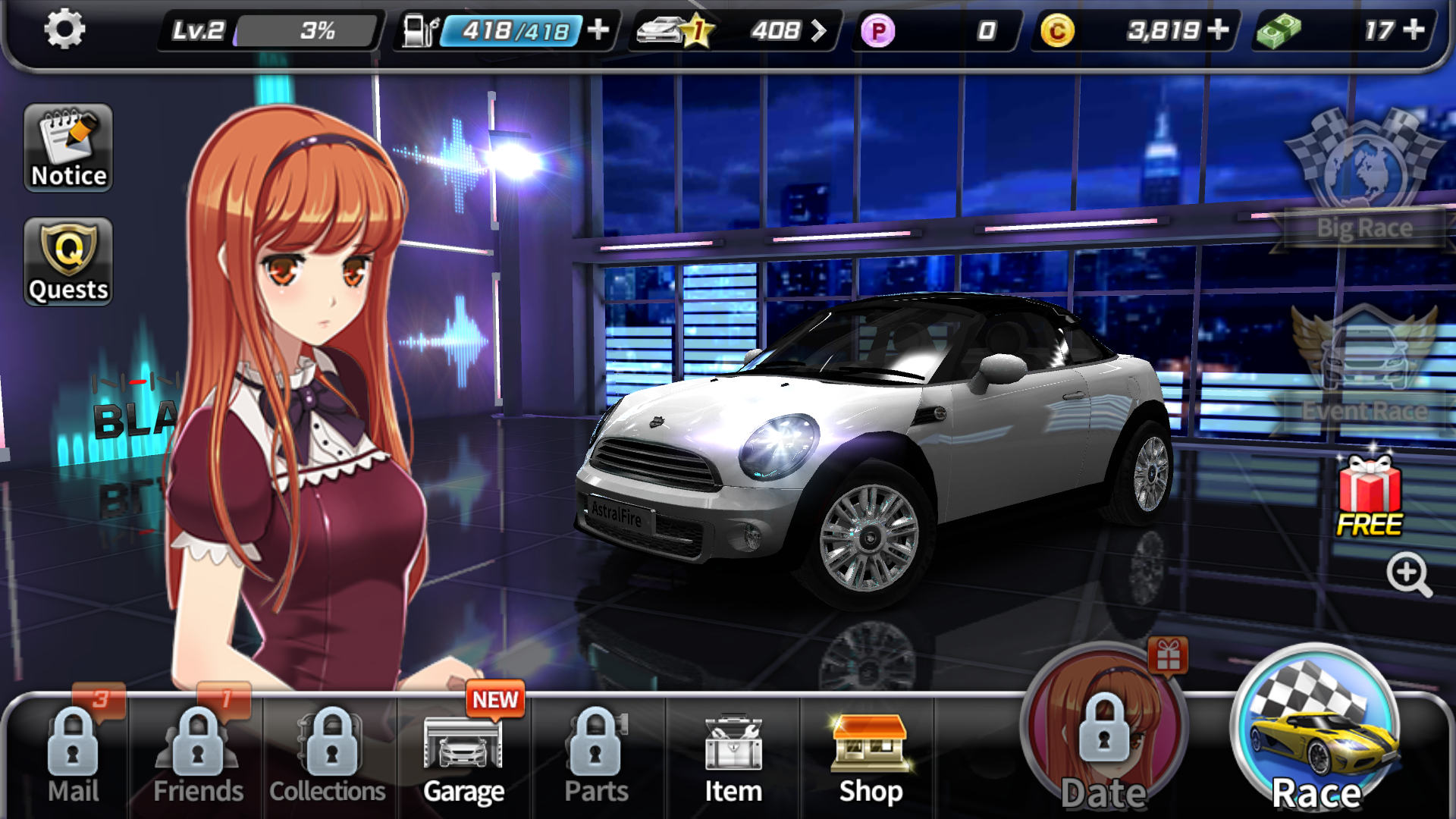
Drift Girls, lest you forget — or are unfamiliar — is an iOS and Android game by Korean developer NHN BlackPick, localised and brought to the West by a company called Toast. It's a curious little game in many ways — in some respects, it's similar to the "gacha" collectible card games that are a particular popular product of the Asian mobile development market, but in others it's entirely its own beast. Either way, it's a genuinely great, enjoyable game that I've been having a whole lot of fun with.

It's kind of a driving game, and it's kind of a dating sim. Both of those elements are intertwined, however; the girls you woo in the dating sim part of the game become passengers while you race, and different girls provide different bonuses to your car's performance. There are also other benefits to dating, too; reach the maximum affection with a girl and you have the opportunity to whisk her away for an "overnight date" with everything that implies, which makes you "feel better" and improve your vehicle's performance by a significant amount for the following day.

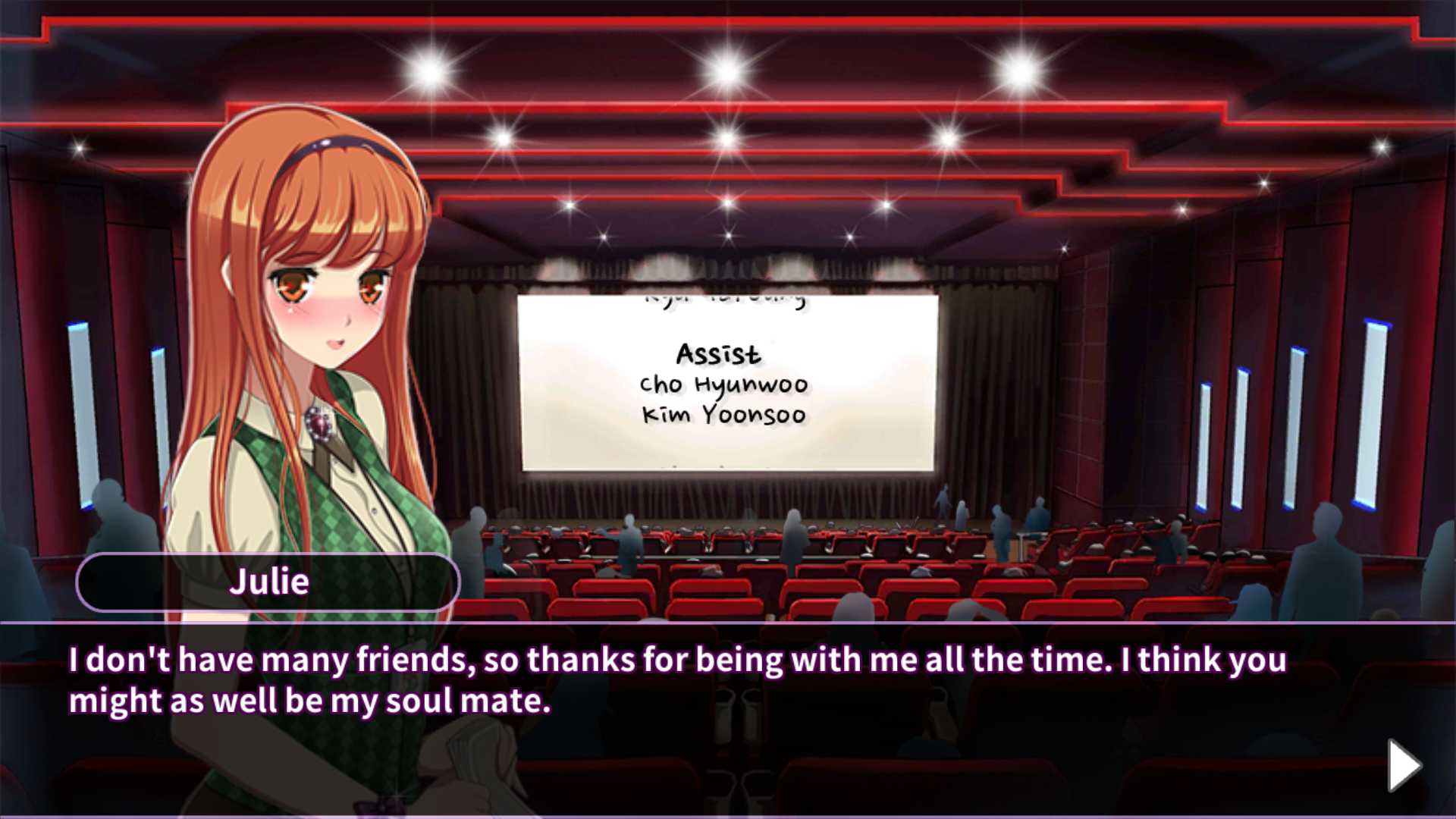
One of the interesting things about the game, though, is the fact that each and every one of the girls in the cast feels like they've had some effort put into their writing — not just in an attempt to show that they have a personality, but to make them feel like they're all part of the game world. As you get to know each of the girls, it becomes apparent that some of them know one another, and you'll often get to know several sides of what initially appeared to be a fairly simple story. Later in the game, too, as the overarching main scenario storyline starts to pick up speed with international smuggling, the Mafia and all manner of other silliness, you get the opportunity for another perspective on events by building up a relationship with the lead detective and prosecutor on the case.

The fact that there's an ongoing narrative and each of the girls clearly has their own little mini-story to work through makes the dating aspect of the game far more than a simple grind to get the girl who provides the biggest bonuses as quickly as possible. Aside from that, too, a system for "exceeding the girl's limits" by completing challenges allows you to boost their stats considerably as well as uncover a bit more of their personality and story.

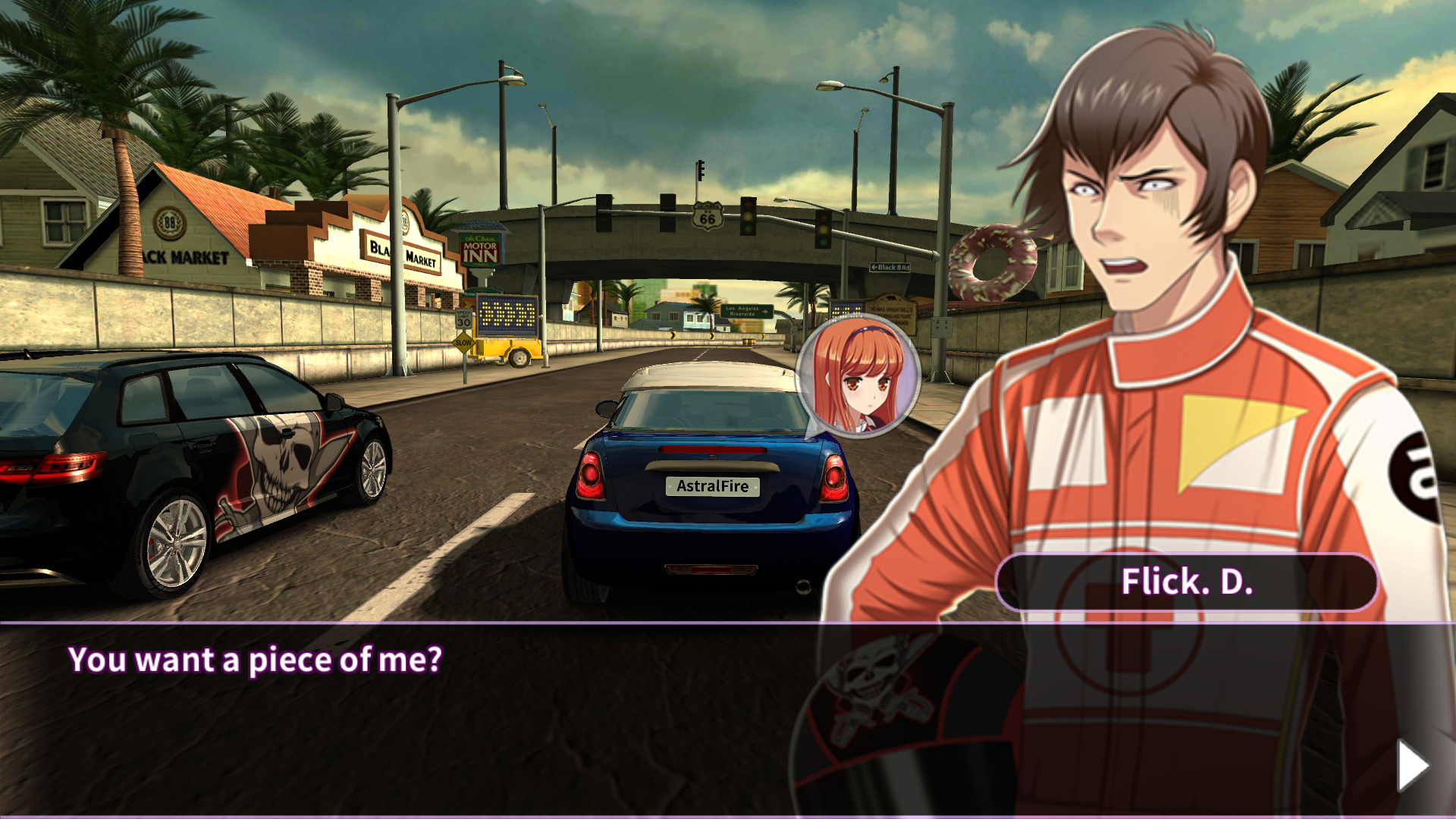
But what of the driving bit? Well, it's very simple, and I'm actually pretty glad of that. Full-on driving games on touchscreens suck beyond belief, so I'm extremely grateful to NHN BlackPick for taking a greatly simplified approach: all you have to do is rev your engine to get a good start, then time your drifts left or right as you enter a corner, then occasionally set off an nitro boost to go a bit faster. In many ways, it has more in common with a rhythm game than a driving game, but it manages to be genuinely exciting, with some lovely graphics, cinematic camera angles and cheesy but entirely appropriate throbbing dance music in the background.

The metagame is fun, too. While there is a "gacha" mechanic for drawing new cars and parts to attach to them, where I've found the most fun is in taking the car I started with — a "one-star" Mini-equivalent — and gradually building it up to remain competitive as the opponents in the game get stronger and stronger. So far I've successfully upgraded it to "four-star" standard, which is enough for story missions now, but I'm starting to run into a few situations where it's not quite enough to beat tough opponents.

I compared this type of mobile game to a more traditional MMO a while back, and having spent probably more time with Drift Girls than any other mobile game of its type — along with my hefty experience with Final Fantasy XIV — I stand by that statement. The gradual creep of power; the joy of getting to a point where you can afford a new piece of equipment or get lucky with an item drop; the feeling of progression; the necessity to keep on the "gear treadmill" to continue to progress — all of these things are typical MMO characteristics that are very much present in Drift Girls, and they make for a compelling, addictive experience that has stuck around in my consciousness a lot longer than I thought it would after the initial "haha, wtf is this" appeal wore off.

Turns out it's actually a really good game. So I think I might just sneak in a quick race or two before I go to sleep tonight…

1967: Drift Girls - Surpassing My Expectations

A few weeks ago, I happened to come across a site promoting an upcoming new mobile game called Drift Girls. On paper, it sounded like my sort of thing — a combination of dating sim and arcade driving mechanics — but I was wary of it for being on the mobile platform, primarily because playing driving games with a touchscreen suuuuuucks.

Regardless, I signed up to be informed when it was available (and to be in with a chance of winning some in-game goodies when it launched) and I was pleased to see this morning that the game had apparently launched either last night or early this morning. So, with some trepidation, I decided to fire it up and take a look.

And… and… well, it's good. Really good, actually.

Screenshot_2015-06-09-10-16-12

The basic structure is similar to most other free-to-play gacha games out there, since those are a proven model for profitability, expandability and social features. In this case, the things you're collecting, fusing, evolving and upgrading are cars and car parts, and as usual there's more than a slight element of "gotta collect 'em all!" to the gameplay — though personally speaking, I find collecting things like cars somewhat less compelling than collecting characters, so I feel far less "guilt" in this game when sacrificing things I don't need to level up the things I am using.

There are a few twists, though. Firstly, unlike some past street racing-themed free-to-play games that didn't even bother to depict the races — yes, this is a thing that actually happened, and several times, as I recall — Drift Girls has some really rather lovely-looking 3D racing sequences that make good use of the limitations of touchscreen-based mobiles to provide an enjoyable, snappy experience that rewards skill as well as making the numbers on your stat sheet go up.

Screenshot_2015-06-09-15-38-07

The control scheme works because it doesn't expect you to do too much. All you have to do is rev your engine at the start line, preferably so it's in the green area of your rev counter to get a Perfect Start, and then press and hold one of the two directional "drift" buttons when you reach a corner. Timing your drift appropriately will increase your speed through the corner as well as earn you nitro boosts, which can be either triggered for a big speed boost or saved until you finish for some bonus monetary rewards when you finish the race. That's it, essentially; the challenge comes from increasingly complex courses and increasingly unforgiving opponents, so you'll need to improve both your own skills and your car's stats in order to progress beyond a certain point.

Here's where the dating sim aspect comes in. Shortly after the opening, the game presents you with three eligible young bachelorettes and invited to spend some time with one of them. You can take the girl on dates or buy her gifts to increase her affection, and higher affection means that she provides you with more significant bonuses as well as some other… benefits. Yes, if you max out her affection, you can shag her… I'm sorry, "take her on an overnight date", which, if you pick the right place to take her, will confer on you a long-lasting 100-point stat bonus, which is significant in the early game.

Screenshot_2015-06-09-15-47-53

Mechanically, then, the girls are "equipment" of a sort, but the developers have actually bothered to put some effort into the writing, with each girl having a distinct personality, a backstory that she gradually reveals as you get to know her over the course of a few dates, and her own set of reactions to various in-game events such as winning, losing, challenging particularly difficult races and all sorts of other things. You're even rewarded for each of these events that you see, even if it's only a couple of lines, so there's incentive to stick with one girl and get to know her fully — though you can also be a bit of a player if you really want to, too.

It would be easy to dismiss Drift Girls as shallow fluff of the usual sort you see on mobile, and sure, there's a certain amount of the usual free-to-play stuff going on — energy bars, premium currency, that sort of thing — but like many of the other actually good free-to-play games I've had the pleasure of playing recently, the game isn't stingy with rewards for non-paying players, and it's overall a highly polished experience that is just plain good. Not "good for a mobile game", but good.

If the premise sounds intriguing, then I recommend giving it a shot — and feel free to add me as a friend in the game under the ID "AstralFire".

Grab it from Google Play or the App Store.