After getting what I thought was "caught up" on the series a few years back (correction: a decade ago. Fucking hell), I am now very behind on Falcom's excellent Ys series. And, despite already having two "big games" on the go — Suikoden and Yakuza 6 — I am severely tempted to start correcting that.
Ys is not the only series I am very behind on, of course. I am also very behind on Yakuza, which is at least partly why I started Yakuza 6 on a whim the other day. Technically I'm not "behind" on Suikoden because I never started it prior to this — though I am enjoying it a lot — but I do want to play, at the very least, the first two in the HD Remaster collection.
Then, of course, there is Trails, that which has apparently become Falcom's flagship series. To date, I have played the first Trails in the Sky… twice. I also made a start on Trails in the Sky Second Chapter, but almost immediately after I started playing that game, Falcom announced the remake of the first Trails in the Sky (and its subsequent follow-up), so I figured that I would delay starting a proper, honest to goodness attempt to "do" that series until all of these remakes were out. And in the meantime, the far end of the series continues to extend further and further into the distance; I am several games behind in terms of actually buying the games at this point, so hopefully by the time I do actually start playing Trails properly, they will still be reasonably available.
Does it all matter? No, of course not. So long as these games continue to be available and the hardware to play them on remains in working order, I can play them at any time. That said, I do feel considerably more "pressure" of sorts to play current stuff sooner rather than later, given how many of them have downloadable updates. I do tend to make a habit of primarily purchasing limited-print stuff, which tends to be fully up to date on cart or disc, but in the case of stuff that gets a broader retail release — like the Trails games now do — there are often updates of varying degrees of necessity from the moment you put the disc in.
And don't even get me started on Game Key Cards, still officially the worst thing about Nintendo Switch 2.
Anyway, at some point, then, I think I will probably be jumping into Ys VIII: Lacrimosa of Dana. I did actually make a start on this ages ago, during a time when we had some friends over, they got a bit drunk and wanted to see some sort of RPG. I haven't touched it for ages, though, so if and when I do start again, it will be going from the beginning once more. I'm also quite tempted to revisit Ys Origin, purely for its finale music. And then there's the Switch versions of Oath in Felghana and Memories in Celceta, both of which I've played, but which it would be fun to have another look at.
And then after that there's Ys IX and Ys X to play, too. Ahh, an embarrassment of riches, truly. And yet how long do you think I'm going to stare at a wall, wondering if I really should start something new when I already have two big games on the go?
No. Fuck it. You know what, I'm just going to do it. I need some howling Falcom guitars in my life right now, and I'm damn well going to go and get them. You see if I don't!
Want to read my thoughts on various video games, visual novels and other popular culture things? Stop by MoeGamer.net, my site for all things fun where I am generally a lot more cheerful. And if you fancy watching some vids on classic games, drop by my YouTube channel.
If you want this nonsense in your inbox every day, please feel free to subscribe via email. Your email address won't be used for anything else.
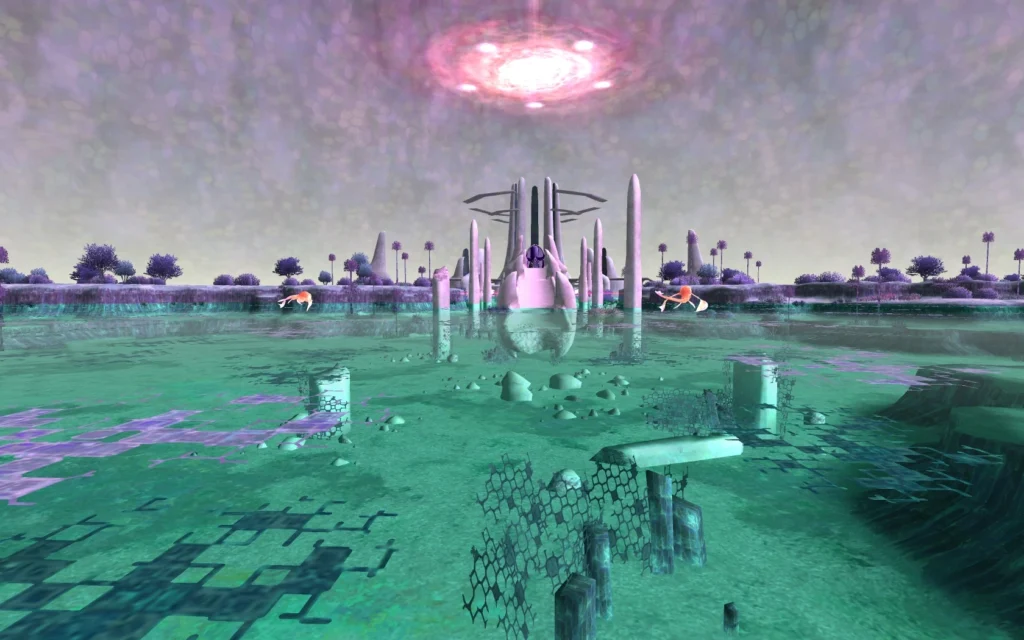
I'm definitely coming up on the end of the Chains of Promathia expansion for Final Fantasy XI. Know how I can tell? Because I'm into an area where everything is made out of hexagons and light, and the world doesn't quite behave as it "should".
I'm not entirely sure why this became such a common trope in role-playing games, particularly those of Asian origin. I assume there's some sort of inherent significance to hexagons — or perhaps someone once just thought they looked cool and futuristic, and everyone else copied that first person. Both explanations are entirely plausible.
A lot of people mock role-playing games that pull the "final boss is in space!" trope, but I love it. One of my favourite things in video games is getting the opportunity to explore and play in abstract environments. There's a definite appeal to realistic environments under the right circumstances, but for me, there's always something special about making that switch from "recognisable" to "completely alien". Doesn't matter what game it is; if you go from hanging out in "the real world" to running along platforms suspended in a starfield — or, indeed, as I have been doing in Chains of Promathia this evening, running across a seemingly solid "sea" that floats above the land far below me, leaving a trail of hexagons and the sound of musical notes with every step I take.
I think the reason I like it is the fact it drives home how video games give you the opportunity to "do" things that are outright impossible in real life. There is not actually anywhere that exists that consists of floating platforms in space or transparent hexagons suspended over a petrified natural environment, and thus having the opportunity to spend time in those places as a virtual world is appealing. It's fascinating. In some respects, it provides a window into the creators' imagination, allowing us a sense that we are sharing in something quite special.
Of course, there's an argument to be made that when you explore a realistic but nonetheless fictional world in a game, you're also stepping into the creators' imagination, but it never feels quite as exciting as getting the opportunity to go somewhere completely alien. It's a silly trope, probably one that is overused at this point — and definitely one that has been used inappropriately (Half-Life's finale says hello) — but it's one that I will always like and appreciate.
I am tempted to see if I can finish off Chains of Promathia this evening, but it is already midnight, so I feel like I should probably go to bed like a responsible adult. Probably.
Want to read my thoughts on various video games, visual novels and other popular culture things? Stop by MoeGamer.net, my site for all things fun where I am generally a lot more cheerful. And if you fancy watching some vids on classic games, drop by my YouTube channel.
If you want this nonsense in your inbox every day, please feel free to subscribe via email. Your email address won't be used for anything else.
This is a cross-post from my gaming site MoeGamer. I figured if I spent several hours writing this, that absolutely counts as Me Having Written Something for today. So please enjoy, even if you don't normally frequent MoeGamer. I will likely be doing this more going forward.
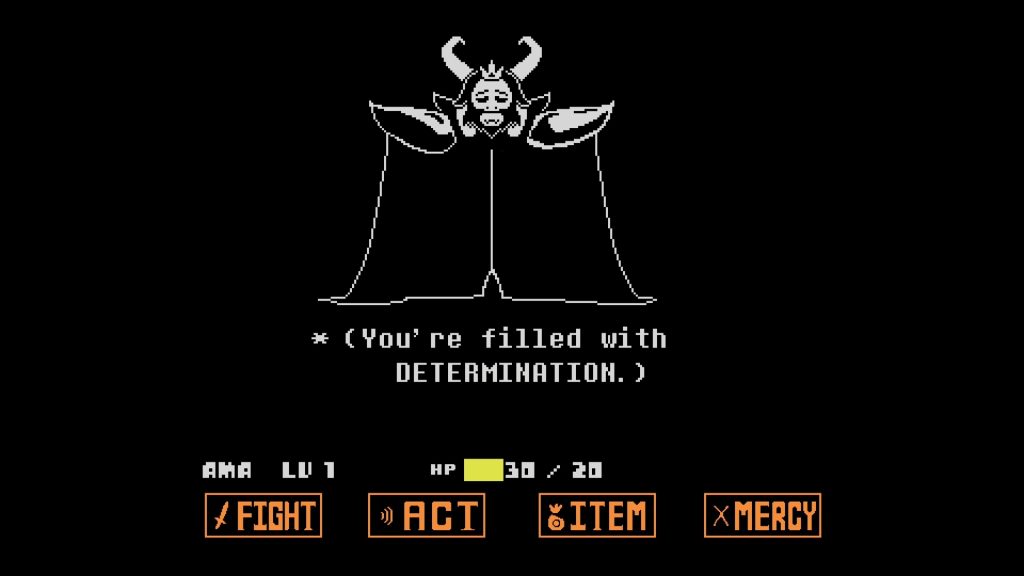
Last week, I got around to something I've been meaning to do for ages: play through Toby Fox's modern classic Undertale, and attempt to understand why it is so well-regarded and popular.
I'd held off for quite some time for a few reasons: first and foremost was simply a matter of making time for it, since as anyone who knows me will be well aware, I have a lot of video games on my shelves. But I was also quite keen to play the game divorced from the context of its somewhat… passionate fanbase.
I have nothing against the Undertale fanbase, I hasten to add — I've never really come into contact with it directly — but for a game like this, I was keen to approach it with as much of a beginner's mind as possible. I wanted to try and understand what, exactly, it was about Undertale that resonated with people so much when it first released. And I think I got there in the end.
Spoilers follow.
Undertale, for the unfamiliar, casts you in the role of a kind-of-sort-of self-insert character. I say kind-of-sort-of because the protagonist is deliberately gender-ambiguous and you can't customise their appearance. You can customise the way they behave, though, and that's something we'll come back to in a moment.
As Undertale begins, you have fallen down a big hole into the land of monsters. Supposedly, many years ago, humankind and monsters lived together on the surface of the world, but a great war eventually led monsters to becoming trapped underground while humans dominated the surface. This is all the context you're really given at the start of the game; in short order, you meet up with a kind-but-a-bit-too-much monster named Toriel, who wants to take you in and look after you.
Toriel is a rather overbearing, motherly type to a borderline sinister degree, and thus it is natural to want to break free of her clutches and explore the greater world in which you find yourself. You can achieve this in a couple of ways, and herein you get to know probably the most important thing about Undertale, and the tagline it's used in various places in more recent years: this is an RPG where no-one has to die.
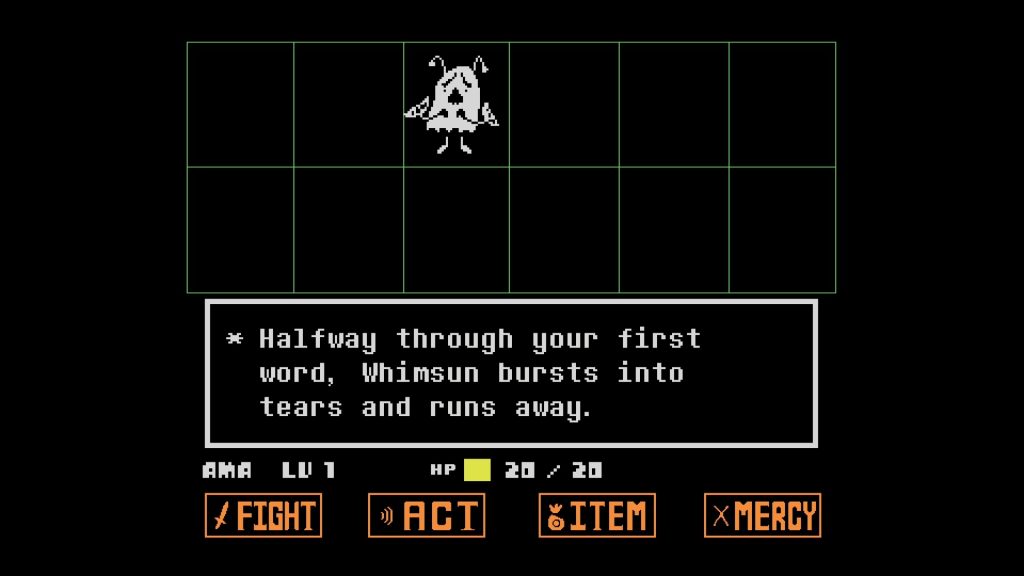
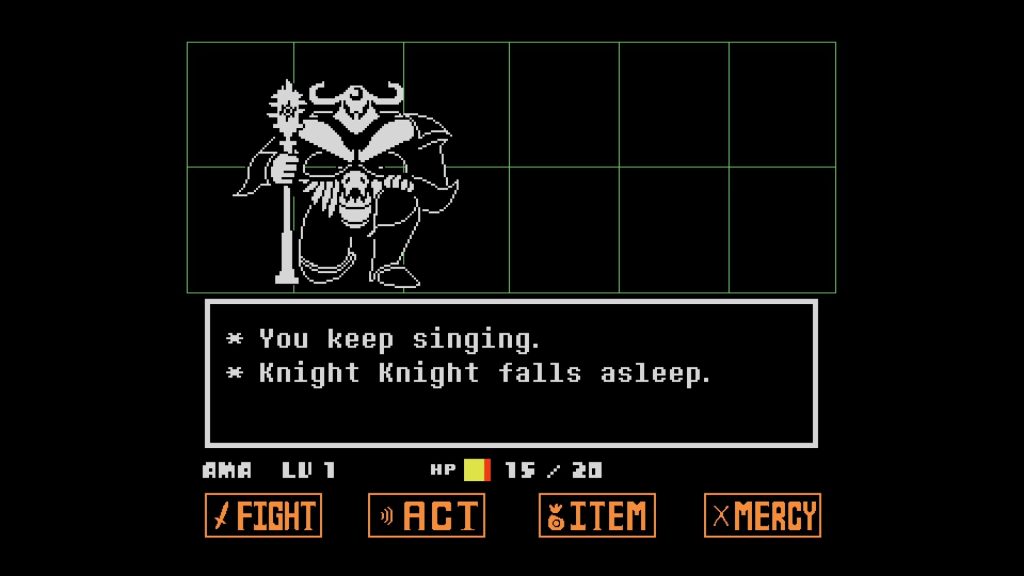
It's true! In every combat encounter you run into throughout Undertale, you have the option of fighting the monsters you come face to face with, or attempting to placate or otherwise peacefully resolve the conflict somehow. The exact way you go about this varies from monster to monster, but it is indeed possible to pass through the entire game without anyone dying by your hand.
Interestingly, resolving conflicts peacefully does not reward you with "EXP" that allows you to increase your "LV", meaning that if you choose to do a peaceful playthrough, your character will never get any "stronger". Undertale takes great pains to never actually use the full terms "experience points" and "level" for very good reason: in its world, that is not what "EXP" and "LV" mean. Instead, "EXP" stands for "Execution Points", hence you only acquiring them when you kill someone, and "LV" is short for "LOVE", which in turn is short for Level Of ViolencE.
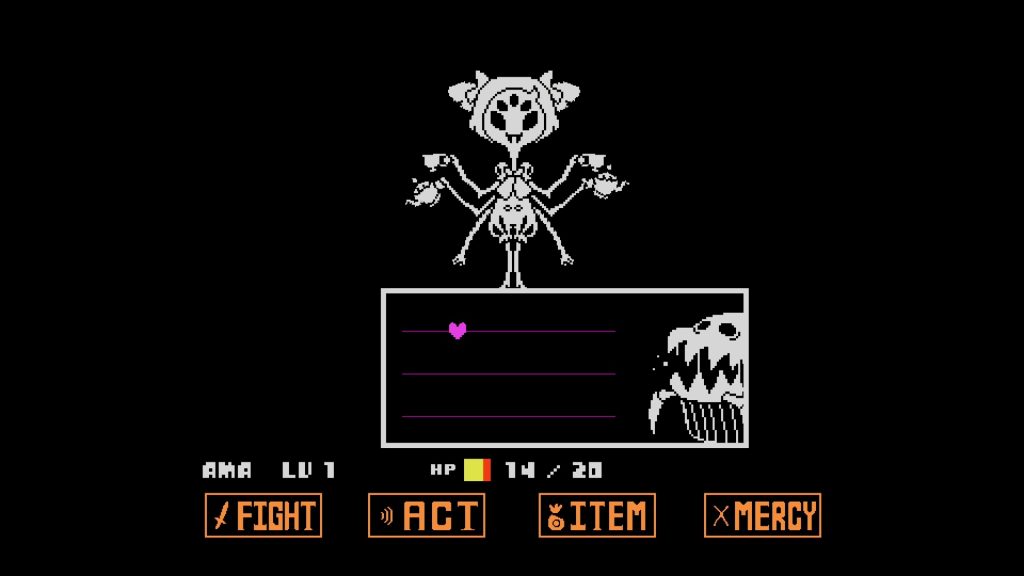
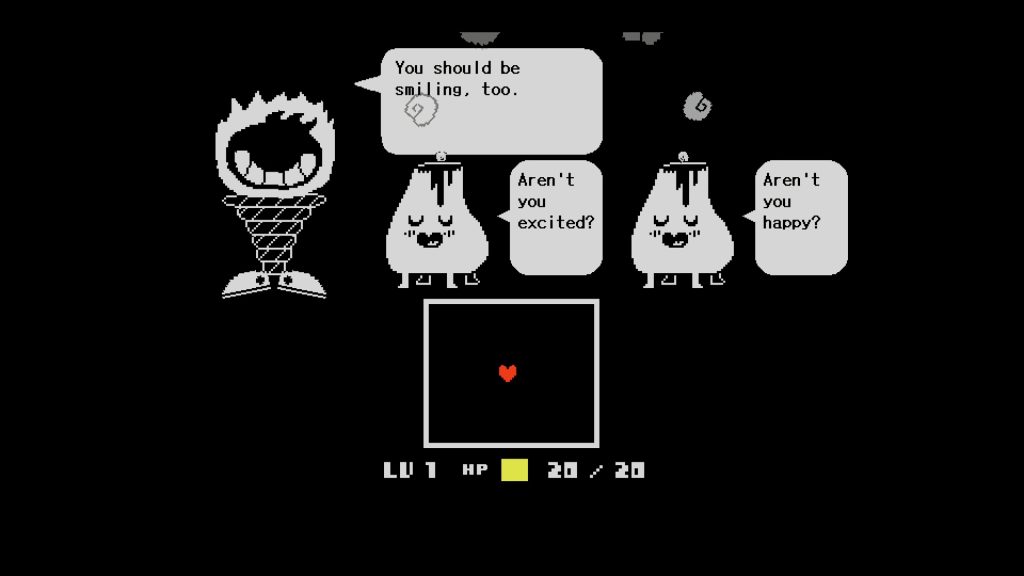
In combat, regardless of whether or not you choose violence, you will have to fend off enemy attacks in short action sequences loosely inspired by shoot 'em up bullet patterns. By controlling the protagonist's SOUL (all caps, but not an abbreviation or acronym to my knowledge), represented as a heart, you can avoid taking damage from enemy attacks. Each enemy type has its own unique attacks, and the further into the game you go, the more varied these become.
One key variation comes with some enemies' ability to change the colour of the protagonist's SOUL. This causes it to behave in various different ways; for example, when it's blue, it's affected by gravity, meaning it has to "jump" over incoming attacks; when it's purple, it can only move between and across set "wires" on the screen. Enemy attacks also have colours, too; blue attacks are harmless if you stay still, orange attacks are harmless if you're moving when they pass through you, and green "attacks" are actually beneficial, providing a small amount of healing and also often triggering special effects. The green attacks most frequently come up when attempting to peacefully resolve conflicts.
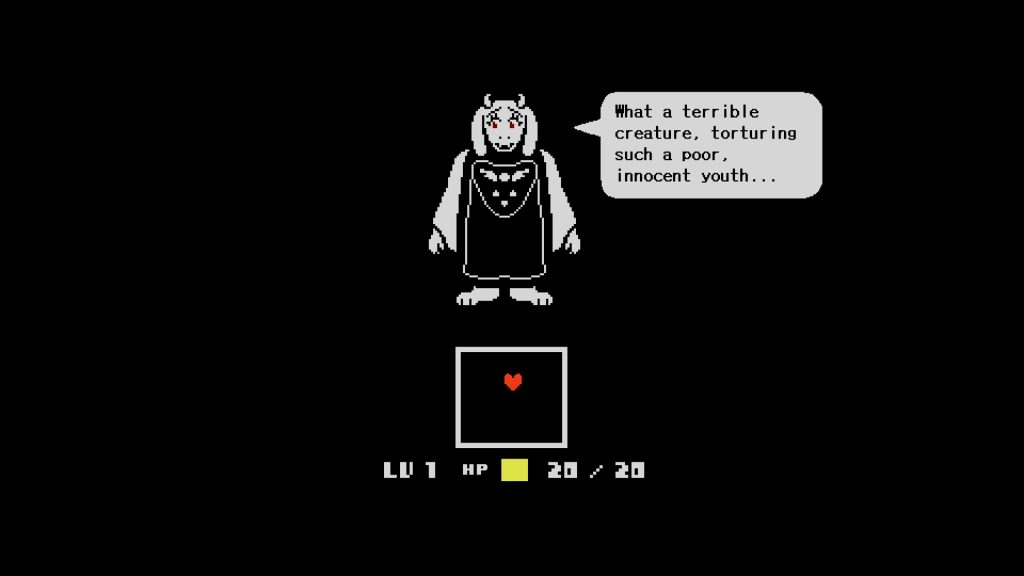
But why might you want to spare the monsters of Undertale, when RPG convention has it that you are "supposed" to kill everything in your path? Well, that's because Undertale makes a specific effort to, for want of a better word considering we're talking about "monsters", humanise everyone and everything you come into contact with. Even fodder enemies have personalities and quirks, and it takes the most steely of resolves to look past all that and murder them. But, crucially, the option is there.
Not only that, but Undertale also keeps track of all manner of other things in the background. If you inadvertently killed someone in a first playthrough and then reset the game without having saved, it will know. On subsequent playthroughs, characters you "haven't met yet" will have recollections of you. And if you went all-out and did a "Genocide" run as your first playthrough, there are some fairly significant differences to how everything concludes.
Undertale is a game that is designed to make you think. Not in the sense that it's especially complicated or difficult to understand, but it really does make you think about the consequences of your actions — and how "game logic" might work were it applied to a "real" situation.
A good example comes if you complete what is known as a "True Pacifist" route. This is only possible after "beating" the game once, and fleshes out the story, resolving in an eventual "true ending" where the monsters finally escape the underground and are able to once again live free on the surface. If you open the game up again after you've reached this ending, the game tells you in no uncertain terms that yes, you absolutely can play again by making use of what it calls a "True Reset", but in doing so you are depriving an entire society — and yourself — of a happy ending. And why are you doing that? Just to see what happens? Is that something you can really justify doing?
A valid response to this is, of course, to say "no, I can't", and to close the game down, never to open it again. You got your happy ending. No need for any "what ifs". No need to satisfy your curiosity as to what might happen if you did the most morally reprehensible thing possible at every opportunity. No need to ruin the lives of a significant number of people.
At the same time, the game absolutely does provide plenty of meaningful changes if you do decide you want to see what might happen if you kill everyone. And then, if you decide to do that "True Pacifist" ending again just to "set everything right", there will be consequences to that, too.
This is the stuff that makes Undertale so clever and noteworthy. The moment-to-moment storytelling and dialogue is charming and memorable — I'd go so far as to say that this is a game with one of the clearest senses of authorial voice I've ever played — but the really interesting stuff comes about once you've been through the whole thing once and you start to contemplate and understand how differently some scenes can unfold depending on your previous actions. Various characters can be seen in rather different lights, and encounters can be resolved in other ways depending on everything from the things you've said to other characters to the objects in your inventory.
Of course, under the hood it's all an illusion based on hidden flags and counters, but in the moment, it absolutely works. Undertale is enormously emotionally engaging from start to finish, and I defy anyone to play through to the conclusion of the True Pacifist route and not at least hesitate before contemplating doing a Genocide run.
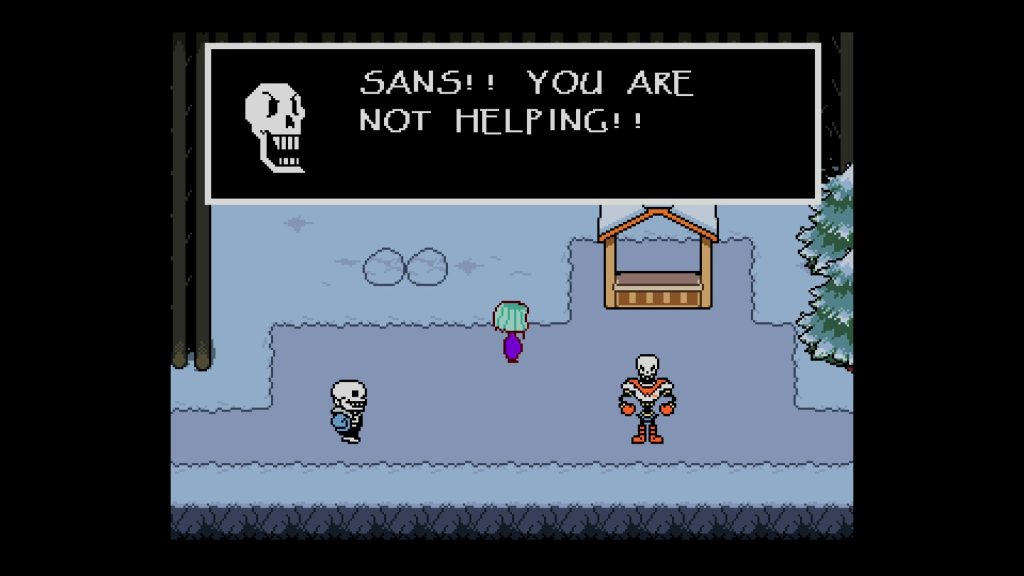
As previously noted, a lot of this is down to author Toby Fox's excellent writing, but Fox doesn't just use well-crafted dialogue to infuse his characters with personality; he uses visual elements such as fonts and the case in which characters' text-only dialogue is presented to help you build up a mental picture of each character. Probably the best example of both of these comes in the case of Papyrus and Sans, two skeletal characters you encounter early in the game after freeing yourself from Toriel's oppressive motherliness.
Papyrus is loud, brash and outspoken — if he had voice acting, he'd absolutely sound like Skeletor — but is this way in order to cover up intense insecurity and loneliness. We can tell this from the combination of his facial expressions, the things he says… and the fact that, as his name suggests, all his dialogue is presented in all-caps Papyrus font, a font that certain types of people tend to use if they want people to like them. Not only that, he's so desperate for validation and friendship that even if you've been on a Genocide run up until this point in the game, your encounter with Papyrus represents a key opportunity to turn back and change your ways.
By contrast, Sans is much more chilled out. Again, we can tell this from the way he looks at us and the things he says, but also the fact his dialogue is all in lower case Comic Sans, a font that everyone knows to be awful, but it serves a function. It's little stylistic things like this that are almost entirely unique to video games; one could get away with the typeface thing in written creative works, but here, it's the way this is combined with other visual and auditory elements that makes it work quite so well.
Expand this to a whole 7-10 hour game, with a variety of other characters who are all equally well-crafted and play very different roles on your overall journey, and you have something that really gets deep into the emotional centres of your brain, and which will stay with you long after the credits roll. This is a game where the characters feel real enough for you to be personally invested in them, and where all but the most hard-hearted will find it very difficult to make the decision to put them to death.
At least, that's how I felt about it, anyway. The nice thing about Undertale is that you can also go in completely the other direction with it, and look at it as an experiment in how video game narratives can manipulate one's emotions so that we believe in things which very much are, by their very nature, unthinking, unfeeling fabrications of someone's imagination. There's no logical reason why you should feel "bad" for "killing" a character in a video game, because you're not actually killing them. After all, think about how many anonymous grunts you've shot in the head in other games; how many slobbering monsters you've hacked and slashed your way through in your average RPG; how many societies you've doomed when you've set a game aside, never to return to it.
Among other things, Undertale makes us think about the context of our actions in video games, and how that might translate to something a bit more real. At its heart, it's not trying in the slightest to be "realistic", hence its deliberately slipshod visual presentation; it behooves us, then, to ask exactly why we end up caring so much more about these characters presented in low-resolution, often monochromatic pixel art than we might do about, say, an anonymous enemy soldier in a Call of Duty, or an enemy knight in a strategy RPG.
The answer, probably, is love. We don't care about grunts in a first-person shooter because we're never given any reason to. We have no opportunity to get to know them; they have a single mechanical function, and that is to stop us achieving our objectives. And, in turn, as Sans points out to us in the late game, "the more you kill, the easier it becomes to distance yourself; the more you distance yourself, the less you will hurt… the more easily you can bring yourself to hurt others."
In Undertale, meanwhile, every potential "enemy" is depicted as someone or something that could also, under different circumstances, be a friend. Even characters like Papyrus, who might initially appear to be set up in such a way to be a "villain", with his fixation on capturing you and seeming inability to actually follow through on this, end up expressing their support and validation for you. And a lot of this happens early on, making those first kills — the ones from before you find it "easy to distance yourself" — hard to perform.
Yes, part of Undertale's effectiveness comes from the fact that it makes you feel good. Because you are playing "you" — despite not being able to customise the player avatar — the game and its characters are effectively able to address you directly. And many of the things both the game and the individual characters have to say are positive, uplifting and supportive. Would you punch someone in the face if they told you that they believed in you, and that they could see you were trying your best?
Some of you might, and Undertale accepts that as a valid response. Some of you, like me, might be a lot more open to what is essentially emotional manipulation (positive), and thus find yourself staring at that post-game screen, unable to click "True Reset" and undo everything you'd done up until this point.
So yeah. I get it. Undertale is excellent. And I'm glad I finally understand why.
Want to read my thoughts on various video games, visual novels and other popular culture things? Stop by MoeGamer.net, my site for all things fun where I am generally a lot more cheerful. And if you fancy watching some vids on classic games, drop by my YouTube channel.
If you want this nonsense in your inbox every day, please feel free to subscribe via email. Your email address won't be used for anything else.
Hello. It's after 1am and I haven't written anything, I need a bath (that can wait until tomorrow) and I'm quite tired. So this will probably be a short one. I did want to acknowledge something, though, which is that I've been playing Clair Obscur: Expedition 33 this evening, and it's real good.
I was a little skeptical about it after feeling a bit burnt by the Blue Prince situation, but this time around it's just flat-out a good game, not "a good game if you have the right kind of brain and 150 hours to plough into it".
I will write more about it on MoeGamer anon, but I did want to acknowledge that my first impressions are very good indeed, and that it has a very distinctive atmosphere about it. I'm getting quite strong Nier vibes from it in terms of its rather melancholy atmosphere — indeed, my wife walked in at one point and asked if it was another Taro Yoko joint. I explained that no, it's French, but I can completely see why she would think that just from overhearing the music.
Oh man, the music. One of the most important things to get right in a dramatic RPG, and boy did they get it bang on in this game. Sweeping orchestral pieces, triumphant choirs, lonely soloists, tinkling pianos, it's all there, and it all hits one right in the Feels.
I was a little concerned about coming to a "J-style" RPG that everyone was saying was the best thing ever when chances are the last "JRPG" they played was Persona 5; I thought it would be an interesting exercise to approach the game from the perspective of someone who has been consistently engaging with this type of game for the last 20 years, while many other folks haven't for various reasons. And I think it's still going to be interesting, but so far my impressions are that no, this isn't just "good if you haven't played an RPG in the last 20 years", it's a good RPG.
There's Nier, there's Final Fantasy, there's even bits of Souls in Expedition 33's DNA, and it all works together in a thoroughly interesting fashion. But, like I say, it's after 1am and I really should probably go to bed. I will write more about this game — much more — over on MoeGamer very soon. But for now, I bid you good night!
Want to read my thoughts on various video games, visual novels and other popular culture things? Stop by MoeGamer.net, my site for all things fun where I am generally a lot more cheerful. And if you fancy watching some vids on classic games, drop by my YouTube channel.
If you want this nonsense in your inbox every day, please feel free to subscribe via email. Your email address won't be used for anything else.
The recent release of Obscure Claire or whatever it's called has spawned some frankly toxic discourse about turn-based vs. real-time RPGs and the perceived accessibility of the RPG genre, so I thought I would take a moment and see if it was possible to name at least one turn-based RPG that had come out every year between Final Fantasy X, which a frightening number of people think was The Last Great Turn-Based RPG, and now.
I'm taking English language releases as gospel here, not Japanese release dates in the case of games that originated there. Because we're talking about English people and their weird selective memory. I'm also going to try not to include more than one entry from a series, and I'm not restricting the list to just "JRPGs". Anything where you take turns to make numbers pop out of monsters is fair game.
Are you ready? Here we go! (Ya ya ya ya… wait, no, wrong genre.)
2001:Final Fantasy X 2002: Suikoden III 2003: Pokémon Ruby and Sapphire (yes, they count) 2004: Lord of the Rings: The Third Age (aka Final Fantasy Tolkien) 2005: Mario and Luigi: Partners in Time 2006: Ar Tonelico: Melody of Elemia 2007: Eternal Sonata 2008: Etrian Odyssey II 2009: The Last Remnant 2010: Atelier Totori: The Adventurer of Arland 2011: Hyperdimension Neptunia mk2 2012: Fire Emblem: Awakening (strategy RPGs are still turn-based RPGs!) 2013: Bravely Default 2014: South Park: The Stick of Truth 2015: Shadowrun: Hong Kong 2016: Shin Megami Tensei IV: Apocalypse 2017: Blue Reflection 2018: Octopath Traveller 2019: Death end re;Quest 2020: Trails of Cold Steel IV 2021: Mary Skelter Finale 2022: Dungeon Travelers 2-2 2023: Sea of Stars 2024: Like a Dragon: Infinite Wealth 2025: Clair Obscur: Expedition 33
Cor. Some crackers among that lot, for sure, many of which I'm still yet to play.
And, it should probably go without saying, these were far from the only turn-based RPGs released each year, to say nothing of RPGs that don't specifically use turn-based mechanics but are nonetheless particularly noteworthy, such as the Xenoblade Chronicles X rerelease this year.
I've said it before, I'll say it again: turn-based RPGs have never, ever gone anywhere. The only difference with Clair Obscur is that all eyes are on it thanks to it using fancy new Unreal Engine 5 tech — which some are already saying is a bit of a hindrance rather than a benefit.
The fact that a lot of the above games don't get much attention outside of niche-interest circles is, more often than not, down to a refusal to engage with anything that might be on the lower budget side of things, or particularly if it involves an anime art style. I know people who have missed out on some absolutely fantastic games just because they refuse to engage with anything that looks a bit anime, regardless of subject matter. And that's their loss.
Getting people to "read" a bit more widely is, I'm sure, a problem with every medium. But dear Lord is it ever frustrating when you've spent years of your life screaming about games you find fascinating, only for people to shrug and make it very clear that they haven't paid any attention whatsoever.
Oh well. As I say, their loss. I know what I like, and I have plenty of the stuff that I like on my shelves. And I guess that's all that really matters at this point.
Want to read my thoughts on various video games, visual novels and other popular culture things? Stop by MoeGamer.net, my site for all things fun where I am generally a lot more cheerful. And if you fancy watching some vids on classic games, drop by my YouTube channel.
If you want this nonsense in your inbox every day, please feel free to subscribe via email. Your email address won't be used for anything else.
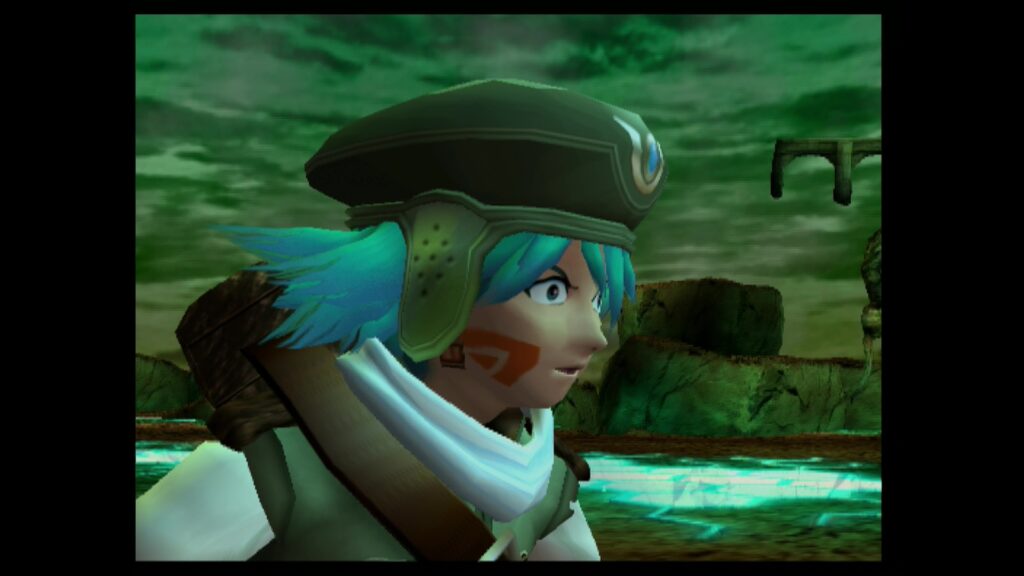
I've been playing .hack//Infection for the last couple of days on PlayStation 2. I've had the full set of four games on my shelf for a very long time and been meaning to properly run through them all, but have somehow never gotten around to it. I have previously completed Infection a very long time ago, but I've never gone through all four games and seen how it all ends — nor have I been spoiled on any of it. I also own a copy of the .hack//G.U. remasters on PlayStation 4, so I'll have to get to those at some point, too, but I wanted to knock out the PS2 games first.
For the unfamiliar, .hack was one of the first (possibly the first) "MMO gone mad, if you die in the game you die for real" series. Unusually, it was designed from the outset as a fully transmedia production: not only were there four PS2 games in the series, each of these games also came with a DVD featuring an episode of a specially made anime known as .hack//Liminality which tells a "real world" story that unfolds concurrently with the events of the game, and there was a completely separate anime series known as .hack//Sign. Since that time, there have apparently been several other anime and manga series, along with the aforementioned .hack//G.U. trilogy of games, which originated on PS2 but which were ported to PS4 in 2017.
That may all sound terribly complicated, but be at ease: you can have a satisfying .hack experience if you just play the games. .hack//Infection, the first of the original set of four games, tells the story of "you", an 8th grader who has just signed up for the hottest new MMO, The World, at the recommendation of your friend Yasuhiko, a veteran player. You join up and in that inimitable "early 2000s MMO" sort of way, you party up with Yasuhiko, or "Orca" as he's known in the game, who destroys absolutely everything before you can even get a hit in by virtue of him being 50 levels higher than you.
But something goes horribly wrong. After an encounter with a mysterious young girl who is seemingly being chased by a bizarre creature carrying a red wand, Orca is entrusted with a strange book and shortly afterwards, his character is "Data Drained", leaving the real Yasuhiko comatose. You end up taking possession of the book, which manifests itself as a strange bracelet that equips you with the power to Data Drain enemies in the game, and it's then up to you to investigate the strange happenings in The World and determine if there's any truth to the game seemingly having an impact on the real world.
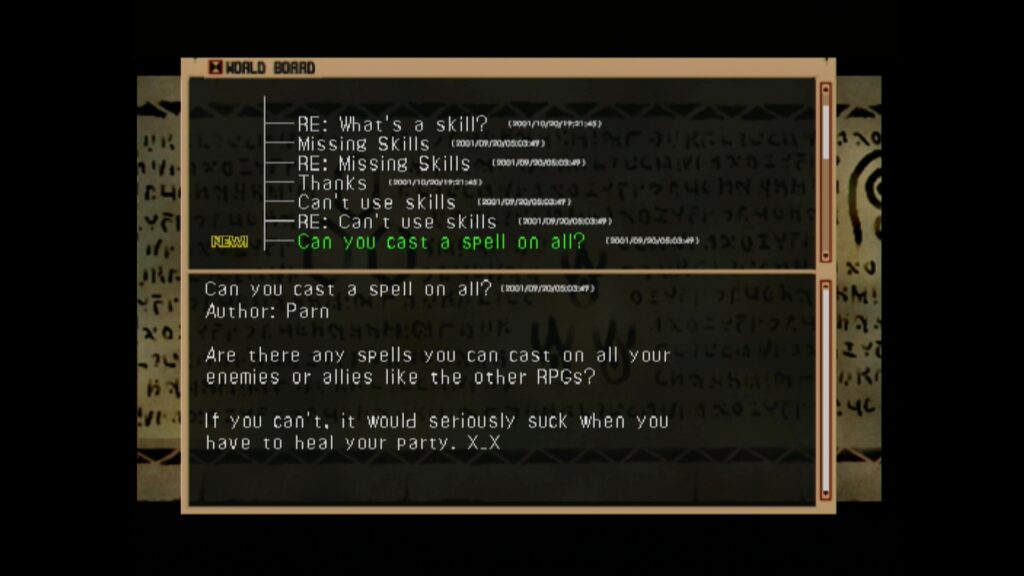
The cool thing about .hack//Infection is that the entire PS2 game is diegetic, intended to represent you using your computer to check your mail, read the news and log in to The World. You never see the actual real world yourself in the game — hence the inclusion of the Liminality DVDs — but instead all your investigation is online. This unfolds through a combination of you checking and replying to mails (with predefined responses) and browsing through the official message boards for The World, looking for clues.
Canonically, .hack//Infection is supposed to be unfolding in 2010, but obviously in 2002 developers CyberConnect2 had to make something of a best guess as to what that near-future setting might look like. They actually got a fair few things right, such as high-speed, always-on Internet access being pretty much universal and fibre-optic cables being the main means of this infrastructure being implemented — though here in the real world, fibre broadband is a little more recent than 2010.
What's quite interesting is the design of The World itself, because it could quite plausibly work as an online RPG — though perhaps not in the way that western players understood "MMOs" at the time. For context, World of Warcraft came out in 2004, two years after .hack//Infection, so "MMO" up until that point in the west meant either EverQuest or Ultima Online.
The World is closer in execution to something like Sega's Phantasy Star Online from 2000 in that there are small, shared communal areas (known as "Root Towns") where you can hang out with other players, but your actual fighting and questing takes place in discrete areas that you teleport to rather than exploring a coherent world. It's not quite the same as the "instanced" areas seen in World of Warcraft and, later, Final Fantasy XIV, as you can meet up with other players who happen to be visiting the same area, but the nature of how The World is structured means that you're relatively unlikely to stumble across someone at random.
Anyway, let's not get bogged down too much in details as I'll probably want to write about this on MoeGamer once I'm finished. Suffice to say for now that .hack//Infection and its subsequent parts unfold as a combination of you just flat-out playing The World to get treasure, gear and helpful items, and gradually working your way through the core mystery at the heart of everything. At most points in the game, you can put the main plot on hold and just go dungeon-crawling to your heart's content — and it's probably advisable to, since you'll need to level both your own character and the various companions you can recruit to your cause.
.hack//Infection is somewhat clunky by more recent action RPG standards, but once you get a feel for it and an understanding of its mechanics, it's enjoyable. There's a variety of enemies to deal with, and their different strengths and weaknesses will often require you to think about various strategies to deal with them. And, since the game is supposed to be simulating an MMO, you can pretty much concentrate on your own play; any companions you bring with you will usually do a pretty good job of fighting alongside you, though you can issue various orders to them if you need them to, say, heal or unleash their most powerful abilities. You can also micromanage their equipment to a certain degree, and since equipment has skills attached, by doing this you can try and optimise them for the challenges you're about to face.
I can completely understand the criticisms of .hack from back in the day. It is repetitive. The dungeons are very obviously constructed from pre-built blocks with different textures put atop them, and there's not a lot of variation to them. And yet there's something about .hack that I've always found fascinating and compelling. I think it's the oddly menacing atmosphere the whole thing has; The World, as a game, is designed to be cheerful and colourful, but it's very obvious that there are dark things going on beneath the surface, and that the players of the game are clearly being used for some nefarious purpose.
I'm in no rush to plough through all four games, but I've enjoyed making a start on .hack//Infection this weekend, and as a long term project I'm looking forward to seeing how it all comes together in the end. And there will, of course, be in-depth articles on MoeGamer (and possibly videos) to go along with it.
Want to read my thoughts on various video games, visual novels and other popular culture things? Stop by MoeGamer.net, my site for all things fun where I am generally a lot more cheerful. And if you fancy watching some vids on classic games, drop by my YouTube channel.
If you want this nonsense in your inbox every day, please feel free to subscribe via email. Your email address won't be used for anything else.
Playing Fairy Fencer F: Advent Dark Force this evening, I was struck by a thought about JRPG protagonists over the years and how they often tend to reflect some of the prevalent attitudes from the time in which they were first written.
Perhaps more accurately, JRPG protagonists often tend to reflect some of the prevalent attitudes in the games industry rather than in society at large, but nonetheless, it is clear that things have changed somewhat over time.
Consider the early days of JRPGs: the first Final Fantasy, the first Dragon Quest. These games featured protagonists that were silent and had no story or characterisation behind them save for "you are legendary hero". They were intended primarily to be an avatar for the player: a means for the player to put themselves inside the game, to inhabit the game world, to become that legendary hero. This reflects how many computer and video games were marketed at the time: on the basis that they allowed you to live out fantasies that were impossible — or at the very least unlikely — in reality. Where games had narration, it was in second-person; marketing materials put the emphasis on "you" rather than the name of the protagonist, if they even had one.
Advance a few years as RPGs started getting a little more comfortable with storytelling. We have the early days of the Ys series, for example, where protagonist Adol Christin was still silent, but he had a certain amount of personality about him that could be understood through the way people reacted to and communicated with him. While the Ys games have their dark moments, the overall tone of them is rather light-hearted, being all about the joy of adventure and discovery; once again, the player was brought along for the ride, but this time, they were a companion to the protagonist rather than being the protagonist.
As we moved into the 16-bit era, games started to become more sophisticated and the increased amount of storage capacity available to developers allowed them to be a bit more ambitious with their storytelling. From Final Fantasy IV onwards, we started to get much more well-defined characters in the main cast, and the same, too, was true for longtime rival Dragon Quest. We still had our silent protagonists — our Adols and our Links — but where our protagonists had a voice, they often had noble intentions or goals: to help people, to save the world, or sometimes simply for the joy of adventure. This overall air of positivity about many of the games of this time was a reflection of this period being regarded as something of a "golden age" for games: everyone was excited about what the 16-bit consoles could do, and as rumours started to leak out about the upcoming 32- and 64-bit offerings from Sony and Nintendo respectively, it was an exciting time to be a gamer.
This air of positivity continued throughout the PlayStation/Saturn/N64 era, and can be seen throughout the numerous role-playing games that graced these platforms — although Nintendo's console, being cartridge-based, often got left behind due to developers having grand ambitions that often required the extensive storage capacity of CD-ROM to fully realise. At the same time, though, a hint of darkness started to creep in. With Final Fantasy VII, we had the beginning of the "moody protagonist" trope with Cloud Strife, which was subsequently continued with the sulky Squall in Final Fantasy VIII before reverting to form with Zidane and company in Final Fantasy IX. The arrival of moody, angsty heroes on the scene corresponded roughly with a sharp rise in teens expressing themselves through music and counterculture; Cloud and Squall hit the scene around the same time many of us were listening to Nirvana and contemplating slitting our wrists to Radiohead.
That seed of darkness took root, but didn't flourish just yet. The Dreamcast and PS2 era saw a continuation of the overall air of positivity and the joy of adventure in role-playing games, with a few notable exceptions. Ryudo from Grandia 2 on Dreamcast stands out in many players' memories as being a bit different from the norm. He wasn't all "let's adventure!" like more traditional RPG heroes, but he wasn't really angsty like Cloud and Squall. His attitude erred more towards the bleaker side of things, though; he was cynical and pessimistic on many occasions, but ultimately he did the right thing. I highlight Ryudo in particular here as the starting point for an increasingly common trope we're seeing these days.
In the PS3 era, we started to see JRPG protagonists diverge in two different directions, more often than not distinguished by gender as much as attitude. Female protagonists tended to be lively, energetic, positive and full of life, but often inexperienced or incompetent, at least at the start of their adventures — the Atelier and Neptunia girls are good examples of this — while male protagonists weren't necessarily tormented or angsty as such, but the air of cynicism which Ryudo had introduced in Grandia 2 started to become increasingly apparent with every male-fronted JRPG.
How this connects to Fairy Fencer F is simple: protagonist Fang is a cynical, lazy lout who is primarily out for his own gratification, at least at the start of the story. As the adventure progresses, he does naturally start to think about others as much as — or even more than — himself — but his intense cynicism, his unwillingness to be bothered with anything that sounds too troublesome, feels very much like a response to prevalent attitudes in a lot of gaming today. Many people can't be bothered with anything that's difficult or troublesome; if something's supposed to take a long time they need to find the most "efficient" way, even if that's also the most boring way; and if the opportunity comes up to bypass hard work for the same rewards — paying up to skip content or get overpowered equipment, watching YouTube videos of endings — then many people will take it.
Of course, there's a kind of delicious irony about Fang as commentary on the laziness and cynicism of many people in modern society in a game by Compile Heart, which will inevitably be hundreds of hours long and filled with lots of grinding and busywork. But given the company's history with using games as satirical works — primarily through the Neptunia series, but Fairy Fencer F has, so far, despite a darker, more serious tone, dipped its toes into satire too at times — this irony is doubtless entirely intentional, and Fang's growth as a character over the course of those hundreds of hours is symbolic of those people who aren't cynical, who are willing to put the "work" in to fully enjoy a game. His development, then, mirrors the player's own journey in many ways: breaking through the endless cynicism, laziness and grumpiness that pervades the modern online sphere to find that stepping out into the wider world is rewarding in its own way.
Or perhaps he's just a grumpy old sod. It's nearly 3am. Humour me.
It's something of a novelty these games to start and beat a game over the course of a couple of days — particularly an RPG — but with Dungeon Travelers 2 being considerable in both length and difficulty, I felt that a palate cleanser of some sort was in order before I tackled the remaining 15+ floors of that game's final dungeon. I considered picking up the new Doom, but I couldn't quite bring myself to spend that much on it, so instead, as I noted yesterday, I turned to the Ys series.
This evening, I beat Ys I. Here are some things I thought about it.
Things I liked
That music! The PC version I was playing has three mixes of the soundtrack available: the original FM version, a remastered MIDI version from a later incarnation and a full-on rock the fuck out version from Falcom's in-house band. I must confess I didn't try the two earlier versions, as Falcom's band is pretty damn amazing. Wailing guitars and pounding drumbeats complemented the action perfectly, and brought a pleasantly nostalgic feeling over me, making me think of both Castlevania: Symphony of the Night (which had plenty of widdly-diddly guitars) and my brother (who was always very good at widdly-diddly guitars when I was growing up).
Levelling up is meaningful. There are ten experience levels in Ys I. Each one is a significant jump in power. From level 1 to level 2 is the difference between taking 4 or 5 hits to kill an enemy and being able to splatter it in a single hit. Your power continues to increase hugely as the game progresses.
You have an HP bar that gets bigger. I don't know why I like this, I just do. I liked it in Metal Gear Solid, I liked it in Kingdom Hearts and I like it here. It's a satisfying visual representation of your growth in power.
Your HP bar shows how much damage the last hit you took chipped off. This is really nice. Similar to how fighting game health gauges work, your HP bar in Ys highlights the amount of damage the last hit gave you in a brighter shade of red so you can estimate roughly how many more individual hits you can take before needing to worry about healing.
Tactical health regeneration. Healing items are few and far between in Ys I, so it's fortunate that you regenerate health by standing still… though only when you're in a place where you can see the sky. Later in the game, you acquire a healing ring that allows you to regenerate in dungeons, too, but for the majority of the time, finding an open-air "clearing" in a dungeon makes a nice checkpoint.
Cute girls. My goodness. I want to cuddle Feena forever.
The sense of place and character. I mentioned this yesterday, but Ys I's world feels remarkably coherent, even with its relatively tiny size compared to some other RPGs. By the end of the game, you recognise every character, and the character notebook feature in the game suggests that the writers thought long and hard about each and every NPC in the game, regardless of their importance (or lack thereof) to the plot.
The interesting structure. Ys I is broadly split into two parts: the first half sees you charging around the overworld completing various quests, and this will probably bring you up to the level cap of 10. Once you've done everything out in the world, you then enter the 25-floor final dungeon Darm Tower, where you'll need to use everything you've learned (and a few other things besides) to make it to the top and kick the last boss' face in.
The last boss is the hardest thing in the game. I've lost count of the number of RPGs I've played where the final boss is an underwhelming battle thanks to the ability to overlevel yourself for it by doing all manner of side activities beforehand. In narrative terms, the final boss should really be your most significant challenge, so it's always a little disappointing when you can mash it in a couple of turns. Not so in Ys I; this asshole puts up a fight.
Things I liked a little less
The bosses are a bit primitive. This is perhaps understandable, given the game's heritage — despite this being a modern remake, the original Ys I came out in 1987 and the bosses in particular make this abundantly clear, with very simple attack patterns that have no "intelligence" whatsoever — simply either randomised or predictable path-based movement.
The last boss is the hardest thing in the game… but for all the wrong reasons. The final boss is all kinds of bullshit. He bounces around the screen, frequently going out of reach. When you hit him, the floor falls away underneath where he was, and this can either kill you instantly or trap you in a corner if you're not careful. He shoots fireballs that split into so many bullets it's literally impossible to dodge them all. Fighting him is more a matter of being able to inflict enough damage on him before he kills you than any real skill at recognising and dealing with his patterns.
Inconsistent item behaviour is a little unfair. You can't use items or change your equipment in boss battles. This means you can't use that healing potion you've been saving, or the magic mirror to freeze your opponent in place. Worse, the various rings you acquire throughout the game — which vary in effect from doubling your damage dealt to halving your damage taken via allowing you to slowly regenerate when standing still — have no effect whatsoever in boss battles, either.
There are a number of instances where the game kind of forgets to tell you what to do next. This happens for the first time right at the very beginning of the game, where no-one tells you that in order to trigger an important event you first have to speak to each and every NPC in the starting town. There are a number of other such incidents later in the game, too, but again, this is perhaps a remnant of the game's 1987 heritage, when games were a lot less hand-holdy.
Ultimately, none of the things I liked a bit less about Ys I distracted me from playing it through from start to finish and really enjoying the experience. I'm not sure whether I'll go back and play it on the notorious Nightmare difficulty — I'm not sure I can face some of those bosses again! — but it's a definite possibility. For the immediate "now", though, I think I'm going to move straight on to Ys II to see how Adol's adventure continues.
Yep. I'm 100% on board with this series, and I look forward to exploring the rest of it.
I only have a couple of trophies left before I have the Platinum on Gust's action RPG Nights of Azure, and I'm coming away from the game very impressed. I wasn't quite sure what to make of it to begin with — though I adored its aesthetic and narrative — but once I got my head around its unconventional systems and subversions of standard RPG mechanics, I was well and truly enraptured.
The game has excellent combat. I was concerned that it would be a little hack-and-slashy when I first started playing, but as it progresses and you open up more and more systems and options for yourself, it becomes really interesting. In fact, oddly enough, one game that I'm constantly reminded of while I'm playing Nights of Azure is Final Fantasy XIV, of all things; while the two games may not appear to have much in common initially, one being an action RPG and one being a hotbar-and-cooldown-based MMO, I maintain that Nights of Azure is what Final Fantasy XIV would play like if it was a single-player action game.
Perhaps I should clarify that. Both are based on making good use of a gradually expanding roster of abilities that you unlock bit by bit as you progress through the game, rather than outright customisation (though Nights of Azure has considerably more customisation when it comes to equipment than FFXIV, with up to four items being equippable, each having both an effect on Arnice's stats and some sort of special effect). Both are based on a combination of open world adventuring (albeit in Nights of Azure's case, said "world" being just one town) and linear dungeons with boss encounters. And in both cases, said boss encounters are based heavily on learning the boss' attacks, how to avoid them, making sure you don't stand in area of effect markers, and recognising when it's safe to attack.
This latter aspect is particularly apparent in the later hours of the game and especially the "epilogue" chapter after you beat the final boss for the first time. The "epilogue" is actually a retread of the last chapter with some additional content and the ability to raise Arnice to the level cap of 11 rather than the previous 10; she also gains the ability to transform into Nightmare form as well as her previous Demon, Moon Rabbit, Phantom and Armour forms. More importantly, totally completing this final chapter unlocks the "true" ending, which I haven't seen yet, since I'm cleaning up the last few trophies first.
Throughout the game, there are a number of boss battles. These are all very good and have a nice amount of variety between them, but for me, the absolute highlight of the game's battles has been the optional "Abyss" battle in the Arena. The Arena is initially designed as a place to practice the various techniques you'll need to use in the game, ranging from chaining long combos to defeating enemies using only your summoned Servans. "Abyss", meanwhile, is the culmination of everything you've learned, in theory, pitting you against the toughest individual foe in the game over the course of several phases; a fight that rivals some of Final Fantasy XIV's raid bosses in its complexity.
Let me explain how I beat the fight and you'll see.
Your opponent is a demon girl fiend — Yfritte, I believe, though don't quote me on that. She's a level 11 opponent — enemies in the game go up to level 15, and your Servans can level this high with an appropriate ability, though Arnice herself can only level to 11. Unlike similar-looking enemies you might have encountered elsewhere in the game, Yfritte (as we'll call her, even if she isn't) has about a bazillion HP and, it becomes clear immediately after engaging her, isn't going to go down without one hell of a fight.
You start across the Arena from Yfritte with no Servans summoned. I summoned all my Servans immediately — my main party consisting of Alraune (healer), Plumie (ranged damage dealer), Toy Trooper (group of damage dealers) and Toy Sentinel (single damage dealer, hits lots of times) — and straight away set off Toy Trooper and Toy Sentinel's Burst attacks to deal some initial damage to Yfritte.
Using Arnice's Blood Sword, I alternated between using the Special attack, which knocks Yfritte down for a couple of seconds, and the Weak attack, which, with the Vlad's Crest item I had equipped, restored Arnice's SP quickly enough to perform Special attacks almost indefinitely, effectively stun-locking Yfritte. This process repeats until about 80% of her HP, at which point she summons two Manticores.
The Manticores can Paralyse you and your Servans, so it's a good idea to have status-repelling abilities or equipment on at least Arnice and your healer. They also have a nasty multi-hit fire breath attack, so staying behind or to the side of them is a good idea. Continue alternating Weak and Special attacks to repeatedly knock them down until Arnice's Transformation bar fills, at which point the combination of Servans I had equipped allowed me to transform into the speedy Moon Rabbit form.
Moon Rabbit's Special attack needs 100SP, but it's a huge area-effect attack that hits lots of times — and, with Vlad's Crest equipped, this means that 100SP is regenerated almost immediately if you hit more than one target with it. It also inflicts Bleed for some damage over time, so it's good for upping your average damage per second. I repeatedly triggered Moon Rabbit's Special Attack, taking care to catch Yfritte and the two Manticores in the AoE, until the transformation ran out, by which point the Manticores were dead and Yfritte had a chunk of life missing.
There now follows a short phase where Yfritte is by herself. She flings missiles at you from a distance, some of which home in on you, and sets off close-range area effect abilities when you're up close, some of which are powerful enough to one-shot Arnice. Distract her with your Servans — use Alraune's Mega Heal to top up their HP if necessary — and return to the Weak-Special combo to keep her off-balance.
After a while, she'll summon a huge number of level 1 Shadows. Move away from Yfritte and hack and slash through the Shadows to build up both SP and the Transformation bar. It's potentially worth unsummoning your Servans at this point, as the Shadows don't hit hard and if you keep clear of Yfritte (and avoid her missiles) you won't take a lot of damage. Plus when you re-summon the Servans, they'll have full SP again, although their HP will be where you left it, so be ready to heal if necessary.
I had a second deck of Servans set up to transform Arnice into Nightmare form, so I took the opportunity to use this powerful transformation once the bar was full. Nightmare form has a wide arc ranged attack that hits multiple times as its default weak attack, so spamming this and avoiding Yfritte's missiles does a significant amount of damage in a short space of time. Once I was safely in Nightmare form, I switched back to my initial deck, summoned Alraune for healing purposes just in case a shot got through, and prepared for the next phase.
The next phase comes when Yfritte summons a huge blue area of effect marker on the ground. This inflicts poison and is also slippery ice, so having status resist abilities or equipment is a good idea, particularly on Alraune. The Mermaid's Tear item completely nullifies any area-effect abilities, so this effectively allows Alraune to shrug it off and continue healing you. Don't summon any other Servans until the AoE disappears, since they're dumb enough to blindly charge straight into it, get poisoned and die straight away. Once it goes away, however, go nuts; return to the Weak-Special combo to knock Yfritte off balance until the next phase starts.
Next up, Yfritte summons a doll who chucks toys at you, which can be easily avoided, and a spirit-type who we'll affectionately refer to as the "bullet hell fairy". Kill the doll first, since it's not got many HP and will go down quickly. The bullet hell fairy is a little more troublesome, since she repeatedly summons large groups of bullets which then explode for significant damage. You can see where they're going to appear and get out of the way of them; use the Follow command on Servans to get them out of harm's way. They're always in the same formation: one at "twelve o'clock", then two more at "eight" and "four". Take care to continue dodging Yfritte's bullets and close-range AoEs while you deal with the fairy.
By now we're getting close to the end, but there's still a couple of phases to go. Yfritte will do another big AoE — red this time — so deal with it the same way: unsummon everything except an immune Alraune and perhaps pelt Yfritte from afar with the Blitz Shooter if she refuses to come out of her little safe space. When the AoE disappears, you're on the home straight.
Yfritte will summon some Shadows again — level 7 this time, so they don't go down so easily. Re-summon your Servans and get them to hack and slash their way through the hordes, though keep an eye on where Yfritte is so you don't get caught out by a one-shot AoE at this late stage in the fight. Build up SP with Weak attacks and clear an area with a Special from the Blood Sword, preferably catching Yfritte on the outside of it so you can knock her down for a bit of damage. Repeat until you charge up another transformation; it's a good idea to pick Moon Rabbit for this one for the large Special AoE, though Nightmare works too, since its ranged attack covers a wide area. Basically you want to rip through as many Shadows as possible while still hitting Yfritte in order to keep your SP topped up.
Towards the end of the fight, Yfritte will summon a Stone Hellion — the same really annoying ones that were in earlier Arena battles, equipped entirely with nothing but one-shot abilities with huge AoEs. Fortunately this one goes down a little easier than the boss-class ones in earlier battles, so catch him in a Moon Rabbit Special if you can while continuing to hit Yfritte. Take care to avoid all his big AoEs — Moon Rabbit's speed is really helpful here — and continue pelting Yfritte with everything you've got while making sure to stay clear of her bullets and AoEs as well as ensuring you don't get overwhelmed by shadows… and eventually, hopefully, you will prevail with time to spare.
Playing some Dungeon Travelers 2 this evening, I found myself pondering exactly why I have, so far, spent 130 hours on this game — the longest I've ever spent on a single-player RPG, I believe — while a short time back, I decided that I really needed to take a break from Final Fantasy XIV, which was previously something of a life and free time-devourer.
On reflection, it comes down to a need for progression; more specifically, a need for a near-constant feeling of progression.
Herein lies the main reason I've set Final Fantasy XIV aside for the time being, and it's by no means an issue exclusive to that game, either — it's a genre-wide thing with all MMOs. And that issue is that once you reach "endgame" level — i.e. you hit the level cap, and progression becomes about acquiring better gear and taking on tougher challenges rather than earning experience points and levelling up — progression stops being constant and instead comes in fits and starts, in extreme cases, with instances of actually improving coming weeks apart from one another.
To put this in some sort of context for those who are unfamiliar with MMO endgames: you have several means of acquiring new gear at the level cap in Final Fantasy XIV. You can loot it from dungeons, which is based on random drops. You can acquire it from the raid dungeon Alexander, but this requires strategically acquiring items from its various floors, because you are limited in what you can acquire each week and different bits of gear require different numbers of items. You can acquire it using Tomestones of Esoterics, which have no limit on how many you can acquire per week. You can acquire it using Tomestones of Lore, of which you're limited to collecting 450 per week. You can take on the lengthy Anima Weapon quest. Or you can acquire it by running the top-tier challenging stuff such as the latest Extreme primal fights or Alexander on Savage difficulty.
Part of the issue here, I guess, is that everyone generally wants to go for the biggest upgrade possible at any given time, and it's these bigger upgrades that you're somehow limited in, meaning progress is artificially constrained. In order to earn a piece of body armour using Tomestones of Lore, for example, which is among the best equipment in the game right now, you need at least two weeks to earn the 825 or so Tomestones required, since you're capped at 450. In that intervening period, all you're doing is grinding for no discernible gain: the actual gain comes only when you've finished the process and you get your shiny new armour. (And then moan about it not having the stats you want, probably.)
Now, this sort of design is a key part of how MMOs generally keep people engaged over a long period — if everyone could get the best possible gear immediately, they'd complain about having "not enough content" more than they do already (which is a lot), and that is obviously undesirable for the development team, who are put under pressure to put out more content more quickly, which inevitably leads to quality suffering. Instead, these moments of progression are significant, but time-consuming: they have a noticeable impact on your character's abilities, but only after a long period of doing the same things over and over again until you've earned enough whatevers to get your doohickey.
That sort of treadmill progression had started to become a little less enjoyable to me than it had been, particularly as the current endgame of Final Fantasy XIV now has a number of different grindathons required to get the best possible gear. And so I put it down for now and instead focused on Dungeon Travelers 2's postgame (actually bigger than the main game) which is also a grindfest, but which is considerably more appealing to me right now for that feeling of constant rather than sporadic progression.
Progression in Dungeon Travelers 2 comes in several forms. The most obvious is in the earning of experience points and levelling up: finishing the main story will get you to about level 50, but the postgame will take you to the cap of 99 by its conclusion. This means that rather than hitting a level cap early and progression slowing by very nature of one of its sources being cut off, there's the constant satisfaction of earning experience points right up until the end of the game. And if you're still hungry for more, a "Level Reset" system allows you to discard those hard-earned levels in favour of some bonuses to the character's base stats if they had reached a high enough level, meaning you can level them up all over again and they'll be marginally better.
That's not the only means of progression, though. Gear is another important aspect of progression in Dungeon Travelers 2, much like other dungeon crawlers. The gear system is very interesting, in fact, since it's based around just a few base items, and then built upon with an enchantment system. What happens is you have a piece of base gear (say, a piece of leather armour) which has a bonus value attached to it (say, +5). The bonus indicates how much better than its base incarnation it is, and the value can keep going up and up and up. In order to make it go up, you have to enchant your gear using the Sealbooks you acquire by defeating sets of 9 of each monster in the game. Each of these Sealbooks has a level, and when you use it to enchant a piece of gear, two things happen: the bonus goes up by the tens value of the Sealbook's level (up to a maximum of 5 for books of level 50 and above) and one or more of the Sealbook's special effects (ranging from bonuses to stats to special effects such as regenerating health and TP each turn) is attached to the piece of gear.
Here's an example. I have a set of Leather Armour+40. I run across the wandering blacksmith in a dungeon, who allows you to enchant your gear. I use a level 50 Sealbook to enchant the armour, which increases its bonus to +45 and attaches a DEF Up and Elemental Resistance Up effect to it, making it considerably more defensive than before. Then I use another level 50 Sealbook of the same type to boost it to +50 and keep the same enchantments. Then I use a different Sealbook of a level higher than 50 (to increase the bonus, the Sealbook must be of a higher level than the bonus' current value) to boost it to +55 and add a Max HP Up effect to my existing DEF Up and Elemental Resistance Up effect, since equipment over +50 can have three, not two, effects attached to it. By this point, I've run out of money for the moment, so I take my leave of the bear blacksmith (yes, really) and proceed on my way, secure in the knowledge that I could upgrade that armour twice more before it becomes "capped" and I'd have to start looking for a stronger base item to progress further gear-wise.
These two systems intertwine so that you're always making one form of progress or the other. Levelling is quite slow in Dungeon Travelers 2 compared to more conventional JRPGs, but it has a noticeable impact, particularly on your characters' maximum HP. In the meantime, you can partly plug the gap for an underleveled character by giving them gear with huge bonuses — there's no level restrictions on equipping items — but you'll need to level them to ensure their survival and their usefulness in most cases.
But that's not all, either. The third means of progression in Dungeon Travelers 2 is simply getting further through the dungeons. Every expedition, you'll manage to get a bit further, perhaps even unlocking a shortcut allowing you to get to the new stuff more quickly next time you head in. Perhaps you'll beat a boss. Perhaps you'll find a nice piece of treasure. Perhaps you'll run into an area that has different enemies to the start of the dungeon. Point is, there's always something to discover, and while you're still wandering around grid-based mazes, swearing at one-way doors and teleporters and fighting battle after battle, at no point are you doing exactly the same thing over and over. You're not running the same dungeon time after time; you're discovering new parts of these sprawling mazes. You're not fighting the same bosses; you're taking on progressively more difficult challenges. And yes, you are grinding, but you're not doing so on a treadmill: you're always moving forwards.
This, I've come to the conclusion, is important to me, and it's why I'm not feeling the MMO thing right now. It's also why I've repeatedly bounced off the Souls series, despite trying to like them several times: those games are so heavily based on learning through repetition that I quickly get frustrated with the lack of forward momentum and tend to put them down after being smacked off a cliff by an armoured douchebag with a hammer for the umpteenth time, only to get smacked off a different cliff by a different armoured douchebag with a hammer on the way to reclaim my hard-earned souls and effectively undo the potential for progression I had before the unfortunate incident.
Nah. Give me a constant feeling of moving forward; that's what I really crave from my RPGs these days. And Dungeon Travelers 2 is very much scratching that particular itch right now.