 Whew, that got pretty heated, huh? I make absolutely no apologies for yesterday's post: it needed to be said, and I stand by every word of it. To reiterate: if you don't like ecchi content in your games, that's absolutely A-OK. The second you start branding people who do like ecchi content in their games as paedophiles, though, that's when you cross a line from "opinionated person" into "total cunt".
I'm really disappointed to hear of the number of NeoGAF bans that have resulted from the article I mentioned yesterday. (Still not going to link to it.) Quite a few friends — and quite a few new acquaintances — all found themselves banned simply for expressing dissent or dissatisfaction with the article, often in a polite manner. And no, that's not just excuse-making — they really were polite about it. More polite than I was yesterday, anyway.
I've never been a member of NeoGAF. Not through lack of trying, though every time I have tried, my email address hasn't been "good enough" for them to allow me in, whatever the hell that means. In one particular instance, it took nearly two years for my "application" to be rejected; I didn't try again after that.

NeoGAF is regarded by many as the de facto gaming community online. It's where all the game journalists from the mainstream publications hang out, it's where game developers and publishers hang out — in short, it's a huge, centralised place to talk about games. Or at least, it should be: in the last few years, however, there's been an increasingly tight leash put on exactly what is and is not acceptable to talk about there — and, relevant to what we've been talking about, a lot of the stuff that is outright banned from discussion falls under the Japanese gaming umbrella.
Trouble is, from what I can tell as an outsider to the overall community, there is pretty much no rhyme or reason to what is and is not acceptable. Senran Kagura is acceptable, it seems — or, at least, it was; a significant number of participants in the long, active Senran Kagura thread got banned as part of this latest nonsense — but something like Criminal Girls is not. Japanese games are the only games that appear to be subject to this much scrutiny; big Western games are discussed without any issues whatsoever, regardless of if they have any sexual or violent content in them.
I don't want to dwell too much on NeoGAF because, as I've already said, I'm not a member there and so cannot comment with authority from the perspective of an actual community member. What I do want to talk about, however, is the broader problem that NeoGAF's situation and yesterday's debacle really highlights: the fact that it's deliberately (and, I'd argue, maliciously) creating a divide between different "strata" of people who enjoy video games. In other words, if you like one of the "approved" games, you're absolutely fine; you can continue discussing games and gaming culture as much as you like. But if you like one of the "forbidden" games — regardless of the fact that these games are not illegal, are not banned and are sold at retail — then your opinion is, it seems, automatically invalid; you're not welcome to discuss it in the Internet's equivalent of "polite society" and are instead forced underground to find cliques and subcultures who will accept you for your tastes, rather than everyone being in a happy melting pot respectfully exchanging opinions and learning from one another.

As I've argued before both here and over on MoeGamer, this situation does a lot of creative works an enormous disservice. In my last ever JPgamer column at USgamer, I commented on the fact that a lot of the games that are habitually branded as "creepy" (or worse) by mainstream critics actually tick a considerable number of the boxes that these people tend to want to see as evidence that gaming is "growing up".
Female protagonists? Or at least women in important positions with regard to the narrative? Sure; check out the Neptunia series, Omega Quintet, Criminal Girls, the Agarest series, Akiba's Trip, Monster Monpiece, Moe Chronicle, Demon Gaze, Dungeon Travelers 2.
Unconventional storyline that isn't simply "solve all your problems by punching/shooting/swording them to death"? Sure! Check out the Atelier series, Recettear, the Ar Tonelico series and plenty more.
Ambitious narrative themes? Sure! Take a look at The Witch and the Hundred Knight (coming soon to PS4!), Time and Eternity, Senran Kagura, Criminal Girls, Ar Tonelico…
You get the idea: these games don't get anywhere near enough credit and are, more often than not, either ignored or derided by people purely on the grounds that they're open and up-front about — in most, not all cases — wanting to indulge in a bit of light-hearted, cheeky teasing as part of their overall aesthetic. In some cases, the ecchi content is even used genuinely effectively to depict the growing relationship between characters; Time and Eternity and Demon Gaze were both particularly good in this regard, reflecting the protagonist's sexual frustration and the growing relationship of trust and love between the player character and their main quest-giving "contact" Fran respectively.
Now, as Brad Gallaway wrote in his absolutely exemplary review of Dungeon Travelers 2, "people who are allergic to skin-heavy content might have a hard time getting past it to enjoy the game underneath. And honestly, that's all right. I've always said that not every game is right for every person, so bouncing off of Dungeon Travelers 2 for that reason alone would be totally understandable." This is the point that appears to be most frequently missed: games are not always for everyone. Sure, there are plenty of box-ticking focus-grouped triple-A games out there that are designed to appeal to the broadest possible demographic: they have to, because they cost an absolute fortune to make, so they'd better sell through multiple millions of copies to prove all the developers' hard work wasn't for naught.

But here's the important thing: not every game is like that, nor should it be. Games with ecchi content are designed for a specific audience — and that audience cannot simply be defined or written off as "horny teenage boys", as it usually is, though they are certainly part of it. In reality, the market for otaku games is male and female; young and old; straight and gay; trans and cis; and made up of pretty much each and every race, nationality and religion. The one thing they have in common? They like what they like. Simple as that. And these games are designed to push their buttons without caring what people outside that existing niche think of them. And that's absolutely fine.
Tastes in art are complex, fluid, ever-changing, and one person can be into lots of things. You can enjoy high-class art and the most lowbrow of entertainment, and I know plenty of people who do. Likewise, you can also choose to enjoy just high-class art or just the most lowbrow of entertainment, or something middle-of-the-road. In the world of games, you can be someone who plays every "walking simulator" out there and believes they're the future of interactive entertainment. You can be like my Dad, and only ever play Microsoft Flight Simulator. You can play nothing but hidden object adventure games. You can be someone who just plays Call of Duty with their friends on weeknights. You can be someone who has invested a thousand or more hours into Dota 2. Or you can be someone who enjoys games where anime girls have breasts and flash their panties.
Or — and here's how you get the richest possible experience from one of the most exciting and complex forms of creative media in the world in 2015 — you can be into multiple things, and you can be open to new experiences. You don't have to like everything, and you almost certainly won't. That's all absolutely, completely and utterly fine; the diversity in tastes is one of the best things about modern gaming, and the fact that month after month, all manner of different tastes are specifically catered to by developers and publishers is absolutely brilliant.
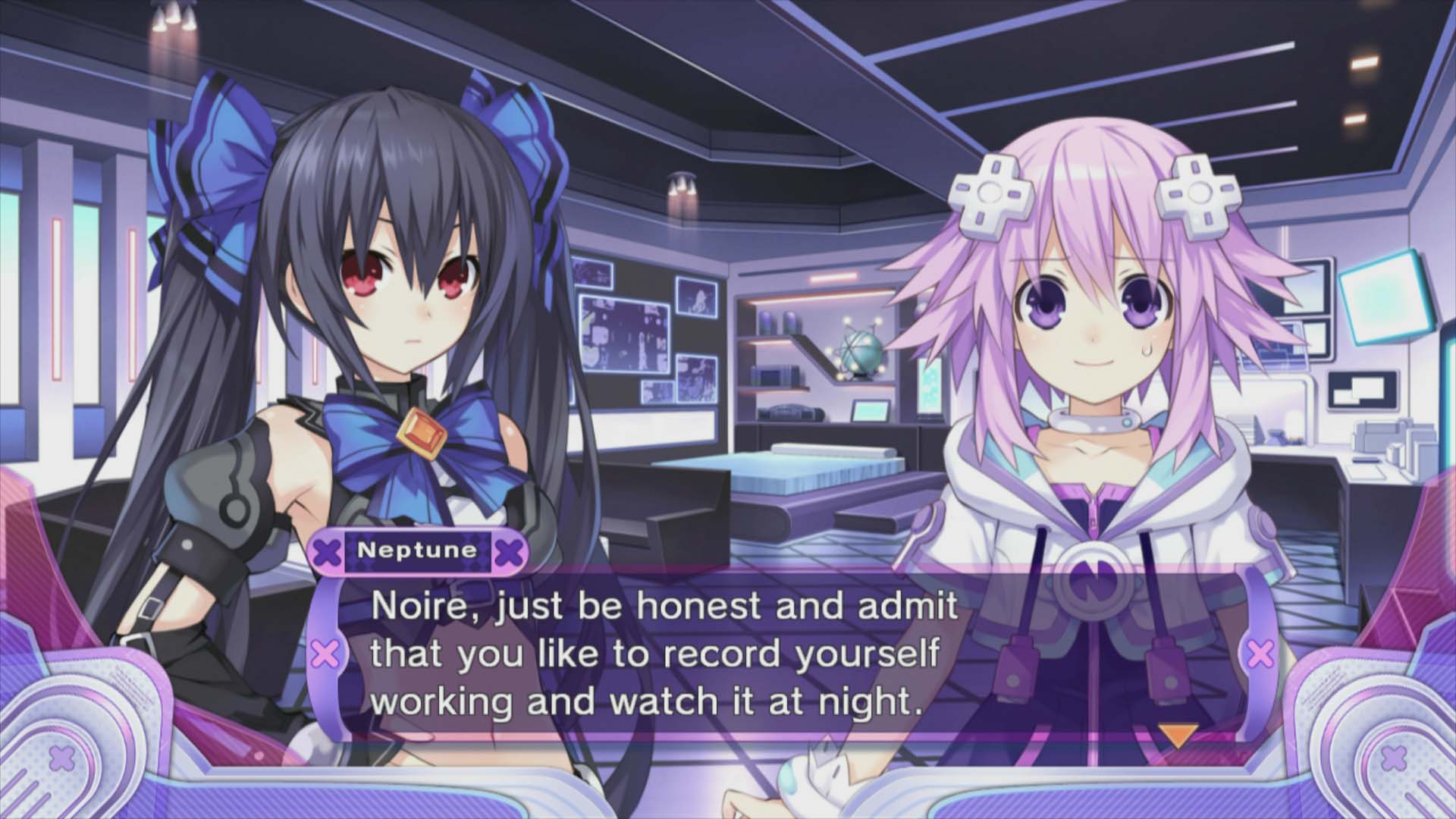
What's emphatically Not Okay by any stretch of the imagination is, as we've already said, shaming people for what they are into, regardless of what it is. Don't like anime panties? Fine. Don't throw horrible names at people who do. Don't like Gone Home? Also fine; likewise, don't throw horrible names at people who do. Don't like Call of Duty? Also fine… you get the idea, no? To sum up: don't be a total cunt.
A little respect goes a very long way. And gaming culture as a whole is not remembering that fact right now, and it saddens me greatly. Let's all try and do our bit to make our wonderful medium a little bit better for everyone, shall we?
 Earlier today (or possibly yesterday, I think), a former colleague posted a piece on a site I used to work for bemoaning, not for the first time, the amount of "ecchi" content in modern Japanese games, particularly dungeon-crawling RPGs. (I'm not going to link to it.)
 Interesting indie game time? Interesting indie game time.


 Interestingly, all four of these games are based on the same basic system — something which I criticised Western-developed free-to-play mobile games for above — but manage to distinguish themselves from one another by the additional elements they stack on top of this basic structure. Western free-to-play games, conversely, tend to adopt one system and stick with it, without adding anything in particular to the formula.
 Otoha is arguably the "leading" heroine in the story due to the fact that she's introduced alongside the protagonist Takt. Otoha is a cheerful, positive, upbeat young girl who has always looked at idol culture — or, in the context of Omega Quintet, "Verse Maiden" culture — with starry-eyed awe. Although Omega Quintet's world is post-apocalyptic and in many ways both bleak and dystopian, Otoha's infectious energy allows her to bring a sense of brightness and lightness to even dark situations; fellow Quintet member Aria even says as much in a rare moment of lucidity.
 Kanadeko, meanwhile, is another energetic character. While Otoha is passionate and determined, Kanadeko is more concerned with having fun and being friends with everyone. This is reflected through everything from her perpetually wide-eyed facial expressions to her seeming inability to stand still and her loud voice. She's keen to do a good job as a Verse Maiden not because she's especially passionate about it in the same way as Otoha — though she is dedicated to her work — but because she thinks it will be a fun thing to do.
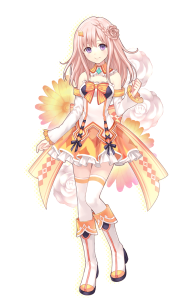 Kanadeko's perpetual companion is Nene, who in many ways is the polar opposite of her loudmouthed counterpart. Nene is shy, awkward and has a tendency to babble incoherently when she's feeling nervous — which is quite frequently. In extreme cases, this trait exhibits itself through her blurting out some things that make people feel a little uncomfortable — such as her enjoyment of and enthusiasm for firearms — usually closely followed up by some embarrassed awkwardness as she apologises for saying "strange" things.
 Kyouka, meanwhile is the character that is probably most directly concerned with her honne and tatemae. As a "class president" sort of character, Kyouka is serious and determined and almost painfully tsun at times, but she sees her lack of confidence in her performance abilities as a failing, and consequently tries to do something about them. She is also very concerned with what people think about her; she spends quite some time worried that her former mentor Shiori hates her for coming to join the other Verse Maidens, and it takes a reluctant intervention by Takt to help the pair at least start to realise that neither of them really resents the other, though they both find that impossible to admit.
 Finally, Aria is the most enigmatic of the Verse Maidens. Initially introduced as a happy-go-lucky, cheerful girl whom Kanadeko and Nene knew when they first joined the group long before Otoha and Takt came along, we subsequently discover that she suffered greatly at the hands of the Blare and went into hiding. When she re-emerges, she's seemingly emotionless — but not cold — and seemingly not quite aware of everything that's going on around her. The damage to her mind by the Blare, it seems, was severe.
 One of the best things about the Japanese games I tend to play in preference to anything else is simultaneously one of the most frustrating things.
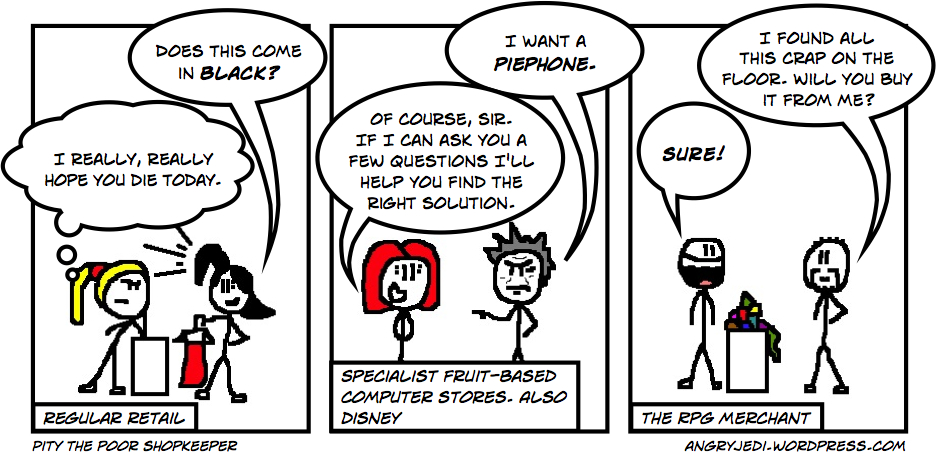 The poor shopkeeper doesn't have it easy, whatever form they take. If they're a retail monkey working for minimum wage in some sweaty hell-hole where chavs repeatedly come up and ask if the nearly-black garment they have in their hands is available in black, then they're probably losing the will to live by the second. If they're working in a, shall we say, "premium" retail environment they're probably having a better time but rapidly growing sick of the fixed grins they're forced to wear, not to mention the stock phrases that spew forth from their mouths like some form of verbal effluvia.
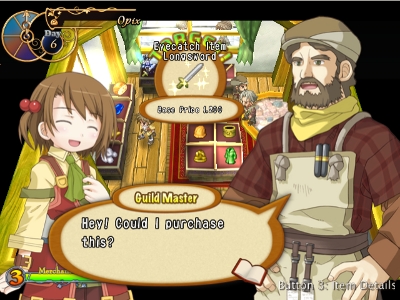 So far, so Animal Crossing, you might say. And you'd kind of be right. Except not. There really isn't another game quite like Recettear out there. There are games which focus on individual elements of the game, sure. But none which blend together such peculiar and diverse elements with such successful results.
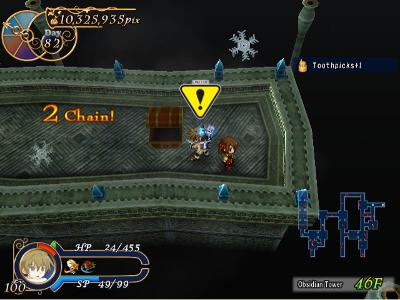 Yes, there are dungeons. Because sometimes the local markets just don't have the things people want to buy. When that's the case, Recette is free to pop down to the local Adventurers' Guild and hire one of the guildies she's made friends with. It's then into an action-RPG dungeon crawler to kick monster booty and gather lots of crap that people might want to buy.