#oneaday Day 661: When people would gnaw off an arm for a freelance writing gig, using generative AI is unforgivable

In the last 18 years, 4,535 posts and 3,263,700 words (yes, really, I got a plugin to count them and everything), I have never once felt the need to outsource my thinking and creativity to a machine. There are two posts written by "guest authors" (which, spoiler, were actually both me in a cunning disguise!) and there are a couple of posts where I permitted drunken friends the opportunity to contribute a sentence or two to a post I was writing while out and about, but the remainder is all me, scooping out the contents of my brain and plopping it onto the page for no other reason than the fact that I enjoy doing so, and occasionally find it helpful.

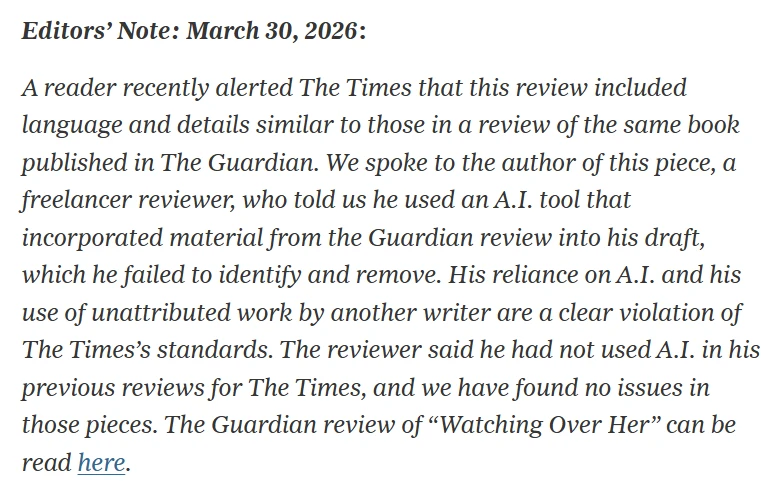
Today, this notice appeared in the New York Times on a book review it had published:

Editors' Note: March 30, 2026:
A reader recently alerted The Times that this review included language and details similar to those in a review of the same book published in The Guardian. We spoke to the author of this piece, a freelancer reviewer, who told us he used an A.I. tool that incorporated material from the Guardian review into his draft, which he failed to identify and remove. His reliance on A.I. and his use of unattributed work by another writer are a clear violation of The Times's standards. The reviewer said he had not used A.I. in his previous reviews for The Times, and we have found no issues in those pieces. The Guardian review of "Watching Over Her" can be read here. (link)

This, to me, is unforgivable. Supposedly there are plenty of writers out there who are doing this — or something like it, anyway — but to me, it is unfathomably awful. To be a writer, someone who cares about one's craft, you have to give a shit. And absolutely nothing says "I don't give a shit" quite like relying on generative AI so heavily that your article has to be pulled because its plagiarism was too obvious.

I mean, when you think about it, it's obvious that this would happen, given the way generative AI works and is trained — if it's pulling all its wording from existing texts that it has absorbed (without any compensation for the original authors) from around the Web, then of course it's going to come up with some of the same things, perhaps even the exact same phrasing.

You'd think it would be obvious, anyway — and that any writer worth their salt would not, as a result, rely on it — but apparently this is not the case. Much how the above-linked Wired article should really result in all the authors named being blacklisted from every freelance writing pool, effective immediately, this incident should be the end of Alex Preston's career. There should be no second chances. To quote the old Batman meme, this is the weapon of the enemy; we do not need it; we will not use it.

Believe me, at this point I've heard every pro-AI argument there is — some, like the nonsensical "back in the '90s some people thought the Internet would be a bad thing!!" one, more than others — and none of them stand up to the slightest bit of scrutiny. AI does not make you a better writer. AI does not make you a writer. The only thing that makes you a writer is, quite simply, writing. And if you are not sitting down and writing something for yourself — whether that be through putting pen to paper, tapping away at a keyboard or dictating your words verbally — you are not a writer. And no, "writing" your prompt to get the bot to churn out a thousand words for you does not count.

Humanity's written languages have survived for thousands of years — albeit with plenty of evolution — through people being taught how to use them. It is, today, a fundamental part of your early socialisation process to learn how to read and write; yes, some folks have specific learning needs that make it harder or even impossible for them to do so, but even for them, generative AI is emphatically not the answer, as we have plenty of assistive methodology and technology that can allow these people to thrive that does not rely on the odious fad that is presently bleeding the planet dry.

So I'm sorry, I have no patience left whatsoever for any incidents like this. The people involved in the Wired and New York Times articles above deserve to be kicked out of their career. Because if they have no respect for writing as a craft, why on Earth should any readers be expected to have any respect whatsoever for the shit they've churned out through the bots?

There are myriad people out there who would chew off their own arm for an opportunity to have a byline beneath a prestigious masthead — and every one of them who relies entirely on their own writing abilities, rather than outsourcing their creative process to the planet-burning chatbot, deserves those opportunities a million times more than those who clearly have no respect for themselves, their peers, or their readership.


Want to read my thoughts on various video games, visual novels and other popular culture things? Stop by MoeGamer.net, my site for all things fun where I am generally a lot more cheerful. And if you fancy watching some vids on classic games, drop by my YouTube channel.

If you want this nonsense in your inbox every day, please feel free to subscribe via email. Your email address won't be used for anything else.

#oneaday Day 654: Jensen Huang is an enemy of the arts

The headline is probably not news to most of you reading this, but I feel like it's worth commenting on, because the NVidia CEO just can't seem to keep his mouth shut.

To recap: a little while back, NVidia introduced its new "DLSS5" technology via transparently obvious Digital Foundry advertorial video. I still don't really know what DLSS is, or what it used to be I guess, but this latest incarnation of it did… not go down well, to say the least.

The reason? It's fucking generative AI, because of course it is. In this case, it's generative AI that takes two multi-thousand dollar graphics cards to render a slop filter over the top of the perfectly functional graphics the game already had. Early defenders tried to convince everyone else that it was just "improving the lighting", but then Huang came out and said the following:

First of all, [the critics are] completely wrong. The reason for that is because, as I have explained very carefully, DLSS5 fuses controllability of the geometry and textures and everything about the game with generative AI. It's not post-processing at the frame level, it's generative control at the geometry level.

(Tom's Hardware)

Okay. So it is generative AI. Which sucks. And everyone hates. And in this instance, it is adding what is colloquially referred to as a "yassification" filter atop character graphics in particular, making them look markedly different from their actual, canonical designs. You know, the ones that artists worked on.

Today, Kotaku posted what I would argue is a bit of a fluff piece on the subject, quoting Huang extensively. Huang is presumably in some sort of "damage control" mode — although not that much, because the part of NVidia that makes decent graphics cards for gaming PCs and consoles is of very little importance to a company that has very much thrown its entire lot in with generative AI.

From the Kotaku piece, quoting Huang, who was speaking on a recent episode of Lex Fridman's podcast:

DLSS 5 is 3D conditioned, 3D guided. It's ground truth structure data guided. And so the artist determined the geometry we are completely truthful to. The geometry maintains in every single frame.

Okay, first of all, what the fuck does "ground truth structure data guided" mean? Secondly, I'm sure the geometry is still there, it's just underneath a hallucinated AI-generated image.

He goes on (emphasis mine):

Every single frame, it enhances but it doesn't change anything. The system is open, you could train your own models to determine, and you could even in the future prompt it. You know, 'I want it to be a toon shader, I want it to look like this kinda,' so you can give it even an example. And it would generate in the style of that, all consistent with the artistry, you know, the style, the intent of the artist. And so all of that is done for the artist, so that they can create something that is more beautiful, but still in the style that they want.

So let me get this straight. It "doesn't change anything", but it does "generate in the style of" how it is prompted, am I getting this right? So it does, in fact, change something?

And who is doing this "prompting", exactly? Who is saying "I want it to be a toon shader"? The end user? Because that sure as fuck doesn't sound like being "consistent with the artistry and intent of the artist". Or is it the artist? Because if an artist wants their visuals in a toon style, they'll design them in a fucking toon style in the first place and they don't need the slop machine to do it for them. Or they don't if they're an artist with any fucking skills, anyway.

All this just confirms exactly what we've known for a while now: Jensen Huang is an enemy of the arts. He doesn't give a shit what the "style and intent of the artist" are, because his magic slop machine can just overwrite it and make it look "more beautiful". Fuck the artists who worked hard on each scene, each character, each object. Fuck having a coherent, distinctive artistic vision and visual style — bring on the uncanny valley AI slop! Fuck everyone who makes it their life's work to bring interactive worlds and the characters who inhabit them to life!

Jensen Huang, you are a rancid little fuckboi who, years after this bubble pops, will be looked back on as one of the most insidious, dangerous influences on the arts that there has been for a very long time. I'm not sure what sort of legacy you think you're leaving behind, but I can tell you with great confidence that it will not be a flattering one.


Want to read my thoughts on various video games, visual novels and other popular culture things? Stop by MoeGamer.net, my site for all things fun where I am generally a lot more cheerful. And if you fancy watching some vids on classic games, drop by my YouTube channel.

If you want this nonsense in your inbox every day, please feel free to subscribe via email. Your email address won't be used for anything else.
#oneaday Day 645: I do not need Gaming Copilot. No-one does

Apparently, three weeks almost to the day after the new AI person in charge of Xbox said that they wouldn't let Xbox become overrun with slop, Xbox has announced that it will be launching a slop generation feature that you can use right on your console!

It's Gaming Copilot! Something absolutely no-one asked for! The world's least popular lying plagiarism bot, shoehorned into the console brand that is seemingly determined to fast-track itself into becoming the world's least popular console!

I do not understand this. I do not want this. I do not understand why people think anyone wants this. It is an oft-overused line, but I come to gaming to escape from all the annoying bullshit of real life — which includes lying plagiarism bots — and not to talk to my fucking Xbox. I do not want my games console to "help" me or offer "advice" (and, given the inaccuracy rate of generative AI, I use those terms loosely) and I certainly do not want or need it to be a "companion".

The people pushing this bullshit have absolutely no understanding of what makes good games work, and why people enjoy good games. At GDC, there was a Google demonstration about how chatbots could power NPCs, and their showcase involved a random nobody in an 8-bit Final Fantasy-style RPG babbling on for three pages about their daily routine. The executives who think this is a good idea are impressed because people can "ask anything" to any character in the game. Anyone who has ever played a game with characters that talk to you will know that writing decent NPC dialogue is an art; it needs to balance worldbuilding with helpful advice, without bogging things down too much with, say, three pages of meaningless waffle from a random townsperson. Google's demonstration does none of this correctly.

And Gaming Copilot completely misses the point of everything, too. Today's games are incredibly, wonderfully immersive, transporting players to a whole other world where they can be someone else and achieve things that are impossible in reality. The best games are full of moments of organic discovery and the joy of play — although there's a whole other discussion to be had about modern game design, particularly in the triple-A space — and absolutely do not need a fucking chatbot listening to everything you do. It is not a substitute for having an actual friend, and it is not a substitute for looking up information from someone who knows the game inside out and can offer you well-sourced, helpful advice.

"Oh, but you can just say what you want instead of having to look it up!" Yes, you can, but if you can't guarantee it will be correct — which you absolutely fucking cannot — then what is the point? Plus where do you think all this information that it is offering you is coming from? That's right, the hard work of people who actually took the time to assemble all that information. And you can bet your fucking ass that Gaming Copilot will not credit the sources of this information, because it certainly isn't doing so in the early demo videos that are currently circulating.

I'm so tired. I'm so tired. The video game medium is in a fucking disastrous state. Earlier today, I saw someone actually say it is in the worst position it has been in since the Great Global Video Game Crash of North America back in '83, and while I'm not sure we're at "burying things in the desert" territory just yet — at least partly because the overwhelming amount of software available today is mostly digital — it's becoming increasingly clear that things are absolutely fucked. Game Key Cards, always-online games, perpetual development roadmaps, live service games — all of it is just driving people like me, who have been involved with gaming since its very inception, far, far away.

At least if everything does come crashing down in the next few years, there is still a rich library of games from between the late '70s and now to enjoy. With each passing day, and with every announcement of Some New Bullshit, I feel increasingly like just packing in "Modern Gaming" altogether and living my life with the games I have in my collection right now.


Want to read my thoughts on various video games, visual novels and other popular culture things? Stop by MoeGamer.net, my site for all things fun where I am generally a lot more cheerful. And if you fancy watching some vids on classic games, drop by my YouTube channel.

If you want this nonsense in your inbox every day, please feel free to subscribe via email. Your email address won't be used for anything else.

#oneaday Day 592: Abstinence from AI

I, as I may have made clear on a few separate occasions on these hallowed pages, fucking hate generative AI. I do not use it. I do not need to use it. I do not want to use it. And I cannot wait for the whole bubble to pop and this whole shitshow to go the way of the NFT and the Metaverse.

In the last few weeks in particular, I've found that there are a lot more people seemingly trying to push AI as "sort of all right, really". You know the sort of thing, people just casually, jokingly drop into a Discord chat that "out of curiosity, [they] threw it into Gemini to see what would happen" and before you know it, all meaningful human conversation has been replaced with copy-pasted obsequious fawning over the prompter, bold-type section headers and bullet-pointed lists.

Not only that, but the press are at it, too; just today, Undark Magazine (which I've never heard of prior to today) posted a piece called "Abstinence from AI is Not the Answer", in which the authors, C. Brandon Ogbunu and Cristopher Moore, make the baffling assertion that refusing to engage with AI "puts vulnerable people at risk".

"Like many new technologies," they write, "AI can either amplify inequality or ameliorate it, depending on how it is deployed. And fears about the likelihood of it amplifying stratification and segregation are valid. But advocating for abstinence will deny communities access to the tools the privileged are already using to help them write college essays, do their homework problems and learn a second language. Puritanical stances leave people ill-equipped to use this technology responsibly and unable to benefit from it."

Okay, but… hear me out… generative AI is terrible at all of those things. AI writing can be spotted a mile off. It gets answers to basic problems wrong, making it useless for homework. Due to its propensity to hallucinate and fawn over the user, you can't necessarily guarantee that its use of a non-English language is correct, nor that it will correct you if you get something wrong. And, more importantly than all of those things, relying on generative AI to do any of those things strips you of the ability to do them yourself. Not only that, it kills your curiosity to learn and discover new things for yourself, because it's much easier to just ask the chatbot to do it for you rather than to put in the work to learn a new skill yourself.

It's this latter part that really concerns me about generative AI. I've seen so many people willingly hand off to a chatbot during normal discussions and arguments and think that's a shortcut to "winning". When our legal and medical professionals are caught using these unflinchingly awful tools, their own skills and knowledge atrophy because they have no need to retain them — the chatbot will do all the hard work for them.

And what happens when, as looks increasingly likely, the money runs out and all these monumentally wasteful services are no longer able to operate? We're going to need humans who can actually do stuff again. And I'm concerned we're going to struggle to find them, because just over the course of the last couple of years I've seen a frightening amount of people completely give up on seeking out reliable information, knowledge and training for themselves because they can just ask the chatbot.

To address Ogbunu and Moore's main point — that abstinence from generative AI puts vulnerable people at risk — I say, full-throatedly, bollocks. The Internet has been a constant presence in all our lives — whether we're privileged or vulnerable — for decades at this point, to such a degree that it is considered one of the basic utilities these days. It is rammed full of helpful, thoughtful, weird and wonderful information, and the only skill one needs to cultivate in order to take advantage of this is how to determine whether or not something is a reputable source. That is something that we learn to do in school — or we should learn how to do, anyway.

If you hand that job over to a chatbot which is demonstrably wrong a statistically significant amount of times you ask it a question, you are not making use of that skill. That is not democratising the delivery of information; it is filtering all that information through a technology that, at its core, has been designed only with the interests of its billionaire owners in mind. And not only that, to get the supposed "best" out of these chatbots, you're expected to pony up $200 or more a month for a subscription. That doesn't sound very inclusive to the most vulnerable of society.

"Choices we make now will determine whether AI will be a tool for the powerful, dazzling the rest of us with its hype and subjecting us to its harms, or whether it will be a tool — imperfect but useful — in everyone's hands," conclude Ogbunu and Moore.

If it's an imperfect tool, it's not useful. I repeat: I do not use it; I do not need to use it; I do not want to use it. My choice is made; if I see anyone "powerful" using generative AI, I will laugh at them, because they are depriving themselves of the joy of thinking, of learning, of discovering, of creating. And then I will pity them.


Want to read my thoughts on various video games, visual novels and other popular culture things? Stop by MoeGamer.net, my site for all things fun where I am generally a lot more cheerful. And if you fancy watching some vids on classic games, drop by my YouTube channel.

If you want this nonsense in your inbox every day, please feel free to subscribe via email. Your email address won't be used for anything else.

#oneaday Day 557: How to torch universal goodwill with one simple interview

Today, Larian Studios, makers of the Divinity series and the universally acclaimed Baldur's Gate 3, found itself in the crosshairs of the Internet's ire due to comments made by its CEO, Swen Vincke during an interview with Bloomberg.

According to Vincke, Larian has been using generative AI behind the scenes to, in his words, "explore ideas, flesh out PowerPoint presentations, develop concept art and write placeholder text". None of which are things you need generative AI for, and all of which are things that people have been perfectly capable of doing with their own human brains for decades. In fact, there are people who specialise in elements of what he described — most notably concept art, which is the area a lot of critics have been focusing on.

Vincke's comments are remarkably ill-considered given the number of times that generative AI use in video games has been subject to backlash from the general public and journalists alike over the course of just the last year — and for many of the same reasons that Vincke is arguing in favour of.

The otherwise well-regarded sci-fi game The Alters was irreversibly poisoned for a lot of people earlier this year when it became apparent that they had used ChatGPT to generate placeholder text for background textures and localised strings for non-English languages.

The umpteenth reboot of Everybody's Golf came under fire for non-specific use of generative AI that I'm not sure anyone ever quite got to the bottom of.

The new Let It Die game, which has no involvement from the previous game's original developers Suda51 or Grasshopper Manufacture, has been lambasted for extensive use of AI-generated material.

The promising "people sim that isn't called The Sims" inZOI turned huge swathes of prospective players away by its game's heavy reliance on generative AI, as well as its publisher Krafton's insistence that they are pivoting to becoming an "AI-first" company.

The latest hot "extraction shooter" (I still don't really know what that is, and no, I don't really care) ARC Raiders got dinged with a 2/5 review score for its use of AI-generated voices — not just because they were AI, but because using AI-generated voices is at artistic odds with the story the game is trying to tell.

Even the once-beloved Oliver Twins, former stars of the UK "bedroom programming" scene in the '80s, got a kicking from press and public alike for their absolutely terrible AI-generated "follow-up" (and I use the term loosely) to their old Spectrum game, Ghost Hunters.

People hate this shit — and with good reason. Generative AI is a lazy, soulless solution for feckless CEOs to foist on their creative teams because they think it will "add value" for shareholders, when in fact there is growing evidence by the day that the entire generative AI scene is financially, environmentally and societally ruinous.

On top of all that, it doesn't work well enough to be worth using! Every single AI "tool" currently available carries a prominent disclaimer that it "might" (read: "will") get things wrong from time to time, making them fundamentally useless for doing anything useful with — and their "fun" uses are causing the Internet to become overrun with even more meaningless, pointless slop than was already splattered everywhere in the first place, on top of boiling all our lakes. At least stupid things from a bygone age like Badger Badger Badger and Seepage (to name just two examples from what I believe to be the golden age of Internet nonsense) are the result of both genuine human creativity and skilful use of creative tools that don't involve typing "make me funny video garfield giant boobs mechahitler piss filter" into a chatbot.

Vincke's point was not that the new Divinity game will be riddled with AI-generated voice lines or visuals. In fact, he claims that the studio is "neither releasing a game with any AI components, nor are [they] looking at trimming down teams to replace them with AI", but that AI is "a toolset for creatives to use and see how it can make their day-to-day lives easier, which will let us make better games".

Vincke has, apparently, been receiving some pushback from within Larian about this — and he's certainly been getting some choice words from former employees today, too. The situation escalated to such a degree that he issued a statement in response to IGN earlier today. Unfortunately, said statement doesn't really say anything — and, worse, attempts to obfuscate his earlier statements by pointedly using the term "ML" (for "Machine Learning") rather than his earlier use of "AI" — today typically interpreted to mean "generative AI" when used in contexts such as this.

For me, the worst thing was his final paragraph:

While I understand [generative AI] is a subject that invokes a lot of emotion, it's something we are constantly discussing internally through the lens of making everyone's working day better, not worse.

Here's the thing. You see that people are getting sniffy about generative AI, something which is well-established by this point to be A Thing The Public Fucking Hates. The sensible thing to do from a public relations perspective at this point, regardless of what you actually think, is to go "okay, you know what, we hear you, this sucks" or something along those lines, and then promise to "do better" or the like. A bunch of people won't believe you, of course, but this is better than going "no, well, I actually do think everyone at Larian should use this, and by 'discussing internally' I probably actually mean mandating that all employees have to use it at least a certain amount", which is how this is all coming across right now.

The particularly dumbass thing about this episode is, as I said above, none of the examples he gave are situations that need generative AI — or even where it is particularly beneficial. In fact, several creative types have commented today on how using "good enough", plausible-looking placeholders is actually detrimental to the entire creative process. Former Rocksteady employee Amy-Leigh Shaw commented thus on Bluesky earlier:

Placeholder text isn't supposed to be unique per line. It is supposed to be an instruction to the writer with a great big warning sign slapped on the top, so that it doesn't slip into the finished game. Unique sentences of bland writing are the least helpful thing to use for that purpose!

I also find that one of the more frustrating blockers to writing is when there's already a (bad) suggestion of what you should say. You are no longer able to organically find the idea because the suggestion in front of you knocks you off the track of your natural thought process.

Shaw is talking specifically about writing here, but several artists agreed that this is the case when dealing with concept art, too. The difference between a hastily scrawled Microsoft Paint doodle and the "this sort of looks right" thing that generative AI spits out is enormous — and in the latter case, it will absolutely colour an artist's interpretation of a scene or character, often unconsciously.

In other words, there's no defence of using generative AI as "placeholders" for text, concept art, voice acting, music — anything that a creative person is actually going to get involved with. The entire point of a placeholder is that it's something obviously shit and out of place so it can be easily spotted and subsequently replaced by a specialist at some point in the development process. Because generative AI produces something that is often "good enough" to the untrained eye or someone not looking closely, it's easy for it to get missed — as happened with The Alters earlier in the year.

Vincke's comments — and his subsequent follow-up statement — have torched a significant amount of goodwill that people had for Larian Studios in the space of just a single day. People fucking loved Baldur's Gate 3 and the previous Divinity: Original Sin games! It feels like it shouldn't have been a difficult job to maintain that goodwill while hyping up your new game — even if some found themselves a tad squicked out by a rather grim trailer at The Game Awards. But no. C-suite gonna C-suite, I guess — and it appears that this is true for companies people had, up until now, actually liked, as much as it is for companies people love to hate. And the net result of this for Larian is that people who were previously excited about a new Divinity game are now not going to touch it.

I know this has certainly given me a great degree of pause on wanting to check out any of Larian's work. I've been meaning to look at the Divinity: Original Sin games and Baldur's Gate 3 for a while — but now I'm in even less of a hurry to do so than I was already.

I'm so very tired of this. I, like many others, cannot wait for this fucking bubble to pop so we can get back to something approaching "normality", whatever that even means any more.


Want to read my thoughts on various video games, visual novels and other popular culture things? Stop by MoeGamer.net, my site for all things fun where I am generally a lot more cheerful. And if you fancy watching some vids on classic games, drop by my YouTube channel.

If you want this nonsense in your inbox every day, please feel free to subscribe via email. Your email address won't be used for anything else.

#oneaday Day 556: Customer non-service

Generative AI has, supposedly, revolutionised a number of sectors, with customer service being one of the most commonly cited areas that benefits from having a lying chatbot front and centre.

Except it doesn't benefit at all, does it? Because all the chatbot adds is an unnecessary step between someone who needs some help with something and them actually getting that help. And, in a lot of cases, the chatbot passes completely incorrect information on to the few remaining real people who might actually be able to do something.

My current predicament is that I'm trying to return something to a retailer. A pair of shoes. They didn't fit. Should be simple enough, right? On the retailer's own website, they allow you to set up the return and organise a courier service to come and collect it.

The courier service of choice for the retailer, Schuh, was Evri. This will probably strike fear into the hearts of most people, but honestly, up until now I've not had a huge problem with them (or their previous incarnation, Hermes). But it seems that Evri, specifically, is having a few issues right now.

My particular problems started ten days ago, when the courier was originally supposed to pick up my package to return it. They did not show up. My wife and I were in all day. There was not a single knock at the door, and I got a notification that there was "no answer" when they supposedly called to pick up the package.

No matter, I thought, checking the tracking information. They said they'll be back the next working day.

They were not back the next working day. Or the one after. So I attempted to contact Evri in order to sort things out.

Initially I got a chatbot that promised to "escalate" the issue and then did absolutely nothing. Like, it just stopped responding to anything. So I tried again. This time I tried some different options and seemingly got a message through to someone.

Except the people on the other end of my correspondence are all absolutely convinced that I am awaiting a package delivery, despite me telling them repeatedly that I need the package collecting from my house. And thus I suspect what is happening is that they are rummaging through their big pile of parcels, hoping to find the one they think they are supposed to deliver to me, not finding it, going "oh shit" and then just not doing anything else — when, in fact, the package that I want them to collect has been sitting in my house's front hallway for the last 10 days.

This isn't the first time I've encountered a situation like this since the dawn of AI chatbots, either. Earlier in the year, I had an Ikea chair break on me, and it was under guarantee, so I tried to get it replaced. After laying out very clearly that I needed the entire chair replaced under the guarantee thanks to the nature of the problem, and receiving assurances that yes, I would receive a full replacement chair from the possibly-human-probably-not thing that I was interacting with online, I waited two weeks… and then received a package through the post that contained a single chair leg.

How is anyone looking at situations like this and thinking "yes, that's a big improvement over what we had before"? The blame isn't entirely at the feet of the AI chatbots, I know, because in all of these cases there's an obvious degree of (possibly) human error involved, but the AI chatbot certainly isn't helping the fucking situation. In every case that I've had the misfortune to interact with an AI customer service chatbot, the bot hasn't been able to help with what should be a very simple enquiry and has passed me on to what is supposedly a human being that speaks English. And in every case it has seemingly passed on incorrect information — information that the supposed human being won't fucking listen to me correcting, even when I do so repeatedly and very, very clearly.

Just another way that the cyberpunk dystopia we live in completely and utterly sucks. With no real benefits to go along with all the suck.


Want to read my thoughts on various video games, visual novels and other popular culture things? Stop by MoeGamer.net, my site for all things fun where I am generally a lot more cheerful. And if you fancy watching some vids on classic games, drop by my YouTube channel.

If you want this nonsense in your inbox every day, please feel free to subscribe via email. Your email address won't be used for anything else.
#oneaday Day 522: Bravo Eurogamer

Just recently, Eurogamer published a review of Arc Raiders, the latest multiplayer craze, and ruffled more than a few feathers when the reviewer, Rick Lane, dinged the game with a 2/5 star rating, primarily due to the game's apparent use of generative AI to create many of its voice lines. The developer, Embark Studios, has form in this area, with its previous title, The Finals, also featuring AI-generated voice lines.

The reviewer's justification for giving the game such a low score was not simply "AI bad" — it was because, from an artistic perspective, getting a soulless robot to voice the human characters in your game that is about robots who have taken over the world and forced humanity underground feels just a little too incongruous to be able to pass without comment.

And I agree. I also firmly, strongly and resolutely believe that the use of generative AI in video game development is an obnoxious, odious, wasteful, exploitative and ethically reprehensible practice — and I have a firm policy that I will absolutely not engage with a game that appears to have been tainted with generative AI garbage. It's why I didn't play The Alters, it's why I haven't played the latest Everybody's Golf, and it's why I won't touch Arc Raiders. (In the latter case, it's also because I suspect I won't like Arc Raiders, but that's beside the point right now.)

I've been disappointed at quite how many people I've seen handwaving away this aspect of Arc Raiders in particular. Indeed, the Eurogamer review has a comments section that is at least as much of a trash fire as you would expect, because Video Game Good, and you're not allowed to take a firm ethical stance about something in a review because then the Gamers™, the good little consumer piggies that they are, will get mad that you said their Favourite Forever Game This Week was perhaps not to your taste for a perfectly valid reason.

The unfortunate thing with Arc Raiders is that its use of AI and machine learning (which are different things) is a bit shrouded in uncertainty right now. Some folks say that its generated voice lines are fine because it's actually just a fancy text-to-speech system; some folks are taking this argument further in order to weaponise disabled people and accessibility features; some are saying that it's fine because the actors the voices were trained on were aware of what they were signing up for.

But regardless of whether or not Arc Raiders' voices were generated by supposedly consenting voice actors, or if they were the product of the more environmentally disastrous end of generative AI, the entire thing rubs me the wrong way. The really stupid thing is that the generated voices in Arc Raiders are for things that voice actors could have very reasonably just recorded — things like vendors, NPCs and suchlike — and Embark's justification for using generated voices is that it's "quicker". On top of that, the results are markedly, obviously inferior to using an actual voice actor recording the complete lines, so one has to question if cutting corners in this way is really worth it.

Embark's not a small, frugal indie company, either. They have the resources to be able to afford voice actors to do a proper job. They're just refusing to. And regardless of the tech that produces the not-very-good end result, it sets a poor precedent to do that.

The arguments in favour of generated voices aren't very convincing, either. The most common one that comes up is that "one day we'll have games where every NPC conversation will be AI-generated, and you'll be able to talk to them about anything!" And to that I say: I absolutely do not want that.

When I'm playing a game that has characters in it, a narrative, a setting, all that stuff — I want to experience the vision of the creators. I want to enjoy something that someone else has created, with a clear vision and purpose behind it. I want to be able to reflect on the way a writer composed a piece of dialogue; how a character's mannerisms tell us more about them; how the tone of the whole piece gives a feeling of coherence to the game as a complete creative work.

If you're AI-generating your dialogue, you get none of that. You get a hodgepodge, incoherent mess that is easily exploitable — and, indeed, we've already seen that numerous times already, whether it's Darth Vader saying fuck or a character in the latest HoyoVerse game apparently having no idea who they are, what their background is, what their personality is or what is around them.

I refuse to accept the "genie is out of the bottle" argument. We've been making video games for 50+ years at this point, and the reason the medium has continued to endure is because of human creativity. We have seen incredible advancements in storytelling, mechanics and the overall craft of making all manner of different games over the years — and the AI glazers seem to want nothing more than to just throw all that experience away in favour of some "vibe coded" garbage with AI-generated dialogue and synthesised speech.

Couple that with the fact that AI is insanely wasteful, growing increasingly likely to make the worldwide economy crash, disastrous for the environment and taking valuable resources away from doing things that might actually make life better for people who really need it to be better? Nah. Don't need it. Don't want it. And will not support anything made with it, no matter how much you argue "no no no, but this is a good use of it, actually."

I say bravo to Rick Lane of Eurogamer for having the balls to stand up and say "no" to this garbage with a thoughtful and well-considered critique. If only we could see a bit more of that kind of thing, and less of this sort of rubbish.


Want to read my thoughts on various video games, visual novels and other popular culture things? Stop by MoeGamer.net, my site for all things fun where I am generally a lot more cheerful. And if you fancy watching some vids on classic games, drop by my YouTube channel.

If you want this nonsense in your inbox every day, please feel free to subscribe via email. Your email address won't be used for anything else.

#oneaday Day 439: Parallel dimension

A recent post over on WIRED begged the question "OpenAI is poised to become the most valuable startup ever. Should it be?" Leaving aside the obvious Betteridge's Law commentary for a moment, the actual content of this article was utterly baffling.

OpenAI claims it is worth $500 billion. We've heard this a lot of times over the last few months, and everyone seems to sort of have accepted it as the "truth". And yet there's this in the article:

[An anonymous OpenAI investor] argues that the math for investing at the $500 billion valuation is straightforward: Hypothetically, if ChatGPT hits 2 billion users and monetizes at $5 per user per month — "half the rate of things like Google or Facebook" — that's $120 billion in annual revenue.

"That alone would support a trillion-and-a-half dollar company, which is a pretty good return, just thinking about ChatGPT," the investor says.

Except that "math" isn't "straightforward" at all, is it? In fact, I would go so far as to say that it isn't "math" at all, because all of it, all of it, is complete fantasyland nonsense plucked out of the arse of a particularly flatulent ogre, then mindlessly parroted by breathless idiots who think spicy autocorrect is in any way a substitute for the most bare minimum of interpersonal interactions.

Look at it. Two billion users. That's a significant portion of the planet, and it's only very few services — likely Google and Facebook among them — that can count that many user accounts on their books, let alone active users, which is what this nonsense is actually talking about. For context, ChatGPT, at present, continually reports somewhere in the region of 300 million weekly users. That's a lot, sure, but an overwhelming proportion of those are people who are not paying for the service and just using it to burn down a forest or two for a picture of Garfield with tits.

To put it another way, assuming that not only are two billion active users going to magically appear from nowhere, but that every single one of them is going to pay $5 a month to use the lake-boiling plagiarism machine that loses OpenAI money on every paying user already, is patent nonsense.

It is, right?

It is, yes?

I know nothing about economics or business, and I feel like I can see beyond any shadow of a doubt whatsoever that this is an absolute absurdity. Couple that with OpenAI's Sam Altman making incredibly stupid comments like "building a Dyson sphere around the whole solar system" just so we have enough space for all the data centres these two billion imaginary users will need to use their equally imaginary $5 ChatGPT subscriptions, and I'm just left feeling like at some point between COVID and now I've crossed over from a dimension where things make sense into one where they just… don't.

Are we really living in a world where a company's valuation is determined based on completely imaginary figures? Well, I guess it makes sense when they have a completely imaginary product, too. Nearly half a decade into this nonsense and there are still no compelling use cases for the technology for most people — and even the most sweaty AI apologists are obliged to admit that yes, the chatbots get things wrong quite a lot of the time.

Microsoft put CoPilot in Excel! You know, the software you use when you want accurate data analysis and calculations! They added it with the disclaimer that it "might be wrong" and that it "shouldn't be relied on for high-risk situations". Like, you know, pretty much fucking anything you might use Excel for in a business situation.

What are we doing? What are we doing? And WHY?! ARRRRGGGGHHHHHH


Want to read my thoughts on various video games, visual novels and other popular culture things? Stop by MoeGamer.net, my site for all things fun where I am generally a lot more cheerful. And if you fancy watching some vids on classic games, drop by my YouTube channel.

If you want this nonsense in your inbox every day, please feel free to subscribe via email. Your email address won't be used for anything else.

#oneaday Day 375: So very very tired

Earlier today, someone shared a photo of a packet of Uncle Ben's instant noodles or something, which came with a disclaimer on the front that the image of the supposed product festering inside the pouch had been "generated with AI". And I think I felt something actually snap in my brain.

What are we doing. What are we actually doing. I am absolutely beyond sick of this garbage being force-fed to us from every possible angle, and for breathless ball-gargling apologists to come out with all the usual "oh, it's a tool, a tool can't be bad".

No. Fuck off. Generative AI is hot garbage, and I think we've proven that beyond every reasonable doubt at this point. "It hallucinates a bit" should be enough to put absolutely fucking everyone off ever even thinking about using it for research and analysis, and the fact that the companies who trained these models have had to go about it in the most underhanded means possible, potentially destroying creators' rights over their own work in the process, should be enough to ward everyone off. And to cap it all, these people spend billions every month to achieve nothing. Several years into this shit and we're still yet to see convincing use cases that don't have hefty caveats. And still the rich get richer, somehow, and the world, as a whole, gets worse and worse off.

Is the fact that people have been driven to suicide by "conversations" with AI bots not enough? Is the fact that multiple social media platforms are now pretty much unusable and a privacy nightmare due to the flood of AI not enough? Does the prospect of people not actually being able to perform necessary skills — like, say, coding to hold the world's infrastructure together — not absolutely terrify you? And do you not see anything even a little bit wrong with ChatGPT offering to modify an existing piece of writing "in the style of" another magazine so you can successfully pitch something you didn't write a single word of?

Every day, the world gets worse and worse, and frankly, I'm reaching a point where it is becoming less and less desirable to live in it. Couple all this inescapable AI shit with what's going on in America, the looming war in the Middle East (again) and the frankly frightening regressions the world has seemingly been going through with regard to acceptance, tolerance and inclusion, and it's not a pretty sight. It's no wonder that everyone in the world seems to be so argumentative, aggressive and confrontational all the time these days. This is a problem, but it's also a symptom.

When I was growing up, it felt like I was living through one of the most exciting periods in cultural, societal and technological history. Now I'm just embarrassed to be on the same planet as a frankly terrifying proportion of the population, who seem to think that everything we're doing right now is just fine, and we should definitely continue on this course, it absolutely won't cause terrible problems down the line.

I don't know what to do any more. I feel powerless, helpless, alone. And I'm sure I'm not the only one feeling that way.


Want to read my thoughts on various video games, visual novels and other popular culture things? Stop by MoeGamer.net, my site for all things fun where I am generally a lot more cheerful. And if you fancy watching some vids on classic games, drop by my YouTube channel.

If you want this nonsense in your inbox every day, please feel free to subscribe via email. Your email address won't be used for anything else.

#oneaday Day 370: Where's the breaking point?

Watching the shit going down in the United States, and seeing the general state of the world today, I have to ask… how far, really, is too far for humanity to put up with? Because part of me thinks that "too far" is, at this point, a distant speck behind us, and yet not an awful lot appears to be Getting Done.

Granted, there have been some big protests in LA recently, and justifiably so. This very much counts as Getting Something Done, particularly as it's making the authoritarian nature of the current U.S. government readily apparent through its response to said protests. But a lot of the people in the States with the actual power to Get Something Done — like, say, the Governor of California, or any number of other politicians with a platform — appear to be doing little more than writing sternly worded letters and posting them on social media, when they should be… well, doing more than that.

It's a similar situation, albeit from a wildly different perspective, with the generative AI thing. The general public doesn't want this. The people whose jobs are being put at risk don't want this. The people who just want "going on the computer" to carry the joy it once had around the turn of the century don't want this. And yet every day I read about huge companies like Google stubbornly digging their heels in, even going so far as to lay people off in an attempt to fund something which, at this point, has proven itself beyond a doubt to be inherently unsustainable, unprofitable and, moreover, useless.

And no, I don't want to hear any AI apologists giving me the "oh but it's great for coding and medicine!" spiel. In both of those instances, the prospect of zero human involvement is, frankly, horrifying. With the amount of bullshit generative AI still makes up on the regular, I wouldn't trust it to code anything without intense human supervision, and the second I see a doctor consulting ChatGPT is the second I report that fucker for malpractice.

But outside of outspoken critics like the previously linked Ed Zitron, not a lot seems to be getting done about the AI problem, either. I suspect a lot of people are scared to be the one to speak up at their workplace if their boss suddenly decides that they're going "all-in" on AI, whatever the fuck that means. (Don't worry, this hasn't happened at my place of work, thankfully.) And I think they're probably right to be nervous; I can see people getting shitcanned for spurious reasons like "not being a team player" if they object to their organisation's use of AI — and no, the irony of that would not be lost on me, given AI's potential to break up efficient, quality teams — and we are probably yet to see the true legal ramifications of someone who decides to challenge an employer who let them go in order to replace them with a hallucinating plagiarism machine.

So is that it? Is the answer that very few people are actually doing anything to resist the absolute bullshit that is happening in our because they are scared? If that's the case… yeah. I kind of get it. The stuff coming out of the States is terrifying to see unfold, even as someone an ocean away from where it's actually happening. And I won't lie, the prospect of losing my job to AI is a concern — one that sits at the back of my mind as a near-constant anxiety right now.

I miss being able to enjoy existence. Because it feels like a very long time since I've been proud to be a human being on this Earth at this particular time in history. Instead, it's an embarrassment. A terrifying embarrassment. And I sincerely hope that the day we look back on this and go "Never a-fucking-gain" is sooner rather than later. Because I'm certainly not going to look back on these days and laugh.


Want to read my thoughts on various video games, visual novels and other popular culture things? Stop by MoeGamer.net, my site for all things fun where I am generally a lot more cheerful. And if you fancy watching some vids on classic games, drop by my YouTube channel.

If you want this nonsense in your inbox every day, please feel free to subscribe via email. Your email address won't be used for anything else.