1742: Reaping Rafflesia

Page_1You may recall a short while ago I talked a little about Turn 5 of the Binding Coil of Bahamut in Final Fantasy XIV, notorious as being one of the most difficult battles in the game and essentially, if you want to look at it that way, the "true final boss" of the game as it existed at launch.

Since clearing that a few times, we've managed to get a regular group together to take on the Second Coil of Bahamut, a four-part dungeon that follows on from the original Binding Coil — and which is soon to be superceded by The Final Coil of Bahamut, bringing this particular side story to a close in suitably climactic fashion with patch 2.4.

We're by no means ready for the Final Coil of Bahamut yet — mainly because you have to clear Second Coil in order to even enter Final Coil — but we've been discovering the joy of having a regular, committed and enthusiastic group together to take on challenging fights.

The first Turn of the Second Coil of Bahamut (known in FFXIV vernacular as "Turn 6" or "T6", since it's the sixth overall part of the Coil storyline) is deceptively simple, much like the other Coil confrontations. You begin by making your way across some perilous terrain and fending off the unwanted advances of golems that spawn from chunks of dark matter and corrupted crystals. Having fought your way past these — destroying the crystals on the way — you find yourself in front of a fragment of Dalamud, the moon that fell from the sky at the end of Final Fantasy XIV's version 1.0 incarnation (and, by extension, the beginning of A Realm Reborn) and burst open to reveal the elder primal Bahamut. Over the course of the first Binding Coil of Bahamut, you come to discover some interesting bits and pieces about what Dalamud really was, why Bahamut was inside it and, indeed, what happened to it following the apocalyptic "end of the world" that appeared to happen at the conclusion of 1.0. Second Coil is elsewhere in the lands of Eorzea, and promises to offer further insights into the truth — but, of course, it's not that easy.

Your main obstacle towards even getting inside the damn place is an unpleasant little thing called Rafflesia, a plant from the Gridanian Twelveswood that has been corrupted by dark matter and which now appears to be a tad on the pissed off side. You ain't getting inside the Dalamud fragment without getting past Rafflesia, and thus begins another extremely challenging battle that our group is yet to clear — but which we've made significant progress on in our two attempts to date.

Like the previous encounters in the various Turns of the Coil, the battle against Rafflesia initially appears to be extremely complex and insurmountably difficult, but in reality it's all about being organised, communicating effectively and knowing how to deal with the various situations in which you find yourself.

Shortly after the fight begins, Rafflesia whips two party members with thorny vines, which attaches them together and continues to do damage as long as they remain joined. The only escape from this spiky fate is to run in opposite directions until the vine is snapped.

The plant monster then goes on to spawn dark matter bulbs, deadly seedlings that sprout into spiky briar patches that slow the movement of anyone unfortunate enough to step into them. A key part of this battle comes in the management of these briar patches; our attempts involved keeping Rafflesia as central as possible and only worrying about bulbs if they appeared where Rafflesia was. This occasionally demands that you dance around a little to make sure you're not standing in thorns, but it does allow you to concentrate on what you're really there for — punching/stabbing/burning/chopping a plant monster to death.

Rafflesia is a hungry beast, though, and every so often a party member will find themselves the target of the monster's appetite. She'll suck in everything in front of her, then devour it before spitting it out again; ideally, by the time she's doing the first thing, you're well out of the way, ensuring that the second and third things don't happen to you.

Rafflesia, being a plant, also has numerous unpleasant spores and gases designed for the obliteration of unsuspecting adventuring parties. Most deadly among these is her Blighted Bouquet, a devastating move which causes immediate death to anyone unfortunate enough to have been doing anything — moving, attacking, using an ability — when it goes off. She's also fond of glazing a party member in honey, which causes dark matter-corrupted hornets to come in and give the unfortunate adventurer some unwanted attention — and eventual death, if they're not defeated, too.

So far, we're yet to defeat Rafflesia; her Blighted Bouquet and dark matter hornets have proven particularly troublesome to deal with, but we've made honest-to-goodness progress in the two sessions of about 2.5-3 hours each that we've had to take on the fight to date. Along the way, we've come to work well together as a party, too, and the desire is there from all of us to continue the fight against Rafflesia, onwards into the fragment of Dalamud and, eventually, into the Final Coil of Bahamut to discover the truth behind the Calamity. (And, of course, to get some sweet loot in the process, too.)

I've been really enjoying our sessions so far; as I've noted before, Final Fantasy XIV is the first MMO that not only maintained my attention from beginning to level cap, but which has kept me interested with its endgame, too. Second Coil is, as of now, the most challenging dungeon in the game — though this will change on Tuesday when Final Coil arrives — and it's a pleasure to be able to take on these tough encounters with a group of people who are becoming not just online comrades, but friends, too.
1735: Thal's Balls

Page_1

Been watching some of the live online coverage of FanFest today — that's the Final Fantasy XIV Fan Festival, if you're unfamiliar.

The concept of a whole, large-scale event dedicated to a single video game may seem like an alien concept to some of you, particularly if you're more accustomed to events like E3 and EGX where hundreds upon hundreds of games are all vying for the press and public's respective attention. But with something like Final Fantasy XIV — which boasts somewhere in the region of 2.5 million players — it's understandable, particularly as the game is entering an exciting period.

This coming week or the next will see the release of the game's 2.4 patch Dreams of Ice, which is likely going to be the penultimate episode of the Final Fantasy XIV base game. We've already started seeing teasers for what the grand finale of the 2.X storyline will be, and doubtless Dreams of Ice will continue in that direction, taking in a spectacular-looking confrontation with Shiva along the way. Patch 2.5, which should follow along in about three months or so, looks set to provide a suitably epic conclusion to this story, and set things up nicely for the expansion Heavensward, which is coming in Spring 2015.

Aside from continuing the main storyline, Dreams of Ice will also wrap up the narrative surrounding the super-challenging endgame dungeons The Binding Coil of Bahamut, The Second Coil of Bahamut and, soon, The Final Coil of Bahamut. Those with the raiding chops to take on the challenges within will be rewarded with the truth behind the Calamity that befell Eorzea five years ago — and what's really going on with Bahamut. Is he going to wake up again and lay waste to the land, or…?

One of the interesting things about FanFest has been the panels, which have been broadcast live via Twitch, giving me my first reason ever to actually go to Twitch and watch something. And there have been some fascinating discussions, too; there was a great panel on the game's music earlier, and shortly before the time of writing there was a superb lore panel based around how the game's world is "written" and "built" — something that is a real strength of the game. Unusually for a largely Japanese game, much of the lore is contributed and composed by a Westerner (albeit one who grew up in Japan), and as such Final Fantasy XIV finds itself in a strong position to appeal to both Western and Eastern players. Its English localisation was so strong, in fact, runs the narrative, that Japanese players started to demand the same attention to detail, sense of humour and wit that runs through the English script, ultimately making all versions of the game into a superior experience. It was a heartwarming tale.

Mostly what FanFest has driven home is that Final Fantasy XIV is a truly global game, and that while it will likely never reach the same dizzy heights of World of Warcraft in its prime, it's in a very healthy position indeed — and that exciting times are ahead for those who make their second home in Eorzea. I'm looking forward to seeing what the future holds in the long term — but in the short term, there's this, at least:

1729: Twintania's Revenge

I cleared Turn 5 of The Binding Coil of Bahamut in Final Fantasy XIV once again this evening, adding another member to the roster of our group of (hopefully) regular raiders.

This time around, I decided that I was going to try and tank it. Although I have a level 50, well-geared Paladin class that I'm pretty confident in using for straightforward stuff like dungeons, complicated 8-player fights like Turn 5 have been something I've generally shied away from to date, unless I could rustle up a group of people I know and trust — and whom I don't think will yell at me if I make mistakes.

I decided I wanted to give it a go this evening, however, if only to be able to help out other prospective Twintania-downers with more than one possible role in the future. And so I stepped up.

For those unfamiliar with Final Fantasy XIV or MMOs in general, a couple of definitions are probably in order. Tanking is the role in a party that maintains the attention ("aggro" or "enmity") of an enemy and takes the brunt of the damage while the rest of the group either stick them with the pointy end (melee DPS), throw pointy or flamey things at them (ranged DPS) or heal people as necessary. In 8-player battles such as Turn 5, you generally have a "main tank" (or MT) that maintains aggro on the boss for the majority of the time, and an "off tank" (or OT) that either has a different role to perform in the fight (as in the case of Turn 5) or alternates tanking the main baddie with the MT (a process called, unsurprisingly, "tank-swapping").

Being an off tank doesn't necessarily mean you have an easy job, though. In Turn 5, the off tank's job is actually probably harder than the main tank's, so I volunteered for the main tank role, while our other Paladin, who had previously main tanked Turn 5 on our previous clears, stepped into the off tank role to get some experience there.

The battle began. Jovayne, our off tank, started the fight, pulling Twintania and her three Scourge of Meracydia enemies to him and getting their attention. I then ran in behind him, used my Provoke ability on Twintania, then pulled her away from the main pack, as is the main tank's job in this fight.

It's at about this point you realise quite what a different affair tanking is to almost any other job on the battlefield. While if you're playing something like Black Mage or Bard, you're probably flinging things at the back of your foe, as a tank they are right in your face — and when it's something as giant and threatening as Twintania, the experience is genuinely intimidating, particularly as you see your hit points fluctuating by frankly terrifying amounts with each hit you take, though.

You have to trust in the people with you, though; unlike a single-player game, you can't do everything yourself in an MMO, and learning how to trust others is an important part of learning to play well. I'd take a lot of damage from Twintania's powerful attacks, but I knew that the healers would be there to keep me safe. I'd make their job easier by making use of my defensive abilities, which reduced some of the incoming damage, but ultimately my life was in their hands.

The rest of the fight progressed slowly as, on the whole, the party was fairly inexperienced compared to the last time we cleared it. We did make steady progress, though, with the notorious "Divebombs" phase, during which Twintania swoops across the battlefield, dealing heavy damage and an enormous knockback to anyone she hits, proving most troublesome, as ever.

Mistakes were made by all — particularly me, since I was playing a role that is still relatively unfamiliar — but eventually we made it through together. When we successfully passed the second most difficult phase of the fight (known as "Twisters", after the instant-death ability Twintania uses in this phase) and were into the home straight, it was a real, genuine, heart-in-mouth moment: just a video game, perhaps, but the feeling of genuine excitement of knowing that you are (probably) going to overcome one of that game's toughest challenges is absolutely magical.

I was really happy after we finished, since successfully tanking it felt like a significant milestone in my development as a player. I've talked before about how I feel like I'm actually quite good at this game, in contrast to a lot of other things I play, and broadening my virtual skill set in this way is very satisfying and enjoyable indeed. Plus it makes me feel like I'm growing in confidence — not just as a player, but personally speaking, too. That's pretty awesome, no?

1722: Shared Hardship on the Shores of La Noscea

I had an enjoyably bizarre experience in Final Fantasy XIV earlier on — and it's the sort of thing that couldn't possibly have been planned; the kind of emergent weirdness that only comes about when you put the unpredictability of humans into the mix with a set of systems that always play by set rules, regardless of context.

In order to explain the situation for those unfamiliar with Final Fantasy XIV, indulge me a moment, veterans, while I define a few things.

One of the main systems in Final Fantasy XIV is known as the Full Active Time Event (or FATE) system. These are essentially "public quests" that spawn at predictable points on the map, but on an unpredictable schedule. Some spawn more frequently than others; some are required to progress in certain quests; some are more "popular" than others owing to their convenient location or rewards on offer.

There are three important things to note about FATEs: firstly, they're time limited, usually providing you 15 minutes to complete the main objective, which is generally plenty of time; secondly, if you are standing inside the blue circle that represents the FATE area on the map and hit just one enemy once — even if it's just a glancing, accidental blow from a weapon better suited for channeling powerful magics than melee combat — you are considered to have "participated" in that FATE; thirdly, the number of people who participated in a FATE the previous time it spawned determines how difficult it is the next time around: in other words, at peak periods, FATEs are designed to be challenging for larger groups of people, whereas if the last time a FATE spawned no-one took part in it at all, the next time it appears it will probably be completable by a (well-geared) solo adventurer, perhaps with a chocobo companion in tow.

Completely separate from FATEs is a newer system called The Hunt, in which each area in the game has three Elite Marks that players can hunt down for substantial rewards: a B-rank mark, which you can fight solo, and which only offers rewards if you have a specific Mark Bill inviting you to hunt it down; an A-rank mark, which requires about 4-8 people minimum to take down, but which offers rewards according to how much you (and, in most cases, your party) contributed to the kill; and an S-rank mark, which is much more powerful but works along the same lines as the A-rank marks in terms of rewards. We're mostly concerned with A-rank marks here, since S-rank marks have special conditions that need to be fulfilled before they'll show up in most cases, whereas A-rank marks will just show up regardless.

A-rank marks spawn on predictable schedules — you can see the timers ticking away for the server I play on right here, for example — and appear roughly once every four hours. What normally happens is that hunting parties will gather when the first marks on the list are approaching the "four hours since last killed" mark, then spread out and start looking for the beasts to respawn. There then follows a phenomenon that has become known as the "A-Train", where hunting parties move from zone to zone and pick off all the A-rank marks on the list one at a time until they're all dead, at which point the parties will all disband — unless there's the possibility of an S-rank showing up — and reconvene again when the first timer on the list hits four hours. It's like clockwork; it's perhaps not how the designers intended the system to work when it was first designed — and indeed, it's been tweaked and reorganised several times since it launched — but if you can get involved (which is usually as simple as throwing up a Party Finder ad with the word "Hunt" in it) it can be both fun and rewarding, if not particularly challenging in most cases.

Anyway, the point here is that when an A-rank mark shows up, a horde of players normally follows — and I do mean a horde. We're talking maybe 30 or so people minimum, and usually much more than that.

When I was sauntering around the lands of Western La Noscea earlier today, hacking and slashing my way through some FATEs in an attempt to collect the very last Atma crystal I needed to upgrade my Paladin's relic weapon into its Atma form, I happened to stumble across one of these gatherings, who had showed up to fight the giant crab Nahn. Nahn, as it turned out, had spawned right in the middle of the FATE I had actually run to this area to complete, and as such there was something in the region of 50 people standing around, killing Sahagin indiscriminately to clear the area ready for the big group push towards Nahn. The important thing to note here is that the Sahagin they were hacking, slashing, punching and setting fire to (depending on class) were parts of the FATE I had shown up to complete, so as far as the game was concerned, when that FATE's boss fell, over 50 people had participated in it.

I'm sure you can imagine what happened a little later, after Nahn was defeated and after I returned to the area to complete the same FATE again as it happened to appear while I was passing through.

Yes, believing that 50 players being in the area, battering Sahagin left, right and centre, was a representative example of the zone's population at that particular hour, the game adjusted the difficulty of the FATE to cater not to little old me and the two other people who happened to wander into the FATE at the same time as me — oh no — but instead to the 50+ people who were no longer present, now doubtless considerably further down the tracks of this particular run of the A-Train.

I didn't notice this initially. I thought that the "trash" enemies that you have to defeat before the main boss monster showed up were a little stronger than I remembered, but I thought nothing of it. My companions and I slaughtered our way through them until the boss showed up, at which point I, as the Paladin — a protector "tank" type — got its attention by smacking it firmly upside the chops with my shield, and then began inserting my sword into various parts of its anatomy while my companions got busy with magic spells and poking it with a spear respectively.

I figured something was amiss when the health bar of the boss was moving very slowly despite us all unleashing our most powerful attacks. To put it in context, the boss' health was declining at roughly the same speed as a well-geared party taking on Ramuh Extreme, currently one of the most challenging fights in the game. Fortunately, the boss didn't receive a damage buff at the same time as his vastly increased hit points, otherwise we would have been in real trouble.

We persisted, though, shaving away a tiny sliver of health with each hit. Andie happened to be passing by at one point, and joined the fray to contribute a bit of extra damage from her Bard class. We were making progress, a tiny bit at a time, though the longer the fight was going on the more exhausted my Paladin was getting, my ever-declining TP (Tactical Points, used for triggering physical attacks) getting perilously close to the zero mark. I had the boss' attention pretty firmly, though, so I eased off the powerful attacks and let my (TP-free) automatic basic attack do its work for a little while.

The timer ticked down. We were into single digits of minutes remaining, despite the fact that we'd all entered the fray with the full 15 minutes on the clock. The boss was barely at 50% of his HP, and I was starting to doubt whether or not we'd be able to beat it. Still we persisted.

"DIE DAMMIT!" I typed in frustration, on the /say channel so that my companions (whom, aside from Andie, I didn't know) could "hear" me.

"for real!!!" came back the response from one of them. We'd shared a moment. It was nice. Still we fought on.

My TP had recovered a bit by now, so I triggered my Fight or Flight ability — which temporarily increases my Paladin's damage output — and started hacking away with a bit more gusto once again. I wasn't sure if it was my imagination, but the boss' health bar seemed to be going down noticeably faster. It looked as if we might just make it.

In fact, it was beginning to look like we'd make it just as the timer hit zero. Would we pull it off?

Sadly not. At less that 1% HP remaining, the timer expired and we failed the FATE. Our characters all fell to our knees and wept for the 15 minutes of effort we'd just put in — and, of course, to add insult to injury, I didn't get an Atma crystal from that FATE either.

I don't regret the experience, though. As I say, I shared a moment with those other people who were there at the same time as me, all doubtless thinking the same things, willing their characters to do just that little bit more damage. When I happened to run into them again doing another FATE in the area about half an hour later, we exchanged pleasantries and had a laugh about how the new FATE was quite a bit easier than our earlier tragedy. Then we went our separate ways. It was a real "ships in the night" moment, but it made what would have otherwise been a frustrating experience into something highly memorable — and, indeed, something I ended up wanting to write about at length.

I've got one more Atma crystal to go before my Paladin's weapon and shield can be upgraded, hot on the heels of my Black Mage's weapon reaching the powerful Novus (second-to-top) upgrade phase recently. If I can have more experiences like the one I just described, though, I really don't mind it taking a little longer; shared hardships like that — while fairly trivial in this instance — can bring people closer together, even if it's just for a moment or two.

1715: Twintania Downed, Again (and Again)

This evening it was my great pleasure to be a part of the inaugural Giant Bomb/Loose Cannons (aka GBomb/LoCo) raid party in Final Fantasy XIV — what I hope will be the first of many joint adventures that take place on a UK timezone-friendly schedule.

Since a couple of members of LoCo hadn't yet cleared The Binding Coil of Bahamut, Turn 5 — something of a "benchmark" for how well groups work together — we had decided that, come hell or high water, we were going to get a group of some description together and attempt it.

We'd tried this once before, filling out the extra spots in the party using Final Fantasy XIV's matchmaking Duty Finder system, but the downside of this is that you never know who you're going to get — even in challenging content like Turn 5, there's always a possibility you'll get someone who is just looking for a quick and easy clear with no fuss, and who might not have patience to deal with people who are hoping to learn the fight and practice it. Indeed, this happened to us; the first time we got to

[Editor's note: At this point, Pete was called away for another hasty attempt at Turn 5, this time with Andie in tow. It was a successful attempt, as was, I'm sure you've already guessed, the one about to be discussed.]

Ahem. Sorry. Anyway. As I was saying, the first time we got to try it together, we were lumbered with one of these people, who got all huffy when someone got hit by Twintania's notorious "divebomb" mechanic — one of the more difficult attacks in the game to dodge and otherwise deal with. Eventually, when Huffy McHuffypants left in a huff, we had to abandon our attempt as, since Turn 5 is fairly old content now, it can sometimes be difficult to get people in there unless you pre-form a group before you start.

But anyway. Tonight we assembled a crack team of GBomb and LoCo types, including a couple who had never cleared it before and a few — including me — who had. Then we jumped in.

Our first attempt went reasonably well. Twintania's companions, the three Scourges of Meracydia, all fell to our onslaught pretty quickly, and we handled Twintania's barrage of fireballs and conflagrations without breaking a sweat, since we were all, by now, pretty familiar with how this part of the fight worked. When Twintania swept off into the inky blackness high above the right hand of Bahamut, we dove into the nearby ditch between the fallen god's fingertips and waited for the angry dragon to show her face again.

Dive, and dodge; dive, and dodge; dive, and dodge; the first set of Divebombs passed without incident, and Twintania's snake-like guardians Hygieia and Asclepius showed up. We dealt some damage to the two Hygieia and then focused our attention on Asclepius again; then it was time for another set of Divebombs.

Dive, and dodge; dive, and dodge; dive, and dodge; the second set passed without worry, and one of our two paladins dragged the annoyed Asclepius and Hygieia across the right hand of Bahamut to join their two companions that had just showed up.

I used the party's collected energy to unleash my Limit Break, calling down a shower of meteors onto the heads of the snakes, killing two of them outright and seriously wounding the rest of them. As the Hygieia died, they increased Asclepius' vulnerability bit by bit, until we were all eventually dealing about twice the normal damage we usually did. It wasn't long before Asclepius fell to that onslaught, at which point we dove into one of Twintania's dropped Neurolinks, the collars that the ancient Allagans had used to control her, and which had gradually been falling from her neck one by one as the fight progressed.

At this point, things fell apart somewhat. Twintania summoned her deadly Dreadknights, and it wasn't long before they ripped through several of our number; the rest fell to her powerful Twisters attack. But not to be deterred, we picked ourselves up and tried again.

Once again, the Scourges fell, and we set to work on Twintania. The fireballs and conflagrations proved little challenge for us, and we deftly avoided the first set of Divebombs. We got a little too enthusiastic on the Hygieia this time around, however; one died before we got out of the ditch and the other was nearly shuffling off the mortal coil as we pulled them together for another Starstorm summoned by my command over black magic.

This time, the furious Twintania didn't faze us. While our lead paladin kept the attention of the giant dragon, the other made sure the Dreadknights didn't reach their destination, battering them repeatedly with their shield while I pelted them with freezing ice, which slowed their movements when they weren't stunned. A Dreadknight would fall, then we would move as one to sidestep Twintania's next Twisters; then another Dreadknight would fall, and we'd once again hop neatly out of the way of Twisters.

Finally, the weakening Twintania resorted to the same attacks her Scourges had used on us at the start of the fight; spitting huge gobs of flaming matter all over the battlefield, creating a Liquid Hell. We'd run to avoid these, but by this point our victory was all but assured; sure enough, not long after that, the beast fell to our relentless assault, and we were triumphant.

I love this fight. It's no longer the most difficult thing in the game, but it's a demanding battle that ensures everyone involved is on their toes and sets expectations appropriately high for the Second Coil of Bahamut (and the Third Coil of Bahamut, which is coming soon). It also bodes well for the group of us who are planning to tackle some of this content on a regular basis; clearing Turn 5 on a second attempt is good going by anyone's standards, and we repeated the situation almost exactly when a few hours later Andie wanted to give it a go with us, too. We seemingly work well as a team — even without using voice chat to coordinate what we were doing — and our own individual skill levels were apparently well up to the challenge Twintania offered.

So what's next? That remains to be seen; all being well, we'll be giving the first Turn of Second Coil a go this week. I've tried this battle once before and it appears to be somewhat demanding in the same way as Turn 5 is; you need to pay close attention to what is going on, and react quickly and calmly to the things that are happening around you. One mistake can leave you lying dead on the floor at a moment's notice — and potentially kill off the entire party. I have faith that we can rise to this challenge, though, and I'm looking forward to giving it a shot.

1709: Stories All Around

Whenever I see a police car or an ambulance screaming down the road in the opposite direction to the way I'm going, I can't help but wonder where they're going, what they're doing and what the story behind that split-second encounter was. For a brief moment, my own story — usually something rather mundane like going to the shops or to get some petrol — intersects with that of some other people; an exciting, possibly tragic story that I will likely never know the details of.

That doesn't stop me wondering, though.

Stories are all around us. Everyone you see is living their own story. And while few of them live up to the obnoxious banner currently hanging in Southampton's WestQuay shopping centre (which promotes a local photography studio and reads "The Most Important Story Ever Told: Yours"), they're all different and they're all interesting in their own way. It can be kind of mind-boggling to contemplate quite how many things are going on at any given time, particularly when you contemplate how many things happen to you — however mundane — on any given day.

It's in acknowledging the fact that stories are going on all around us — and continue without our intervention — that it becomes possible to craft a convincing, compelling fictional world. And it's true across all forms of media: many comic books these days unfold in shared universes, with foreground events in one series fading into the background in others, but still being acknowledged; crossover TV shows keep their own narratives mostly parallel, but occasionally bend inwards a little to meet for a fleeting episode or two before diverging again; prolific authors spend volume after volume building up a convincing mental picture of how their world works, and the many adventures that the people therein have over time.

And the same is, of course, true of video games. The most well-crafted video games embrace this feeling of stories happening all around us at any time and, more so than any other medium, allow us to explore them at our leisure, pursuing the threads we're interested in to build up a full picture of what it must really like to be an inhabitant of a virtual world.

This sort of thing is particularly important in sprawling role-playing games, where a poorly crafted world can do great harm to the immersion factor of the game. It's the reason why the Elder Scrolls games have never really resonated with me: I never got the sense that the people wandering around and occasionally looking in my direction mattered; I never got the sense that they had their own personal stories, even when they formed the basis of a quest or two. There was the odd exception — tucked away in a few nooks and crannies were some interesting diary entries and illicit items that suggested all was perhaps not as it seemed with a character that seemed otherwise respectable — but for the most part, the identikit nature of most of the characters in these games was immensely offputting.

It will doubtless not surprise you to hear that this is one thing I feel Final Fantasy XIV does exceptionally well, much as its predecessor Final Fantasy XI did before it. Although the world is primarily populated by static NPCs who go about their same old business at all times of day or night — that and the players, of course — the game does, on regular occasions, make the effort to make the land of Eorzea feel truly lived-in.

This is most apparent in the relatively recently added "Postmoogle" quests, in which you're recruited (somewhat reluctantly) by the Deputy Postmoogle to deliver a series of letters to various characters around the realm. Mechanically, these quests are little more than "go here, talk to this person" fetch quests, but if you stop and pay attention to what is being said — and who is involved — they take on a whole new amount of meaning.

This is because they involve characters that you will have seen elsewhere out and about in the world in various contexts.

One quest sees you accompanying the aptly named Hunberct Longhaft and his two adoring Miqo'te companions around the city of Ul'Dah; your only previous contact with these characters will have been during one of the major "FATE" events out in the world, at which point there was little time for conversation, but just enough time to wonder exactly what was going on between Hunberct and the two Miqo'te.

Another sees you engaging in conversation with a group of four gladiators whom you've likely only ever encountered as the last "boss" of the dungeon Halatali (Hard). Another still delves into the background of the "aesthetician" — the character you can summon from your inn room to get a new haircut — and his Ishgardian heritage.

It's not just the Postmoogle quests that do this, however. Many of the sidequests that have been added since the game's launch acknowledge popular minor characters, such as the ill-fated adventuring party you run into early in the game's main scenario, whose erstwhile leader is beheaded in battle "off-camera" while you run your first dungeons. The next time you meet the group, the healer of the party — the deceased leader's fiancee — is carrying his head around in a bag with her, stricken with guilt; the next time you meet them, which is much, much later, at level 50, long after the initial main scenario is over and done with, things have gone very, very wrong indeed.

Final Fantasy XIV is far from the only example of this idea of stories being all around us being used effectively in video games, but it's one of the best in recent memory.

I still can't help wondering where that ambulance was going, though. I hope the person it was on its way to help is all right.

1708: Playing on Home Turf

Regular readers of this blog will be well familiar with how much I enjoy Final Fantasy XIV (as does Andie now, too) and, for sure, I've had a blast since the game's original beta sessions last year. I've been fortunate enough to be able to run with the same people since I started playing — the Giant Bomb Free Company — and most of them have been playing fairly constantly since launch, so there are usually some familiar faces online at any given time, and other people come and go around that stable of predictable, reliable players.

The downside to the Free Company that I'm a member of is that the vast majority of people involved live in the States. This makes things a little difficult when I want to participate in things that practically necessitate forming a group yourself rather than relying on the game's built-in "Duty Finder" matchmaking system. It hasn't stopped me trying, of course — and I'm very pleased to have completed both The Binding Coil of Bahamut Turn 5 and Ramuh's Extreme Mode incarnation with my friends in the Free Company — but since these attempts normally necessitate staying up until about 3am at the earliest in most cases, they're not always practical, particularly now I have a proper job and consequently have to get up at some ungodly hour in the morning in order to arrive on time.

Enter our neighbours, then — yes, they're actually our neighbours; their Free Company house is right across the street from ours — the free company Loose Cannons, more commonly known as LoCo. I've seen these guys around a bit over time, but didn't really know them that well. They always seemed to be pleasant people, though, and they were always gracious enough to wave and greet me when I passed by them on my way to do something else.

After a while, a "linkshell" — essentially a custom chat channel, for those unfamiliar with Final Fantasy XIV parlance — was set up to allow Giant Bomb and LoCo to communicate with one another, since the Free Company chat channels are restricted to members only, and you can only be a member of one Free Company at once. You can have up to eight linkshells, though, so I happily accepted the invitation — though, being me, I was somewhat hesitant to muscle in on what I saw as already-established social groups, and thus remained rather quiet around the unfamiliar people.

The other night saw an encouraging milestone, though; it transpires that many of the members of LoCo operate in the same timezone as me, and moreover, that a lot of them are interested in taking on the game's most challenging content, such as the aforementioned Binding Coil of Bahamut Turn 5, and the subsequent four-part raid the Second Coil of Bahamut. Since I'm also interested in challenging this content, but didn't want to muscle in on the established, US-timezone groups that had already naturally formed in Giant Bomb, this has the potential to be an ideal situation for me.

I've never been a part of a "static" raiding group before and indeed have usually shied away from this sort of thing in MMOs because I doubt my own skills, usefulness and ability to commit to the group. As I wrote the other day, though, Final Fantasy XIV is one of a few games that I actually feel confident that I'm quite good at, and the prospect of not only challenging myself but developing some close friendships with others who enjoy the game in much the same way I do is very exciting to me. I've often mentioned how playing Final Fantasy XIV can be as much of a social activity as a video game, and having a regularly scheduled evening where a predictable, reliable group all shows up and we work our damnedest to try and take down Twintania, Rafflesia and whatever lies beyond that? Well, that's something that I'm looking forward to a lot.

Is this how people on sports teams feel?

1700: Showing Your Skills

One of the reasons I think I've stuck with Square Enix's excellent MMO Final Fantasy XIV for as long as I have now — I've been playing since the beta, which means my dear character Amarysse is now well over a year old — is that I actually feel like I'm quite good at it. This is a nice feeling.

I'm not saying I'm the best at it, or anything, and I'm certainly not one of those players who makes passive-aggressive comments in the vague direction of those they believe to be "beneath" their skill level (aside: earlier today there was one such jerk in 24-player raid Syrcus Tower berating a newbie tank for what he perceived as a lack of skills, and I was gratified to see all 23 other players admonish him for being an "Internet tough guy"; he shut up shortly afterwards) but I do feel pretty confident that I know how most of the things in the game works, and I'm comfortable helping and advising newcomers with how best to proceed.

As I say, this is a nice feeling, and it occurs to me that there haven't been all that many games — or indeed activities in general over the years — that I can honestly say that about. I like board games, for example, but I wouldn't say I'm an expert at, say, Agricola (as my unbroken losing streak will back up), Carcassonne or Catan. Likewise, I like performing music, but I'm realistic about my own abilities; I know there are plenty of people out there who are much better than I am. And likewise, I enjoy writing, too, but again, know that there are a lot of people who are better at that than me, too.

Final Fantasy XIV, though, I feel like I'm largely on top of my game. Sure, I haven't cleared everything yet — The Second Coil of Bahamut still remains elusive, though this is more a scheduling issue than anything else right now — but I have completed some of the most difficult content, such as The Binding Coil of Bahamut, Turn 5 and the Extreme difficulty version of the Ramuh boss fight. I have a damage-dealer, healer and tank class to level 50 and at least reasonably well-geared in all cases — very well-geared in the case of my "main", which is the Black Mage damage-dealer class. I know all the dungeons inside out because I've run them so many times. I know most of the Primal fights pretty well — with the exception of the Extreme mode variants, which I've only done once each — and I'm confident I could talk newcomers through most of The Binding Coil of Bahamut.

Knowing that I'm actually not some newbie scrub who constantly needs help from other people has actually helped me in a personal sense. Being able to complete all this content and even lead expeditions into some of the game's most challenging dungeons and encounters has meant that I've developed my own sense of confidence and assertiveness. I still have some way to go — I'm hesitant about asking people multiple times for something I really want to do, because I don't want to be a bother, for example — but I'm a lot better than I was.

This particularly comes to mind with regard to the game system added in patch 2.3, known as The Hunt. The Hunt is a take on Final Fantasy XII's system whereby you're given "marks" to find out in the world, then substantial rewards for beating them. In the case of Final Fantasy XIV's take on this system, there are three "tiers": B-rank, A-rank and S-rank. B-rank hunts can be soloed and you only need to do one per week to get a decent reward. A- and S-rank, meanwhile, require groups of people to beat.

The Hunt is, frankly, one of the most poorly implemented things in the whole of the otherwise pretty consistently excellent Final Fantasy XIV. It offers rewards that are much too big, and it is designed in such a way as to encourage enormous groups to power through it rather than smaller parties being able to take on these challenging monsters without being hassled by others. There's something of a reputation of A- and S-rank monsters getting "zerg rushed" by hordes of players looking to make some quick endgame currency, and on occasion the sheer number of people showing up for the more lucrative marks can cause game crashes and freezes. Not so good.

By far the worst thing, though, was the fact that it caused a fair amount of tension in the community because, at least initially, no-one quite seemed able to agree how they should be handled. Should the person who found a hunt mark be allowed to engage it in combat whenever they felt ready, or should they wait for other people to turn up first? Is it acceptable for someone to call out a "pull time" for a hunt, even if they weren't the person who found the monster? Is it acceptable to "reset" a monster (by moving it far enough from its spawn point that it restores all its HP and the fight effectively starts over again) in the name of giving people who haven't arrived yet the chance to get some credit for the kill? (In the latter case, the official answer to that is "no"; it's regarded as harassment due to the fact that doing so not only resets the monster's HP but also individual players' hidden "contribution points" to slaying the mark, which could potentially affect the rewards they receive.)

Said tension led to arguments — bitter, public, loud ones, as players formerly happy to cooperate with one another were suddenly at each other's throats over how they wanted to play the game. A number of people decided to take charge and say that this was how things were going to be done from now on, and if you didn't follow their arbitrary rules, they'd do their best to get you blacklisted by as many other players as possible. Not pleasant… and certainly not conducive to someone like me, who still suffers a certain degree of social anxiety in an online environment, wanting to join in the "fun".

However, the other day, I can't remember why, but I bit the bullet and gave it a go. I joined a hunt party and killed some monsters with them. And I had fun. The people involved were nice. No-one was yelling at each other or accusing others of "doing it wrong". (It helped that it was relatively early in the day in server terms, and consequently there were fewer people online.) It inspired me to go back again and get some more rewards. And then to make my own party and lead it — something I wouldn't even have considered even just a few weeks ago.

Having conquered that anxiety-inducing hurdle, I feel like I'm in a good place; I'm happy with my own level of skill at the game, and happy that I can help others out. I'm also happy to have a positive influence on those around me — I've defused more than a few potential arguments among hot-headed players in parties I've been involved with — and generally be a good member of the game's overall community.

Can't really ask for more than that, can you? And it's that feeling that means that, even as I have somewhat less time to play now that I have a full-time job, I'll be sticking with Final Fantasy XIV for quite some time to come, yet.

1678: Old Man of the Forest

Been a little while since a Final Fantasy XIV post, so here's one for your delectation: I was fortunate enough to be around for our Free Company's first clear of the Extreme difficulty version of the Ramuh boss fight this evening. I'm thrilled about this; I've never been present for a first kill before, and it's an enormously satisfying moment, knowing that 1) you've been part of the culmination of a group of people's efforts, and 2) your own skills and abilities are up to the task of taking on some of the game's most challenging content.

I'm glad. One issue with MMO endgame play is that after a while, you're so well-geared that a lot of the challenges you'd normally take on become quite easy, and progressing becomes a matter of doing things almost by rote: you know that in this dungeon, you can afford to pull this many enemies before having to stop and fight them; than in this boss fight you need to stand here at this moment in order to make sure you don't die. I don't mind this aspect of play at all, as it happens — I actually rather like the heavily "choreographed" nature of many of the endgame encounters, as it's really quite an awesome sight to see eight people moving as one to dodge incoming attacks and position themselves appropriately to deal as much damage as possible as quickly as possible. But the fact remains: a lot of stuff is quite easy.

Which is why I was keen to challenge myself with the Extreme difficulty boss fights — particularly those against Good King Moggle Mog XII, Leviathan and Ramuh, all of which I was yet to clear. I gave myself a double challenge for the first two by tanking them as a Paladin rather than going as my main class Black Mage; it was a lot of fun, and helped me gain some confidence in what goes on when you're tanking an eight-player encounter. For Ramuh, however, everyone needed to be on top of their game, and as such I was back in my lovely dark blue yukata — my current Black Mage outfit — to take on the old, somewhat electrifying presence of Ramuh.

I'd held off taking on the Extreme primal fights because the initial three against Garuda, Titan and Ifrit were all very difficult — unsurprising, given the Extreme moniker, of course, but I found them rather stressful rather than just challenging. Moogle, Leviathan and Ramuh were all a different matter, however; these were just plain fun fights in which yes, you needed to know and understand all the mechanics well in order to succeed, but they were enjoyable in that everyone had something interesting and useful to do; no-one was stuck just standing around flinging damage or "tanking and spanking".

It was also a great opportunity for bonding with the Free Company members. It's always nice to have the opportunity to do things together with other people, and as we've all been progressing at slightly different paces and discovering the things that we each enjoy doing, it can sometimes feel like those occasions are rare. Tonight was a great example of people pulling together for a common goal, though; we'd decided that we were going to beat Ramuh, and by gosh we sure did at that.

Now it is after 4:30 in the morning and I should probably get some sleep. I anticipate dreams filled with an old, bearded, lightning-flinging man.

1645: Animus

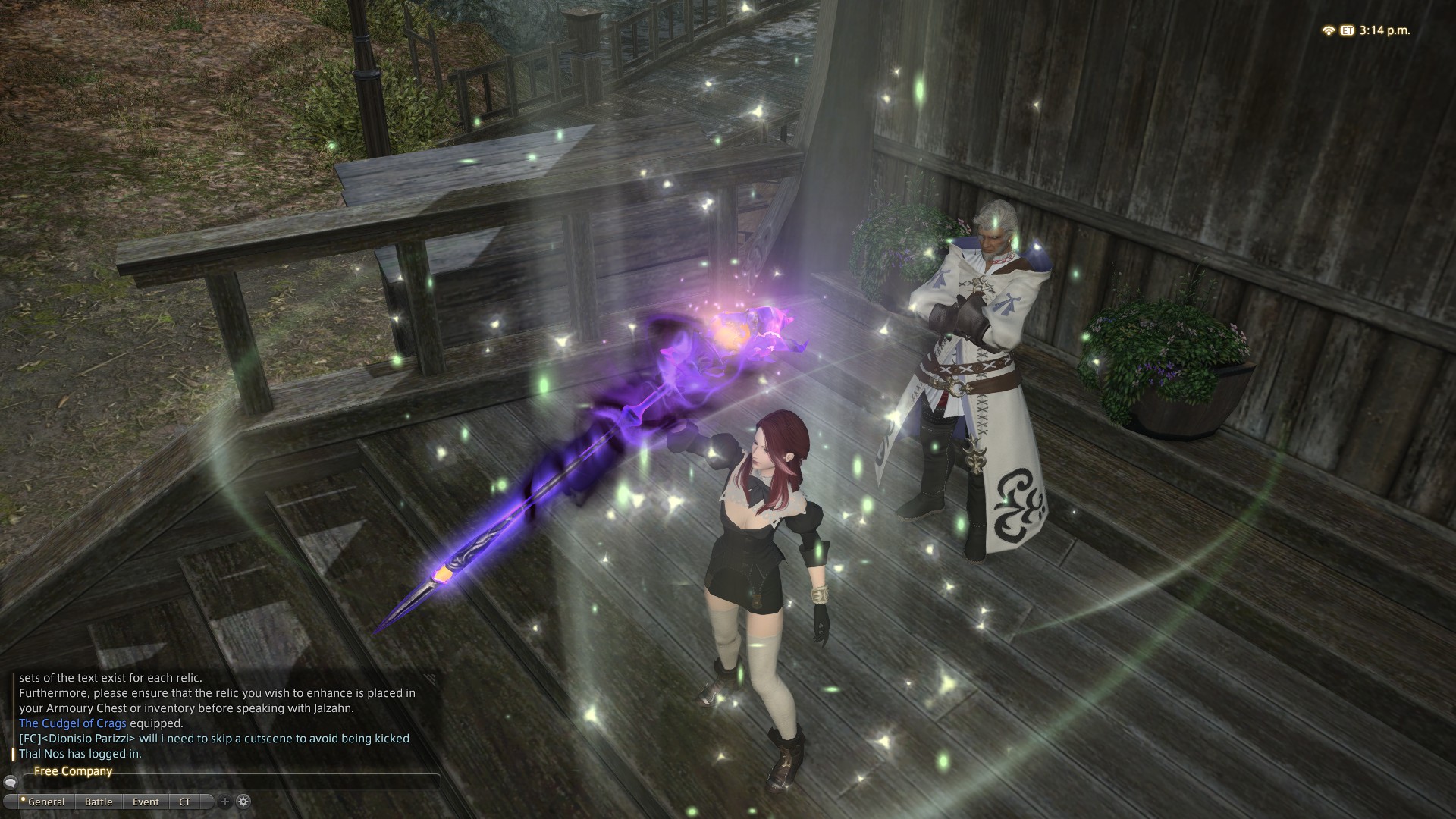
17754480252836380672_screenshots_2014-07-22_00001A long road finally came to an end today — no, nothing important, it was just a lengthy quest in Final Fantasy XIV. Specifically, it was the quest to upgrade my weapon's "Atma" incarnation into its more powerful "Animus" form, which means it's now just one step away from being its (currently) ultimate "Novus" incarnation.

The quest to acquire and upgrade your "relic" weapon in Final Fantasy XIV is a pain in the arse, extremely time-consuming and, at times, very frustrating, but it's also one of the most rewarding things to do at endgame. It gives your character a continual sense of gradual progression — particularly during the Atma-Animus phase that I've just completed — and it gives you a series of long-term goals to aim for, which is important to keep things interesting.

I really like it, in other words, partly for the fact that it's everything what is effectively a "construct your own lightsaber" quest should be. Star Wars MMO The Old Republic featured a "construct your own lightsaber" quest that was not particularly big or epic, and the lightsaber you ended up constructing would often be replaced by something better along the line anyway. Final Fantasy XIV's Relic questline, meanwhile, turns this process into a long journey, with each milestone proving to be a satisfying improvement in your weapon.

The process begins with a sidequest that sees you tracking down a once-legendary smith who now spends his days at the bottom of a bottle in the depths of the Black Shroud forest. Eventually, you track down a legendary weapon appropriate for your class, but it's in a sorry state and can't be used. Newly inspired — though he'd never admit that — the smith challenges you to find a suitable "host weapon" and infuse it with materia to act as a base for the reconstructed relic. You then need to challenge several of the toughest bosses in the realm — at least they used to be, anyway — in order to get various materials that Gerolt the smith requires to reconstruct the relic. Eventually, you're left with a weapon that you've worked hard for — but it doesn't end there.

After infusing your weapon with additional power through a strange concoction known as Thavnairian Mist, you can then begin scouring the realm for Atma crystals. These elusive little things have a very low drop rate from FATEs, the public quests that pop up around the realm, and you need to collect twelve of them: one each from a variety of different areas. This is the part that proves most frustrating for a lot of people — there's not really any way that you can make the search for Atma crystals any easier other than just doing a lot of these FATEs, but from a game design perspective it's actually quite clever: it keeps even the low-level FATEs relevant for even level-cap players, meaning that low-level players who might want to use FATEs to gain experience points will usually have at least a few people to help out, since most FATEs are designed around the assumption that multiple players will show up and participate.

Once you've gathered twelve Atmas, you upgrade your weapon into its Atma form. Initially, this offers no improvement whatsoever over its previous Zenith form, but by purchasing and then completing the various trials in a set of books chronicling the exploits of the Zodiac Braves (the ones from Final Fantasy Tactics? Who knows?) you gradually upgrade your Atma weapon, a tiny bit at a time, until it's considerably more powerful than it once was. When you've completed all the books, your Atma weapon becomes an Animus, and it's then that the road to Novus begins — the road down which I'll soon be starting.

Upgrading your Animus to Novus is a similarly time-consuming process, but rather than simply grinding through tasks again, you instead make use of the game's "materia" system to infuse a magical scroll with various stats you would like to apply to your finished weapon. In total, you have to apply 75 points of stats to the weapon, but how you distribute those is up to you — with the only restriction being the hard cap on certain stats. This means that, unlike any other weapon in the game, you can customise your Novus to be the weapon you want it to be. If you want to emphasise Accuracy — essential if you plan on venturing into the challenging endgame raids The Binding Coil of Bahamut and The Second Coil of Bahamut — then you can. If you'd rather emphasise Determination, a stat that improves your damage output, you can. If you'd rather make your spells cast just that little bit faster, you can do that too. In most cases, the combination of stat caps and the requirement to apply 75 points to the weapon means that you'll end up doing a combination of things, but it's still possible to specialise to a considerable degree.

I haven't really considered what I'm going to do with my Novus yet, but work starts on it when I next start playing. In the meantime, I have my shiny, glowy new Animus to enjoy; it helps me kill things even faster than I already could as a Black Mage. I'm looking forward to trying it out soon.