1463: Losing Face

Jan 20 -- FBI've been off Facebook for some time now — a cursory search through these pages suggests I closed my account in October of last year — and for the most part I haven't missed it.

I certainly haven't missed the endlessly inane reshares of content from George Takei('s PR intern) which in turn was stuff that already did the rounds on Reddit and subsequently Twitter several days earlier.

I also haven't missed the few people who seem to think that Facebook is an appropriate platform for standing atop their soapbox and bellowing the most ill-informed political and/or sociological opinions they can possibly think of.

also haven't missed having shit games and advertising jammed forcibly down my throat every time I log in. I spent a considerable amount of time reviewing Facebook games professionally and all it left me with was a bitterly passionate desire to never play one ever again.

And yet…

Over the weekend I went out. This is nothing unusual in itself, but this was something of a special occasion — it was a reunion of sorts for those of us who studied music at the University of Southampton between 1999 and 2002. We were a pretty close-knit bunch while we were there — though I must confess, being a joint-honours English and Music student, that I always felt somewhat on the periphery of this particular social group — and most people have kept in touch pretty well ever since. A number of us are still in Southampton, too, though a distressingly small number of us are actually doing anything with our music studies professionally. (Note to kids planning their future: when someone tells you that a particular degree is a "good, general choice that will get you into most careers," they are talking bollocks.)

Anyway, yeah. We went out to a pub near Newbury and ate our respective body weights in roast dinners and custard-covered desserts. It was thoroughly pleasant, particularly as I hadn't seen some of these people for a while.

It's partly my fault, of course — I could have very easily picked up the phone and invited them over for dinner, or coffee, or whatever, but I haven't. But then they haven't either. I don't say this with bitterness — it's just the way that the rapid pace of modern 21st century life makes people think. Real-life friendships often fall by the wayside somewhat, and people whom you once spent every day with become people that you see a couple of times a year — albeit on those occasions, you'll start singing improvised offensive German barbershop a cappella as if no time whatsoever had passed between the last couple of times you saw one another. (At least you will if you are me and my friends.)

The thing is, though, for many people, Facebook fills that gap between in-person interactions — or "face time" as obnoxious wankers like to call it. It allows you to remind each other of your existence, and to likewise acknowledge one another's existence with a Like or a Comment.

At least, that's the intention. One might argue that said intention has been somewhat diluted over the last few years as Facebook has become less and less about meaningful social interactions and more and more about sharing viral content in an attempt to amass as many Likes, comments and shares as possible.

Having almost missed out on this reunion due to my non-presence on Facebook, I find myself questioning my decision to leave the network. It also makes me ponder whether or not it might be possible to use it in a different way — specifically, to have a substantial cull of my friends list to just those who are local and whom I am likely to want to see again at some point. I'd cut out any Pages that I was following — not that I think I was following many in the first place — and keep my friends list down in the double-digits if at all possible. I'd be ruthless in the culling of people who didn't post anything interesting or useful and consequently cluttered up my news feed with bullshit, and I'd lock down my account so I'd be in complete control of who could find me. I'd also minimise overlap between Facebook and Twitter, because what's the point?

I'm tempted to try this, though with all the changes I've seen Facebook make regarding how it decides what it wants to show to you, I have my doubts as to how useful the service is even with these attempts to take ownership of the experience. It certainly can't hurt to give it a go, anyway, and if it does turn out to be useless nonsense as I suspect, it's little bother to simply hit the "deactivate" button again.

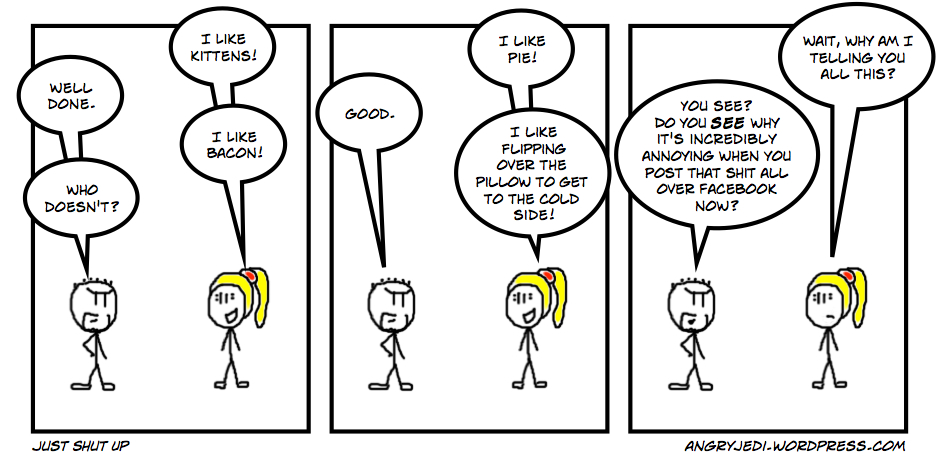
I'll leave you with this, which is a big part of my hesitance to return:
1371: Cutting the Cord

You'll recall that I've been contemplating this for some time now, but as I promised to myself, I've reached a decision: the Monday after this one just coming, I'm deactivating my Facebook account.

"Who cares?" I hear you say. And, well, that's sort of the point, really; I don't care about Facebook. It is largely useless to me these days.

As I noted in my post a few days ago, there's been a noticeable shift in the quality of posts among my Facebook friends recently. While I don't blame any of them for wanting to share things that are important to them personally, it's getting to the point where there's so much noise that there's not any room for conversation any more.

Social media is increasingly becoming "fire and forget"; people post something designed to get noticed — perhaps a passive-aggressive status update, or some sort of sociopolitical rant, or an Upworthy article with a particularly smug title — and then wait for the comments and likes to roll in. And then… nothing. Nothing at all. There's no discussion — except in rare sociopolitical cases where you can guarantee there'll be at least one person coming along to state the opposite opinion and start a tedious circular argument in which no-one ever agrees to disagree — and no real value to it all. For me, anyway.

I remember being resistant to Facebook when it first started getting big. A number of my real-life friends were encouraging me to jump aboard — remember, Facebook used to only allow you to add people you actually knew — but I thought it was going to be a passing Myspace-ish fad, and as such held off for a long time. I finally gave in while I was on holiday in the States visiting my brother, and Facebook proved to be a good means of sharing the photos I'd taken — photos that I was particularly keen to share because I'd started experimenting a bit more with composition and editing.

All was good for a while; Facebook's Groups and Events features served their purpose for a while, too, proving to be a practical means of organising collections of people and inviting people to events. But increasingly, over time, and as Facebook started to become more and more popular and more open, these features lost their value. When was the last time you responded to an Event invite? When was the last time you joined a Group?

I can trace the beginning of Facebook's downfall from my personal perspective to a fairly precise moment — it was back when they started making it into a "platform" instead of simply a site; back when Facebook games and "apps" first started appearing. I was initially in favour of this — the accompanying site redesign that came with the launch of the Facebook platform made the site look a whole lot better on big, high-resolution monitors, and it was and still is a potentially good idea to have the site act a bit like an operating system.

Unfortunately, things just declined from there. There started to be too much of everything. Too many games, too many people, too many ways of posting. People felt obliged to share each and every mundane little thing about their lives, egged on by other people and the mass media. Today, you can't watch the news without the newsreader demanding to "let us know what you think"; you can't watch a new TV show without a hashtag appearing in the corner.

These things aren't bad in isolation, of course. It's neat to be able to discuss a TV show in real time while it's on; it's cool that people have a medium of self-expression and communication that simply wasn't really possible and practical pre-broadband and smartphones. But everything just adds up to a frustrating experience, and it all but destroys the original point of Facebook — a cosy little private network where you could easily communicate with your real-life friends and share select photos and notes with them.

Times have changed. I haven't gone with them. And I'm fine with that. As such, the Monday after next, my Facebook account is going kaputt. I'm leaving a week's leeway in order to ensure that those people who do want to stay in touch have the opportunity to pick up my alternative contact details; those who don't bother? Well, it's probably time I cut those people out of my life, anyway.

If you're reading this, have (or indeed had, if you're reading this after the fact) me on Facebook and want to know alternative means of getting in touch with me if you don't already have them, let me know via a comment on this post — be sure to leave your email address in the appropriate field.

Tata, Facebook. It's been fun. It's not you, it's me.

Actually, it is you.

1365: Your Face

I find myself once again giving serious thought to the closure of my Facebook account. This is not something I should be agonising over as much as I have been, I know, but given that Facebook is such a firmly-entrenched part of modern society, it bears some consideration.

The main thing that's frustrating me with it at present is the fact that the whole "broadcast and amplification" thing seems to be getting far worse than it's ever been. My News Feed at present consists almost entirely of people making ill-informed political statements and sharing the latest scaremongering chain letter that they haven't bothered to fact-check. (Currently? It's an apparent epidemic of "false widow" spiders in the UK — these spiders do actually exist, but it's rare that a bite from one will cause anything more than a bit of discomfort, and certainly not require the amputation of a limb in any cases other than those which have suffered the most severe of allergic reactions.)

The point here is that Facebook's original purpose of communicating and sharing personally meaningful things has all but completely gone out of the window in favour of sharing the latest "inspiring" clickbait from Upworthy (seriously, fuck off, Upworthy, Buzzfeed and all of your fellow content farms), the latest moral panic from Daily Mail-like sources, or the latest "OMG hilarious!!!" video from whatever dark corner of the Internet produces nothing but "OMG hilarious!!!" videos.

The reason I hesitate so much and continually wonder whether cutting the Facebook cord is a good idea is that old chestnut — "it's the only way I'm still in touch with some people." Well, to be honest, a lot of those people for whom Facebook is the only means I can still contact them I haven't actually spoken to for ages, even on Facebook; those people who actually care will probably know how to reach me via other means, or will pay attention if I leave some sort of post with alternative contact information prior to closing down my account. Those people who don't care? Well, I guess they weren't that good friends after all.

In cutting the Facebook cord, then, it will doubtless be sad to effectively cut ties to some university and school friends, but it's also an inescapable truth of life: people go their separate ways following milestones, and sometimes that's for the best. I won't deny that there are people I miss, but I've been just as lax at staying in touch with a lot of these people as they have been lax towards me. It's no reflection on either me or them in most cases; it's simply the fact that our lives have moved on in different directions, and we each have our own different priorities, groups of friends and personal interests.

Typing this out has helped me think a few things over. I'm going to carefully examine my Facebook usage over the next week, and make a decision at the end of the week as to whether or not I'm going to close my account. If I decide to close it — which, right this second, is the decision I am erring towards — I will leave a message up on my profile for a further week with alternative contact information — where people can find me elsewhere on the Internet (primarily Twitter or Google+), or via email — and then close it. At that point, those people who want to get in touch can; those who can't will be confined to the past, likely never to be heard from again.

Anyway. Apologies for thinking out loud. Perhaps some of you are thinking the same things too, though.

1283: Dislike

I find myself thinking more and more about deactivating my Facebook account. I realise that in this day and age doing such a thing is tantamount to unplugging yourself from The Matrix, but I really don't feel there's a lot of value there for me any more.

The thing that has stopped me from closing my Facebook account in the past is the fact that "it's the only real means I have of staying in touch with certain people." That may be true, but the real question is how often I actually speak to the people for whom the only means I have of reaching them is Facebook? I have a lot of doubling-up between Facebook and Twitter, and in the case of most of my "real-life" friends I have their phone numbers. If I want to make plans with someone, I'll generally text them. If I don't have their phone number, I'll reach for Twitter. Facebook messages are frequently ignored.

The reason Facebook's value has declined for me over time is because the social media landscape has changed. What was once a cool means of communication has been roughly shoved in the direction of "branding" and advertising. It's obvious the moment you read anything in tech journalism about social media, whether it's Facebook or the latest pointless mobile app that lets you manipulate photos no-one cares about in a slightly different way to all the other apps that let you manipulate photos no-one cares about. None of the press coverage about new social media apps has anything to do with people communicating with one another; it's all about how brands can leverage their social graph and monetize their core demographics. It's about how a seemingly innocent app that allows you to subtly manipulate photos no-one gives a shit about is actually a means of getting your "brand" in front of as many people as possible. It's about "engagement", "ROI" and "CPC".

I don't give a fuck. And I don't want to be a part of it. I don't want to be confronted with an ad for an app or game I don't give a shit about before I see anything my friends have posted — which, nine times out of ten, I probably don't give a toss about anyway. I don't want to be continually confronted with "sponsored posts" festooned with comments from complete imbeciles who think telling an ad to "fuck off" will make it go away. And I really couldn't give a flying honk what George Takei's PR team (spoiler: that's not George Takei writing those posts) saw on Reddit last week and is only now getting around to sharing with everyone on the Internet.

Even outside of "branding" and advertising, though, the way people use Facebook has changed, too. With more and more different types of post available, the service has become more of a means of simply broadcasting pointless, impersonal shit into the void of the Internet rather than a way to start discussions or have conversations. What was once a two-way discussion is now a largely one-way street. (I'm aware a blog is exactly the same, but at least a blog is under no illusions about what it is and is not; Facebook, meanwhile, has always marketed itself as some form of communication tool, when this is, in fact, a relatively minor part of its reason for existence these days.)

All this may be hypocritical, because I've been guilty of all of the above at one time or another. But that was a process of discovery and exploration, leading me to the realisation I'm at today: aside from Twitter, which genuinely is still a reasonably useful means of communication for me, most other forms of social media carry little value to me besides giving me something to fiddle with on my phone when small talk dries up and I don't want to just sit there looking like some sort of mute twat.

I haven't decided yet whether or not I'm actually going to close down my Facebook account, but now I don't work reviewing awful, exploitative and, hell, just downright crap social games for a living, I have no real "need" for that particular ball and chain any more. I'm going to do some very serious thinking about whether Facebook has a place in my life any more in the next week or two, and come to a conclusion then. If you've been having similar thoughts to me, then I urge you to do the same. I have a strange feeling we'll feel better without that particular annoyance in our lives.

1191: Social Burnout

I've been thinking this for quite a while, as you've probably noticed from past posts I've made on the subject, but I'm beginning to feel completely burned-out on social media. Everything has to be social these days. Everything has to have little like buttons and little comment buttons and allow every denizen of the Internet to spew their ill-informed thoughts and opinions over it, or to share it pointlessly to Facebook.

Earlier today, I was distressed to discover that an official Pizza Hut app is coming to Xbox 360, presumably aimed at those people who find phoning, using a mobile phone app or using the Internet to order a pizza too easy and would instead prefer to do so by navigating the monstrosity that is the Metro interface. One line in the Polygon article about it — here — jumped out at me and kind of drove it home how "way too far" we've taken social media these days. Here it is:

"After submitting an order, users can share their choice with friends via Facebook."

Why. Why. Why why whywhywhy would you want to do this?

Pizza Hut aren't the only offenders in this regard, of course — Amazon offer a convenient facility to tweet or share on Facebook anything that you've just bought, as do a lot of other websites. You can even set up the PlayStation 3 and Vita to automatically share every purchase you make on PSN to Facebook. And every time I see this facility, I wonder why on Earth anyone would want to use it. But apparently people do.

This glut of auto-sharing is killing the original point of social media, which was to allow people to engage in conversations with one another by sharing things that were important to them. Now, it's more like a convention of ADHD sufferers running around going "I JUST BOUGHT A PIZZA! LOOK AT THIS VIDEO OF A DUCK RUNNING! HERE'S A PICTURE OF A CAT! I'D SAY SOMETHING PASSIVE-AGGRESSIVE BUT 'SOMEBODY' WOULDN'T LIKE IT!" rather than what I remember my early experiences with Facebook being like.

I vividly recall resisting signing up to Facebook in its early days, because everyone seemed to be doing it and I just couldn't be arsed with it. When I eventually started using it, however, I was impressed to discover a site that was seemingly built for real-life friends. Any time I added someone to my friends list, I had to indicate how I knew them, and the other person had to verify that story. My profile was only visible in full to those whom I had marked as a friend, and there weren't really any privacy settings to worry about. Stuff that was shared was the sort of stuff you'd share if you were actually in the same room with friends — what you'd been up to, some photos from your holiday, perhaps a longer piece of writing in the form of a "Note". No games, no spam, no "I Fucking Love Science" posts. Just actual interactions. The Like button was there, but it didn't have the all-encompassing power it has now, and people hadn't really started using it as a substitute for actually saying things.

Now, though, with the proliferation of "LIKE IF YOU HATE CANCER, SHARE IF YOU LOVE KITTENS" posts, the signal-to-noise ratio is all out of whack, and people are used to posting tons of crap while simultaneously saying nothing of value. This has the side-effect of meaning that when you actually want a response from someone, it's quite difficult to get one. The other day I attempted to find someone to take care of our pet rats while we're on holiday in Canada; the only responses I got were jokey, non-serious ones, and within a couple of hours it had dropped off the face of everyone's News Feed, never to be seen again… unless I were to slip Facebook $7 to "promote" it, of course.

Or take today, when I saw someone post an actual non-rhetorical question that needed an answer, and the first response was a "Like".

Not helpful. At all. You "Like" my question? Great. Do you "Like" it enough to actually fucking answer it, perhaps? No? Then piss off. I'm not so desperate for validation that I count the number of "Likes" a particular post gets and see it as some form of brag-worthy e-peen.

That said, if you want to "Like" my new "K-On Girls Wear the Union Jack" fanart cover photo, feel free.

Sigh. I'm such a hypocrite.

I've been rediscovering forums recently — I was a member of a My Little Pony forum for a while before it shut down due to admin drama, and I'm currently taking some tentative steps into the RPG Maker community. While forums have their own issues — largely people being a little lawyerish about the community rules and regulations — I'm beginning to think they're not such an outdated means of discussion as many seem to think…

1184: For the Love of God, Please Learn About Snopes.com

Hello, you, random acquaintance and/or friend of my parents on Facebook. Yes, you. The one who has been clicking "Like" and "Share" on everything from posts that imply you want cancer to kill everyone if you don't click "Like" to posts that wilfully spread misinformation, such as accusations that Red Bull causes brain tumours, that baby carrots are saturated with chlorine, or that aspartame causes cancer, brain tumours and multiple sclerosis.

You know who you are.

I'd like to introduce you to a website. I'd like you and this website to become best friends. I would like you to go to this website any time you find yourself questioning the validity of something that someone else asks you to share. I would like you to check this website before you share the thing that someone asks you to share. And if this website informs you that the thing that someone asks you to share is not, in fact, true, please politely tell the person who asked you to share the thing about this website, and direct them to the relevant entry debunking the thing they asked you to share. (Conversely, if this website informs you that the thing that someone asks you to share is, in fact, true, feel free to share as you see fit, but please stop using quite so many exclamation marks.)

This website is called Snopes.com.

It may not look like much, but it has been around in one form or another since 1995, and has been debunking chain letters and other urban myths ever since. It is a valuable resource that has been proven on numerous occasions to be both accurate and reliable. Please use it.

The reason I bring this up is that the unpleasantness that accompanied the Boston Marathon yesterday has brought with it a number of stories that are complete fabrications, and which have nonetheless found themselves spreading at an alarming rate across all varieties of social media. There is a convenient page summarising all of the claims made about the Boston Marathon and the events which supposedly occurred there right here. Please read it. Please familiarise yourself with it. Please take note of which stories are completely false and/or based on inconclusive, unproven information. Please do not share stories which have been proven to be false, or which are based on inconclusive, unproven information.

You may feel that there is "no harm" in "raising awareness" of issues by sharing things like this, even if they are not true. Unfortunately, that is not the case. By polluting social media with falsehoods, it becomes difficult for people who are personally invested in an unfolding story such as the Boston Marathon bombings to determine what the facts really are. By polluting social media with falsehoods, you run the risk of causing considerable distress to these people who are likely already very emotional. By polluting social media with falsehoods you continue to perpetuate a cycle where people willingly share misinformation in lieu of actually doing something useful, because clicking "like" and "share" feels like you've done your bit. And, frankly, by polluting social media with falsehoods, you make yourself look uninformed at best; gullible and stupid at worst.

So use a bit of common sense, will you? The next time something sounds unbelievable, it probably is; before you jump on that "Share" button, pay a quick visit to Snopes.com and look up the key points. And if Snopes.com tells you that the claims are complete rubbish, for heaven's sake don't just share them anyway. Educate the person you saw them from. Teach them about Snopes.com. And hopefully together we can make the world a less ignorant place.

1139: Just Shut Up

Page_1I think I'm "over" social media. Allow me to clarify that bold statement, however, as it's perhaps not entirely accurate as is. I think I am over social media as it exists today — a sprawling, disorganised mess of ill-defined concepts that contribute very little to the people's understanding of one another, and more often than not is about vanity rather than actual socialisation.

In other words, I yearn for the days when social media was simple and straightforward — when its sole intended purpose was to allow people to stay in touch with each other and perhaps, occasionally, share a photograph or two with them.

Looking back on this blog, I see I have written about this subject at least twice in the past, and my disillusionment with it has only grown over the last year or so — perhaps due in part to the fact that as part of my job I come into contact with some of the most utterly pointless examples of social media that I've ever seen.

These days, there are social media apps to share anything you can think of. I mean, there are literally (YES LITERALLY) apps and services that allow you to share anything you can think of. There are also more specialised ones with questionable usefulness to society as a whole. I reviewed one recently where the entire purpose was to share what your current mood was — you couldn't add any text explaining said mood, only an emoticon — and another where you could share the weather in your local area, then "like" or comment on the weather in other places. Another still allowed you to send a video or photo to someone, but they were only allowed to look at it for ten seconds, after which it locked itself and became useless (I swear I'm not making this up).

The trouble with these things is that despite their pretensions towards being "social media," they're not actually all that social at all in terms of the way in which people use them. They're a means of broadcasting things and seeking approval of other people rather than a means of actually engaging in conversation with anyone. Take a look at the average comments thread on an Instagram picture of a moderately-attractive person (usually a woman) and you'll see what I mean. No-one's actually talking to each other — everyone's just dropping an asinine opinion bomb and then never coming back. The poster of the selfie is seeking approval from commenters telling them how attractive they are; meanwhile, the commenters are seeking approval from the poster and hoping that their specific compliment is the one that will get them some specific attention.

This isn't the case universally, obviously. There are still some actual conversations that go on on Facebook, for example, but these can easily be lost in the torrent of people resharing crap from pages like "I fucking love science" (do you? Then go do some rather than recycling endless fucking memes) and "LIKE AND SHARE!!" (NO!!). Twitter is a reasonable platform for discussion at times, but conversations are easily derailed and, as has been proven hundreds of times in the past year alone, 140 characters is really not enough to make a coherent argument about a complex issue. It's also incredibly easy to be taken out of context on Twitter.

Google+ perhaps fares the best out of all of these services in my experience, though even that's variable. Join a good, small community that has a clear focus and whose moderators keep a tight leash on discussion and you'll have a good experience chewing the fat with people who may well become good friends. Follow Felicia Day or Wil Wheaton and you might see some interesting content, but the quality of discussion goes out of the window. Follow Google+'s own page and all you get are blithering idiots making ill-informed political rants any time the team behind the page even dare to mention the President.

I think the thing that's been striking me most heavily recently is "do I really need to share this? Do people really need to know this?" And more often than not, the answer is "no". I don't feel the need to collect an arbitrary set of "Likes" with services like CircleMe or GetGlue. I don't feel the need to "check in" to places with Foursquare. I don't even really need to use stuff like Raptr to broadcast my gaming activity, but that has, on occasion, sparked some good discussions — as, I'm sure, the other services do in some cases. Just not mine. Not any more. Perhaps once in the past — I met some good friends through Foursquare's now-defunct competitor Gowalla — but not now.

Consequently, since quitting Twitter a while back (and not really missing it, to be honest — though I do miss some of the people) I've been paring back my personal social media use hugely. I've closed my Tumblr account — I never really understood the point of that site, and these days all it seems to be used for is white people shouting about how guilty they are about being white and how we should all stop being such racists/misogynists/fedora-wearing perverts — and I've unistalled the vast majority of social apps from my phone, including Twitter and Instagram. Facebook made the cut, because as much as I dislike it at times, it's still a good way of staying in touch with a lot of people, and Google+ also survived, as it's the new home of the Squadron of Shame and serving our needs well.

Obviously this blog is still going, too (and will be for a long time to come, hopefully!) and I still comment on friends' blogs — but I don't really count that as "social media" in the same way, particularly as the discussions had tend to be (for the most part, anyway) wordy and thought-provoking rather than inspiring little more than a knee-jerk "lol".

Everything else, though? Out the window. And life is much calmer and more pleasant as a result.

#oneaday Day 936: Biggest != Best

No, I'm not talking about penises.

Let's talk about Facebook.

Facebook is massive. Facebook has taken over most people's daily existence on the Web to such a degree that there are plenty of people out there who genuinely believe that it is the Web. Like, all of it.

It's not. But then you probably knew that already.

But the fact stands that it is a massive global phenomenon, and something that has happily grown and evolved over time from its humble beginnings up to the multi-bajillion dollar business it is today.

Thing is, though, as it's grown, it's sort of lost sight of what it's for.

"Facebook is a social tool that connects you with people around you," the login screen used to say. When adding a friend, you used to have to indicate how you knew them, and the recipient of that friend request had to verify your story. It was actually quite a good idea that got around the MySpace "friend collecting" issue, whereby people would just add and add and add each other and then not talk to any of their 40,000 friends. Facebook's systems ensured that you 1) were actually friends with the people you marked as friends and 2) didn't fall into the "popularity contest" trap.

Whizz forward to today, and the Facebook of 2012 is a very different place. Now we get people promising "2,000+ friend requests" if you Like one of their pictures. I don't want two thousand friends. I want my online friends to reflect people I actually know, and occasionally give me the opportunity to meet someone new who is relevant to my interests and/or knows people that I know. Give me two thousand newcomers from all over the world, all of whom are vying for my attention simply to make some arbitrary number higher than everyone else, and you sort of lose that.

Part of the reason for this change is the different in what Facebook thinks we should use it for these days. I first joined the site quite a while after many of my friends had — at the time, I assumed it was going to be one of those passing fads like MySpace, and would quickly disappear into obscurity. But I found its value while on a trip to the States to visit my brother — while abroad, I could share the photographs I'd taken and easily stay in touch with my friends as a large group rather than emailing them individually. It was nice.

Over time, things started to shift. Facebook's big change to something a bit closer to its current layout upset a lot of people, and the addition of "applications" marked the beginning of how the social network looks now. At the time, I was of the attitude that the people complaining about it were bleating on about nothing, but in retrospect they may have had a point. As everyone's news feed started filling up with FarmVille brag posts, the signal to noise ratio started getting worse.

Then came the brands. Facebook undoubtedly thought they were doing everyone a favour when they opened up the previously "personal" social network to companies and businesses who wanted to grow their social presence. And in some cases, it worked well, with companies able to engage with their customers and post important information as and when needed.

Unfortunately, this too lost the plot somewhere. Now, pretty much every brand page uses the same obnoxious "engagement strategies" to keep people commenting, talking and Liking — the worst of which by far is the fucking awful "fill in the blank" status update that invites commenters to give their own meaningless opinion on something utterly asinine and irrelevant to the company's product. ("My favorite color is ____________!" proclaimed the Facebook Page for The Sims 3 on one memorable occasion. Over four thousand people replied.)

You see, people seem to absolutely love posting things that have absolutely no value. People love thinking their opinion is important, that they are being listened to, that the things they say are somehow valuable to someone.

The things you say are valuable to someone. The people they are important to are called your family and friends. Not the PR representative for The Sims 3. They don't care what your favourite colour is. They just want you to keep giving them page impressions and comments and Likes.

Likes. Fuck Likes. The Like button is Facebook's most enduring legacy, and one of the biggest blows to actual communication in today's connected world. Why comment any more when you can just click "Like"? It means nothing, particularly when it's connected to a sentence for which the verb "like" is completely inappropriate. ("My grandad died. So sad right now." "Insensitive Twat likes this.") It's a meaningless metric designed to measure how many people have seen something you have posted and want to interact with it, but are slightly too lazy to actually write anything.

The diminishing sense of Facebook's usefulness for actual communication is perhaps best exemplified by the current way someone's profile looks. Known as "Timeline", the theory behind it is that it is an easy to navigate history charting everything interesting that has happened in someone's life.

It's a sound plan. Unfortunately its implementation is just terrible.

The problem is that there's no consistency in how posts show up, and seemingly no understanding of how people read content. Leaving aside the fact that one's profile cover image and fairly pointless basic information takes up over 500 lines — or nearly half of a 1920×1080 display — there's seemingly no rhyme or reason as to what gets posted at the "top" of one's profile.

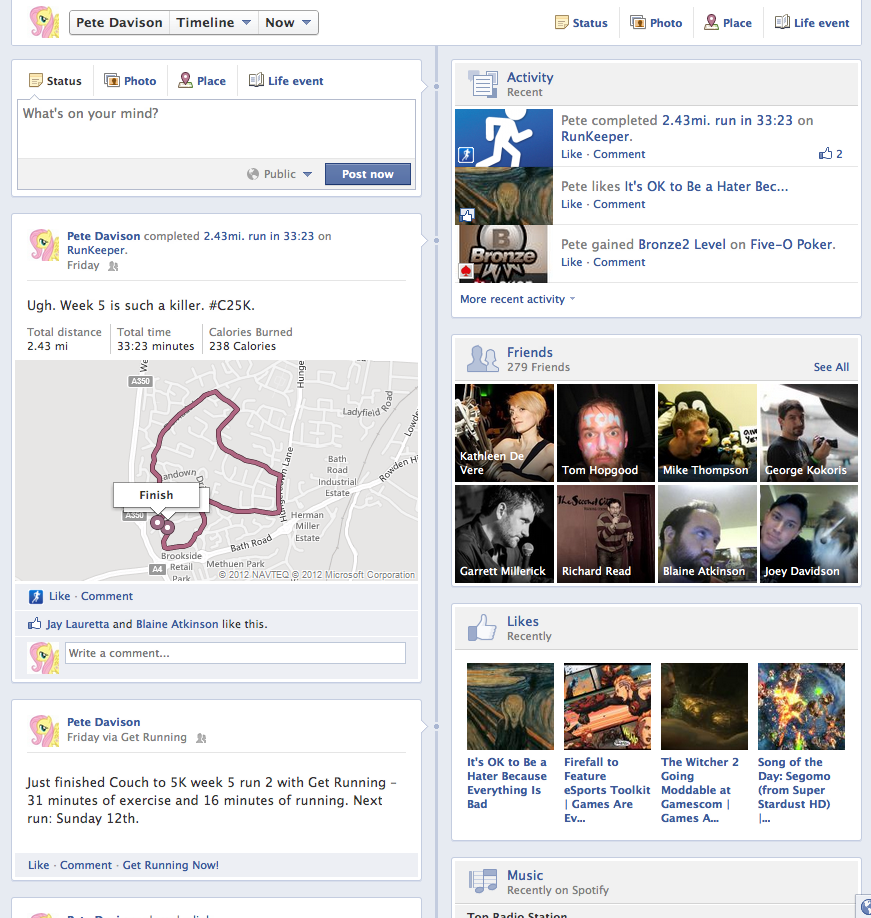
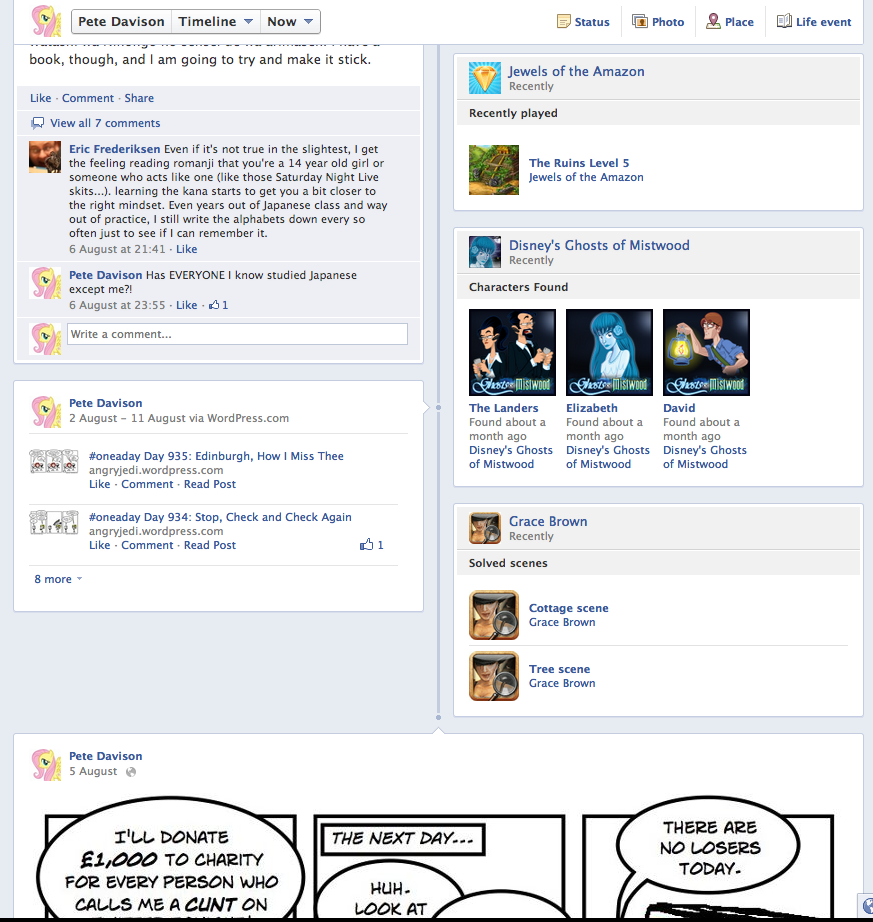
The conventions established by blogs and earlier social networks dictate that the most recent things go at the top, so anyone checking in on someone's page doesn't have to scroll around or search to find something new. Yet with all the sources from which Facebook can pull information these days — games, external sites, apps, Spotify, Netflix —  there is no consistency in what goes where. For example, at the time of writing, this is what the top of my Timeline looks like:

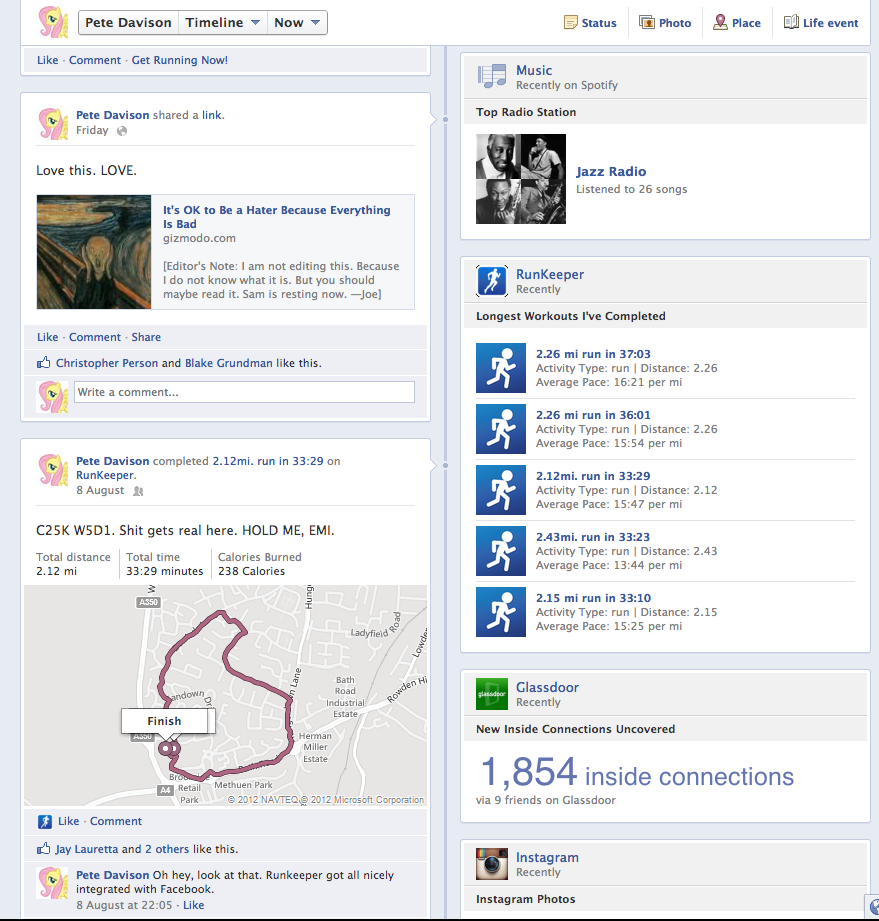
What a mess, and very little of it is stuff that I 1) actively shared and 2) feel people really need to know. I deliberately shared the RunKeeper stuff because I like sharing my fitness achievements because it helps keep me honest, but I have no need to show people who eight of my friends are, nor do people need to know that I achieved Bronze Level 2 in Five-O Poker, a game I reviewed earlier in the week and specifically told not to share shit on my timeline. At the other end of the spectrum, pages that I have "Liked" elsewhere on the Internet — and thus wanted to share with others, perhaps because I wrote them or just found them interesting — have been unhelpfully collected into a single box that shows just four of them. This behaviour changes seemingly daily, with Liked pages sometimes showing up as individual posts on one's Timeline (useful) and sometimes being collected into that box (not useful). At the time of writing, Facebook appears to have decided that "not useful" is the way to go on this one.

Let's scroll down a few "page heights" and see what else we have:

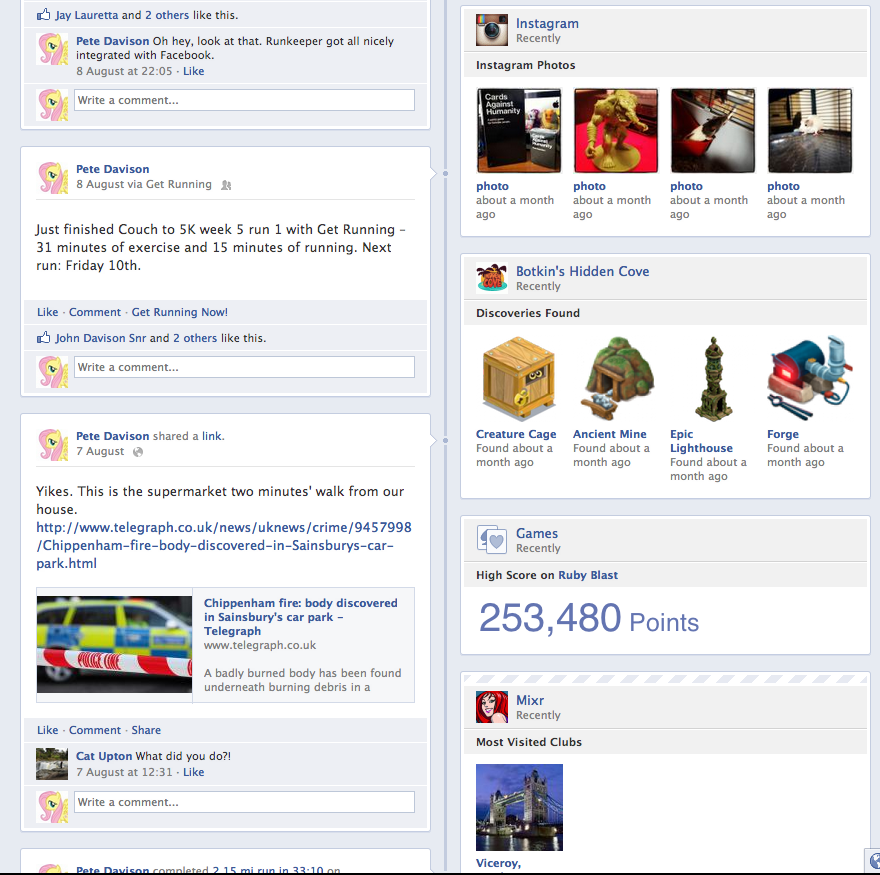
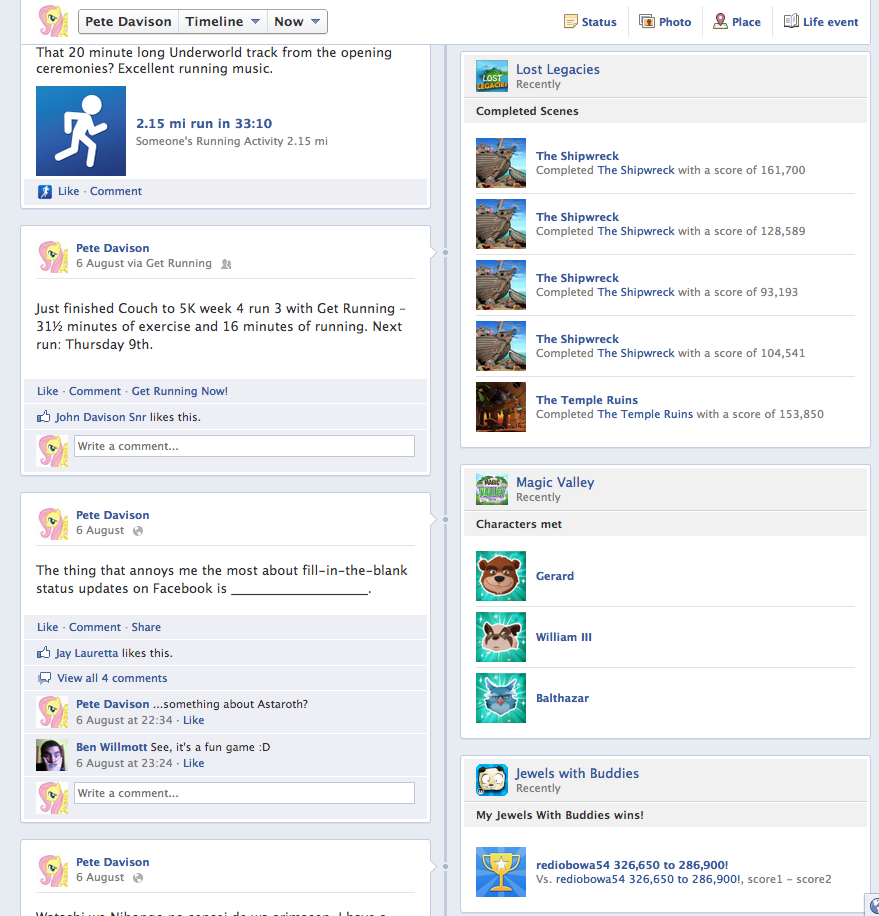
The left column? Sort of all right. The right column, though?

SO MUCH IRRELEVANT CRAP.

Including posts from games that I 1) didn't press a "Share" button in once and 2) have since removed from my Facebook account.

There. After five screen-heights worth of scrolling, I finally get to one thing that I actually want to share with people — my recent WordPress posts, aka a feed from this blog to my Facebook Timeline. Again, though, like the Likes, they have been collected together into a box that displays very little relevant information and, in this case, is put in a stupid, stupid place. Why stupid? Because the most recent post in that little WordPress.com box came considerably after the RunKeeper post at the top of my Timeline — and certainly considerably after all the spammy crap those games have plastered all over that infuriatingly useless right column.

"Facebook is a social tool that connects you with people around you" my arse. "Facebook is a digital scrapbook maintained by a five-year old with ADHD," more like.

I'll see you on Twitter.


#oneaday Day 934: Stop, Check and Check Again

The social Web is an incredibly frustrating place to be at times. I'm aware that I've commented on this subject a number of times before, but it's important: the spread of misinformation is at best irritating and at worst incredibly dangerous.

The most recent example was a result of this image:

This image has been doing the rounds recently — first on Twitter, where the supposed exchange took place, and subsequently, as tends to happen, a day later when Facebook's denizens caught up with the rest of the Internet.

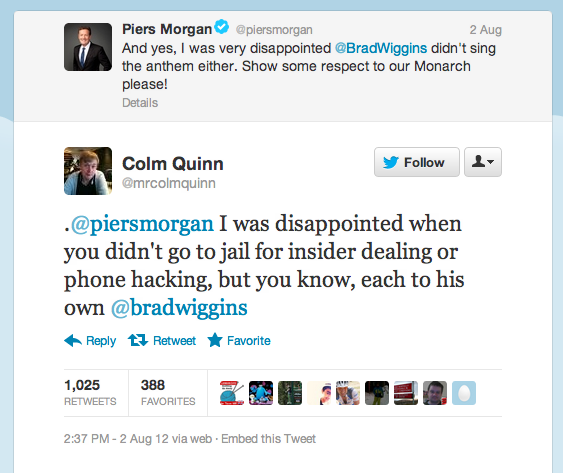
It is, of course, bollocks. This exchange took place, oh yes, but it was not between Piers "Cuntface" Morgan and Bradley Wiggins. No, instead, this is what happened:


You have doubtless noticed that the person who replied to Piers Morgan was not, in fact, Bradley Wiggins, and was instead one Colm Quinn, who just happened to mention Wiggins in his tweet, which is where the misunderstanding came from — probably from someone who doesn't quite understand how Twitter works. (Ending the message with "@bradwiggins" could look like a "signature" to someone not familiar with the way a typical Tweet is structured.)

As usual, however, the fact that "BRADLEY WIGGINS GAVE PIERCE MOREGAN AN AWESUM COMEBAK" makes a better story than "SOME DUDE YOU'VE NEVER HEARD OF GAVE PIERS MORGAN AN AWESOME COMEBACK" struck, and it struck hard. The (inaccurate) story spread like wildfire, of course, with no-one bothering to actually check Wiggins' timeline to see if he actually said the things that were attributed to him. And it spread. And spread. And spread.

Over time, some people got wise to the truth of the matter and pointed this fact out. But more and more people continued to post the inaccurate details — and then it spread to Facebook, and the whole thing started all over again, with both sides getting increasingly frustrated with one another.

I know it's a seemingly silly little thing to get riled about, but like I say, consider the potential implications if the "fact" that started spreading was something that could actually put someone in danger, or ruin a person's reputation. When the entire social Web starts acting like Daily Mail reporters by just blindly reposting things without even bothering to see if they're true or not, we have the potential for a real mess. Just look at the reactions of Facebook-bound idiots who don't know what The Onion is for a preview of what might be.

Fact-checking isn't just for journalists. Of course, there are plenty of journalists out there who seem to think it doesn't apply to them, either, but that's another matter entirely. It takes a matter of seconds to check something like a Tweet is the genuine article. You should be immediately skeptical of anything posted as a screen grab of a bit of plain text that looks like it was written in WordPad, or anything described by someone as SO AWESOME/FUNNY/HILARIOUS/LMAOOOOOOO etc. And, most importantly, if something sounds like it was too awesome to be true, it probably was.

Respect to Mr Colm Quinn for his excellent admonishment of Piers Morgan's twattish behaviour. Disrespect to all of you out there (you know who you are) who fall for this crap every time, whether it's "OMG TODAY WAS THE DAY MARTY MCFLY WENT TO IN BACK TO THE FUTURE PART II!" (for the last time, it is October 21, 2015) or "OMG! PIERS MORGAN GOT BURRRRRRRRNED BY BRADLEY WIGGINS".

Simple routine: before you retweet or share something, stop, check, then check again. It's not that hard.


#oneaday Day 885: Foul-Smelling Vagina

20120622-013552.jpg

There, that got your attention, didn't it? Mention a stinky faff in your headline and everyone suddenly takes note. I'll remember that for the future.

Anyway, I do actually sort of want to talk about fragrant fannies today, but not in quite the way you might be expecting. I am instead referring to the social media backlash which "intimate hygiene" product line Femfresh encountered today on its Facebook page.

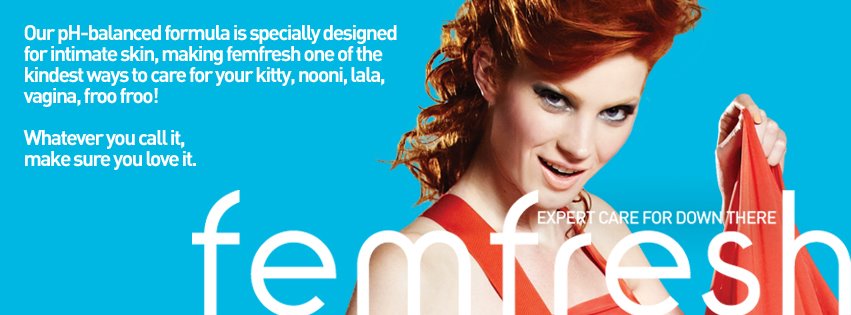
There were a number of reasons that Femfresh drew the ire of the Internet community today, but one of the most common complaints was its cover photo. Here it is:

Apparently, it seems a lot of ladies find the company's seeming inability to use "adult" words for their respective minges somewhat patronising — and before I go any further, I will point out that my use of various offensive euphemisms throughout this post is purely for facetious comedy value (and variety) rather than any ulterior motive — and thus took umbrage with Femfresh's page as soon as they saw the top of it. (Quite what they were doing on it in the first place is their business and their business alone.)

Not only that, but it seems that on the whole (shush!) women are, in fact, rather well-educated about what is and isn't appropriate to smear over or stick up their flange. "Bacterial vaginosis" is the result of using the wrong things, it seems, and no, I haven't Googled that because I don't want to. Don't let me stop you from doing so, however, if you're curious. Just don't come crying to me if Google Images decides to serve you up some tasty treats.

Anyway. Here are a few choice comments from the public:

"I call it a vagina because I'm not 12 years old and because I love it I'll go nowhere near this vile 'care range. Cheers."
— Holly Rae Smith.

"Are you kidding me? Trivialising something innately precious by calling it something so thoroughly ridiculous offends me and, believe it or not, all the posters on this page. Did you not perform any market research on this area and then develop a communication and marketing strategy? It appears not otherwise you wouldn't have received such an insane backlash on your attempts to flog a thoroughly unnecessary and damaging product…"
— Helen T

"Just to clarify, is Femfresh for vaginas or vulvas? Because your ad says vagina, which implies your product is a douche, in which case you're advertising a harmful product. If it's for vulvas only, change the words you're using to make it clear."
— Kirsten Hey

I shan't talk any more about the science of quim because I'm not a gynaecologist (I can, however, spell gynaecologist without using spellcheck) but I will focus on the larger issue here, which is that social media advertising campaigns can and will go very, very wrong if they're not thought out effectively. Instead of simply advertising their (apparently controversial) product, Femfresh made the mistake of attempting to engage with their "fans" when there was really no need to. By actively encouraging people to comment on their posts (and by posting vapid, patronising nonsense) they essentially brought about their own downfall. Everyone has been talking about Femfresh today, and they haven't come off too well. "All publicity is good publicity" doesn't really apply when the vast majority of those "publicising" your product are pointing out proven health risks.

The broader issue here is that social advertising should not be "essential" as so many advertisers seem to believe it to be. On Facebook, you can "Like" everything from HP sauce to a favourite video game. Doing so used to simply be a means of self-expression — quite literally, demonstrating that you liked something. Now, publicly "Liking" something is inviting the brand in question to bombard you with crap, ask you asinine questions at all hours of the day in an attempt to "build a community" around things that really don't need a community built around them. If people honestly think that their lives are going to be enriched when they click "Like" on the page of a thing that they're quite fond of, they are sorely mistaken.

Those who have "Liked" (or at least come across) Femfresh have taken a stand against this sort of pointless nonsense that is infesting social media like, well, bacterial vaginosis. In this case, it's because the advertising was both patronising and inaccurate. For less contentious products, it's going to be harder to train people to not be corporate shills — the last post on Pepsi's Facebook page has 1,094 "likes" and 74 comments, for example, none of which say anything remotely meaningful — but it seems we're starting to see a backlash of people who are no longer willing to be an unpaid part of a product's promotional team. I've certainly started "unliking" pages on Facebook that post nothing but pointless questions or fill-in-the-blank exercises rather than useful information (although seriously, what "useful information" could the official social media presence of HP Sauce ever really give you?) and I'd encourage others to do so too. This form of social advertising adds nothing of worth to society and, as Femfresh have seen today, can be completely counter-productive for the brand in question. (I guess there's an argument for the fact that today's debacle may have educated some women about bacterial vaginosis, but still.)

I'll leave you with this: