#oneaday Day 814: Death of a publication

I've finally finished my efforts to catalogue all the games-related articles (including roundups, re-reviews, type-in listings and issue disk bonuses) from Page 6/New Atari User. My data sheet has over 2,000 rows in it, though some of those are repeats. Even so, that's a lot of material to work with.
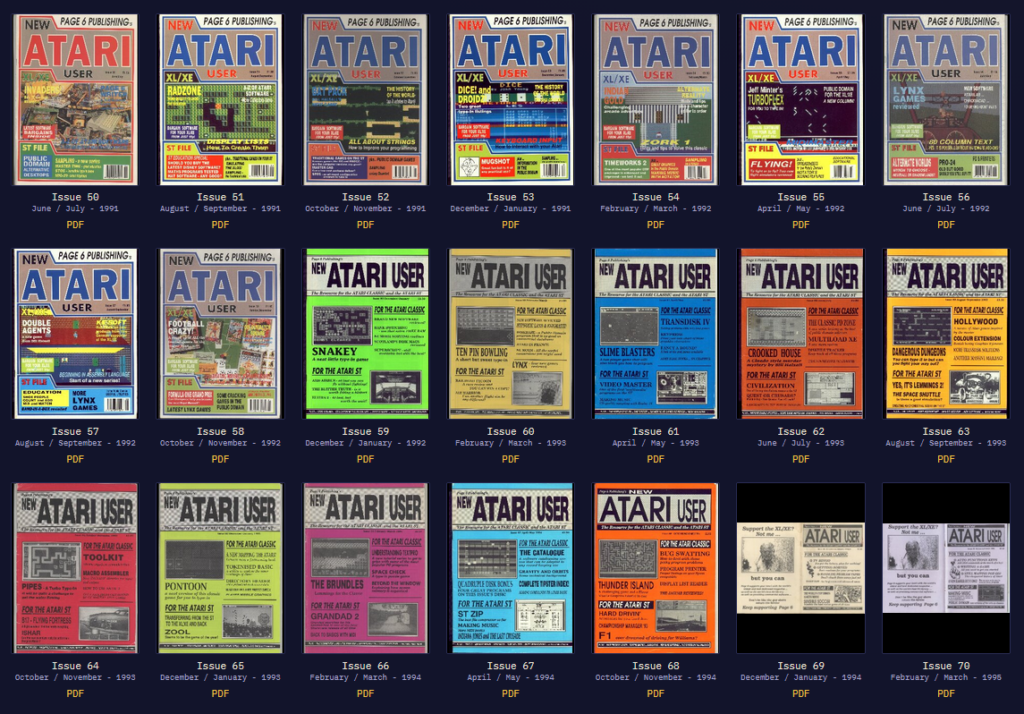
As I found myself reviewing the latter-day issues in the magazine's run, though, I found myself feeling an intense sense of melancholy and almost mourning, I guess. Over the course of the publication's complete run, you can see at a glance when it was doing the best (full-colour covers with specially commissioned artwork or photography to appear prominently and attractively on newsstands) and when things started to go downhill (single-colour covers, the return to a subscription-only model) and when things were nearing the end (a switch to an A5 format, with less and less in the way of commercial releases covered each issue).

Here's a shot from Atarimania, which hosts a full archive of Page 6/New Atari User issues, that shows three stages of this evolution:
I found myself feeling sad all over again while working my way through these issues — because I remember this happening first time around. I remember getting Page 6/New Atari User every month, and in those latter years, feeling like something which had been a fixture in my life for as long as I could remember was ailing and would eventually die. Page 6 started before I was old enough to know what a computer or a magazine was, so it was always present throughout my childhood and adolescence.

Its final issue — in which the editor, Les Ellingham, made an unfortunately unkept promise to readers that there would be six more issues of the magazine before it finally closed for good — is a sad read. Even my Dad, who had been a contributor from midway through the magazine's run up until its very last issue, had given up writing about specifically Atari-related stuff, and was instead posting a regular column about the wonders of the then-nascent (at least in consumer-accessible form) Internet and World Wide Web. My article spreadsheet has just a single game-related entry for that final issue: a public domain version of Tetris for Atari 8-bit.

One of the most remarkable things about Page 6/New Atari User is that it wasn't the Atari ST coverage which lasted until the b(l)itter end. No; the last few issues contained pretty much nothing but Atari 8-bit coverage, which provided the first hints of the fact that the "Atari Classic" scene, as the magazine referred to it at the time, would continue to thrive in the years to come, even in the absence of a major specialist publication.

The ST scene is still alive too, but I can't help but feel like there's a lot more Atari 8-bit enthusiasts out there than Atari ST people. After all, the ST marked the beginning of the shift towards all home computing being PC-based; the ST certainly had its own distinctive, unique features, but it also marked a point where the distinction between purportedly different platforms was less pronounced in various ways. Thus, I suspect what happened, is people who were once ST enthusiasts just sort of… "upgraded" to MS-DOS and then Windows-based PCs and then never looked back. That's certainly what my family did — although I certainly never quite left the Atari machines behind, as they had been so important to me growing up, and continue to be important to me to this day.

Anyway, the thing I think I find most sad about the slow death of Page 6/New Atari User is that it was clearly taking a mental toll on Les. In some of the last few issues, he described how the editor of an American Atari newsletter had found himself succumbing to ill health, at least partly due to the stress of working on his publication, and he indicated that he had no desire to do himself a mischief in the same way — particularly because, in these latter years, he was also trying to support himself with handmade crafts. In one of the last issues, he mentions that he thinks he might have to get a part-time job to continue supporting himself, because between the magazine and his crafts, there was no longer enough money coming in to completely make ends meet.

But all good things have to eventually come to an end, and in the tech space in particular, the rate at which things progress can be absolutely mind-boggling at times. I don't think there's any shame in Page 6/New Atari User's eventual bowing out, even with the regrettably unkept promise from Les' final editorial. To consider that this was a publication which continuously supported both the Atari 8-bit and, once it hit the market, the ST, from 1983 up until 1998 is absolutely mindblowing. Les' refusal to let go until it was absolutely, definitely no longer viable to continue in any way whatsoever is incredibly admirable — as is the commitment of the freelance contributors who kept sending in articles issue after issue, without fail, like my Dad.

So yeah. While reliving the end of something that brought me so much joy as a child has made me a little bit maudlin, I also continue to celebrate everything this publication achieved — and continue to derive joy from it as I grow older, since I am now in possession of the complete run of issues that I grew up with.

It saddens me a bit that when something similar happens these days, in the form of a website going down and no longer being accessible, that there is often no easy way to simply look back fondly over past "issues" in the same way as you can with a magazine. There are many, many online publications that are just gone these days, and while The Internet Archive has done an incredible job of preserving some of them, there are others that we'll just never see again in any form. I know — I've worked on a bunch of them, and now most of my articles are now buried, nigh-unsearchable, in the archives of other sites that ingested the data of the closing publications, often introducing a bunch of errors in the process.

Page 6/New Atari User, though, that will always exist in the form that I knew and loved it. So although I'm sad all over again at the end of such an important publication, I know that I will continue to derive joy — and attain knowledge — from browsing that archive of issues over and over again. One day I might even get around to learning how to program the Atari 8-bits properly beyond simple BASIC. You never know.


Want to read my thoughts on various video games, visual novels and other popular culture things? Stop by MoeGamer.net, my site for all things fun where I am generally a lot more cheerful. And if you fancy watching some vids on classic games, drop by my YouTube channel.

If you want this nonsense in your inbox every day, please feel free to subscribe via email. Your email address won't be used for anything else.
#oneaday Day 812: Research update

My efforts to catalogue all the noteworthy mentions of Atari home computer games and software (including type-in listings) that I might, one day, want to make a video about are proceeding apace. I have finished reviewing issue 50 of Page 6/New Atari User, and my spreadsheet is up to 1,179 lines. This may have been a mistake.

I joke, of course. This is actually proving to be a very valuable, helpful exercise for a variety of reasons: first of all is my originally stated, intended purpose for all this: to be able to easily track down press coverage for games I might want to do videos on for my Atari A to Z and Atari ST A to Z series. But some other benefits are coming to light, too. For example, a number of these games have multiple entries on the list thanks to being featured in various types of articles — besides straight-up individual title reviews, there are also compilation reviews and broader topic roundups — which means I can see how (or if) various titles were responded to differently by different reviewers or in different contexts.

Sometimes a game might be a hard sell at full price, but a decent use of some pocket money if and when it comes to a budget label. Sometimes a game might not have resonated with one reviewer, but really hit home with another — or vice versa. Sometimes a game might be a good inclusion as part of a compilation, but not quite strong enough to stand on its own merits. It's interesting to see all these things, and to have the various issues that relate to the various mentions of all these titles at my fingertips.

The other main benefit is more personal. I originally stopped doing the regular Atari A to Z and Atari ST A to Z series because I was worried I was running out of interesting things to talk about. This nearly 1,200 line spreadsheet — which is set to increase considerably in size as I continue to review Page 6/New Atari User issues up until the final Issue 85 from Autumn 1998 — has shown me that there is a veritable wealth of stuff I haven't even thought about tackling as yet. Whether or not I'll be able to stick to the original "A to Z" formula I haven't yet determined — as you might expect, there are some letters that just aren't all that commonly used to begin titles — but in terms of the sheer number of things, to have this amount just from one magazine's run is kind of incredible.

Once this process is finished, I would like to expand my efforts to other magazines. Initially I will likely cover the other early Atari magazines — Atari User, Antic and ANALOG being the main ones — but may well expand to some slightly later ones such as Atari ST User and ST Action, both of which I used to read back in the day. I'm already seeing with the choice of titles covered just in Page 6/New Atari User that they didn't even attempt to cover absolutely everything that was coming out in time for each issue, so it's very likely indeed that each magazine I look at will cover different things at different times. This, in turn, will make it interesting to compare reactions to titles between a European (Page 6 and New Atari User) and North American (Antic and ANALOG) audience, among other things.

Anyway, this is a substantial project, but it's going well and I'm getting a little bit done each day. I've already got more than enough to make use of when I start up the video production machine again, but it would be great to have enough material to last me a very long time indeed. (Honestly, I probably already have that, but the more the merrier, I say.)

I'm actually getting quite excited about rediscovering this focused approach. Checking the dismal viewing figures on my recent Terranigma video only convinced me further that this is probably the right thing to do for the sake of my own enjoyment. It may not necessarily lead to particularly impressive viewing figures, income, subscribers or anything like that — but honestly, I'm happy with how my channel has gradually grown over the course of the last few years. I have nearly 4,200 subscribers on YouTube now, and I would guess that a significant proportion of them are there for the Atari stuff that was my channel's main focus for quite some time. Switching over to something that I specialise in allows me to say "fuck The Algorithm, this is for me and anyone who happens to want to come along for the ride". And that's much more fun when the whole thing is supposed to be a hobby!


Want to read my thoughts on various video games, visual novels and other popular culture things? Stop by MoeGamer.net, my site for all things fun where I am generally a lot more cheerful. And if you fancy watching some vids on classic games, drop by my YouTube channel.

If you want this nonsense in your inbox every day, please feel free to subscribe via email. Your email address won't be used for anything else.

#oneaday Day 289: Some games magazines I used to like

I love old games magazines, and will frequently re-read them years after they were relevant. In fact, I'm currently in the process of assembling a collection to bung on an SD card and pop in my otherwise unused Kindle Fire 7 to use as a portable retro magazine library. I've also got a vague plan to make some more videos on classic magazines, as I really enjoyed making the first two on Page 6 magazine — you can watch those here (issue 1) and here (issue 2).

In the absence of anything else to write about — I've been playing Xenoblade Chronicles X for most of the weekend, and I already wrote about that earlier — I thought I'd give a rundown of some magazines I used to like, and which I may well take some time to cover on YouTube at some point.

Note: I say "magazines I used to like"; most of them are magazines I knew someone who worked on, usually my brother. I make no apologies for this.

Page 6/New Atari User

This is the one I bring up most commonly on my channel, and for good reason: three members of my family (my Dad, my brother and me) were involved in it at various points, and it's the magazine that launched the career of my brother — a career that, with him being a big bossman at IGN now, he's still in.

Page 6, as it was initially known, started life as a user group newsletter. Within one issue, the editor Les Ellingham had decided that he wanted to fulfil a grander ambition: to publish the UK's first Atari-specific magazine. And he only went and did it. For an astronomical amount of time, considering the subject matter, too; Page 6 ran in one form or another from December of 1982 until the autumn of 1998, and it was still covering the Atari 8-bit in its very last issue.

Page 6 was an enthusiasts' magazine. It wasn't a games magazine; Les in particular was keen to stress from the outset that while computers were excellent games machines, there was also a ton more you could do with them. And part of the point of the magazine was to educate people on the possibilities their computers offered. It achieved that through articles about software releases (including both games and "serious" software), interviews, tutorials, type-in listings and plenty more.

It was always a pleasure to read. One gets the impression that it was a real labour of love for Les in particular, and there are plenty of occasions where his editorial page came across as very frustrated that other people didn't seem to care quite as much as he did — but I cared. I still do care. Page 6 was a formative part of my youth, and revisiting old issues today, I still feel a lot of the same magic I felt in the early days of computing.

Read them all at Atarimania.

Atari User

Showing up a little later, Atari User from Database Publications (later Europress) launched in 1985 and ran until November 1988, at which point Page 6 acquired the rights to the Atari User name and rebranded as New Atari User. Page 6 was still on the newsstands at that point, and it was thought that the Atari User name would attract more casual interest, since "Page 6" is a nerdy reference to an area of the Atari 8-bit's memory that only people already well-versed in the system's "culture" would understand.

At heart, Atari User was a similar sort of magazine to Page 6, covering both games and "serious" applications, perhaps with a slightly greater focus on things that, if not games, were at least entertainment of a sort. Like Page 6, there were a variety of features each issue, including type-in listings, and often some interesting-looking "Gadgets" sections for electronics projects you could do with your Atari. I never tried any of them — I was a bit young — but they always looked interesting.

I enjoyed reading both Page 6 and New Atari User because they each had a very different style to them. Page 6 always felt like it took itself very seriously, with a fairly no-nonsense, stern, professional-looking layout in each issue — not to say that individual articles lacked personality and humour, mind; I'm talking purely aesthetically — while Atari User made use of the bigger budget it had thanks to being part of a larger corporation by producing colourful issues with large, attractive pieces of artwork and photography throughout. I was sad when Atari User went under, as it was one of those magazines that it was just fun to look at thanks to its colourful cover art.

Read them all at Atarimania.

Antic and ANALOG

Antic, subtitled The Atari Resource, was one of two Atari-specific magazines from the States, with ANALOG (short for Atari Newsletter And Lots of Games) being the other. You could get them both relatively easily in this country via specialist importers. Antic and ANALOG were both, like Page 6 and Atari User, magazines that revelled in the joy of home computer ownership. Part of that was gaming, yes, but it was also about programming, productivity and creativity.

I actually haven't revisited Antic and ANALOG for many years and I think I'm long overdue to, as I remember enjoying them both. I do remember Antic having noticeably thicker issues, while ANALOG became renowned for its excellent machine language type-in listings. So they're both going on my portable magazine library, assuming it works as I hope it does.

Read Antic and ANALOG at Atarimania.

Games-X

Page 6 was where my brother got started writing about games, but it was Games-X that truly launched his career properly; he left home to work on it, and it ended up being the beginning of a whole life in the games press.

Games-X was unusual: it was a weekly games magazine (a decision which founder Hugh Gollner later described as "a big mistake" financially), and most other magazines at the time were monthly. Page 6 was bi-monthly (as in, every two months, not twice a month). This naturally allowed it to be a lot more "up to date" with gaming news than many other magazines, but it was also fun to be able to buy a new games magazine every week, initially for just 60p an issue.

Games-X covered that strange period late in the ST and Amiga's lifespan when consoles were just starting to really get a foothold in the UK. The majority of the focus in each issue was on home computer games, but there was a dedicated console section — and the next magazine my brother worked on after Games-X was Mega Drive Advanced Gaming.

Games-X had a fun, irreverent attitude to it and, in many ways, was very "'90s", with everything that entails. I still really like it, though, and think it stands out as a magazine that deserves to be remembered a bit more than it is.

Read them all at RetroCDN.

Advanced Computer Entertainment (ACE)

I don't think I actually had many issues of this, but I enjoyed every one of them a great deal. Advanced Computer Entertainment, or more commonly just ACE, was a multi-format magazine that one gets the impression liked to think it was a cut above the other games magazines around at the time. It was still about video games, sure, but it lacked some of the '90s abrasiveness of other publications, and took things a bit more "seriously", for want of a better word. One might call it the Edge of its day, only marginally less pretentious. (And yes, I checked; Edge launched in 1993, while ACE folded in 1992.)

That is, after they got over an initial rocky patch where there were more errors in the early issues of ACE than I think I've ever seen in any other magazine. Typos, mistakes, outright blank sections of pages — they had it all. But once it settled down, it was a very high quality magazine that I always enjoyed. The magazine was noteworthy for its "Pink Pages" section in the rear, a no-nonsense "reference" guide to new releases, charts and review summaries, plus a bizarre "Stock Market" section that never really made much sense, but I believe it was an early attempt to try and aggregate review scores for various developers and publishers, if I remember rightly.

I rather liked that ACE took things seriously. The silly humour of other magazines could be entertaining, to be sure, but it was nice to be able to read a magazine about games that was just… about games, rather than about its writers trying to launch a comedy career. As with Page 6, that's not to say that individual articles and writers lacked personality or a sense of humour; it's just that humour wasn't the main point, whereas with some other magazines around at the time, particularly once we moved into the 1990s, it felt like they were trying to be a funny magazine first, about video games second.

Read them all at Atarimania.

PC Zone

Now, this may make me sound a bit like a hypocrite after what I literally just said, but I always enjoyed PC Zone, even before my brother's time there as editor and publisher. PC Zone in its prime always felt like it struck a good balance between humour and information, and I loved it for that. It acknowledged that games were fun, silly and often stupid, but also recognised that people were passionate about them — sometimes to a fault.

PC Zone is also noteworthy in retrospect for being an early outlet for Charlie Brooker, and his articles were always a highlight, as were his eminently silly The Cybertwats cartoon strips, which got the magazine a bunch of complaints on multiple occasions, particularly after he depicted Lara Croft machine-gunning someone's cat to a particularly violent and bloody demise.

When people talk about old magazines being fun, I think of PC Zone. While in retrospect some of it may have been a bit "lads mag"-ish (see: front cover depicted above), it never really felt particularly exclusionary. Plus I spent two weeks doing work experience in their offices and, although I didn't really do much other than make a lot of cups of coffee and tea (and write a review of Virtua Fighter PC) that fortnight remains one of the happiest of my life.

Read them all at Pix's Origin Adventures.


And there's more I could be going on with, but I think that's probably plenty for now. If you're a retro computer and gaming enthusiast, you could do far worse than familiarise yourself with the above publications. And the links I've provided will let you do just that.

Note: I will not be held responsible for anyone complaining at you suddenly taking a lot longer in the toilet.


Want to read my thoughts on various video games, visual novels and other popular culture things? Stop by MoeGamer.net, my site for all things fun where I am generally a lot more cheerful. And if you fancy watching some vids on classic games, drop by my YouTube channel.

If you want this nonsense in your inbox every day, please feel free to subscribe via email. Your email address won't be used for anything else.