One of the things that I've wanted to do for many years is get to grips with really being able to program the Atari 8-bit. This will be a completely useless and unmarketable skill for me to learn, but with the Atari 8-bit in particular having always been so important to me, it feels like a natural step in my enjoyment of the hobby. Only trouble is: I don't really know where to begin!
I still have a vague knowledge of Atari BASIC from my days typing in listings as a kid and inventing my own programs way back when, but I suspect a lot of the intricacies may have fallen out of my head at some point, as I haven't really done anything substantial in Atari BASIC since… well, since it was current and relevant. Beyond that, though, there are a wide variety of things that are a complete mystery to me. And I think the sheer wealth of things it's possible to learn, even on an old computer like an Atari 8-bit, is what makes it so daunting.
Do you get in-depth about how to handle variables and strings? Do you figure out the mathematical functions? Do you learn what all the different default graphics modes do, and what they are best used for? Do you tinker with the sound capabilities of the POKEY sound chip? Do you learn how to display, move and otherwise use player/missile graphics, aka hardware sprites? Do you learn about the display list, and how a display list interrupt is a different thing from manipulating the display list? Do you learn what a vertical blank interrupt is, and how to use it? And at what point in all of this do you "graduate" from BASIC to machine code?
This constant string of questions, which I could have extended to at least five times that length, is probably the big thing that holds me back from actually dipping into "learning how to program the Atari 8-bit" as a serious hobby. I'm sure there isn't really a "bad" place to start — and having an idea of what I would like to be able to program is probably a good way of determining what things I should focus on looking at first — but it's that old Analysis Paralysis thing again; when confronted with seemingly infinite options, you end up choosing none of them.
So I think the answer is probably just to pick a book — of which there are many available on the subject of Atari 8-bit programming, coming at it from myriad angles — and work my way through it. All of it. Then, from there, I can learn where I might want to head next, or figure out where the gaps in my knowledge are. Ultimately, then, I can develop a solid understanding of all the things I might "need" to know in order to be able to program the system effectively.
The reason why this is all on my mind right now is, of course, because of the increasing number of AI slop projects I've been seeing in retro gaming. Over on the website Atarimania today, two out of the four new additions to the database have "developed using AI" disclaimers on them. And one might ask: why don't I just "get the AI to do it for me"? Surely it is easier than ever to shit out a program-shaped object using Claude (they had to pick the cuntiest name possible for it, didn't they?) and then convince everyone that "I made this"?
Well, no. If you've spent any time reading this blog over the last few years, you'll know that this would provide me with absolutely no satisfaction whatsoever. Just because "an easy option" exists now doesn't mean I want or need to take it. In fact, I feel like with how likely it is that the AI bubble is going to burst and all of this crap is just going to go away one day — and God, I long for that day — it is all the more valuable to learn how to do something like this properly.
What I'd love to be able to do is create a game for the Atari 8-bit. That feels like a very far-off goal right now — but one way of looking at it is that back in the '80s, people had a fraction of the reference resources we have today (and no, I don't count AI in that) and were still able to learn how to do these things in their own time relatively quickly. So with a bit of determination, dedication and actually setting a bit of time aside to do this, I feel like I might be able to learn something.
As I say, it'll be something that is mostly useless and not really marketable, but who cares? Remember a time when hobbies were just things you did because they were fun, and you didn't feel the need to monetise them or even share them with others? I'm thinking that's what this has to be. Something that is just for me; something that I want to learn for myself. Not because I want to make and sell a game, but just because it's something I've always wanted to learn, and to be able to make something for my own satisfaction.
So I think maybe for the rest of this evening I might go spend some time tinkering in Atari BASIC on the ol' MiSTer…
Want to read my thoughts on various video games, visual novels and other popular culture things? Stop by MoeGamer.net, my site for all things fun where I am generally a lot more cheerful. And if you fancy watching some vids on classic games, drop by my YouTube channel.
If you want this nonsense in your inbox every day, please feel free to subscribe via email. Your email address won't be used for anything else.
It will probably not surprise you to hear that, as an autistic person, I quite like organising sets of information into a visually pleasing and/or easy-to-refer-to manner. To that end, ahead of my intention to reboot my Atari A to Z and Atari ST A to Z series, I have been doing something I have been meaning to do for a while that will aid with research.
I've been going through old magazines — just Page 6/New Atari User to begin with, but I will expand my efforts at a later time — to determine which issues had reviews (or otherwise substantial articles) of what in them, and recording that information in a big ol' searchable, filterable, sortable table. Or, y'know, a spreadsheet. (I guess this makes me a "spreadsheet person" after years of resisting such things.)
This will (hopefully) make it much easier to track down these articles when researching something — and might also give me some ideas on what to cover, too.
One of the things I find most interesting when either revisiting old favourites or discovering new ones is taking a look at what the "professionals" had to say about them, and seeing if they treated them fairly, or if they were talking nonsense. I don't really mind either way; there is value to both confirming a critical opinion from back in the day, and having the opportunity to look at it from a more detached, modern perspective and perhaps disagreeing with what was said back then.
It's also kind of interesting to, in some cases, give these games a bit more time and attention than they might have perhaps had back in the day, particularly if the reviewer in question clearly didn't have a lot of time to spend with them, or didn't understand them completely. I mean, we're only talking a play session of maybe 20-60 minutes when it comes to most of my videos, but sometimes you do notice properly intriguing things about games after spending a bit of protracted time with them, rather than spending a few minutes on them and then moving on to something else.
Alongside the traditional "reviews", I'm also recording mentions of games in things like topic-based roundups, type-in games (which can be just as interesting and worthwhile as commercial software!) and… basically any mention of something I might want to cover, and which I might want to refer to what was being said about it Back In The Day.
It's going to take a while to compile all this information — particularly if I want to throw other magazines into the mix — but I think it's going to be a worthwhile endeavour that will be helpful for the direction I think I want to take the YouTube channel (back) in. It also gives me a good reason to look back at old computer and video games magazines, and I will always welcome any opportunity to do that. Not that I need a reason. But it is nice to have a reason to do so.
Anyway, my intent is still to hold fire on YouTube until after our holiday, then get back into the swing of things with the rebooted Atari A to Z and Atari ST A to Z series in mid-September, likely with my first recording session being the weekend of the 19th (meaning the first of the new videos will come out the following week). I'm sure I'll have a good chunk of this organising done by then, and I think it will be enormously helpful in adding some additional insight to my videos that will hopefully be as interesting for anyone watching them as it is for me making them.
Right this second, though, after taking care of 28 issues of Page 6 today, I think I've earned a bit of video game time. So it's back to Ys VIII for me!
Want to read my thoughts on various video games, visual novels and other popular culture things? Stop by MoeGamer.net, my site for all things fun where I am generally a lot more cheerful. And if you fancy watching some vids on classic games, drop by my YouTube channel.
If you want this nonsense in your inbox every day, please feel free to subscribe via email. Your email address won't be used for anything else.
Hello. I am Pete, and I love the Atari 8-bit range of computers. You probably knew that already, but I wanted to talk about it a bit today.
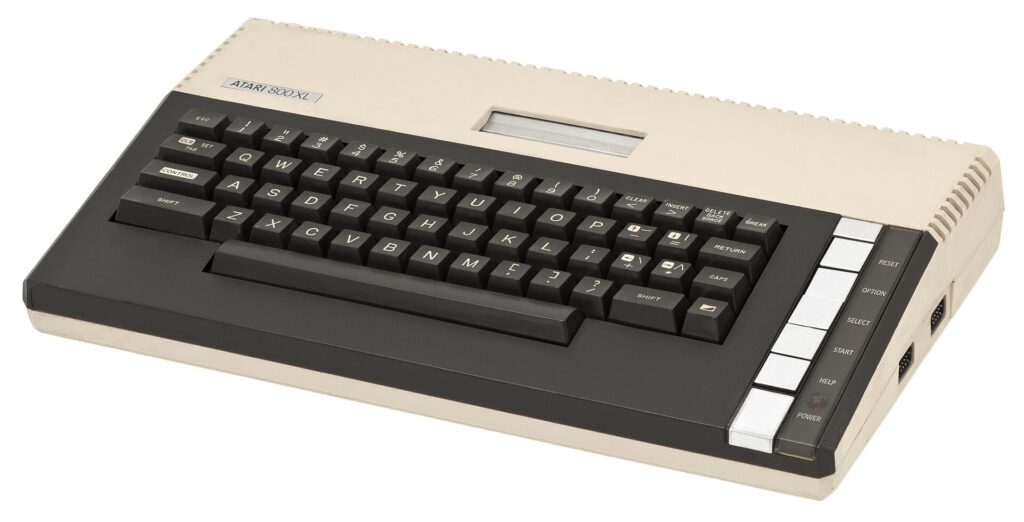
By Evan-Amos – Own work, CC BY-SA 3.0, https://commons.wikimedia.org/w/index.php?curid=18553927
I think I'm probably going to make a video along these lines sometime soon — although my prior video on the announcement of The400 Mini a while back covers a lot of the points I'd want to cover — but it's on my mind today, so that's what we're talking about today.
One of the reasons I want to talk about Atari 8-bit computers is because I don't feel they get nearly enough respect. No, they were by no means as popular as the Commodore 64 and Spectrum — the former of which is the subject of a cover feature in Retro Gamer magazine this month — but I also feel like they had a significantly stronger foothold in the market than other "failed" micros from the era. Not only that, but they are historically very significant for a number of reasons, some of which I'll try and outline today.
This is going to be a bit of a stream-of-consciousness sort of probably autistic infodump, because I'm just banging this out as I feel like it. If and when I do decide to make a video about all this, there will probably be a bit more structure, research, that sort of thing. Like I say, this was just rattling around in my head today, though, so I wanted to at least get some thoughts down on paper. So here it is.
For the unfamiliar, the Atari 8-bit range consists of several models:
The Atari 400, which released in 1978, and initially features 8 kilobytes of RAM, though later revisions bumped this up a bit. This was marketed in some areas as a games machine, as it was the cheaper of the two models to release in 1978, had four joystick ports and sported a flat, supposedly spill-proof membrane keyboard to make it suitable for "family" use.
The Atari 800, which released alongside the 400 in 1978, and was positioned as a more "serious" machine. It had a "normal" keyboard, user-upgradable RAM (up to a maximum of 48 kilobytes) and two cartridge slots instead of one (though there were very few releases that took advantage of this) — and it cost considerably more.
The Atari 1200XL was the first step in a refresh of the Atari 8-bit line in 1983, intended to replace the 800. It came with 64 kilobytes of RAM, a completely redesigned case, built-in self-test features and a rather nice keyboard. It was also much too expensive and had a number of issues, causing Atari to pull it from sale before long, and to not release it in PAL territories at all.
The Atari 800XL (pictured above) was a do-over of the 1200XL project. It also had 64 kilobytes of RAM, the newly designed case (now not quite so deep), built-in self-test features and lovely keyboard, but also added built-in BASIC to the mix along with revisions to the operating system. It was Atari's best-selling 8-bit home computer.
The Atari 600XL was a cost-reduced version of the 800XL, which had an even slimmer case and only 16 kilobytes of RAM. With the 800XL replacing the 800, this was effectively the replacement for the 400, but it did not sell very well compared to its big brother.
The Atari 130XE was launched in 1985, after Jack Tramiel took over Atari, and was designed to look like a "little brother" to the 16-bit Atari ST. It featured 128 kilobytes of RAM, new revisions of the operating system and BASIC and a new case design, but otherwise didn't bring anything significantly new to the table. It is a nice machine, though, and my Atari 8-bit of choice.
The Atari 65XE was essentially identical to the 130XE, only with 64 kilobytes of RAM instead of 128.
The Atari XEGS was a 65XE in a console-style case with a detachable keyboard. It was positioned primarily as a games console, even more explicitly than the 400 back in 1978, but was a fully functional computer that would work with all Atari 8-bit peripherals.
Broadly speaking, these models are all cross-compatible with one another, aside from obvious exceptions such as programs that need a particular amount of RAM to run properly. There are a few compatibility issues between very early pieces of software that were designed for the 400 and 800 and the later XL/XE models, but these can usually be got around by using a "translator" program to temporarily load in an older version of the operating system, and the Atari community at large has also been hard at work patching many games to work universally on all Atari 8-bit systems.
Like most other 8-bit computers, the Atari 8-bit had three means of loading software: ROM cartridge, cassette tape or 5.25" floppy disk. ROM cartridges are incredibly simple: plug them in, turn on the machine and the software is there, ready to go. These were primarily used for games, particularly in the early days of the platform, but there are some pieces of utility or productivity software that run from cartridge, too. Notably, using a cartridge effectively allows the ROM within to "extend" the Atari's capabilities; a good example of this is the SpartaDOS X package, which adds an MS-DOS style command line for manipulating files on floppy disks.
Cassette tapes were certainly used by Atari enthusiasts, but not to the same extent as on the Commodore 64 and ZX Spectrum. The reason for this is that the tape loading system in the Atari 8-bit was significantly slower than on its main rivals, resulting in load times of half an hour or more for games that would take just a few minutes on other platforms. That said, the Atari 8-bit could make innovative use of the tape medium by playing back audio during a program — a good example of this is the Conversational Language series of packages, which teach French, German, Italian and Spanish through interactive lessons, with recorded speech coming straight off the tape and being played back through the TV speakers at the appropriate moments.
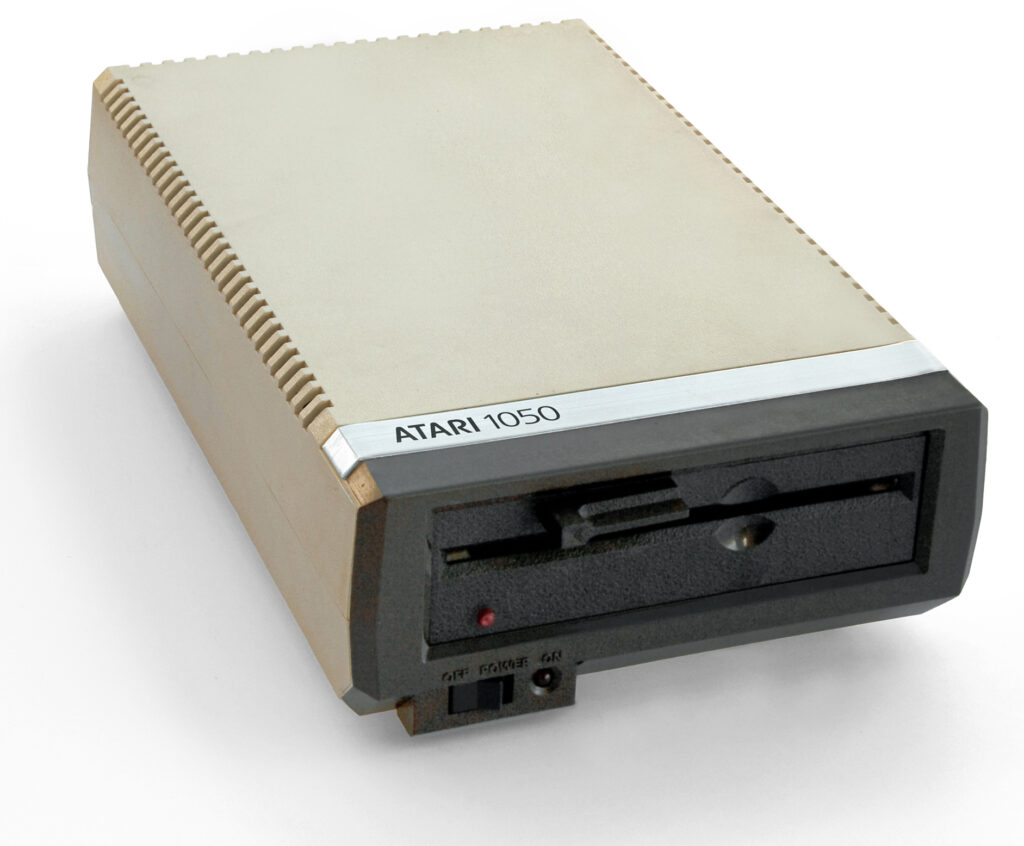
By Bilby – CC BY 3.0, https://commons.wikimedia.org/w/index.php?curid=48108881
Instead, disk drive use was very popular. There were two main disk drives in the prime of the Atari 8-bit's lifespan: the original Atari 810, which followed the design language of the 400 and 800, and the Atari 1050, which was designed to fit in alongside a 600XL or 800XL setup. There was an even later XF551 drive, but this didn't really catch on for various reasons, and these drives are a lot harder to find today.
You connected a tape deck or disk drive to the Atari via its proprietary Serial Input/Output (SIO) port, and this brings us to one of the most historically significant things about the range: SIO was designed as a universal connector for all manner of different peripherals, not just media storage devices. Sound familiar? That's right; it's very much a precursor to modern USB; Joe Decuir, who created this architecture, holds patents on USB.
SIO had a few differences to modern USB, most notably the fact that devices could be daisy-chained together. This means that even though the system only had one SIO port, you could connect multiple devices simply by linking them together. Obviously this was dependent on the device in question having a suitable port — and not every device did — but in theory you could keep on linking as required, making it easy to have, for example, setups that used multiple disk drives, and even cassette and disk simultaneously if you so desired.
Using a disk drive with the Atari 8-bits required one extra step: the use of a Disk Operating System, or DOS. Atari made its own DOS that underwent several revisions over the lifespan of the Atari 8-bit models, and although closed source and distributed under a proprietary license agreement, it could be redistributed. Good job, too, because in order to actually boot something from disk, DOS needed to be loaded first. If you wanted to be able to save BASIC programs to disk, you also needed to boot DOS from disk before starting to write your program.
The most commonly seen versions of Atari's DOS from back in the day used a menu-driven interface that allowed various disk functions such as copying and deleting files as well as locking/protecting them, loading executable files that were not set up to automatically boot when turning the computer on, formatting disks and creating new DOS disks.
Programming on the Atari used, like most of its contemporaries, a dialect of BASIC. Unlike many other BASICs at the time, it is not a version of the popular Microsoft BASIC (although this was available) and thus had a number of its own unique Atari-specific commands. Carrying out many functions, particularly relating to graphics, that would require POKEs on other platforms could be done with dedicated commands on the Atari, but conversely Atari BASIC lacked the ability to create arrays in string variables. It was, on the whole, a well-liked language, and the two main Atari magazines of the era, Page 6 and Atari User (which later merged to become New Atari User), typically printed type-in listings for all manner of programs in every issue. Not just games, either; both magazines were keen to position the Atari computers as capable, multi-function devices that were far more than just sources of entertainment.
Other programming languages were, of course, available. Those keen to get their hands dirty could write programs using 6502 assembler, while as the years went by, speedy languages such as Action! and Turbo BASIC XL came along and offered compelling alternatives to the built-in or cartridge-based BASIC that was, for many, the foundation of programming on the Atari range. These languages could be compiled into executable binaries, too, meaning that an end user would not need a copy of the language to run a program written in it.
The Atari's audio-visual capabilities were very solid. The dual ANTIC and GTIA graphics chips offered hardware scrolling, built-in "player-missile" sprites, and a wealth of different graphics modes allowing various balances between memory usage, resolution and colour depth. The POKEY chip offered four-channel audio with a good amount of customisation — although not quite as flexible as the SID chip found in the Commodore 64. It also handled a lot of the Atari 8-bit's input/output, meaning the system has the charming feature of making blippity bloop sounds when loading and saving from/to disk or tape rather than the horrific screeching heard on other platforms.
And then we come to the games. While some of the high-profile software houses — notably outfits like Ocean, Imagine, Ultimate and suchlike — refused to support the Atari 8-bit, others, like Electronic Arts and Activision, did, at least in the early days, and the budget companies like Mastertronic, Atlantis, Zeppelin and Alternative had a good presence on the platform, too. The end result of this from a 2026 perspective is that the Atari 8-bit library is largely unique, with many titles not being found on any other platforms — and in the case of multiplatform affairs, the Atari release often being a particularly good version. (There are exceptions, of course; the Atari 8-bit versions of Action Biker and The Last V8 are woeful compared to the C64 releases.)
There's also the fact that a lot of games which went on to worldwide success on a variety of platforms often originated on Atari 8-bit. All-time classics like Boulder Dash, M.U.L.E., Miner 2049'er and Spelunker debuted on Atari before spreading to other platforms, and esteemed creators like Archer Maclean were really able to make the system sing with games like Dropzone.
The only thing the library is lacking compared to its more successful 8-bit counterparts is a library of solid arcade conversions from the years following the initial early '80s "golden age"; those early '80s titles are well-covered, however, with excellent versions of Pac-Man, Dig Dug, Pole Position, Qix and plenty more — and a wealth of "unofficial" clones, too.
So why doesn't this system get anywhere near the love and attention that the Commodore 64 and ZX Spectrum do? I honestly don't really know, because although the platform undoubtedly sold considerably less than both of its main rivals, I don't think one can in any respect call it a "failure". Its longest-lasting magazine published its final issue in 1998, for heaven's sake — and said magazine was including material for the Atari 8-bit right up until that very final issue. Not only that, the modern "homebrew" scene is incredibly active and vibrant to this day, with some truly amazing new games being released for the platform on a regular basis, along with some excellent ports of C64 and Spectrum games that never made it to Atari back in the day.
I would love to see the Atari 8-bit get more acknowledgement. There are some YouTubers who do give it its dues — Kim Justice is a good example — but I do wish the field of "gaming history" would, more broadly, pay attention to the Atari 8-bit: a platform that still has a lot to offer, which is a hell of a lot of fun to have been involved with since its original inception, and which is dead easy to explore today with solutions like Altirra for software emulation, and the excellent Atari800 core for MiSTer if you're an FPGA person.
Still, that's a big reason my YouTube channel exists. So I will continue to champion the system how I can — and at least then I know that I have done my part in remembering this wonderful platform and the many amazing journeys it has taken me on over the years.
Want to read my thoughts on various video games, visual novels and other popular culture things? Stop by MoeGamer.net, my site for all things fun where I am generally a lot more cheerful. And if you fancy watching some vids on classic games, drop by my YouTube channel.
If you want this nonsense in your inbox every day, please feel free to subscribe via email. Your email address won't be used for anything else.
Every so often, I get kind of a hunger to learn something new, but a little gremlin in my mind almost always stops me from pursuing that thought with a simple phrase: "there's no point".
His thinking is that learning how to do something new absolutely must be something useful that you can use in your day-to-day life, and preferably make money from. And the reason I listen to him is because I understand where he's coming from; we live in a mercenary world with a cost of living that continues to escalate, and thus it would seem eminently sensible to learn something that would, at the very least, have some value in the job market.
But at the same time, there are things I want to learn about that, while arguably "pointless", I think would just be fun and interesting. One that I keep coming back to is the concept of programming — but specifically programming on the Atari 8-bit home computers.
I used to dabble quite a bit in programming in BASIC when I was a kid. I had several floppy disks' worth of BASIC listings that represented a combination of things I had typed in from magazines, things I had adapted from things I had typed in, and completely original creations. I never got particularly good at programming in Atari BASIC, but I did enjoy doing it. And for the longest time I've found myself wondering "what if I actually applied myself and tried to rediscover and expand on those skills?"
That's about where the gremlin enters the picture, you see. There is no rational reason why I should spend time learning how to program a long-defunct computer that you can't buy any more and which, in the grand scheme of Home Computers People Have Heard Of, ranks far behind the Commodore 64 and Spectrum, despite having capabilities at the very least on a par with, and often superior to, both of them.
"It's a waste of time," he says. "There's no point. You won't make any money from it. No-one will want to hire you based on that."
Well, frankly, who gives a shit? I'm not getting any younger, and I feel like learning new things is a good way to keep the brain active. So I think what I might actually do is put some serious time into this. Maybe devote an evening or two a week to it and see what happens.
It might not go anywhere. But at least I'll have been trying something new. And that's quite an exciting thing.
Another thing that has been holding me back is not really knowing where to start, but a blog I stumbled across by chance earlier today gave me some good recommendations of books to take a look at. And if people back in the '80s could learn how to program using just these books and no Internet to look things up on, I'm sure I can do something similar.
Maybe. We'll see.
Want to read my thoughts on various video games, visual novels and other popular culture things? Stop by MoeGamer.net, my site for all things fun where I am generally a lot more cheerful. And if you fancy watching some vids on classic games, drop by my YouTube channel.
If you want this nonsense in your inbox every day, please feel free to subscribe via email. Your email address won't be used for anything else.
I frigging love '80s Activision games, particularly on the Atari 2600 and Atari 8-bit. I grew up with the ones on Atari 8-bit, of course, and since I never had a 2600 back in the day, those are a (relatively) more recent discovery. But I adore every one of them, and I'm beyond thrilled that I've been part of bringing them back to a new audience on Evercade.
The first of our Activision cartridges isn't out yet, but I, of course, have a copy. Perks of the job and all that. It's already becoming one of my most-played Evercade cartridges, and I don't see that changing any time soon.
We're actually doing three collections in total (this isn't Super Secret information, it was in our press release) and I've been largely responsible for the curation of said collections. All three of them are very strong indeed (you'll have to wait and see the lineup for the others, which are coming next year!) but this first collection comes out of the gate swinging with some of my absolute favourites.
My personal highlights are MegaMania, Enduro, Crackpots and River Raid, with honourable mentions to Beamrider and Demon Attack, games I've gotten to know a bit more recently.
MegaMania is one of the absolute best fixed shooters of the early '80s. Pitting you against waves of strange household objects, this "space nightmare" keeps things constantly interesting, as each wave has its own distinctive movement pattern — and then once you've cleared a complete loop of all of them, they go and change up their patterns a bit, just to keep you on your toes. It's a beautiful example of how utterly elegant some early games can be: it's simple to understand, has a brilliantly paced difficulty curve, a well-crafted scoring system and is endlessly replayable.
River Raid is, of course, a pioneering vertically scrolling shoot 'em up, whose noteworthy features include the ability to adjust your speed as you fly and the necessity to refuel your aircraft while negotiating obstacles and blasting enemies. The fact that this game was crammed into 4 kilobytes of ROM will never not be amazing to me. Carol Shaw was an actual wizard — not just for the game's technical accomplishments, but for the fact that, like MegaMania, it's an incredibly well-paced, considerately designed game that is likewise replayable until the end of time.
Enduro is the spiritual precursor to the home computer game The Great American Cross-Country Road Race, a game which I played as a child many years before I ever encountered Enduro for the first time. Enduro is, partly by necessity of the more primitive hardware it's running on, a simpler game, but I think its simplicity is also a core part of its appeal. All you have to do is overtake a set number of cars as a full day-night-and-weather cycle of a set duration proceeds: overtake 200 cars on the first day, then 300 each day thereafter. Your final score is how many "miles" you successfully drove before failing to qualify for the next day, and the score is presented using a lovely rolling analogue counter effect. I would have loved that as a kid — hell, I love it now.
Crackpots is a relatively recent discovery, and a game I feel I would have probably been terrified of as a kid. Again, the concept is simple: bugs are climbing your building, and you must drop flower pots on them. With each wave of bugs cleared, a new colour appears, and each colour of bug has a distinctive movement pattern. When you've cleared one loop of all the bug types (black, blue, red, green) the cycle repeats, but faster. The bugs chew through a layer of your building every time you let too many past you, and this affects the pace of the game from thereon. After too many layers of your building have been eaten, the game is over. It's pure high score fodder, and once again, beautifully paced and designed, with a dynamic difficulty level that raises and lowers according to how well you're doing.
Beamrider is, in essence, another fixed shoot 'em up, but it probably has more in common with Atari's Tempest than anything else, in that rather than moving freely, you switch between distinct "lanes" that the enemies proceed down. Thus there's a much stronger element of precision and even strategy to Beamrider than some other games, and the presentation, considering the host platform, is very good indeed. It's another game I got to know quite recently — there is an Atari 8-bit version, I believe, but I never encountered it back in the day.
Demon Attack is a game that I became familiar with after watching Classic Game Room's Atari 2600 reviews many, many times. It's a very simple fixed shooter, in which all you have to do is blast demons in the sky above you. Only three demons appear at once, and only one of them fires at you. It should be primitive and stupid and dumb, but it's incredibly compelling, particularly once the pace of the game increases and the demons start splitting into smaller bits. This one actually wasn't an Activision game back in the day; it was by Imagic, but Activision got the rights to all the Imagic stuff at some indeterminate point in the past. So yes, the Evercade Activision cartridges will have some of the Imagic stuff, too.
I'm quite fond of Activision Anthology on the PlayStation 2, but the last time I played it, I spotted quite how poor the emulation is in that version. It's not altogether surprising — there have been 23 years of advancements in emulation since — but, given how accessible good quality emulation of these games is about to become with the Evercade cartridges (and, hell, how easy it is to get 2600 up and running on systems like MiSTer and cheapo Chinese handhelds) it's a little hard to go back to. The built-in "badge" challenges, weirdo visual effects and '80s soundtrack are fun, though. I feel like we'll never see a compilation quite like that ever again.
But anyway. I am banging on about this because I spent today making a video about the upcoming cartridge. Watch out for it on the Evercade YouTube channel soon!
Want to read my thoughts on various video games, visual novels and other popular culture things? Stop by MoeGamer.net, my site for all things fun where I am generally a lot more cheerful. And if you fancy watching some vids on classic games, drop by my YouTube channel.
If you want this nonsense in your inbox every day, please feel free to subscribe via email. Your email address won't be used for anything else.
I play a lot of classic games on my YouTube channel, and that's not going to be changing any time soon. But I'm always pondering interesting new things I might be able to do with the channel, and something popped into my head earlier.
What if I do some videos specifically about programming in Atari BASIC, with an aim to showcasing what an interesting, flexible language it is — particularly compared to some other micros' BASICs — and basing the videos on the numerous tutorials published in magazines like Page 6 and Atari User? (Crediting the original writers, obviously.)
My thinking behind it comes from several perspectives: one, there is a niche interest "market" in videos about programming for classic computers, as evidenced by the thoroughly lovely Yawning Angel Retrochannel, who specialises in programming the Amiga with the AMOS language.
Two, I just think it would be an interesting twist on what I do on the channel.
Three, I will probably learn something from it — albeit something that may not necessarily be especially "useful" in the modern world.
Four, it's something to do with the magazines I've been acquiring besides just doing flipthroughs of them (which I also intend to keep doing on an occasional basis).
And five, it's something a bit different to do with the computer stuff. I'm not exactly bored of doing the games — there are still myriad titles I haven't covered on both Atari 8-bit and ST! — but I have reached a point where I want to do something a little different. This is part of the reason I've done so much console stuff on the channel recently — that and the MiSTer Multisystem 2 making it so easy to capture from all manner of different platforms — but I'm always conscious that the backbone of my channel was built on Atari home computer stuff.
I think I will try an experiment in the coming weeks and months. I will start with the absolute basics (no pun intended) for the sake of those who have never programmed in '70s/'80s computer BASIC, and gradually move on to the Atari specialisms: graphics, sound, manipulating the Display List, Player/Missile Graphics and all manner of other things. Some of these things I've never understood, so I feel like taking the time to make a video version of some of these tutorials may well allow me to improve and advance my own knowledge — something I've always kind of wanted to do, but never really made the time for.
In time, maybe I'll even be able to Snorkify some Atari BASIC games. But let's not get ahead of ourselves, shall we…?
Want to read my thoughts on various video games, visual novels and other popular culture things? Stop by MoeGamer.net, my site for all things fun where I am generally a lot more cheerful. And if you fancy watching some vids on classic games, drop by my YouTube channel.
If you want this nonsense in your inbox every day, please feel free to subscribe via email. Your email address won't be used for anything else.
My 5.25" floppy drive and power source came today, so I've been tinkering this evening attempting to image some Atari 8-bit disks from the big boxes I have buried in a cupboard upstairs.
After a few frightening mechanical noises and some initial frustrations — the most annoying of which by far was discovering I had the floppy drive cable inserted into the Greaseweazle the wrong way around, causing the drive to perpetually spin and never actually read anything — I got the setup up and running, and successfully ripped a couple of disks, initially to the "raw flux" .scp format, and then converted them to the more commonly used (for emulators, MiSTer and suchlike) .atr.
(For future reference, Atari disks are 40 tracks, meaning you need to set Greaseweazle to read cylinders 0-34 and 35-39. I don't know the technicalities behind this, but it worked.)
My initial success was reassuring, but I had a number of failures after that. I think some of these disks may be beyond help — and frustratingly, so far it appears to be the disks with more "personal" contents.
I attempted to rip a disk that had some of my brother's early BASIC programming experiments on it (including a simple multi-choice adventure game called Treasures of Crylos that I remember being rather fond of), but the disk barely registered as having any contents at all when I attempted to rip it.
I had a little more success with "Pete's Disk 1", which was a SpartaDOS X-formatted double-density disk, so a bit of an unusual edge case. The disk seemingly ripped successfully, and loading it into an emulator with SpartaDOS X installed allowed me to view the disk directory, but I was unable to actually load and run anything from the disk. So close! So very close. Also man, SpartaDOS X could fit a hell of a lot of stuff on one floppy disk. No wonder my Dad set me up with it for my personal disks rather than trusty old DOS 2.5. You can squeeze a lot more on when your file sizes are measured in bytes rather than sectors.
Other successes I had included what we colloquially referred to as "The Dutch Demo", a multi-part graphics and sound demo that is, unsurprisingly, Dutch (and I don't think I've ever seen archived anywhere online, so I will be sharing that at some point); Red Rat's Technicolour Dream Demo, which is a slideshow of pictures produced with the software in question, which supported considerably higher colour depth than the Atari was "supposed" to support; and a couple of disks of collected games.
I haven't started ripping and organising in any great depth yet, but I would like to rip as many of these as I can, then archive them somewhere online. While most of the software on these disks is archived via other means elsewhere around the Internet, it's the little things, like the menu systems used to collect these games together, and the specific combination of things on each disk, which is unique to my own computing history — and something that I'm keen to preserve if at all possible.
I don't know how many of these disks are going to be salvageable. I'm already seeing that some brands of disk have much better longevity than others — thus far, Radio Shack and Verbatim's disks have had the highest success rate, with Wabash being the worst — so it will be interesting to find out exactly how much I might be able to recover and (re)discover throughout this process.
I'm done for the evening, though. Back to it on Friday, since tomorrow is a Work Trip. A fun Work Trip, but still one I have to get up early and catch a train for, so I better get some sleep.
Want to read my thoughts on various video games, visual novels and other popular culture things? Stop by MoeGamer.net, my site for all things fun where I am generally a lot more cheerful. And if you fancy watching some vids on classic games, drop by my YouTube channel.
If you want this nonsense in your inbox every day, please feel free to subscribe via email. Your email address won't be used for anything else.
Earlier today, I had an idle thought that has occurred to me numerous times over the last little while, but today I thought I'd look into actually doing something about it.
A while back, I bought a Greaseweazle, which is a USB device you can connect to a modern PC at one end and a floppy disk drive at the other, then "rip" floppies using a particularly accurate method of imaging known as flux imaging. These images can then be converted into various formats, such as those commonly used with emulators (or MiSTer), and can then be safely archived.
I've got two boxes of 5.25" Atari 8-bit disks in my cupboard upstairs that I'd quite like to get all the stuff off — assuming the discs themselves have survived. I know some of them have (and, equally, some appear to have not) and so I thought it would be a nice, interesting and fun thing to do to archive my unique collection of disks, which in some respects are a snapshot of family life in the mid 1980s.
Besides the obvious disks full of pirated games, my brother and I both had our own disks that we'd save BASIC programs to — both those that we'd typed in from magazines, and those which we'd written ourselves. Then there's a bunch of disks that my Mum and Dad did stuff with — my Dad did all manner of things, including writing, music and various productivity things (that and Flight Simulator II, which "isn't a game") while my Mum, on several occasions, spent some time writing. My brother made pictures with AtariArtist. And I'm sure there are plenty of other hidden treasures among them, too.
Now, here's the problem. I bought the Greaseweazle with a mind to making some floppy disks that could be used with the Atari ST, which uses 3.5" 360K or 720K disks. (Actually, Atari format can push the 800K+ mark, but they're broadly MS-DOS compatible, so 720K is a sensible limit for everyday use.) The device worked great for that, though I ultimately got an UltraSatan for the ST (which is an SD card-based storage solution that effectively emulates a hard drive) and have now moved on to the MiSTer for most of my retro computing needs and wants.
I'd been putting off getting a 5.25" drive to archive these big boxes of Atari stuff, though. I knew the process of getting a 5.25" drive hooked up was a little more involved, for one thing, since a 3.5" floppy drive can power itself from the Greaseweazle, while a 5.25" drive generally needs an external power source. But something in me today said "right, go on, get this sorted". So I headed for eBay in search of what I thought would be an easy thing to find: an old, discarded but working 5.25" floppy disk drive that someone had grabbed out of an obsolete PC and decided to sell online.
Reader, it turns out that 5.25" drives are not, in fact, easy to find. In fact, there seem to be very few floating around out there, and the ones that are are surprisingly expensive. While you can score yourself a 3.5" drive very easily — and it probably be in decent working order, too — 5.25" drives are, apparently, like gold dust.
I did find one promising looking unit earlier, which was actually a self-contained enclosure with a power supply and two 5.25" floppy drives, but after bidding on it a few times, the price went a little higher than I was comfortable paying, so I dropped out. (Also, I was having dinner at the time the auction ended, so I kind of sort of forgot to check in.) The final price was over £80, though, which would have probably given me a certain degree of buyer's remorse. Or maybe not. I guess now we'll never know.
I'll keep keeping an eye out for reasonably priced drives, though. I really would like to get those disks archived and share them with my family — it's something I probably should have done a long time ago (before 5.25" drives went completely extinct, apparently) but I guess it's going to be a bit of effort to get up and running!
Want to read my thoughts on various video games, visual novels and other popular culture things? Stop by MoeGamer.net, my site for all things fun where I am generally a lot more cheerful. And if you fancy watching some vids on classic games, drop by my YouTube channel.
If you want this nonsense in your inbox every day, please feel free to subscribe via email. Your email address won't be used for anything else.
I finally got together the motivation and energy to make some videos, which you'll be seeing over the course of the next little while over on YouTube. I made four in total, which I'm pleased with, as that means I don't need to be in a rush to make any more for a little while. Not that I ever "need" to be in a rush, but I've felt in a bit of a rut with the channel recently, and have really struggled with motivation.
Not so today, though! I think it helped that it's rained a fair bit over the last few days, and that's cooled things down a bit, meaning it's not quite so unbearable to just exist. It's amazing quite how much energy a bit of heat can sap from you; I'm sure I could have probably mustered up some energy to do something vaguely productive if I really cared that much, but I think the "break" also did me a bit of good and revitalised my enthusiasm for some of the things I want to cover.
Today's videos see me returning to the Atari 8-bit for the first time in a while. Every time I come back to the humble 8-bit after spending a bit of time away, I'm reminded how much I love that system. Seeing its fonts is like coming home; it's a comforting, warm blanket that makes me feel thoroughly pleasant. I'm sure part of this is nostalgia talking, but I do genuinely mean it when I say I find it a comfort. I got to know the Atari 8-bit and its capabilities so well when I was a child fiddling around with Atari BASIC that just the sight of half-height, double-width Graphics 1 characters is enough to make me smile today. Throw in the games I grew up playing, and, well, that's a happy place I feel like I should probably spend some more time in, judging by how much I enjoyed today's recording session.
The games I covered today are Donkey Kong, Donkey Kong Junior, Mountain King and Stealth. There was no particular reason for picking these, aside from knowing that Donkey Kong Bananza is on the way for Nintendo Switch, so I thought it would be fun to look at the "Nintendo on Atari" games; Mountain King I chose because I happened to rewatch Classic Game Room's review of the 2600 version the other day, and Stealth… I can't quite remember what brought that to mind recently, but it's a game I've always loved. Or, perhaps more accurately, I always loved its prototype version, Landscape, which we had on one of our Big Box of Pirated Disks that everyone had back in the 8-bit era.
I haven't published any of the videos yet, but make sure you're subscribed over on YouTube if you want to see them when they go up. I'll likely put one up tomorrow, and the rest over the course of the next little while. I have my monthly trip to the office on Tuesday night to Wednesday this coming week, so that will be… fun, probably? I don't relish the long drive every time I have to do this visit, but it is always nice to see everyone. Unfortunately I don't get to stay in a hotel this time because the usual place I book was full up this time around, and the local Travelodge wanted £120. I'm not paying over a hundred quid to stay in a fucking Travelodge, particularly with how they've repeatedly fucked up bookings I've tried to make with them in recent months. So anyway. I will be staying with my parents and delivering my Dad his belated Father's Day gift, which I inadvertently delivered to myself instead. Whoops.
Anyway, videos are uploaded, eyelids are drooping and it's a school night so I guess I better get to bed. Enjoy the vids once they're up!
Want to read my thoughts on various video games, visual novels and other popular culture things? Stop by MoeGamer.net, my site for all things fun where I am generally a lot more cheerful. And if you fancy watching some vids on classic games, drop by my YouTube channel.
If you want this nonsense in your inbox every day, please feel free to subscribe via email. Your email address won't be used for anything else.
As of today, I now have videos recorded for all 25 of the games included on The400 Mini, the miniature games console based around the Atari 8-bit. Not all of them have been published yet — the final one, which covers both Centipede and Millipede, will be out later in the week — but it's nice to feel like another creative project is "done". If you're interested, I set up a playlist on YouTube here:
As you'll note from the thumbnail, this playlist includes both videos that I've previously recorded that happen to cover the games on The400 Mini and new vids that I've recorded specifically to look at everything included on the system. The Atari 5200 games included in the playlist, covered during my "Atari A to Z Flashback" project, where I made videos for all 150 games on Atari Flashback Classics for Switch, are fundamentally identical to their Atari 8-bit counterparts, and a few others I'd previously covered on the 8-bit-centric "Atari A to Z" series.
I'm pleased with this, at least partly because it means I can now get on with exploring the broader Atari 8-bit library once again. The games included on The400 Mini are a fun cross-section of what was out there on Atari 8-bit, but they are just a fraction of the whole picture — a picture that today includes some incredible efforts from modern developers who are still putting out amazing stuff for the platform.
One of the things that I hope comes to light for people who watch my videos is that a lot of games that ended up being very famous across multiple platforms actually got their start on Atari 8-bit. Off the top of my head that I've covered already, there's Boulder Dash, Alley Cat, Spelunker, Lode Runner, M.U.L.E.and plenty of others besides.
All of these are arguably more famous in other incarnations (except perhaps M.U.L.E.) but I feel it's important to acknowledge where they came from in the first place; a lot of self-styled gaming historians don't give the Atari 8-bit the credit it is due, assuming it to be a niche system on the level of stuff like the Oric Atmos, Dragon 32 and suchlike. But no; while the Atari 8-bit never had the same widespread acceptance of the ZX Spectrum and Commodore 64, it was still a lively, active and well-supported system (supported by everyone except Atari for significant portions of its lifespan, anyway) with some excellent capabilities that the platform's more talented programmers really got to grips with.
I realise this all might sound a bit fanboyish, but that's just because, well, I'm an Atari fan. Always have been. And I feel it's a bit silly for big chunks of computing and gaming history to be ignored just because they didn't happen on the most famous platforms.
And so I will continue to bang that drum on my YouTube channel. I have a platform there, and have amassed a following of quite a reasonable size. If the stuff I do convinces just one or two people to explore things a little beyond the usual scope of "retro" — or just to acknowledge that Atari home computers exist — then I'll feel like I've done a decent job.
Want to read my thoughts on various video games, visual novels and other popular culture things? Stop by MoeGamer.net, my site for all things fun where I am generally a lot more cheerful. And if you fancy watching some vids on classic games, drop by my YouTube channel.
If you want this nonsense in your inbox every day, please feel free to subscribe via email. Your email address won't be used for anything else.