#oneaday Day 816: Follows shortly

Living, as we do, in an age where the entirety of human knowledge and creativity — and an increasing amount of machine-generated garbage — is available at our fingertips, it can be easy to forget that in the past, certain portions of entertainment were a lot more linear. And that brought with it its own considerations.
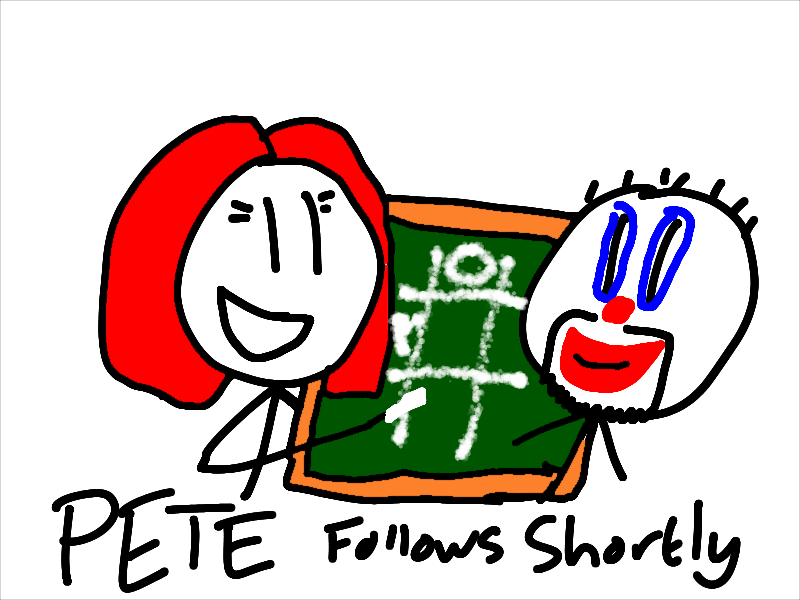
One of the most interesting things I occasionally think back on is the phenomenon of the "Follows Shortly" screen on television, which punctuated programmes that apparently weren't quite long enough, or, presumably, covered for when the continuity announcer needed to go and take a really big shit or something.

You never see these any more today, but at a certain point in the 1980s in particular, they were quite frequent. (I don't know about before that, because I wasn't alive to see them then, but I assume they still happened in the earlier years of television, too.) They are, in effect, "loading screens" for live television. And they came in varying degrees of elaborateness.

One of the most elaborate was the one that came before ITV's schools programming on Channel 4, which if I remember correctly was broadcast in the middle of the night because no-one in their right mind would want to watch that voluntarily. Thus, in this case, I'm pretty sure the "Follows Shortly" screens were there to cater for variations in the clocks on video recorders, which everyone would have had to set manually rather than just letting the Internet do it for them. If you build in a buffer of a few minutes either side of your programme, that means even if there is some variation in the time people have set their clock to, everyone will be able to record the whole programme without having to leave an impractical amount of time either side of it.

The other thing about ITV Schools is that it had incredibly memorable music, particularly for the final 1-minute countdown to the programme actually starting:

In fact, a lot of these continuity-filling slots actually had some really great music, similar to that heard during Pages from Ceefax. Have I talked about Pages from Ceefax on here? I forget. [checks] Apparently not. Well, there's something to talk about another day, then.

Anyway, all you need to know for the moment is that Pages from Ceefax had great music, and a similar crop of inoffensive yet undeniably catchy instrumental tunes were used for "Follows Shortly" pages, particularly when schools programming was involved.

It's funny the things that you start to miss and even pine for as you get older. When I was a kid, a "Follows Shortly" page coming up on TV was immensely frustrating, because I just wanted the show to start now! Today, though, they can be seen as a symbol of a lost age: a time when we didn't feel the need to be constantly "consuming content", and when it was okay to stop for a moment, put the kettle on, have a wee, tickle the cat and perhaps have a brief conversation before the programme you were waiting for actually came on.

So yeah. I miss them. And I suspect my thinking back oddly fondly on these stupid inconveniences is at least part of the reason why I've never minded load screens and load times in video games all that much. Sometimes waiting a moment is just part of the experience, and it doesn't have to be a negative thing. Sometimes it can be quite valuable.


Want to read my thoughts on various video games, visual novels and other popular culture things? Stop by MoeGamer.net, my site for all things fun where I am generally a lot more cheerful. And if you fancy watching some vids on classic games, drop by my YouTube channel.

If you want this nonsense in your inbox every day, please feel free to subscribe via email. Your email address won't be used for anything else.

2384: Turbo Kid: The Best '80s Movie That Wasn't Made in the '80s

0384_001

After repeated exhortations of extremely enthusiastic approval from my friend Tom, I decided to watch the movie Turbo Kid this evening on Netflix. I was not disappointed.

Turbo Kid is a study in contradictions. It's a movie that is a perfect recreation of 1980s action flicks, but it was made in 2015. It's not a comedy, but it's hilarious. It is, at heart, simplistic and straightforward, but nonetheless compelling and thought-provoking. More than anything, though, it's terrible, but it's stunningly brilliant.

Turbo Kid is set in the apocalyptic far-off future wastelands of the year 1997, where some awful disaster that isn't really explained (but was probably something to do with the Cold War and/or robots) has turned everything to shit. Our story centres around a nameless young boy, known only as The Kid, who was orphaned early in the post-apocalyptic period, but who has, against all odds, managed to survive in the wasteland through scavenging and keeping his childish hopes and dreams alive through vintage comics about his favourite superhero, Turbo Rider.

Early in the movie, The Kid meets Apple, who initially seems to be a charmingly dimwitted young girl, but subsequently is revealed to be a robot, because '80s movie. Apple is dying thanks to getting hit in a skirmish, and The Kid, who after some initial reluctance to even be around her having been alone for so long, agrees to help her find some replacement parts before her "heart gauge" (rather beautifully depicted in Zelda-style pixel art on an embedded display in her wrist) runs out and she deactivates forever.

I'll spare you the rest of the details, but suffice to say, The Kid finds himself taking on the role of Turbo Rider to the best of his capabilities, and there are plenty of ridiculous action scenes along the way, not to mention a particularly loathsome villain in the form of self-appointed wasteland baron "Zeus" — who of course has a connection with The Kid, because '80s movie.

I was reading an article in a GamePro from a couple of years ago the other day, and someone — I forget who offhand, but I think it was someone like Tim Schafer or his ilk — made the very good point that the best comedy is made of juxtapositions, most commonly the juxtaposition of serious words with silly visuals, or vice-versa. Turbo Kid is pretty much entirely designed around this philosophy: it takes itself very seriously and never, at any point, winks knowingly at the audience to go "DIDYA SEE THAT?!". Instead, it makes use of the exact same techniques '80s action movies did to juxtapose the ridiculous with the deadly serious: terrible, extremely obvious special effects; excessive amounts of blood and gore; unnecessary swearing at the most bizarre moments; but, at heart, a rather touching story of a kid who realises he doesn't want to be alone in the world any more.

Of particular note is the blood and gore, of which there is lots, but it's so insanely exaggerated — again, like the best worst '80s action flicks — that it's impossible to feel grossed out by it. In one scene, a man gets his face thrust into the spinning blades of a blender. In another, someone gets his guts pulled out by them being attached to the back wheel of a bicycle (in this particular post-apocalyptic future, everyone rides pedal bikes — which sort of makes sense, when you think about it, as fuel would eventually run out). In the climactic battle scene, the dismembered torso and legs of two other enemy grunts become firmly lodged on the head of a third enemy. And, of course, Turbo Rider/Kid's unique gadget is a device on his wrist that immediately causes anyone it is pointed at to explode into a fine red paste.

Turbo Kid really benefits from being written and constructed as an '80s action flick, without any fourth wall-breaking self-awareness going on. In being designed this way, it provides commentary on how desensitised to violence we are these days — many of the more gory scenes in the film would likely have got the movie banned as a "video nasty" back in the '80s — while at the same time pointing out how far popular culture has supposedly come in the last 30+ years. Or you can look at it another way: it can be interpreted as a fond look back at the '80s, when not all entertainment was expected to have some sort of socially aware "message" behind it (with the possible exception of children's cartoons, which tended to lampshade these messages extremely obviously) and it could sometimes just be about many boys' childish fantasies: the ability to point at a bad guy and have them explode into goo.

If you have an hour and a half to spare, then, be sure to check out Turbo Kid on Netflix. If you grew up in the '80s and/or you enjoyed Far Cry: Blood Dragon (which is a similarly hilarious but loving homage to the more ridiculous side of '80s popular media), you will very much appreciate what it has to offer.

1755: Dad Rock

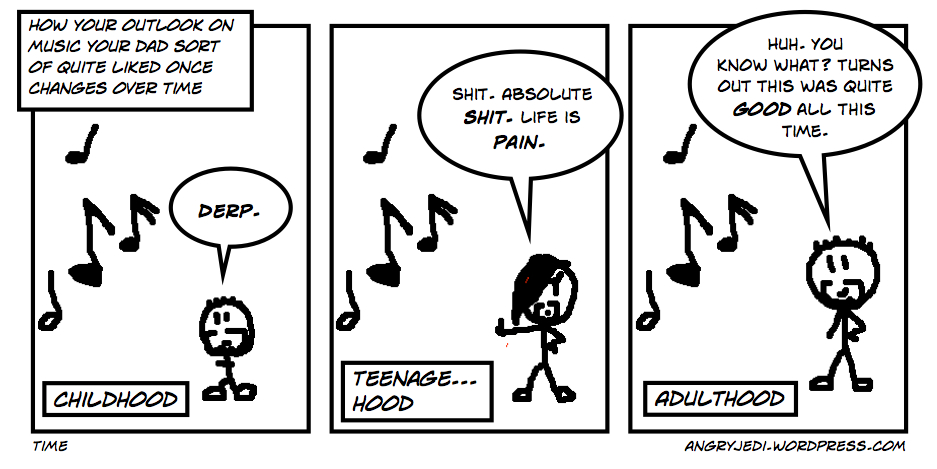
Page_1I have a playlist on my phone called "Dad Rock". The title will be fairly self-explanatory to most of you, I'm sure, but for those wondering why I would call it that when I'm not a father (and have no intention of being one, either), the explanation is actually relatively simple. It's a playlist full of stuff that I secretly quite enjoyed listening to when I was young and impressionable, but which during my teenage years I steered well clear of owing to the fact that it's not at all cool to be into records from your Dad's collection. Not that I was cool at all during my teenage years anyway, but that's beside the point.

Anyway, the point is, my Dad Rock playlist contains a selection of stuff from artists like Pink Floyd; Yes; Emerson, Lake and Palmer; and the Electric Light Orchestra. It's a playlist I intend to build on over time as I recall things from the past that I actually quite enjoyed, and ultimately will become a pleasing collection of somewhat retro music (largely erring on the prog rock side of things) that I can listen to at my leisure.

One of the first albums that I added to the mix was Time by ELO. I'm not entirely sure why this album has stuck in my mind all these years, but downloading a copy and listening to it on the way to and from work recently has confirmed to me that yes, it really is a cracking album and one that I'm very happy to have rediscovered.

Time, if you're unfamiliar, is a concept album based around the theme of a man from 1981 (the year of the album's original release, and the year of my birth) who somehow finds himself in 2095. The theme is rather flimsy, to be honest, but it's a good excuse for a selection of vaguely sci-fi-themed tracks about The Future — or at least The Future as imagined in 1981.

What I love about Time is how unabashedly earnest and unironic it is about everything. It features lyrics that would be used in a cynical, sarcastic or parody manner today, but it takes them seriously. Take this wonderful little bit from Yours Truly, 2095, referring to an apparently emotionless robotic woman that reminds the narrator of someone he left behind back in 1981:

She is the latest in technology,
Almost mythology, but she has a heart of stone
She has an IQ of 1,001,
She has a jumpsuit on,
And she's also a telephone.

Wonderful stuff. And it doesn't stop there, but I won't bore you with too many quotes.

What's interesting about Time is how its vision of the future actually isn't too far off the mark in a few situations. The above example from Yours Truly, 2095 is extreme, of course, but the prospect of the latest technology having "being a telephone" thrown in almost as an afterthought is already a reality thanks to smartphone technology and software like Skype. Similarly, these lines from Here is the News accurately predicted the launch of round-the-clock rolling news coverage and the subsequent banality that comes with it when there's not all that much going on.

Here is the news,
Coming to you every hour on the hour,
Here is the news,
The weather's fine but there may be a meteor shower.
Here is the news,
A cure's been found for good old rocket lag,
Here is the news,
Someone left their life behind in a plastic bag.

More than anything else, though, Time is an evocative work that uses a variety of different musical styles, some well-crafted (if occasionally cheesy when viewed through a 21st-century lens) lyrics and some genuinely catchy themes. Despite the fact that the "narrative" of the album is somewhat shaky and unclear, it certainly does manage to evoke an uncommonly vivid image of the future — not quite dystopian in nature, but certainly a rather alien existence to that which we know even now in 2014.

Early in the morning,
The sun was up and the sky was very blue,
Without a warning,
As I looked out, my thoughts returned to you,
A noise in the city made the children run,
And hide themselves away,
And thunder boomed and lightning filled the sky.

Since I've always known Time as a complete experience — and there's very much a feeling of a "journey" throughout the tracks, even if the narrative itself is a little muddy — it's one of those albums that I absolutely can't listen to on random play, even though I like most of the tracks individually. It's a work designed to be experienced as a whole, and it's one that still — for me, anyway — holds up remarkably well today. So I have a feeling there's going to be at least a few more journeys to and from work with it blasting from my speakers, yet.