#oneaday Day 91: Let Me Be Good To You

I know that Disney is the megacorporation everyone loves to hate these days — and with good reason — but when I was a kid, I really enjoyed Disney movies. And however much of a mess modern-day Disney makes of today's entertainment sector by attempting to monopolise all of it, it doesn't take away from the fact that Disney's classic movies are still a good time.

I haven't watched any Disney movies for a while so, following a discussion on them the other day, I decided to grab a few Blu-Rays. They were like a fiver each on Amazon, so I snagged two of my all-time favourites from back in the day — Robin Hood and The Sword in the Stone — along with one that I've never seen but always wanted to see: Basil The Great Mouse Detective — or, as I've since learned it's actually called, just The Great Mouse Detective.

Prior to today, when I got around to watching Basil The Great Mouse Detective, my sole experience with this particular Disney property was 1) the Atari 8-bit game by Gremlin Graphics, which was a rather obtuse arcade adventure sort of affair, and 2) this video, which I suspect created almost as many furries as the entirety of Robin Hood did.

Basil The Great Mouse Detective (I know that's not what it's called, but nearly 40 years of calling it that are a hard habit to break, so I'm not going to) follows the adventures of Basil of Baker Street, a mouse who lives in a hole beneath the home of Sherlock Holmes.

The story opens with a toymaker mouse being kidnapped by a bat called Fidget, and taken to the lair of the villainous Professor Ratigan for some initially unknown purpose. The toymaker's daughter Olivia successfully hid herself while the kidnapping was taking place, and ends up encountering Dr. Dawson, the film's Watson analogue, shortly after his arrival in London. Together, the pair seek out Basil of Baker Street, a renowned and somewhat eccentric detective.

The eccentricity of Basil is obviously designed to mirror that of Sherlock Holmes, and Basil The Great Mouse Detective does a great job of reflecting this. One of the first things we see Basil do is pile up a big load of cushions and then fire a pistol right into them — initially it looks like he's just doing this for fun, much to the annoyance of his housekeeper, but before long it becomes apparent that he wanted to fire a bullet from that specific gun in order to compare its rifling markings with that of one he had retrieved from another unspecified crime scene that related to Basil's arch-nemesis, the aforementioned Ratigan.

Basil is initially resistant to paying any attention to both Dawson and Olivia, but as soon as they mention Fidget — a known henchman of Ratigan — he takes on her case with enthusiasm. Thus begins an adventure across London that successfully incorporates elements of the classic Holmes stories — most notably the ever-reliable dog Toby, here presented as a Basset hound rather than the half-spaniel, half-lurcher mutt described in the original Holmes stories.

Basil The Great Mouse Detective hails from 1986, putting it in a category that I still think of as "more recent" Disney films despite it actually being 38 years old. Some critics point to this era of Disney as a time when their animated features contained markedly less in the way of peril and threat than earlier work from the animation studios, but I can see elements of Basil The Great Mouse Detective as being potentially scary for young kids. Fidget in particular is quite threatening despite also being a bit of a comic relief character, and he delivers a few mild jumpscares over the course of the movie.

Ratigan, too, is often cited as being quite a threatening Disney villain, showing zero hesitation or remorse for putting one of his own henchmen to death (via consumption by cat) in the relatively early moments of the movie. It's got that classic Disney balance of appealing silliness with a dark undercurrent that really works, perhaps best exemplified by a sequence where Basil and Dawson are attached to a distinctly Heath Robinson-esque trap that, were it to go off, would not only strangle them in a mousetrap, it would also blast them with a human-sized pistol, drop an axe on them and finally crush them beneath an anvil.

I enjoyed the movie as a whole and am glad I've finally seen it. It felt somewhat light on musical numbers compared to some Disney films — there are only three real songs in it, with only one of them (The World's Greatest Criminal Mind) being a traditional "song and dance" number, with the others being diegetic numbers in the form of a live performance (the above Let Me Be Good To You) and a phonograph recording (Goodbye, So Soon) that also acts as the end credits theme. That's not necessarily a bad, thing, though; the format of Basil The Great Mouse Detective meant that excessive musical numbers would have probably dragged the pace down a bit, and the ones that were present were worthwhile and made sense. Given that the aforementioned "execution" occurs in the middle of The World's Greatest Criminal Mind, one could argue that Disney was attempting to subvert its own formula somewhat.

Basil The Great Mouse Detective is actually the first full-length movie I've made time to sit down and watch for a long time, and I enjoyed it. I think I might have to invest in some more Disney Blu-Rays, as spending an hour and a half just enjoying the movie with zero distractions was a pleasant experience I wouldn't mind having a bit more often. Plus I don't think Andie's seen that many Disney movies, so this might be a fun opportunity to educate her a bit!


Want to read my thoughts on various video games, visual novels and other popular culture things? Stop by MoeGamer.net, my site for all things fun where I am generally a lot more cheerful. And if you fancy watching some vids on classic games, drop by my YouTube channel.

If you want this nonsense in your inbox every day, please feel free to subscribe via email. Your email address won't be used for anything else.

#oneaday Day 90: Dream modding

The Dreamcast is a notoriously unreliable and temperamental console, particularly now the poor old thing is getting on a bit in years, so I've been meaning to look into optical drive emulators (ODEs) for a while, as I mentioned here.

Well, today I finally got together all the bits for one of these possible ODE solutions, known as GDEMU. This included the GDEMU board itself along with a mounting kit that plugs the gap left behind when you remove the Dreamcast's original GD-ROM drive, and also allows easy access to the "disc change" button for multi-disc titles. (It also supposedly helps with airflow; having a honking great hole inside the Dreamcast supposedly isn't great for that.)

I'd looked up instructions on how to fit a GDEMU and for the most part it seemed like a very simple job. I normally hand over anything that requires delicate use of tools to my wife as she's much less cack-handed (and much more handy) than I am, but this looked like something I thought I could probably do myself. So I decided to be brave and to do it myself.

And you know what? It was easy. There were just a few steps to the process that went roughly as follows:

  • Remove three screws from the bottom of the Dreamcast
  • Remove the modem (it just pops out)
  • Remove the screw that is revealed when you remove the modem
  • Pop off the top of the Dreamcast
  • Remove three screws holding the GD-ROM drive in place
  • Remove the GD-ROM drive (it's just plugged directly into a connector that sticks out from the bottom of the casing)
  • Screw the mounting kit to the GDEMU board (I forgot to do this, but getting the board back out to do it was easy… I then also forgot to put the button for the disc change in the mounting kit, but, again, it was easy enough to undo the work and correct the mistake)
  • Stick the GDEMU board into the socket the GD-ROM drive went in
  • Screw the GDEMU board into the Dreamcast case where the GD-ROM drive used to be
  • Put the case back together
  • Put the four screws in the base back in
  • Put the modem back in
  • Done!

Most places online also recommended putting some resistors in the power supply between the 12V pin and one of the three Ground pins. This is apparently because without the original GD-ROM drive drawing from the 12V… whatever it is, the inside can get a lot hotter than it would do normally, but this can be avoided with the resistors, which basically trick the power supply into thinking the GD-ROM drive is still drawing power. I don't entirely understand everything about it, but I understood what I had to do, which was twist the wires on three resistors together, then poke one end in the hole with the 12V pin, and the other end in the hole with one of the ground pins.

This was the one part of the procedure I really wasn't sure about. I haven't done any sort of fiddling with electronic components before (outside of maybe a term's work on very simple circuits — mostly logic gates — in secondary school Design and Technology and Science classes) so I was a bit nervous I'd poke something in the wrong hole and make things go bang. I was reassured by some people who take apart old computers and consoles all the time that it was very unlikely putting a few resistors in would make anything go bang, but I was still a bit concerned the resistors might not stay where they were supposed to be or would short-circuit something.

It took a few attempts to get it done to my satisfaction, but eventually I got the resistors in the right place and was satisfied that they were as secure as they were going to be without getting hot glue involved, and I put the whole shebang back together.

And, believe it or not, when I booted it up, it all worked first time! I was expecting something to go wrong somewhere, but no — everything went very smoothly, and I now have a Dreamcast that has a nice selection of games built right into it. No worrying about the drive failing mid-game and causing a reboot to the system menu; no worrying about discs not reading properly; no worrying about region, either.

I'm very happy with how things went, and I'm looking forward to using my Dreamcast a lot more now it's been "revitalised" like this. It also encourages me to look into similar solutions for other consoles — particularly the Saturn. I have a Saturn that I acquired at some point (but no power supply, AV cables or controllers… or indeed games) that it would probably be fun to get loaded up with games in the same way. So I'll probably do that at some point.

Long term I'd like to get all my classic systems hooked up with a solution like this, such as the Everdrive range for cart-based systems. As fun as it is to collect for old consoles, I've been burned just a few times too many by cartridges that don't work — I have two copies of Desert Strike for SNES that don't work in the exact same way, for example — plus I don't really have a lot of room left for collecting, either.

There's still a certain magic about playing games on classic hardware — and part of that, admittedly, is using original media; the clunk of the cartridge slot on consoles like the SNES in particular is a fun part of the experience. But as many of these old games are starting to run into reliability issues by virtue of their age, it's great that we have alternative solutions that allow us to still enjoy the consoles themselves, even if the media is past its best. And for everything else, we have emulation and modern, officially licensed solutions like the Evercade.

Now maybe time for a bit of Dreamcast before bedtime, I say.


Want to read my thoughts on various video games, visual novels and other popular culture things? Stop by MoeGamer.net, my site for all things fun where I am generally a lot more cheerful. And if you fancy watching some vids on classic games, drop by my YouTube channel.

If you want this nonsense in your inbox every day, please feel free to subscribe via email. Your email address won't be used for anything else.
#oneaday Day 89: Under the influence

I'm not entirely sure when exactly "influencer" became a widely accepted job title, but I do vividly remember when I first heard it that I felt "…we probably shouldn't make that a thing". And in 2024, I stand by that. I find it horrifyingly dystopian that we live in a world where people are unironically referred to as "influencers" — and, perhaps even worse, there are people out there who see "influencers" as somehow inherently more trustworthy than traditional media.

The traditional media has its problems, of course, and it always has done. But there has always been a certain separation between editorial and commercial content — and when there isn't, it is clearly demarcated. There are no such demarcations when it comes to "influencer marketing" — and, from where I'm sitting, there appears to be absolutely zero scrutiny or oversight of how "influencers" are doing business, with minimal obligations for them to share the fact that they're being paid to say things.

The scourge of "influencers" is a universal one, but obviously my most direct experience with it is in the world of gaming. One of the most common criticisms thrown at old-school games journalists is that they've been "paid off" by publishers to do things a certain way — either to inflate a product's review scores above what it is perceived to "deserve", or perhaps to disparage rival products.

Having spent several years in the industry, I don't doubt that there have been occasions where that goes on. And there have been plenty of related incidents, too, with probably the most famous being "Gerstmanngate", where a writer was let go from Gamespot for giving a bad review to a game whose publisher had spent a considerable amount on advertising said game.

Most people would agree that a games journalist being in the pocket of a publisher is a bad thing. I don't believe it goes on nearly as often as the most insufferable people on the Internet think it does, but I think we can all agree that if money changes hands in this way, the "journalism" on the thing in question is compromised.

And yet the same people who would take a games journalist to task for accepting money from a publisher to cover a game are all over the world of "influencers", believing that having your face on YouTube makes you inherently more "real" and "trustworthy" than those people who hid behind all those pesky written words. And "influencers" (no, I'm not going to stop with the scare quotes, I fucking hate the term) are openly accepting paid promotional deals, then covering the products in question. Some of them remember to disclose this; not all do. But regardless of whether or not any disclosure is going on, how is that any fucking different?

I find it absolutely unfathomable that "influencers" accepting money for coverage of things is apparently just tickity-boo, whereas the exact same thing was one of the worst accusations you could throw at a games journalist. How does that make any sense whatsoever?

I feel mostly immune to influencer marketing, but it's very clear that the younger generation in particular are very susceptible to it. And it's dystopian. It's horrible. And it's one of those things that we can't just "walk back" any more, because the influencer "industry" has become so massive over the course of the last decade or so.

I saw someone argue earlier that we're probably overdue for a brand new "segment" of the Internet, like how we once had stuff like Telnet and Gopher alongside the World Wide Web. If the Web has become this utterly devastated late-stage capitalism wasteland, perhaps it's time for people to move on to something else? And no, not the fucking Metaverse. Honestly, at this point, I'd welcome the ability to engage with a fully text-based Internet that wasn't 99% controlled by advertisers. Then we can leave all the "influencers" and their mindless zombie followers to it, and build something better elsewhere.

And then wait for that to be ruined. Still, it might be fun for a few years at least, before the Brands find it.


Want to read my thoughts on various video games, visual novels and other popular culture things? Stop by MoeGamer.net, my site for all things fun where I am generally a lot more cheerful. And if you fancy watching some vids on classic games, drop by my YouTube channel.

If you want this nonsense in your inbox every day, please feel free to subscribe via email. Your email address won't be used for anything else.
#oneaday Day 88: Is social media marketing over?

Just recently at the day job we've been having some Thoughts about using social media for marketing. I won't go into the details for obvious reasons, and I will note that everything I say here is my own opinion and no-one else's. But I feel like the age of social media marketing is coming to a close.

To be perfectly honest, I've never been on board with social media marketing from a consumer's perspective. Facebook went from being tolerable to almost unusable once The Brands™ arrived, and it's only gotten worse year after year. And back when I was an active user of Twitter, I not only didn't follow any Brands™, I actively went out of my way to block any that ended up in my feed through "promoted" tweets or whatever.

Y'see, I've always had the somewhat controversial viewpoint that social media is best used for socialising. I used to actually quite enjoy using Facebook when it was a place to interact with friends. Likewise Twitter used to be a ton of fun when it was just people hanging out and shooting the breeze. But today? Both of those platforms are nigh-unusable for different reasons. And with people jumping ship from both, I struggle to see how their usefulness as marketing tools can continue.

This comes particularly to mind after the recent news that the "live service" game Concord has taken the unprecedented step of not only ceasing its online features, but actively refunding anyone who bought the game just 11 days after it hit store shelves. The writing was already on the wall for it; reports shortly after its launch suggested it had made "just" $1 million and only about 25,000 sales; these might seem like big numbers, but they really aren't in today's gaming industry, particularly towards the big-budget end of things, which is the space Concord occupies.

This occurrence got me thinking: how much of Concord's disastrous launch was down to the troubled landscape of social media today? A few years back, a big game launch like this would be accompanied by a frenzied Twitter campaign in an attempt to drive "organic" (ugh) word-of-mouth promotion. To put it in non-marketing speak, the game itself would post something on social media, then other people would share it, gradually spreading word of the game through shares, replies and retweets.

Today, we live in a world where Twitter is fast becoming a dirty word, as Elon Musk's "X", as Twitter is now known, is increasingly becoming prone to the "Nazi Bar Problem", since his constant bleating about "free speech" and "wokeness" has meant pretty much the only people left there now are some of the absolute worst dregs of humanity imaginable. It's no longer fun or useful to the vast majority of people who used to hang out there, so a lot of people have jumped ship — either abandoning social media entirely, or moving to alternative platforms such as BlueSky. So one has to wonder how much value there is in marketing to what is rapidly looking like a room full of Nazis.

The same can often feel like it's true of other platforms that are less of a "problem". I talked recently about the issues we had attempting to enforce rules more specifically on a Discord I help manage, and it's hard not to think about that "Nazi Bar Problem". We don't have a problem with "Nazis" as such (the few who have shown inclinations in that vague direction have been shown the door) but there are a few people who have become so entrenched that they're a problem… and it's honestly making us wonder if the time, effort and mental health expended on said server is worth it.

Can a product or Brand™ survive without social media? The assumption has always been "no", but like I said above, I've found myself actively repulsed by Brand™ presences on social media for the most part, and I'm sure I'm not the only one. Sure, there are some Brand™ accounts that post interesting things — and the one I'm in charge of I try and make an effort to use in such a manner — but are they really adding any value?

I'm not convinced they are. We are living in a peculiar time, and I don't think anyone quite knows what's going to happen next.


Want to read my thoughts on various video games, visual novels and other popular culture things? Stop by MoeGamer.net, my site for all things fun where I am generally a lot more cheerful. And if you fancy watching some vids on classic games, drop by my YouTube channel.

If you want this nonsense in your inbox every day, please feel free to subscribe via email. Your email address won't be used for anything else.

#oneaday Day 87: The most toxic person in retro gaming

One of the things that continually surprises me is quite how toxic the retro gaming community, particularly in the UK, can really be. I'm fortunate that I have only ever really encountered people who are thoroughly nice and lovely — and, even better, have been able to draw inspiration from them to make my own creative work better.

In this regard, I'd particularly like to throw some love (and some links to their YouTube channels) at, in no particular order and off the top of my head, RoseTintedSpectrum, WhatHoSnorkers, Timberwolf, Gouldfish on Games, Dudley of Yesterzine, Kim Justice, Slopes Game Room, Digitiser, More Fun Making It, Beyond the Scanlines, Gears of Games, Yawning Angel and doubtless myriad others that I'm forgetting. All of these folks are thoroughly lovely, supportive people that I am happy to have had direct contact with to varying degrees at various points over the course of the last few years. Click those links and subscribe to all of them. They do amazing work.

Sadly, there's a really unpleasant underbelly to the retro gaming community in the UK, and a lot of it centres around an individual known variously as "George Bum", "George Cropper" (not his real name), "Funky Spectrum" and any number of other aliases. "George" is a serial harasser who has been thrown off YouTube for his behaviour, and now festers in his own filth on his own little website (which, no, I'm not linking to), surrounded by chirruping sycophants who hang on his every shit-encrusted word — many of whom are very much old enough to know better.

I'm not pulling any punches here: "George" is an absolutely vile human being, and the way he has picked on several members of the retro gaming community for years at this point without any sort of punishment is utterly repugnant. He has particularly targeted the YouTuber Octavius with stalker-like obsessiveness, and is almost as bad with his fixation on Peter "Nostalgia Nerd" Leigh and his Norwich-based vegan bar-cum-arcade Barcadia. Most recently, he's had Kim Justice in his sights, because he thinks her well-researched book is not as good as his AI-generated drivel that he listed on Amazon for £250.

And yet no-one does anything about him. Because there's not really anything that can be done about this festering waste of space any more.

He's in his element on the Twitter of 2024, which is a disgusting sinkhole full of the absolute worst people on the entire Internet — many of whom are openly spouting their garbage under their real names — although I take some small comfort from the fact that anyone with any sense has abandoned the platform long ago.

He's been banned from YouTube for his harassment videos. (Of course, he maintains he did "nothing wrong".) Now, at least, he's confined to his stupid website. Sadly, as it's self-hosted I suspect there's not much anyone can really do about him short of actually raising a legal objection to some of the things he posts on there. And I doubt anyone wants to go through the time, energy and expense involved in doing that.

Which sucks, really, because it means this festering boil on the arse of UK retrogaming will never truly get lanced. All I can really do is encourage anyone reading this to never go anywhere near him. He is Bad News.


Want to read my thoughts on various video games, visual novels and other popular culture things? Stop by MoeGamer.net, my site for all things fun where I am generally a lot more cheerful. And if you fancy watching some vids on classic games, drop by my YouTube channel.

If you want this nonsense in your inbox every day, please feel free to subscribe via email. Your email address won't be used for anything else.

#oneaday Day 86: Emio - Roll Credits

I just finished Emio – The Smiling Man: Famicom Detective Club, the new Nintendo Switch release that, as the name suggests, acts as an official sequel to the two classic Famicom Detective Club games that were first released on Famicom Disk System, and subsequently remade for Switch a couple of years back. You can read my thoughts on both of them here and here.

I'll do a "proper" writeup on the game at some point in the next few days over on MoeGamer, but suffice to say for now that it was excellent, and acts as a wonderful successor to the already very good two predecessors.

For the unfamiliar, the Famicom Detective Club series unfolds as Japanese-style adventure games. That means you spend the majority of your time selecting actions from a menu, reading a lot of dialogue and searching for the next "trigger" to move the story along. Japanese adventures are more about the plot than solving puzzles; to put it another way, they are the modern equivalent of the narrative-centric "interactive fiction" versus the mechanics-centric "text adventures".

The first two Famicom Detective Club titles occasionally lapsed into "click on every option multiple times until something happens", which was mildly annoying, but this new third one makes the sensible decision of highlighting important words and phrases in the dialogue which generally gives you a solid idea of what you need to do next. You can actually turn this feature off if you prefer, but honestly just leaving it on is the best way to keep the story flowing.

The story this time around concerns a dead body that has been found. The corpse is a student named Eisuke, and he appears to have been strangled. Unusually, his corpse was found with a paper bag over his head, and a creepy smiley face scrawled crudely on the bag. What then follows is your attempts (as both the self-insert protagonist from the first two games and his long-suffering coworker Ayumi) to solve the case by interviewing suspects, examining important locations and gradually piecing everything together.

In the tradition of Japanese adventure games, you're not really "doing" much beyond simply advancing the plot, but that's fine. There's no "moon logic" to worry about here; it's just about enjoying the story unfold, and occasionally demonstrating that you've understood what you've witnessed through short "Review" sequences that quiz you on the most recent happenings. There aren't really any consequences for getting these wrong other than Ayumi giving you the stink-eye, but that will be punishment enough for many players.

I'll refrain from saying any more about the plot for the moment for the sake of spoilers, but I will say it's refreshing and welcome to see Nintendo going unabashedly adult with this one. It's PEGI 18 rated with good reason; it does not pull punches, and I mean that in several respects. The game is all the better for not holding back; it drives home the fact that the case you're investigating is very serious for a number of different reasons, and the complex motivations of the many characters you'll encounter over the course of the plot will keep you intrigued right up until the end.

I was also impressed by how comprehensively it wrapped things up by the conclusion. It pulls a little bit of a fast one on you in this regard, but I'll leave exactly how for you to discover.

Anyway, yes; Emio – The Smiling Man: Famicom Detective Club is proof that the Switch very much still has plenty to offer in what most people are assuming is its twilight year. And it's yet another reminder, if one were needed, that modern gaming isn't actually all that bad, really — so long as you steer clear of the shit bits.

More on MoeGamer at some point this week.


Want to read my thoughts on various video games, visual novels and other popular culture things? Stop by MoeGamer.net, my site for all things fun where I am generally a lot more cheerful. And if you fancy watching some vids on classic games, drop by my YouTube channel.

If you want this nonsense in your inbox every day, please feel free to subscribe via email. Your email address won't be used for anything else.

#oneaday Day 85: Find another word than "weird"

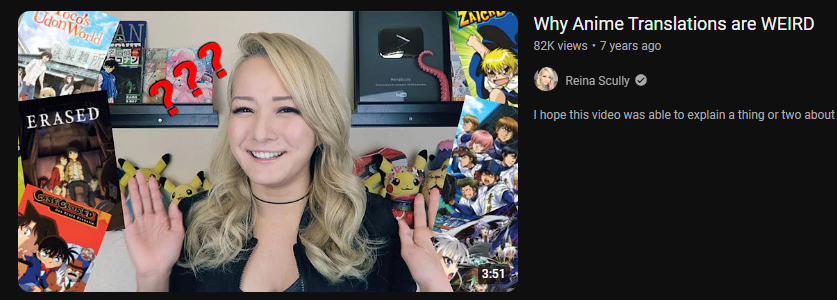
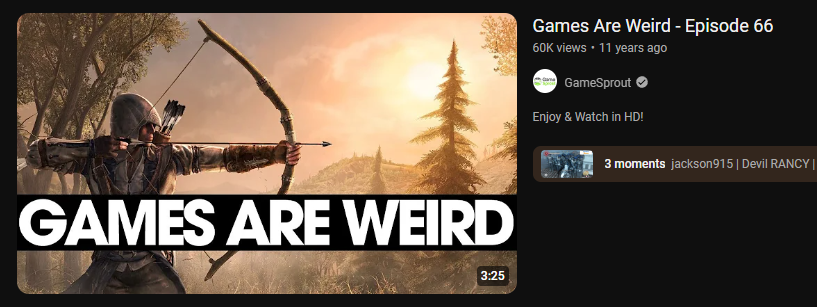
It seems that people of a certain — I don't even know if it's age, but it's definitely a specific social group of some description — are incapable of describing something via any word other than "weird". This is particularly apparent on YouTube, where there is a veritable surfeit of videos called, simply, "[x] is weird".

Here's one:

And another:

Here's a brand new one with no views:

And here is part of what is apparently a whole series of the bloody things:

What these videos inevitably go on to describe is something that is emphatically not weird, usually rather mundane and which could have probably been better served with a more descriptive title.

At this point I'm sure someone desperately wants to bring up the American left-wing tendency to refer to anyone on the right of them as "weird", which is a current trend in the run up to the next U.S. presidential election. This is a separate issue — and one which, I have to say, I'm kind of on board with, because nothing shuts down a raging idiot like telling them they're being weird and making an idiot out of themselves — so I am not including it in the trend I am describing above, which has been around a lot longer.

I often find that the "[x] is weird" trend goes hand in hand with the tendency for Certain Types of People (again, not necessarily age-specific, but a definite type) to write things all in lower-case. You can see this in the first video example above. Nothing in the video title or the text on the thumbnail uses a capital letter, even when one is really needed (such as in the word "I", on the name "Tony Hawk" and the abbreviation "THPS" for "Tony Hawk's Pro Skater"). And, again, the people who do this sort of thing often like to make out that exceedingly mundane things are somehow outlandishly remarkable.

I'm not even entirely sure why this bothers me so much. I think it's that "[x] is weird" does the video (it's usually a video), the subject matter the video is covering and the creator of the video a disservice. I'm sure many of these "[x] is weird" videos are actually quite interesting, but I am, at this point, completely put off from clicking on them almost as much as if I see "I played 100 days of [game]".

I guess it's just another example of Stuff That Isn't For Me. And judging by the viewing figures on a couple of those videos I posted above, it seems I'm in a bit of a minority. But still. If you ever catch me posting a video with the name "[game name] is WEIRD" you have full permission to slap me. Even if I'm covering a French home computer game from the early '90s. Now those really WERE weird.


Want to read my thoughts on various video games, visual novels and other popular culture things? Stop by MoeGamer.net, my site for all things fun where I am generally a lot more cheerful. And if you fancy watching some vids on classic games, drop by my YouTube channel.

If you want this nonsense in your inbox every day, please feel free to subscribe via email. Your email address won't be used for anything else.

#oneaday Day 84: Modern gaming is great

It's very easy to be cynical about the state of modern gaming if all you pay attention to is triple-A. There are a bajillion YouTube videos on this very subject. I even made my own counterpoint, which you can enjoy here if you see fit:

Fact is, though, if you look outside all the identikit Live Service open-world player retention monetised-out-the-wazoo triple-A space (and the indie darlings who desperately wish they were part of that space), we've never had it so good.

We're living in a world where, in 2024, there is a brand new Famicom Detective Club game out now, with an English version and a physical release. I bought it, because I really enjoyed the modernised versions of the first two. (You can read my thoughts on them here and here, and some more detailed thoughts on this new third entry will follow soon.)

We're living in a world where preservation of retro games is not just taking place in the form of rereleases — and it's great that that is happening in itself — but also in the form of fantastic "museum-style" pieces featuring interactive historical artifacts, video clips and all manner of other goodness.

We're living in a world where Japanese games we once thought would never be localised are readily available in English — and with gorgeous big-box physical releases just like PC games from 25 years ago.

We're living in a world where all the mainline Yakuza/Like A Dragon games are available in English, which I'm sure makes the guy who used to harass me on MoeGamer because he thought anime-style games were stopping Yakuza games from getting localised mad for some reason.

And, of course, we're living in a world where thanks to emulation and related solutions, everyone has easy access to pretty much every game ever made, so if you ever claim you have "nothing to play" you really only have your own boring ass to blame.

There's plenty that's shit, of course. The aforementioned live service games. Perpetually unfinished releases with endless "roadmaps". The scourge that is Game Pass. The death of traditional games journalism, particularly magazines. The general standard of "discourse" online (or lack thereof) surrounding video games. All of that sucks fat horse dick.

But a lot of it also doesn't matter. Because you can shout and scream and yell about how shit you think "modern gaming" is… or you can actually engage with "modern gaming" until you figure out that it's much, much more than just the incredibly shit bits. And the sooner you leave the incredibly shit bits behind — and yes, it absolutely is possible to do so, I have done since about 2010 and have been eating well games-wise ever since — you'll find things better than ever.

So close that Twitter window where you're complaining about Helldivers II or whatever, and boot up a copy of, say, Emio: The Smiling Man. And don't look back.


Want to read my thoughts on various video games, visual novels and other popular culture things? Stop by MoeGamer.net, my site for all things fun where I am generally a lot more cheerful. And if you fancy watching some vids on classic games, drop by my YouTube channel.

If you want this nonsense in your inbox every day, please feel free to subscribe via email. Your email address won't be used for anything else.

#oneaday Day 83: Modernising the old stuff

One of the nice things about being into retro gaming and computing these days is that there are a lot of very convenient things you can use that simply weren't a thing Back In The Day for one reason or another. And while I'm not a huge fan of doing major modifications to classic hardware that effectively rips out the original "soul" of the machine, I do want to share a few things that just make life a little bit easier for various use cases.

SDrive-MAX (Atari 8-bit)

One of the most common points of failure on classic hardware is old media — both in terms of the media itself, and the hardware required to read it. I have several disk drives for my Atari 8-bit computers, and none of them quite work properly. One of the 1050s can be coaxed back into behaving itself by taking it apart, giving it a poke and putting it back together again, but that's a bit of a pain and I'm always wary of doing so.

So what's the alternative? Well, enter the SDrive-MAX, a little gizmo that plugs into the Atari 8-bit's SIO port (precursor to USB, fact fans) and effectively acts as a virtual disk drive. Like most convenient add-on gizmos these days, it's based around a little Arduino mini computer that basically pretends to be an Atari disk drive. Set it up with the default gubbins and it automatically boots to a convenient menu screen — using the Atari's own OS, not anything you've "bolted on" to it — where you can choose from disk images and executable files you've put on an SD card. You can even create new disk images to save things — such as documents in productivity software and saved games in games — and mount multiple disk images simultaneously for easy swapping between.

It's a lovely little thing, and has effectively removed most of the need I might have for a classic Atari disk drive. There are some old files and documents trapped on old Atari floppies that I'd like to find a solution to preserve at some point, but if I just want to play a game or something on real Atari 8-bit hardware, the SDrive-MAX is all I need.

UltraSatan (Atari ST)

A similar sort of thing for Atari ST is the UltraSatan. This, once again, is a little gizmo you plug into a port on the base spec micro without having to make any modifications, and it allows you to load things from SD card rather than having to rely on floppy disks. There are ways to make it boot floppy disk images, but by far the most convenient thing to do is set it up as a virtual hard drive and boot everything from there.

One of the most popular things to do in this regard is contact a slightly intimidating member of the Atari enthusiast community who has diligently worked to convert a massive selection of Atari ST games to run from hard drive. Not only that, but he's set a lot of them up to support save states and quick quitting back to the desktop without having to reboot the machine — and he's also put in the work to ensure that the vast majority of things work on all variants of the ST's operating system, thereby completely eliminating one of my biggest bugbears with the ST: the fact that some games will only work on certain models of ST.

Like the SDrive-MAX, the UltraSatan fitted with the "PeraPutnik" driver and hard drive image turns the ST into a ready-to-go gaming battlestation, loaded up with every game you might possibly want to play (and some you'll never want to touch). And because using it doesn't involve faffing around with anything inside the ST — it plugs into the hard drive port that already exists on most STs — you can still use your old floppies, too.

MemCard Pro 2 (PlayStation/PlayStation 2)

One thing PlayStation enthusiasts have almost certainly run into at some point is the challenge of remembering which memory card has what saved games on it. If you have a large PlayStation and PlayStation 2 collection, it can be easy to lose track of what is saved where, unless you're diligent about labelling and cataloguing your cards, which I'm willing to bet most people are not.

Enter the MemCard Pro 2, another little gizmo built on a tiny computer. This time, it's not for booting game images; it's for creating virtual memory cards on an SD card. This means you can easily organise and catalogue your saved games without having to constantly swap cards; changing memory cards is a matter of pressing a button on the device, or using the Web-based interface from your mobile phone to select a "card" directly.

It supports both PlayStation 2 and PlayStation memory cards, and the only limit to how many virtual cards you can have is the size of the SD card you put in it. And with PS2 memory cards being 8MB (and PS1 being 192KB!) you can fit a lot on even a small SD card.

Even better, if you're just getting into PlayStation collecting and you start a game for the first time, the MemCard Pro 2 can automatically detect and create a memory card specifically for that game. If you use this feature, you basically never have to switch anything ever again — though if you have existing saves on old memory cards, you'll probably want to spend some time copying them across to the MemCard Pro 2 at some point.

8bitdo Retro Receiver (PlayStation/PlayStation 2)

Finally, you can easily upgrade your PlayStation or PlayStation 2 to modern wireless controls with this lovely little thing. You can pair it with all manner of devices, including Sony's own DualShock 4 controllers to keep the authentic PlayStation feel, and finally bin all those old DualShock 2s that have been making weird rattling noises for years. Lovely stuff.

I'm looking forward to adding the Dreamcast GDEMU (and I also ordered an EverDrive for the N64) to this mix. Modernised retro consoles ahoy!


Want to read my thoughts on various video games, visual novels and other popular culture things? Stop by MoeGamer.net, my site for all things fun where I am generally a lot more cheerful. And if you fancy watching some vids on classic games, drop by my YouTube channel.

If you want this nonsense in your inbox every day, please feel free to subscribe via email. Your email address won't be used for anything else.

#oneaday Day 82: Ode to ODE

I've bought an ODE for my Sega Dreamcast. For the unfamiliar, an ODE is an Optical Drive Emulator: a replacement for ageing optical disc drives that instead loads disc images directly from some sort of flash storage — usually an SD card of some description.

I've been meaning to do something like this for a while, but the seemingly prohibitive cost of doing so was putting me off a bit. But it turns out I was looking at the absolute most expensive possible way of doing it, known as a "MODE" device. This is apparently a nice bit of kit, but a much more affordable means of doing almost exactly the same thing is known as a GDEMU.

I'm generally hesitant to go for console modifications because I'm not at all confident with my own skills at taking things apart, putting things that weren't originally supposed to be there inside, then putting it all back together again — and the instructions for doing so are usually put together by the sort of person who installs Linux for fun. But the Dreamcast GDEMU operation looks so simple I'm pretty sure even I can do it. You unscrew the case, unscrew the disc drive assembly, take the disc drive out and then plug the GDEMU directly into the same socket the disc drive was in. And that appears to be it — aside from a slightly scary-sounding suggestion that you stick some resistors in one of the bits of the power supply to help prevent overheating since the disc drive is no longer using that part of the power supply.

The way I see it is this: my Dreamcast is already a battered old thing that likes to reboot Sega Rally while I'm in the middle of playing it, and I'm pretty sure that the disc drive is to blame for all the woes I have with it. So if you take that out of the equation and replace it with something solid-state, then it will become much more enjoyable to use, and thus I will probably be more likely to use it on a more regular basis. If it all goes wrong, I'm left with a Dreamcast that didn't work all that well in the first place, so no biggie. And if it does work, I have a revitalised machine that will hopefully be a lot of fun to use.

The reason I'm considering this at all in the first place is because although Dreamcast emulation is in quite a good place, it's nowhere near as "near-perfect" as emulation for the classic cart-based systems and the PlayStation at this point. There are just enough little graphical glitches and considerations with Dreamcast emulation to make me want to take this approach with real hardware; I'm sure that will change with time, but for now, I think it's going to be a more practical, enjoyable option.

The Dreamcast is a delightful system with a small but well-formed library filled with some great arcade-style games. It's probably the last console where classic arcade-style games was a priority of the library — and while that probably contributed to its downfall as more ambitious, more hefty games took hold of the public's imagination on other platforms, it makes the Dreamcast a very appealing prospect today. An ideal system for when you don't want to get involved in anything too deep, but you still want to play a game.

So I'm looking forward to giving all this nonsense a go. It'll be a while before all the parts I need arrive, but I'll give a full report when they do.


Want to read my thoughts on various video games, visual novels and other popular culture things? Stop by MoeGamer.net, my site for all things fun where I am generally a lot more cheerful. And if you fancy watching some vids on classic games, drop by my YouTube channel.

If you want this nonsense in your inbox every day, please feel free to subscribe via email. Your email address won't be used for anything else.