We went out to Toronto's apparently-famous comedy club The Second City tonight to see a sketch/improv show called The Meme-Ing of Life. And what do you know? It was pretty great.
I'm a fan of sketch comedy, and have been since the days of The Fast Show and Big Train. One of my favourite shows that I've seen live at the Edinburgh Festival Fringe in years gone by was a sketch/improv show, too — performed by Amsterdam outfit Boom Chicago. I particularly enjoyed tonight's show because it reminded me, to a certain degree, of Boom Chicago's shows that I've seen in the past — and that is most certainly a very good thing indeed.
The Meme-Ing of Life was an interesting show for a number of reasons, perhaps chiefly for what it wasn't. The name and posters implied that this would be a show heavily inspired by Internet memes, which gave me some degree of trepidation going into it. A two-hour show in which people who think they're funny simply regurgitate things they've seen on Reddit recently would be pretty cringeworthy, I'm sure we can all agree — there are certain things about Internet humour that make it best viewed in its native environment rather than bringing it into meatspace.
Fortunately, however, the cast didn't take this route. Rather than directly referencing memes, the show consisted of a series of sketches that were loosely inspired or which made oblique references to things which had been Kind of a Big Deal on the Internet at various points in the past. For example, one sketch featured a band of cheerleaders spewing out increasingly-inappropriate sexual chants on the subject of "legitimate rape", abortion et al, while "Coach," an "old white man who knows what's best for us" gets increasingly irate. This is, obviously, a reference to a number of things — the famously-heated discussions over whether or not you can make the word "rape" funny (hey! You can!) and the U.S. politician (I forget who) who made the ill-advised comments about "legitimate rape" a while back.
It wasn't all politically-charged stuff, though, and not all of it wore its inspirations on its sleeve. Two of the best sketches in the show featured no words whatsoever — one was a wonderful mime/dance number accompanied by music in which a man and a woman did the "dance" that will be familiar to anyone who has ever ridden public transit in their life as the man attempted to get the woman to move her bag off the seat; the other was a fantastic mime scene in which two rival basketball players performed increasingly-ridiculous shots.
The overall theme of the show was "making a little difference", and this was returned to a number of times throughout the course of the evening through a number of touching little interludes. In one, a member of the audience was "picked on" and it looked as if he was going to be the butt of a few gags, but it actually turned out the cast were just buying him a drink. In another, the same thing happened, but this time the "unfortunate" audience member was rewarded with a pre-loaded Starbucks card. And in the last, an audience member was quizzed on what she would do if she had a bit of money to spare and then rewarded with an improvised song about her desires which unfolded while a bucket was passed around the audience for everyone to sling some spare change into — once the song was over, she was just given the money.
To say too much about the show would be to spoil it significantly, but it provoked a number of genuine laughs very regularly. I'm always impressed by the quick wit of people who are good at semi-improvised sketch comedy, and this show certainly did not disappoint in that regard. In fact, just to prove that they were serious about what they do, the cast returned after the main show had ended and performed an extra, completely improvised routine based on an audience prompt word. It was something quite special to see.

 I've already talked about both
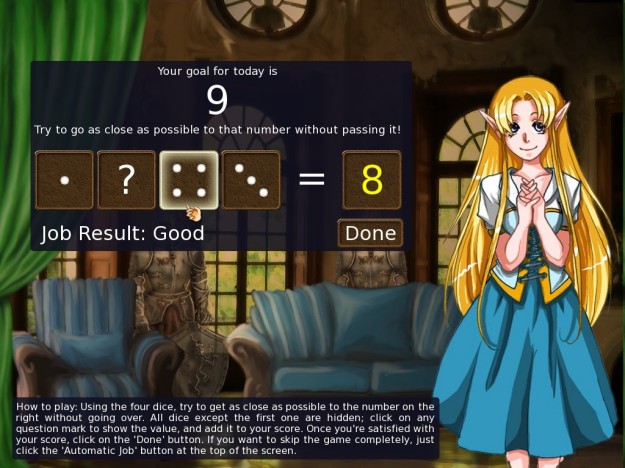 Both Long Live the Queen and Spirited Heart differ considerably, however, despite having fundamentally similar mechanics. Long Live the Queen sees you playing a predefined character — the titular Queen — and then sending her down the path of your choice, while Spirited Heart allows you a lot more freedom to design your own character and choose what your goals are, be they romancing a specific character or attempting to accomplish a mission set for you by your race's goddess. While neither of these games are particularly shiny or exciting to look at, I've found them surprisingly compelling, and they make me want to check out more games of a similar ilk.
 One reason I've been enjoying them a lot is due to their similarity to an old favourite visual novel/dating sim known as True Love (above). I first played this back in probably 1999-2000 and still think of it very fondly today, despite the fact it is an absolute bugger to get running on modern machines. Like the life sims I've been playing recently, True Love saw you managing your time carefully in an attempt to build up your stats enough to attract one or more of the game's heroines and make her your "true love". I attribute my present-day love of games like the Persona series to my earlier experiences with True Love, and I'm getting a lot of the same feelings from titles like Long Live the Queen and Spirited Heart, too, which is nice.
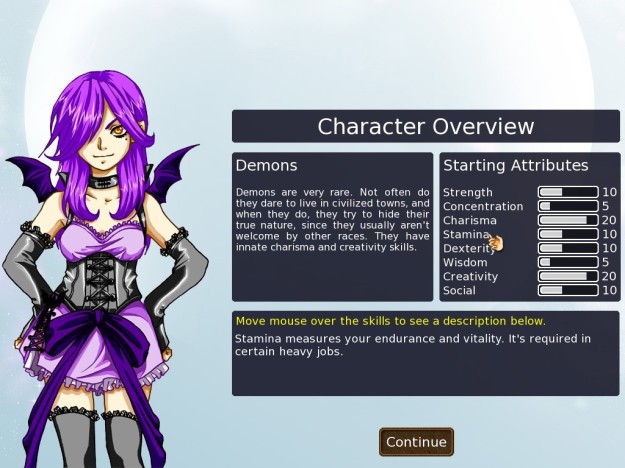 Spirited Heart does a number of interesting things that distinguishes it from Long Live The Queen. Chief among these is the fact that you're not playing a fixed character — you're playing one of your own design, to a certain extent anyway. There isn't any option to customise your character's appearance, for example, but the way you play does determine what sort of person your character ends up as.
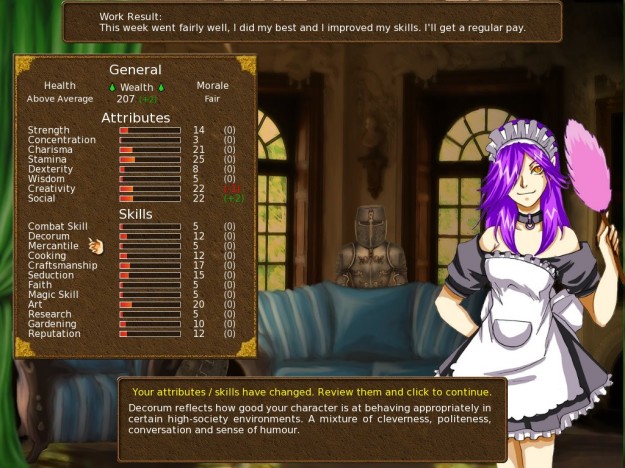 The way the game works is that each week, you choose whether your character goes to work or takes a week off. Going to work allows you to choose any occupations you meet the prerequisite stat requirements for, while resting allows you to restore your health and morale, which can often be negatively impacted both by going to work and through random events that occur. You can't go to work if you're too unhealthy or if your morale is too low, so sometimes you need to take a week off in order to progress. Working, meanwhile, often improves your stats and allows you to earn money, which can be used on more effective vacations when required.
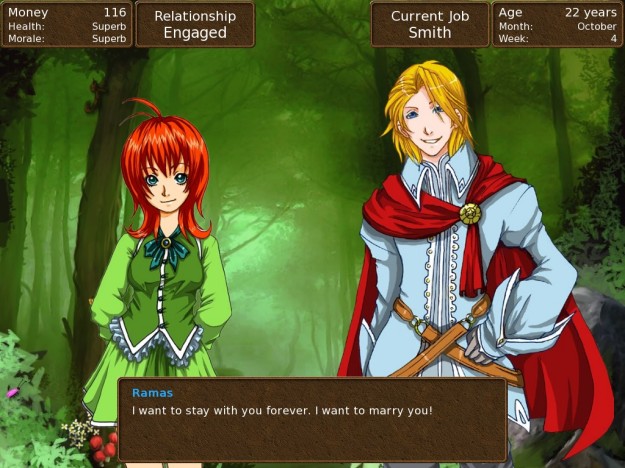 Just to confuse matters, partway through the game, my character was visited by her Goddess and tasked with attaining a particular "title" by the time she reaches the age of 30. Unfortunately, pursuing the elf of her dreams and following the Goddess' quest are not really compatible, since the Goddess' quest requires me to become an Artist, while pursuing the elf requires me to continue working as her maid. CHOICES. DECISIONS. CONSEQUENCES.
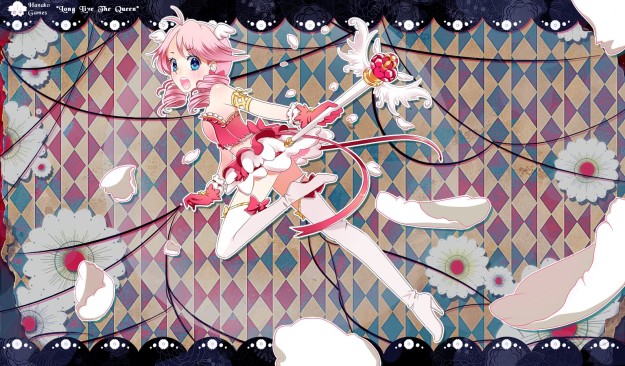 A short while back, a few indie developers that I enjoy the work of very much released a bundle of games that looked interesting. Among this selection of games was a title known as Long Live the Queen by Hanako Games, developer of Magical Diary, a game which I enjoyed very much. I picked up the bundle and, as tends to happen frequently with this sort of thing, forgot all about it completely until recently.
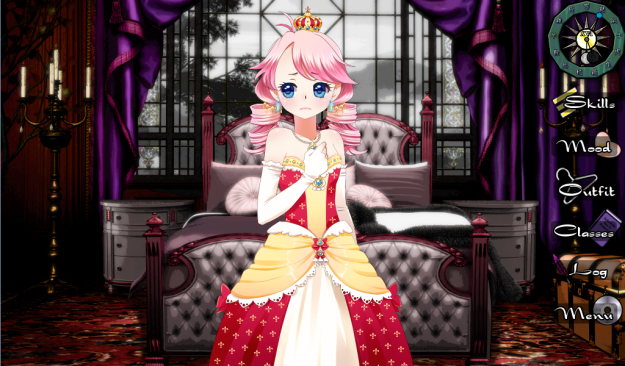 Essentially, Long Live the Queen is a game somewhat akin to old Japanese games like Princess Maker, in that you have a young anime girl to take care of and must train her up to deal with various situations appropriately. The course which the game's plot takes depends on the skills which you choose to train up, and the skills which you can train most effectively are determined by Our Heroine's current mood — for example, if she's depressed, she's particularly wont to express herself through things like music and singing, whereas if she's angry, she can channel her aggression into training in things like military strategy and proper use of weapons. Training to particular levels in things unlocks various costumes appropriate to the skills she's learning — for example, learning a lot of spiritual skills unlocks a priestess outfit, while becoming a "Lumen" and awakening to her family's magical heritage unlocks a particularly awesome "magical girl" outfit.
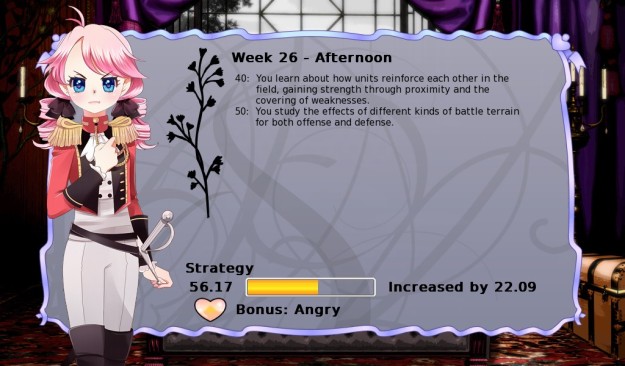 Making it through the game without dying horribly is a case of carefully making decisions and levelling up skills appropriately, and it's not at all uncommon for Our Heroine to meet a sticky end — in fact, it's positively encouraged via the "collect them all!" death checklist in the game's main menu. It's almost preferable to play the game like a roguelike — starting from the beginning, only saving when you're stopping playing rather than before you make a critical decision, and dealing with the consequences of your actions. In a nice touch, reaching the end of a game — whether with Our Heroine's coronation as Queen or with her death — allows you to export a complete log file of everything that happened so you can perhaps figure out what on Earth went wrong.