2437: Ultimate Fencer

0437_001

I finished up Fairy Fencer F: Advent Dark Force this evening, including getting the Platinum trophy, and I've come away thoroughly satisfied with what is possibly Compile Heart's best game to date, although it's a close-run thing between this and MegaDimension Neptunia V-II.

I was particularly impressed by how much the two new narrative paths diverged from the original Fairy Fencer F's storyline — while they involve many of the same dungeons, locales and characters, the important stuff about the story is very different indeed, right from the characters' personalities in some cases all the way to their motivations and eventual goals.

I found the fact that the game wasn't afraid to be a bit dark to be very much in its favour. Its colourful Tsunako character designs would suggest an adventure similar in tone to the Neptunia series, but in actual fact Fairy Fencer F is lighter on the comedy, heavier on the drama and even tragedy at times. That's not to say there isn't any comedy at all — what comedy there is tends to be well-timed in order to lighten the mood after some particularly heavy exposition — but it's not the main point of it all.

This seems to be a direction that Compile Heart is moving in with its recent releases, and one that it seems to feel comfortable with. The Neptunia series has been expressing greater confidence with storytelling as it has proceeded, too — while the first game felt a bit like a string of amusing events loosely tied together with the semblance of an overarching plot, mk2/Re;Birth2 took a much darker tone with some truly odious villains (and one of the series' most notoriously unpleasant optional endings) and Victory/Re;Birth3 had a much stronger sense that it had been composed as a complete story rather than a series of episodes. As for MegaDimension Neptunia V-II, that had its darker elements — particularly towards the end — and consequently, narratively speaking, was the most "structurally sound" of the series.

I didn't play the original Fairy Fencer F when it came out, but I've now experienced that game's story thanks to Advent Dark Force's Goddess arc. It's clear that Compile Heart wants to experiment with more ambitious narratives, but thought, quite rightly so, that Neptunia probably wasn't the best place to do it (although that said, mk2's Conquest ending is effective precisely because it is so tonally dissonant with what you've been conditioned to expect from the rest of the series). Fairy Fencer F jumps in headfirst with a likeable cast of rogues, many of whom are a bit morally ambiguous, and which Advent Dark Force does a good job in exploring over the course of its three distinct narrative paths.

Perhaps most striking about Advent Dark Force is that it isn't afraid to let main characters die — something that would be unthinkable in a Neptunia game, regardless of how dark the overall plot got — and it demonstrates this early on. In most of the narrative paths, which take place after a "time loop" at the end of the common route, then diverge in three very different directions, protagonist Fang seeks to atone for the deaths he directly or indirectly caused in the common route, with varying degrees of success. Each path features a different combination of characters from the complete playable cast, with some of these characters dying or even being on the "other side" in different routes.

Of particular note is the character Sherman, who — mild spoiler, sorry — is the villain in the original Fairy Fencer F story, but in the Vile God arc he spends a significant amount of time being the protagonist in Fang's absence. In the Evil Goddess arc, meanwhile, he has a more complex role that I'll leave for you to discover.

One of the other great things about the additional routes in Advent Dark Force is that it gives some of the "filler" characters from the original something to do. Fairy-loving scientist Harley, for example, doesn't have a whole lot to do in the original game's narrative, but in the Evil Goddess arc in particular she plays a leading role. Likewise, in both the Vile God and Evil Goddess arcs we see a lot more of the taciturn child assassin Ethel, including how she became the person she was and how it came to be that she could only communicate through the word "kill" with varying intonation.

After having finished all three routes, I'm left with the feeling that I have when I finish a good visual novel: I have a good, solid understanding of all the characters, the situations in which they found themselves and the world which they inhabited. And, if the post-credits sequence in the Evil Goddess arc — clearly intended to be the "true" path — is anything to go by, then I have little doubt that we're going to see more of these characters in the future. I certainly wouldn't complain about more Fairy Fencer F games if it gives Compile Heart a chance to spread their wings and explore more ambitious narrative themes — particularly if the game itself is as good as Advent Dark Force ended up being.

I'll say one more time for now: if you're still ignoring (or worse, deriding) Compile Heart games and call yourself a fan of JRPGs, you're missing out on some great experiences. Fairy Fencer F: Advent Dark Force is a good entry point to start exploring their work for yourself if you feel a little overwhelmed by the amount of Neptunia out there already; if you enjoy good, traditional JRPG stories, solid combat, wonderfully loathsome villains (one of them even does the ol' "ohohohohohoho!" beloved of '90s anime) and a colourful, immensely memorable cast of characters you can't go wrong with this one.
2436: Default Tone

0436_001

Earlier today, I was browsing through the digital editions of the old magazines I downloaded from AtariMania and came across a short series of articles written by my Dad about "going online".

This was pre-Internet "going online", however, involving a 64K Atari 800XL, a 300 baud modem and an external interface for plugging in such devices, and as such involved dialling up bulletin board services (BBSes) directly to access their information and files.

What struck me when reading my Dad's wide-eyed wonderment at being able to phone up a computer in Birmingham, read messages and download programs (a much more cumbersome process than we take for granted today, involving downloading the program into a "buffer" and then saving it to floppy disk or cassette afterwards) was the fact that any time he mentioned interacting with other people — usually through the BBSes' approximation of a "forum", which allowed people to post and reply to short, simple text-based messages — he was struck with how pleasant, polite and enthusiastic people were. These BBSes were generally run by enthusiasts rather than professional, commercial organisations and consequently tended to attract people in a similar vein.

Fast forward to today and I witness this somewhat sad, plaintive monologue from PR superhero Tom Ohle of Evolve PR:

I'm with Tom here, but I'm at a loss as to how we got from the enjoyably enthusiastic experience my Dad described in these articles to a situation where the default tone on the Internet is aggressive, confrontational, cynical and negative.

This isn't universal, of course — there are still plenty of community groups that are made up of genuine enthusiasts, and interestingly enough many of them are still centred around the Atari community — but even among such community groups you find trolls, naysayers and people who are always keen to see the negative in everything.

This is particularly apparent in the gamer community, who are seemingly never satisfied by anything — blockbuster triple-A games are too formulaic, indie games are too weird, imported games are too "censored" — but it happens right across the Internet, make no mistake.

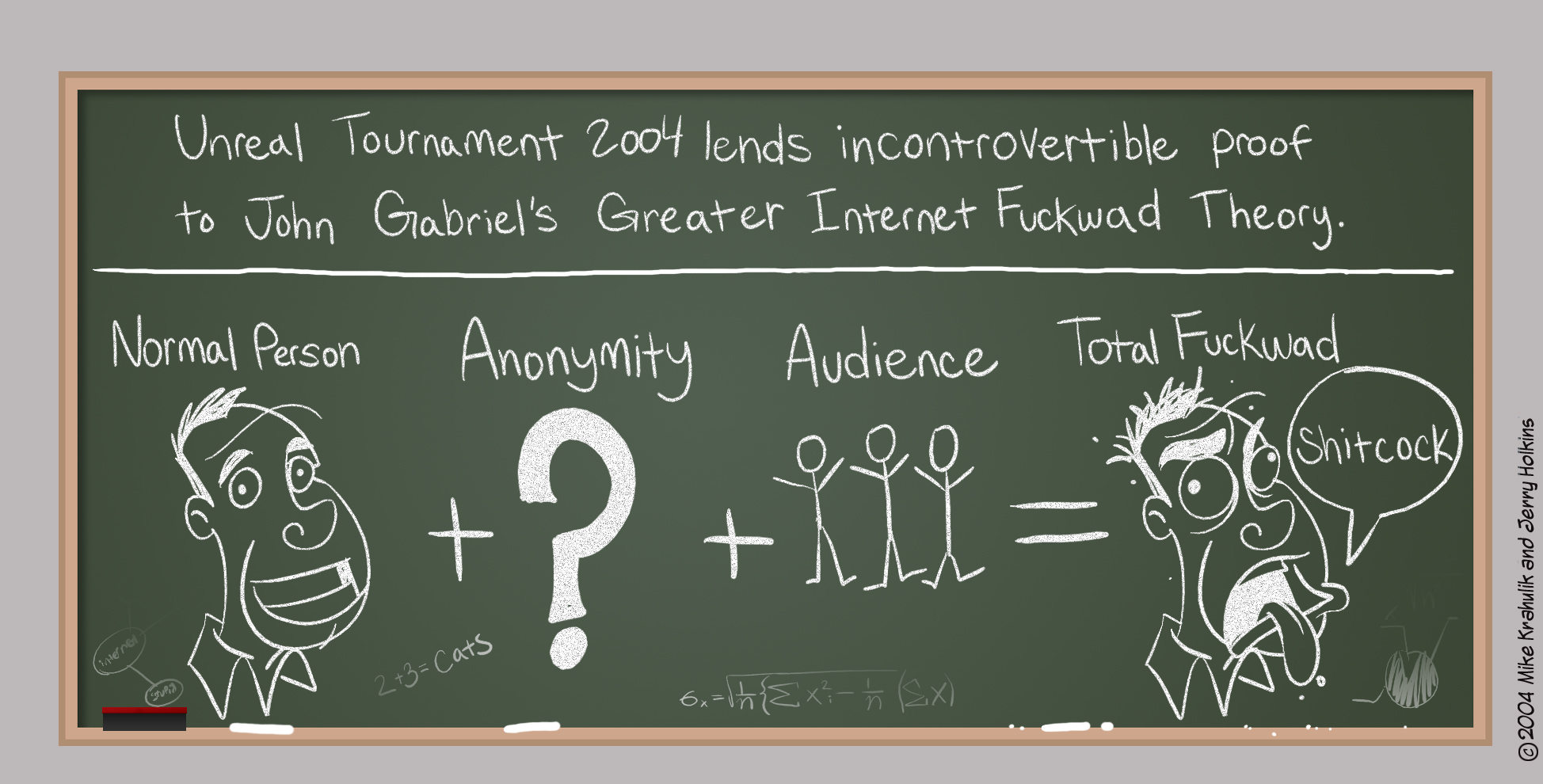
It's usually explained away by the John Gabriel Greater Internet Fuckwad Theory:

215499488_8pszr-2100x20000

And for a while that was plausible. But it's not as simple as that any more: the rise in services such as Facebook means that people are quite comfortable being total fuckwads even with their real name attached to the nonsense they're spouting. And it seems to be the default tone these days, which is disheartening; it's actually unusual when you find a community that isn't full of complainers.

Perhaps it's a consequence of throwing everyone from all different backgrounds all together into a melting pot, resulting in inevitable culture clash. Or perhaps the world of today really does engender negativity rather than positivity — I know that I certainly don't feel particularly happy about the way the world is these days, though my way of attempting to counter it is instead to focus on the things that I do love.

Whatever the explanation, I feel it's sad how things have developed since those innocent days of dialling up that BBS in Birmingham and having to explain to my mother why we were on the phone for so long. I feel we've gone backwards rather than forwards, and that it's probably too late to do anything about it now.

All an individual can do, I guess, is try their best not to be part of it.


2435: Memories: Read

0435_001

I finished Read Only Memories earlier. I liked it a lot! I posted a review on Steam, but I thought I'd post it here too because I'm feeling lazy.

Read Only Memories is an adventure game in the '90s mould, seeming to draw specific inspiration from titles like Snatcher and Rise of the Dragon, and set in the same world as the (later, and wonderful) VA-11 HALL-A.

On the whole, it's a great experience. The pixel art aesthetic really works for the game and has clearly been designed by people who know what good pixel art looks like. Everything about the interface, including the font, is well-designed to look like a retro adventure game, and the FM-synthesis soundtrack complements it nicely.

Puzzles are relatively thin on the ground but in a couple of cases are more interesting than "use the thing on the thing", which is worthy of note, though the final puzzle in the game seems to play by some inconsistent rules that can lead to failure seemingly by no fault of your own.

The story is well-written and filled with interesting characters, plus deserves note for having a number of possible solutions to various situations, though not all will lead to the "best" ending. The game encourages you to consider the consequences of your actions and the things that you choose to say, even though those consequences may not become apparent until much later. I very much liked that your behaviour over the course of the whole game affected some later events rather than choices having an immediate impact on what was going on.

The overall plot is one of tolerance and understanding, and strikes a good balance between casting the player (whom you can name and gender as you desire, since you never see them) as an "everyman" sort of character prone to putting their foot in their mouth when confronted by groups they don't quite understand, and presenting a solid message about acceptance, learning to trust one another and personal growth.

The only real criticism I'd level at the game is that its handling of gay and transgender characters feels a little ham-fisted, with their presence and the "reveals" of their identity seemingly being calculated to go "SURPRISE!" rather than simply blending them into the setting. Big burly, manly bartender dude? SURPRISE! Next time you meet him, he has another big hairy dude all over him calling him "hon" at every opportunity (though that said, I couldn't help but like Gus). Meet an eccentric, long-haired, bearded TV producer? SURPRISE! They're a lady! That and the presence of a non gender-specific character demonstrates just how awkward using singular "they" as a pronoun is in dialogue.

Ultimately it doesn't hurt the overall plot at all, but these instances stick out like sore thumbs when they happen as they just don't quite feel like they're in keeping with the tone: the implication elsewhere in the plot is that society has moved beyond discrimination by gender and sexuality, and instead onto discrimination against those who are "augmented" in some way, either through cybernetics or genetic hybridisation. To specifically draw attention to gay and transgender characters in this way as the game does feels counter to this implication, which is otherwise well handled.

This game's spiritual successor VA-11 HALL-A handles gay characters much more elegantly by them simply… just being there, no big deal, no big fuss about who they are, no sense that the game is holding you down and urging you to admire how progressive its views are.

I played this game before the big update that adds voice acting, and if you're interested in this game, I'd encourage you to do the same. The few parts of the game that do already have voice acting (just the intro and epilogue at present) are immensely jarring with the rest of the game's presentation, and the delightful beepityboopityboop noise that dialogue makes throughout the rest of the game is a much more powerful stimulus to the imagination than a voice actor whose interpretation of the character may not match the one you have in your head after reading the text.

Overall, Read Only Memories is a game I give a solid thumbs up. The issues I mentioned above are minor in the grand scheme of things, but hopefully the team will learn from them — and from the things VA-11 HALL-A did better, despite being produced by a different team — and produce even greater works in the future.

2434: Crewsin'

0434_001

I've been spending some time with Ubisoft's The Crew for the last few days. I actually picked it up shortly after release but didn't play it all that much. With the recent announcement that the base game would be free throughout September (you can still claim a copy here at the time of writing) I thought I'd give it another go.

What is The Crew? Allow me to elaborate in video form, because I can.

I'm left wondering why I didn't play The Crew more when it first released, because it occurs to me that it's what I wanted from a driving game for quite some time: the elusive ideal of the "caRPG", or an RPG with cars if you prefer less clumsy portmanteaus.

The Crew ticks all the boxes that I wanted. For one, it has a plot that is reasonably interesting and features some characters that, while a bit cliched, occasionally have some entertaining things to say — the protagonist offhandedly complaining to his FBI handler that he really wanted a shower because he'd been in his damn car for days was a nice bit of self-reference to the fact that The Crew doesn't have any on-foot missions. The plot itself may be Fast and Furious-level nonsense, but it works in context.

Secondly, it has a levelling system that is actually meaningful. Unlike games such as Forza Motorsport, which largely seem to have a levelling system just to show how long you've been playing, The Crew's levelling system actually works like one in a more conventional RPG — some gear is level-locked, your cars get more powerful as you level up and there's an MMO-style "endgame" once you reach the cap, further improving your abilities by getting better and better loot.

Which brings us on to the third point. The Crew is also a loot-whoring game, which is something I never thought I'd say about a racing game, but it's true. Any activity you complete rewards you with loot, with better results giving you better gear. You get immediate feedback on whether the gear is better or worse than your current setup by means of an "item level"-like system for each of your cars, and events have recommended vehicle levels so you never tackle anything that is going to be way too difficult for you.

In case you're still not quite convinced about The Crew secretly being an RPG, well, there are different classes of cars, too. Fullstock cars are exactly as they came out of the garage. Street cars are modified street-legal cars for road races. Dirt cars are suitable for offroading and stunts. Raid cars are powerhouses that can take a beating and dish one out too. Perf cars are extremely fast. And there's plenty more where that came from — even more with the Wild Run expansion, which adds several "extreme" specs to the list, too.

And then there's the multiplayer, which to be honest I haven't tried all that much yet. There's a sort of passive multiplayer a la Test Drive Unlimited as you zip around the open world, occasionally passing other players by. You can queue up for PvP-specific missions. You can recruit people to help you out with story missions, which then have to be played fully cooperatively — race missions, for example, mean that your teammates just have to make sure that you win by fair means or foul, whereas missions where you have to wreck a fleeing vehicle are likely to be much easier with company.

And on top of all that, The Crew makes driving around its vast open world interesting by 1) having some lovely scenery and 2) scattering Project Gotham-style skill challenges around the roads, tasking you with everything from slaloming around markers to simply getting as far away from your start point as possible. Each of these reward you with loot and experience, making them the equivalent of "trash" enemies in a more conventional RPG.

I'm enjoying the game a lot. Handling is enjoyably slidey and arcadey, just how I like it, and there's a ton of stuff to do, yet enough structure to ensure that you never get overwhelmed with too many options at any one time. And it feels like the best use of Ubisoft's open-world formula to date, with plenty of hidden things to find that reward you with experience, loot and even hidden cars to uncover.

The Crew is free for the rest of the month on PC. Be sure to claim your copy here.

2433: Read Only Voices

0433_001

This evening, prompted by an earlier discussion on Discord, I fired up Read Only Memories for the first time. This is a game I've been meaning to play ever since I discovered it had significant connections to the wonderful VA-11 HALL-A, my love for which has been well-documented.

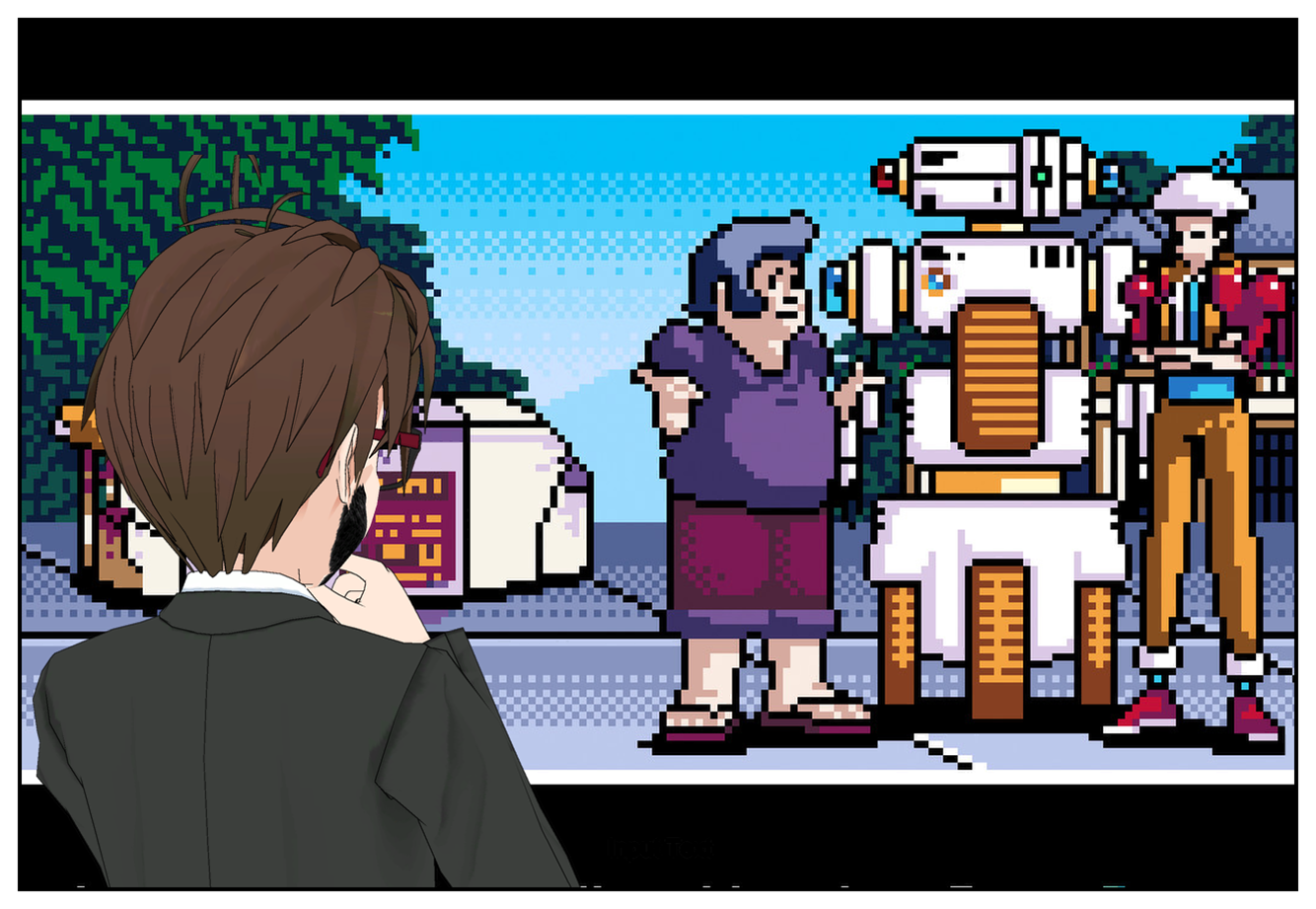
For the unfamiliar, Read Only Memories, or ROM for short, is a retro-style pixel art cyberpunk point and click adventure/visual novel hybrid. Its emphasis is thoroughly on story rather than brain-taxing puzzles, though unlike VA-11 HALL-A it does have more substantial puzzles than determining what drink everyone wants — one where you have to reroute a taxi to end up back where it started is a particularly good one.

Like VA-11 HALL-A, ROM is, at present anyway, text-based. Dialogue appears on the screen for you to read, and it is accompanied by that lovely old-school "bloobloobloo" noise that we've been hearing since the technological Dark Ages. (ROM's particular take on "bloobloobloo" specifically reminds me of Paul Woakes' Mercenary series, which is fitting because all of the dialogue in that was delivered by your somewhat sarcastic personal computer Benson.)

I say "at present" because the team behind ROM are currently working on a significant update to the game to coincide with its PS4 and Vita release. The main addition to this new version of the game is voice acting. I was already erring on the side of thinking "oh, no" when I first heard this announcement, and then I watched the voiceover trailer.

Oh boy. That is… not good. Not good at all. Particular anti-props to Jim Sterling for making absolutely no attempt to disguise his distinctive voice. Thankfully, the voices will apparently be optional, and recognisable, potentially contentious voices such as Sterling are seemingly mostly confined to relatively minor characters.

My reaction to this trailer actually makes me feel a bit bad for the game, and for people who will only be playing the new version when it releases. I genuinely think that the current version with its retro sound effects and wonderful Kefka-style synthesised laughter is better than what this promises to be; adding voices to a presentation that otherwise screams mid-'90s retro gives a strong sense of dissonance to the whole affair; voices just don't fit with the aesthetic the game was going for and had already captured extremely well. And while the voices can be turned off, they'll be turned on by default, meaning that most people's first experience with it will not be with the charming retro-style presentation, but with anachronistic voice acting.

This got me thinking about voice-over work in games in general, and how you have to be extremely careful when implementing voice acting. It's not a universal catch-all to make a game better as was once believed in the early days of the CD-ROM era. (If you don't believe me, go back and play Indiana Jones and the Fate of Atlantis and see how long it takes you to switch back to text-only mode.) With interactive entertainment now sophisticated enough to bring us both realistic-looking movie-style experiences as well as beautifully pixelated work that explicitly looks "like a computer game", it's all the more important for developers to make careful decisions about how to present their work, particularly in the latter case, where more stylised presentation typically implies that the player is going to be expected to use their imagination a bit.

This then got my mind going off on a tangent about why I typically like to play Japanese games with English subtitles but Japanese audio. Aside from the fact that the Japanese voice acting is very often (though not always!) of a higher quality than the English dub, I feel that experiencing a game in this way allows you to enjoy the best of both worlds: you get to enjoy the additional nuance and meaning that the English translation affords while at the same time also being able to recognise and appreciate the verbal tics, non-standard speech forms and honorifics in the Japanese speech that simply aren't possible to replicate directly in English. To take an example from a recent game I've been playing, Tiara from Fairy Fencer F's attempts to seem like a "princess" are emphasised further by her use of "desu wa" rather than the more usual "desu" at the end of sentences. Likewise, you can infer things from whether male characters refer to themselves as "watashi", "ore" or "boku", or whether female characters use "watashi", "watakushi" or "uchi". Obviously everything I've said in this paragraph requires that you have a passing understanding of Japanese (and I mean passing, I'm by no means fluent!) and consequently may not apply to everyone, but that's how I feel, at least.

Ultimately my concerns about ROM probably don't matter all that much because, like I say, the option is still there to play without voices. (And they better not remove the "bloobloobloo" if you choose to play in text-only mode!) I'm just a bit worried that what the developers clearly seem to think is an "upgrade" to the game is actually significantly at odds with the audio-visual aesthetic they were going for in the first place. Not to mention the fact that the inclusion of certain cast members seems deliberately… antagonistic. But that's probably a subject for another time!

Read Only Memories is £14.99 on Steam right now, and I'd say probably worth playing before its big new update hits.

2432: Still Not Doing Great

I'm still not doing all that great. And I really don't know what else I can do.

The thing that is making me feel most shit and useless is the fact that I don't have a job, so I am trying my best to sort that out. I've revamped my CV multiple times, tailored cover letters to job specifications in various ways according to advice I've read and discussed with people, attempted to put across my desire to be a valuable member of someone's team, but… nothing. Nothing at all.

All this is conspiring to make me feel like a complete waste of space. To be perfectly honest, I've felt like this ever since USgamer kicked me to the curb with little warning the day before my birthday in 2014. Nothing quite makes you feel valued like being booted out of a job you loved and seeing your replacements half-arsedly covering the things you were passionate about in a way that is both frustrating and upsetting. (And not just for me; I've had numerous messages since I left USgamer expressing their sadness that I was no longer the site's resident Japanese games specialist.)

I've had dribs and drabs of other jobs since. My longest ongoing gig, if you can call it that, is my current semi-regular freelance work for an e-learning company, which I can't complain too much about aside from how sporadic the work is. At least I get to work from home.

My next longest position was with energy company SSE, and if my ejection from USgamer made me feel bad, this just made things all the worse. SSE is a company that doesn't value employees as individuals in the slightest — a common complaint with large corporations, I'm sure — and patronises everyone with primary school-level presentations and activities on Health and Safety. In the meantime, their spectacularly inefficient working processes meant it took absolutely forever to do the most simple task. It took them over two years to launch a new website thanks to their adoption of the most cumbersome, shitty piece of content management software I've ever had the misfortune to get hands-on experience with. It would often take several days to get a simple spelling mistake corrected on the existing site. And I ended up getting punished because I worked quickly and efficiently and ended up with nothing to do, which made me look like I was twiddling my thumbs doing nothing. I guess that's not how you do things in corporate culture; should have worked more slowly.

SSE tried its very best to drain the individuality out of me — people weren't people there, they were "resource" (singular, which always bugged me almost as much as the word itself) — but I figured I should try to stay on for as long as I could to get some experience with being a content editor. That's an actual job title that I can search for, and indeed I've been applying for a number of positions in that vein.

Nothing, though. Nothing at all. Not even a rejection in many cases. And so it is that I'm sitting here at half past eleven on a Friday night with £10 in my bank account, utterly despondent and completely out of ideas as to what else I could possibly do to make things better for myself.

Nothing is springing immediately to mind. I guess I just have to persevere for the moment.

That or win the lottery.

2431: I Also Made This

I made another video today in an attempt to further solidify my knowledge of Hitfilm 4 Express, and indeed to refresh my subject knowledge with regard to video editing in general, as it's one of those skills that can atrophy from non-use, particularly with how non-intuitive professional-grade programs can be.

I'm still in two minds about the advent of video on the Internet and how, for young people in particular, it has taken the place of good old fashioned text Personally speaking, I'd still rather read a good article with nice screenshots than watch a video — particularly if I'm out and about on my phone and am not in a situation where listening to the audio of a video would be practical — but I'm forced to reluctantly admit that for gaming content, video does sort of make sense.

Video games are, for the most part, a dynamic, audio-visual medium in which the way things move around the screen and the noises they make are just as important as what they look like as still images. This is more true for some genres than others — shoot 'em ups such as the two games I've covered with my videos over the past couple of days are a good example. But even in more sedate games, there's value to being able to actually demonstrate what the thing looks like in motion, how its interface works and all manner of other things. And while you could take the TotalBiscuit approach and make hour-long videos about options menus — there is value there for some people — I think the real strength in video coincides with the atrocious attention span most people have these days: short, snappy summaries of what something is all about and why you should pay attention to it.

I don't yet know if I've nailed that format in my videos just yet, but I'm enjoying making them if nothing else. Plus insofar as creative projects go, they could potentially end up forming a "portfolio" of sorts should I find myself in a position where my video-making skills might potentially get me a job of some sort. That would be nice, wouldn't it? I'm trying not to think about it too much, but as I'm broke it's kind of constantly on my mind.

Still, I guess this counts as a vaguely productive use of my time, and I did at least apply for two jobs earlier today, so I can say I got something done. Unfortunately none of those somethings quite pay the bills at present, but, well, doing something is better than nothing, non?

2430: I Made This

0430_001

It's been a surprisingly productive day, both in terms of "things I wanted to do" and "things I had to do". I got the bit of work I had to do done, and even had time to write a hefty piece on One Way Heroics' mechanics over on MoeGamer and make a short video about Atari classic River Raid.

Here's said video, if you're curious.

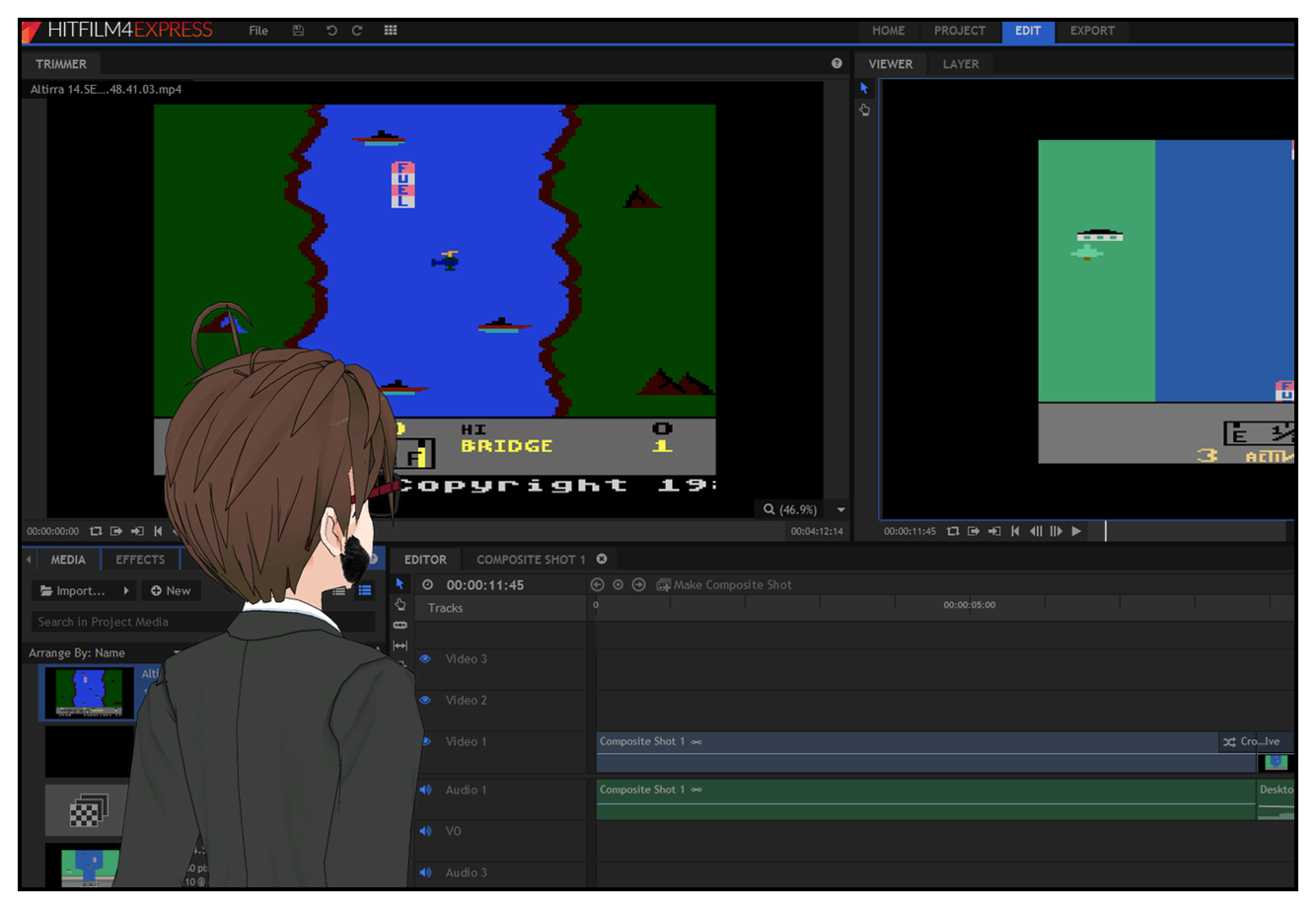
I wanted to take a moment to talk about making this video, as its production involved the discovery of a really fine piece of free software: Hitfilm 4 Express.

Hitfilm 4 Express is a fully-featured non-linear video editor in the Final Cut mould, with a particular emphasis on compositing. It allows you to import media in a variety of formats — both still images and video sequences — and edit them together using an extremely professional-looking (and rather daunting!) collection of tools. Once your masterwork is complete, you can then export it to all the usual formats as well as upload it completely seamlessly to YouTube with minimal fuss.

I'm particularly enamoured with the YouTube connectivity as my past experience with making movies using my PC has been with Windows Movie Maker, which by default exports in a horrible format that YouTube then has to spend several hours converting and optimising after you upload it. This video, meanwhile, was ready to watch mere minutes after uploading, suggesting that Hitfilm 4 Express was smart enough to encode it in the appropriate format for YouTube automatically without me having to do anything else. It even kept it in 1080p/60fps format, which is arguably a bit wasteful for a video about an Atari 2600 and 8-Bit game, but eh; YouTube viewers are picky bastards and whinge if you don't upload in the highest quality possible even if it is of practically no benefit to the source material whatsoever.

Anyway. I've barely scratched the surface of what Hitfilm 4 Express offers so far, but I'm in love. It's a full, professional-grade package for free that can be further expanded by purchasing effects modules that plug into it — which is where they make their money. It's free software that isn't riddled with toolbars for your browser, pop-up adverts and nag screens — it's simply an excellent package that did exactly what I wanted it to with minimal fuss, albeit a little bit of reading the manual.

On that note, probably time for bed. (If you're wondering about the posting time, Andie is working nights at the moment which means both our sleep patterns are pretty screwed. I'm taking advantage of the quiet time to Get Things Done.)

2429: Ads Ruin Everything

0429_001

(This was supposed to post last night but didn't for some reason.)

If anyone here is in advertising or marketing…kill yourself. It’s just a little thought; I’m just trying to plant seeds. Maybe one day they’ll take root – I don’t know. You try, you do what you can.

Kill yourself.

Seriously though, if you are, do.

Aaah, no, really. There’s no rationalisation for what you do and you are Satan’s little helpers. Okay – kill yourself.

Seriously. You are the ruiner of all things good.

Seriously.

No this is not a joke. You’re going, “There’s going to be a joke coming.” There’s no fucking joke coming. You are Satan’s spawn filling the world with bile and garbage. You are fucked and you are fucking us. Kill yourself. It’s the only way to save your fucking soul. Kill yourself

Planting seeds.

I know all the marketing people are going, “He’s doing a joke…” There’s no joke here whatsoever. Suck a tail-pipe, fucking hang yourself, borrow a gun from a Yank friend – I don’t care how you do it. Rid the world of your evil fucking machinations. Whatever, you know what I mean.

I know what all the marketing people are thinking right now too: “Oh, you know what Bill’s doing? He’s going for that anti-marketing dollar. That’s a good market. He’s very smart.”

Oh man, I am not doing that, you fucking, evil scumbags!

“Ooh, you know what Bill’s doing now? He’s going for the righteous indignation dollar. That’s a big dollar. A lot of people are feeling that indignation. We’ve done research – huge market. He’s doing a good thing.”

Godammit, I’m not doing that, you scumbags! Quit putting a goddamn dollar sign on every fucking thing on this planet.

– Bill Hicks

It makes me feel a little bit sick inside to recall that when I was a child, I used to actually enjoy the advert breaks on commercial TV. There were ads I used to look forward to seeing, and ads that I still remember today that, to my knowledge, I only ever saw broadcast once.

The reason this memory makes me feel a bit sick is because I look around today and look at all the damage advertising has done to so many aspects of modern life, and I'm disgusted and ashamed.

Mobile phone games, once thought to be a true competitor to home computers and consoles, have been ruined by advertising. Creative work has been devalued to such a degree that it's now a significant risk for a developer to release anything at a price point above "free" (with in-app purchases of up to £80 a time, mind you), with ads punctuating every aspect of the game experience — or, in the worst-designed cases, actively getting in the way of what you want to do.

Games journalism has been ruined by advertising. Earlier today I saw a link to a "review in progress" of a soccer game. The "review in progress" format is usually reserved for games that it is impossible to review based on a launch-day experience — things like MMOs or multiplayer-centric titles. But it's increasingly being used by publishers to stake a claim on all-important search engine optimisation terms and ad revenue by posting an article that includes both the game name and the word "review" in its URL — thereby attracting anyone casually Googling "[game name] review" — without having to actually do a full job of reviewing a game in the traditional sense, and lapping up the ad revenue in the process. Not only that, we have sites spamming articles about the latest, most popular games — even if the sites' verdict on said game was that it wasn't very good, as has happened with Rock, Paper, Shotgun and divisive space sim No Man's Sky — and pulling in those precious ad revenue clicks by anyone Googling the game in question.

Online video streaming has been ruined by advertising. Earlier I was attempting to watch an episode of 8 out of 10 Cats Does Countdown — hardly the most thrilling or cerebral viewing, but I was enjoying it at the time as an accompaniment to dinner — and the ad break halfway through the programme crashed. When this happens, there is no way to skip the "broken" ad because oh no, you have to watch five minutes of adverts before you can see the rest of the programme, and if you can't watch those five minutes of ads, well then, you're not seeing the rest of the programme.

The Internet in general has been ruined by advertising. I can't think of many sites I've been to recently that haven't had some sort of obtrusive background, auto-playing video trailer or worse, complete page takeover making the browsing experience actively unpleasant. One of the worst offenders is one of the most useful sites on the Web: Wikia, which allows users to create wikis for any topic under the sun, but which makes the site practically unusable on mobile by first loading the page in, then loading a full-page pop-over ad a couple of seconds later which you inevitably click on when you're trying to simply follow a link in the text.

Computer software has been ruined by advertising. Whether it's Windows bugging you to upgrade or anti-virus software promising you a "free gift" that is actually just the ability to subscribe to its premium service for the same price it always is, not even in the world of productivity can you escape someone, somewhere trying to extract money from you.

I hate, loathe and despise it, particularly when I see how demoralised it makes people who want so desperately to do things ethically, but who inevitably find themselves trampled underfoot by people with fewer scruples.

I think I hate it most of all for what it's done to something I love, though: writing about games. There's little to no room for passion in the commercial games press today; instead, it's all "you must have [x] articles about [insert popular game name here] up by the end of the week". It does the wonderful diversity of the medium an incredible disservice, and I feel sorry for those people who, like me, are genuinely passionate about the things they enjoy, but who struggle to get heard and can't even think about making a living from what they love.

Unfortunately, it's the world we live in now. I'm kinda with Mr. Hicks on this one.

2428: Seal the Vile God... For Good!

0428_001

I finished my first playthrough of Fairy Fencer F: Advent Dark Force tonight. I completed my first playthrough, as I'm sure most people do, on the Goddess route, which is (mostly) the same as the PlayStation 3 original. Having never quite gotten around to the PS3 original, it was all new to me, so it was an exciting journey to take.

I found Fairy Fencer F  — the Goddess route, anyway — to be an interesting experience because it's by far the most "traditional" RPG that Compile Heart has put out, in that it has a spiky-haired male protagonist who goes on an Oprah-worthy journey of personal growth over the course of the entire story, a band of plucky companions that he attracts to his cause through his own charisma and personal magnetism, a plot that involves aspects of faith and religion, and a suitably climactic battle against a supernatural being at the end.

This is in stark contrast to, say, the Neptunia series, where the overall plot is often the least important aspect of the game (though MegaDimension Neptunia V-II placed greater emphasis on the overall plot and was one of the best Neptunia games I've played as a result) and instead the main attraction is the developing relationship between the recurring cast members.

Fairy Fencer F is ample proof that Compile Heart has what it takes to butt heads with the masters of the genre, though, at least in terms of characterisation and storytelling. Their method of interacting with the game world affords it fewer opportunities for demonstrating the sheer level of detail Falcom puts into works such as the Legend of Heroes series — Compile Heart RPGs typically flow like visual novels punctuated by dungeon crawling rather than the more free-flowing experience that is a Falcom RPG — but the game nonetheless manages to paint a convincing picture of the world in which the story takes place, and the people who make the story happen. It achieves this by taking an approach Compile Heart also adopts in many of its other games: keeping the scale of things relatively small. Fairy Fencer F features only one town and a few dungeons in its immediate (rather geographically diverse) vicinity, and consequently you get to know the area and the people in it pretty well, both through the main story and the optional interactions with incidental characters around the town and its various locations.

Of particular note in the story as a whole is the protagonist Fang and his relationship with the two leading ladies of the piece: his fairy Eryn, with whom he constantly bickers but obviously trusts absolutely, and Tiara, whose first encounter with Fang and Eryn comes when she tricks them into drinking paralytic tea so she can steal the Fury the duo were in pursuit of. Tiara in particular demonstrates herself to be a complex character over the course of the complete narrative, and while the big "revelation" about her identity may not be a big surprise to those who have played a lot of RPGs, the story takes some very surprising twists and turns, particularly immediately leading up to the "split point" where the new version diverges into three different narrative paths.

Also noteworthy is the game's tendency to demonstrate that people aren't necessarily always as "good" or "evil" as they might immediately appear. Indeed, one of the most squeaky-clean characters in the game turns out to be a bit of a bastard, while overtly playing for Team Evil is a noble swordsman whom Fang can eventually recruit to his cause (fail to do so and he kills himself, a shot of darkness I'm not entirely used to seeing in Compile Heart games!), a young woman who spends her free time caring for orphans using the Obligatory Big Bad Corporation's funds, and a salaryman who is only perpetrating less-than-noble deeds to care for his wife and child, whom it is clear he genuinely loves a great deal.

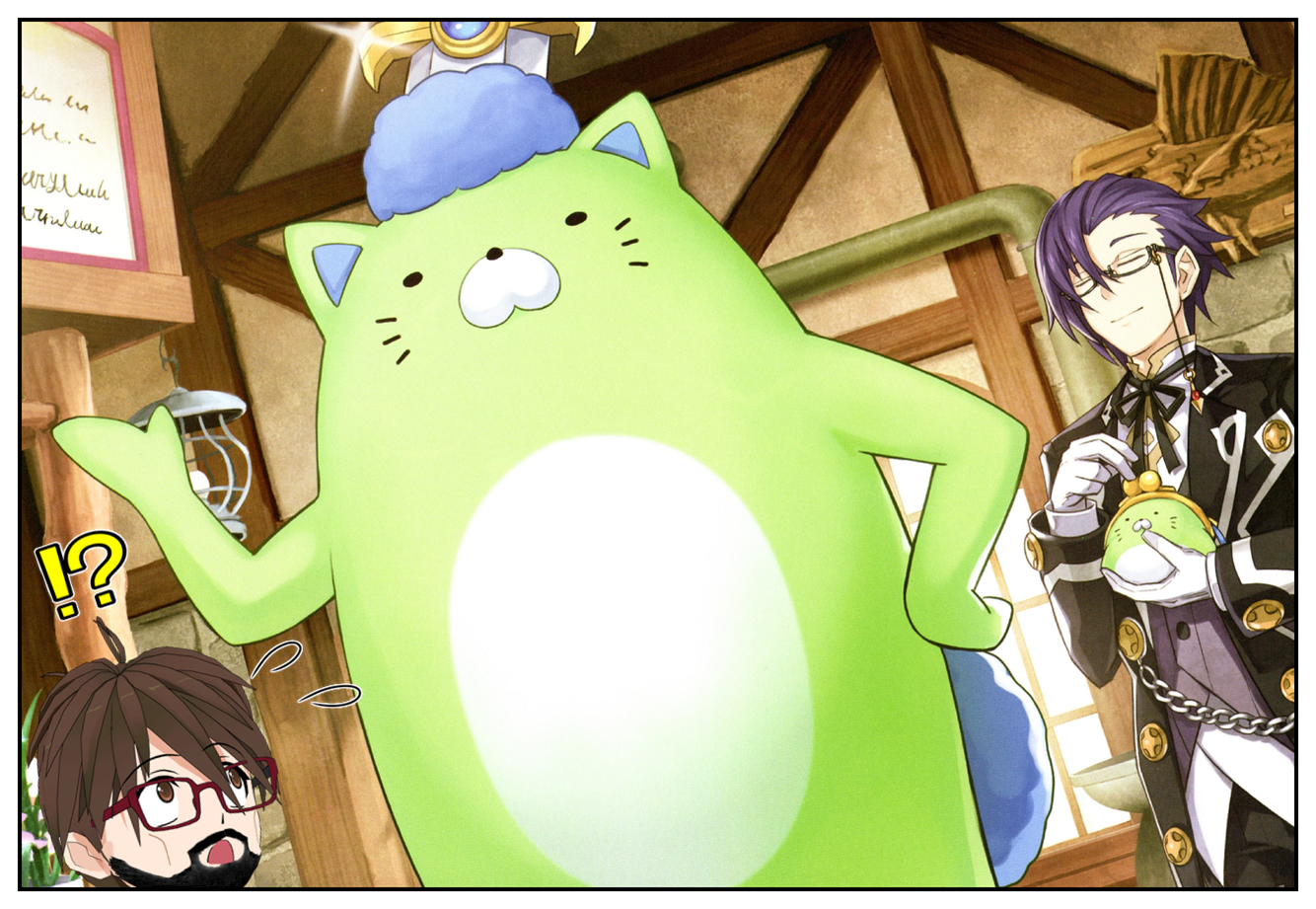
This "people aren't exactly what they seem" theme is also seen to a lesser extent through Tiara, who acts like a "proper lady" — her Japanese speech is riddled with watakushi and desu wa, both of which are verbal signals that we're dealing with someone who either is "noble" or at least wants to put across the impression that they are — but is actually, as Fang puts it, "nasty" underneath. And the trope is explicitly lampshaded in the form of the character Pippin, who appears to be a strange green cat-like creature, and who constantly extols the virtues of not judging a book by its cover. Indeed, Pippin remains something of an oddball enigma right up until the very end of the game, but after a while you just start thinking of him as an odd person, not an odd green cat-like creature.

All in all, my 50-hour first playthrough of Advent Dark Force leaves me feeling like it's Compile Heart's strongest game to date — yes, even better than the already excellent MegaDimension Neptunia V-II — and hungry for more. Fortunately, there is more — I have two more narrative routes to play through, plus a Platinum trophy to chase. I'm particularly interested to see how the two other narrative routes differ from the Goddess route — whether it's a few changed events or a complete restructuring of the story. I'm kind of expecting the latter based on what I've seen people discussing, but either way, I'm looking forward to spending more time with this great cast of characters.

Serious talk: if you're still rejecting Compile Heart games just because they're Compile Heart games, you're missing out on some truly great RPGs. Including this one.