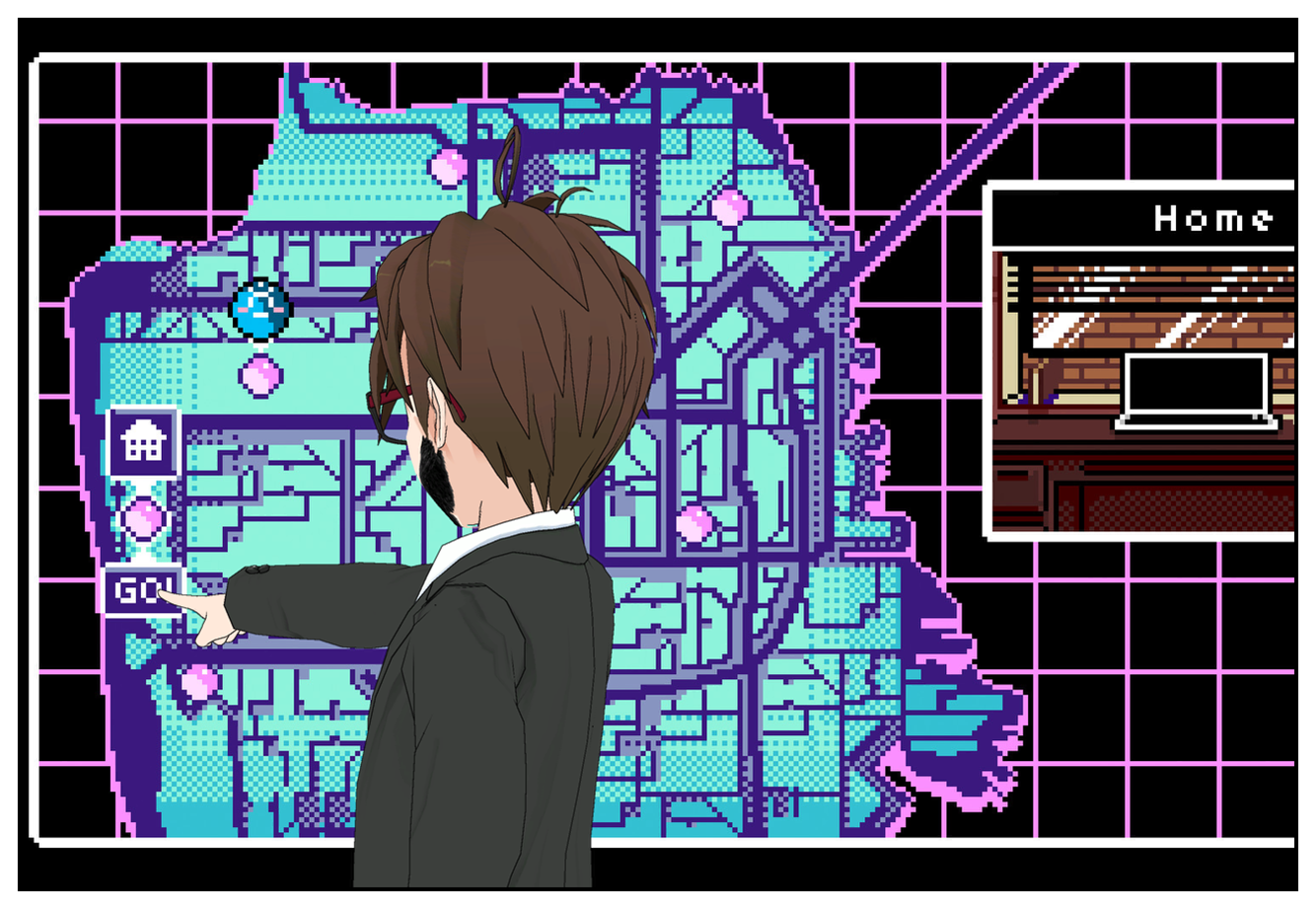
This evening, prompted by an earlier discussion on Discord, I fired up Read Only Memories for the first time. This is a game I've been meaning to play ever since I discovered it had significant connections to the wonderful VA-11 HALL-A, my love for which has been well-documented.
For the unfamiliar, Read Only Memories, or ROM for short, is a retro-style pixel art cyberpunk point and click adventure/visual novel hybrid. Its emphasis is thoroughly on story rather than brain-taxing puzzles, though unlike VA-11 HALL-A it does have more substantial puzzles than determining what drink everyone wants — one where you have to reroute a taxi to end up back where it started is a particularly good one.
Like VA-11 HALL-A, ROM is, at present anyway, text-based. Dialogue appears on the screen for you to read, and it is accompanied by that lovely old-school "bloobloobloo" noise that we've been hearing since the technological Dark Ages. (ROM's particular take on "bloobloobloo" specifically reminds me of Paul Woakes' Mercenary series, which is fitting because all of the dialogue in that was delivered by your somewhat sarcastic personal computer Benson.)
I say "at present" because the team behind ROM are currently working on a significant update to the game to coincide with its PS4 and Vita release. The main addition to this new version of the game is voice acting. I was already erring on the side of thinking "oh, no" when I first heard this announcement, and then I watched the voiceover trailer.
Oh boy. That is… not good. Not good at all. Particular anti-props to Jim Sterling for making absolutely no attempt to disguise his distinctive voice. Thankfully, the voices will apparently be optional, and recognisable, potentially contentious voices such as Sterling are seemingly mostly confined to relatively minor characters.
My reaction to this trailer actually makes me feel a bit bad for the game, and for people who will only be playing the new version when it releases. I genuinely think that the current version with its retro sound effects and wonderful Kefka-style synthesised laughter is better than what this promises to be; adding voices to a presentation that otherwise screams mid-'90s retro gives a strong sense of dissonance to the whole affair; voices just don't fit with the aesthetic the game was going for and had already captured extremely well. And while the voices can be turned off, they'll be turned on by default, meaning that most people's first experience with it will not be with the charming retro-style presentation, but with anachronistic voice acting.
This got me thinking about voice-over work in games in general, and how you have to be extremely careful when implementing voice acting. It's not a universal catch-all to make a game better as was once believed in the early days of the CD-ROM era. (If you don't believe me, go back and play Indiana Jones and the Fate of Atlantis and see how long it takes you to switch back to text-only mode.) With interactive entertainment now sophisticated enough to bring us both realistic-looking movie-style experiences as well as beautifully pixelated work that explicitly looks "like a computer game", it's all the more important for developers to make careful decisions about how to present their work, particularly in the latter case, where more stylised presentation typically implies that the player is going to be expected to use their imagination a bit.
This then got my mind going off on a tangent about why I typically like to play Japanese games with English subtitles but Japanese audio. Aside from the fact that the Japanese voice acting is very often (though not always!) of a higher quality than the English dub, I feel that experiencing a game in this way allows you to enjoy the best of both worlds: you get to enjoy the additional nuance and meaning that the English translation affords while at the same time also being able to recognise and appreciate the verbal tics, non-standard speech forms and honorifics in the Japanese speech that simply aren't possible to replicate directly in English. To take an example from a recent game I've been playing, Tiara from Fairy Fencer F's attempts to seem like a "princess" are emphasised further by her use of "desu wa" rather than the more usual "desu" at the end of sentences. Likewise, you can infer things from whether male characters refer to themselves as "watashi", "ore" or "boku", or whether female characters use "watashi", "watakushi" or "uchi". Obviously everything I've said in this paragraph requires that you have a passing understanding of Japanese (and I mean passing, I'm by no means fluent!) and consequently may not apply to everyone, but that's how I feel, at least.
Ultimately my concerns about ROM probably don't matter all that much because, like I say, the option is still there to play without voices. (And they better not remove the "bloobloobloo" if you choose to play in text-only mode!) I'm just a bit worried that what the developers clearly seem to think is an "upgrade" to the game is actually significantly at odds with the audio-visual aesthetic they were going for in the first place. Not to mention the fact that the inclusion of certain cast members seems deliberately… antagonistic. But that's probably a subject for another time!
Read Only Memories is £14.99 on Steam right now, and I'd say probably worth playing before its big new update hits.
Discover more from I'm Not Doctor Who
Subscribe to get the latest posts sent to your email.

It's sad about Sterling . . . although not too much or a surprise. For some reason he's got a bit of a wierd connection in the world of indie point-and-click adventure games. He also did voice work for Mastertonic's Charnel House series:
http://www.hardcoregaming101.net/charnelhouse/charnelhouse.htm
On a more positive note, Jesus H. Christ I want to make love to ROM's graphical presentation. It's one thing for indie devs to ape the looks of Western adventure games . . . but this sucka is pure Snatcher. I can't look away!
Yeah, he's done a few things, and he always just sounds like Jim Sterling in all of them. It's unfortunate.
Rom does look great. It's lower-res than VA-11 HALL-A but, like its spiritual successor, fundamentally understands how low-res pixelart worked and did its best to remain authentic… which is why the voices are so jarring.
The other reason is that a number of the characters are seemingly supposed to be a bit "ambiguous" in terms of identity, and giving them a voice undermines the good work they did with the writing, with the most glaring example being Turing. The writing explicitly states that Turing was designed to be outside of the uncanny valley, yet the moment you give him/her/it a voice, you not only humanise him/her/it more than intended, you give him/her/it a gender that may not have been the same as the one in the player's mind — or indeed, assigned a gender where the player may not have assigned one at all in their mind. That seems to somewhat undermine one of the messages in the game.