One thing I find myself having a bit of trouble with these days is feeling like I'm able to "mix things up" with regard to the things that are entertaining me. I feel a peculiar sense of "guilt" if I start on a new game, TV series or any other form of media before finishing one that I have already been working on for a while. And while in some respects that's not necessarily a bad thing — I estimate I finish more games and TV series than probably 95% of the average game-playing public out there — it's also a bit different from how I used to live.
When I think back to, say, the PS2 era, I had absolutely no problem chopping and changing between what games I was playing. Sure, if I found myself particularly compelled by an RPG or other narrative-based game, I'd probably make that a priority, but I also wouldn't feel any sort of "guilt" if I decided that no, that evening I really wanted to play Grand Theft Auto III. And I'm trying to figure out what, exactly, changed in my mind to create this, frankly, irrational feeling.
My initial reaction was that it might stem from the time where I was doing "Cover Game" features on MoeGamer, where I committed to playing a (usually long) game through from start to finish, penning at least four articles about it along the way. But then I remember while that was at its peak, I was also putting out pretty much daily articles about all manner of other games that I was playing. Granted, a lot of that came down to the fact that I was desperately bored at my day job and thus spent a lot of "work" time actually writing new articles for MoeGamer, but I still had to actually play the games in order to be able to write about them.
So whatever it is, it's happened since that time, so I estimate probably within the last 5 years or so.
Perhaps it's just generally feeling pretty run-down, and not wanting to have to think about too many things at once. That's a plausible suggestion, but inevitably I tend to find when I do have an evening where I just say "fuck it", put my current "big game" to one side and play something else for a bit, I have a good time. So it's not necessarily that I don't want to engage with something else; it's that I'm putting up a weird mental roadblock preventing me from doing so.
Part of it also may well be a false, completely unreal sense of "urgency" that is all in my own head. "I have all these games," I think, "so I have to get through all of them as soon as possible!" And this is nonsense. When I think back to that PS2 era and even earlier, I thought nothing of going back and replaying a favourite game multiple times, just because I enjoyed doing so. I thought nothing of playing a game with multiple endings repeatedly from start to finish without skipping anything. And those were good times!
I'd like to try and get back into that vibe I had when I was writing daily posts on MoeGamer. A while back, I experimented with the idea of "Gaming on a Schedule", and chronicled my thoughts on the process. I came away thinking that it was kind of a good idea, but that it was also possible to be too rigid about such things. The optimal balance is one where you still make time for your "big game" so you actually finish it, but also feel free to have an evening or two or three a week where you just… do something else instead.
So I think I just need to have a bit of a word with myself. If I have an evening such as I am having tonight, where I feel like "I don't really feel like playing Xenoblade Chronicles," there is no reason that I should feel guilt about that. I've already spent nearly 100 hours on that game, and I'll be spending at least that amount of time again on Xenoblade Chronicles X starting this time next month. So what does it matter if I have an evening "off" and play something else instead? It doesn't mean that I'm never going to finish Xenoblade Chronicles, which I think is where this whole roadblock stems from. Leaving aside the fact that I'm already very near the end, I have, after all, already beaten it once in my life, albeit on a different console.
So y'know what? This evening I'm going to play something else. Exactly what, I haven't quite got as far as deciding just yet. But I'm going to go with my gut rather than agonising over it for hours and then getting to bedtime having not actually done anything fun at all this evening.
So there. That's that. Here we go.
Want to read my thoughts on various video games, visual novels and other popular culture things? Stop by MoeGamer.net, my site for all things fun where I am generally a lot more cheerful. And if you fancy watching some vids on classic games, drop by my YouTube channel.
If you want this nonsense in your inbox every day, please feel free to subscribe via email. Your email address won't be used for anything else.
I am an avid reader of Ed Zitron's blog (sorry, newsletter, because apparently that's just what we call blogs now) Where's Your Ed At? If you're at all interested in the tech space, I highly recommend you subscribe or at least check in on it regularly, because Zitron is one of the only people in the space who has the balls to say it like it is: that an awful lot of what is coming out of the mouths of tech companies right now is complete and utter bollocks.
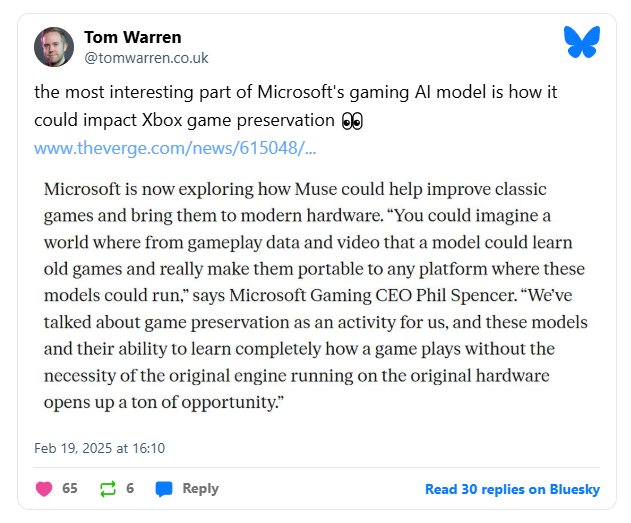
Today, a story went round about a research project at Microsoft where they were using generative AI for "game ideation", and also noted that they thought they could use their generative AI models for "preservation". This was reported on by Tom Warren, senior editor at The Verge, thus (screenshotted rather than embedded 'cause the coward deleted it after everyone dunked on it):
Now, if you know anything about video game preservation, you know that feeding an old game into a generative AI model and then hoping it will hallucinate at least a rough approximation of the original game experience is not "preservation". It's bastardisation at best, a completely useless endeavour at worst, and a massive waste of energy and money regardless of the result that comes out of the other end.
Game preservation is a problem that, for the most part, we have solved. We have excellent software emulation solutions, built over the course of decades of development. Hardware emulation via FPGA at an affordable cost for the general public has advanced hugely in just a few short years. Software libraries for pretty much any system you can think of are archived in their entirety at numerous places across the Internet, and strong strides have been made in providing commercial, legally relicensed versions of classic games for a modern audience, both on existing modern systems and on bespoke emulation-centric devices.
So why, then, why the fuck would we want a generative AI model to make a best guess at what a video game that already exists and has been preserved perfectly well might look like if you play it for longer than 10 frames?
That paragraph above is what tech journalists should be asking. And the reason I bring up Ed Zitron at the start of this post is because he's one of the only people to actually ask questions like this: to take a look at the utter garbage being spewed by today's tech companies and to say "this is complete horseshit, what the actual fuck are you on?"
And Zitron, being an outspoken type, is not afraid to call out today's tech journalism space for not doing this. And he's absolutely right to do so. It is the tech journalism sector's job to look at what it going on, to realise that it is complete horseshit and then have the confidence to say that it is complete horseshit.
But they won't do that, for a variety of reasons. Advertising deals. Exclusive access. PR partnerships. An inexplicable desire not to rock the boat, despite the fact the boat has a huge hole in it and has been steadily sinking for 15-20 years at this point.
I'm not one of those people who thinks that journalists are taking bribes for positive reviews in literally all circumstances — I have experience in the industry, remember, and the most I had to worry about in that regard was a mild admonishment from my editor for criticising a Mortal Kombat game's DLC plan when Mortal Kombat was the cover game for that issue of GamePro.
But come on now. Tech journos should be looking at this utter garbage that keeps getting flung our way, and instead of declaring it "interesting" and doing the stupid looky-eyes emoji that makes their post immediately look like a 14 year old girl wrote it, they should be going "hang on a minute, what does that actually mean?" then exploring it further, asking some probing questions (which inevitably won't get a response, but that in itself says something) and then confidently declaring the latest generative AI "innovation" to be what it is: complete and utter horseshit doused in the finest snake oil.
And people wonder why the entire journalism sector is floundering. Could it perhaps be because very little actual journalism seems to be getting done?
Shout-out at this point not only to Ed Zitron's aforementioned blog, but also the excellent coverage of the Elon Musk nonsense in the States by Wired's politics department, 404 Media being a rare example of tech journalism that actually asks those hard-hitting questions, and Aftermath for doing something similar with games journalism. There are still people doing good work out there. But the people on the big, well-known mastheads, like Warren above, need to step their game up, stop being so incredulous and start acting like actual journalists.
Want to read my thoughts on various video games, visual novels and other popular culture things? Stop by MoeGamer.net, my site for all things fun where I am generally a lot more cheerful. And if you fancy watching some vids on classic games, drop by my YouTube channel.
If you want this nonsense in your inbox every day, please feel free to subscribe via email. Your email address won't be used for anything else.
I don't think it's an exaggeration to say that probably 75-80% of the games I've bought in the last… maybe 5 years or so, possibly more, have come from limited-press companies. My reasoning for this? I like owning physical copies of games, and most of the limited-press companies wait to put out a physical version of a game until it has all its updates applied and usually (though not always, these days) all its DLC.
Taking this approach to buying games has a few effects. Firstly, it makes me consider whether or not I really want something, or if, as often happens with digital releases, I'm likely to download it, play it maybe once or twice and then never think of it ever again.
I value physical releases more. I just do. This isn't a slight against those who can't afford to, don't want to or aren't able to do physical releases, it's just a fact about how I approach my video game collection. If it's not on a cart or a disc, I am very likely to forget about it.
One thing I'm growing increasingly tired of is the collective whingeing that goes on any time a limited-press company announces its involvement in a physical print run of something. It happened just today with Digital Eclipse's long-awaited announcement that it will be publishing physical versions of its "Gold Master" interactive documentary series on Karateka, the back catalogue of Jeff Minter and Tetris. Because Limited Run Games are involved, some people have already written the release off completely. One person in a Discord I frequent described it as the "worst birthday present ever".
And… I just don't see it. Limited Run used to have big problems back when they opened pre-orders for five minutes and then promptly had them all swallowed up by scalpers, but they don't do that any more; instead, they have an open preorder window, during which they establish who actually wants a copy, then they print those copies. Sometimes it takes a good few months from ordering a game to actually getting it, but the company has always been up-front about that being a thing, at least partly for the reasons I described above — wanting to ensure that the game is "complete on cart/disc" with all updates applied — and partly to give them the time needed to take all those preorders, pass those orders on to their manufacturing partners and then sort the whole shebang out.
The same is true for other limited-press houses. Probably the "worst" of the batch in terms of being kept waiting is Strictly Limited Games, who has been sitting on preorders for some games for (checks) three years at this point, but when their eminently affordable special editions do arrive, they are absolutely lovely in terms of quality, with tons of extras and just plain gorgeous packaging.
I guess I just… don't mind waiting. I am under no illusions as to when I will be getting a game when I order from one of these companies; more often than not, it's a nice surprise several months (or even years, in the case of Strictly Limited) down the line when I get a dispatch notification for something I'd all but forgotten I ordered.
To an extent, I get why this pisses people off. We live in an age where if you order from Amazon at the right time, you can get something on the same day you ordered it. We live in an age where you can click a button online and get food delivered to your door within half an hour or so. We live in an age of digital convenience, where if you want to watch something you just click the thing to watch it rather than having to search for somewhere that has it in stock, order it and wait for it to arrive.
To anyone who is used to those modern conveniences, paying up for something you won't get for months is unthinkable. But it's not that unusual. Many online shopping sites that aren't Amazon take a while to ship things. eBay sellers can be relied upon to not even think about shipping your item until a week after you paid. Things go out of stock and sometimes aren't back in stock for months. Granted, most of these situations doesn't see you waiting as long as you do for a limited-press video game, but after several years of hearing people constantly whining out non-specific complaints about Limited Run and its ilk, I just have to say… I don't care. Shut up.
In seven years of ordering from Limited Run, I've had precisely one mishap, and that was down to the courier in this country making a mess of things rather than anything Limited Run did — I ended up with a slightly crushed Switch case for the Contra collection from Konami. So y'know what I did? I got a new Switch case and replaced the damaged one. Job done.
In multiple years of ordering from other limited-press companies, I've had no issues. Yes, I have the aforementioned outstanding Strictly Limited orders, but I have faith that those are going to arrive. It doesn't really matter when they arrive, because I have over a thousand other games on my shelves all around me, and even more in my Steam library and downloaded to various consoles. It'll be nice to finally have those, but I'm not mad about them not being here yet, because there's really no point in being mad about it. I paid my money knowing that I'd be waiting for a while, and so that's exactly what I will continue to do.
I will also be ordering the Digital Eclipse Gold Master games when preorders open on February 25 — although as it happens, Digital Eclipse have sensibly partnered with a European distributor (Clear River Games, who also distributed their excellent remake of the first Wizardry game) as well as Limited Run for North America, which makes life quite a bit easier.
I'm tired of not feeling like I can be excited or pleased that something I hoped would get a physical release is actually getting a physical release, because The Internet can't get over its collective hateboners. And I can almost guarantee that a significant proportion of the people whingeing about it being Limited Run don't have any specific complaints other than they don't like them, or because someone involved in the company said something dumb on Twitter.
If you don't like them, you have no obligation to give them money. You have no obligation to buy anything if, for whatever reason, you don't want to give the people making it any money. I happen to like what they do, and I'm getting real tired of people pissing over my excitement for things like the Digital Eclipse releases because they can't get over the publishing partner.
Anyway, that was a useless rant. No-one's reading this anyway. But I feel a bit better. Time to go watch Angel in bed.
Want to read my thoughts on various video games, visual novels and other popular culture things? Stop by MoeGamer.net, my site for all things fun where I am generally a lot more cheerful. And if you fancy watching some vids on classic games, drop by my YouTube channel.
If you want this nonsense in your inbox every day, please feel free to subscribe via email. Your email address won't be used for anything else.
Through various combinations of circumstances, I found myself looking at the information about Hasbro's recent(ish) reboot of HeroQuest earlier, and I actually found my finger hovering over the "Buy" button (it was £30 off on Amazon, putting it down to a much more reasonable £70 from its usual £100 price tag) before the rational part of my brain kicked in, reminded me that I haven't seen another human being other than my wife in my house for a very long time indeed, and found myself feeling a bit sad that I, seemingly, would be forever deprived of playing something that I think would actually be rather fun.
Of course, this is nothing new. Growing up, I had a copy of Advanced HeroQuest (still do, in fact) that I played with other people precisely… twice, I think. Space Crusade (which I no longer have) hit the table a couple of times, and a couple of more recent successors like Descent: Journeys in the Dark also had a couple of plays, but I have never yet managed to play through a complete campaign of any game like this. And this makes me sad, because I have wanted to ever since my brother's teenage girlfriend (as in, girlfriend when they were both teens, to be clear) Allie introduced child me to the original MB release of HeroQuest many, many years ago.
Part of me is just saying "fuck it, buy it anyway" and maybe convince my wife to play, or perhaps convince my few remaining in-person friends to come play it for a day when I manage to pry them away from their oh-so-busy personal lives for the one occasion a year they'll actually leave their houses around my birthday. But that rational part of me keeps saying "you'll never get anyone to play it, you'll have wasted your money".
And perhaps I will have. But part of me still wants it.
There's something about the original HeroQuest that I've always liked. I know there's elements of it that are stupid (like the roll-to-move mechanic, which is at least phrased as "you may move up to that many spaces" rather than "you must move that many spaces", and the fact every monster in the base game only ever had 1 body point, meaning it was nearly as easy to kill a lumbering Gargoyle as it was a pathetic Goblin) and that other, later games did what it's doing a lot better. But I also think there's still a distinct appeal to HeroQuest that those "better" games lack.
Take Descent: Journeys in the Dark, for example. Ostensibly this is the same kind of game: you have 1-4 hero players competing against an antagonistic player who is in control of all the monsters. But each scenario is much more of a tactical strategy game challenge rather than a dungeon crawl. There are elements of exploration, sure, but the whole thing feels less about delving into dank dungeons, and instead more like a wargame. That's not necessarily a bad thing; I just think I prefer the dungeon crawling aspect.
Then there are games like Gloomhaven, which, although critically acclaimed, make me feel like they overcomplicate things massively — and again, each scenario often ends up feeling more like a wargame than a dungeon crawl. I wanted to like Gloomhaven, particularly after a friend spent a lot of money on the fancy Kickstarter edition, but I just… didn't. It really didn't grab me, for some reason, and its potentially interesting "Legacy" elements, predictably, went mostly unused because we only played a couple of sessions of it.
I think the place for something like HeroQuest is firmly in what often gets described as "beer and pretzels" territory: a game that everyone around the table can enjoy, but which no-one really needs to concentrate on too hard. A game you can play while gradually getting more and more intoxicated and still have a good time. A game that you can easily introduce newcomers to without having to spend an hour discussing the rules — and a game that a group can easily return to several weeks or months after their last session and still remember how to actually play.
So I dunno. I feel like buying a copy of HeroQuest would be silly. But I still kind of want to. I haven't yet decided if I'm going to. But I'm certainly considering it.
Want to read my thoughts on various video games, visual novels and other popular culture things? Stop by MoeGamer.net, my site for all things fun where I am generally a lot more cheerful. And if you fancy watching some vids on classic games, drop by my YouTube channel.
If you want this nonsense in your inbox every day, please feel free to subscribe via email. Your email address won't be used for anything else.
I've had a nice quiet weekend that has been almost entirely occupied with Xenoblade Chronicles. I thought about making some videos, but decided that I didn't really have the mental fortitude to sort that out, so I have just had a completely relaxing weekend where I thought about nothing of any importance whatsoever, and just enjoyed myself.
This is a valuable thing to do now and again, particularly if you are feeling any sort of burnout or stress, which I most certainly have been of late. Honestly, I feel like I am starting to come out of the other side of the funk I've been in for the last while. I'm not completely out of it by any means just yet — and I'm sure the first time I look at social media for work on Monday I will suffer a mental health setback — but I am feeling a bit better, partly for having spent some time just relaxing, partly for having got some things off my chest with the post the other day, and partly… well, these things just pass eventually, usually.
That, honestly, is one of the things that's kept me holding on through difficult times — the knowledge that "this, too, shall pass". It always has done. Sometimes there have had to be difficult decisions made in order to encourage this, too, to indeed pass, but for the most part, just gritting your teeth and hanging on in there generally allows one to pass any number of this, toos, that might find themselves coming your way. And thankfully this most recent bout of the blues appears to have fallen into that category.
One thing I try to do when I'm feeling low is to ponder the things I do have that I should be — and am — grateful for. I'm not saying that just because you have things to be grateful for that you shouldn't be sad, of course — processing one's emotions is important and healthy — but rather, I think I'm saying that when things get hopeless I find it helpful to remember that I do not, in fact, have nothing, and that as difficult as it can be to appreciate that when you're down the bottom of a depression hole, those things you do have are a welcome sight when you eventually clamber back out.
That was a tortured metaphor, I know, but I'm just bashing things out on fumes here. Early night tonight and an attempt to get back into a routine of feeling like a vaguely normal human being. I don't know if I'm quite ready to return to the super-early mornings and going for a walk down to the shop, but I can at least look to tomorrow with good intentions if nothing else.
I hope you've had a pleasant and appropriately relaxing weekend, and that your week ahead isn't looking too stressful or chaotic. I am very much ready for a break, but I have a couple of weeks to get through before I can enjoy that break. That's feeling eminently doable at this point, though, so here's to Getting Back Into Things.
Want to read my thoughts on various video games, visual novels and other popular culture things? Stop by MoeGamer.net, my site for all things fun where I am generally a lot more cheerful. And if you fancy watching some vids on classic games, drop by my YouTube channel.
If you want this nonsense in your inbox every day, please feel free to subscribe via email. Your email address won't be used for anything else.
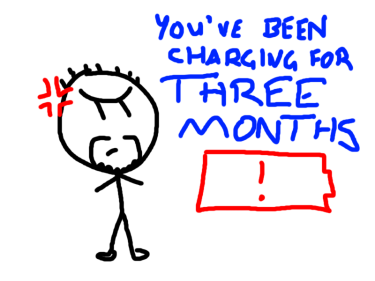
I've been having an issue with my fancy, expensive Razer keyboard for a while. I've had it plugged in to USB, but as soon as I take the USB cable out, it seems to completely forget that it's been on charge and just die. This meant that I couldn't use it wirelessly, which was one of the keyboard's main selling points: it was a rare example of a mechanical keyboard that was also wireless. It didn't used to do this.
For a while, I just thought the battery was dead. Then I remembered that I'd uninstalled the Razer software a while back, because a shonky update process had made it cause my computer to pitch a shitfit and completely lock up for ages. So, out of curiosity, today I reinstalled the Razer software, plugged in the keyboard to charge and went off to play Xenoblade Chronicles for a couple of hours.
I am now typing this with the keyboard's USB cable unplugged, and the battery reading 100%. So it was the fucking software. My keyboard officially will not charge its battery unless you have Razer's stupid software installed.
Thankfully, they seem to have fixed whatever the locking-up issue was when I uninstalled it, so it's not a huge inconvenience to have it installed again. But it's pretty annoying to have spent several months thinking that my keyboard was broken in some way, or that it needed a new battery, only to discover that a completely arbitrary piece of software was preventing my keyboard from doing something that, you'd think, it should be able to do without any software intervention whatsoever. I mean, USB charging is a fundamental part of most of our tech these days, and most pieces of tech can charge without a piece of software running. You just plug them into a wall, the device goes "ooh, there's power coming in, I should route that to the battery" and that's that.
But no. Not for Razer, apparently, and I suspect there's other manufacturers who do the same thing, too. Logitech, for example, pissed people off when they tried to install some weird AI software into people's mouse drivers a while back, and the general enshittification of tech is, at this point, extremely well documented — though the number of people actually doing something about it, or even acknowledging that it's a problem, is rather slimmer than it perhaps should be.
Now, I'm not saying that my £150 keyboard not charging when its software isn't installed is really making my life significantly worse in the same way that Facebook and Instagram's abusive practices are systematically destroying the mental wellbeing of individuals in the name of perpetual corporate growth, but it's still symptomatic of the age we're living in. 20 years ago, if I had a wireless thing with a rechargeable battery, I could just plug it in and be safe in the knowledge that it would, y'know, charge. Today, apparently, that is not the case. And that seems stupid. Really stupid.
But I guess that's the world we live in now. So, for now at least, we just have to live with the stupidity.
Want to read my thoughts on various video games, visual novels and other popular culture things? Stop by MoeGamer.net, my site for all things fun where I am generally a lot more cheerful. And if you fancy watching some vids on classic games, drop by my YouTube channel.
If you want this nonsense in your inbox every day, please feel free to subscribe via email. Your email address won't be used for anything else.
Whew, that was heavy going yesterday huh? I am pleased to report that it resulted in some healthy and worthwhile discussions, so I'm pleased I plucked up the courage to write it. But I figured I should probably go a little lighter this evening. And not just because I've left it until 1am to write this.
I've been enjoying working my way through the first season of Angel as some bedtime viewing, and I'm now about halfway through the fourth disc of the set. I'm glad that this show is just as good as I remembered; I'm always a little concerned when revisiting an old favourite after many years, but thinking back on things, there's been very few, if any, occasions when I've felt let down by something I used to love.
Perhaps this is because in a lot of ways, I've never really left the past completely behind. I often think back fondly on my school and university days, for example, which is when I was enjoying shows like Friends and Angel, and hell, I still play a lot of the video games I played from before I was even ten years old.
There have only been a couple of things that I'm hesitant to go back to, and they're all things that raging transphobe Graham Linehan was involved in — stuff like Father Ted and The IT Crowd. But then I haven't had a problem going back to Angel knowing that Joss Whedon is a bit of a tool, because "his" shows were much more about the writers, the directors and the actors than just him. So I'm sure if I went back to Linehan's shows I'd be separating art from artist in no time, because they, too, are all about their casts and their performances.
In fact I think these days it's much too easy to get hung up on whether the creator of a former favourite is actually an awful person or not. In some respects, I think I was happier just not really knowing anything about anyone, and just letting the creative works speak for themselves. But that's not really an option these days.
Anyway, regardless of all that, Angel is still good. And I think that's all I really want to say today!
Likely to be a long one today, and I'm not entirely sure exactly what I want to say, nor exactly how to say it, but I ask you to indulge me, whether you're a regular reader, someone who stumbled across this page, or someone I specifically pointed in the direction of this post.
I'm just going to start typing and see where things go from there.
This is something I've been meaning to write for some time, but have never really known exactly how to write it. It's probably going to be difficult to write, it's probably going to be difficult contemplating the possible reactions to it, and I honestly don't know if it's a good idea to even write it at all in the first place. But having had… Feelings festering inside me for probably the best part of a decade and some change at this point, I think it's time I got at least some of them down on paper.
I was inspired to write this by Chris "Papapishu" Person's excellent post over on Aftermath, I'm Only Here Because I Was A Forum Poster, in which he contemplates how, in the mid 2000s, he found a community of like-minded folks on the forums for 1up.com, and that, via a somewhat roundabout route, resulted in him being a professional games journalist, initially for Kotaku and subsequently for Aftermath.
Pishu isn't the only person for whom this is true. I can probably attribute my current position indirectly to those days back on the 1up.com forums, and Jeff Grubb and Mike "Tolkoto" Minotti of Giant Bomb, both specifically namechecked in Pishu's piece, almost certainly have their own similar stories. Those heady pre-social media days on 1up.com were, it's fair to say, a real high point for online socialisation for me and for many others, and I feel like things have only gotten worse since the collapse of that site and its consequences: the community scattering to the four winds, never really settling down and calling one place "home" ever again.
I first came to 1up.com because of the family connection. My brother, John Davison, helped to launch the site, and was also working on Electronic Gaming Monthly and the Official U.S. PlayStation Magazine at the time. 1up.com was a bold new experiment in online video game-related media: its social features were, at the time, pretty revolutionary, allowing any of its users to start a blog, create a club with its own private message board, and post on the forums. The site still had professional staff, of course, and for many folks the various 1up.com podcasts by that staff were a real highlight of the site. But for me, the thing that made me happier more than anything was the sense of community it had at its peak.
As someone who is what I now understand to be autistic, finding a community of like-minded nerds online was an absolute lifeline. Finally, I had a place where I could well and truly be myself, among "my people". And it didn't take long for me to find a niche within a niche: nerds who enjoyed video games, and who enjoyed talking about them at great length, in great detail, and with a mind to proper in-depth critical analysis rather than just flame wars or quickly writing things off because they didn't score over 80% in a review.
If you look back over the past entries of this blog, you'll see frequent references to "The Squadron of Shame". This was a loose conglomerate of 1up.com members who came together after a discussion on the 1up Yours podcast about "The Pile of Shame": what today tends to be referred to as "the backlog". The pile of games that you've bought, but haven't gotten around to. The games you always meant to play, but haven't. The games that don't get the time of day in reviews, but which you always thought looked interesting.
Fun fact: the first video I ever posted on YouTube was a hacked-together "trailer" for the games we'd covered up until that point.
1up Yours was initially intending to pick a game from the hosts' respective Piles of Shame, play it as a group, then discuss it the following episode, book club style. They didn't really manage to do that — and this isn't a criticism or admonishment of them, as they were all busy people — but a group of us on the forums thought that it was a really good idea… so we did it instead, beginning with the game the 1up Yours crew intended to cover: Psychonauts.
Squad "Missions", as they were known, took the form of a forum thread, in which the person proposing the "mission" would outline the reasons they thought the game in question was noteworthy and why they thought it could do with some in-depth discussion. These initial posts were often long and in-depth in their own right, and they set a good tone for the subsequent discussion: Squad threads became notorious as being wordy, but no-one gave us grief for it, and we often got a shout-out on 1up Yours for successfully picking up and running with the otherwise aborted concept.
One day, something terrible happened on those forums, and I'm not entirely sure why. Where there once had been a selection of subforums specific to particular types of discussion — including individual platforms, plus a special forum for the "1up Radio" podcasts, which is where the Squad threads resided — there were now just two forums: "Games" and "Not Games". Presumably this was done in an attempt to make moderation easier, but it was the beginning of the end for 1up.com's community.
The first Squad thread we posted under this new layout (in "Games") was immediately trolled by someone, clearly unfamiliar with how we had done things on the 1up Radio boards, complaining about a "massive fucking wall of text", and things derailed quickly from there. It was abundantly clear, both from this forum upheaval and various other behind-the-scenes happenings at 1up.com, that the writing was on the wall for this community, and so we started looking into alternative approaches. (1up.com actually hobbled along until 2013, but most of the community and staff left long before that.)
Many of us settled on the fledgling Twitter as a means of interacting with one another, but one of the most important things we did was organise a podcast. This would take the place of our megathreads on the 1up.com boards, and allow a rotating group of us — with several regulars — to discuss the games in-depth, in person, for as long as we wanted. Although severely lacking in confidence to speak up when surrounded by people I always felt were probably a lot more clever and articulate than I was, I quickly developed a reputation among the group as The Guy Who Was Good At Editing The Podcast, so my seat in pretty much every episode was all but assured, and I made a (now-defunct, and apparently non-archived) website that left a written record of all the podcast episodes and the things we discussed. (The episodes themselves, thankfully, survived — you can find them all on my Soundcloud.)
For a while, things went well, and friendships solidified. I even made the trip across the pond to visit various other members of the Squad (who were mostly North America-based) on multiple occasions, and we played host to some Squaddies on at least one occasion that I recall.
We changed the format in which we discussed things several times over the podcast's complete run, shifting from the "book club" format to focusing on a particular topic and bringing our own examples to the table. Things were good, for a while. Then we stumbled across Katawa Shoujo, a visual novel about a boy with a heart condition and how he came to love a group of girls with disabilities that he came into contact with when they all attended the same special school.
Katawa Shoujo was — is — a thoroughly interesting cultural artifact, if you're unfamiliar. It stems from the work of an independent Japanese artist named RAITA (if I remember correctly), who sketched some girls who had various forms of physical disabilities. Various members of the notorious imageboard 4chan found these images somewhat striking, and so, seven years after the original images' publication, they took the unusual step of forming a development collective of individuals from all across the world in order to bring these characters to life. The result was an absolutely fascinating visual novel that handled the subject matter infinitely more sensitively than anyone would have ever expected, given the origins of the development team being a website commonly referred to by many (not without cause) as a "cesspit".
In keeping with the visual novels that tended to come west at the time of its release, Katawa Shoujo was a sexually explicit game, featuring erotic scenes between the protagonist and each of the various heroines. Unsurprisingly, this made some people uncomfortable, particularly given the high school setting of the game and the way it (like many other localised Japanese works) left the cast members' ages somewhat ambiguous. And, although we had a great podcast discussion about the game itself — during which several of us opened up emotionally more than we'd ever done in public before — some damage had been done to our group. I don't blame the folks who splintered off or their reasons for it, but I am still sad that it happened, because it marked the beginning of the end.
We managed a few more episodes post-Katawa Shoujo, but eventually things petered out. We'd had plans for a Squadron of Shame website with its own forum to host discussions just like in the Good Old Days, but it took a long time for those to come to fruition, and it never quite built up the same momentum as in the 1up.com era. Eventually, it fizzled out completely, and after many years of reflection I probably can't say with any confidence that I was completely blameless in this.
Around the time of our Katawa Shoujo discussions, I'd started getting to know one of our members known as "Shingro" a bit better, and he was particularly interested in anime, manga and Japanese games. He, along with a couple of other people I knew in other places online (including Google+, remember that?) had given me some recommendations for some localised Japanese games to try — games that never got much attention from the press, weren't received particularly positively when they did, but which were likely to appeal to anyone who "got" what Katawa Shoujo was going for. Among those games were the early entries in the Hyperdimension Neptunia series, the Atelier Arland series and the Ar Tonelico series.
I played and absolutely adored all of those games, and, along with Katawa Shoujo, found that I was experiencing something unusual and interesting: I was enjoying games that felt like they had been tailor-made to suit me and the way what I would later come to recognise as my neurodivergent brain worked. I recognised that they likely wouldn't appeal to everyone for a wide variety of reasons — and not just the sexually provocative element. They were unabashedly cheerful, they were colourful, they were often gleefully experimental (and not always successfully so) with their game mechanics, and their voice acting had a lot of screeching and shouting, particularly if you played in Japanese.
But I liked them for that; they knew their audience, and they unashamedly catered to that audience and no-one else with a laser-like focus. I started to discover hidden depths in these games; even the most silly-seeming ecchi titles, like Senran Kagura Burst, had something interesting to say, and they often had a lot less shame about it than many mainstream titles, many of which were still in their "dark and edgy equals mature" phase. In stark contrast to my growing disillusionment with triple-A games — Gears of War was my absolute last straw in this regard, as I hated that game and pretty much swore off "big games" after that — I felt like I was discovering gaming afresh for the first time.
And, naturally, I wanted to share the way these games made me feel. So I did. And for a while, things were okay, until I saw a few messages that made me feel a bit uncomfortable. Messages that, while it almost certainly wasn't the intent, given the sources, made me feel like I was being judged for the type of entertainment I was enjoying — entertainment that, let's not forget, I had recently come to feel was "speaking" to me like pretty much never before in my gaming career. Words like "creepy" and "perverted" were bandied about a bit too readily, and I… did not like that.
For a bit of context, I was struggling in my personal life around this time. (So what else is new?) Shortly after I took one of the aforementioned trips across the pond to meet some Squad members at PAX East in Boston, I split up with my first wife. And I… did not handle it very well. I felt betrayed, broken, utterly destroyed, and the things that I could cling onto for some degree of comfort in those trying times were of increasing importance to me. By the time Katawa Shoujo and the aforementioned other games came along, I was several years deep into A Difficult Time and, although I had met Andie, the wonderful person who is now my wife, I was still struggling and in great need of comfort.
I started to get frustrated when I saw the things I enjoyed come under what I perceived to be "attack". In the early to mid 2010s, this really started to come to a head, as the modern progressive movement started to really raise its head online — and was being more than a little abrasive about it, with public shaming often being the weapon of choice. In retrospect, I recognise how effective this can be — and how flaccid groups like the USA's Democratic party appear when they're not willing to step up and confidently declare their opponents to be Bad People — but at the time, I did not like it, particularly as I saw people I knew and cared about caught in the crossfire on multiple occasions.
At this point I should clarify that I have always had beliefs that are broadly in line with what one would call "progressiveness". I believe that straight white men have indeed been in a position of power and privilege for many years, and that marginalised groups, including women, have had an uphill struggle to stand on the same level — and that it is the responsibility of those who are in positions of power and privilege to help others up, so we can all benefit. I believe trans rights are human rights, I believe everyone has the right to love whoever they want to love, regardless of gender, and I believe racism is something we should have left behind long ago, and that it doesn't go challenged nearly often enough these days.
At the same time, part of my frustration stemmed from those mid-2010s feeling like I was being demonised for my gender and my sexuality in particular. I am sure at least part of this was down to my vulnerability at the time, but when I saw articles literally branding people who liked certain games as "creepy", "paedophiles" and "sex pests", I didn't like it. At all. Striving for equality, I felt, shouldn't mean dragging people down — particularly when there's a lot more nuance to the situation than just "white straight man = privileged". As someone having difficulty with my own personal situation — and what I later learned was neurodivergence — I certainly didn't feel like I was in the same position as the hypothetical straight white bogeyman, sitting in his suit with his perfect white teeth, counting his money and posting slurs on the Internet.
So I lashed out. There are numerous posts on both this blog and on MoeGamer where I did just that: I attempted to express how I was feeling about this. I attempted to express how these things that were important to me made me feel — and how it made me feel when I was called all manner of horrible names simply for what I liked, including by former colleagues. When I left USgamer, I was subject to some absolutely horrible abuse from an individual who joined the organisation as I was on the way out, and I received absolutely no support from anyone when that happened.
All this, as you might expect, eventually attracted the attention of the Gamergate crowd, who also counted among their number people who liked sexually provocative (or explicit) games, just like I did, and seemed to be forming a community of like-minded folks. I recognised even in the early days that Gamergate — and particularly its subreddit, KotakuInAction — was a scarlet letter, so I always took care not to publicly associate myself with the movement or even express support for it, particularly as things escalated and it became clear that no, for some of those people, it really wasn't about ethics in games journalism.
I maintain to this day, however, that among the early Gamergate crowd were some genuinely good people who wanted change for the better — and in a few cases actually achieved meaningful change that didn't involve any sort of bigotry — but with the inherently disorganised nature of the whole thing, it was, in retrospect, very easy for it to become an alt-right pipeline, and for bad actors to take control of things. And, as silly as it may sound for a dispute supposedly over video games to have such power, I firmly believe that at least part of the reason the world (particularly the online world) is in such a mess today is down to Gamergate.
Although I continued not to associate myself with Gamergate or its supposed beliefs, I found supporters from among its members for what little overlap we had. And I won't lie, it was nice to feel like there was someone who supported the way I felt, regardless of where they'd chosen to plant their flag. I found people who seemed to understand me, many of whom were on the periphery of the whole "culture war" by choice, much like I was, but who often got dragged into things whether they wanted to or not.
I continued to feel frustrated and vulnerable, though, like I was being pushed aside by people I had once called friends and a community I had once felt part of, all for the things I enjoyed. I continued to lash out, including towards people who had once been good to me, close friends, all because I felt like they had "sided" with people who didn't value my opinion, who wanted to brand me some of the worst names you can call people. And all because I liked anime-style games that occasionally crossed a line into sexual provocativeness or explicit scenes.
I said some things that I regret on multiple occasions, and I am deeply sorry about that. I recognise today that, in retrospect, I was standing at the very mouth of the alt-right pipeline and, if I had made some very different choices, I would be in a far worse situation than I am in today. Thankfully, I eventually recognised the danger I was in, and successfully changed my ways in such a way that I could continue to enjoy the things I loved without putting myself at risk of becoming one of those "everything I don't like is WOKE" idiots who infest online discourse today. And one of many positive results from that was a very enjoyable period in charge of Rice Digital, which subsequently led to my current position with Evercade — a job that, were it not for the necessity to check in on social media every day when I have otherwise mostly abandoned it for my personal life, would be 100% a dream assignment.
That doesn't change the regrets I have, though, and I wish I had come to the above realisation sooner than I did. There was still a period where I was in a bad place, and doing bad things, whether or not I really intended to. I deeply regret lashing out and pushing people away, and I wish I could make up for what I did, regardless of my reasons for it.
The reasons don't even matter any more; all that remains is the result, that being that I am growing older, I am mostly alone (except, thankfully, for the blessings that are my wife, cats and family) and in complete and utter despair at the mess I've made of my interpersonal relationships over the course of the last decade and a half.
I have many regrets. I am sorry to those I hurt. And I want to make things right. I just don't know how.
So this post is, hopefully, a start.
If you're reading this and you used to know me before… all this, I would like to know you again. I'm sure both our lives are very different to how they once were, hopefully for the better. On the whole, my life is much better than it was 10-15 years ago.
But I wish I hadn't lost those 10-15 years, and all the people I lost with them.
I am sorry to those of you I pushed away, either consciously or unconsciously. I am sorry to those of you I hurt. It doesn't matter if it was deliberate or not; if I hurt you, I hurt you, and I am sorry.
I just want things to go back to how they were during that one brief time in my life when I can say I was happy, when I felt I was accepted, when I felt I was among "my people". I know it can never be exactly the same as it once was. But I'm willing to put in the work needed to rebuild, reconnect and rekindle lost friendships.
Whatever it takes.
Thanks for reading.
Want to read my thoughts on various video games, visual novels and other popular culture things? Stop by MoeGamer.net, my site for all things fun where I am generally a lot more cheerful. And if you fancy watching some vids on classic games, drop by my YouTube channel.
If you want this nonsense in your inbox every day, please feel free to subscribe via email. Your email address won't be used for anything else.
It's day 250 of this bullshit, which feels like a significant milestone, and I feel like I don't really have anything to write about. Inevitably, I will almost certainly now proceed to churn out at least 500 words on nothing in particular as I always do when I claim to have "nothing to write about", but I at least wanted to set expectations up front.
I am feeling exceedingly burnt-out right now, and I use that phrase deliberately. After my reading up on autistic shutdowns the other day, I also ended up reading a bit about autistic burnout, which is not a "medical" term, but it is one that has come to be commonly used among autistic people and those who care for them. And it's definitely something I feel like I am contending with right now. Persistent tiredness? Check. Random irritability? Check. Inability to concentrate? Hell to the yes. Desire to just shut down completely? Absolutely.
I should probably talk to someone about this, but I don't really know where to begin, and don't want to come across like I'm making excuses or anything. It's a busy and stressful time for everyone at work right now, and I don't want to leave anyone else in the lurch by just noping out of life for a few days, but at the same time I feel like if I don't put my hands up and say "I need a fucking break" I will almost certainly involuntarily end up noping out of life for a few days. And I don't really want that.
As I've alluded to on previous days, the current happenings around the world aren't helping, and I'm also becoming frustrated with the few online communities that I have remained a part of in a vain attempt to feel any sort of social connection with anyone. There's one in particular that I'm very close to just ditching completely because I'm tired of the moaning negativity that goes on in there, but I like the people who run it so I don't want to upset them by appearing to go off in a huff or anything like that. (Who am I kidding, I suspect no-one will actually notice if I leave.)
I am finding distraction from my own negative thoughts through a combination of Friends, Angel, Xenoblade Chronicles and, yes, I bought the RPG Maker DLC the other night and have made a start on making a stupid self-indulgent project. So that is something. At least I am not sitting staring at a wall or anything like that. But I would like to feel, y'know, better about things generally. And I'm not entirely sure where to start with that.
Oh well. The week is half over. I can, at least, look forward to the weekend. We have nothing in particular planned, but that is nice. I fully intend to sleep in, play some video games, perhaps record some videos and just forget about all this for a couple of days. And once my commitments for this month are over, perhaps I will finally take that time off I clearly owe myself.
Want to read my thoughts on various video games, visual novels and other popular culture things? Stop by MoeGamer.net, my site for all things fun where I am generally a lot more cheerful. And if you fancy watching some vids on classic games, drop by my YouTube channel.
If you want this nonsense in your inbox every day, please feel free to subscribe via email. Your email address won't be used for anything else.
I'm getting a hankering to make a game again. I say "again", having only ever finished one game-making project (technically two, though one was a remake of the first). I'm not sure what triggered this — perhaps a recent post on Bluesky that I found quite striking:
Just make insanely self-indulgent shit. Quality does not matter. Quantity does not matter. "It's just [thing] yet again 🙄" does not matter. Whether or not you ever show it to anyone does not matter. Make self-indulgent shit because it's the only way to live and be happy.
And… this is good advice. Being creative is fun, and the biggest mistake a lot of people make when pondering whether or not to be creative is "can I monetise this?" The modern Internet has made us all believe that everything we do should be to the end of making money from it, but it really doesn't work that way. Some of the most rewarding creative work I've ever done came about because I just… wanted to create it. (Frustratingly, one of my all-time favourite works in this regard, my epic, albeit unfinished, RPG Maker 2000 project The Adventures of Dave Thunder, has long been lost to the ghosts of PCs past.)
And so I've been pondering booting up one of the many different versions of RPG Maker I've acquired over the years. My specific thinking this time around is not to do what I always do — which is to get overly, stupidly ambitious, spend six months gathering plugins and reading half-finished, unresolved Reddit threads about how to do stuff, then never actually make a finished game — and instead to just do something simple, unassuming and straightforward. To that end, I have my eye on a couple of asset packs for RPG Maker MV that include Famicom-inspired graphics and music, and I kind of want to see if I can make an enjoyable game using just that and the stock RPG Maker MV mechanics.
I've been hovering over the "Buy" button for those asset packs all day. They're £50 in total, which is quite a lot to spend on what will almost certainly be little more than a vanity project, but I also feel like I'll probably get £50 worth of fun out of making something, even if the only person who ever plays it is me.
The other thing stopping me is pondering what sort of concept I should use. In past RPG Maker projects I've always had grand ambitions to do something unusual and expectation-subverting — but subverting players' expectations is almost a cliché in its own right these days, so just making a straightforward Famicom-style RPG feels like it would be more fun at this point. And, thinking back on my beloved The Adventures of Dave Thunder project, I had the most fun by just making the damn thing up as I went along, balls to any sort of coherence. Self-indulgence was the name of the game there, and I loved it.
So I think that might be the play. Just download those assets (perhaps waiting an hour to see if they go on sale in the RPG Maker event that's supposed to be starting today) and just make, and see where things end up. Who knows? I might even end up making something actually good. Or, indeed, finish something. But we'll see.
Want to read my thoughts on various video games, visual novels and other popular culture things? Stop by MoeGamer.net, my site for all things fun where I am generally a lot more cheerful. And if you fancy watching some vids on classic games, drop by my YouTube channel.
If you want this nonsense in your inbox every day, please feel free to subscribe via email. Your email address won't be used for anything else.