#oneaday Day 923: A Tale of Two Sadistic Sisters

Something convinced me that it was time to finally go back and finish Chantelise: A Tale of Two Sisters. It's been almost a year since I actually purchased that game, and it's been mocking me from my Steam list ever since, reminding me of how much I loved Recettear: An Item Shop's Tale, which was developed by the same team, and localized by the (different) same team.

For those unfamiliar with Chantelise, it's a peculiar beast indeed. In its native Japan, it was Recettear's predecessor, but localization team Carpe Fulgur brought it to Western audiences after Recettear. This had the unfortunate side-effect of giving people perhaps unreasonably high expectations for it when it came out, since Recettear was pretty much universally loved by everyone who has ever come across it. In Japan, there was a noticeable upswing in quality and creativity between the two games; over here, people misinterpreted Chantelise as being a step backwards, since it appears at first glance to be much simpler and shallower than its shop-running successor.

After over 12 hours with it (probably about 15 in total — I started again for this play sesssion) I can say with some confidence that Chantelise certainly isn't a shallow game, it's just very, very different from Recettear. You can see how people would get confused, however, since a good 90% of the graphical assets are shared between the two games, and  the music for the final dungeon in both games is almost (but not quite) identical. When you consider this, it becomes easier to see why everyone had such lofty expectations for Chantelise and were then disappointed when it wasn't what they expected.

Note: "not what they expected" is not the same as "inferior", though some chose to interpret it that way. While Recettear was an accessible, adorable game combining action-RPG dungeon crawling elements with a simple business management sim (and a surprising amount of hidden depth for those willing to jump down that rabbit hole), Chantelise initially appears to be a rather straightforward action-RPG. Hack, slash, rinse, repeat. Job done.

And while there certainly is an element of mindless hack and slash to Chantelise's gameplay, the game has a sadistic streak in it that I haven't seen since Dark Souls. If you do not learn to play Chantelise properly, the game will punish you and send you back to the start of the area you've been challenging, effectively putting a big red "X" through your homework and telling you in no uncertain terms to "DO IT AGAIN! BETTER!" And, assuming you're not the sort of player who gives up after suffering a setback like this, you will get better, because the game will keep punching you in the face until you understand what it's trying to tell you.

You see, while Chantelise may initially appear to be a simple hack-and-slash RPG there's actually a considerable amount of depth that many commentators don't give it credit for. The fact that protagonist Elise doesn't level up traditionally, for example — all modifications to her stats are achieved through equipment, and she gains HP through finding or purchasing special medicine. Finding the correct combination of equipment to make it through a particularly challenging stage is key to victory in Chantelise — some stages will require that you buff up your physical defense; others will practically require the use of an elemental crystal to defeat monsters with resistances; others will need you to focus on magic. As you progress through the game and defeat bosses, Elise gains the ability to equip more items simultaneously, allowing her a substantial increase in power.

The game's magic system is an interesting aspect of gameplay, too. Rather than simply allowing Elise and her companion fairy Chante to cast spells as they please, they have to pick up coloured magic crystals in order to cast spells. Each crystal corresponds to an element — red for fire, blue for water and so on. The twist comes when you use more than one crystal at the same time. Using two, three or four of the same colour produces different spells with different effects — for example, one yellow crystal produces a metal ball that spins around Elise for protection, two causes her to gain a great deal of defensive power and resistance to being knocked back, three causes her to drop a giant boulder on her enemy and four summons an earth elemental who casts the other three spells at random for a short period.

But then there's spells the game doesn't tell you about. Augment the "two yellow" Super Armor spell with two red crystals, for example, and Elise gains a large amount of both attack and defensive power. Use of this spell is an absolute necessity in the later stages of the game, but it will only be discovered through experimentation (or reading an FAQ), because the game sure isn't going to let you know about it. Similarly, the game doesn't tell you that equipping a Darkness Crystal and hitting a baddy with a "charged" attack will drain health from the enemy and give it to you, making it a very efficient means of staying alive against baddies who do lots of damage.

All these factors — the surprisingly brutal difficulty; the uncompromising, punishing nature of the game; the hidden depths of the game's various systems — combine to make a game that is very much an acquired taste, but one that is infinitely more satisfying than it first appears, assuming you find those aspects of it palatable.

In short, it's not Recettear. It's not easy (not that Recettear was, particularly — though with enough determination and patience you'd make it through eventually). It's not traditionally "accessible" despite the simplicity of its controls. It doesn't give up its secrets easily. And it wants very much to hurt you, make you scream, and cackle maniacally as you fling your controller across the room at your fifteenth death that session. Yet it does this with the same veneer of adorable characters and a compelling "small-scale" plot, just as in Recettear. You can see why people got confused.

In summary, then, is Chantelise a bad game? Its Metacritic score certainly seems to suggest so, but as we established a while back with Nier, a Metacritic score is absolutely not a reliable metric as to whether or not a game is "worth playing". And such is the case here — though I certainly wouldn't recommend the game to everyone. If, however, you fall into that category of gamers who enjoy being punished by their games and figuring out how best to make use of the seemingly-simple systems with which you've been presented, then you should certainly check it out. If you feel like doing so, here it is.
#oneaday Day 922: Interactive Tales

As you may have realised if you read my lengthy series of pieces about Katawa Shoujo (and one about Kana Little Sister, which I really must get around to replaying), I am a big fan of the "visual novel" genre, a style of video game that tends to be big on story and light on interaction.

I came to this genre through the Ace Attorney series, which remains one of my favourite video game franchises of all time. (Hurry up and release those iOS remakes, Capcom!) Phoenix Wright and its sequels combined the strong sense of narrative, puzzle-solving and dialogue choices from adventure games with a style of presenting the story that really allowed you to get in close with the characters, giving you a real sense of what made them "tick". Audio-visual presentation was very simple, with detailed anime-style characters overlaid over static backdrops, and a large degree of imagination on the part of the player being required.

Ace Attorney is a relatively good entry into the visual novel genre because it's fairly family-friendly (despite being based around solving a variety of murder cases) and doesn't delve into the less salubrious side of things that some of the more "niche" titles explore. There's no fucking in it, basically, despite Franziska von Karma's clear tendencies towards S&M.

I've talked extensively about Katawa Shoujo in the past, so I won't delve into that too much here, but I did want to mention a new acquisition which showed its face on my doorstep today. School Days HQ from JAST, which is apparently a remake of an earlier title of the same name, and an adaptation of an animé I know nothing about aside from something to do with "nice boat". Or possibly some other combination of those things. I'm not sure.

School Days is an unusual visual novel in that it's fully animated. Yes, rather than watching static images and reading mountains of text, the game is essentially an interactive, episodic animé series, where the player watches what unfolds and occasionally makes choices that direct the path of the story — choices that, unusually for the genre, can include remaining silent through inactivity. Structurally, it's identical to something like Katawa Shoujo — decision points branch the narrative down various "paths" leading to either "good" or "bad" endings, and the game client is set up in such a way as to easily allow players to "rewind" and try other choices — the virtual equivalent of putting your fingers in the possible pages you could turn to in a Choose Your Own Adventure book.

I've only played the first of the game's episodes so far, but the setup is intriguing — and, as with most visual novels, pleasingly mundane. Makoto likes Kotonoha. Kotonoha likes Makoto. Both of them are too shy to do anything about it, so in steps Sekai, Makoto's classmate, who manages to get the two of them together but steals a kiss from Makoto as "payment" for her services. Already there have been a couple of hints about Sekai being dangerously unhinged, so I will be very curious to see how the inevitable love triangle unfolds.

But anyway. I'm not here to talk plot. I'm here to talk about this style of game, and wonder what happened over the course of the last twenty years to make it "okay" to develop a narrative-focused game in which the player's interaction is largely limited to occasional choices.

You see, I vividly remember back in the late '90s when the CD-ROM revolution started. The vastly-superior storage capacity of CDs allowed developers to put a whole bunch more content in their games than was previously possible. One of the most common uses of this space was full-motion video — real actors performing scenes in games. And thus, the "interactive movie" was born. The exact implementation of the "interactive movie" genre varied from traditional adventure games which happened to include full-motion video (Sierra's Phantasmagoria and Gabriel Knight: The Beast Within spring to mind here) to titles which already had designs on movies taking the next step (say hello, Wing Commander III and IV) and, at the far end of the spectrum, games that were quite literally movies that sometimes stopped for — you guessed it — the player to make a choice. (Submarine-themed game Silent Steel is the first game of this type that I remember.)

At the time, the latter option was ridiculed for offering only the most rudimentary of gameplay while flaunting the new technology unnecessarily — and often making it painfully apparent that most game developers didn't have the same budgets as movie studios. (How times change, huh?) But now, this style of gameplay has become a firmly-established genre, particularly in the Japanese market, with a little spill-over into the West thanks to publishers like JAST and hard-working enthusiasts like Four Leaf Studios, the crowdsourced team behind Katawa Shoujo.

I'm not complaining, really — I must confess that even in the late '90s I found interactive movies to be something of a guilty pleasure, despite their poor reviews — but I find it interesting that a style of play which many commentators at the time believed would be nothing more than a passing fad is now a firmly-entrenched part of the landscape of gaming. A niche part, sure, but one that certainly doesn't appear to be going away any time soon. School Days is an interactive movie, and unashamedly so — it has rewind and fast-forward buttons at the top of the screen, for heaven's sake — and there certainly seems to be plenty of people clamouring to play it.

Naturally, the apparently popularity of School Days is nothing to do with the fact that it, unlike Ace Attorney, does have fucking in it. (I also discovered post-install that it supports a USB-connected wanking machine (yes, really, and no, you probably shouldn't click that link at work), which is a mildly terrifying prospect in and of itself. No I don't have one.) Actually, it might be, though perhaps not for the reasons you're doubtless thinking of right now. The visual novel genre represents a sector of gaming that is absolutely unashamed to deal with issues that would be unpalatable to mainstream publishers (and possibly consumers, too). It tackles adult issues — sexuality in its many forms, violence and people acting like people rather than game characters — and does so without patronising the player or being "preachy", unless of course the story calls for it to do so for whatever reason. While there will undoubtedly be those who come to School Days purely to get their rocks off — and the game caters to those people by allowing the sex scenes to be viewed again once they have been "unlocked" in the story (that and the wanking machine compatibility, of course) — I have a sneaking suspicion that a lot of people are attracted to titles like School Days and indeed the visual novel genre in general because, for the most part anyway, it treats them like adults.

Which, coincidentally, is something that a lot of interactive movies failed to do. The lack of budget that many of these titles suffered caused them to feel cheap and nasty, and any violent, sexual or otherwise graphic scenes tended to come across as rather laughable rather than an integral part of the story. Phantasmagoria, for example, featured a "rape" scene that was badly handled and clearly put in purely for shock value. Mention of this notorious scene made up a significant proportion of the game's viral marketing, though when it actually came down to it, it was terribly executed, poorly acted and had the complete opposite effect to what such a scene should have. Instead of being horrifying, traumatic and, most importantly, mature, it was just laughable, embarrassing, dumb. Compare and contrast, meanwhile, with a number of very uncomfortable scenes in, say, Katawa Shoujo (and I'm guessing the later stages of School Days, given the fact that it carries a warning for "violence" as well as "sexual content" on its box), all of which were thought-provoking, respectful of the player's intelligence and had a strong, real impact.

As I drift further and further away from the "blockbusters" of the games industry to get my entertainment, it pleases me that certain barriers seem to be gradually collapsing. While once the prospect of playing an "eroge" visual novel would be shameful, now people will happily and freely admit to it — thanks, at least in part, to a much better cultural understanding of the difference between "porn" and "containing erotic content". (That said, people are a lot more open about their porn consumption these days, too.) While I wouldn't recommend titles like School Days or Katawa Shoujo to someone not mature (or open-minded) enough to be able to handle their content, I'm very happy that they exist, providing true entertainment for adults without any of the associated skeeziness of porn.

(I can't get away from that wanking machine option in the menus, though. That's just odd. Does the game prompt you when to get your knob out? And how do you… oh, no. Never mind. Probably best not to think about it too much.)

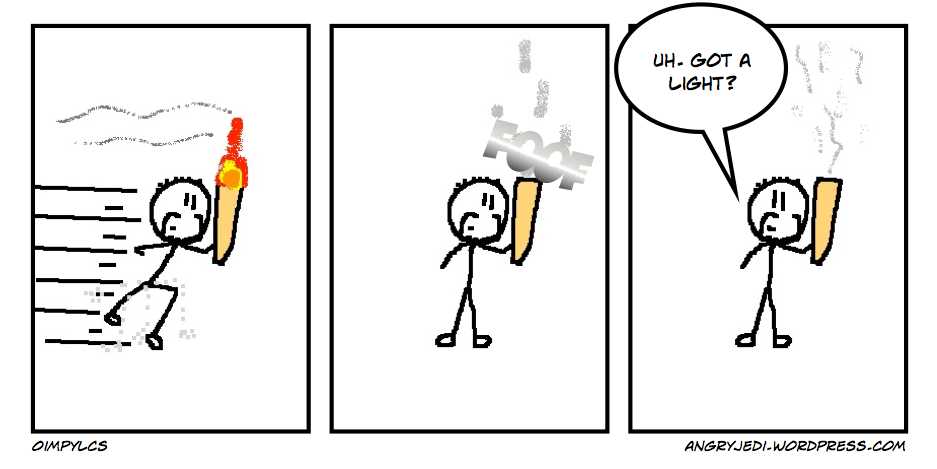
#oneaday Day 921: Oimpylcs

I watched (almost) all of the opening ceremonies for the London 2012 Olympics (as it seems they must be called) and didn't hate them.

I was surprised.

I mean, I wasn't going to watch them at all. I have been guilty of Olympic cynicism in recent weeks — not helped by media coverage of the Games being predominantly negative. To be fair, if even half of the stuff regarding the overzealous branding nonsense is true, then yes, that is ridiculous and should be shouted about, but it's easy to get caught up in and neglect to focus on the things that the Olympics are supposed to be about.

I don't like sports as a general rule. They go on too long and the ones that are on telly are usually undertaken by people who are being paid far too much to, essentially, do what kids do on lunch break at school. But the Olympics regularly manages to capture my attention in a way that no other event — certainly not anything football-related — ever manages to do.

I attribute this fact at least partially to the number of Olympic-style computer games I played as a child — Summer Games, Winter Games, Decathlon, World Games, Track and Field, Olympic Gold, Arena — the list goes on. Most of them were responsible for the destruction of at least one joystick, and Arena did its damnedest to mangle the Atari ST keyboard with its inexplicably joystick-phobic control scheme. But they helped me to understand a wide variety of the weird and wonderful events that make up the Olympics — events which you tend not to see on television under normal circumstances. I attribute my knowledge of the fact that "skeet shooting" is a thing that exists to having played Summer Games, for example.

I remember the first Olympics I actually made an effort to watch — though not specifically what year it was, unfortunately. I want to say Barcelona 1992, but I might be making that up. Anyway, I was staying at my grandparents' house with my parents (and my grandparents, obviously) and the Games just happened to start while we were there. I decided that I was going to Make An Effort to watch them. (Actually, thinking about it, I'm pretty sure it was 1992, because I vividly remember Queen singing "BAAARCELOOOOONA, such a beautiful horizon" at the start of every broadcast.) So I did. I made an effort to watch some of the "traditional" track and field events as well as some of the weird shit. It was quite entertaining, though I can't remember the names of any of the athletes I saw or any of the medals that were won. I would be a crap sports fan.

But back to today and the opening ceremonies. I was ready to dismiss the whole thing after the faintly cringeworthy beginning section (particularly the gratuitous and unnecessary insertion of the Eastenders "dum, dum, dumdumdumdum dum"), but the "industrial revolution" section hooked me back in with men in top hats and an excellent soundtrack. It then lost me a bit with a distressingly awful "age of social media" section with gratuitously-overlaid "LOOK THIS IS FACEBOOK BUT IT ISN'T" fake status updates and a poorly-mixed (but otherwise solidly-selected) playlist of excellent British music. By this point, I was oddly hooked, so I didn't even mind the interminably tedious parade of athletes.

Oh, also, there was a bit where James Bond skydived (skydove?) out of a helicopter with The Queen. (Okay, the skydiving bit clearly wasn't The Queen. But the VT involving her and Daniel Craig was pretty neat.) And there was a lengthy tribute to the NHS, which the current government is doing its best to either get rid of or privatise. This was then followed by an army of Mary Poppinses battling a giant Voldemort. Yes, that happened. I think.

So yes, on the whole, the Olympics opening ceremony was what people tend to refer to as a "triumph", shaky bits (and yes, I include Paul McCartney in that description) aside. There were some impressive visuals, an excellent soundtrack (helpfully listed over on The Telegraph) and a few cringeworthy bits. And also some mindblowingly bizarre sections. (The whole "tribute to children's literature" bit was mildly terrifying and will likely give more than a few people some horrendous nightmares this evening.)

Well done, then, London. I don't know if I'll be watching any of the Games themselves, but having sat through that lot this evening I kind of feel a bit obliged to now…

#oneaday Day 920: Zu Heiss

[No cartoon tonight — the Mac (on which Comic Life is installed) is currently installing Mountain Lion!]

It is hot. Really hot. I know, I know, it's nothing compared to feeling your brain melt out of your ears in the desert, and nothing compared to what would happen if you couldn't find a nice shady spot on Mercury, but it's still really hot.

Hot weather is widely regarded by people as a positive thing. Everyone gets all excited about the onset of summer and the prospect of sitting out in the garden slowly irradiating yourself to death. But you know what? Balls to that. Hot weather sucks, and I can't wait for it to 1) piss it down with rain and 2) get back to the normal overcast weather for which this country is so well-known.

My feelings on this matter may be partially due to the fact that I got a bit burnt and suffered some mild heatstroke on the wekend — though thankfully nothing compared to the time I went to Gran Canaria for a couple of weeks and came back looking like I'd changed ethnicity (apart from my bum and associated front regions). The weather is just so damn oppressive right now — stepping outside the front door feels like stepping into an airless greenhouse. It's hard to breathe, it's exhausting to do anything and it's just plain unpleasant. And, this being the UK, we're not as enlightened regarding air conditioning as our American cousins, which means going indoors rarely helps very much, either. In fact, at several times over the last few days, it's actually ended up being even hotter indoors (particularly upstairs) than it has been outdoors.

Honestly. I can't wait for it to cool down. It just makes me not want to do anything except sit directly in front of a fan sucking on ice cubes and chugging back anything in a can that has been in a fridge for at least six hours.

Of course, the moment the temperature drops, I'll probably complain that it's too cold, too wet or too something else, so the weather can't win really, unless it's just sort of "nondescript" rather than hot, cold, wet or any combination thereof. Fortunately, as I said previously, the UK is particularly good at weather that is best described as "nondescript". A grey sky, no rain, no snow, no sleet, perhaps a gentle breeze (but not too much) — that's what I can live with.

Perhaps I should move somewhere like Scotland. The weather there seemed to be like that all the time on every occasion I've been there. But then, of course, I'd live in Scotland, which I have nothing against per se, but would somewhat stand in the way of my objective to move back closer to where my friends are.

Perhaps I'll just invent some sort of environmental suit with built-in climate control. That sounds like the ideal solution, really. Now, just to strip the air conditioning unit out of Andie's car while she's not looking…

#oneaday Day 919: Friendship Is Magic

I've been delving a little into the Brony community recently. As an open and "out" fan of My Little Pony: Friendship is Magic, I felt it behooved me (no pun intended… all right, maybe a little) to actually try and engage with the wider community of fans. As such, I Googled for Brony communities and came across the Friendship Is Magic forum, which I promptly signed up for.

I haven't been an active member of a forum since, ooh, about 2006 or so, I guess, when I was a relatively well-known member of the Times Educational Supplement forums. They were a good place to blow off steam about educational and general life issues as well as just chatting to like-minded people from a pretty wide variety of backgrounds — albeit usually with an interest or involvement in the teaching profession. I haven't logged in there for a very long time now for a multitude of reasons, just one of which is the fact that social media has mostly taken over the functions that dedicated online communities once had.

But I was determined to make a go of it on Friendship is Magic. I introduced myself in the relevant section and started replying to a few threads. While I don't think I've made a "name" for myself as yet, I like to think that my relatively few contributions so far have been noticed — and meanwhile, it's given me a good opportunity to observe the Brony community from within.

You see, I had no idea what a "Brony" really was. Who are these people? Are they actually anything like me, or is the only thing we have in common a love of a show that is ostensibly for little girls? I was hoping to find out through joining the forum — and, as an aside, keeping an eye on the results of the intriguing Brony Study research project, which has been aiming to clarify attitudes both towards the community from without, and towards various pertinent issues surrounding the fanbase from within.

Thus far my (purely anecdotal) observations have been interesting. Bronies cover a wide and diverse array of human beings — young and old, male and female, and varying degrees removed from what society would deem "normality". Some Bronies use 4chanesque dialect ("newfags", "copypasta" et al), others use a clear, straightforward and polite means of communication. Some Bronies like to act "in character" and roleplay their original pony creations on the forum as a means of escapism; others are simply themselves; others still take the middle road and incorporate Ponyville dialect ("everypony", "fillies and colts" et al) into their posts. Some Bronies love the show and actively participate in the huge creative community that has sprung up around it; some simply appreciate the content that others have created; others have no interest in it whatsoever.

In short, there's not really a single unifying characteristic that it's possible to point to and say "that's a Brony" — besides an appreciation for My Little Pony: Friendship is Magic, of course, and a seemingly-genuine sense of tolerance, acceptance and understanding, regardless of a person's background and regardless of the depth of their affection for the show and its surrounding subculture.

Then, of course, there's Rule 34, the aspect of the fandom that tends to get the most attention from outside. (If you don't know what Rule 34 is, you need to brush up on your Rules of the Internet. Borderline NSFW and will probably offend everyone. No porn, though.) Indeed, when radio personality Howard Stern set out to explore the fandom in a recent show, an undue level of attention was given to certain parts of the community who generally prefer their activities to be kept behind a closed stable door, shall we say. This naturally and understandably upset those Bronies who don't participate in that particular aspect of the fandom, and even prompted voice actor Tara Strong (who voices series protagonist Twilight Sparkle) to defend the entire community (and particularly the "Rule 34" crowd) on Twitter.

While the "Rule 34" stuff isn't to my taste, I'm not about to denounce anyone for either enjoying or being involved in making it. It's easy enough to avoid if you don't want anything to do with it, and it's there if you do. If it's not hurting anyone, then knock yourself out, I say. Live and let live. Stern's logic was based on a flawed assumption: the idea that if one fan likes something that is seen as "deviant" in some way, then clearly they all do! This is clearly, as I've seen even in my limited dealings with the community at large, absolute nonsense. Bronies, just like any community, come from a wide variety of backgrounds and each indulges in their passions to a varying degree. No-one's approach to their fandom is "wrong" — assuming it's not causing anyone (including the person themself) any distress — and if it's a good outlet or means of getting away from the stresses of the day then, well, keep on cloppin'.

…wait, clopping means what?

#oneaday Day 918: We Dig, Dig, Dig, Dig...

Yes, I've been playing Minecraft again, thanks largely to several members of the Squadron of Shame finally biting the bullet and jumping on the bandwagon. And, once again, I am rediscovering the sheer joy of that game.

The first time I played Minecraft I wasn't overly enamoured with it. Not because of the deliberately lo-fi graphics — on the contrary, I found them highly endearing — but because I had literally no idea what I was supposed to do, and at the time I started playing, it was largely up to the player to either work things out for themselves or refer to a wiki. Nowadays, of course, there are achievements to guide your early days in the game and basic techniques are practically common knowledge — the Xbox version also removes the need to remember the specific "patterns" to craft tools altogether, making it even more accessible and a great jumping-on point for those who have no idea what Minecraft is all about.

After spending a hefty proportion of time in Minecraft's many pixelated, blocky worlds, however, that sense of "what on Earth do I do now?" is, as it turns out, precisely what appeals to me about the game. I have no goals aside from the ones I set for myself. There is no "end" to the game aside from the time when I wish to stop playing. (Well, technically that's not quite true — you can "finish" Minecraft through a long and convoluted process culminating in a difficult boss battle against a giant evil dragon thing. But you can carry on playing after that.) The world is different each time I start a new game. And therein lies Minecraft's biggest joy.

Minecraft is like being a kid again, assuming you were a kid who never had to get home in time for dinner, and a kid who was trusted with various sharp implements. Minecraft taps into that youthful desire to explore, to discover, to see what's over that next hill, around that corner, on the other side of that sheer rock face. It taps into that youthful fear of being lost in the middle of nowhere and having no idea of how you're going to get back home. And, like those youthful expeditions into forests and caves, it's much more fun with friends.

Minecraft is what you make of it. I currently play on two multiplayer servers — one with a small group of "real-life" friends and the other with a group of people I primarily know online — the aforementioned Squadron of Shame. The differing approaches we take on each server are very interesting, and represent two very different social dynamics.

On my "real-life friends" server, everyone quickly staked their claim to their "territory" and built something big and impressive there to mark it. Tim built a huge castle; James built a wizard's tower and network of connected walkways with giant mushrooms (plus a huge tree made of trees); Andie built some quaint (and practical) little houses; and I built a large, experimental pyramid-like structure and enormous, intricately-carved bridge.

On the Squadron of Shame server, meanwhile, things were a lot more cooperative from the get-go. I was one of the first people on the server, so I took the time to establish a basic base camp — wooden hut with crafting table and furnace, sufficient to last the night. Over time, and with the assistance of others, this hut expanded with an extra room containing beds, and a large mine beneath it. Other structures sprang up nearby until our improvised "base camp" started to look like a small village. I built roads in every direction as I explored, and others followed suit to help us find our way to various impressive landmarks. When we found a cool piece of randomly-generated scenery, we talked about it as if it was a real place. Other "citadels" sprang up around the map, and we as a group went further and further afield. I constructed some kick-ass bridges.

In both cases, the world feels alive — because it is alive. It's constantly growing and changing according to how far people have explored and what they have built. It's an immensely satisfying experience to know that you've played a part in the shaping of a virtual world, whatever your contribution and whatever your particular skill sets might be. In many ways, it's similar to the satisfaction of playing an active role in something like Second Life, which I've been known to spend time in in the past, and which I once referred to as "taking a walk through other peoples' imaginations". The key difference here, though, is that Minecraft has a great deal more immediacy than Second Life — and considerably fewer prostitutes.

So if you've been holding off on playing Minecraft, I suggest you give it a shot — preferably with friends. If you have no idea what you're letting yourself in for, fire up the Xbox version and play online or in split-screen. When you're ready, grab a copy of the full experience on PC and prepare yourself for the most immersive game world you'll ever experience — the one you helped create.

#oneaday Day 917: Select an Ability to Learn

I like learning stuff. It's a fun process to start from "nothing" and gradually equip yourself with Knowledge. I've done it a number of times over the years, though I will admit that I've not taken any of these things really far enough to, say, get a qualification. But I do have a working knowledge of HTML, CSS and several specific software applications that I didn't know before, all thanks to my ability to self-study.

The trouble with self-study, though, is that it requires time — time that you don't always have — or time that you might not have the inclination to spend "working" when there are nicer things you could be doing.

It's when I think about this sort of thing that I wonder what it would be like to go back to university. I'm pretty sure there are a lot of people I know who look back very fondly on their university days, but that — assuming they went at 18-19 — the actual "studying" part of things isn't the main reason for the rose-tinted spectacles. I know it's certainly not true in my case — while it was a lot of fun to, say, get up on stage in a nice concert hall and perform music, or sit in a small room and argue semantics with a group of fellow English students, the things I remember most fondly are the extracurricular and social activities I did. Theatre Group and their various productions. Trips to the Edinburgh Fringe. Drinking in Chamberlain Bar. That time my friend Plummer came down and we got wasted on the Union's £1 triple vodka and oranges then consumed roughly a pound of cheese between us at about three in the morning. That time a shopping trolley showed up in our flat so we mounted a huge clandestine operation to get rid of it without being identified.

Now I'm a little older, I can't help but think that going back and, you know, doing it "properly" might be fun. That said, the possibility of shenanigans is also appealing. Andie and I were discussing this the other day — university is one of the only times in your life when you have pretty much all of your friends together in one place, making it an absolute snap to arrange impromptu social events. Nowadays, I don't see my friends anywhere near as often as I like, and it's sad. But I digress.

Yes. Doing it "properly" might actually be fun. Picking a topic, studying it, doing assignments, getting graded, improving. Learning something. Coming away from the experience with both practical experience of applying subject knowledge and an actual qualification to prove you've done it. Sounds pretty good to me. If I had the opportunity, I'd study something practical that I know very little about — probably something computer-related, since I've always been IT literate and willing to tinker about, but my actual specific technical knowledge of things like, say, programming is rather limited.

Unfortunately, it's pretty unlikely to happen any time soon. Going to university is very expensive, and I don't see myself surviving on the relative pittance that is the student loan any more.

That said, I do have a work-from-home job with flexible hours and good pay.

Hmmm.

Hmmm.

No. No, I can't do that. Not just to satisfy some sort of whim or early-30s crisis or whatever it is that's going through my mind right now.

What I can do, though, is take some steps to learn something new on my own time. Self-study. Perhaps signing up for some sort of evening class. I'd like to do it, certainly, it's just a case of finding — or perhaps making — the time.

Now, what to learn…?

#oneaday Day 916: You Have Earned a Trophy

I go back and forth on whether or not I like Achievements/Trophies/equivalents. Sometimes I like them. In Diablo III, for example, they became an addictive metagame once you'd ploughed your way through the main (rather predictable and marginally disappointing) story. In World of Warcraft, they provide a wide variety of things to do that reward you with tangible things with which to outfit your character. In The Secret World, they're a handy way of tracking what you have and haven't done.

But in other cases — typically in story-heavy games — they just make the sense of ludonarrative dissonance even more pronounced than it needs to be. The most egregious example I can think of was Oblivion, in which I raced through the various Guild questlines in order to get all the achievements, then the Shivering Isles expansion, then the main quest. By the end, I had all Oblivion's achievements, but had completely lost all sense of that thing that made The Elder Scrolls series special — that sense of you being a character and forging your own path in the world as if you "lived" there. Instead, all I had done was follow a checklist. It ruined it. And it soured me on Skyrim somewhat. (Well, that and the realisation that Bethesda RPGs have great worlds but some of the worst characters and storytelling in all of gaming. But that's another matter altogether.)

At the moment, I'm playing Yakuza 3. The joy of the Yakuza series is, like its spiritual predecessor Shenmue, exploration and discovery giving you a sense of immersion in the game world. What's down this side alley? Oh, it's an arcade! I wonder if I can play the arcade machine? Oh, I can! That's kinda cool. I wonder if the crane game works? Yes it does! Awesome! Oh, hey, there's an irritable-looking lady, I wonder what's wrong with her? Oh, she's had her bag snatched… etc. etc.

Since Yakuza 2, the series has had a "completion" menu that taunts players with how many sidequests they've completed, how many cabaret girls they've romanced and what foods they've eaten in restaurants. After 40 hours of Yakuza 2, I had beaten the main plot but apparently only "beaten" 33% of the game. I didn't feel short-changed, as a lot of the stuff I'd missed was simply eating as much food as possible and playing some minigames that, while fun, weren't the reason I was playing Yakuza.

Yakuza 3 compounds this problem with a Trophy list. Not only do you have a "completion" menu now, but you also have an actual checklist of Things to Do. I wouldn't mind so much if these trophies simply tracked your progress through the game, but when they demand that you spend time playing indecipherable Japanese board, dice and card games in order to score some sort of virtual trophy, that pulls me right out of the experience. It puts me in a quandary while I'm playing — "should I go and do this stuff I don't really enjoy just to get a trophy?"

The answer, of course, is "no". There is no sense in playing a game if it's not enjoyable — unless, of course, it's something like Pathologic, in which case its sole reason for being is to be less than enjoyable — but I continually see people who insist on "Platinuming" or "1000Ging" their games and feeling like they've short-changed themselves if they don't. That's fair enough, and of course it's their call if they choose to do that, but the fact is that in most cases, it becomes abundantly clear that these people are not having any fun. By following these arbitrary checklists, they are voluntarily sucking the fun out of a game that might have been a favourite.

"Oh, but chasing the trophy list is fun in itself," you might say. And for some people it might be. But for the trophy whores I follow online — who, for all I know, could be in the minority, I'll admit — pretty much every single one refers to their relentless pursuit of Platinum/1000G as "work", a "slog", a "grind", and they express relief rather than joy when it's done. That, to me, is just bizarre. Why continue doing something long after it has ceased to be fun in the pursuit of something intangible that, in most cases, doesn't benefit your in-game experience at all? Are we so vain that we need to brag about the fact that we started ten fights in first-person mode (an actual achievement in Yakuza 3) or that we spent three hours mastering an ultimately-irrelevant darts minigame just so that we could get a "hat trick" (another actual Yakuza 3 achievement)?

Apparently we are. I'm not judging you if you're one of those people who likes (if that's the right word) chasing Platinum trophies. I'm saying that I find it completely unfathomable. I have no desire to grind my way through abject tedium purely so I can get a differently-coloured virtual trophy that no-one will look at or care about. I don't beat a game, look at that trophy list and feel I've not had my money's worth if I haven't got 100% of the game's trophies. I beat a game, roll the credits and then, in most cases, move on to any one of the bajillion other titles waiting on my Pile of Shame — which, I have to admit, has only got bigger during the recent Steam summer sale.

It's easy enough to ignore Achievements and Trophies, I guess, and they certainly don't hurt anyone. But I kind of resent the "torn" feeling they give me when playing a title like Yakuza 3. I'd much rather they not be there at all than pull me out of the experience by making me wonder whether or not I should be seeking out locker keys, cabaret girls, karaoke bars, dartboards… you get the idea.

My favourite implementation of achievements in a narrative-based game? Deadly Premonition, which rewarded you with one achievement per completed chapter, one for completing 100% of its sidequests and one for completing it on each difficulty level. That's how it's done. I don't need any more incentive than that. Build your reward structure into the game and build the achievements around that — don't give me a list of arbitrary objectives that don't actually improve my game experience at all.

Achievement whores, I salute you. I'm a patient sort of guy in most cases, but you guys must be like saints.

#oneaday Day 915: No, I Haven't Seen [Insert Movie Name Here]

I haven't seen The Dark Knight Rises yet. I'm probably not going to. I also didn't see that new Spider-Man movie, The Avengers or any of the other films that people have been going apeshit over in recent months. (And, it has to be said, being extremely tiresome about. So you enjoyed The Avengers? Great. I don't need to be kept up to date on how many times you've seen it. Also, quit retweeting your friends' Foursquare checkins of when they go to see it. No-one cares.) (Sorry. Apparently I am grumpy tonight. Disregard all of that. A bit.)

I just can't "do" movies. It's not through a lack of attention span — I can happily sit and play a game, read a book or dick around on the Internet for hours and hours and hours — but I just find it impossible to sit down and watch a movie any more. There's always a lingering sensation at the back of my mind that I'd rather spend two hours doing something — anything — else.

Actually, that's true of watching movies at home. I sold most of my DVDs to Music Magpie a while back and I haven't missed them since. I have a Netflix account on which I haven't watched any movies (though I have more than got my money's worth from all the TV shows on there). The idea of watching a movie at home is just… no. I don't want to do it.

Going to the cinema is a marginally more appealing prospect because of all the associated "other stuff" that goes with it. Comfy seats, a nice dark room with a big screen and impressive sound system, a bucket of popcorn which looks like it will last forever (but inevitably only lasts until the end of the trailers) and an opportunity to Do Something With Your Friends. (Of course, that Something is sitting in a darkened room, in silence, in a straight line so it is impossible to talk to each other, so you might as well be there by yourself.)

But then at the cinema you have to deal with shite you don't have to put up with at home. The scrotes who sit behind you and jiggle your seat with their feet. People who can't eat quietly. People who won't shut up. People who won't put their bastard mobile phone away for five seconds. (I hate these people on planes, too.) People who think everything that isn't funny is absolutely, massively, hilariously funny and turn a serious scene into some sort of farce with a laugh track.

None of these things represent specific reasons that I don't want to watch movies. I simply… don't want to watch them. I am fine with this. As such, if you ask me "have you seen [insert movie name here] yet?" the answer will almost definitely be "no." You can also drop the "yet" because I'm probably not going to see it at all. So there.

I am grumpy. Now I am going to bed.

BALLS.

#oneaday Day 914: Chinese Whispers

Twitter was angry today. There was some degree of justification — the horrific shooting in Aurora at the screening of the new Batman movie had emotions running high, and I certainly don't begrudge anyone that. But it demonstrated, once again, some of the dangers inherent in social media — a force which should, by all accounts, be a positive thing.

Misinformation spreads like wildfire on the Internet thanks to services like Twitter. People post things without thinking, without bothering to back things up with research and evidence. Journalists encourage this, with TV news being a particular offender, inviting people to contribute their own thoughts on a particularly pertinent story using hashtags. It thus becomes something of a challenge to determine exactly what the facts are, and what is simple hyperbole dreamed up by the increasingly-hysterical mass of people who suddenly all think that They Know Best.

I shan't talk too much about the Aurora shooting specifically here because I haven't read up on all the gory details myself as yet. I will refer to a couple of other recent incidents where this phenomenon became particularly apparent, however.

Most recently was the "Arctic Ready" campaign, in which Shell apparently made the amateurish misstep of opening up a slogan competition on a controversial subject — drilling in the Arctic — to the public. The "Let's Go! Social" gallery page promptly became filled with anti-drilling, environmentalist slogans and it looked, by all accounts, to be one of the most colossal fuck-ups in social marketing history.

Except that it wasn't. It was actually a genius piece of social marketing, but not by Shell. No; the whole thing was, in fact, a clever ruse by Greenpeace, who then went on to troll Shell even further by picking a "winner" from the supposed competition and putting it on a billboard right outside Shell's Houston headquarters.

It should have been pretty obvious to anyone who stopped to think about the whole thing for a moment that this clearly wasn't Shell's doing. The kind of people who handle social media marketing are generally fairly savvy sorts (though there are exceptions) and would have stepped in to deal with the mass trolling of the supposed competition. In fact, they would have probably removed it altogether fairly sharpish. They certainly wouldn't have left it up for several weeks, opened up a new Twitter account just to repeatedly request that people don't retweet "offensive" adverts and generally keep poking the fire.

Unfortunately, it wasn't obvious to a lot of people. It caught people out not once, but twice — first, when the "Arctic Ready" site first appeared, and again a few weeks later when the Twitter account appeared. People posted, retweeted and commented without stopping to think about whether or not it was real. Others who were wise to it posted, retweeted and commented about how it was clearly fake. But amid all the noise from both sides it became impossible to differentiate who was talking sense and who was simply repeating the digital equivalent of what they had heard down the pub while drunk.

The Shell incident isn't the only one either. The "Today Is The Day They Went To In Back To The Future Part II" hoax has been around twice, too. Both times it caught people out. Why? Because, again, no-one bothered to check. No-one took a moment to fire up the movie and take a look. If they had, they would have seen that the claims made by whoever started that ridiculous rumour on each occasion were patent nonsense.

It happens in journalism too, and particularly in games journalism. One site posts a "Rumour:" or "Report:" story, and others pick up on it. The content spreads and becomes somewhat distorted over time. It happened today with a story from MCV which, as it turned out, apparently misreported the facts in the first place (or rather, more accurately, posted a story with a misleading headline) and was then sourced by Destructoid and a ton of other sites. This then inspired Ben Kuchera, official unelected and self-styled arbiter of How To Do Games Journalism On The Internet, to pen this piece bemoaning the whole situation, and by God I hate agreeing with Ben Kuchera — but he had a point. With a bit of research (or indeed just carefully reading the quotes that MCV included in its own piece) it's clear that the "story" (or, more specifically, the headline) that was going around simply wasn't true.

It's exhausting at times to keep up with all this stuff, and while it's great to be able to tap the pulse of everyone at the same time on a hot topic, it's less great to find yourself in the world's biggest game of Chinese Whispers. So do me a favour. Before you blindly retweet something that seems a little "off", take a minute and check to see whether or not it's actually genuine.