1092: Modest-Breasted Heroine

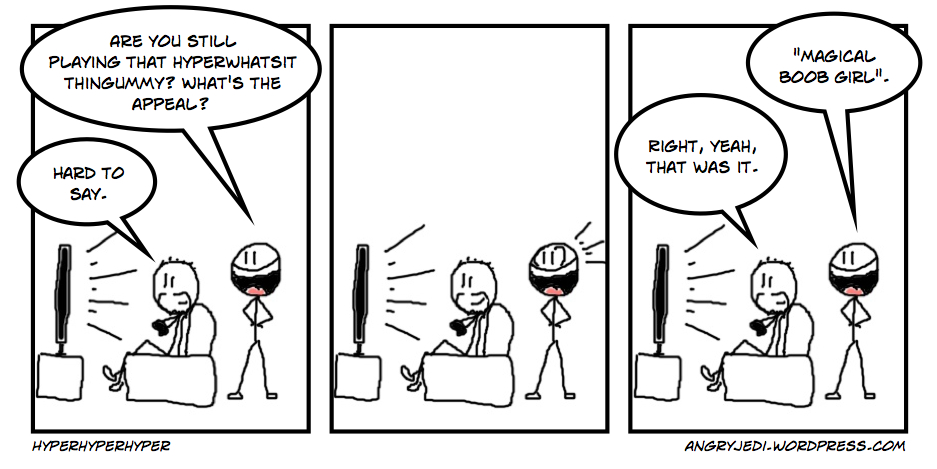
Page_1The title of this post is taken from a trophy I attained in Hyperdimension Neptunia today celebrating my acquisition of the character "Nisa", an embodiment of the game's Western publisher NIS America. ("Nisa", geddit?) Nisa wears a Bayonetta-style super-revealing leather catsuit unzipped to beneath her bellybutton, but is constantly ridiculed for having small breasts. She doesn't seem to mind too much, to be fair, even when surrounded by the heaving bosoms of squeaky-voiced Compa and Neptune in her, I quote, "magical boob girl" form.

Hyperdimension Neptunia revels in the sort of innuendo and playful, childish humour prevalent in a lot of anime, particularly of the moe variety. In many ways, it's quite refreshing to play a game that doesn't really hold back on the boob-related humour, but it's also easy to see how some might take issue with the game and its all-female cast's shenanigans. Having played it for more hours than I'd care to count (the game doesn't include the usual timer seen in most other RPGs) I can say with a fair degree of confidence that the game certainly doesn't mean any harm by all this — it's being bawdy and lewd for the sake of getting a few cheap giggles out of the player (regardless of gender) rather than explicitly "sexy", a few fanservicey "event" pictures and costumes aside.

More importantly, though, said bawdy humour is but a small part of the game as a whole. After a while it just becomes the way things are in that world; part of the aesthetic. The characters all do plenty more than comment on the size of each others' jumblies; they're all actually rather well-realised, if a little reliant on rather conventional anime tropes. (I swear this game has more tsunderes per square foot than anything else I've ever played… b-but it's not like I'm complaining or anything!) That said, the game often lampshades said anime tropes with the characters calling each other on when they're falling into particular stereotypes, and there are several who have occasional surprises up their sleeves.

IF/Iffy/I-chan is a case in point. Initially appearing to be your stereotypical sour-faced textbook tsundere, Iffy quickly reveals herself to be quite an interesting character on the whole, particularly if you pursue the story arcs of the two DLC characters 5pb and Red. In the case of 5pb, we see Iffy acting as a confidante and counsellor to the chronically-shy idol, who is immensely insecure in herself when not hosting her radio show or performing her songs for fans. In the case of Red, we see Iffy humouring a childish girl's fantasies and showing a softer side to her sometimes gruff-seeming exterior. It would be easy for Iffy to tell Red and her "Wifey number 1!" babblings to take a hike, but instead she plays along, even going so far as to award her "charisma points" any time she does something good.

The "goddess" characters are something of an enigma at this point in the story, but it's quite amusing that the grumpiest of all the tsunderes in the whole game is the one supposed to be representing the Nintendo Wii, the happiest and most sunshiney of all consoles. The land of "Lowee" is a fantasy kingdom filled with houses that look like cakes, rainbows, mushrooms and bizarre, surreal happenings, but its ruler is a sour-faced, foul-mouthed young girl who would much rather lock herself in her room and read a book rather than have to deal with any of the events that are transpiring in the world. The PlayStation-themed goddess, meanwhile, is rather Gothic Lolita in her stylings (and very tsundere when in her "CPU" form) while the Xbox goddess is a sleepyhead blonde-haired, blue-eyed girl (anime shorthand for "foreigner") who is addicted to online games.

It's been a pleasure to discover the various layers this game has as I've progressed through it. The dungeon crawling is still very straightforward and unlikely to change significantly for the rest of the game, but the moves the characters are unlocking are becoming increasingly ridiculous, the time-attack dungeons are fun to challenge and the growing party means that I can start to take advantage of interesting mechanics such as the ability to switch party members in mid-combo.

The pacing is such that you never spend too long battling through endless random combats, either; each dungeon is short (if you know what you're doing and skip the excess of the attack animations you can clear each one in 3-5 minutes tops) and you're often rewarded for making progress with additional entertaining scenes between the girls. And as the game's narrative has continued, these characters have started to show that they have been crafted with what seems like genuine affection from their creators. There's a good sense of them being friends with one another, though the various "optional" characters don't put in nearly enough appearances in the story scenes. I guess that's understandable, though. The "core" of the game is the way the three contrasting characters of Nep-Nep, Compa and IF behave around one another; the others are relatively incidental characters whom you just happen to be able to take into batle.

I'm a little under 50% done with the game according to the menus, and I have no intention of stopping until I've finished it. Whether I tackle any of the free DLC dungeons (many of which have obscenely high "recommended levels") remains to be seen, but I certainly intend to see as much of the core game as possible. And then move on to the sequel.

So yes. I laugh in the face of Hyperdimension Neptunia's sub-50 Metacritic score. I'm having a blast, and you can't stop me! MWAHAHAHA!
1091: You've Got... You Know

Page_1Speaking as someone who grew up with the early days of popular online activity (BBSes, CompuServe and finally the "proper Internet") I find it mildly interesting (or at least worthy of a late-night blog post, which isn't necessarily the same thing) how much the role of email has changed over the course of the last 15-20 years or so. I am prompted into these thoughts by a casual glimpse at my own inbox, which currently contains a devilish 666 messages, none of which visible on the front page are, to my knowledge, written directly to me by an actual human being.

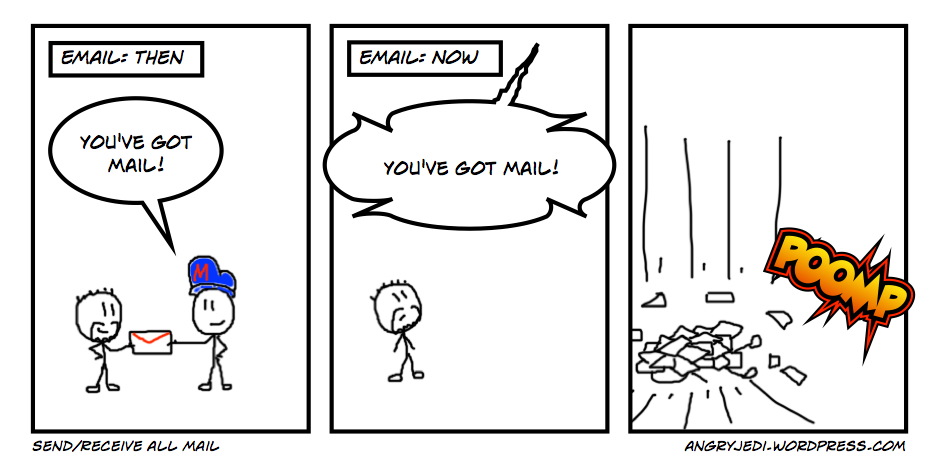
This is something of a change from the earlier days, when clicking "Send/Receive Mail" in Outlook Express was an exciting moment, and you knew if the progress bar came up you had email incoming. Who would it be from? Would it be from someone interesting? What would they have to say? Would there be an attachment? In just a minute or two (LOL DIALUP) you would find out, and then you'd lovingly file the email into an appropriate folder to keep for all eternity. (I say "you" again when, of course, what I actually mean is "I". I don't know if everyone else was quite so fastidious with their email organisation when they first got online, but I certainly ran a tight ship… for a while, anyway.)

Looking at my inbox today, though, it's clear that email has a very different purpose today to what it once had. Whereas once it was effectively one of the only forms of social media (the others being forums and live chat rooms) it is now a general repository for crap. You'll occasionally get a meaningful message in there from someone who actually has a brain and a soul, but more often than not, if my inbox as of right now is anything to go by, it'll be a string of automated messages notifying you that so-and-so has added a new track to a playlist in Spotify (unsubscribe!), so-and-so has commented on something you don't give a fuck about on Facebook (unsubscribe!) or that that website you signed up for just so you could download a .zip file containing some porn/games that you wanted wants to wish you a happy birthday.

A relatively recent addition to the types of email you get nowadays is the guilt-trip "PLEASE COME BACK!" email. This happens with everything from mobile apps to online games, but the execution is always the same. "Here's all the great stuff you're missing out on!" it'll say, usually worded in such a way as to make you think that you're somehow doing something wrong by not using a service you currently have no need for. Often there will be some sort of bribe involved in getting you back, particularly when it comes to online games of various descriptions.

A Facebook game I reviewed a while back known as Outernauts was particularly bad for this. Outernauts was highly-anticipated by a lot of people because it was from a high-profile studio (Insomniac, for those in the know) and was aiming to be a social game that appealed to the sort of people who typically only played standalone, "pay once, keep forever" games on computer and console. It wasn't awful, but the overzealous means through which it was monetised — the ever-obnoxious "energy" mechanic — prevented anyone from being able to enjoy it for more than a few minutes at a time. Consequently, after an initial surge of interest, the very players it was trying to attract dropped it. Some months after I reviewed it and criticised it for its aggressive monetisation, it "relaunched", apparently with "fast recharging energy". It was still a pain in the arse to play. Some months after that, it relaunched again, this time promising "near limitless energy". Note: "near limitless", not "limitless".

I'm getting off the point slightly, but the fact is, every time Outernauts decided to do something a little different, it sent a begging email to me pleading for me to take it back, because it can change, it won't annoy me any more, it won't do that thing that annoys me any more. It was too little, too late, though; my experiences with Outernauts while reviewing it left such a sour taste in the mouth that I had (and still have) no desire to return, "near limitless energy" or not. That probably won't stop them sending me another email the next time they change something, though. Unless I blocked them. I might have blocked them.

Another offender in this sort of thing is a service called Earndit which I evidently signed up for at some point in the past. (I think I mistakenly signed up for it while looking for Fitocracy while the latter was still in closed testing; the two are different services but do have a few things in common.) Earndit sends me an email every week with sickly-sweet, overly-apologetic language about how I haven't earned any points this week, and that if they have it wrong I should get in touch with them PLEASE LOVE ME etc. It's annoying.

The response to all this annoying email is, of course, to unsubscribe from the mailing lists I've found myself on, send these messages to the spam folder or just to stop using my actual email address to sign up for things. But it's a pain to keep on top of. You can be as careful as you like to tick/untick the boxes that give websites permission to spam you with crap, but some will still get through, and over time there'll be so much incoming stuff that it's almost impossible to keep on top of your "unsubscribe" needs. The knock-on effect of all this is, of course, that genuine messages from real people can easily drift by completely unnoticed. If this has happened to you, it is nothing personal; you can blame Zynga, EA, Facebook, Twitter, Spotify, Google and indeed any of the million-and-one completely unnecessary social networking apps for mobile devices that I've reviewed over the course of the last year.

I miss the old days; the days when being notified you had a new message was exciting. Checking your email used to be a pleasure; now it's a chore.

1090: Housewarming

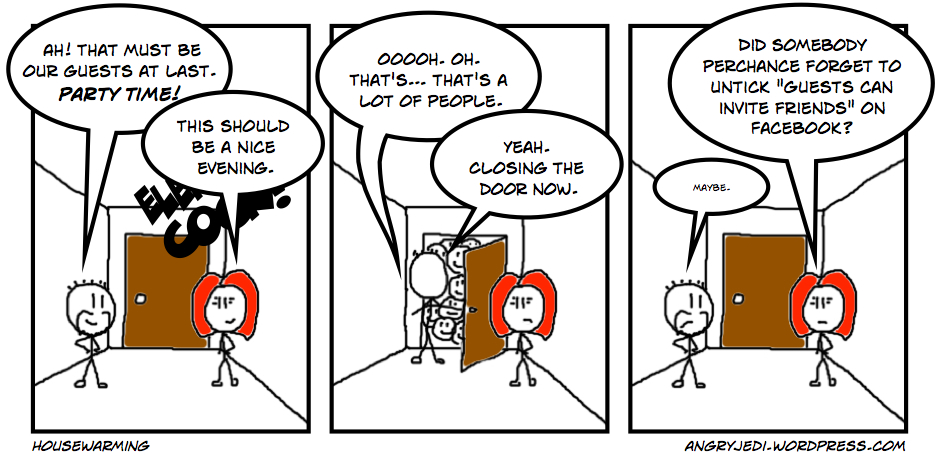
Page_1Tonight Andie and I are hosting a housewarming party. We attempted to do this in the last house we moved into, but failed miserably at getting people to come, making it a rather quiet affair. (We did have some people, just nowhere near what we were hoping for!)

(Aside: If you are a friend of mine and in the Southampton area and were inexplicably left off the invites list on teh Facebookz, it was not intentional and you are welcome to come and join us — just drop me a text or a message via various forms of social media and let me know you're coming.)

Anyway, yes. We are throwing a party. Now there's a word that changes its meaning as you get older and, theoretically, wiser.

When you're a kid, a "party" is a big deal, because it's something well out of the ordinary and, usually, a celebration of an important event — typically a birthday. I remember going to a number of birthday parties for various kids in the village where I grew up, and it was always fun doing things like playing Pass The Parcel and that stupid game where you had to put on a scarf, hat, coat and gloves and then eat a bar of chocolate with a knife and fork. You know, that one. No? Just me? Damn rural upbringing.

Then you get to be a teenager, and a "party" is typically an illicit sort of affair where you take over the house and invite too many people around while your parents are away. I attended a few of these and threw one of my own that I got into a lot of trouble for and still feel somewhat guilty about to date. (It was an awesome party, though, to be fair.) The key thing here was the illicit nature of it, though — it was an occasion for teenagers to do things they weren't supposed to do, like drink, smoke and… err, anything else that teenagers who weren't me probably did. (I had a somewhat sheltered life.)

Then you get to university, and "parties" become acceptable again, though they tend not to be tied to a particular occasion. "[Insert name of person you barely know] is having a party tonight," your housemate will say. "Want to go?" The correct response is, of course, "yes," because undoubtedly there will be a ton of drink, possibly stuff to eat and, in the eyes of a horny late-teens-early-twenties person, the potential to get laid that inevitably never comes to anything. (Not that I'm complaining; I was never really the one-night stand type.) The thing with parties of this nature, though, is that they tend to have no real purpose — they're purely social occasions designed to get people together, not a celebration of anything. They're barely even a celebration of friendship, because inevitably there'll be a bunch of people there who no-one seems to know, who will have showed up as a sort of "friend of a friend" arrangement.

There are exceptions to the above, of course — after-show parties from Theatre Group productions at university were always entertaining. I will never forget the one which coined the phrase "The Chair of Eternal Disappointment" and subsequently went on until well after sunrise, moving on from the original house party to a dirty, horrible beach on the banks of the river that we somehow found our way to. On said beach, we engaged in improvisatory theatre and then our friend Tom got his knob out before eating some dirty seaweed and commenting it "tasted of oil and poo".

Then you leave university and enter the adult world, and parties tend to take on that air of vague respectability once again. Rather than being aimless, meaningless social occasions, they tend to revolve around a special event, much as they did in childhood. In our case, we're celebrating our housewarming, but they're also often thrown in celebration of the new year or someone's birthday. In many ways, an adult party (not THAT kind of "adult party") is a lot closer to the joyful exuberance of a child's party than anything else, albeit with everyone usually behaving in a slightly more respectable manner than your average child.

The exception to the "special event" classification of adult (NO) parties is, of course, the "dinner party", which isn't really a "party" as such in that you're not really celebrating anything. No, rather you're just having people around for dinner, presumably in an attempt to show off your cooking skills and talk in a respectable, grown-up way around the dinner table before retiring to the living room to, I don't know, listen to jazz or something. I'm not quite sure at what age you start having "dinner parties" but it doesn't feel quite like something that's "right" just yet. Do people even have "dinner parties" any more? The very concept of "dinner parties" feels like something from an Alan Ayckbourn play.

Anyway, there's no real point to this post, I'm aware, I just wanted to write something before everyone arrived and starts eating the copious amounts of party food we have laid on for them. As I say, if you're in the Southampton area, are free tonight and missed out on an invite (probably because I assumed you were no longer in the area) then feel free to show up and say hello — contact me for the address.

Now I'm off to gaze longingly at the bajillion cupcakes Andie's made.

1089: Ding, Dong, Ding, Dong

Page_1

(Buffy's Swearing Keyboard. You're welcome. NSFW, obviously.)

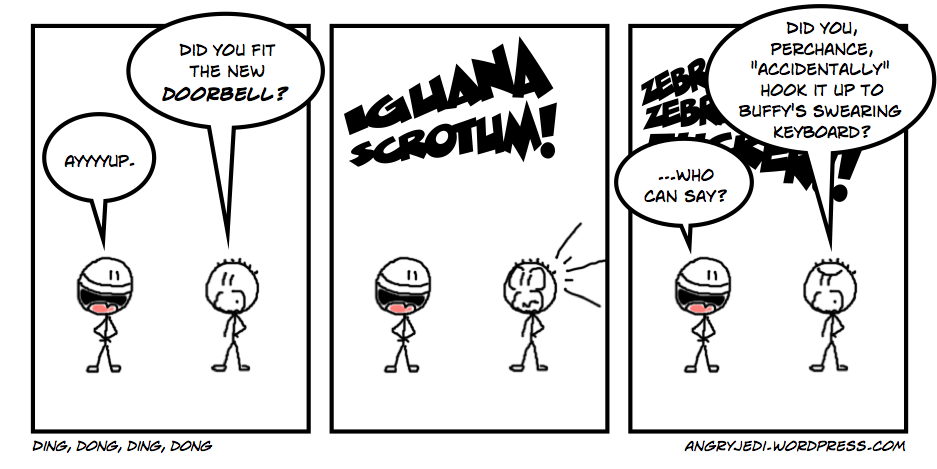
Andie and I bought a doorbell the other day. This is not something I have ever had to purchase before, but it was something of a necessity — we live on the second floor (third if you're American) and there were doorbells for flat 1 and 2 in our block, but not ours. This meant a distinct chance of missing out on deliveries of orders from Amazon and Chinese takeaway due to a lack of any means for someone at the block's front door of letting us know we were there. And that will never do. A man needs his Chinese takeaway and AMAZOO.nep deliveries.

Actually, the statement that said I've never had to purchase a doorbell before isn't quite accurate — in my second year at university, I lived in a first (second) floor flat which didn't have a doorbell. The front door was at ground level and opened straight on to some stairs up into the main part of our flat, so if my housemate and I were in our rooms or the living room, chances are we wouldn't hear anyone knocking. (We sure as hell heard the fight outside our door one night, though, and got a bit scared when we heard shattering glass. Luckily the aggressor in the incident had punched through our neighbours' door, not ours. I say "luckily" — obviously not for our neighbours, who then had to spend the next few months with their front door boarded up because the landlord of the building was too lazy to do anything, ever. But these brackets have gone on for too long so I'd better close them before I lose the point of what I was saying.)

Anyway, yes. I popped down to our local massive hardware store, which was but a short walk from our flat, and investigated doorbells. At the time, wireless doorbells, which would have been the ideal solution, were rather expensive. As a student, spending forty quid on a doorbell was out of the question, and I didn't really feel like drilling holes in the doorframe and poking wires through, largely because I didn't have a drill. So on that occasion we survived without a doorbell.

Not so this time, though. Both Andie and I are in gainful employment, and as such we were more than able to afford a doorbell for our new place, particularly as wireless doorbells appear to have come down in price considerably over the course of the last ten years. Wired ones didn't appear to be an option, even. I am fine with this.

The doorbell we chose was a bog-standard model with a single sound that thankfully isn't too horrendous — it just makes a nice, normal (if obviously electronic) doorbell sound. It doesn't play a horrible monophonic ringtone-type tune and it doesn't go on for longer than it needs to, which were the things I was worried about. There's nothing more embarrassing than a doorbell that outstays its welcome. (Well, there is. Lots of things are. But you know what I mean.)

What I was particularly surprised about as we were browsing the fine selection in B&Q (which I maintain is one of the most tedious stores in the world despite the presence of chainsaws) is the ridiculous features the more expensive doorbells offered. The most expensive one they had there — which was about the same price as the basic wireless ones from ten years ago, as I recall — not only had a wide selection of built-in chimes for you to pick from at your leisure, it also had the ability to play MP3s.

Think about that for a moment. A doorbell. That plays MP3s. Truly we are living in the future. An incredibly pointless future where instead of flying cars and cures for cancer we have doorbells that play fucking MP3s.

I express mock outrage at this but I guess it's sort of amusing. You could, with that doorbell, essentially have anything as your chime. If you wanted Brian Blessed shouting "GIMME THAT FUCKING BADGE BACK!" (possibly the best video on all of YouTube, that) every time someone was at the door, you could. Or perhaps the chiptune ALF theme from the dancing chicken man video I used to love so much. (Used to? I just put it on and fell in love all over again. CAN'T STOP WATCHING) Or, if you really wanted to drive yourself absolutely insane, this. Or this. Or perhaps the song that gave us Epic Sax Man. Or… well, yeah. You get the idea.

Damn. Now I sort of wish I'd splurged on the stupid MP3-playing doorbell. Much better for trolling Andie with than getting Siri to call her "Bumface".

1088: Shadows Over Camelot

Page_1I had some friends over tonight. (I'm still reeling from the novelty of being able to invite my friends over and them actually coming because I'm not a two-hour drive away from them, but I digress.) We played some Wii U (Nintendo Land is still great) and then settled down for a board game.

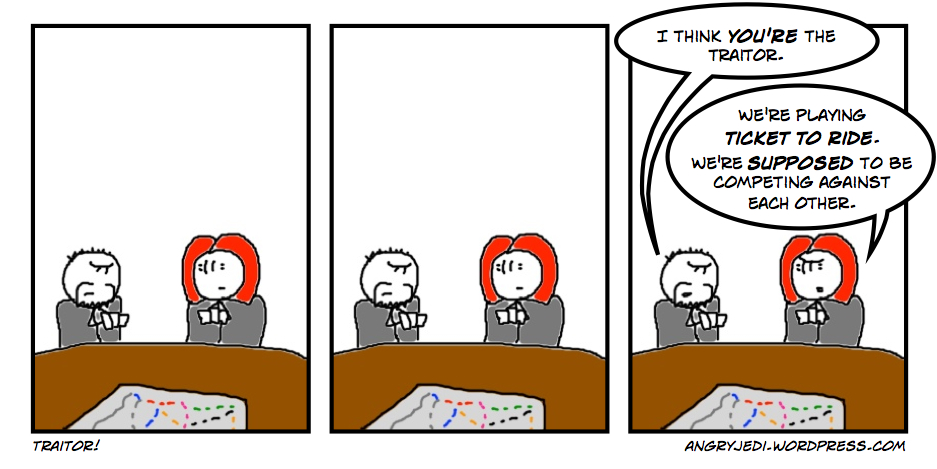
Tonight, it was the turn of Shadows Over Camelot, a new acquisition that I got for Christmas. It's a game that we've had on our collective radar as a board gaming group for quite some time, but none of us knew that much about it. All we really knew is that it had a mechanic similar to that found in the Battlestar Galactica board game (which is absolutely excellent, even for those unfamiliar with the show) in that there was a chance with every game that one player would be a secret traitor tasked with foiling the group's otherwise cooperative attempts to beat the game at its own… you know.

Shadows Over Camelot is a Days of Wonder production, and anyone who is into board games will know what that means — a nice hefty box with quality artwork, decent components, lovely thick gameboards and nice stiff cards that are easy to handle and shuffle. The only slight letdown with Shadows Over Camelot's components is with some of the miniatures provided — a few of them have unnecessarily "bendy" bits — swords in particular are very soft and bendy, though I suppose it's better that than them be rigid and easily breakable — or, for that matter, sharp and easy to poke into bits of delicate skin and make yourself bleed. (I speak from experience — Games Workshop's dungeon crawlers mauled me more than a few times in the past.)

I'd read through the instructions when I first got the game, but it didn't make a ton of sense without sitting down and actually trying it out for ourselves. We nearly didn't try it at all because as a group, we're generally terrible with new games — they tend to take twice as long as the suggested amount of time given on the game box, and we inevitably mess something up along the way. It had already got to 9pm by the time we'd eaten, so the worry was that we'd be there until the early hours of the morning playing.

Fortunately, there was no such problem, as Shadows Over Camelot actually has pleasantly simple, elegant mechanics that give it a nice, fast pace that constantly keeps flowing around the table — again, much like many other Days of Wonder titles.

Essentially, the aim of the game is twofold: firstly, do not allow any of the "defeat" conditions to come to pass, and secondly, ensure that victory is achieved. The players (except the traitor, if there is one) lose if there are twelve siege engines outside Camelot, if all the player characters die, or if the Round Table fills up and there are more black swords than white ones. Or if there are seven or more black swords, which amounts to much the same thing.

White and black swords are attained by going on quests, each of which are represented by small boards, and all of which are takes on Arthurian legends. You have the tournament against the Black Knight, the quest for the Holy Grail, fending off invasions, fighting dragons and claiming Excalibur.

Each quest has its own specific mechanics, but most involve playing cards in various arrangements. The Grail quest, for example, demands that players, between them, play a total of seven Grail cards onto the quest area — though if various "anti-Grail" cards appear, additional Grail cards must be played to remove these, too. Combat-focused quests, meanwhile, involve playing various poker-style hands one card per turn in an attempt to accumulate a high enough value to defeat the value of the black cards the game mechanics have been putting on the quest in the meantime. It's difficult to describe in words, but when playing, it makes sense very quickly.

A turn is simple and snappy. First of all, you do a "bad thing" — either take a point of damage, add a siege engine outside Camelot or draw a black card, which has one of a variety of bad effects. Later in the game, black cards that would normally be played on a quest that has now been completed summon additional siege engines, so the late game involves fending back the tides of darkness while attempting to push the game into a victory state.

Once your "bad thing" has been done, you get to do a "good thing". This can be as simple as moving, or performing an action unique to the quest you're currently standing on — playing a card, for example. Alternatively, there are some special cards you can play with specific useful effects, or you can even heal yourself by discarding a set of three identical cards. It's cooperative in that you are working together to defeat the game, but each player maintains their own independence to do as they please. Meanwhile, the traitor is doing their best to remain hidden while screwing everyone over as much as possible.

We were surprised when the game was over within an hour and a half — that's absolutely a new record for us when trying out a new game for the first time, and testament to Shadows Over Camelot's simple but elegant mechanics. I'm impressed, in short, and looking forward to trying it again, this time with a traitor — we followed the game's recommendation and played without one this time. Hopefully that will be pretty soon!

1087: Recaffeinated

Page_1I'm in serious danger of becoming a coffee snob. I haven't had a cup of instant coffee — not even the nice Nescafe Azera stuff (which I can highly recommend for people who don't have more complicated coffee-making equipment but who find normal instant coffee to be gross) — for quite a while now, and am instead enjoying an array of cafetiere and espresso coffees.

The reason for this is primarily the fact that Andie and I acquired a Nespresso machine as a Christmas present to ourselves. I've owned a coffee machine for quite a while, but it's a right faff to keep clean, plus it vibrates so much when pumping the water through it that the cups fall off the platform. Not ideal.

The Nespresso machine (a Krups U, if you're curious) is lovely, though. You turn it on, wait for the little light on the top to stop flashing (which takes less than a minute, rather than waiting for a kettle to boil), pop in a coffee capsule and close the slidey lid thing, ensuring you have a cup underneath first, obviously. After a loud farty noise (and a complete lack of accompanying vibration, unlike with my previous coffee machine) you have a cup of espresso. Combine this with the "Aeroccino" milk frother (which either does warm, slightly whisked milk for lattes and warm, fluffy, frothy milk for cappuccinos) and you have the means of making some fine, fine coffee right in your own home. It's the kind of coffee that's even nice just straight and black — the machine makes a lovely crema on top that makes it nice and smooth and easy to drink, even without milk.

We actually got a Nespresso machine just before Christmas, albeit sans the Aeroccino frother thingy, but it seemed to be leaking a lot. We just put it down to us doing something wrong somewhere along the line, but one morning it blew a fuse in the flat, suggesting that it was, in fact, faulty and water was getting into places that water wasn't supposed to get into. We're waiting for the ever-unreliable Yodel to come and pick up our old one so we can get a refund, and we purchased a combined package that included the frother thingy from John Lewis in the meantime — it worked out cheaper than buying the frother separately.

This kind of "capsule coffee" machine has been around for a while now, and I've held off looking at them until now as I was concerned that the capsules were wasteful and would end up costing significantly more than fresh-ground or instant coffee. The difference actually isn't that bad — I can't remember the exact "price per cup" it works out to offhand, but it's certainly fairly reasonable and definitely way cheaper than going to Starbucks. You also get a selection of different coffees bundled with the machine for you to try out, and we also snagged a voucher to get a bunch of money off an order from the Nespresso "coffee club", so our next order of capsules should be significantly cheaper than it would be normally! There's the mild inconvenience of having to order them and receive them through the mail rather than just nipping down the shop when you're getting low, but it's easy enough to see how many capsules you have left and prepare accordingly.

If you're in the market to become a coffee snob, then I can personally recommend the Nespresso machines as, beside our leaking problem with our first machine, they seem to be well-made pieces of kit that make good coffee and are simple to keep clean.

Too lazy to Google it? Here you go.

1086: Keep on Moving

Page_1Moving house this time around has made me realise a few things: firstly, that it's actually quite a while since I moved from one place of my own to another (my last two moves were from my parents' place to Chippenham, and prior to that from Southampton to my parents' place), and secondly, that things have changed quite a bit for the better when it comes to all the annoying things you have to do when you move.

I dread moving house every time it happens. There are many reasons for this. I don't like packing up boxes. I don't like carrying heavy boxes. I don't like discovering that the box I spent ages packing is far too heavy to carry, or that it collapses under the weight of the contents if I do manage to get it off the ground. I don't like trying to squeeze everything into a van (or, in particularly unpleasant cases, a car) and I really don't like driving a van.

But those aren't the only things you have to do when you move. They're the things that are foremost in the mind, sure, because they're the hard work, physical labour bit. But once you're in your new place, you have to deal with a whole new set of inconveniences and frustrations, mostly related to telling various utility and service companies that you are now, in fact, living in a different location.

To their credit, a lot of these companies have implemented online interfaces that allow you to tell them that you're moving and provide them with your meter readings and whatnot. This helps get around one of the things I used to dread — having to spend hours on the telephone listening to Chris de Burgh hold music and then having to deal with talking to an overly-cheerful person reading from a script and trying to convince you to stay with them. (I've moved house, asshole — I am leaving your company out of necessity.) In the case of our gas, electricity, water and phone/broadband providers, I've been able to inform them that I've moved without having to speak to anyone at all. Efficiency! It's the way of the 21st century.

For the most part, it's been great, though Andie and I are a bit miffed at BT because they delayed the installation of our broadband and phone connection without any explanation — we now have to survive until the end of the month using only our neighbour's Wi-Fi hotspot, which carries a rubbish "fair use" policy that means once we go over a certain number of minutes' usage (which seemed to be devoured alarmingly quickly) it will unceremoniously and without warning disconnect us every 30 minutes. The irony is that said hotspot is a BT service and part of the package we're paying for — if they hurried up and installed our proper broadband in our new place we wouldn't be running afoul of their stupid policies. I sent them a stroppy email today politely pointing out that by the time our broadband and phone is installed, we will have paid for a month of pretty much jack shit. Oh well. Patience is a virtue and all that — though it's infuriating to have such an unreliable connection (the iPhone and Mac in particular struggle to stay connected) when I'm trying to work from home.

Some companies don't seem to quite "get" the convenience and security of the Internet, however. Take the bank. I bank with Lloyds. Their online banking service is pretty good — it lets me manage my money, transfer money between accounts and make payments quickly and easily. Payments are transferred within a couple of hours rather than taking several days, and there are other features I could use to budget more effectively if I wanted/needed to.

The one thing you can't do? Change your address. There's a link for it, oh yes there is, but clicking it takes you to a page inviting you to print out a form and either take it into a branch or post it to them. The reason I am doing this on the Internet is because I don't want to do either of those things, jackass. Sigh. I can understand the reason for it, of course — it's presumably something to do with security and the prevention of identity theft, but given that logging into Lloyds uses two-step authentication it's already a pretty secure service, and really, do you think that sending a form through the post is actually any more secure than transmitting your information over a secure Internet connection? (Clue: It's not.)

Oh well. I guess I can't complain too much, really. At least I have some form of Internet access here, and I can walk to the bank to sort things out if and when I can be bothered. And I've successfully avoided having to use the phone for all the other stuff, so that's pretty good really.

All in all, this move has been a lot less painful than it could have been. Okay, granted, I was absent for a lot of it due to my recent jury service, and Andie sorted a bunch of stuff out for us while I was absent, but getting other stuff done has been relatively painless. And once it's all done (and our bloody Internet is installed, grumble grumble) we can really start to enjoy this new place.

Then think about moving somewhere new. Hah.

1085: Don't (Always) Ignore the Crap

Page_1I last wrote about this topic some time ago, so I figure it's time for a revisit, given what I've been playing and enjoying on my PlayStation 3 recently.

My point today is this: you shouldn't immediately dismiss stuff that is regarded as "crap" because there's every chance that if you tried it for yourself, you might just find yourself enjoying it. (Note: I'm not saying that stuff regarded as "crap" is always going to end up being good — some stuff we can all agree is shite — but in many cases it pays to go in with an open mind!)

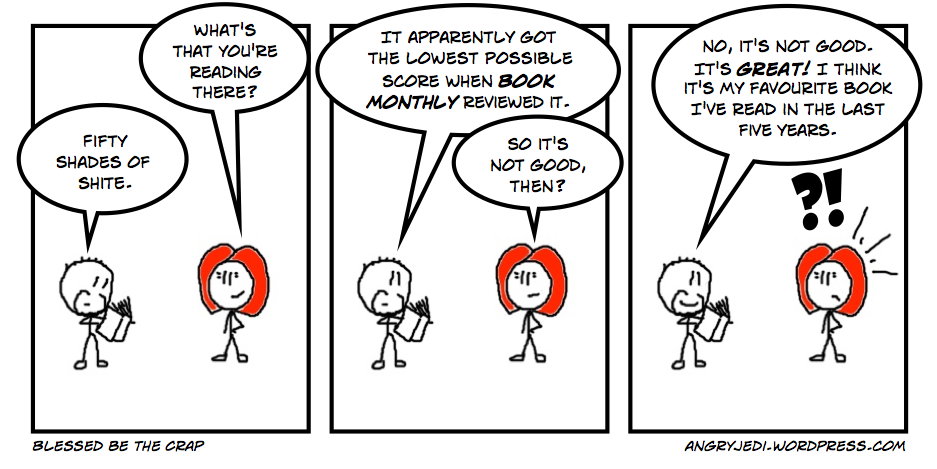
Let's take Hyperdimension Neptunia as a timely example. Hyperdimension Neptunia received a spectacular 2/10 panning from Eurogamer's Simon Parkin, by all accounts a well-respected critic whose opinions a large number of people trust. Consequently, a lot of people didn't even bother to pick it up. This was such an issue that the (apparently considerably superior) sequel only had a limited print run and is now extremely difficult to find a copy of. (I tracked one down from Italy — European console games tend to be in English by default, perhaps with the packaging localised.)

And yet, while I can see its many flaws, I am having a lot of fun with Hyperdimension Neptunia. It's bright, brash, colourful, silly and rather entertaining despite being the sort of game some people I know would be embarrassed to be seen playing, particularly when the occasional "fanservice" images make an appearance, or every time the character Compa trips over and flashes her panties at the end of a fight. It's genuinely amusing, though — if deliberately cringeworthy at times — and packed with plenty of things to do. It combines two of my favourite styles of game — visual novel and JRPG — into one package with some really nice features. I love the ability to set custom images on "summon" spells, for example. Seeing the "I HAS A HERB" cat setting off a wind spell never gets old.

Hyperdimension Neptunia is far from the only example of a game which was poorly received but which I have ended up enjoying. In the post I linked to at the top, I mentioned Duke Nukem Forever and Alpha Protocol, both of which endured critical drubbings for various reasons — Duke for its grossout, sexist humour and Alpha Protocol for its broken gameplay aspects and appalling console versions. And yet in both cases — for I played them both to completion — I found myself having fun, being able to look past the flaws or "problematic" material and find an entertaining experience underneath. Am I somehow "wrong" to feel this way?

Well, of course I'm not. Opinions are entirely subjective, after all. I could tell you I found the critically-acclaimed movie Drive to be stultifyingly boring, for example (I did) but that doesn't stop you from enjoying it, rewatching it a bajillion times or putting it atop your "My Favourite Movies of All Time" list. Likewise, Nier's heavy reliance on fetch quests and seemingly tedious activities may cause you to switch off completely, while I found the experience to be an interesting example of a game requiring the player to "method act" the role of the protagonist, and found myself playing it obsessively as a result. We both might tell each other about how much we like our respective Things We Like, but it's unlikely we'll sway each other around to our way of thinking. And that's just fine.

The sad thing, though, is the fact that there are people out there who hold a considerable degree of influence over the public's spending decisions, and their opinion carries an undue amount of weight that might cause some people to miss out on things they might actually like. If Parkin gives Hyperdimension Neptunia 2/10, you better believe that's going to affect a large number of people's decisions as to whether they're going to buy it or not. (Probably the latter in this instance — in the notoriously top-loaded game review score scale, a score of 2/10 is theoretically reserved for an absolute stinker that is completely broken.) How many of those people whose opinion was swayed by Parkin's review would actually enjoy the game if they gave it a chance? How many people are actually going to give it a chance after reading that review?

The other thing worth mentioning particularly when it comes to titles like Hyperdimension Neptunia and Duke Nukem Forever is the fact that some critics seem to feel obliged to act as arbiters of taste and decency, when in fact everyone's tolerance for potentially "offensive" content is completely different. Both Hyperdimension Neptunia and Duke Nukem Forever attracted accusations of sexism on their original release to varying degrees of justification — the specifics of which I'm not going to get into right now because that's a whole other matter, particularly in the former's case — and these accusations negatively impacted the critic's view of the game in both instances. That's fair enough — as I said, everyone's "good taste" boundaries are different and said critics are entitled to voice those views — but when it comes to interactive entertainment, subject matter is just one part of the whole experience. And more to the point, in all forms of media, enjoying something that contains potentially objectionable subject matter doesn't imply that the person reading/watching/playing the thing in question is, by extension, a supporter of that particular viewpoint. In other words, you can like anime boobies and still see actual real-life women as actual real-life people. (I say "you" when, obviously, I mean "I".)

If you enjoy something, you enjoy something; you shouldn't feel guilt about your own tastes. Unless, you know, your "tastes" involve bludgeoning kittens, puppies and babies to death with a sledgehammer. (In real life, not in video games, obviously.) Or, you know, actively stirring up hate against a specific social group. Or just generally being a dick. Then you should probably feel a bit guilty. Basically, so long as you're not actually hurting anyone (physically or psychologically) or actively oppressing someone with the things you like, enjoy whatever you want within reason!

Now, if you'll excuse me, I'm off to plumb the depths of the bottom half of Metacritic to see what awesome experiences I can find to enjoy next…

1084: Darkdeath Evilman

Page_1So, I seem to have jumped down something of a rabbit-hole with regard to my current gaming. Specifically, I seem to have jumped down the NIS America rabbit-hole, which means lots of brightly-colored anime-style JRPGs with heavy degrees of ridiculousness. Hyperdimension Neptunia, which I discussed yesterday (and which I'm aware is developed by Idea Factory rather than Nippon Ichi themselves), is a fine example of said ridiculousness being taken to the extreme with its personifications of gaming platforms and companies as cute anime girls with a habit of flashing their panties.

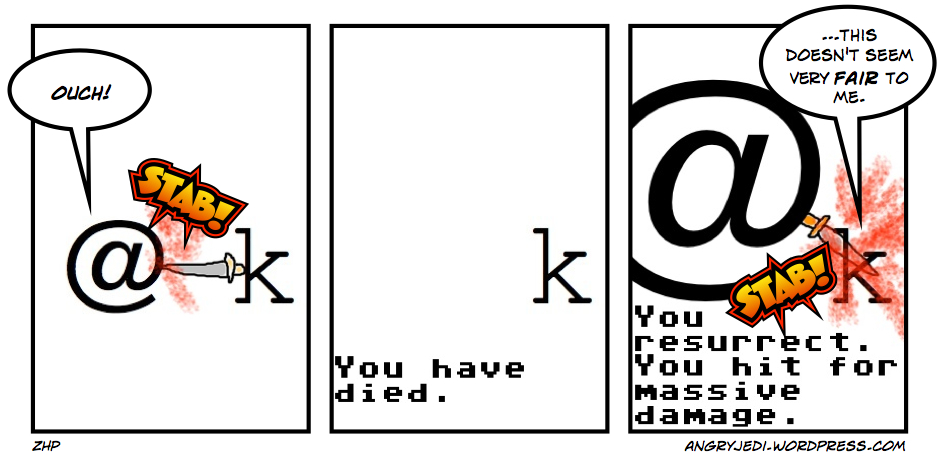
I decided to start something on portable in parallel, though, so I had something to play on the toilet/in bed/in coffee shops. I wanted to pick something that was portable-friendly — i.e. something you could dip into in short sessions rather than feeling like you need to spend hours at a time playing, but which would last a good long while in total. The game I picked for this purpose was the rather gloriously-titled Z.H.P. Unlosing Ranger vs. Darkdeath Evilman for the PSP/Vita, a game from the Disgaea team and one which wears its influences on its sleeve.

Z.H.P. (as it shall be known from hereon) is an isometric-perspective tactical roguelike RPG that plays somewhat like Disgaea (which is normally a strategy game somewhat akin to Final Fantasy Tactics, if you're unfamiliar) would play if you only controlled one character and could only move them one space at a time per turn. It follows the traditional style of roguelike gameplay, in other words — you move, the enemies move, but between moves you can stand still and contemplate what to do next without fear of getting twatted while you come to your decision. As per usual for the genre, you find yourself exploring a series of increasingly-difficult, increasingly-complex randomly-generated dungeons in an attempt to become as strong as possible and eventually take down the titular bad guy Darkdeath Evilman.

There's a bit of a twist on the usual formula, though. Rather than featuring a permadeath system that forces you to start over when you bite the big one in a dungeon, Z.H.P. instead features a rather odd levelling system whereby each time you enter a dungeon, you start at level 1, but your total levels gained over your lifetime playing the game determines your base statistics. If you die, you lose all the loot you acquired on that particular dungeon run, but any levels you gained are added on to your total level count, boosting your base statistics by a little and meaning that the next time you start a dungeon run, you'll be slightly stronger even though you're still technically level 1. If that makes your head hurt, don't worry — it starts to make sense after playing for only a short period.

The eventual aim of the game is to work your way through the story and make the nameless, voiceless protagonist (who, rather endearingly, is canonically named simply Main Character) into the hero he was supposed to replace — the Unlosing Ranger, the only one who can defeat Darkdeath Evilman. Every so often in the story, you'll find yourself returning to Earth from the Bizarro Earth in which you've been doing all your dungeon-crawling, and thrust into a traditional JRPG-style battle against Darkdeath Evilman, who is your stereotypical "final boss" sort of character. As the game progresses, these battle sequences become increasingly elaborate — they start with a first-person 8-bit sequence somewhat reminiscent of the end of the original Phantasy Star and gradually progress to… well, I'm not sure yet as I haven't got that far.

There are some fun additions to the basic roguelike formula, and it's here that the Disgaea influences are apparent. You can pick up enemies and fling them around, for example, though disappointingly you can't simply lob them off the edge of a precarious platform into the lava below. You can also throw items from your inventory, many of which have special effects. It also provides a use for items that have degraded to a durability level of 0%, meaning that the bonuses they normally provide are completely ineffective until repaired. If you don't want to spend your limited funds on repair bills, simply throw them at the enemies.

Then there's the guest appearances from the Prinnies, the weird explosive penguin-like things from Disgaea. Early in the game, you inexplicably find yourself married to one and gain the once-per-expedition special ability to summon your "wife" and have her bring you a lunchbox to restore your endurance points.

I could go on, but I would like to play the game a bit more before I talk about it too much. Early impressions are very positive, though, and if it's anything like Disgaea this will be a game designed to keep one occupied for a frighteningly long time. If you're looking for something endearingly bizarre but which backs up that bizarreness with solid gameplay and good presentation, you could do far worse than check out Z.H.P. — it works on Vita, too, so you can just download it from the PSN store rather than attempting to track down a physical copy.

See you in the dungeon, dood!

1083: Hyperwhatnow Nepperwho?

Page_1I finished Trails in the Sky this morning (not last night — it got to 4am and I still hadn't reached the final boss so I decided to save it for this morning, and it was well worth the wait) so today saw that age-old question, "What to Play Next" rear its head.

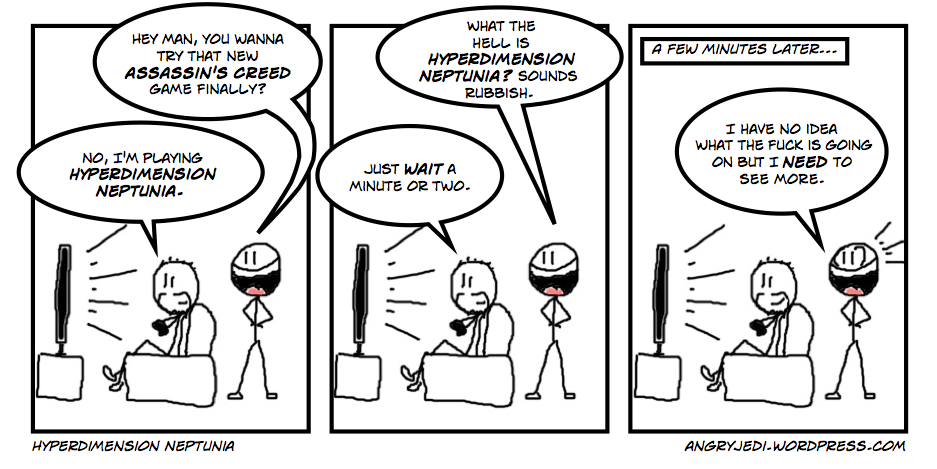
I fancied something light-hearted and silly, so I chose Hyperdimension Neptunia. I knew nothing about this prior to starting to play, and just knew that it was rather silly, very Japanese, packed with rather unnecessary fanservice (that I secretly quite enjoy) and not necessarily what you'd call "good" by the traditional definition. However, given that many of the games I've enjoyed most of all over the course of the last year have not been what you'd call "good" by the traditional definition (Nier springs immediately to mind) I was willing to give it a chance.

I think I'm going to like it.

Hyperdimension Neptunia casts you in the role of Neptune, a personification of the cancelled console the Sega Neptune. Cast out of Celestia by her goddess sisters (each of whom represents one of the Xbox, PlayStation and Wii respectively) and forced to fend for herself in the lands of Gamindustri, it's up to her to… well, I don't really know yet, as I haven't got that far and the events in the intro left her with amnesia which she conveniently points out is to help the players understand what is going on. I swear I'm not making any of what I just said up. This is indeed a game that represents the seventh-generation "console wars" as ridiculous anime-style battles between anthropomorphised hardware manufacturers.

Besides the silly premise, which I have a lot of time for, there actually seems to be quite an interesting game under there, too. The game unfolds in several distinct components — visual novel-style storytelling sequences; a "between missions" bit where you can shop, read background information and discover sidequests; and dungeon-crawling. The game isn't really a traditional JRPG in terms of structure — there's no wandering around field screens or towns, for example, and the story scenes all unfold using head-and-shoulders shots of the characters rather than in-engine graphics, like a visual novel rather than a standard JRPG.

Where the interesting gameplay comes in is in the dungeon-crawling component. Structurally, this is very straightforward — you wander around a dungeon finding treasure chests and occasionally getting into random battles. The characters in your party each have "dungeon abilities" that recharge over time that allow them to do different things — Neptune can smash through obstacles, for example, while Compa, a character who appears early on, can trigger tough battles at special summoning zones to temporarily lower the random encounter rate, and IF, another early character, has the ability to lead the way to normally-invisible treasure chests.

The battle system is turn-based, but makes use of an "ability points" system, whereby each character has a certain number of points that they can spend on their turn. Each move they do costs ability points, and up to four moves can be chained together into a combo. Certain moves allow the combo to continue registering with second, third, fourth sets of four button pushes, and the longer a combo goes on for, the better.

It's this combo system that provides some rather daunting complexity to the battle system. You're not limited to the basic skills the game provides for you. Rather, you can redefine pretty much any combination of four buttons to perform any of the character's unlocked skills to create custom combos. Some skills are learned through levelling up, others through acquiring CD-Rs and CD-R/Ws with skill information on. CD-Rs have preset skills; CD-R/Ws have customizable skills that you can rename and visually tweak by importing an image from your PS3's photo library. So yes, you can have a spell that summons, say, Twilight Sparkle to kick some ass. This is, as they say, awesome. And hilarious. It also gives people an actual reason to load some images into their PS3's photo library, which is surely worthy of praise.

So thus far it seems like an interesting game, albeit one with more than a few flaws. On the technical front, the frame rate and graphics aren't all that great (though the visual novel scenes look lovely and feature animated characters); the dungeons look like they might be a bit "samey" over time; and the game doesn't do a great job of explaining its more complicated aspects in detail. But, for me anyway, part of the joy in this sort of thing is in discovering the hidden secrets for oneself and working out just what the fuck is going on.

It's early days yet, but I've enjoyed what I've seen so far. Let's see if it has what it takes to keep me playing in the long run!